This guide is independent and contains no paid placement. Venue dog rules, beach signing and bus times change, so where this guide flags a check, please confirm the latest official information before you travel.
Robin Hood's Bay with a dog is a tide-first, hill-second kind of place: park or stay at the top of the bank, walk down the famously steep lane on a short lead, and time the beach for low tide, when a vast sweep of sand and rocky scaurs opens up for exploring. Build cliff walks on the Cleveland Way and flat miles on the Cinder Track around the tide table, keep dogs close around rock pools, seals and cliff edges, and check the official latest guidance before you go for beach rules, path closures and anything seasonal.
The village is vertical: your first descent
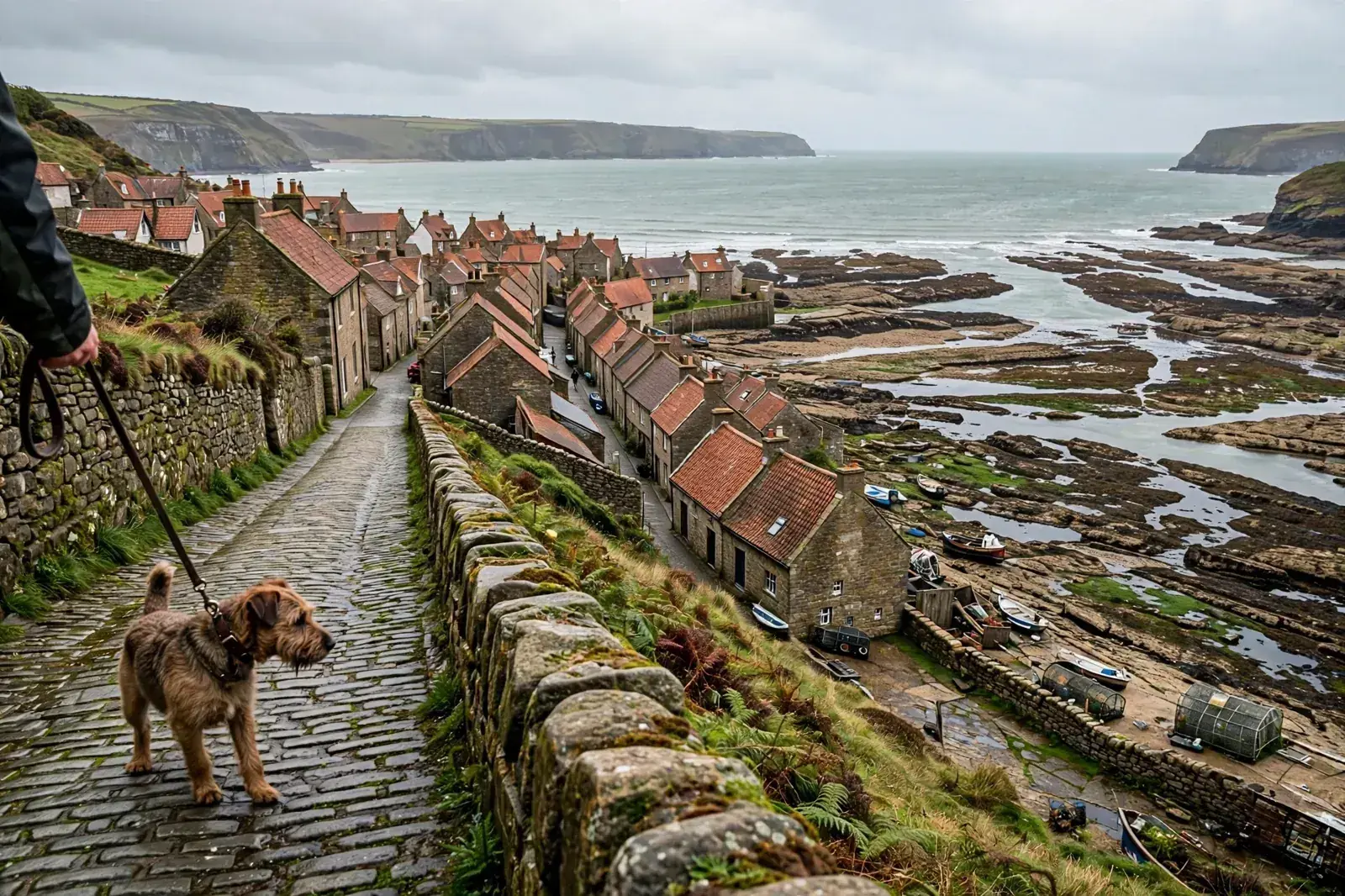
Most guides to Robin Hood's Bay begin with the beach. Start instead with the hill, because the hill decides everything else about a visit with a dog. The village comes in two stacked halves. At the top, on the flat ground by the main coast road, sits the upper village — car parks, the old station area, shops and much of the accommodation. Below it, the old fishing village pours down a single steep lane to a slipway and the sea, in a tumble of red-roofed stone cottages so tight and picturesque that first-time visitors routinely stop in the middle of the road to stare. Your dog will need to be walked down that lane, and later walked back up it, and the lane is properly steep: the kind of gradient that has walkers leaning backwards on the descent and pausing, ostensibly to admire the view, on the way up.
Treat the descent as an event in itself rather than a commute. Keep the lead short, because the lane is shared with residents' vehicles, delivery vans, other dogs, pushchairs and a steady flow of people who are looking at the rooftops rather than at your dog. The surface varies between tarmac, stone setts and worn cobbles, and it becomes slippery after rain and genuinely treacherous with frost or wet leaves, so footwear with real grip matters more here than on many a named mountain trail. Walk on the side away from the drop where the lane allows it, step into doorways and passing places to let vehicles and bigger groups go by, and never let an extending lead turn a corner ahead of you: the alleys that branch off the lane are blind, stepped and full of other people's front doors.
Be honest about who the hill suits. A fit adult dog will treat it as a warm-up. An elderly dog with stiff hips, a dog recovering from injury, a heavy dog whose joints you are protecting, or a puppy whose growth plates should not be doing repeated steep descents may find the lane the hardest part of the whole holiday, harder than any cliff walk. For those dogs, plan fewer, longer beach sessions rather than popping up and down all day, take the descent slowly with pauses, and use the flatter upper village and the old railway path described later in this guide for the in-between walks. There is no shame and no shortcut: the lower village is essentially pedestrian by design and by gradient, and that is a large part of its charm.
One more arrival habit pays off all day. Dogs arrive at the bottom of the lane already stimulated — new smells stacked on every doorstep, gulls, fish, sea air — so give yours two minutes at the slipway to simply stand, sniff and take stock before you set off across the shore. A dog who has processed the arrival walks better on the rocks, recalls better around the rock pools and settles better outside the pub. The hill got you here. Let the dog catch up with itself before the tide clock starts.
The beach is a tide clock: sand, scaurs and rules
Robin Hood's Bay beach is really two beaches sharing one name, and the tide chooses which one you get. At low water the bay opens into a broad, generous shore of firm sand cut by long rocky reefs — the scaurs that run out into the bay — with rock pools, seaweed gardens and acres of room for a dog to trot, sniff and paddle. At high water almost all of it disappears. The sea comes right up to the slipway and the sea wall in the lower village, the sand goes, the scaurs drown, and what remains is a handsome but essentially beachless harbour front. Neither version is a disappointment, but they demand completely different days, which is why the tide table, not the clock, should plan your visit. Check tide times before you travel and again on the day, and build the beach session around the falling and low tide rather than arriving at a fixed hour and hoping.
On dog rules, the Bay is friendlier than many famous beaches. It is generally treated as a year-round dog beach, without the seasonal ban that covers the main sands at some larger resorts, and dogs are an ordinary, expected part of the scene on the shore. That general picture is exactly the sort that local signing can qualify, so treat it as a starting point rather than a promise: read the signs at the slipway and beach access points when you arrive, follow any temporary restriction on the day, and check the official latest guidance before you go. Our national explainer on dog-friendly beach rules in the UK sets out how these local rules, signs and fines work and why the sign at the access point always outranks anything printed in a guide, including this one. Everywhere, always: dogs under close control around families, other dogs and anyone fishing from the rocks, and everything cleared up, including on the scaurs, where the tide is not a bin service.
Safety on this shore is mostly about respect for water and rock. The scaurs are slippery with algae and weed, uneven underfoot and cut by channels that fill quickly and quietly as the tide turns; a dog ranging far out on the reefs at the start of the flood tide can be cut off more easily than its owner realises, and so can the owner who goes after it. Work the shore on a falling tide where you can, keep a turnaround time in mind rather than drifting, and keep dogs out of the deeper rock-pool channels and gullies. The cliffs along the bay are soft, layered and prone to falls and mudslides, especially after wet weather: never walk or sit close under the cliff base, keep dogs from scrambling on the lower slopes, and treat any fresh rockfall as a reason to give that whole stretch a wide berth. If your dog swims, read the shore the way a local would — this is an open North Sea bay with shore breaks and currents around the scaurs, not a sheltered cove — and our guide to dog swimming safety covers the judgement calls that matter before any dog goes beyond paddling depth.
Finally, learn the exit points before you need them. From the lower village the slipway is the obvious way off the shore, with further access points along the bay towards Boggle Hole to the south at low tide. As the tide floods, those options narrow in sequence. A relaxed rule serves most visitors well: when the returning sea starts covering the sand you arrived on, it is time to be heading in, dog on lead, whatever the printed tide time says. The bay gives generously for hours and then takes everything back quite quickly, and the dogs splashing in the last pools belong to owners who planned it that way.
Fossils, rock pools and the low-tide shore
The shore at Robin Hood's Bay is part of one of the most famous fossil coasts in Britain. The cliffs and scaurs here are Jurassic rocks, laid down in a tropical sea long before there were dogs to walk on them, and the foreshore has been collected, studied and argued over for two centuries. Ammonites are the signature find — the coiled shells of extinct sea creatures, weathering out of the rocks and shales — alongside belemnites, fossilised shells and, for the very patient and very lucky, fragments of much larger marine reptiles. For a dog owner the practical joy of this is simpler: fossil hunting is a slow, heads-down, low-tide activity that pairs perfectly with a dog who is content to mooch, sniff and investigate pools while the humans scan the shingle. Few beach pastimes suit a steady older dog better.
Collect responsibly, because the rules here are about safety as much as science. Take only loose fossils found on the foreshore, in fallen material and among the shingle. Do not hammer or dig into the cliffs or the in-place rock of the scaurs: the cliffs are unstable, the practice damages a protected and studied coastline, and loose material after winter storms offers plenty for the casual collector. Keep well away from the cliff base while you search, since the same weathering that frees the fossils brings down rock without warning. If you find something significant — a large or articulated specimen, or anything that looks like bone in quantity — the right move is to photograph it in place, note where it was, and report it to the local museum services rather than attempting a heroic extraction. Most visitors go home with a small ammonite, a pocketful of interesting stones and a dog covered in rock-pool water, which is exactly the correct outcome.
Rock pools deserve a dog protocol of their own. The pools on the scaurs hold crabs, shrimps, anemones, small fish and periwinkles, and they are fragile, self-contained worlds that a thirsty or curious dog can wreck in seconds. Let your dog look, by all means — pool edges are fascinating to a nose — but keep it from drinking pool water, which is concentrated seawater with extras, from trampling through pools after crabs, and from eating anything the shore offers, living, dead or long-dead. Dead seabirds, fish remains, washed-up jellyfish-like creatures in summer and the occasional seal carcass all appear on working coasts like this one, and all of them are veterinary visits waiting to happen. A reliable leave-it, practised at home, earns its keep on this beach more than almost anywhere else in Yorkshire.
Kit for a fossil shore is unglamorous and worth it: shoes or boots that grip wet rock for you, a towel and spare lead for the dog, water to drink because there is none on the shore, and a small rucksack so finds and full poo bags both travel back up the hill with you. Everything taken off this beach, including the bags, has to climb the lane at the end of the session, which is one more reason the low-tide hours here end with tired legs in every species.
A smugglers' village: lanes, alleys and village life with a dog
The lower village repays slow exploration, and it does so for a reason that has nothing to do with postcards. In the eighteenth century Robin Hood's Bay was deeply involved in smuggling. Contraband landed on this shore — tea, spirits, tobacco and silk among it — and was moved up through the village and on to the moors, and local tradition holds that the houses were so arranged, with connecting cellars and passages, that goods could travel from the water to the top of the village without ever seeing daylight. How much of that is architecture and how much is a good story improved by retelling is a question to enjoy rather than settle, but the physical village the trade left behind is real enough: a warren of narrow alleys, stepped ginnels, tiny yards and cottages stacked at angles that make no sense until you understand that concealment and short cuts to the sea were once worth more than a sea view.
Walking that warren with a dog is a pleasure with etiquette attached. The alleys are other people's doorsteps, washing lines and window boxes as well as public footpaths, so keep your dog close, on a short lead, and moving through rather than investigating doorways, and do not let it water against cottage walls and doorsteps in the tight lanes, however historic the urge. Many of the prettiest passages are stepped, slick when wet and too narrow for a dog and a pushchair to pass, so be ready to retreat cheerfully to a wider spot and let people through. The village is a lived-in place, not a film set, and the welcome dogs get here depends on owners remembering that at close quarters.
As for the name: enjoy it, and hold it lightly. There is no solid evidence connecting the outlaw of Sherwood with this bay, and the name's origin is genuinely uncertain, with local legend doing what local legend does. What is documented is a hard-working fishing community — herring and crab and lobster among its trades — a bay dangerous enough to shipping that lifeboat history runs deep here, and a village that in the later nineteenth century became a draw for artists, geologists and holidaymakers arriving at the station whose line is now a walking and cycling path. The small museum in the lower village tells the smuggling, fishing and shipwreck story properly; its opening is seasonal and its dog policy is the kind of detail that changes, so check before you build a wet-weather plan around it, and never tie a dog up outside unattended in a strange village as a substitute.
One modern tradition is worth knowing before you arrive at the slipway to find it full of walkers drinking champagne. Robin Hood's Bay is the eastern end of the Coast to Coast Walk, the long crossing of northern England from the Irish Sea, and finishers traditionally dip their boots in the North Sea here and celebrate at the pub by the slipway. On summer afternoons the bottom of the village can be joyful, crowded and faintly emotional, with rucksacks, banners and a great many people hugging each other. Most dogs cope fine; a nervous dog will prefer the shore or a quieter lane at those moments, and that is a fair trade for a village that, the rest of the time, shares its alleys generously.
The Cleveland Way: to Whitby one way, Ravenscar the other
The Cleveland Way National Trail runs the length of this coast on its way between Helmsley and Filey, passing directly through Robin Hood's Bay, and it gives the village two of the finest half-day dog walks in the North York Moors. Both directions are cliff walking in the proper sense: waymarked, well used, high above the sea for long stretches, and exposed to whatever the North Sea weather is doing. Distances here are quoted as approximations because published figures vary slightly by source and start point, so carry a map or a downloaded route and judge the day by your dog's legs rather than by any guide's mileage, including this one.
North to Whitby is the classic, roughly six to seven miles of cliff path with the abbey ruins on the headland growing slowly larger ahead of you. The walking is undulating rather than mountainous, but it accumulates: steps, gates, short climbs and descents, and very little shade or shelter. Keep your dog on a lead near cliff edges throughout — the edge is unfenced in places, slopes away deceptively, and supports rabbits, which are a lead-testing emergency in a dog who has been well behaved all week — and on a lead or under the closest control around the livestock that graze some cliff-top fields. Ground-nesting birds breed on the coastal grassland and heath in spring and summer, so follow any seasonal signing about leads exactly. Carry all the water both of you need, because there is no reliable supply on the cliffs, and plan the finish: Whitby rewards the walk properly, and our guide to Whitby with a dog covers its beaches, abbey approach and dog-friendly stops, with buses back along the coast road for tired legs if you check the current timetable first.
South to Ravenscar is the quieter, stranger walk, roughly half the Whitby distance, and for many dog owners the better one. The path passes Boggle Hole, a small cove with a youth hostel in an old mill setting, and continues along cliffs layered with industrial history: this coast was quarried and worked, including for alum, and Ravenscar itself is famous as the ambitious Victorian resort that largely failed to happen, leaving a station site, a grand hotel and a great deal of atmosphere. Below the cliffs near Ravenscar, grey seals haul out on the shore in season — one of this coast's genuine wildlife spectacles. View them only from the cliff top, at a distance, with your dog on a short lead and quiet: seals are easily disturbed, a dog on the shore among them is a serious welfare incident for every animal involved, and access to that shore is not a dog walk in any case. Check the official latest guidance before you go for seal season information and any local restrictions.
Whichever direction you choose, respect the two cliff-path rules that outrank scenery. First, the shore is not a shortcut home: walking back along the beach beneath these cliffs is a low-tide-only undertaking with real cut-off points, and walkers are caught out on this coast every year. Take the cliff path back, or the bus, unless you know the tide state and the exit points properly. Second, conditions change underfoot: after heavy rain, sections of this soft-cliff coast slip, crack and divert, and temporary route changes are a normal feature of the trail's life. Follow diversion signs exactly, keep dogs away from fresh cliff-edge cracks, and check the official latest guidance before you go for path closures on your dates.
The Cinder Track: the flat inland option
Every steep village needs an escape valve, and Robin Hood's Bay has a superb one. The Cinder Track follows the old Whitby to Scarborough railway line, closed in the 1960s, along the coast inland of the cliff edge, passing close by the village at the site of its old station. Because it is a former railway, the gradients are gentle and the surface is largely made — cinder, gravel and tarmac in varying proportions — which makes it the obvious choice in this area for older dogs, dogs in recovery, cyclists, pushchairs and any human whose knees have filed a formal complaint about the lane to the beach. If the cliff path is the Bay's dramatic walk, the Cinder Track is its everyday one, and on a week-long stay it will probably carry more of your dog's miles than either.
From the village you can ride the line of the old railway in both directions. Northwards the track runs towards Whitby, shadowing the coast with sea views between the trees, and makes a fine alternative to the cliff path for the same journey: longer in feel, gentler underfoot, and usable when cliff-top wind makes the Cleveland Way a battle. Southwards it runs through Ravenscar and on towards Scarborough, through cuttings, over bridges and past old station sites, in a green corridor that feels a world away from the shore while rarely being more than a field or two from it. As with any out-and-back linear route, plan the turnaround by time and energy rather than ambition; the track's kindness is that turning round is always easy and the way back is never steeper than the way out.
Shared use is the track's one management demand. It carries cyclists — many of them, some travelling at a fair pace on the descents — horse riders in places, runners, families and a great many other dogs. Keep your dog on a short lead or under genuinely close control when bikes approach, step aside on the narrower cuttings and bridges, and be especially careful at the access points where paths and lanes cross the track. Dogs who chase wheels should be trained elsewhere first; a busy Sunday on the Cinder Track is not the classroom. In winter the surface can be muddy and icy in the shaded cuttings, and after storms fallen branches and washouts appear, so check conditions locally and carry a light for the dog as the afternoons close in.
The track also solves a practical problem the village otherwise sets you. On a day when the tide is high through the middle of the day — when the beach has temporarily ceased to exist — the Cinder Track gives you a long, interesting, dog-satisfying walk that starts near the top of the village and never asks anyone to climb the bank twice. Pair a morning on the track with a late-afternoon falling tide on the shore and you have used the Bay's two great assets in the order the day intended.
Pubs, cafés and eating with a dog
A village built on fishing, smuggling and walking produces good pubs as reliably as it produces steep lanes, and Robin Hood's Bay eats and drinks well for its size. The pub down by the slipway in the lower village holds the famous position — the Coast to Coast finishing point, with the sea at the door — and the upper village and the lanes between them hold further pubs, cafés, tea rooms, fish and chip options and small shops, so no dog owner here is far from a meal or a takeaway. What varies, as it does everywhere, is the dog policy in the room you actually want to sit in. Many village pubs welcome dogs in the bar and garden while keeping the dining room dog-free; cafés range from dogs-everywhere to assistance-only; and policies shift with season, refurbishment and management more often than any guide can track.
So use the method rather than a list. Check the door signage, ask cheerfully before you settle, and treat a no as information rather than insult — the next door along may say yes, and a takeaway eaten on the harbour wall or a bench above the slipway, with the dog settled on a mat and the gulls negotiated with firmly, is a genuinely good version of lunch in this village, not a consolation prize. Where dogs are welcome inside, the courtesies that keep them welcome are the usual ones, sharpened by how small these rooms are: dog on the floor and off the seats, lead short and tucked out of the walkways between tables and bar, no feeding from the plate, and a dog who has already been walked and toileted rather than one vibrating with unspent cliff-path energy. Dry the worst of the scaurs off before you go in; a towel by the door is appreciated in a village where half the customers arrive with wet boots.
Two food warnings belong in a Robin Hood's Bay dog plan. The first is the gull problem, which on this coast is not a joke: gulls here are confident, accurate and entirely willing to take food from a hand, a table or a bench, and a dog who lunges at a swooping gull on a crowded slipway creates the kind of incident that closes terraces to dogs. Keep food covered and close, never feed gulls, and keep your dog settled rather than snapping at birds. The second is scavenging more generally: fish and chip wrappings, dropped batter, crab shells and worse collect around bins, slipways and harbour edges, and cooked bones and shell fragments are real veterinary risks. The pavement scan you learn on the first evening should become automatic by the second.
Water and supplies are straightforward if you plan one step ahead. Carry drinking water for the dog on cliff and track walks, because taps are not a feature of the Cleveland Way; in the village, many pubs will fill a bowl happily for a customer, and asking is always better than assuming. For dog food, treats and forgotten kit, the upper village covers basics and Whitby and Scarborough cover everything else, but a dog on a specific diet should travel with its own food as always — a smugglers' village is a wonderful place to run out of many things, and prescription kibble is one of them.
Stays, parking and practicalities
Where you sleep in Robin Hood's Bay changes the shape of every day, because of one question: which side of the hill is your front door on? Staying in the lower village puts the beach at the end of your lane, the pubs a stroll away and the car back up at the top where it belongs — evenings are magical and mornings start at the sea. The price is the climb, every time, with luggage, shopping and a tired dog, and the near-total absence of vehicle access to your door. Staying in the upper village reverses the bargain: level pavements, parking nearby, easier arrivals and departures and the Cinder Track close at hand, with the beach a deliberate expedition down and — the part everyone forgets at booking stage — back up. Neither is the wrong answer. The wrong answer is booking the pretty cottage at the bottom with a dog, or a human, who cannot do the hill twice a day, so read listings for access detail, ask owners direct questions about the walk from car to door, and believe the answers.
Dogs-welcome specifics need the usual checking behind the label. Confirm how many dogs are accepted, whether there is a per-dog charge, whether dogs may be left alone in the property and on what terms — many owners in old cottages say no, for good reason — and what the nearest after-dark toilet walk actually involves. In the lower village that walk is a lantern-lit lane or the slipway; in the upper village it may be a proper pavement circuit. Ask about enclosed space with particular care here: cottage yards in the old village are often tiny, shared or stepped, and a yard that contains one dog may not contain yours. Bring bedding, towels and a drying coat as standard; stone floors and boot rooms are common and forgiving, and hosts in this village have seen every grade of mud the North York Moors can produce.
Parking follows the geography. Day visitors and most staying visitors use the pay-and-display car parks at the top of the bank, around the old station area and the main road through the upper village, and walk down into the lower village, where access is on foot and vehicles are heavily restricted to residents, access and deliveries. Both car parks fill on sunny weekends, bank holidays and high-summer days, so arrive early or arrive by bus. Charges, limits and payment methods change, so read the signs and the operator's current information when you arrive rather than trusting any printed figure. Buses run along the coast road between Whitby and Scarborough and serve the top of the village, which makes a car-free stay entirely workable for a dog who travels well — our guide to taking a dog on UK trains covers the rail leg to Whitby or Scarborough and the rules that apply on board. And the rule that outranks every parking decision stands unchanged: never leave a dog alone in a parked car while you explore, eat or walk the cliffs, in any weather, for any duration.
For emergencies and essentials, save the details before you need them. The nearest veterinary practices are in the surrounding towns rather than in the village itself, so store the practice and out-of-hours numbers in your phone at the start of a stay, not from a cliff top with a limping dog. Mobile signal is patchy in the lower village and along the cliffs; download tide tables, maps and bus times for offline use while you have a connection. Cash, layers, a torch for the lanes after dark and a spare lead complete the unglamorous kit that keeps a vertical village easy. Robin Hood's Bay rewards planners disproportionately, and most of the planning is five minutes with a tide table and a weather forecast.
A tide-first day that actually works
Put it together and a good Robin Hood's Bay dog day is written by the tide table, so write it the night before. If low water falls in the morning, start there: down the lane early, while the village is still quiet, and out onto the opening shore as the scaurs emerge. Fossil-hunt slowly back towards the slipway as the pools appear, give the dog the long, sniffy, unhurried version of the beach, and be off the shore with time in hand as the tide turns. If low water falls in the afternoon instead, reverse the day without a moment's regret — the shore will wait, and the walks will not mind going first.
The middle of a low-morning day belongs to the cliff path or the track. Take the Cleveland Way towards Whitby if legs and weather are willing, with the abbey as the prize and the bus as the safety net, or choose the quieter Ravenscar direction and the seals watched silently from the cliff top. On a windy or wilder day, or with an older dog, take the Cinder Track instead and let the old railway do the work while the sea performs beyond the fields. Lunch fits wherever the dog policy says it fits — a pub bar, a café garden, or fish and chips above the slipway with the gulls kept at a negotiated distance — and a proper rest after it is part of the plan, not a failure of ambition. Dogs who have done a shore session and a cliff walk have earned a sleeping afternoon, and so, quietly, have most owners.
On a low-afternoon day, the evening writes itself: a last descent as the light softens, the bay emptying of day visitors, the scaurs shining, and the slow climb home in the dusk with a tired dog and, if the shore was kind, a small ammonite in a pocket. Finish in the upper village or the lower, wherever your door is, with the tide table checked once more for tomorrow — because the whole pleasure of staying here, rather than visiting, is that the bay gives you a different beach, a different walk and a different village every single day, and all you have to do is read the water and mind the hill. For the natural companion trip a short hop north, see our Whitby with a dog guide, and for bigger sands and castle coasts further up the same shoreline, our Northumberland dog guide continues the journey.
Practical questions
Before you go
Are dogs allowed on Robin Hood's Bay beach all year?
Robin Hood's Bay beach is generally treated as a year-round dog beach without the seasonal ban found on some larger resort beaches, and dogs are a normal sight on the sand and scaurs at low tide. Local signing and any temporary restrictions take priority, so read the signs at the slipway when you arrive, check the official latest guidance before you go, keep your dog under close control around other beach users and clear up after your dog everywhere, including on the rocks.
Can I walk from Robin Hood's Bay to Whitby with a dog?
Yes, on the Cleveland Way cliff path, a walk of roughly six to seven miles that most fit dogs and owners manage comfortably in two to three hours. Keep your dog on a lead near cliff edges, livestock and ground-nesting birds, carry water because there is little shade and no reliable dog water on the cliffs, and do not attempt the shore route unless the tide is well out and you know the cut-off points. Buses run back along the coast road, but check the current timetable before you rely on one.
Is Robin Hood's Bay suitable for older dogs?
Partly, with honest planning. The lane between the car parks at the top and the beach at the bottom is very steep, which rules it out for some older, arthritic or very young dogs, and for many pushchairs and wheelchairs. Older dogs who cope with hills can still enjoy the beach if you take the descent slowly with rest stops, while the flatter upper village and the Cinder Track former railway path give you level walking on the days when the bank is too much. Judge the hill by your own dog, not by the dog in the photograph.
Where do I park for Robin Hood's Bay with a dog?
Use the pay-and-display car parks at the top of the bank, by the old station and the main road through the upper village, and walk down into the lower village, where access is on foot and cars are heavily restricted. Both car parks fill on sunny weekends and in high summer, so arrive early, check the current charges and time limits on the signs when you arrive, and never leave a dog alone in a parked car while you explore, whatever the weather appears to be doing.
Can dogs go in the pubs and cafés in Robin Hood's Bay?
Many of the village pubs and cafés welcome dogs in bar areas, gardens or terraces, and the pub by the slipway at the bottom is a famous finishing point for Coast to Coast walkers, but each business sets its own rules and they change with the season and the management. Check the door signage, ask before you settle, keep your dog on a short lead on the floor and out of walkways, and have a takeaway-and-harbour-wall plan ready for the places that say no.