This guide is independent and contains no paid placement. Import rules change: check the official guidance before you travel and treat the dates on your own certificate as the final authority.
A dog travelling from the USA to Great Britain needs a microchip, a rabies vaccination given after that microchip, a GB health certificate completed by a USDA-accredited veterinarian and endorsed by USDA APHIS, a tapeworm treatment given 24 to 120 hours before arrival, and travel on an approved route with an approved carrier. On most transatlantic flights that means cargo, not the cabin. Start at least two months before departure.
Why the USA route is different
Moving a dog across the Atlantic is not a longer version of a short European crossing. Great Britain runs its pet travel rules by country category, and the USA sits in a different category from European Union member states. The practical consequence is that the document set is different, the authority that signs it is different, and the way the dog physically travels is usually different too. Anyone who has previously brought a dog from France or Spain, or who has read a guide written for that journey, should set that experience aside and work through the USA process on its own terms. Our companion guide to bringing a dog to the UK from the EU describes a separate regime and none of its paperwork shortcuts apply here.
The key distinction is the certificate itself. Dogs arriving from the USA do not travel on an EU pet passport. They travel on a Great Britain (GB) veterinary health certificate for dogs, cats and ferrets from a listed third country, completed in the USA and endorsed by the United States Department of Agriculture (USDA). The endorsement step is what most first-time travellers underestimate. It is not a rubber stamp applied at the airport on the day of travel. It involves a USDA-accredited veterinarian, a review by USDA APHIS (the Animal and Plant Health Inspection Service), and a timetable that has to be fitted around the certificate validity period, the tapeworm window and the flight. If any link in that chain slips, the whole journey can slip with it.
Country listing matters for a second reason: it determines whether a rabies antibody blood test is part of the standard requirements. The USA is treated as a listed country for Great Britain pet travel purposes, which means the standard entry route does not normally require a titre test of the kind demanded for dogs from unlisted countries. That is genuinely good news for planning, because a titre test plus its waiting period can add months to a move. But listing status is a regulatory fact that can be revised, and individual circumstances such as a complicated vaccination history can change what applies to one particular dog. So the rule for this guide is simple: use the listed-country position as your planning assumption, then check the official guidance before you travel and ask your veterinarian to confirm it for your dog.
The third difference is the journey itself. There is no tunnel or short ferry crossing from the USA. The dog will fly, and on the routes that serve Great Britain that almost always means flying as manifested cargo in the hold, booked through the airline cargo department or an approved pet shipper, rather than as excess baggage or in the cabin. This changes everything from crate choice to airport arrival times, and it means the airline is not just transport: the carrier is part of the compliance system, because dogs may only enter Great Britain on an approved route with an approved carrier, and the carrier checks documents before loading. A flight that looks convenient but is not an approved route for pet entry is not an option at all, however good the price or the timing.
Finally, remember the geography of the rules. These are the rules for entry into Great Britain: England, Scotland and Wales. Northern Ireland operates under different arrangements, and the Republic of Ireland is a separate jurisdiction again. If your final destination is Belfast or Dublin rather than London, Edinburgh or Cardiff, do not use this guide as your checklist. Check the official guidance before you travel for the jurisdiction you are actually entering, because a certificate prepared for Great Britain will not necessarily satisfy a different entry regime.
The paperwork chain: vet, USDA, carrier
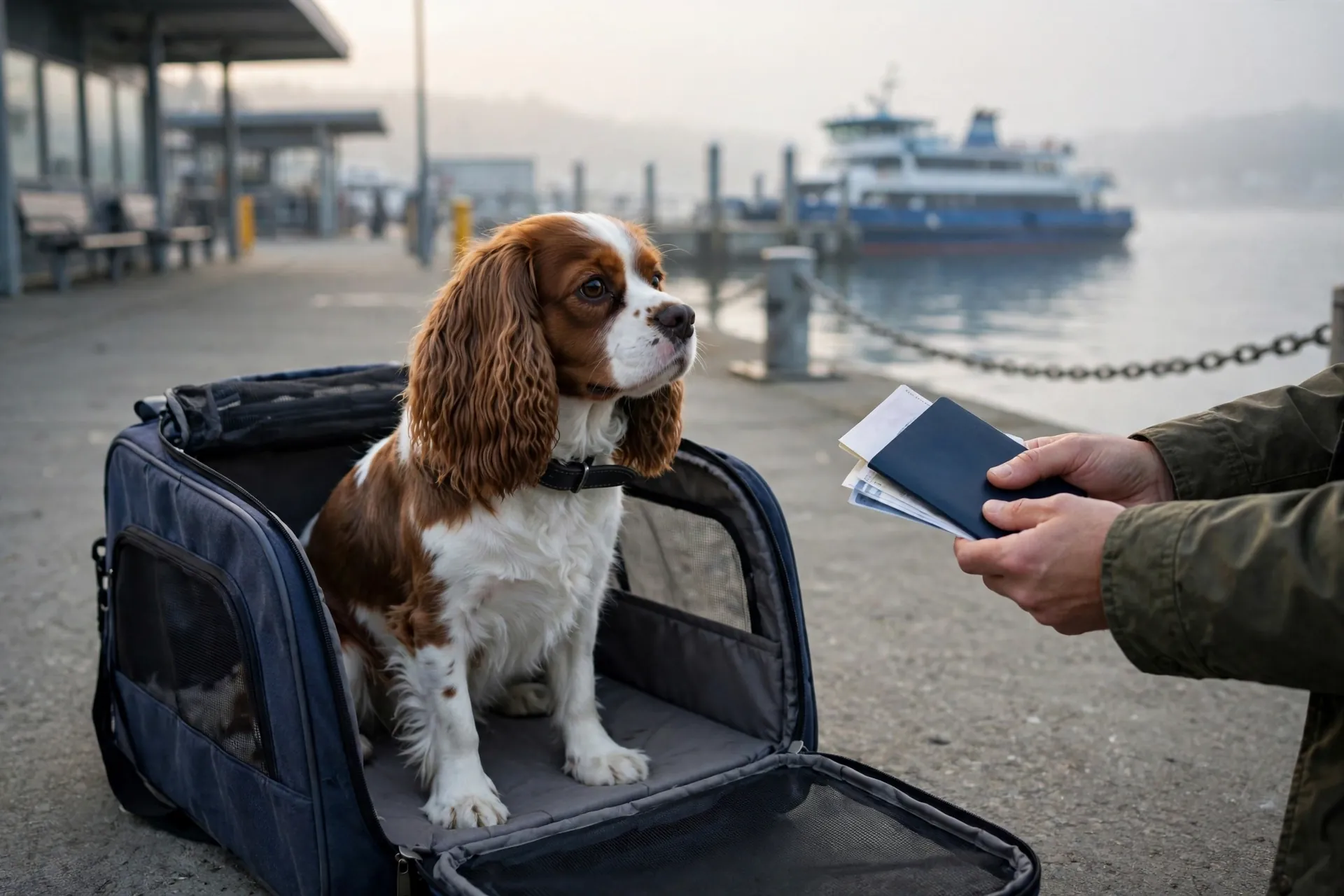
Think of the USA-to-UK paperwork as a chain with four links, and plan the journey backwards from the flight. The first link is the dog: microchip implanted and readable, rabies vaccination current and correctly sequenced after the microchip, and general health fit for a long flight. The second link is the USDA-accredited veterinarian, who examines the dog, completes the GB health certificate, records the microchip number, vaccination details and tapeworm treatment, and signs it. The third link is USDA APHIS endorsement, which confirms that the certificate and the veterinarian behind it are recognised. The fourth link is the carrier, which checks the endorsed certificate, the dog and the crate before accepting the animal for the flight. Every link has to hold. A perfect flight booking cannot rescue an unendorsed certificate, and a perfect certificate cannot rescue a booking on a route that is not approved for pet entry.
Finding the right veterinarian is therefore the first practical task, not an administrative detail to leave until the week before departure. Not every practising veterinarian in the USA is USDA-accredited, and not every accredited veterinarian regularly completes GB health certificates. Look for a practice that handles international pet exports routinely, ask directly how many GB certificates it has completed in the last year, and ask who in the practice owns the endorsement timetable. A practice that does this work weekly will know the current certificate version, the APHIS office turnaround, and the common errors that cause endorsements to be returned. A practice that does it once a year may still do it well, but you will be doing more of the chasing yourself, so budget extra time and extra checking.
The endorsement itself can be handled in person at a USDA APHIS Veterinary Services office or by mail, depending on the office and the certificate. Mail-in endorsement needs a realistic postage buffer in both directions, plus time to correct any error APHIS spots. In-person endorsement can be faster but may require an appointment and travel to the endorsing office, which is not necessarily near your home veterinarian. Ask your veterinarian at the first appointment which route they recommend and what turnaround they are currently seeing, then add contingency days. Certificates have a validity window, so the endorsement cannot be done months early either: the certificate must still be valid on arrival, and the tapeworm treatment must fall inside its own narrow window. This is why experienced shippers describe the final two weeks as a choreography problem rather than a paperwork problem, with the vet visit, the endorsement, the tapeworm treatment and the flight all sequenced against each other.
Before anything is sent for endorsement, read every field of the draft certificate as if you were the border inspector who will read it on arrival. The microchip number on the certificate must match the number that scans from the dog, character for character. The vaccination dates must be consistent with the microchip date. The dog description, including breed, sex, age and colour, must match the animal in the crate. Transposed digits in a microchip number and a vaccination date recorded before the microchip date are among the most common and most avoidable causes of trouble. Photocopy or photograph every page once endorsed, keep the originals in your hand luggage, and carry a second set of copies separately. Our dog travel documents checklist is a useful packing companion for this stage, because it covers the supporting papers and backups that sit around the certificate itself.
One more distinction deserves emphasis. The USDA endorsement authenticates the veterinary certificate for Great Britain. It is not the same thing as a United States export requirement in general, and it does not replace the airline own acceptance checks, which cover crate dimensions, ventilation, labelling, feeding instructions and the dog fitness to fly. Nor does it cover any requirement of a transit country if your itinerary routes through one. Book a direct flight where possible. If a connection is unavoidable, confirm with the carrier what happens to the dog, the documents and the tapeworm window during the transit, and check the official guidance before you travel for every country the dog will pass through, not just the final destination.
Microchip and rabies timing
The order of events matters more than any single date. The microchip must be implanted before the rabies vaccination that counts for travel. If a dog was vaccinated against rabies before being microchipped, that vaccination does not count for entry purposes, even if it was perfectly valid as a domestic vaccination. The dog will need to be microchipped and then revaccinated, and the waiting clock starts from that later vaccination. This is the single most common timing trap for owners who adopted an adult dog, rescued a dog overseas, or simply never thought about the sequence because their domestic veterinarian never needed to. Check the sequence in writing from the vaccination record before you book anything: microchip date first, qualifying rabies vaccination second.
After the qualifying vaccination, the standard waiting period before travel is 21 days for a primary vaccination. That means a puppy or a dog receiving its first rabies vaccination cannot fly to Great Britain the following week, however urgent the move. The 21 days are counted from the date of vaccination, and the dog must not travel before the period has elapsed. Booster vaccinations follow a different logic: a booster given before the previous vaccination expired, and recorded correctly, does not normally restart the 21-day wait. But a lapsed booster, a missing record, or a booster given after the microchip was replaced can all change the picture, which is why the veterinarian completing the certificate must see the full vaccination history, not just the most recent certificate. Bring every rabies certificate you have to the first planning appointment, including old ones from previous owners if you can obtain them.
Puppies add a further constraint. A dog must be old enough to have been microchipped and vaccinated and to have completed the waiting period, which in practice means very young puppies cannot make the journey. Do not let a breeder or a seller promise a travel date that the vaccination calendar cannot support. If the puppy timeline does not fit your move date, the honest options are to delay the puppy travel, to arrange compliant care in the USA until the dog is eligible, or to reconsider the move date. Shipping a puppy early on the hope that nobody checks the dates is not a plan; it is a route to refusal at the border, and the dog pays the price of that gamble.
Microchip technology itself is worth a paragraph. Great Britain requires a microchip that meets ISO standards and can be read by a standard scanner. Most modern US microchips are ISO-compatible, but older or domestic-only chips are not always readable by the scanners used at the border. Ask your veterinarian to scan the chip with a universal scanner at the planning visit and to confirm the number that scanner reads. If the chip cannot be read reliably, or if it has migrated, discuss re-chipping before the qualifying rabies vaccination, because re-chipping after vaccination restarts the sequencing problem described above. Record the chip number in your phone, in your travel folder and on the crate label, so a scanner failure at any point does not become a paperwork failure as well.
Finally, keep the rabies story clean and complete. A single coherent record, with microchip number, vaccine product, batch number where recorded, vaccination date and veterinarian signature on each entry, is far easier for an endorsing officer and a border inspector to accept than a folder of loose, contradictory printouts. If any record is missing or ambiguous, resolve it with the issuing veterinarian before the certificate appointment, not during it. If you cannot resolve it, check the official guidance before you travel and ask your veterinarian whether revaccination and a fresh waiting period is the safer route. A delayed flight is an inconvenience; a refused entry is a crisis.
The tapeworm treatment window
Dogs entering Great Britain must be treated against tapeworm by a veterinarian, and the treatment must be given no less than 24 hours and no more than 120 hours before the scheduled arrival time. That 24-to-120-hour window is measured back from arrival, not from departure, and it is recorded on the health certificate with the product used, the date and the time. It is the tightest deadline in the whole process, and it is the one most exposed to flight disruption. A treatment given too early is out of window; a treatment given too late is out of window; a treatment given by the owner at home rather than by a veterinarian does not count at all.
Planning the window starts with the flight schedule, not the vet diary. Work out the scheduled arrival time in Great Britain, count back 120 hours to find the earliest treatment moment and 24 hours to find the latest, then book the veterinary appointment inside that span with room for the unexpected. Many owners aim for the middle of the window, roughly 48 to 72 hours before arrival, so that a moderate delay does not immediately break compliance. That middle-of-window strategy only works if the veterinarian can complete the treatment and update the certificate in the same visit, or if the certificate mechanics allow the treatment to be recorded after endorsement in the way your veterinarian and APHIS advise. Confirm that mechanic explicitly at the planning appointment, because the order of treatment, certificate completion and endorsement varies with the route your veterinarian uses.
Flight delays are the scenario to rehearse in advance, not to discover in the departure lounge. Ask the carrier what happens if a flight is delayed beyond the tapeworm window: can the dog be re-treated, does the certificate need amendment, and is there a veterinary service at the transit or arrival airport that can help? Ask your veterinarian the same question from the medical side, including whether a repeat treatment within a short interval is appropriate for your dog. Also consider what a missed connection does to the arrival time on which the window was calculated. On a direct flight the arithmetic is simple; on a routed itinerary with a connection, a missed connection can move arrival by a day and break a window that was perfectly compliant when the dog was loaded. This is another reason to prefer direct flights and to build slack into the treatment timing wherever the certificate allows it.
The product itself is a veterinary matter, but the record is your responsibility to check. Before leaving the practice, confirm that the certificate shows the treatment date and time, the product name, and the veterinarian signature and stamp where required. A treatment that was given but not recorded is, for border purposes, a treatment that did not happen. Photograph the completed tapeworm entry before the certificate goes for endorsement or into the travel folder, so you have evidence of what was recorded even if a page is later questioned.
One common misunderstanding should be cleared up directly. The tapeworm rule applies to dogs entering Great Britain even when the dog has lived its whole life in the USA and has never shown signs of tapeworm. It is a population-level biosecurity measure, not a judgement about your individual dog. There is no exemption for indoor dogs, for dogs on regular preventative treatment at home, or for dogs that were treated last month. The treatment must be the one recorded on this certificate, inside this window, by a veterinarian. Owners who treat the tapeworm appointment as optional are the owners most likely to be stopped on arrival, so treat it as the non-negotiable appointment it is.
Cargo-only reality on transatlantic flights
For most travellers, the single biggest adjustment is accepting that the dog will fly as cargo. Transatlantic airlines serving Great Britain generally do not accept dogs in the cabin on these routes, and Great Britain does not permit dogs to enter as accompanied baggage in the way some other countries do. The dog travels in the aircraft hold in an airline-approved crate, handled by cargo staff, loaded and unloaded under cargo procedures, and collected from the cargo or animal reception facility at the arrival airport rather than from the baggage carousel. Owners do not see the dog during the flight, cannot visit the hold mid-flight, and should expect to wait after landing while the animal is offloaded, checked and released. Planning for this reality early makes every other decision easier, because crate, booking and airport timings all follow from it.
Booking cargo is a different transaction from booking a passenger seat. You will deal with the airline cargo department, an approved pet shipper, or both, and the booking will be made against the flight, the crate dimensions, the dog weight including crate, and the route approval status. Pet shippers earn their fee here: they know which carriers accept dogs on which routes, which aircraft types have suitable hold conditions, what embargoes apply in hot weather, and how the animal reception process works at each arrival airport. If you book directly with the airline, allow extra time for the cargo booking process and confirm every detail in writing, including the flight number, the acceptance window, the drop-off location, and the collection procedure on arrival. A passenger ticket and a cargo booking are separate records; holding one does not prove the other exists.
Approved routes and approved carriers are legal requirements, not airline preferences. Dogs may enter Great Britain only by an approved route and with a carrier approved for that route, and the list of approved routes and carriers is maintained by the UK authorities. Before you pay for any flight, confirm that the specific carrier and the specific route are approved for dog entry. A codeshare adds a trap here: the airline whose website sold the ticket may not be the airline operating the aircraft, and approval attaches to the operating carrier and route, not to the marketing brand. Ask the carrier or shipper to confirm approval in writing for the exact flight you will use, and keep that confirmation with the certificate.
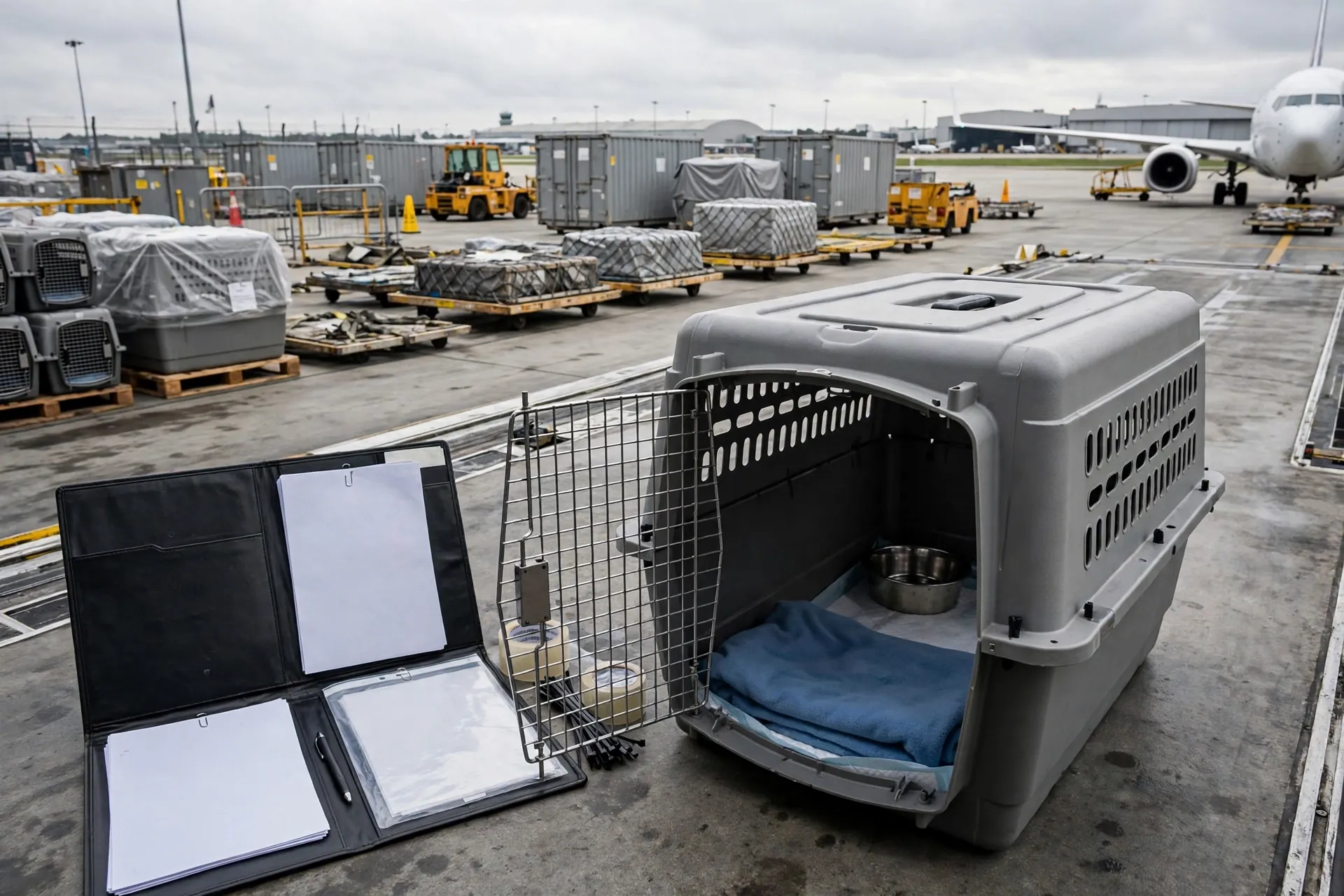
Crate preparation deserves the same care as the paperwork. The crate must be large enough for the dog to stand, turn around and lie down naturally, rigid enough to withstand handling, ventilated on the sides the carrier requires, and fitted with a secure door that cannot be opened by the dog or by accidental contact. Attach a water container that can be filled without opening the door, label the crate with the dog name, owner contact details, flight details and handling notes, and acclimatise the dog to the crate over weeks, not days. A dog that has slept in its crate at home, eaten in it, and travelled short distances in it will cope with a long flight far better than a dog meeting its crate for the first time at the cargo terminal. Line the crate with absorbent bedding, avoid loose items that could be chewed into hazards, and follow the carrier instructions on food: most carriers require the dog to be fed well before acceptance and then fasted for a period before flying, so confirm the feeding window when you book.
Emotional support and service dog designations do not convert a cargo journey into a cabin journey on these routes. Assistance dogs that meet the recognised criteria for travel to Great Britain are a distinct category with their own evidence requirements, and they should be discussed with the carrier and the authorities well in advance. A letter from a clinician or an online registration does not, by itself, secure cabin access on a transatlantic flight to Great Britain, and presenting it as if it did will only cause delay and disappointment at the cargo terminal. If your dog is a trained assistance dog, raise it at the first carrier conversation, ask what evidence the carrier and the entry authorities require, and check the official guidance before you travel for the assistance-dog position that applies to your route. For every other dog, plan for cargo from day one and spend the energy on making the cargo journey as safe and calm as possible.
What happens on arrival
Arrival in Great Britain is a process, not a moment. The dog is offloaded by cargo handlers, transferred to the animal reception or border inspection facility at the airport, and checked against the endorsed health certificate, the microchip scan and the tapeworm record. The carrier presents the documents; the checking authority verifies them; the owner, who will usually have arrived on the same or an earlier flight, waits to collect the dog once released. Build waiting time into your plans. Collection is rarely immediate after landing, and it can take hours on a busy day or when several animals arrive on the same flight. Do not book a tight onward train, a non-refundable hotel check-in deadline, or a long drive that depends on collecting the dog within an hour of touchdown.
The checks themselves are systematic. The microchip is scanned and compared with the number on the certificate. The rabies vaccination dates are checked against the microchip date and the 21-day rule. The tapeworm treatment is checked against the arrival time and the 24-to-120-hour window. The certificate endorsement is verified. The dog is observed for signs of illness or distress that might require veterinary attention. Any mismatch can stop the process: a microchip that does not scan, a date that does not fit, a treatment outside the window, or a certificate that lacks endorsement. Some problems can be resolved by producing a corrected or supplementary document; others cannot be resolved at the airport at all, and the dog may be held or quarantined while the position is clarified. Quarantine, where imposed, is at the owner expense and is not a comfortable fallback, so the entire purpose of the planning in this guide is to make arrival a verification exercise rather than a negotiation.
Refusal is the outcome everyone wants to avoid, and it is worth stating plainly what it means. A dog that does not meet the entry requirements can be refused entry, returned to the country of origin, held in quarantine, or in extreme cases dealt with under the animal health legislation. These are not theoretical powers. They are used, and they are used precisely because biosecurity depends on the rules being enforced at the border rather than waived for sympathetic cases. The border inspector is not judging whether you love your dog or whether the journey was expensive; they are checking whether the documents prove compliance. That is why this guide repeats the same advice in every section: check each line, each date and each number before departure, and check the official guidance before you travel for anything you are unsure about.
Practical arrival planning also covers the human side. Know the name and location of the animal reception facility at your arrival airport before you fly, confirm its opening hours and collection procedure, and carry photo identification that matches the owner details on the booking and the certificate. If someone else will collect the dog, confirm with the carrier in advance that they are authorised to do so and what identification they must bring. Have a UK mobile number or a reachable contact method ready, because the facility may need to reach you about timing or documentation. And have a plan for the first night that does not depend on everything going perfectly: a nearby dog-friendly hotel booking that can be moved, a vet practice identified in advance, and enough food, water and familiar bedding for the dog after a long and tiring day. Our guide to finding an emergency vet on holiday is worth reading before departure for exactly this reason, even though the emergency it describes may never happen.
If your journey involves a UK domestic onward flight after the international arrival, treat it as a second journey with its own rules. Domestic carriers have their own pet policies, crate requirements and booking procedures, and a dog that has just cleared border checks still needs an accepted booking for the domestic leg. Confirm the domestic booking before international departure, allow a generous connection window that accounts for the animal reception process, and consider whether a road journey for the final leg would be less stressful for the dog than a second flight on the same day. A tired dog that has flown eight hours does not need a rushed second loading to meet a tight connection.
Flat-faced dogs, heat and crate rules
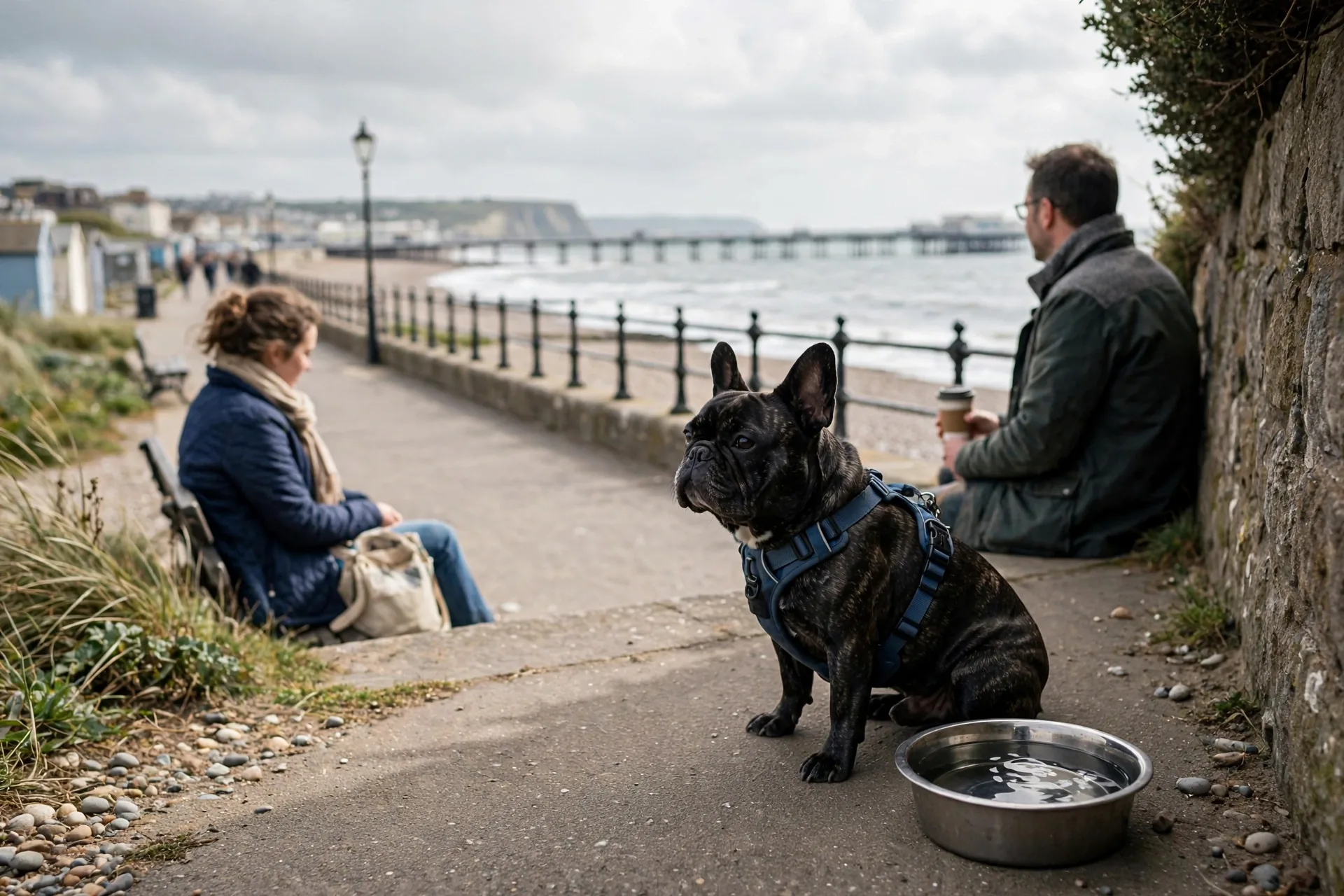
Flat-faced breeds, including French bulldogs, pugs and English bulldogs, face additional risk on long flights, and many carriers restrict or refuse them in cargo, particularly in warm weather. The reason is physiological: a shortened airway makes temperature regulation and breathing under stress harder, and the hold environment, while pressurised and climate-controlled, is still a stressful place for a dog that already works hard to breathe. Some carriers impose seasonal embargoes on brachycephalic breeds, others require a veterinary fitness statement, and some decline them altogether on certain aircraft or routes. If your dog is flat-faced, the carrier conversation must happen before any other booking, because the answer may determine whether the journey is possible at all on your preferred dates.
Heat embargoes apply more widely than to flat-faced breeds alone. Many cargo operations suspend pet acceptance when forecast temperatures at departure, transit or arrival exceed a threshold, typically in the summer months. A July departure that was bookable in March can become unbookable in June if a heatwave is forecast, and the embargo decision may be made close to departure. Build flexibility into summer plans: choose shoulder-season dates where possible, prefer early-morning or late-evening departures that avoid midday heat, and keep a backup date in reserve. Discuss heat risk frankly with your veterinarian, including whether your individual dog, whatever the breed, is a good candidate for a long cargo flight in summer at all. Our French bulldog travel tips cover the breathing, heat and routine precautions in more detail and are worth reading alongside this guide.
Crate fit is also a welfare issue, not just a compliance box. A crate that is technically large enough but leaves a large, anxious dog sliding around on every movement is worse than a well-fitted crate with familiar bedding and a secure water supply. Measure the dog standing, sitting and lying down, compare those measurements with the carrier crate sizing guidance, and choose the size the carrier recommends for your dog weight and dimensions, not the size that looks convenient to carry. Ventilation matters more than insulation on a long flight: confirm that the crate ventilation meets the carrier requirements for the aircraft type, and do not cover ventilation openings with blankets or bedding, however tempting it is to make the crate feel cosier.
Finally, prepare the dog, not just the crate. Weeks of crate acclimatisation, short car journeys in the crate, and calm departures and arrivals at home all reduce flight-day stress. Avoid sedatives unless your veterinarian specifically recommends them for your dog, because sedation can impair temperature regulation and breathing at altitude, and some carriers will not accept a sedated animal. If your veterinarian does recommend any medication, confirm with the carrier that it is acceptable and record it on the booking. A calm, crate-comfortable, well-exercised dog with an empty bladder and a familiar-smelling blanket is the best version of cargo travel that planning can produce.
Costs and a backwards timeline
Budget honestly, because a transatlantic dog move is expensive and the costs arrive in several currencies and several instalments. The veterinary side includes the planning consultation, the microchip if one is needed, the rabies vaccination or booster, the certificate completion fee, and the USDA APHIS endorsement fee, plus the tapeworm treatment appointment. The travel side includes the cargo booking, which is priced by weight including crate, route and carrier, and any pet shipper fee if you use one. The arrival side includes the animal reception and inspection charges where applicable, ground transport from the airport, and the first UK veterinary registration. Owners commonly report total costs running into thousands of dollars for a single medium-sized dog, with larger dogs costing more because crate size and weight drive the cargo price. Get itemised quotes for the cargo and shipper elements before committing to dates, and confirm whether quotes include fuel surcharges, handling fees and arrival charges or whether those are billed separately.
Hidden costs are usually time costs in disguise. A second veterinary visit because a record was incomplete, a re-endorsement because a field was wrong, a rebooked flight because a heat embargo intervened, or a night in an airport hotel because collection ran late all cost money that no initial quote captured. The cheapest way to control the total is to control the error rate: one planning appointment with complete records, one careful certificate draft checked line by line, one endorsement done correctly, one tapeworm appointment inside the window. Every avoided correction is money saved, and every correction avoided close to departure is stress saved as well. Keep a simple spreadsheet of quoted versus actual costs as you go, so the final total is a record you can learn from rather than a surprise you resent.
A backwards timeline makes the process manageable. Eight weeks before departure, confirm the microchip and rabies sequence, choose a USDA-accredited veterinarian experienced with GB certificates, and open the carrier or shipper conversation, including route approval and crate sizing. Six weeks before, confirm the cargo booking in principle, order the crate, and begin or intensify crate acclimatisation. Four weeks before, hold the certificate planning appointment, resolve any record gaps, and confirm the endorsement route and turnaround with the veterinarian. Two weeks before, finalise the flight, confirm the endorsement appointment or mailing schedule, and plan the tapeworm window against the scheduled arrival time. In the final week, complete the certificate and endorsement, hold the tapeworm appointment inside the window, confirm the cargo acceptance time and location, and pack the travel folder with originals and copies. On departure day, arrive at the cargo terminal in the acceptance window, not at passenger check-in time, and keep your phone charged and reachable until the dog is confirmed loaded.
Two timeline warnings complete the picture. First, do not book non-refundable human travel or accommodation until the dog side is confirmed in principle: microchip and rabies sequence verified, carrier and route approval confirmed, crate sized. Human plans are easier to move than a vaccination calendar. Second, do not treat the timeline as a guarantee. Endorsement offices get busy, flights get embargoed, and weather intervenes. A timeline with a week of slack built into the early stages is a timeline that survives a single setback; a timeline with no slack is a timeline that fails at the first one. If your move date is fixed and immovable, start earlier than the eight-week outline above, and say so to every professional involved so they can prioritise accordingly.
After arrival: vets, settling in and the return trip
The first week in Great Britain should be deliberately quiet. Register with a local veterinary practice promptly, bring the endorsed certificate, vaccination record and microchip number to the registration appointment, and ask the practice to scan the chip and confirm that the number on their system matches the certificate. This step closes the loop on the microchip record and gives you a UK veterinary contact before you need one urgently. Ask about local parasite prevention, because the parasite risks in Britain differ from those in the USA, and a prevention plan that was right in Texas or Florida may not be right in Yorkshire or Cornwall. Discuss diet continuity as well: a sudden food change on top of jet lag and a new home is a reliable recipe for digestive upset, so bring enough of the usual food for at least a week and transition gradually if you plan to switch brands.
Settling routines matter more than sightseeing in the first days. Keep feeding times, walking patterns and sleeping arrangements as close to the USA routine as possible, give the dog a quiet base with familiar bedding and a familiar-smelling item from home, and introduce new environments gradually rather than filling the first weekend with busy markets, crowded beaches and long car journeys. Some dogs bounce back within a day; others take a week or more to eat normally, sleep soundly and show their usual confidence. Appetite changes, loose stools and clinginess in the first few days are common responses to a long journey and a new environment, but persistent vomiting, diarrhoea, lethargy or refusal to drink should prompt a veterinary call rather than a wait-and-see approach. Knowing the location of the nearest out-of-hours vet before arrival turns a worrying night into a manageable phone call.
Legal and practical housekeeping follows quickly. If you are staying long-term, confirm whether the dog needs any UK registration beyond the veterinary record, check the local rules on leads, fouling and restricted areas for your neighbourhood and any beaches or parks you plan to use, and review your insurance: pet insurance, third-party liability cover and travel insurance all have territorial and residency conditions that a transatlantic move can affect. If you rent, confirm the pet permission in writing for the specific property, including any breed, size or number conditions, because a general assurance from an agent is not the same as a clause in the tenancy. These tasks are dull, but they are the difference between a settled arrival and a series of small crises in the first month.
Finally, think about the return journey before you need it. A dog that travels to Great Britain and later returns to the USA will face United States import requirements on the way back, which are set by the US Centers for Disease Control and Prevention (CDC) and USDA and are separate from the Great Britain rules described in this guide. The return requirements have changed in recent years and depend on the dog origin, age, microchip, rabies documentation and the country of departure. Do not assume that a successful outward journey guarantees a simple return. When a return date becomes likely, check the official guidance before you travel for the USA entry rules that apply at that time, and start the return planning with the same backwards timeline used for the outward journey. Owners who plan the return as carefully as the arrival avoid the painful discovery that a short holiday has become a long compliance project.
For most owners, the USA-to-UK journey is a once-in-a-lifetime logistical effort on behalf of a family member who cannot fill in their own forms. It is expensive, it is fiddly, and it rewards exactly the qualities this guide has emphasised: early planning, careful records, direct conversations with the veterinarian and the carrier, and a willingness to check the official guidance before you travel rather than trusting a summary, however well written. Get those qualities right and the border check becomes what it should be: a verification of work already done, followed by a reunion at the animal reception facility and the start of the British chapter of your dog life together.
Practical questions
Before you go
Can my dog fly in the cabin from the USA to the UK?
Almost certainly not. Most airlines operating transatlantic routes to Great Britain carry dogs as cargo only, and dogs may enter Great Britain only through an approved route with an approved carrier. Cabin travel is not a normal option on these routes, so plan and budget for cargo from the start and confirm the position with your chosen carrier in writing.
What is USDA endorsement and why does my dog's certificate need it?
USDA endorsement is the step where a USDA-accredited veterinarian completes the GB health certificate and the USDA Animal and Plant Health Inspection Service (APHIS) endorses it. Without that endorsement the certificate is not the document Great Britain requires for a dog arriving from the USA, so the endorsement step must be built into your timetable, not treated as an afterthought.
How long before travel must the rabies vaccination be given?
The rabies vaccination must be given after the microchip is implanted, and a dog generally cannot travel until at least 21 days after the primary vaccination. Booster timing depends on the vaccine product and the dog's history, so ask your veterinarian to check the dates against the certificate before you book flights, and check the official guidance before you travel.
When must the tapeworm treatment be given?
The tapeworm treatment must be given by a veterinarian no less than 24 hours and no more than 120 hours before the scheduled arrival time in Great Britain, and the treatment must be recorded on the health certificate. Because the window is counted back from arrival, a delayed flight can break it, so discuss contingency plans with your veterinarian and carrier in advance.
Does my dog need a rabies blood test to enter the UK from the USA?
For a dog coming from the USA, which Great Britain lists as a listed country for pet travel purposes, a rabies antibody titre test is not normally part of the standard entry requirements, unlike for dogs from unlisted countries. Requirements can change and individual circumstances differ, so check the official guidance before you travel and ask your veterinarian to confirm what applies to your dog.
What happens if the paperwork is wrong on arrival?
If the documents do not match the dog, the dates, or the route requirements, the dog can be refused entry, held, or placed into quarantine at the owner's expense while the problem is resolved. Some errors cannot be fixed at the airport. That is why the certificate, microchip number, vaccination record and tapeworm entry should be checked line by line before departure, not on arrival.