This guide is independent and contains no paid placement. If affiliate links are added later, they will be clearly marked and will not change our editorial checks.
French bulldog travel tips for the UK start with one priority: breathing. Brachycephalic (flat-faced) dogs overheat faster and work harder for every breath, so travel cool, travel short and travel slow. Get a vet check before longer trips, use a harness never a tight collar, plan frequent shaded stops, skip midday summer journeys altogether, and learn the noisy-breathing warning signs that mean stop, cool down and call a vet.
First, drop the two myths at either extreme
Two opposite claims follow flat-faced dogs everywhere, and both are unhelpful. The first says French bulldogs, pugs, English bulldogs and similar brachycephalic breeds should never travel at all. The second says they are just like any other dog and need no special planning. The reality sits in the middle, and it is where good holidays happen: these dogs can enjoy UK trips thoroughly, provided the trip is designed around how they breathe, cool down and sleep.
Brachycephalic means short-skulled. The shortened muzzle, narrowed nostrils, elongated soft palate and often narrower windpipe found in flat-faced breeds mean each breath takes more effort, especially during excitement, exercise and heat. Dogs cool themselves mainly by panting, and panting is precisely what a compromised airway makes inefficient. That single piece of physiology explains almost every rule in this guide: why summer midday travel is out, why a harness matters, why excitement at a busy station is a genuine risk rather than a cute quirk, and why a snoring soundtrack on a train deserves respect rather than laughter.
Individual variation is wide. One French bulldog ambles happily around a cool coastal town in October; another struggles on a warm train in May. Breed is a starting point, not a verdict — your dog's breathing at rest, exercise tolerance, weight and history matter more than the label. The pre-trip vet check described next turns those general risks into a personal plan, which is why it is the most important of all these French bulldog travel tips for UK owners.
A final myth to retire: that a dog who is coping quietly is necessarily coping well. Flat-faced dogs in difficulty may go still and silent as easily as they may panic noisily. Watch effort, not volume alone — flared nostrils, a wide open mouth with the tongue curled at the edges, elbows held out from the body and an anxious expression are all reasons to stop, cool and rest, whatever the noise level.
The pre-trip vet check: questions worth the appointment
Book a vet appointment two to four weeks before any long journey or first holiday with a flat-faced dog. Ask specifically about airway assessment: many practices can grade breathing and advise whether your dog's anatomy makes certain trips unwise, whether weight loss would meaningfully improve tolerance before you go, and whether any procedure or medication should be discussed. Be honest about the planned itinerary, including journey length, hills and the warmest conditions you might meet — a vet who knows the real plan gives better advice than one reassuring a vague one.
Weight deserves direct attention. Excess body fat insulates a dog who already struggles to shed heat and adds tissue around the neck and chest that breathing must work against. Even modest, vet-supervised weight reduction in the months before a summer trip can noticeably improve a flat-faced dog's stamina and heat tolerance. Crash diets are not the answer; steady change is, and your vet can set a safe target. If the holiday is imminent, accept the dog you have and plan shorter, cooler days instead.
Use the appointment to cover the whole travel file: vaccinations and parasite control up to date, microchip details current, any skin-fold or eye issues typical of flat-faced breeds checked before a week away from your usual practice, and the location of emergency care near your destination saved into your phone. Ask what the practice advises for a dog who becomes distressed by breathing difficulty en route, so the decision is made calmly in a consulting room rather than at a motorway services in a panic. Check the latest professional guidance before you travel too, as advice on brachycephalic health is actively evolving.
If your vet advises against a particular trip, believe them. A shorter break, a cooler month or a cottage an hour away can deliver the same shared pleasure at a fraction of the physiological cost. Owners of older flat-faced dogs will also find the pacing principles in our senior dog travel guide apply with double force.
Heat rules with no exceptions built in
Heat is the main enemy, and the UK climate does not exempt you. A humid 24 degrees can trouble a flat-faced dog more than a dry 28 troubles a long-nosed one, because panting works poorly in saturated air. Build the itinerary backwards from temperature: travel early morning or evening in warm months, schedule indoor or shaded rest through the middle of the day, and choose accommodation with hard floors, airflow and a cool room rather than a sun-trap conservatory. In a heatwave, the kindest itinerary change is cancelling the day trip entirely — dogs do not feel disappointed about a plan they never knew existed.
Never leave a flat-faced dog in a parked car, even briefly, even with windows cracked, even on a merely mild day. Car interiors heat far faster than owners intuit, and a dog who cannot pant efficiently has almost no safety margin. This rule also applies to waiting: one person stays with the dog in shade while the other queues. The wider heat guidance in our summer heat and dogs travel guide is essential reading before any warm-weather trip.
Learn active cooling that actually works. Move to shade, stop all exercise, offer small amounts of cool — not ice-cold — water to drink, and wet the body with cool water, especially the neck, armpits and belly, while encouraging air movement. Current veterinary first-aid guidance emphasises cooling first and contacting a vet urgently if breathing is laboured, the dog is disoriented, vomiting, or unusually sleepy; do not delay help to finish a journey. Confirm the latest heatstroke advice with your vet before you travel, and save an emergency number for your destination area.
Pack cooling help without treating it as permission. A cooling mat trialled at home, a portable fan, a spray bottle, a light breathable shade for rest stops and frozen water bottles wrapped in a towel can all take the edge off a warm afternoon. None of them converts an unsafe plan into a safe one. If the base plan needs a gadget to be survivable, the plan is wrong: shorten it, move it to a cooler hour, or drop it.
Cars and trains: harness, airflow and the excitement problem
Restrain a flat-faced dog with a well-fitted harness, never by a collar alone. Pressure on the neck is the last thing a compromised airway needs, in a sudden stop or during a startled lunge. Fit the harness so two fingers pass under every strap, attach it to a proper seatbelt point, and position the dog where air actually reaches — a ventilated back seat beats a stuffy boot area, however spacious. Our dog car harness vs crate comparison covers restraint choices in depth; for this breed, harness fit and airflow should decide.
Excitement is a breathing load. The first ten minutes of a journey, arrivals at services, and boarding a train all spike arousal, and aroused flat-faced dogs breathe harder precisely when the air is warmest and the space most crowded. Counter it with boredom: a calm settle on a familiar mat, a long-lasting chew once moving, unhurried boarding after the initial rush, and a toilet-and-sniff pause before entering any busy space. Arrive at stations early so nothing is rushed, choose quieter services where you can, and keep greetings with enthusiastic strangers politely short.
On trains, pick the coolest spot you can: away from direct sun through windows, near a door's airflow rather than a stuffy carriage centre, on the floor where air is cooler rather than on a seat in the sun. Travel off-peak, keep journeys as short as the plan allows, and offer water at every stop. The step-by-step rail advice in our guide to taking a dog on UK trains covers bookings and etiquette; add the heat and excitement filters from this page on top of it.
Flying needs a separate, careful conversation. Many airlines restrict or refuse brachycephalic breeds, particularly in the hold, because of the recognised breathing risks at altitude and during ground handling in heat. Policies differ and change, so check the current rules directly with any airline well before booking, and weigh whether a flight is necessary at all for a UK-focused trip. For most flat-faced dogs, the car or train is simply the kinder vehicle.
Walking pace, hills and the honest turnaround point
Plan walks at flat-faced pace, which means slower, shorter and earlier than the breed-neutral itinerary in your head. A cool morning hour with sniffing stops can be a triumph; repeating it at noon because the schedule says so can be an emergency. Build every walk with a built-in shortening option — a loop you can cut, a café you can stop at, a taxi number for the return — so turning back never feels like failure. Turning back early, while the dog is still comfortable, is the skill that keeps these holidays happy.
Hills multiply effort. A gradient a fit collie floats up will have a French bulldog breathing hard within minutes, and altitude itself is rarely the issue in Britain so much as sustained climbing in still air. Choose valley paths, promenades, canal towpaths and beach walks at low tide over summit ambitions, and if a hill is unavoidable, take it in short stages with full stops in shade. Watch breathing recovery: a dog who returns to near-normal breathing within a few minutes of stopping is coping; a dog still working hard after ten minutes of rest needs a shorter day tomorrow.
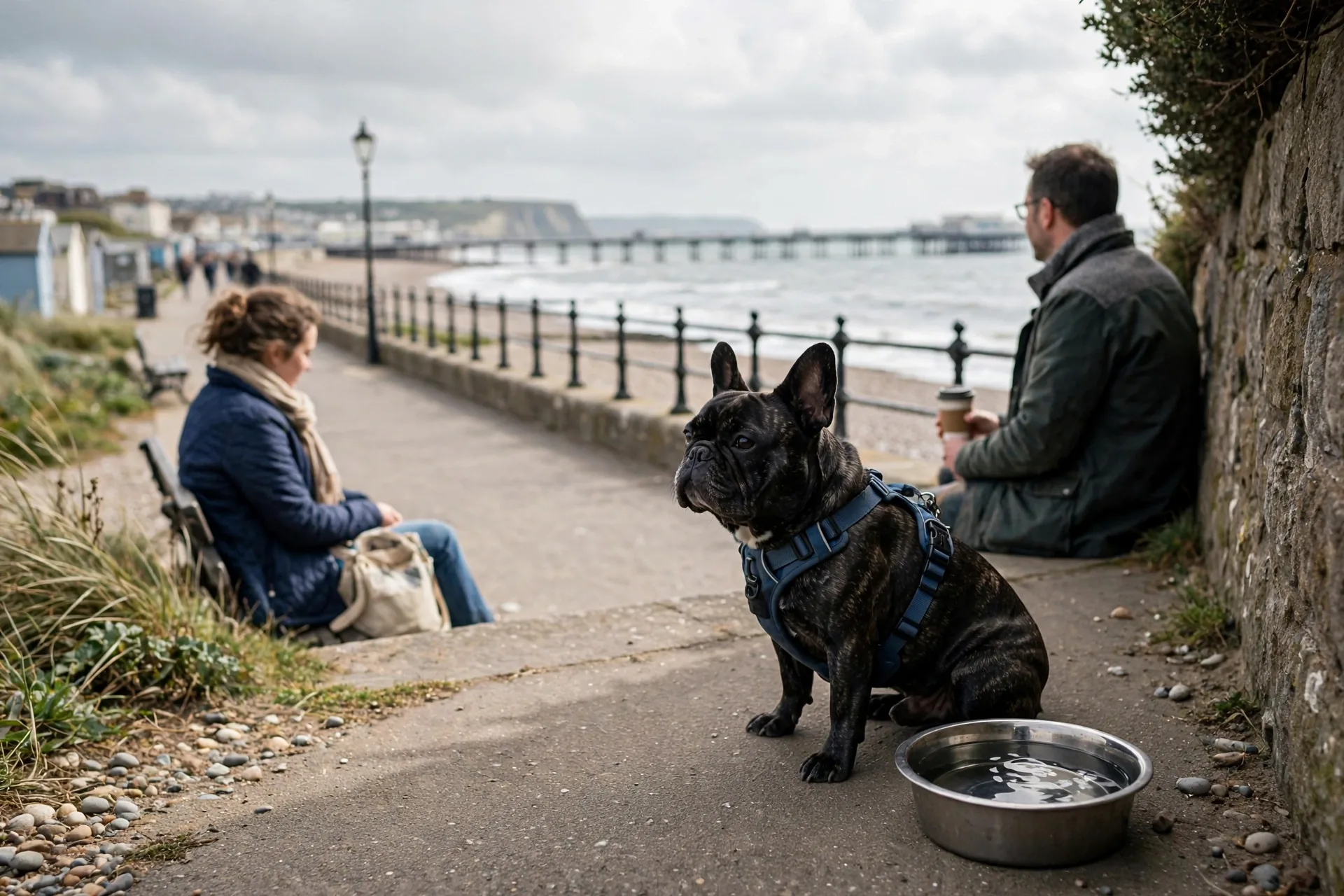
Water on walks is non-negotiable, and so is a bowl — many flat-faced dogs drink poorly from bottles or streams because of their facial shape. Offer small drinks often rather than a huge drink rarely. Swimming deserves caution: flat-faced breeds are often poor swimmers because of their build and breathing, so keep them out of deep water, use a properly fitted buoyancy aid near boats or docks, and never treat paddling enthusiasm as swimming ability.
Muzzle training has a place even here. Some transport, vets and crowded settings are calmer if a dog accepts a basket muzzle, but for a brachycephalic dog any muzzle must allow full panting and drinking, must be fitted with particular care, and should be introduced gradually at home. If a muzzle restricts panting in any way, it is unsafe for this breed in warm or stressful conditions — discuss alternatives with your vet instead of improvising.
Sleep, snoring and choosing the right place to stay
Night-time breathing is part of the travel plan, not an afterthought. Many flat-faced dogs snore; some have genuinely obstructed sleep. Choose accommodation where the dog can sleep in a cool, ventilated room with you nearby, on a bed that keeps the head and neck in a natural position rather than buried in soft bedding. Avoid stuffy attic rooms and caravans that hold the day's heat into the evening. If your dog normally sleeps better slightly raised at the head end, recreate that arrangement rather than experimenting on holiday.
Ask hosts the flat-faced questions before booking. Is there a ground-floor room, to skip hot stairwells and lifts? Is there shade in the garden at midday, and hard flooring where a dog can sprawl to cool down? How close is parking, so arrival does not mean a long hot walk with luggage? A cottage with a cool stone floor and a shaded yard will suit this breed better than a glamorous property up three flights of stairs, whatever the photos promise.
Evenings out need the same realism applied to any dog, sharpened here. Dogs should not be left alone in unfamiliar accommodation unless the booking terms explicitly allow it and the dog is genuinely settled — and a flat-faced dog should never be left in a warm room unchecked for long. Favour places where the dog can join you on a terrace, eat early when restaurants are cooler and quieter, and keep the last walk short, late and unhurried so the dog starts the night cool and empty-bladdered rather than hot from a final burst of play.
If sleep is badly disturbed — repeated waking, gasping, or a dog who cannot settle flat — treat it as health information, not a holiday quirk. Shorten the next day, cool the room further, and contact a vet if it persists. Good trips are built by responding to what the dog showed you yesterday, not by defending the itinerary you wrote last month.
Warning signs: the stop-cool-call sequence
Commit this sequence to memory before you need it: stop, cool, call. Stop all activity at the first signs of trouble — breathing that becomes harsh, rasping or unusually loud; frantic panting that does not ease with rest; drooling, bright red or grey-blue gums, wide anxious eyes, stumbling, vomiting, or a dog who suddenly goes quiet and still. Do not wait to see if it passes on a warm day. Breathing difficulty in a flat-faced dog can deteriorate quickly, and early action is what prevents a scare from becoming a crisis.
Cool actively while someone else phones. Move into shade or the coolest available space, wet the coat with cool water and keep it wet, encourage air movement with a fan or fanning, and offer small sips of water if the dog is alert and wants them. Do not drape wet towels over the dog and leave them — they warm up and insulate — and do not force water into the mouth of a dog who is struggling. Then call a vet: your own practice for advice, or the nearest emergency service to where you are, which you saved before departure. Follow their instructions over anything in any guide, including this one.
After any episode, the holiday changes shape. No more exercise that day, veterinary clearance before further travel if the episode was more than momentary, and honest reflection on which rule was bent — the midday leg, the long hill, the exciting arrival. Most serious incidents, reviewed afterwards, have a visible cause earlier in the day. Learning that chain for your own dog is worth more than any kit list.
Insurance is the quiet backstop. Check that your policy covers emergency treatment away from home and any breed-related conditions, and understand its exclusions before you travel rather than during a crisis. Our dog travel insurance guide explains what to compare. For flat-faced breeds, where a single emergency can be costly, that homework is part of responsible planning, not pessimism.
Practical questions
Before you go
Can French bulldogs travel long distances in the UK?
Many can, on adjusted terms: a pre-trip vet check, cool travelling hours, a harness rather than a collar, frequent shaded stops and a shorter total day than a long-nosed breed would manage. Split very long drives with an overnight stop, travel off-peak by train, and be ready to shorten the plan if breathing or heat becomes an issue.
Why should flat-faced dogs wear a harness instead of a collar in the car?
A collar puts pressure on the neck and airway, which is the last thing a brachycephalic dog needs in a sudden stop or a startled lunge. A well-fitted harness spreads restraint across the body. Attach it to a proper seatbelt point, check two fingers fit under every strap, and position the dog where air reaches them.
Can flat-faced dogs fly within the UK?
Many airlines restrict or refuse brachycephalic breeds, especially in the hold, because of recognised breathing risks. Rules differ between airlines and change over time, so check directly with the airline well before booking — and consider whether car or train is kinder. For most UK trips, surface travel is the simpler and safer choice for this breed.
What temperature is too hot for travelling with a French bulldog?
There is no single safe number, because humidity, excitement and the individual dog matter as much as the thermometer. As a working rule, avoid exercise and unnecessary travel in the warm part of warm days, travel early or late, and treat any laboured breathing as a stop signal at any temperature. In a heatwave, cancel non-essential trips.
How do I know if my flat-faced dog is in trouble while travelling?
Watch effort, not just noise: harsh or rasping breathing, panting that does not ease with rest, flared nostrils, drooling, red or pale gums, anxiety, stumbling or sudden quietness all mean stop immediately. Move to shade, cool the dog with cool water and air movement, and call a vet urgently — do not continue the journey to see if it passes.