This guide is independent and contains no paid placement. If affiliate links are added later, they will be clearly marked and will not change our editorial checks.
Buckden suits dogs that like water, open valley walking and quiet villages. Start with a short riverside loop, save Buckden Pike for a fit dog on a clear day, keep the lead ready for sheep, and walk the valley to Kettlewell when you want a longer day without driving anywhere.
Where the river is still young
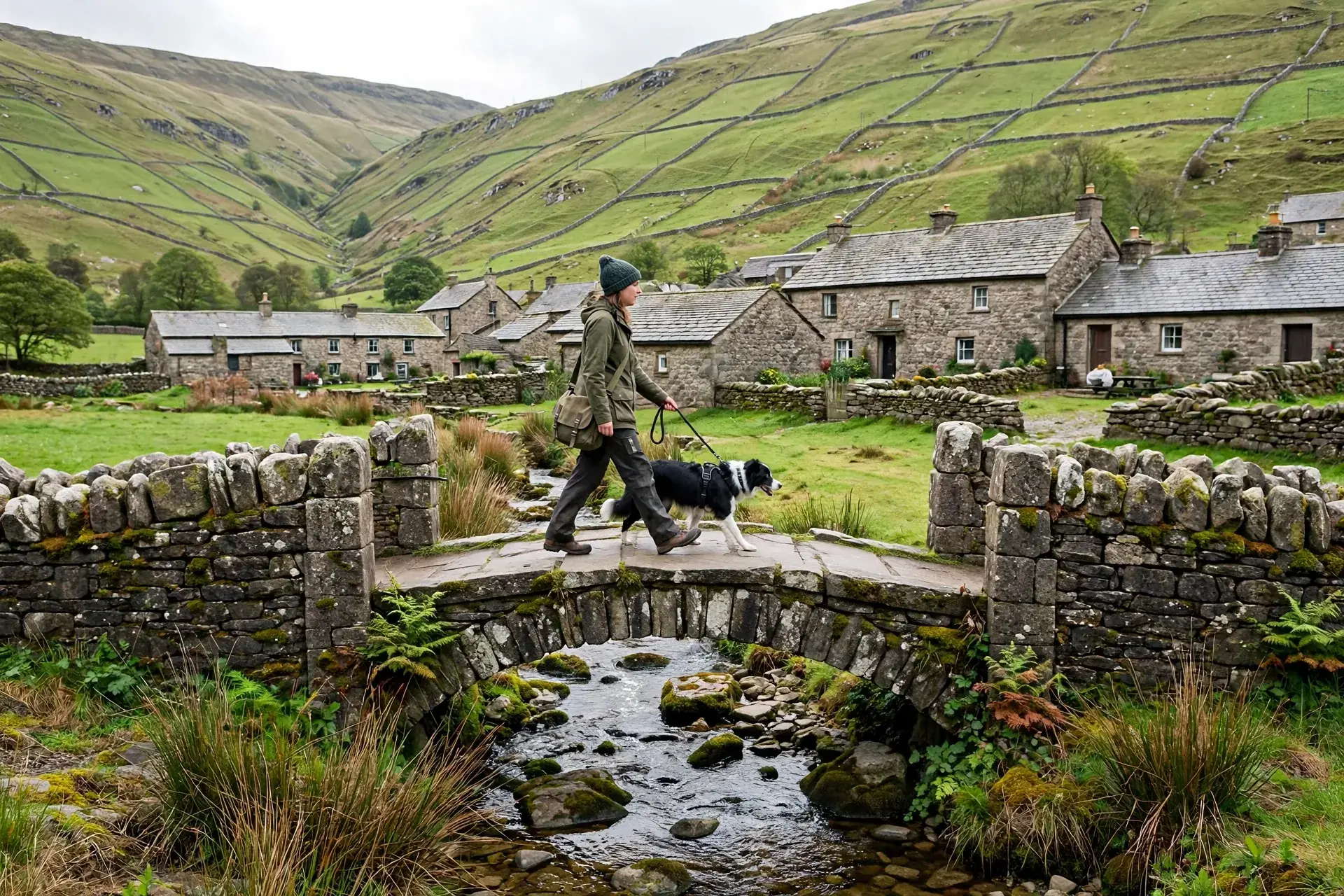
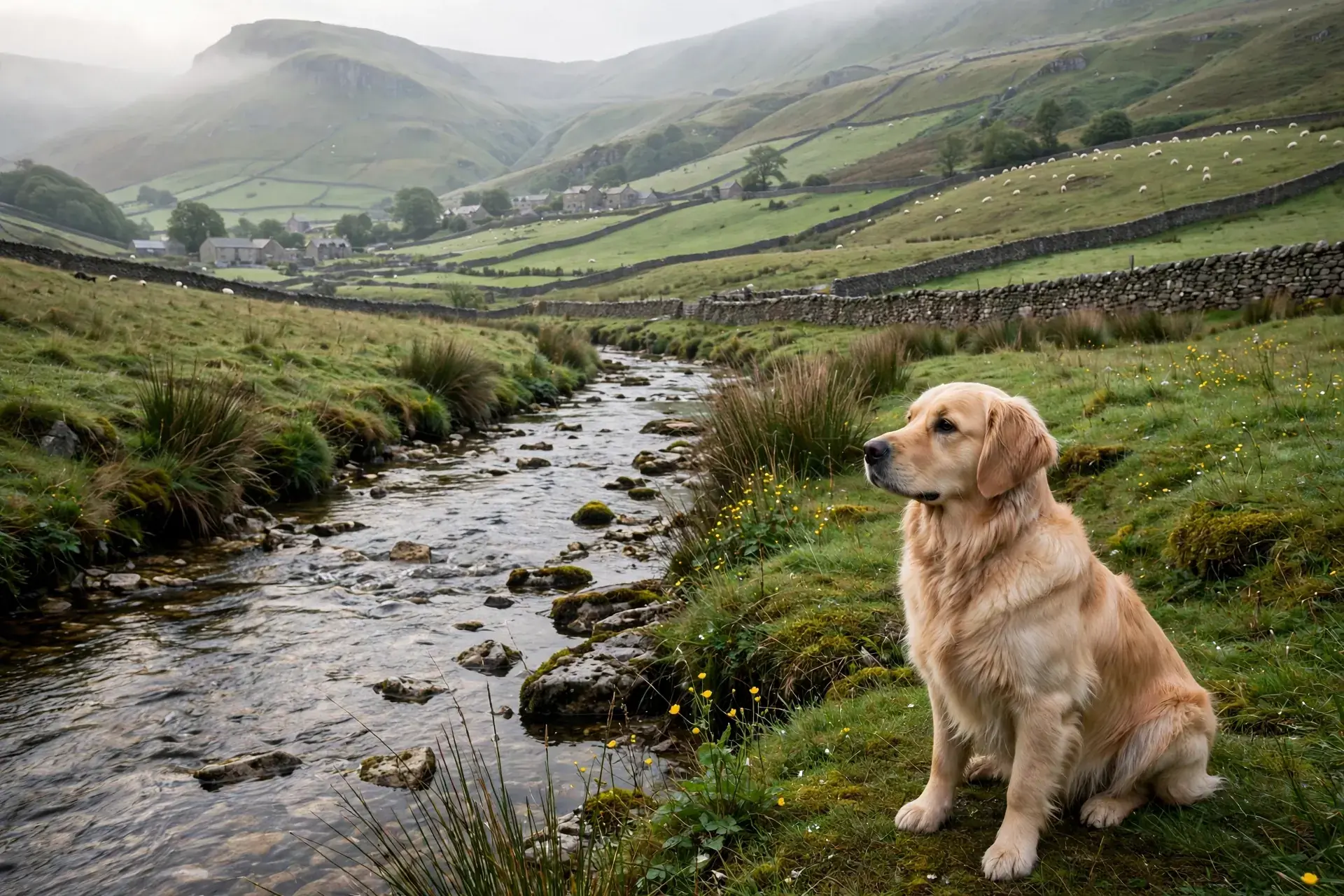
Most people meet the River Wharfe further down the valley, where it is wide, busy and famous. At Buckden it is a different river altogether: narrower, faster, colder and younger, running through a green valley that has not yet opened out into the broad dale below. The village sits near the top of Wharfedale, close to where the Wharfe begins its long journey south, and that position shapes everything about a visit with a dog. Walks start at the water rather than leading to it, the fells rise close on both sides, and the whole place feels like the beginning of something rather than the middle of it.
That matters for planning, because Buckden is not a place for ticking off attractions. There is no single sight to rush towards. The pleasure is in the scale of it: a short riverside path where a dog can sniff and paddle, a village green where nothing much happens, a fell track that climbs steadily out of the valley, and a long valley path that follows the river downstream. Dogs that enjoy sniffing, wading and open ground will be happy here. Dogs that need constant stimulation, cafes on every corner and a beach to run on will find it quiet, and that quiet is exactly the point.
Buckden is also a working farming village in the Yorkshire Dales National Park, not a resort built for visitors. Sheep graze the fields around the village, farm traffic uses the narrow roads, and the weather on the fells can change while you are still deciding which coat to wear. The advice in this guide is written around those facts: leads ready, water carried, plans that can shrink as easily as they can grow. A good day in Buckden is a flexible one, built around the river and the weather rather than a fixed timetable.
Before going further, it helps to understand the shape of the valley. Upstream from Buckden, the Wharfe runs through Langstrothdale, a narrower and wilder valley that leads towards Hubberholme and Yockenthwaite. Downstream, the river passes Starbotton and then Kettlewell, the next village of any size, before continuing through Grassington and on towards Bolton Abbey. Buckden sits at the hinge between those two moods: the wild upper valley behind it, and the gentler, more walked valley in front of it. That is why it works so well as a base. You can turn either way from the village green and find a completely different kind of walk.
The river itself deserves respect from the start. The Wharfe at Buckden is shallow in places and deep in others, and its bed is rocky and uneven. After rain in the fells, the water rises fast and runs brown and strong, even when the sky over the village looks fine. Dogs that paddle happily on a dry summer morning should not be allowed near the same stretch after a wet night. The rule for the whole trip is simple: look at the water before the dog does, and decide for them. If the river is high, fast or cloudy, keep the dog on a lead and choose a field path instead.
Access is another thing to get right early. The Yorkshire Dales National Park covers this area, and public rights of way are well marked, but the land between them is working farmland. Stay on the marked paths, close gates behind you, and keep dogs on leads through fields with livestock. The Dales Way, the long-distance path that runs through the valley, passes through Buckden, so much of the best walking here follows a waymarked route rather than guesswork. Carrying a paper map or an offline map on a phone is still wise: phone signal in upper Wharfedale can be patchy, and a dead battery should not become a navigation problem.
Buckden village first
Buckden is small enough to learn in a single slow circuit, and that first circuit is the best way to settle a dog. The village green sits at the heart of things, with stone cottages around it, the Buckden Pike rising behind, and the river a short walk away. There is a village shop for basics, a pub, a church, and a small cluster of cottages and holiday lets. Nothing is far from anything else, which makes it easy to work out where the dog can walk, where the car is parked, and where you will eat later, all before the first proper walk begins.
Start by walking the dog around the green and the quiet lanes, on a lead. This is not just orientation. It lets the dog take in the smells of a new place, meet the local rhythm of farm vehicles and other walkers, and settle before the excitement of the river. Dogs that arrive straight from a long car journey and are immediately taken to the water tend to be over-aroused and harder to recall. A calm ten minutes around the village, with a chance to toilet on grass rather than on a verge beside the road, makes the rest of the day easier.
The village green itself is a useful open space, but it is not an off-lead exercise field. It is a shared village space, close to the road, with other dogs, children and walkers passing through. Keep the dog on a lead here, pick up after them, and treat it as a meeting point rather than a playground. The real off-lead opportunities, where they exist, are on the open fell and on quiet riverside stretches away from livestock, and even there the lead should stay in your hand and ready.
Buckden has a strong walking history, and the village has long been a stop on the Dales Way. Walkers pass through in both directions, which means the village is used to muddy boots, wet dogs and people asking for directions. That also means the pub and the shop are used to dogs, though policies can change, so always check the official guidance before you travel and ask on arrival rather than assuming. A polite question at the door, a dry dog and a mat to lie on will get you further than any assumption about a place being dog-friendly.
One practical point: Buckden has limited facilities compared with Grassington or Skipton further down the valley. There is no large supermarket here, no petrol station, and no vet in the village. Bring the dog food, medication and supplies you need, and know where the nearest vet is before you need one. The nearest practices are in the larger towns down the valley, and in an emergency the drive matters more than the postcode. Save the number in your phone before the first walk, and check the official guidance before you travel if opening hours or services have changed.
The church at Buckden, St Michael and All Angels, is worth a look from the outside, and the churchyard is a quiet place to pause, but dogs should be kept on a lead and under control in churchyards, and not every churchyard welcomes dogs. The same applies to the village lanes: stone walls and narrow roads mean there is little room to step aside, so a short lead and good recall matter more here than on an open fell. If your dog pulls towards every passing sheep, car or cyclist, the village lanes are the place to practise short-lead walking before the open ground tempts you to let go.
Buckden Pike above the village
Buckden Pike is the fell that dominates the village. At 702 metres, it is a substantial climb, and the walk to the top is the classic Buckden outing for fit walkers. The summit carries a war memorial, and on a clear day the view stretches across Wharfedale and over the surrounding fells. For dogs, it is a proper mountain walk rather than a hill stroll: steep in places, rough underfoot, exposed to wind, and often much colder and wetter at the top than in the village below.
The usual route climbs from the village, often by way of the track past Buckden Lead Mine, the remains of an old lead-mining area on the fellside. The mine ruins are a reminder that this landscape was worked hard in the past, and they add interest to the climb, but they also mean uneven ground, old walls and spoil heaps where a dog could cut a paw. Keep the dog on a lead near the mine workings and on the steeper sections, and watch for sharp stones and old metal. The route is waymarked in places, but mist can come down quickly on the Pike, so carry a map and know how to use it, and be ready to turn back if visibility drops.
How long does it take? Most walkers allow three to four hours for the round trip from the village, depending on fitness, stops and weather. Dogs add time, because they need water stops, sniffing stops and rests on the steeper ground. Plan for a half-day rather than a quick outing, and start early on warm days so the hardest climbing is done before the heat of the day. In summer, carry more water than you think you need: there is no reliable drinking water for dogs on the upper fell, and a dog that is panting hard on a dry track needs water now, not at the summit.
Not every dog should attempt the Pike. Older dogs, puppies, dogs with joint problems, brachycephalic breeds and dogs that have not walked hills before will find it hard. The descent is often harder on joints than the ascent, and a dog that bounds up the fell may struggle on the way down. If in doubt, choose a lower walk instead: the riverside paths and the valley route to Kettlewell give a full day of walking without the steep climb, and the dog will enjoy them more. There is no prize for reaching the summit with a lame dog.
Weather is the deciding factor. Check the forecast for the fell, not just the village, and check the official guidance before you travel if conditions are uncertain. Wind on an exposed summit can be strong enough to unbalance a small dog, and rain on the Pike can turn a track into a stream. If the forecast mentions hill fog, strong winds or heavy rain, postpone the climb. The Pike will still be there tomorrow, and the valley walks are a better choice on a bad-weather day.
On the fell, sheep graze freely, and the lead rule is absolute. Dogs must be on a lead near sheep, and under close control at all times on open access land. A dog chasing sheep on a fell can cause serious harm, and farmers are entitled to protect their livestock. If your dog has a strong chase instinct, or has never been tested around sheep, keep them on a lead for the whole fell walk, or choose a different route. The same applies to ground-nesting birds in spring and early summer: keep dogs on paths and under control during the breeding season, and check the official guidance before you travel for any seasonal access advice.
At the summit, give the dog a rest, water and a snack, and check their paws for cuts or soreness before the descent. The memorial at the top is a place for a quiet pause rather than a picnic, and the wind often makes it colder than expected, so a dog coat can help a short-coated dog on a chilly day. Take photographs, enjoy the view, and then come down the same way or by a marked alternative route, keeping the dog close on the steeper sections. The best fell days end with a tired dog asleep by the fire, not a vet visit.
Riverside walks from the village
The riverside walks are the heart of a Buckden trip with a dog, and they are also the most flexible. Short loops from the village suit older dogs, puppies and bad-weather days, while longer stretches upstream and downstream suit fit dogs that want a full morning out. All of them follow the Wharfe at its most attractive: clear water over stone, grassy banks, dry stone walls, and the sound of the river as a constant companion.
A good first walk is a short loop along the river from the village and back through the lanes. It gives the dog water, smells and space without committing to a long distance, and it lets you judge the river level, the ground conditions and the dog's energy before deciding on anything longer. Look for a shallow, slow stretch for a paddle, and avoid deep pools, fast runs and any place where the bank is steep or undercut. A long line is useful here: it gives the dog freedom to explore the bank while keeping them out of trouble if the current is stronger than it looks.
Upstream, the river leads towards Hubberholme, a tiny hamlet with a church beside the water, and beyond it towards Yockenthwaite and the wilder Langstrothdale. This is quieter walking than the downstream route, with fewer people and a narrower valley. The path can be rough and muddy after rain, and there are fields with livestock to cross, so keep the lead ready and the dog close. The reward is a sense of remoteness that is hard to find further down the dale: the river, the walls, the fells, and very little else.
Hubberholme church, St Michael and All Angels, sits in a beautiful spot by the river, and the churchyard is a peaceful place to pause, but dogs should be on a lead and under control, and the church itself may not be open. Do not plan a visit around going inside. The walk is the point, and the church is a landmark to walk towards rather than a destination with facilities. Carry water and snacks, because there is nowhere to buy them on the upstream path.
Downstream, the river walk towards Starbotton is gentler and more open, with good views back up the valley to Buckden Pike. This stretch is part of the Dales Way, so the path is well used and generally in good condition, but it still crosses fields and passes through gates and stiles. Some stiles are awkward for larger dogs, so be ready to lift a smaller dog over, or to find an alternative gate. Never force a dog over a stile it is afraid of: a frightened dog on a stile is a recipe for injury, and a short detour is always better.
Water safety deserves a section of its own, because the Wharfe is deceptively attractive. Dogs are drawn to moving water, and many will jump in without checking the depth or the current. Before letting a dog near the water, look for a shallow entry with a gentle slope, a slow current, and a clear exit downstream. Avoid weirs, footbridges with fast water underneath, and any stretch where the bank is high and the dog could not climb out. After heavy rain, skip the paddling altogether: a river in spate is dangerous for dogs and people alike, and no swim is worth the risk.
After a swim or a paddle, dry the dog before the car or the pub. A wet dog in a car chills quickly, and a wet dog in a pub is unwelcome. Carry a towel and, in colder months, a drying coat. Check the dog's ears after swimming, especially for dogs prone to ear infections, and rinse off mud and grit from paws at the end of the walk. The Wharfe is generally clean, but standing water and muddy puddles can carry bacteria, so offer fresh drinking water rather than letting the dog drink from every puddle.
Season changes the riverside completely. In spring, the valley is green and the river is often high from winter rain and snowmelt, so paths can be muddy and the water cold. In summer, the river drops, the banks dry out, and the shallow stretches become ideal for paddling, but the sun on open ground can overheat a dog, so walk early or late and carry water. In autumn, the colours are superb and the paths are often at their best, but the river can rise quickly after autumn storms. In winter, the valley can be beautiful and very cold, with icy paths and a river that looks inviting but is dangerously cold for a swim. Each season has its own version of Buckden, and the best walk is the one that fits the day in front of you.
The valley route to Kettlewell
The walk from Buckden to Kettlewell is the classic valley day out, and it is one of the best dog walks in Wharfedale. It follows the Dales Way downstream, mostly on riverside and field paths, through Starbotton and along the Wharfe to Kettlewell, a larger village with pubs, a shop and a green. The distance is roughly three miles each way, and most walkers with a dog allow around one and a half to two hours each way, though that depends on stops, weather and how much sniffing the dog insists on doing.
Start from Buckden village and follow the Dales Way signs downstream. The path leaves the village, crosses fields, and soon reaches the river, which it follows, with small detours, for much of the way. Starbotton is the halfway landmark: a tiny village with a pub, the Fox and Hounds, which is a useful stopping point, though opening hours vary, so check the official guidance before you travel if you are counting on it. The pub garden is a good place for a rest, and the river nearby is a good place for a paddle on a warm day, with the usual cautions about current and depth.
Between Starbotton and Kettlewell, the valley opens out, the river meanders, and the views widen. This is easy, pleasant walking for most dogs, with grassy banks, field paths and the occasional stile or gate. Sheep and cattle graze the fields, so the lead stays ready, and gates must be closed behind you. The path can be muddy after rain, especially on the field sections, so wear boots with grip and be ready for a muddy dog at the end. A towel in the car is not optional on this walk.
Kettlewell itself is worth the walk. The village has a green, stone cottages, a church, pubs and a shop, and it is a natural turning point for lunch before the walk back. Our guide to Kettlewell with a dog covers the village in detail, including its beck, its pubs and its own walks towards Arncliffe and Littondale. If you plan to eat in Kettlewell, check opening times and dog policies in advance, and bring a mat for the dog. On busy weekends, the pubs fill up, so an early lunch is easier than a late one.
There are choices at Kettlewell. Fit dogs and walkers can continue further down the valley, or loop back by a different route. Tired dogs can simply turn around and walk back the way they came, which is still a lovely walk in the other direction: the views change completely when you walk upstream, and Buckden Pike appears ahead of you as you return. Alternatively, if two cars are available, one can be left in Kettlewell and the walk done one way, though this needs planning and a driver willing to shuttle. Do not rely on public transport to get back: bus services in upper Wharfedale are limited, and dogs on buses are subject to the operator's rules, so check the official guidance before you travel.
For a longer day, the Buckden to Kettlewell walk can be extended into a circular route, returning by a higher path or by the road, but the road is narrow and busy with farm traffic, so it is not a pleasant or safe choice for dogs. A better extension is to add a loop around Kettlewell itself, or to walk a short way further downstream before turning back. The principle is the same as for the whole trip: add distance on paths, not on roads, and turn back while the dog is still enjoying it rather than after they are tired.
Navigation on this route is straightforward, but do not rely on it entirely. The Dales Way is waymarked, but markers can be missed at field corners, and a wrong turn can add a mile through a farmyard. Carry a map, follow the river as a handrail, and if the path seems to disappear, retrace your steps to the last marker rather than pushing on across a field. Dogs do not mind retracing steps; they mind being lost.
River levels and weather
Upper Wharfedale weather is a subject in itself, and it decides more about your day than any guidebook can. The valley is narrow, the fells are high, and rain that falls on the tops reaches the river quickly. A sunny morning in Buckden can turn into a wet afternoon on the Pike, and a dry day in Grassington can be a wet day in Buckden. Check the forecast for the upper dale, not just for Yorkshire in general, and be ready to change plans.
River levels are the practical measure to watch. Before any riverside walk, look at the water: is it clear or brown, slow or fast, high or low against the banks? Brown, fast water after rain means the river is in spate, and dogs should stay on a lead and well away from the edge. Clear, slow water on a dry day means the shallow stretches are safe for a paddle. If you are unsure, ask a local: the pub, the shop or another walker will usually know whether the river has risen overnight. Local knowledge beats any app.
Rain is not a reason to stay indoors, but it changes the walk. Waterproofs for you, a coat for a short-coated dog, and a towel for the car make a wet walk comfortable. Paths become slippery, especially on limestone and on the steep tracks of Buckden Pike, so slow down and keep the dog on a lead on descents. After a wet walk, dry the dog thoroughly, check paws for cuts from grit and stone, and give them a warm place to rest. A wet, cold dog that is left damp will stiffen up and may be sore the next day.
Heat is the less obvious risk in the Dales, because people associate the area with rain. On a hot summer day, the open valley offers little shade, and a dog walking on a sunny track can overheat quickly. Walk early in the morning or late in the afternoon, carry water for the dog and offer it often, and watch for signs of overheating: heavy panting, drooling, wobbling or a reluctance to move. If you see them, stop, find shade and water, and cool the dog gradually. Never leave a dog in a car on a warm day, even for a few minutes, and never rely on a cracked window.
Winter in Buckden is beautiful and demanding. Frost on the paths, ice on the river edges, and snow on the Pike are all possible from late autumn onwards. Dogs need shorter walks in very cold weather, and their paws need checking for ice balls between the toes and for salt or grit on the roads. A dog coat helps small and short-coated dogs, and a warm bed after the walk matters more than an extra mile. If the roads are icy, the drive to Buckden may be the hardest part of the day, so check the official guidance before you travel and allow extra time.
Midges and flies are a summer nuisance in the Dales, especially near water and in still, humid weather. They bother dogs as well as people, particularly around the ears and eyes. A dog-safe insect repellent, or simply walking in a breeze and avoiding still, damp spots at dusk, helps. Ticks are also present in the Dales, especially in long grass and bracken, so check the dog after every walk, remove any ticks promptly with a tick remover, and talk to your vet about tick prevention before the trip. These are small precautions, but they prevent uncomfortable problems later.
Parking and arrival
Buckden is a small village with limited parking, and on fine weekends and school holidays it fills up early. The village car park is the sensible first choice: park tidily, pay if required, and do not block farm gates, driveways or the turning circle for farm vehicles. If the car park is full, do not park on verges or in gateways. Instead, consider starting from Kettlewell and walking up the valley to Buckden, which is a lovely walk in its own right and spreads the parking pressure between villages.
Arrive with a plan for the first half hour. Dogs that have travelled for an hour or more need a toilet break, water and a chance to stretch before a long walk. Find a grassy spot away from the road, let the dog toilet, offer water, and then take the short village circuit described earlier. This is also the time to check the dog's paws, collar and lead, and to make sure you have water, a bowl, a towel, poo bags and a lead for the walk ahead. Forgetting poo bags in a small village with no shop open is an avoidable mistake.
Car safety matters in the Dales, where temperatures inside a parked car can rise quickly even on a mild day, and fall quickly on a cold one. Never leave a dog in a car while you go for a walk, a meal or a look around the village. If you need to leave the dog briefly, take them with you or leave a person with them. The same applies to the journey home: a tired, wet dog in a cold car needs a blanket and a dry bed, and a hot car needs ventilation and water before you set off.
If you are arriving by public transport, check the official guidance before you travel, because bus services in upper Wharfedale are infrequent and may not run on Sundays or in winter. Dogs are usually allowed on buses at the driver's discretion, but this is not guaranteed, and a large dog on a busy bus can be refused. Plan the return journey as carefully as the outward one, and have a backup plan, such as a taxi number, in case the bus does not come.
For visitors staying overnight, arrival is also the time to learn the house rules for the dog: where they can sleep, where they can toilet, and whether they can be left alone. Ask the host, read the welcome information, and do not assume that a cottage that accepts dogs also accepts them in every room. A quick conversation on arrival prevents an awkward one later, and it helps the host help you: they will know the nearest vet, the best local walk, and the quirks of the garden gate.
Pubs, cafes and places to stay
Buckden's pub is at the centre of village life, and it has long welcomed walkers and their dogs. The Buckden area has a tradition of dog-friendly pubs, and the bar area is the usual place for dogs, with a fire in colder months and a garden in summer. That said, policies can change with the season, the landlord and the time of day, so check the official guidance before you travel and ask on arrival. A dog that can settle on a mat under the table will be welcome almost anywhere; a dog that barks, wanders or begs will not, however dog-friendly the sign on the door.
Pack a pub kit for the dog: a mat or blanket, a chew or a stuffed Kong, a water bowl, and a towel for muddy paws. Feed the dog before you go in, or bring their dinner to eat quietly under the table, so they are not hungry and restless. Sit near the door if your dog is nervous, so you can step outside easily, and avoid the busiest times if your dog dislikes crowds. Lunchtime on a fine Saturday is the hardest time for a nervous dog; a weekday evening is often much calmer.
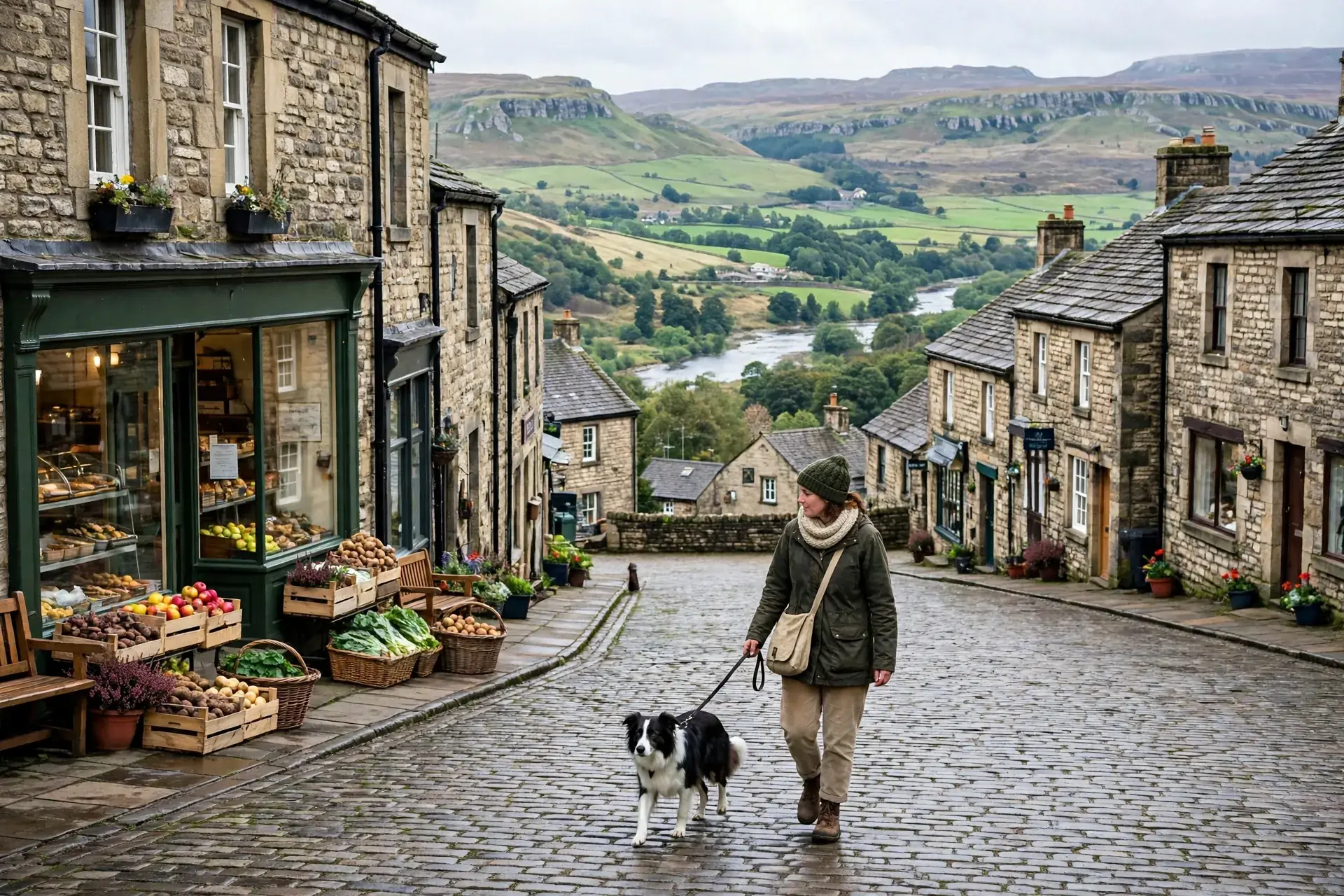
For food beyond the pub, Buckden has limited options, and the village shop covers basics rather than full meals. Grassington, further down the valley, has more cafes, pubs and shops, and our guide to Grassington with a dog covers its cobbled square, its riverside walks and its dog-friendly places to eat. If you are staying in Buckden for several days, plan a shopping trip to Grassington or Skipton for supplies, and bring the dog's food with you rather than relying on finding a particular brand locally. Skipton, the gateway town to the Dales, is covered in our guide to Skipton with a dog, and it is the best place for a larger shop, a vet visit or a rainy-day wander.
Staying in Buckden with a dog usually means a cottage, a holiday let or a bed and breakfast, and the choice matters more than the price. Look for a place with a secure garden or a nearby field for the last walk of the day, a hard floor or washable rugs for muddy paws, and a drying area for wet coats and leads. Ask about the garden boundary before you book: a low wall or an open gate is not secure for a dog that likes to explore, and a garden that backs onto sheep fields needs a lead even for a toilet break. Ask too about stairs, because many Dales cottages have steep, narrow stairs that older dogs struggle with.
When you book, be honest about the dog: breed, size, age, whether they shed, whether they bark when left alone, and whether they are housetrained. Hosts who know what to expect are far more welcoming than hosts who discover a large, muddy dog at the door. Confirm the pet fee, the number of dogs allowed, and the cleaning expectations in writing, and leave the place as you found it: hoover up dog hair, wash the dog towels you used, and report any damage honestly. Good guests are remembered, and they are welcomed back.
Wet-weather eating deserves a thought, because a rainy day in Buckden can mean a wet dog and a long afternoon indoors. A cottage with a drying area, a pub with a fire, and a car with a towel and a change of clothes for you will get you through it. Bring a book, a chew and a puzzle feeder for the dog, and accept that some days are for resting rather than walking. A dog that has had a short walk, a good meal and a warm bed is a happy dog, even if the rain never stops.
Sheep, livestock and slower dogs
Sheep are the single most important safety subject in Buckden, and they deserve more than a passing mention. The fields around the village, the fell above it, and the valley path to Kettlewell all pass through grazing land. Sheep are easily frightened, and a dog that chases them can cause ewes to miscarry, lambs to be separated from their mothers, and sheep to injure themselves on walls and fences. Farmers in the Dales take this seriously, and the law allows them to shoot a dog that is worrying livestock. That is not a threat; it is a fact that every dog owner walking in the Dales should know.
The practical rule is simple: if you can see sheep, the dog is on a lead. If you cannot see sheep but you are crossing a field with a livestock gate, a feed trough or sheep droppings, the dog is on a lead until you are sure. Do not rely on recall, however good it is at home. A dog that has ignored sheep a hundred times can still chase on the hundred and first, especially if the sheep run, and once a chase starts it is very hard to stop. A long line is a good compromise on open ground: it gives the dog room to move while keeping them under control.
Cattle need a different kind of care. The valley fields sometimes hold cattle, including cows with calves, and a dog can make cattle defensive. Keep the dog on a short lead, walk calmly and steadily through the field, and do not let the dog run towards the cattle or bark at them. If cattle approach you, keep the dog close, do not run, and walk steadily towards the nearest gate. If you feel threatened, let the dog off the lead so it can run to safety: a dog can outrun cattle, but a person holding a lead cannot. This is the one situation where letting go is the safer choice, and it is worth knowing before you need it.
Older dogs, puppies and dogs with health problems need a Buckden plan of their own. The village itself, with its short riverside loops and quiet lanes, suits them well, while Buckden Pike and the full walk to Kettlewell may be too much. Watch for signs of tiredness: lagging behind, lying down, heavy panting or a reluctance to continue. When you see them, stop, rest, and turn back. A dog that is carried or lifted over a stile needs to be handled gently, and a dog that is struggling on a descent may need to be carried down a steep section. Bring a sling or a carrier for a small dog if you plan a long walk, and know your dog's limits before the walk, not during it.
Reactive dogs, nervous dogs and dogs that dislike other dogs can still enjoy Buckden, because the village is quiet and the walks are wide. Walk early in the morning or late in the afternoon, when the paths are emptiest, and choose the upstream route towards Hubberholme if the Dales Way is busy. Keep the dog on a lead, give other walkers plenty of space, and step off the path to let others pass. A yellow ribbon or a lead sleeve that says the dog needs space can help, but it is not a substitute for distance and control. If your dog is reactive to other dogs, the village green at midday on a Saturday is not the place to practise.
Finally, think about the dog's paws, coat and ears after every walk. The Dales are hard on paws: limestone, grit, mud and wet grass can all cause soreness, and a small cut can become infected if it is not cleaned. Rinse paws after a walk, check between the toes, and dry the coat thoroughly. Long-eared dogs need their ears checked after swimming and after walks through long grass. A five-minute check at the end of the walk is the cheapest vet visit you will ever make.
A slow day in Buckden
The best way to use this guide is to build a slow day around it, rather than trying to do everything at once. Here is a pattern that works for many dogs and their owners, and it can be shortened or stretched to fit the weather and the dog. It is a suggestion, not a schedule, and the river and the dog should be allowed to change it.
Start early, before the village wakes up. A short riverside loop from the village, with a paddle in a shallow stretch and a sniff around the lanes, wakes the dog up gently and gives you a first look at the river level and the weather. Back at the cottage or the car, feed the dog, dry their paws, and have breakfast yourself. This is also the time to decide on the main walk: Pike, valley or upstream, depending on the forecast, the river and the dog's energy.
For the main walk, choose one thing and do it well. If it is a clear, calm day and the dog is fit, take the Pike and allow a half-day, with water, snacks and a map. If it is a mild day and the dog wants distance, walk the valley to Kettlewell, have lunch there, and walk back slowly. If it is wet, windy or the dog is older, take the upstream path towards Hubberholme, turn back when the dog has had enough, and spend the afternoon in the pub or the cottage. One good walk beats two rushed ones, and a dog that is tired but not exhausted will sleep well.
After the main walk, give the dog time to rest. Dry them, check their paws, offer water and food, and let them sleep. Dogs need rest after a long walk just as people do, and a dog that is pushed from one walk to another without a break will be sore the next day. While the dog rests, you can plan the evening: a short evening loop along the river, a visit to the pub, or simply a quiet hour on the village green. The evening walk is often the best of the day, when the light is low, the valley is quiet, and the dog is calm.
End the day with a short, familiar loop rather than a new adventure. Dogs settle better when the last walk of the day is one they already know, with the same smells and the same route. Give them a final toilet break, a drink and a comfortable bed, and let them sleep. If you are staying for several days, keep the first day gentle and build up: the Pike on the first day, after a long drive, is a poor choice for most dogs. Save the big walk for the second or third day, when the dog knows the village and is rested.
If you have a second day, use it to explore in the other direction. Walk upstream towards Hubberholme and Langstrothdale on one day, and downstream towards Kettlewell on the next. Or take a short drive to Grassington for a different kind of village day, with more shops and cafes, and a riverside walk to Linton Falls. The Dales reward slow exploration, and Buckden is a good place to practise it: a small village, a young river, a fell above it, and a valley that leads somewhere new in both directions.
Whatever you choose, leave Buckden as you found it. Pick up after your dog, close gates, keep to the paths, and thank the pub, the shop and the hosts who welcomed you. The Dales depend on visitors who respect the land and the people who work it, and a dog owner who does that will be welcomed back. The river will still be there, the Pike will still be there, and the valley walk to Kettlewell will still be waiting for the next visit.
Practical questions
Before you go
Can dogs swim in the River Wharfe at Buckden?
Some dogs paddle happily in the shallow stretches near the village, but the Wharfe is a real river, not a paddling pool. The current is stronger than it looks after rain, the bed is rocky, and levels can rise quickly. Keep your dog on a lead near fast water, choose a calm shallow edge for a paddle, and never let a dog swim where the river is swollen or muddy.
Is Buckden Pike suitable for dogs?
Fit, confident dogs cope well with Buckden Pike, but it is a proper fell climb with steep ground, rough tracks and exposed weather. Keep your dog on a lead where sheep graze, carry water for both of you, and turn back if the wind or cloud closes in. Older dogs, puppies and dogs with sore joints are better on the riverside paths below.
Are dogs welcome in the pubs in Buckden?
Buckden has a long-standing dog-friendly pub tradition, and dogs are commonly welcome in bar areas, but policies can change with the season and the landlord. Check the official guidance before you travel, ask on arrival, and bring a mat and a chew so your dog can settle quietly. Wet and muddy dogs should be dried before going indoors.
Where can I park in Buckden with a dog?
Buckden is a small village with limited parking, so arrive early on fine weekends and school holidays. Use the signed village car park and village green edges where parking is allowed, park tidily without blocking farm gates or driveways, and never leave a dog in a car on a warm day. If the village is full, consider starting from Kettlewell and walking up the valley instead.
How long is the walk from Buckden to Kettlewell?
The valley walk between Buckden and Kettlewell is roughly three miles each way along the Dales Way, mostly on riverside and field paths. Most walkers with a dog allow around one and a half to two hours each way, depending on stops, weather and ground conditions. Check the official guidance before you travel, carry water, and keep your dog on a lead through fields with livestock.
What should I do if my dog meets sheep near Buckden?
Put your dog on a lead as soon as you see sheep, even if your dog has ignored them before. Walk calmly past at a distance, keep the lead short, and do not let your dog chase or stare. Farmers in the Dales may shoot dogs that worry livestock, and the law allows it, so a lead is not optional near sheep. If your dog is unreliable around livestock, choose a riverside route away from grazing fields.