This guide is independent and contains no paid placement. Village rooms, routes and parking arrangements change with season and ownership, so a detail that shapes your day is worth a local check on arrival.
Kettlewell suits dogs that like valley walking with options: a village beck stroll, a stepping stones riverside walk, and loops toward Arncliffe, Starbotton and Buckden. Keep dogs on lead in the village and around livestock, and treat beck and river crossings with respect after rain.
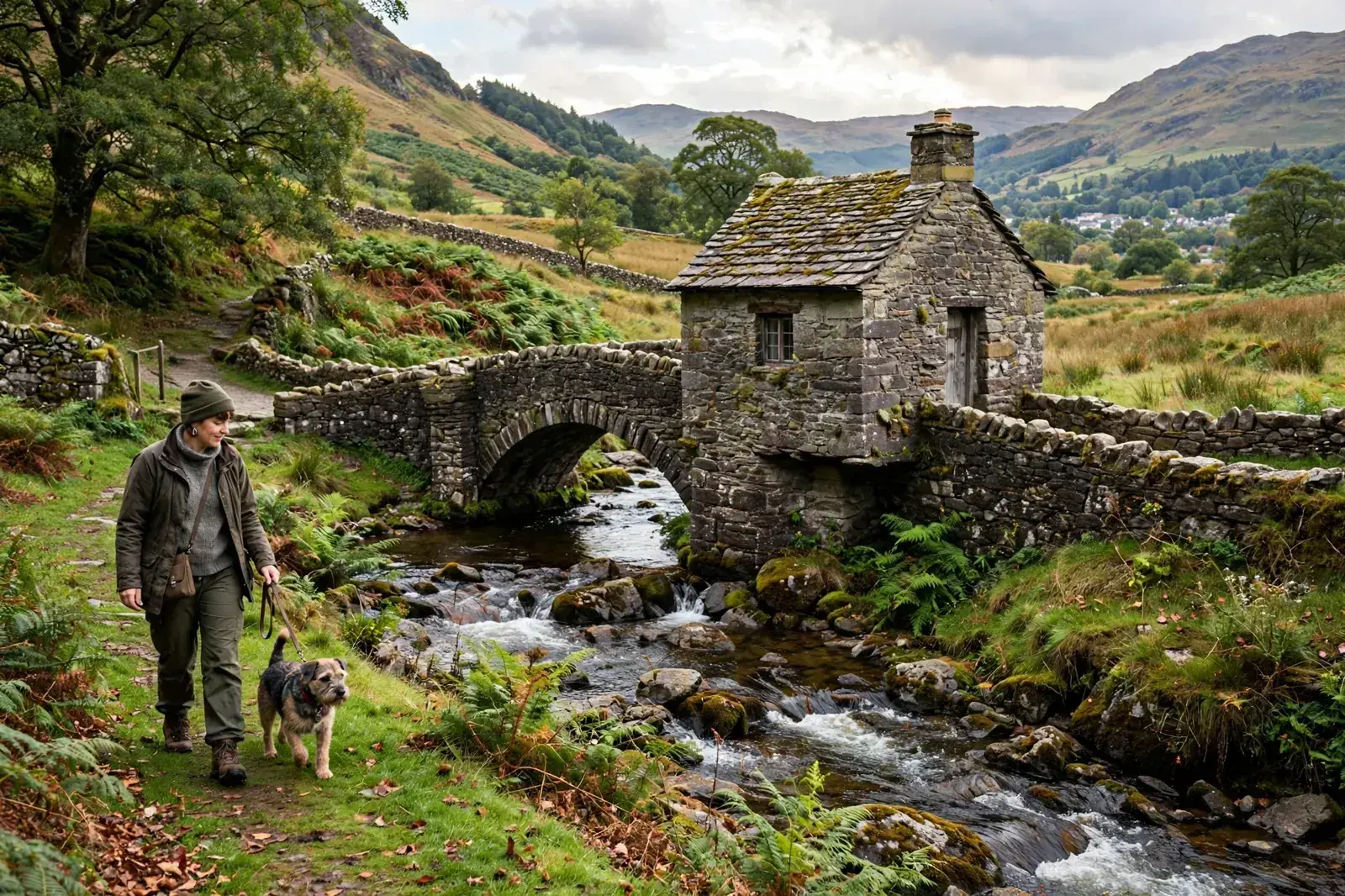
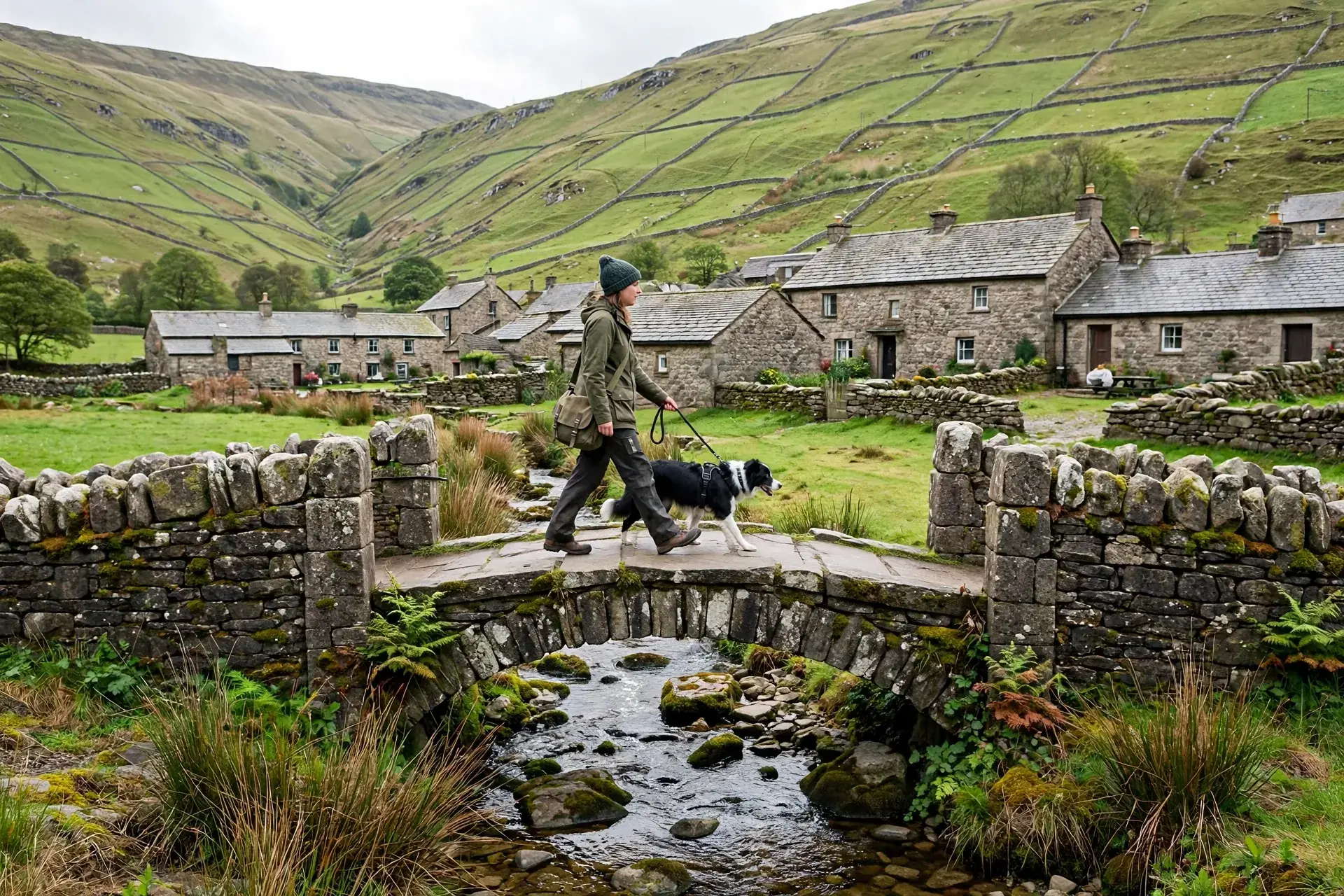
A village built around a beck
The beck sets the walking order in Kettlewell before any route choice does. Water threads between stone cottages, slips under small bridges, and fixes where a dog can pause, sniff, and step to the bank without blocking a lane. A first circuit of the village therefore works as a reading of that water: watch how fast it moves under a bridge arch, where the bank drops steeply to stone, and where a flat grass edge gives a dog a calm place to stand beside the flow. That opening loop also tells you how the dog is coping with village sound, passing walkers, and the smell of a working dale settlement, all before a longer valley line asks more of it.
Where the lane narrows beside the water, the walking line narrows too. Stone walls, cottage fronts, and bridge parapets leave little room for a dog to drift sideways, so the dog stays close at your side through those pinches and the pair moves as one unit past other walkers. Wider grass at a bridge approach or a beck-side verge gives the breathing space for a pause, a drink from a carried bowl, and a look back at the water before the next narrow stretch. Choosing those wider spots for stops, rather than halting in a pinch point, keeps the village moving and gives a nervous dog a clear view of what is coming toward it.
Bank surfaces around the village change every few steps, and that change matters more than the beck itself. A grass bank lets a dog step down, paddle at the edge, and climb out without scrambling, while a stone coping stays slick after rain and offers no easy exit if a paw slips. On a warm day, a flat grass edge with slow water at the margin suits a brief paddle, whereas a fast run under a bridge, a deep-looking pool below a drop, or a bank with no visible way back out calls for staying on the path. Towelling mud from paws after that paddle keeps the next pub doorway and the next stretch of lane in a civilised state.
Stepping stones and riverside sense
The stepping stones read as a water gauge first and a crossing second. Dry stone tops with a pale, rough surface invite a careful step, while a dark wet band around each stone, water lapping at the top edge, or a visible push of current across the line warns that the crossing has changed character. At the stepping stones and the small beck bridges, a short lead keeps dog and owner moving as a pair instead of two separate bodies trying to balance on wet stone. A confident, agile dog may step across in low, still water beside its owner, but the same stones after rain, with a smaller dog, an older dog, or a dog that hesitates at the first stone, belong to the bridge route instead.
The bridge keeps the same riverside walk without asking a dog to judge wet stone. Its deck gives steady footing, a view up and down the water, and a rejoining point with the path beyond the stones, so taking it loses no part of the valley line. Dogs that balk at the stones often walk the bridge calmly, because the surface does not move, the edges are clear, and the owner is not balancing beside them. Turning back from the stones is a route decision, not a failure of nerve, and it leaves the dog dry, steady, and ready for the meadow stretch that follows.
Below the village, the River Wharfe widens the whole question. Its channel carries more water, its banks rise higher in places, and its pace after rain alters the safety of a riverside stretch far more than the village beck does. A riverside meadow walk therefore starts with a look at the bank: a gentle grass slope down to a slow margin reads differently from a steep, undercut bank above fast water. Where the margin is shallow, slow, and easy to leave, a dog can paddle at the edge; where the water runs hard against the bank, the path itself, set back from the edge, is the walk. That bank-by-bank judgement, repeated at each new stretch, is the riverside skill Kettlewell asks for.
Arncliffe and Littondale
Leaving Kettlewell toward Arncliffe, the ground shifts from village lane to valley line in stages. The path follows the Wharfe, crosses the river, and then turns into Littondale, where the valley narrows and the walking surface moves between riverside grass, farm track, and short stretches of lane. Each surface asks a different footfall from a dog: grass forgives a long stride, a farm track firms the pace, and a lane with a hard edge needs a steady line close to the verge. Views back toward Wharfedale open as the Littondale side rises, and those widening views mark progress better than any clock.
Littondale keeps a quieter temper than Wharfedale. One road serves the valley, farms sit scattered along it, and the villages of Litton and Arncliffe stay small, with few places to refill or shelter, so water and a route plan travel with the walker rather than being found at every stop. That quiet suits a dog that prefers space to crowds, because meetings with other walkers thin out and the verges give room to pause. Farm vehicles use the single road through the day, so stepping onto the verge at the sound of an engine, and pausing at field gateways before continuing, fits the valley rhythm.
Arncliffe itself rewards the crossing with a change of scale: a small village, a green, and a stiller atmosphere after the Wharfe crossing. The return can retrace the valley line, or the walk can be cut short at the river bridge when a dog's pace shortens and its pauses lengthen, which is a sensible reading of the day rather than a shortened ambition. For a different limestone valley shape on another day, the Malham village guide describes a contrasting dale centre, but the Arncliffe line stands on its own as Kettlewell's quieter valley extension.
Starbotton and Buckden: the longer loop
Upstream from Kettlewell, the Wharfe line toward Starbotton and then Buckden stretches the valley walk into a longer proposition. Meadows give way to riverside woodland, the path bends with the river, and each small village on the way marks a bridge, a lane junction, and a natural point to judge the dog's stride. A dog that moves freely at the first meadow may shorten its stride by the woodland stretch, and that change, noticed early, sets the rest of the day: press on toward Buckden only while the stride stays even and the dog still lifts its head to new smells.
Starbotton sits as the useful midpoint of that longer line. Its bridge and lane junction offer a clean decision point, where the walker can weigh the remaining upstream stretch against the dog's energy, the state of the path underfoot, and the weather building over the valley. Turning at a midpoint with a dog still keen beats arriving at Buckden with a dog dragging, because the return still has to be walked. On a hot day, shade comes in patches along the woodland stretch and thins again on open meadow, so rest stops belong where shade and a grass verge meet, not at a fixed distance from the start.
Buckden, at the head of the valley, closes the longer loop with a village green and a sense of arrival that makes the upstream effort legible. The return choice belongs at Buckden, made while the dog is still in front of you: the opposite bank for variety, or the same path back for familiarity and a known surface. A tired dog benefits from the known surface, because every bridge, gate, and lane junction on the way back has already been read once. Ending the loop with a dog still willing to walk the village beck is the measure of a well-judged Buckden day.
Great Whernside: an honest approach
Great Whernside rises above Kettlewell as a slope problem before it becomes a summit question. The lower fell-side starts as grass, firms into rougher ground as the gradient steepens, and then opens onto exposed high ground where wind finds no shelter and the path offers no easy turn. Reading that gradient in stages gives the dog a fair test: a free stride on the lower grass, a shorter, more deliberate stride as the slope bites, and a clear decision point where rough ground and rising wind meet. A dog that already shortens its stride on the lower slope has answered the summit question without needing to reach the top.
Most Kettlewell visitors get the better fell experience by stopping partway up. The fell-side walk delivers height, open air, and a wide view back over Wharfedale without the sustained climb and the exposed top, and the return follows a slope the dog has already learned on the way up. Turning where the ground roughens, or where wind begins to push at the dog's coat, keeps the descent as a controlled walk rather than a tired scramble. The fell stays where it is for a fitter day and a calmer forecast, while the valley walks below remain the reliable alternative.
On a steep fell-side, the way a dog is connected to its owner matters more than on flat meadow, because a downhill pull or a sudden sidestep on rough ground moves both bodies at once. A harness that fits snugly across the chest and stays put when the dog leans into a slope gives a steadier connection than a loose fit that slides as the gradient changes, which is why choosing a hiking harness for dogs deserves a read before a Whernside attempt. Fit it at home, test it on the village beck bridges and the lower fell-side grass, and only then trust it on rougher ground, where adjustment with cold hands and a restless dog is nobody's idea of a good pause.
Pubs, cafes and village manners
Kettlewell's pubs and cafes meet a valley walker at a particular moment: muddy paws, a tired dog, and a need for a table where the dog can settle out of the doorway traffic. Rooms vary, and that variation is the point to establish on arrival: which room takes dogs, how much floor space sits under a table, and whether the seating near the door will bring a stream of passing dogs past a settling one. A towel over muddy paws before entry, and a bowl of water under the table once seated, turns a wet valley return into a calm pub interval instead of a dripping negotiation with a carpet.
Seating choice follows the dog in front of you and the room in front of the dog. A sociable dog may settle in a busy bar, while a dog that watches every arrival needs a corner away from the door, its body turned toward its owner and its view of the entrance partly blocked by a table leg or a chair. Ordering once the dog has lain down, rather than while it is still scanning the room, sets a calmer meal, because the dog learns that the table means rest. If barking starts at a passing dog, a short step outside for a quiet village lane pause resets the dog better than a longer stay that tightens with every new arrival.
Evening meals ask for the same room question at booking time, stated plainly when the table is reserved: the dog is coming, the room matters, and a bar table suits a dog better than a dining room that does not take them. Some rooms welcome dogs while a neighbouring dining room does not, and learning that split before arrival avoids a doorway conversation with a tired dog at your feet. A dog that cannot join an evening meal needs a plan made with the host in advance, not an improvised arrangement in an unfamiliar room, because a dog left to bark through a wall disturbs neighbours and ends the next dog-owning guest's welcome before it begins.
Parking, arrival and valley roads
Arrival in Kettlewell starts with the village car park rather than a search for a gap on a narrow street. Village streets pinch between stone fronts and beck bridges, and a car tucked into such a pinch blocks walkers, farm vehicles, and the very route a dog walker wants to use. The village car park gives a clean start: a grass edge for a first toilet break, a chance to check harness fit and footing on village stone, and a short beck-side settle before the longer valley line. On busy summer weekends the car park fills early, and a space further out simply lengthens the warm-up walk along a lane into the village.
The drive up Wharfedale deserves the same terrain reading as the walk. Valley roads narrow, bend around stone walls, and meet farm vehicles, cyclists, and walkers on the same tarmac, so passing places are used with patience and speed stays low enough to stop for a walker around a bend. Valley bus times and beck levels are the two things worth confirming locally before you leave the cottage door. Buses through Wharfedale run thinly on Sundays and in winter, and a missed connection after a long loop turns a valley day into a roadside wait, so the return plan is fixed before the outward walk begins.
A calm arrival sequence suits Kettlewell's geography: park, walk the beck at village pace, judge the water at a bridge, and only then commit to Arncliffe, Starbotton, or the fell-side. That opening beck walk doubles as a diagnostic, showing whether the dog's paws cope with village stone, whether its stride stays even on grass, and whether the water level suggests a bridge day rather than a stepping stones day. A dog that arrives straight from a car into a long valley loop skips that diagnostic, and the first sign of a sore paw or a tired stride then appears miles from the village instead of beside the beck where a shorter day was still easy to choose.
Stays, seasons and tired paws
Kettlewell stays divide by the kind of night a dog needs, and the village offers the usual dale spread: cottages, bed and breakfast rooms, pub rooms, and campsites nearby. A cottage with an enclosed garden gives a dog a safe night-time toilet area without a lane walk in the dark, while a pub room suits a dog that sleeps through village noise and footfall. A bed and breakfast room suits a calm dog that copes with other guests on a landing, and a ground-floor room with direct outside access suits an older dog whose night-time steps are slower and whose joints stiffen after a day on valley stone. Washable floors matter after a Wharfedale day, because beck mud and riverside grass travel on paws into any room.
Seasons rewrite the Kettlewell walking day without changing the village map. In spring, Littondale and Wharfedale fields holding lambs need a wide berth at field edges, with dogs kept close beside their owners and field gateways treated as pause points rather than shortcuts. Summer crowds the village and the riverside, so an early start gives a dog quieter beck banks and cooler meadow grass, while autumn thins the crowds, colours the valley sides, and shortens daylight so a late walk needs a torch for the lane home. Winter brings cold wind off the fell, icy lane surfaces, and shorter opening patterns in village rooms, so a winter day is planned around daylight and a warm room at the end of it.
A Kettlewell week works when long and short days alternate around the beck. A Buckden loop one day and a village beck day the next lets paws recover on grass after stone and woodland track, while an Arncliffe day followed by a fell-side stroll gives variety without repeating the same gradient daily. Feeding times, bed place, and the last beck-side walk of the evening stay constant through the week, because a dog reads routine as safety in an unfamiliar cottage. With that alternation, a returning dog learns the village quickly: the bridge where the water runs fastest, the meadow where the stride lengthens, and the cottage door that means rest.
A Kettlewell walking day
A Kettlewell walking day opens on the beck, not on a map. The first village circuit judges the water at a bridge arch, the dog's stride on stone and grass, and the state of the stepping stones against the bridge alternative, and that judgement picks the day's direction. Low, still water and an even stride point toward the longer Starbotton line or the Arncliffe crossing, while high water or a hesitant stride points toward a bridge-based riverside walk and a shorter valley outing. Coffee in a village room follows that opening circuit, with the dog already settled from a real walk rather than a car ride.
Midday belongs to the valley line chosen in the morning, with rest stops at bridges and grass verges where the dog's stride can be read again. A stride that stays even through the meadow and the woodland stretch earns the Buckden continuation, while a stride that shortens at Starbotton earns a turn at the midpoint and a return on a known surface. Lunch in a village room or back in Kettlewell follows the return, with the dog sleeping under a table after a morning of real terrain, and the afternoon stays gentle by design: a beck stroll, a wander through the village lanes, or a rest at the stay while the dog sleeps off the morning.
Evening closes the day where it began, beside the beck. A final village circuit gives a last toilet break on grass, a last look at the water level for tomorrow's plan, and a calm end that helps the dog sleep through the night. For a longer stay, the days stack by terrain rather than by distance: Arncliffe for a quiet valley, Buckden for a long upstream line, a fell-side stroll for height without a summit, and a village beck day for recovery, each chosen the night before from what the previous day's ground taught about the dog. That stacking, valley by valley and slope by slope, is how Kettlewell repays a week.
Practical questions
Before you go
Can dogs cross the Kettlewell stepping stones?
Read the stones before stepping onto them. Dry, rough stone tops in still, low water may suit a confident, agile dog, but water lapping at the top edge, a dark wet band, or a visible push of current means the bridge route instead. Older dogs, smaller dogs, and dogs that hesitate at the first stone also belong on the bridge, which keeps the same riverside walk. Lifting a wriggling dog over wet stone tops adds a second balance problem, so the bridge is the better choice whenever doubt appears.
Is the walk to Arncliffe suitable for older dogs?
The Arncliffe line suits many older dogs because it is a valley route with a clean shortening point. Taken slowly, with pauses at bridges and grass verges, it gives riverside grass, a river crossing, and a quieter Littondale stretch without a sustained climb. The river bridge marks the turn if the stride shortens, pauses lengthen, or the dog starts to lag on lane sections. Turning there, and walking back on a known surface, leaves the dog keen for the next village day instead of exhausted by a finished circuit.
Is Great Whernside suitable for dogs?
Great Whernside suits only fit, healthy dogs with experienced owners and settled weather, because the climb is sustained, the upper ground is rough, and the top is exposed to wind with no shelter. A dog with stiff joints, breathing difficulty, or a short stride on the lower slope has already shown that a summit attempt is unwise. Most visitors enjoy the fell-side walk partway up instead, which gives height and a view over Wharfedale without the exposed top, and the descent follows a slope the dog has learned.
Where should I park in Kettlewell with a dog?
Use the village car park rather than a gap on a narrow village street, where a parked car blocks walkers and the beck-side route itself. Arrive early on busy summer weekends, when the car park fills and a further space lengthens the lane walk into the village, which doubles as a warm-up for the dog. Once parked, take a grass-edge toilet break and a short beck-side settle before the main walk, so the dog starts the valley line calm and the village streets stay clear for everyone using them.
Are dogs welcome in Kettlewell pubs?
Many Kettlewell pubs and cafes welcome dogs, but the welcome varies by room and season, so the room question comes first on arrival and at booking time. State when reserving that the dog is coming, ask which room takes dogs, and settle the dog under the table with water. A corner away from doorway traffic suits a dog that watches arrivals, while a sociable dog may settle happily in a busier bar. A towel for muddy paws before entry keeps a valley return welcome in a carpeted room.
Is Kettlewell a good base for a Wharfedale break with a dog?
Yes, for walkers who like valley walking with several lines from one door. Kettlewell gives a beck stroll in the village, a stepping stones and bridge riverside walk, the Arncliffe and Littondale crossing, the longer Starbotton and Buckden upstream loop, and a fell-side walk toward Great Whernside, all without moving accommodation. That spread lets a week alternate a long upstream day with a quiet Littondale day and a short beck day, so the dog's stride, rather than a new base, sets the pace of the break.