This guide is independent and contains no paid placement. Venue dog rules change, so where this guide flags a check, please confirm the latest official information before you travel.
What can a dog actually do in Skipton? Start with the honest answers: a dog can walk the Leeds and Liverpool Canal towpath, explore Skipton Woods on a lead or long line, and work the outdoor market early on a short lead — but a dog generally cannot tour inside Skipton Castle. Build the day around canal, woods and town edges, treat the castle as a split or people-only visit, and use Skipton as a practical Gateway to the Dales base rather than pretending every attraction welcomes dogs everywhere.
What can a dog actually do in Skipton? Start with the honest answers
Can your dog go everywhere you go in Skipton? No — and knowing that before you arrive is what turns a potentially frustrating day into a good one. Can your dog have a full, varied and genuinely enjoyable day here anyway? Yes, easily, provided the plan starts with water and woodland rather than with the castle doorway. Skipton is a compact market town at the southern edge of the Yorkshire Dales, often described as the Gateway to the Dales, and its dog-friendly strengths are outdoors: a canal towpath that leaves the centre in both directions, an ancient woodland tucked behind the castle, a broad High Street with an outdoor market, and field and riverside walking within easy reach of the town.
So ask the questions in the right order. First: where will the dog walk properly, not just relieve itself between attractions? In Skipton the answers are the towpath for flat, steady mileage, the woods for shade and sniffing, and the quieter streets and green edges for short loops. Second: where will the dog wait while humans do human things? Not in a car, ever, and not tied up outside a shop in a busy street if that can possibly be avoided. The honest options are a split visit, where one person stays with the dog, a dog-friendly café or pub garden you have confirmed on the day, or back at accommodation where the rules genuinely allow a settled dog to rest. Third: what will you skip without regret? For most dog owners that is the castle interior on this trip — interesting, well preserved and, for a dog, simply not available.
That question-led approach also helps with timing. Skipton changes character through the day and through the week. Market days fill the High Street, weekends fill the canal basin, and a sunny Saturday can make the centre feel much smaller than the map suggests. Early starts solve most of it. A dog walked on the towpath before the town wakes up can cope with a short market browse afterwards. A dog taken straight from a car into a crowded High Street, past food stalls, other dogs and a brass-band level of noise, has been set an unfair test. The sections that follow take each part of the day in turn — castle honesty first, then the canal, the woods, the market, food, the wider Dales and the practicalities of staying — so you can assemble the version of Skipton that fits the dog in front of you.
Skipton Castle: inside, outside and the woods are three different questions
Skipton Castle dominates the top of the High Street, a remarkably well-preserved medieval fortress with gatehouse, towers and a long history as a northern stronghold. It is also the place where dog owners most need a straight answer rather than a hopeful one. Dogs are generally not admitted inside the castle itself, other than assistance dogs. Do not plan on carrying a small dog in, tucking a dog into a bag, or assuming that a quiet weekday will produce an exception at the ticket desk. Treat the interior — the rooms, exhibitions and enclosed historic spaces — as a people-only visit, and check the official latest guidance before you go, because access arrangements, opening patterns and any rules for outdoor areas can change.
The grounds-versus-interior distinction matters, and it is where vague round-ups often mislead. Even where a historic site allows dogs in some outdoor areas, that permission never extends automatically to interiors, shops, tearooms or every courtyard, and conditions can be different again on event days. If any part of a castle visit matters to your plan, confirm that specific part on the official site for your date rather than relying on a general statement that a place is dog friendly. Our guide to English Heritage sites and dogs explains the same pattern nationally — grounds, interiors and assistance-dog rules are separate questions — although you should always use the individual property's own official information for the final decision, since Skipton Castle is managed on its own terms.
What, then, are the workable options? For two or more adults, the split visit is the cleanest: one person tours the castle while the other takes the dog into Skipton Woods behind the castle or down to the canal, then you swap or reunite for food in town. Timed honestly, the dog's share of that arrangement is arguably the better half. For a solo traveller with a dog, the honest choice is usually to admire the gatehouse and the castle's presence over the town, give the dog the woods and towpath instead, and save the interior for a trip without the dog. That is not a failure of planning. It is planning.
One rule sits above every version of this section: never leave a dog in a parked car while you tour the castle. Not in shade, not on a cool-looking morning, not for a shortened visit. Cars heat unpredictably, castle visits expand, and no historic interior is worth that risk. Equally, do not tie a dog outside the entrance and go in — a busy pavement at the top of a market town's main street is no place for an unattended dog, however steady that dog usually is. If nobody in your party wants to miss the interior, the correct answer is to rearrange the day, not to improvise storage for the dog.
The Leeds and Liverpool Canal towpath: the town's easiest good walk
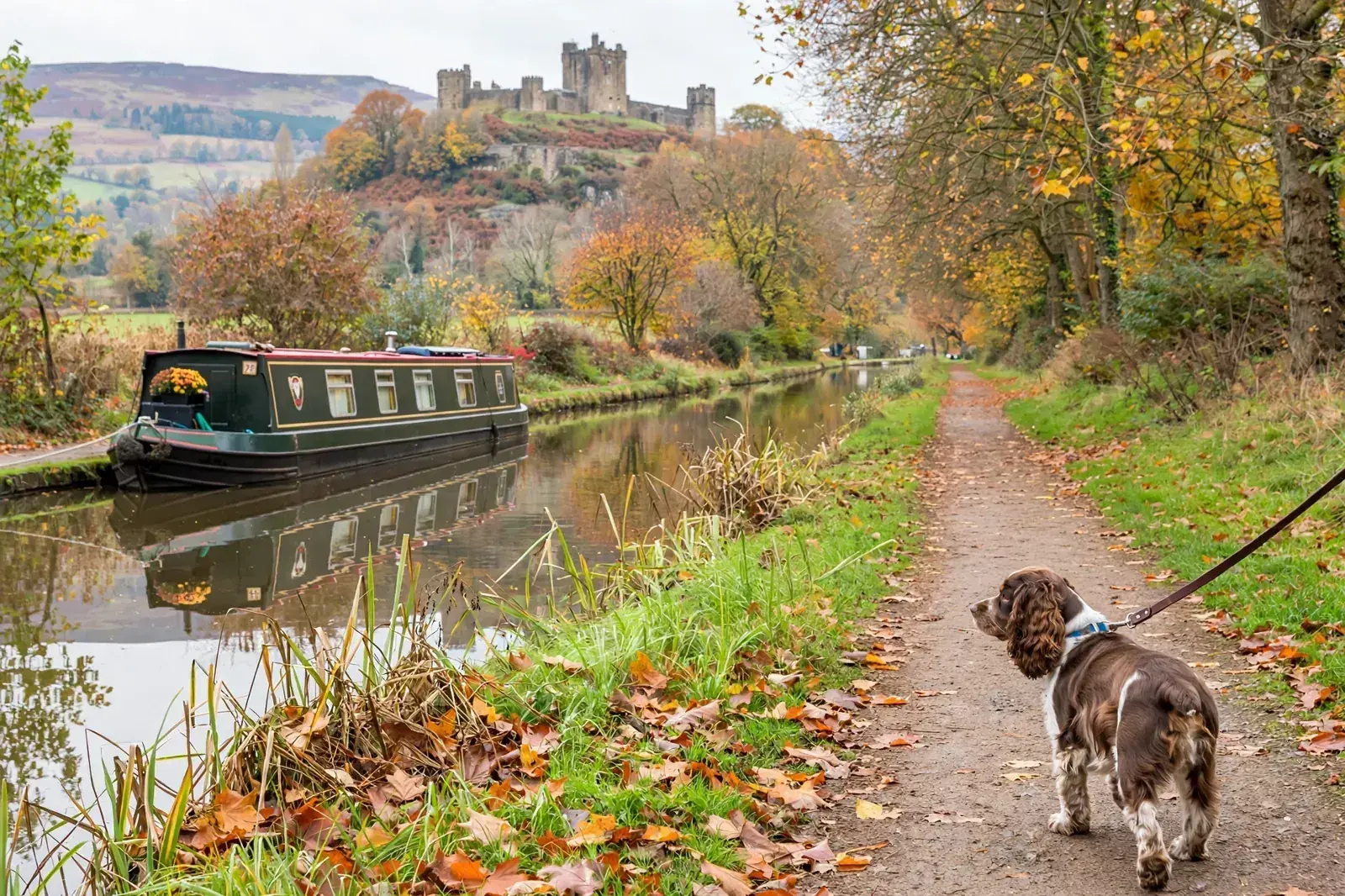
If the castle is Skipton's no, the canal is its clearest yes. The Leeds and Liverpool Canal runs through Skipton, with a basin and moorings close to the centre and a short branch, the Springs Branch, heading towards the castle side of town beneath the woods. The main towpath gives dog owners what towns so often lack: a level, traffic-free, easy-to-follow route that starts in the middle of things and keeps going for as far as legs and daylight allow. You do not need a map to enjoy an hour on it, you do not need to drive to a trailhead, and you can turn back at any bridge when a young, old or tired dog has done enough.
Choose your direction by mood and time rather than by ambition. Walking out of town in either direction, the towpath settles quickly into a rhythm of water, hedgerows, fields, moored boats and swing or lift bridges, with the Dales hills beginning to frame the views. Short out-and-back walks suit arrival and departure days. Longer walks need the usual towpath honesty: a canal is a straight line, so every mile out is a mile back, there may be no shortcut to a road or café when you want one, and a dog who was cheerful at mile three may be filing a formal complaint by mile six. Carry water for the dog even though you are walking beside water — canal water at boat moorings, near locks and around waterbirds is not a drinking bowl, and dogs should not be sent down steep or slippery banks to reach it.
Towpath etiquette decides whether the walk is relaxing. Keep your dog on a short lead near moored boats, locks, bridges and the basin, where space narrows, ropes and mooring pins create trip hazards, and boaters may have their own dogs aboard. Give cyclists room to pass, step to the same side consistently, and keep leads out of cycle paths across the towpath surface. Anglers need space behind them for casting, so pass on the landward side where possible and call your dog in close. Swans, ducks, moorhens and other waterbirds live along this corridor year-round and nest in spring; a dog who lunges at birds should stay on a lead the whole way, and no dog should be allowed to chase along the bank or plunge in among nesting birds and moored boats. In wet weather parts of the towpath and the grass beside it soften and narrow, so sensible footwear for humans and a towel for the dog make the return to a café or car far more civilised.
Skipton Woods: ancient shade directly behind the castle
Behind the castle, and reached from the town side near the castle and the Springs Branch canal, Skipton Woods is the town's other great dog asset — and the natural pairing with a split castle visit. This is old woodland along a beck in a steep-sided valley, with paths climbing and dropping through trees, views back towards the castle, and the particular quiet that mature woodland produces even a short distance from a busy High Street. For a dog, it offers what a towpath cannot: shade on hot days, leaf litter and earth paths for noses, and a walk that feels like countryside without leaving town.
Go in with the right expectations about terrain. Woodland paths here are not towpath paths. Expect mud after rain, exposed roots, steps and steeper sections, and places where the beck, drops and narrow paths demand attention. Keep your dog close on a lead or a long line held short at entrances, near water, on steep or narrow stretches and whenever other walkers, children or dogs are passing in single file. Follow any signs on the day about paths, closures or seasonal requests, and keep to the paths where asked — ancient woodland floors, spring flowers and ground-nesting wildlife are easily damaged by ranging dogs, and banks erode quickly when everyone invents a shortcut down to the water.
Off-lead honesty belongs in this section too. A woodland full of squirrels, birds, other dogs appearing suddenly around bends and a beck at the bottom of a slope is a demanding environment for recall, whatever a dog can do in an empty home field. If recall is not reliable around wildlife and water, this is a lead walk, and it loses nothing for that: the sniffing, climbing and exploring on a long line will tire a dog more thoroughly than a flat off-lead trot elsewhere. Puppies should do shorter versions, because steep woodland paths work young joints harder than the distance suggests, and older dogs may prefer the lower, gentler stretches near the entrances to a full circuit of the valley sides.
Practical notes complete the picture. There may be few or no bins once you leave the town entrances, so carry bags in and carry them out. After prolonged rain the beck runs faster and higher, paths become slippery and some routes may be unsuitable — turning back to the canal on those days is a decision to be proud of, not a defeat. In autumn the woods are beautiful and very muddy, in spring the wild garlic and woodland flowers reward a slow pace, and in summer the shade makes this the best midday walk in Skipton. Whatever the season, allow more time than the modest mileage implies, because a woodland walk with a dog who is reading every tree is measured in sniffs, not in miles.
Market day: browse early, keep the lead short, know when to leave
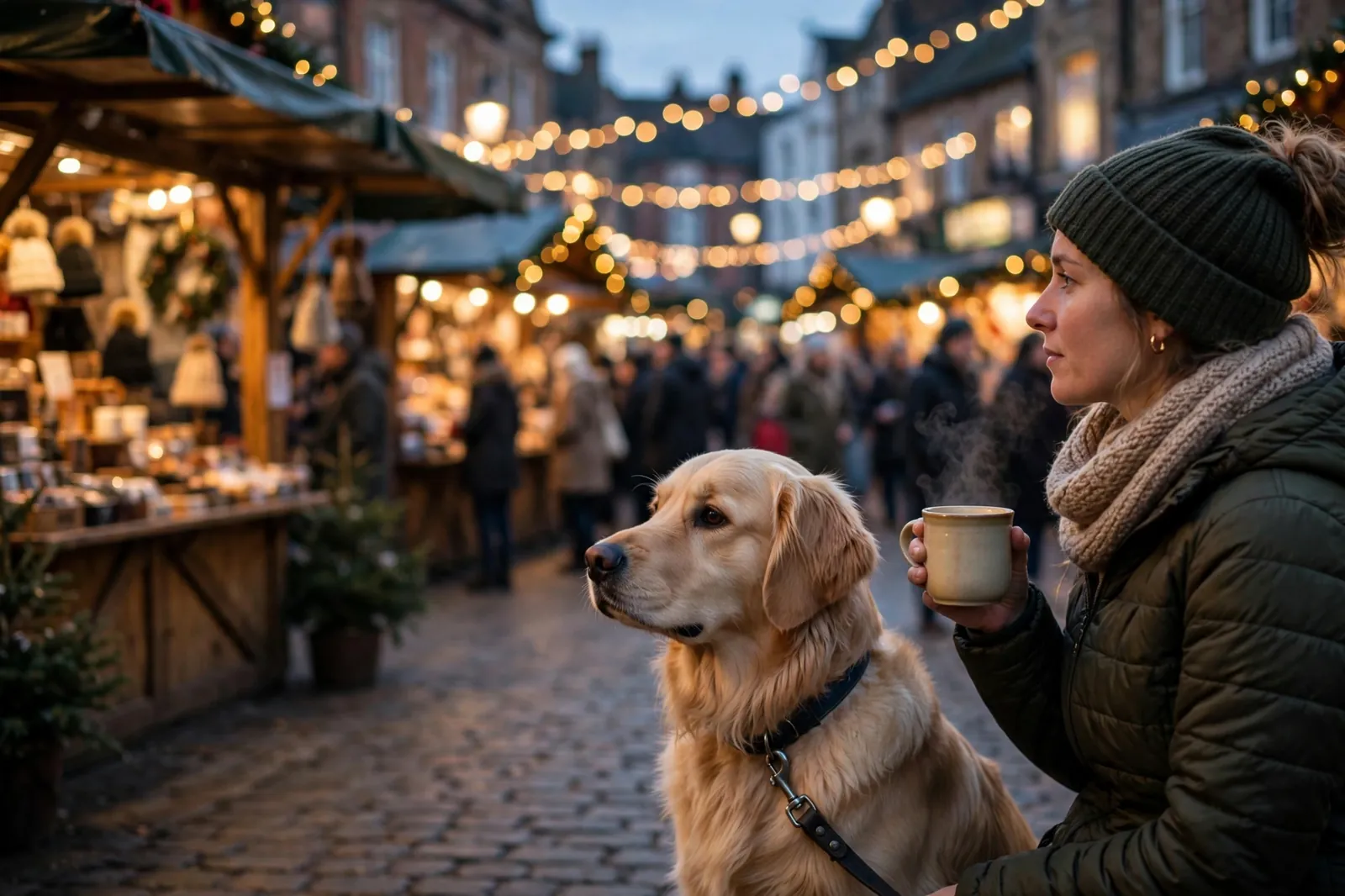
Skipton's market fills the High Street with stalls selling food, produce, clothing, household goods and local specialities, and it is a big part of the town's identity. Skipton market is traditionally held on Monday, Wednesday, Friday and Saturday, although which stalls attend, and occasionally how a given week runs around bank holidays, weather and special events, can vary — so check before you go, especially if the market is the main reason for your trip. For dog owners it is an outdoor market on a public street, which means a dog on a short lead can walk through it with you. That simple fact, however, is only the beginning of doing it well.
Our national guide to dog-friendly markets in the UK sets out the method, and Skipton rewards every part of it. Go early, when aisles are wider, shoppers are purposeful and the dog has space to understand the environment. Keep the lead genuinely short between stalls, walk your dog on the side away from the busiest flow, and keep moving rather than parking a dog in the middle of a crowd while you browse. Step out regularly — into a side street, down towards the canal, or to the quieter top or bottom ends of the High Street — and give the dog grass, water and a minute of doing nothing. Ten calm minutes of market followed by a break beats forty minutes of escalating crowd work every time.
Watch the ground, not just the stalls. Markets concentrate dropped food at exactly dog height: chips, pastry, cooked meats, cake, and around bins and food stalls, worse. A reliable leave-it is the most valuable skill a market dog can own, and a committed scavenger may honestly be better walked on the towpath while a human does the shopping. Be considerate to traders as well. Stallholders set the terms at their own stalls, shops on the High Street set theirs independently, and food premises may not be able to admit dogs beyond assistance dogs. Ask before stepping inside anywhere, accept a refusal cheerfully, and never let a dog investigate produce displayed at ground level. A market town that welcomes dogs does so because most visiting dogs are unobtrusive; every owner is spending or saving that welcome for the next one.
Town streets, cafés and pubs: a compact centre that needs a plan
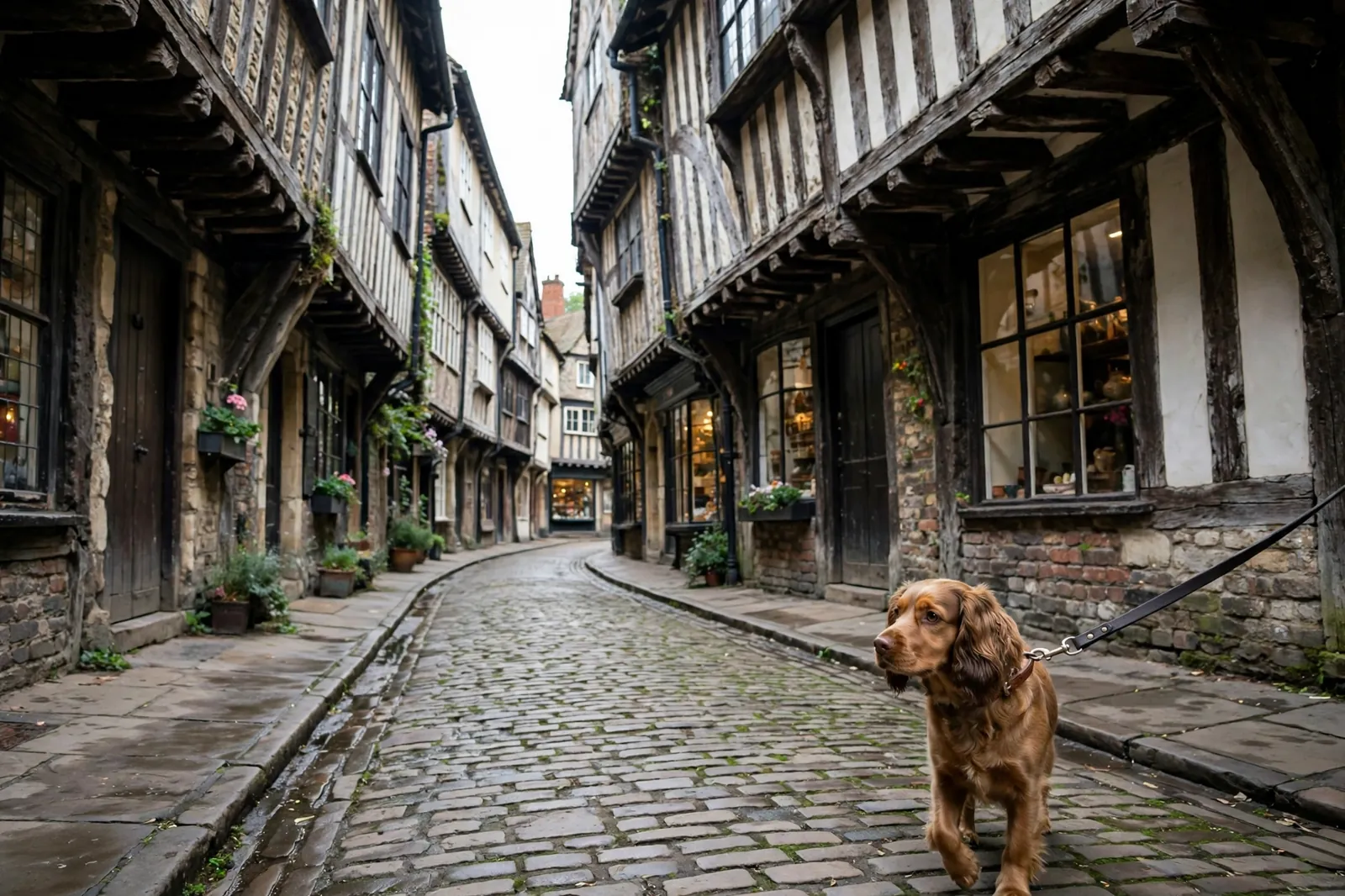
Beyond the market, central Skipton is a dog-friendly town in the practical, unglamorous sense that matters: short distances, plenty of independent shops and cafés to ask at the door of, pubs with gardens or bar areas in many cases, and green and waterside escape routes never more than a few minutes away when the centre gets too much. The High Street itself is broad by market-town standards, with the castle at its top end and the canal a short walk from its lower streets, so a town-centre hour can be broken into pleasant segments rather than endured as one crowded block.
Eating and drinking follow the same rules as in every town in this series, because individual businesses — not the town — decide dog policy. Some cafés and pubs welcome dogs inside, some in a bar, snug or garden only, some at outdoor tables, and some food premises cannot admit dogs at all beyond assistance dogs. Policies also change with ownership and with how busy a day is. The reliable routine is to look for signage, ask before settling, keep the dog on the floor and out of walkways on a short lead, offer your own water bowl discipline rather than letting a dog drink from glasses or investigate neighbouring tables, and leave a place cleaner and quieter than you found it. Mud is understood in a Dales town after a wet walk, but a towel-down at the door and keeping a wet dog off soft furnishings are courtesies that keep doors open.
Two town-specific cautions are worth adding. First, market days transform pavement space: stalls, queues, shoppers with bags and delivery activity compress the walking line, so a dog who struggles with close passing should do town errands on a non-market morning or early before the crowds build. Second, the streets around the canal basin and the station side of town carry more traffic and more visitors moving between car parks, boats and trains, so keep the lead short and your attention up at junctions, car park entrances and the swing-bridge areas where people, bikes and vehicles meet in a small space. Small towns feel safe, and mostly are — but they reward the same road discipline as a city, in miniature.
Gateway to the Dales: using Skipton as a base, not just a stop
Skipton's nickname — Gateway to the Dales — is a planning instruction as much as a slogan. From a base here, a dog holiday can mix easy town days with bigger country days in the southern Yorkshire Dales: valley villages, riverside paths, limestone country and market towns are all within the sort of driving or bus distance that suits a short break, and returning each evening to a town with shops, vets, cafés and a canal for the last walk of the day is a genuine practical advantage over a remote cottage with none of those things. If you are combining Skipton with a historic city day on the same trip, our guide to York with a dog makes a useful contrast: York is a full city day of walls and riverside crowds, while Skipton works best as the slower base that absorbs the days either side of bigger excursions.
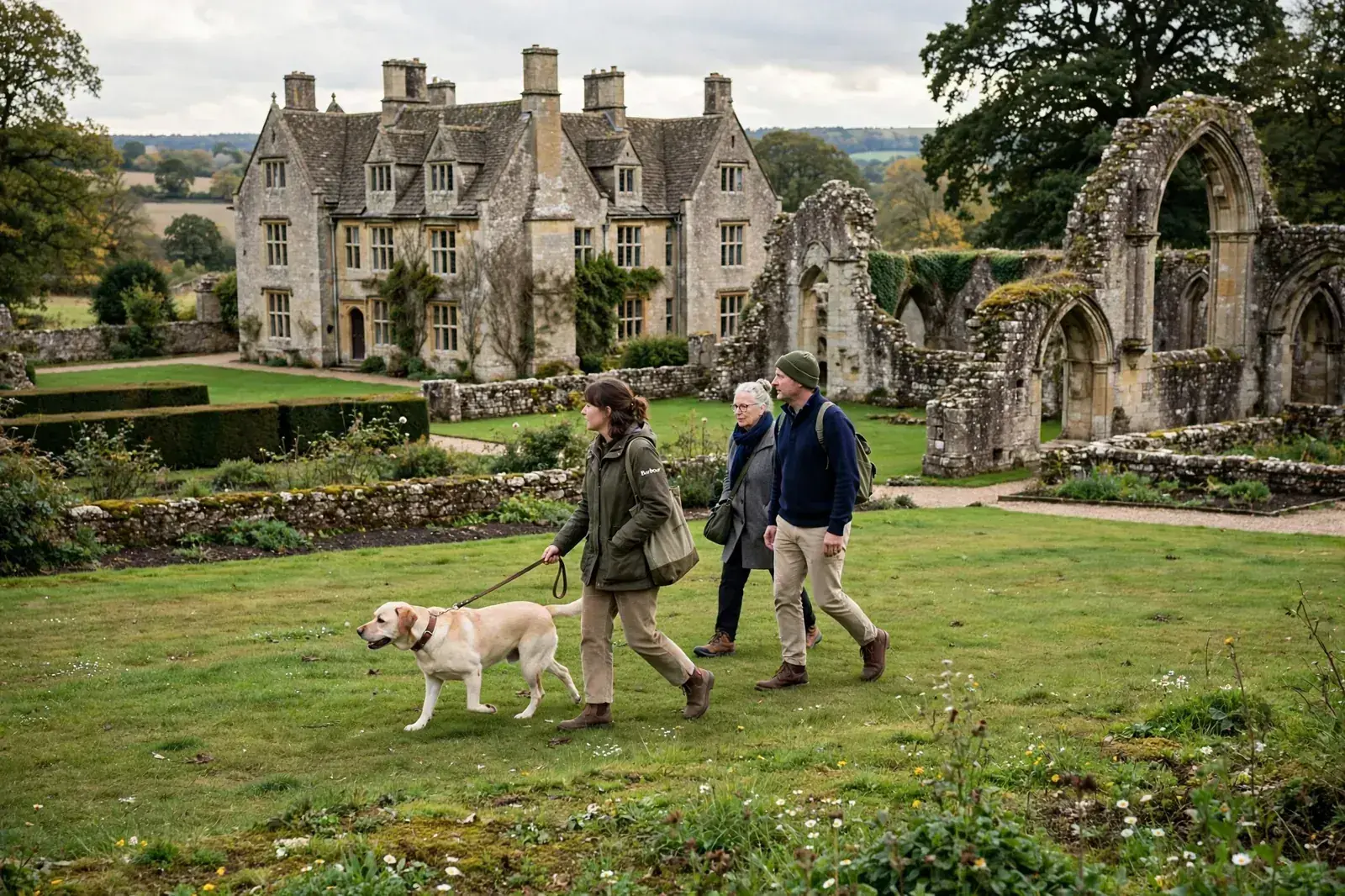
Build the week in layers. Use Skipton itself for arrival day, a market morning, a rest day and a wet-weather day — the canal and woods can absorb a surprising amount of a holiday without repetition if you vary direction, length and time of day. Save the bigger Dales walks for settled weather and a rested dog, and research each one individually rather than assuming that a national park welcome extends to every path, farm and attraction in the same way. Estate villages, abbey ruins, show caves, waterfalls and country houses across the wider area all set their own dog rules, and several of the most famous involve livestock-heavy parkland, steep ground or interiors where dogs cannot go. Check the official latest guidance before you go for any specific attraction, and keep the split-visit and no-dog-in-car rules from the castle section in force everywhere.
The base-camp logic also helps older dogs, puppies and dogs in recovery, who are often the reason a grand touring holiday fails. From Skipton, a dog who wakes up stiff can have a flat towpath day while fitter members of the party take a hill day, and nobody has wasted a booking. A young dog overwhelmed by a big walk on Tuesday can have a woods-and-town Wednesday and be ready again by Thursday. Holidays planned from a flexible base bend; holidays planned as a chain of non-negotiable big days break. Skipton, usefully, bends.
Leads beyond the town: sheep, rivers and Dales law
Step outside Skipton's streets and the landscape becomes working farmland very quickly, which means the lead rules tighten from courtesy to legal duty. Sheep graze the fields around the town, along the canal corridor in places, beside the rivers and throughout the dale bottoms, and cattle graze in rotation on many of the same pastures. Keep your dog on a lead or under the closest possible control around livestock at all times, and assume there are animals beyond every wall and hedge even when the field in front of you looks empty. Our guide to dogs on leads and the law in the UK sets out the duties in full, including the protection the law gives farmers and the responsibilities it places on anyone walking a dog through grazing country.
Rivers and becks need the same respect as the fields beside them. The waterways around Skipton — the becks in the woods and the wider river valleys of the southern Dales — run clear and inviting in summer and fast, cold and dangerous after rain. Let a dog paddle or swim only where access is legal, safe and free of anglers, nesting birds and livestock, enter and exit by a gentle bank rather than a drop, and skip the water entirely when levels are up or the current is visibly strong. Keep dogs away from fishing tackle, out of troughs, and off private banks where signs ask you to stay on the path. Adders are present in suitable rough, sunny habitat in parts of the wider Dales in warm months, so keep dogs out of long grass and bracken edges on hot days and know where your nearest veterinary practice is before a long walk, not during one.
Seasonal ground-nesting birds complete the picture on the higher and rougher ground beyond the town. Between early spring and late summer, follow any signed requests or requirements for short leads in sensitive areas exactly as written, keep to paths, and give alarm-calling birds a wide berth. Close every gate as you found it, take every poo bag back to a bin in town or at a trailhead, and remember that in this landscape you are a guest in a workplace. The lead, the closed gate and the carried bag are the whole contract — and Skipton's surrounding farmers and land managers host enormous numbers of visiting dogs each year on exactly those terms.
Stays, parking and getting there: Gateway practicalities
Staying in Skipton suits dog owners who want facilities on the doorstep. The town and its surrounding villages offer inns, hotels, bed and breakfasts, self-catering cottages and apartments, with campsites, caravan and holiday parks in the wider area. As always, dogs welcome is a headline rather than a detail, so confirm before booking: how many dogs are allowed, whether there is a per-dog or per-stay charge, whether dogs may be left alone in the room or property and under what conditions, whether dogs are allowed in dining areas or only in a bar or garden, and what the flooring and furnishing rules are. Most importantly for daily life, ask where the nearest sensible late-night and early-morning toilet walk is. In Skipton the canal, the woods entrances and quieter residential streets give most bases a workable answer, but a town-centre room above a busy street needs a different routine from a cottage with a walled yard.
Garden and yard security deserves a specific question in Dales properties. Stone walls look absolute and often are, but gates open onto lanes, walls have low or broken sections, and a garden that safely contains a settled adult dog may not contain a young dog who has seen a cat on the other side. Check before you rely on any outdoor space off lead, keep the first explorations on a long line, and bring your own bedding, towels, throws and a drying layer — a dog who has done the woods and the towpath in October will need all of them, and hosts who provide a hose, tap or boot room should be treasured and told so.
Day visitors should plan parking and arrival as carefully as the walks. Skipton has pay-and-display and other car parks in and around the centre, and the busiest — on market days, sunny weekends, bank holidays and during town events — can fill early. Charges, time limits, payment methods and any height or size restrictions change, so read the signs and operator information as they stand when you arrive rather than trusting figures in any guide. The town also has a railway station with services towards Leeds, Bradford and the Settle–Carlisle direction, which makes a car-free dog day or stay feasible for some visitors — check current timetables, dog travel rules with the operator and the walk from the station to the canal and centre before relying on a particular train. And repeat, one final time, the rule that outranks every parking decision: a dog never waits alone in a parked car in Skipton, whatever the season appears to promise when you lock the door.
A one-day plan that asks the right questions first
Put the honest answers together and a good Skipton dog day builds itself. Start early on the canal, before the basin and towpath fill, and walk out of town for a defined time rather than a defined distance, turning back while the dog is still fresh. Return through town while the market is still setting up or just opening if your day is a market day, browse early on a short lead with a break partway through, and buy anything bulky at the end rather than carrying it past every stall twice. If the castle interior is on the human list, this is the moment for the split visit: castle for one party, Skipton Woods for the dog party, meeting afterwards with both sides feeling they got the better deal.
Give the middle of the day to the slower Skipton. A café or pub that has confirmed it welcomes your dog, a takeaway eaten by the canal away from the busiest moorings, or a rest back at your base will reset a dog who has done crowds and woodland in the same morning. Follow it with the woods if you have not yet been, choosing the gentler lower paths for a tired dog, or a second, shorter towpath stretch in the other direction for a dog who still has miles left. Resist squeezing in a major Dales excursion on the same day as a full town programme; Skipton rewards being done properly at town scale, and the Dales will still be there tomorrow, which is rather the point of using the town as a gateway.
Finish as the town empties. Market stalls pack away, day visitors leave, boats settle on their moorings and Skipton becomes a Dales market town again rather than an attraction. A last slow circuit — High Street, castle view from outside, canal basin and back — with a settled, tired dog is the version of Skipton that regular visitors aim for. The town has not asked anything unreasonable of you: a lead in the right places, honesty about the castle, respect for boats, birds, traders and sheep, and no dog left in a car. In return it gives you one of the most flexible, forgiving and repeatable dog days in Yorkshire.
Practical questions
Before you go
Can dogs go inside Skipton Castle?
Generally, no. Dogs are not generally admitted inside Skipton Castle itself, other than assistance dogs, and arrangements for any outdoor areas can change. Treat the castle interior as a people-only visit, plan a split visit or a dog walk in the woods or on the canal instead, never leave a dog in a car, and check the official latest guidance before you go.
Can dogs walk the Leeds and Liverpool Canal towpath in Skipton?
Yes. The towpath through Skipton is a shared-use path where dogs are welcome, but keep your dog on a short lead near boats, locks, bridges, cyclists and other towpath users, and well away from swans and nesting waterbirds. The surface is mostly level, but it can be narrow, muddy after rain and busy near the canal basin at weekends.
Is Skipton market dog friendly?
The market is outdoors on the High Street, so a dog on a short lead can walk through with you, but it is busy, narrow and full of dropped food at peak times. Skipton market is traditionally held on Monday, Wednesday, Friday and Saturday, although stalls and days can vary, so check before you go. Visit early, keep moving, and step into a side street or head for the canal when your dog needs space.
Can dogs go off lead in Skipton Woods?
Keep the lead decision honest and local. Skipton Woods is a working ancient woodland with steep, muddy paths, a beck, wildlife and other walkers, so many dogs are best kept on a lead or a long line, especially near water, entrances, steep drops and in the spring nesting season. Follow any signs on the day, keep your dog on the path where asked, and recall must be reliable before any off-lead freedom is considered.
Is Skipton a good base for the Yorkshire Dales with a dog?
Yes, if you choose the base carefully. Skipton has town-centre stays, inns, bed and breakfasts, cottages and sites in the surrounding area, plus a canal, woods and market on the doorstep for easy days. Confirm how many dogs are allowed, any charges, whether a dog can be left alone, garden security and the nearest late-night toilet walk, and check parking charges and time limits on the signs when you arrive.