This guide is independent and contains no paid placement. Beach rules, pub policies and parking charges change, so check the official guidance before you travel.
Budleigh Salterton suits dogs that like variety: a long pebble beach with no seasonal dog ban, a wildlife-rich estuary to watch from the bank, and cliff-top coast path in both directions. Come for the quieter end of the Jurassic Coast, bring water and a towel, and keep your dog on a lead near the reedbeds and the cliff edges.
The town at a glance
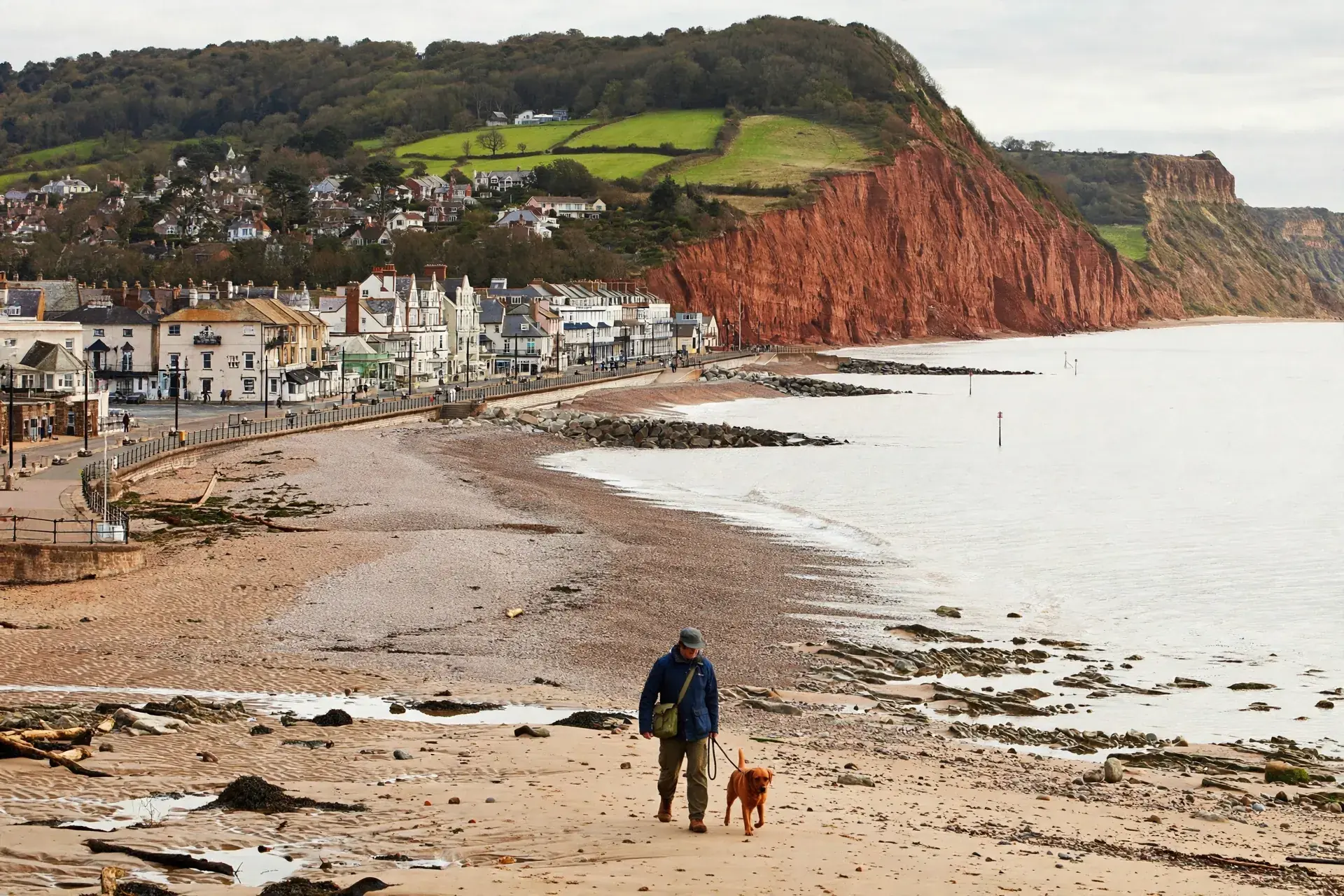
Budleigh Salterton is a small seaside town in East Devon, where the River Otter runs down from the Blackdown Hills, through Honiton and Ottery St Mary, and meets Lyme Bay at the western end of a long pebble beach. It is one of the quieter stops on the Jurassic Coast, the UNESCO World Heritage Site that runs for 95 miles from Exmouth to Studland, and it feels very different from its busier neighbours. There is no pier, no amusement arcade and no crowds of day-trippers fighting for a patch of sand — because there is no sand. Instead there is a wide sweep of smooth pebbles, red sandstone cliffs, a cricket green, a thatched museum and a High Street of independent shops that still closes early on a Sunday.
That quietness is exactly why it works so well with a dog. The town is compact enough to explore entirely on foot, the seafront is flat and level, and the best walks start from the beach rather than from a car park miles away. A dog can begin the day on the pebbles, cross to the estuary footpath for a sniff through the reedbeds, and be on the South West Coast Path climbing towards Ladram Bay before lunch. Nothing here needs a car once you have arrived, which matters when you are carrying a wet towel, a water bottle and a lead in each hand.
Budleigh Salterton sits roughly five miles east of Exmouth and seven miles west of Sidmouth, with Honiton about ten miles inland to the north. Most visitors arrive by car along the B3178 from Exmouth or the B3179 from the A3052, and the town has no railway station of its own — the nearest stations are at Exmouth and Honiton, with buses connecting both to the town. That slightly out-of-the-way position keeps the beach calm even in August, when the sandier resorts further along the coast are full. On a weekday out of season you may have a long stretch of pebbles almost to yourself, which is a rare thing on the south coast of England.
The town itself is worth a slow wander before you head for the cliffs. The High Street runs down to the seafront, lined with butchers, bakers, bookshops and cafes, and the Fore Street end leads towards the seafront green, where the cricket club plays in summer and dogs on leads are a familiar sight. The Fairlynch Museum, in a thatched cottage dating from 1811, tells the story of the town and the coast, and the seafront has a row of painted beach huts that photograph well in any weather. Everything is on a human scale: a dog that is nervous in busy towns will find Budleigh Salterton far easier than a resort with a funfair and a queue for everything.
The pebble beach: what dogs (and paws) need to know
The beach at Budleigh Salterton is the town's defining feature, and it is made of pebbles — millions of smooth, rounded stones in shades of grey, brown, rust and cream, washed down over millennia and tumbled by the sea. Geologists know them as the Budleigh Salterton Pebble Beds, a Triassic formation roughly 250 million years old, and the same hard quartzite pebbles turn up in the red cliffs that frame the bay. For a dog, the practical meaning is simple: this is not a beach for digging holes or for a soft landing. The stones shift underfoot, they are uneven, and they make a particular rattling sound as the waves pull back through them — a sound that startles some dogs the first time they hear it.
Most dogs adapt quickly, but plan the first visit with care. Walk down to the waterline on a lead and let your dog test the surface before you let them off. Older dogs, dogs with sore joints and small breeds with short legs often find the steep, loose shingle tiring, because every step sinks slightly and the slope near the water is steeper than it looks. A fit spaniel or collie will bound across it happily; a stiff-legged terrier may prefer the flatter, firmer pebbles near the top of the beach, close to the sea wall and the promenade. Watch for limping in the first ten minutes and be ready to turn back — a dog that overdoes it on pebbles will feel it the next morning.
Heat is a real consideration in summer. Pebbles absorb the sun and can become uncomfortably hot for paws by mid-afternoon on a clear July day, even when the air feels mild. There is almost no shade on the open beach, and the nearest drinking water is whatever you carry, so bring a bottle and a collapsible bowl and offer water every twenty minutes in warm weather. A dog that is panting hard and seeking the shade of a beach hut is telling you it is time to move to the estuary path, where the trees and reedbeds give cover, or back into town for a drink.
Swimming needs the same caution you would give any open coast. The beach shelves steeply, the water deepens fast, and Lyme Bay can carry a strong pull even on a calm-looking day. Some dogs will paddle happily at the edge and never go further; others will charge straight in after a ball. Keep throws short and parallel to the shore rather than far out to sea, and do not let a dog swim after a ball that has drifted beyond the break. If your dog is a keen swimmer, a buoyancy aid is worth packing, and a long line gives you a way to call them back without wading in after them. After a swim, rinse salt and grit off at the nearest tap or with fresh water from your bottle, because pebbles and sand trapped between the toes can cause sore paws by the evening.
The other pebble habit to watch is stone-eating. Some dogs, especially puppies and young retrievers, pick up pebbles and carry them, and a few will try to swallow them. A swallowed pebble can block a dog's gut and needs a vet, so if your dog is a stone-carrier, keep them on a lead on the beach and swap every pebble for a toy or a treat the moment they pick one up. A ball on a rope or a floating toy is a safer beach game than a stick, which can splinter, or a stone, which can break a tooth. Poo bags are essential here too: the pebbles hide mess well, which is no excuse for leaving it, and there are bins along the seafront and at the Lime Kiln end of the beach.
One of the best things about Budleigh Salterton beach is that dogs are generally welcome on it all year round, without the seasonal bans that close several other East Devon beaches to dogs in summer. That makes it a reliable choice in July and August, when many owners are hunting for somewhere their dog is still allowed. Rules can change, and local restrictions are set by the district council, so check the official guidance before you travel, and keep your dog under close control near families, anglers and other beach users on busy days. Early morning and evening are the calmest times, and the low winter sun on the red cliffs makes a late-afternoon walk in January feel like a private beach.
The River Otter estuary and nature reserve
At the western end of the beach, the River Otter slips into the sea through a wide, reed-fringed estuary that is one of the most wildlife-rich corners of East Devon. The lower Otter valley is a Site of Special Scientific Interest and a nature reserve, and the mix of salt marsh, reedbed and mudflat draws wading birds through the year: little egrets standing in the shallows, curlews calling over the marsh, redshanks picking through the mud at low tide, and kingfishers flashing along the river in winter. It is a place for slow looking, and it rewards a dog walk that stops often rather than marching straight through.
The main estuary footpath runs inland from the beach along the eastern bank of the river, on a flat, easy surface that suits dogs of all ages and owners with pushchairs. From the path you can watch the tide come in across the mudflats and see the reedbeds change colour with the seasons — green and dense in summer, gold and rustling in autumn, flattened and silvered after a winter storm. There is a bird hide and viewing points along the way, and the path eventually crosses the river on a footbridge, giving you a loop back towards the town or onwards into the Otter valley. The whole circuit is gentle, sheltered from the wind that can bite on the open beach, and a good choice on a wet or blustery day when the cliff path would be miserable.
Dogs and the estuary need a clear agreement. The reedbeds and mudflats are a protected habitat, and the birds that feed there in winter have flown thousands of miles to reach it — a single dog charging through the reeds can undo a morning's feeding in seconds. Keep your dog on a lead along the estuary path, and never let them into the reedbeds or onto the mudflats. The mud itself is a hazard as well as a habitat: it is deep, sticky and deceptively soft in places, and a dog that runs onto it can get stuck or lose a shoe, a lead or its nerve. If your dog does get muddy, rinse them with fresh water afterwards, because estuary mud dries like concrete in a coat and can irritate skin.
The estuary is also the place to teach a young dog that not every walk is about running. The path is rich in smells — river water, salt marsh, rotting seaweed, the tracks of birds and voles — and a dog on a long line can spend a happy half-hour working through them at its own pace. Bring a towel for the return journey, because even a dog that stays on the path will pick up damp and mud on its legs and belly after rain. In winter, when the waders are at their most numerous, the estuary is at its best and its most sensitive: give the birds space, keep your voice low near the hide, and enjoy the fact that a quiet town beach can also be a serious wildlife site.
If the estuary whets your appetite for the river valley, the Otter runs inland through Ottery St Mary and on towards Honiton, and the valley walks further north are gentler still, through water meadows and riverside woods. Our guide to Honiton with a dog covers the market town at the head of the valley, its High Street and the Otter Valley walks that start there, and it pairs well with a Budleigh Salterton break if you want a day inland away from the wind.
Jurassic Coast walks: west to Ladram Bay, east to Sidmouth
The South West Coast Path runs straight through Budleigh Salterton, and from the seafront you can walk in either direction along some of the most distinctive coastline in England. The cliffs here are red, not white: Triassic sandstone stained rust-red by iron oxide, layered and crumbling, with the sea working at their base and the path climbing and dipping over the headlands. It is a dramatic, open landscape, and it is also an exposed one — there is little shelter once you leave the town, so check the weather and the wind before you set out, and carry water for the dog even on a short stretch.
West from Budleigh Salterton, the path climbs out of the town and follows the cliff top towards Ladram Bay, roughly two miles away. This is the shorter and easier of the two directions, and it suits a morning walk with a dog: allow about an hour each way at a relaxed pace, with time to stop at the viewpoints and let the dog sniff the gorse. The views open out quickly, back across the pebble beach to the town and then out over Lyme Bay towards Exmouth and the open sea. Ladram Bay itself is a privately owned holiday park with a sandy beach at low tide, and the red rock stacks just offshore are a landmark of this stretch of coast. Dogs need to be on a lead near the cliff edges and anywhere livestock are grazing, and the path has some steep steps and narrow sections where a short lead is safer than a long line.
East from Budleigh Salterton, the path climbs towards Sidmouth, about seven miles away along the coast. This is a full day's walk rather than a morning stroll, with several stiff climbs and descents over the headlands, and it is best attempted with a fit dog, a packed lunch and a plan for getting back — either by walking the same route in reverse, which doubles the distance, or by catching a bus back from Sidmouth to Budleigh Salterton. The rewards are considerable: high red cliffs, wide views across the bay, and the long descent into Sidmouth past the Salcombe Regis cliffs. Our guide to Sidmouth with a dog covers the town at the far end, its beach, the Esplanade and the walks that start there, so you can plan the day as a one-way walk with a bus home rather than a there-and-back.
Whichever direction you choose, the coast path rules are the same. Keep dogs on a lead near cliff edges, where a moment's distraction can be fatal, and near livestock, where sheep and cattle graze the cliff-top fields for much of the year. The path surface varies from firm grass to loose stone and mud after rain, and some sections run close to the edge with no fence, so a dog that pulls hard on the lead needs a harness and a short lead rather than an extendable one. In summer, adders can bask on the warm path edges, so keep dogs on the path and out of the long grass, and know the signs of a bite — swelling, pain and lethargy — and the route to the nearest vet. After heavy rain, check for path closures, because the soft red cliffs erode quickly and sections of the path are sometimes diverted inland.
A useful middle option for dogs that are not ready for a full cliff walk is to take the coast path west for twenty minutes, enjoy the first viewpoint, and then drop back down to the beach for the return leg along the pebbles. That gives a dog the smells and views of the cliff top without the distance, and it leaves the afternoon free for the estuary or a cafe. The coast path is not a race: the best Budleigh Salterton walks are the ones that stop, look at the sea, and let the dog decide the pace.
Walks around town: the seafront, Lime Kiln and quieter loops
Not every walk needs to be a cliff expedition. Budleigh Salterton's seafront promenade is a flat, level, paved route that runs along the top of the beach from the town centre towards the Lime Kiln car park at the western end, and it is the town's easiest dog walk — suitable for puppies, older dogs, dogs recovering from injury and owners who want a gentle evening stroll rather than a workout. The promenade has benches, bins and a low sea wall to sit on, and on a calm evening it is the place the whole town seems to drift to, dogs included.
The Lime Kiln end of the seafront is the practical heart of a dog visit. The car park there is the closest parking to the beach, the beach access is straightforward, and the estuary footpath starts nearby, so you can combine a beach walk, a stretch of the estuary path and a return along the promenade into a single easy loop of about an hour. There is a cafe at the seafront here that welcomes dogs outside, and the area is flat enough for a dog in a buggy or a wheelchair-using owner with a dog. On summer weekends it is also the busiest part of the beach, so if your dog is nervous around crowds, start your walk from the quieter eastern end of the beach instead, where the pebbles stretch away towards the cliffs and the people thin out within a few minutes.
For a longer town loop, follow the estuary footpath inland for a mile or so, cross the river on the footbridge, and return through the lanes on the far side of the valley, coming back into town past the cricket green and the church. The lanes are quiet, the hedgerows are full of smells, and the route gives a dog a mix of riverside, field edge and town pavement in a single walk. Take care on the narrow lanes, where there is no pavement and cars can appear suddenly: keep the dog on the inside, on a short lead, and wear something bright in poor light.
The town's green spaces are modest but useful. The seafront green, by the cricket ground, is a flat expanse of grass where a dog can have a game of fetch away from the pebbles, and the paths through the town are lined with gardens that smell wonderful in spring. What Budleigh Salterton does not have is a large enclosed dog field, so if your dog needs a secure off-lead run, the beach at low tide is the best option — a wide, open space where a dog can run in a straight line and you can see them the whole time. Even there, recall matters: check that your dog will come back before you unclip, because the beach is long and a dog that runs east towards the cliffs can be out of sight quickly.
Seasons, tides and safety
Budleigh Salterton changes with the seasons, and the best time to visit with a dog depends on what your dog enjoys. Spring brings the cliff-top flowers, the return of the summer birds and a beach that is still quiet before the holidays. Summer brings warmth, long evenings and the busiest beach, along with the need for shade, water and paw care on the hot pebbles. Autumn is many regulars' favourite season: the light turns golden, the estuary fills with wading birds, the crowds thin, and the pebbles are cool underfoot. Winter is wild and beautiful, with big seas, empty beaches and the red cliffs at their most dramatic — but also the strongest winds, the muddiest paths and the shortest days.
Tides shape every beach visit here. At low tide the beach is wide, the waterline is far out, and there is room for a proper run. At high tide the sea comes right up to the sea wall and the promenade, and there may be almost no dry pebbles at all, especially on a spring tide. Check the tide times before you travel — they are published for Exmouth and apply closely enough to Budleigh Salterton — and plan the long beach walk for a falling tide, when the wet pebbles are firm and the sea is retreating. Never let a dog swim or paddle near the river mouth at the western end when the tide is running, because the current where the Otter meets the sea can be strong, and a dog that is swept a few metres out will be in deep water quickly.
Weather on this coast can turn fast. A bright morning can become a wet, windy afternoon, and the cliff-top path is no place to be in a thunderstorm or a gale. Check the forecast the night before and again in the morning, and have a wet-weather plan: the estuary path, the town's cafes and the car are all better than a cliff walk in a storm. In winter, the promenade can be slippery with seaweed and spray, and the pebbles are at their most treacherous when wet, so slow down and keep the dog close. In summer, watch for the heat on the pebbles and in a parked car — never leave a dog in a car on a warm day, even with a window open, and even for a few minutes.
Wildlife safety matters here too. The estuary birds are protected, and dogs must not chase them at any time of year, but winter is the sensitive season, when the waders are feeding hard to survive the cold. Adders live on the cliff tops and heathland, and while bites are rare, they are a genuine risk in warm months. Keep dogs on the path, watch where they put their noses in long grass, and carry a phone with the number of a vet saved. The nearest vet practices are in Exmouth and Honiton, so save a number before you travel, and check the official guidance before you travel for any local notices about wildlife, algae or water quality.
Eating and drinking with your dog
Budleigh Salterton is a friendly town for a dog that wants to join lunch. Several pubs and cafes welcome dogs, usually in the bar area or on outdoor seating, and the town's relaxed pace means nobody hurries you out of a sunny spot. Along the High Street, the Sir Walter Raleigh — a Wetherspoon pub — is a reliable stop with water for dogs and a straightforward welcome, and the Feathers Hotel, at the top of the town, has long been a dog-friendly place to eat and drink. Smaller pubs and cafes along Fore Street and the seafront vary in their rules, and some welcome dogs only in the bar or only outside, so ask before you sit down and check the official guidance before you travel if a particular place matters to your plans.
The seafront cafe at Lime Kiln is a natural end to a beach walk: dogs are welcome outside, there is water to hand, and a coffee and a cake taste better with salt on your lips and a damp dog at your feet. Bring a blanket or a mat for your dog to lie on, because the ground is concrete and pebbles rather than carpet, and a tired dog will settle far better on something familiar. If you are eating inside a pub, choose a table near the door rather than in the middle of the room, so the dog has a clear view of you and a quick route out if they get restless.
A few habits make eating out with a dog work smoothly in a small town. Bring a water bowl and a chew or a stuffed Kong to keep the dog occupied while you eat, and feed the dog before you sit down so they are not begging for your lunch. Keep the lead short and tucked under your chair, not stretched across a walkway where a waiter or another customer can trip on it. If your dog barks at other dogs, ask for a corner table or sit outside, and be ready to take a short walk if the dog cannot settle — a ten-minute loop around the green is better than a tense half-hour in a crowded bar. And remember that policies change: a pub that welcomed dogs last year may have new owners this year, so confirm before you rely on it.
For supplies, the High Street has a butcher, a baker and small food shops where you can pick up picnic food, and there are dog treats and basics in the town's shops. If you are self-catering, stock up before you arrive or in Exmouth on the way in, because the town's shops are small and close earlier than a supermarket. A picnic on the seafront green, with the dog on a long line and the sea in front of you, is often the best lunch in Budleigh Salterton — cheaper than a pub, easier for the dog, and with the best view in town.
Staying over with your dog
Budleigh Salterton makes a good base for a longer Jurassic Coast break, and there are dog-friendly places to stay in and around the town, from hotels and bed and breakfasts on the seafront to self-catering cottages in the town and the surrounding villages. The Feathers Hotel welcomes dogs in some rooms, and several cottages and guest houses in the town advertise as dog-friendly, but the details vary widely: some charge a per-dog fee, some limit the number or size of dogs, and some allow dogs only in certain rooms or only downstairs. Ask for the exact terms in writing before you book, including whether the dog can be left alone in the room, where the nearest toilet walk is after dark, and whether there is a secure garden or a drying area for a wet dog.
Self-catering is often the easiest option with a dog, because you control the routine, the feeding times and the door. Look for a cottage with an enclosed garden or a patio, a hard floor that is easy to clean after a muddy estuary walk, and a washing machine for towels and dog bedding. Check the garden boundary in person when you arrive: a low wall or a gap under a gate is an escape route for a determined terrier, and a cottage that looks secure in photographs may have a side passage you did not expect. Bring the dog's own bed, a familiar blanket and their usual food, because a new place is easier to settle into when the smells are familiar.
Holiday parks and campsites are another option nearby. Ladram Bay Holiday Park, just west of the town along the coast, accepts dogs in some of its accommodation and on the park, and there are campsites in the Otter valley and around Exmouth that welcome dogs. These suit owners who want a base with facilities and a ready-made dog walk from the door, but the same checks apply: confirm the dog policy for your specific pitch or unit, ask about the pet fee, and find out whether the dog can be left in the accommodation while you eat. Check the official guidance before you travel for the current rules at any park or site you are considering.
Whatever you book, arrive in daylight if you can. A first evening in a new place is much easier when you can walk the garden boundary, find the nearest toilet spot and settle the dog before dark, rather than doing it all with a torch after a long drive. Keep the first night's routine as close to home as possible — same feeding time, same bed, same last outing — and take a short walk around the block before bed so the dog knows where it is. A dog that sleeps well on the first night will enjoy the whole holiday; a dog that spends the first night pacing will not.
Getting there, parking and practical kit
Most visitors drive to Budleigh Salterton. From the west, the B3178 runs along the coast from Exmouth; from the north and east, the B3179 and the A3052 connect the town to Honiton and Sidmouth. The roads are mostly single carriageway and can be slow in summer, so allow more time than the satnav suggests, especially on a Friday afternoon or a sunny Saturday. There is no railway station in the town: the nearest stations are Exmouth, about five miles west, and Honiton, about ten miles north, and buses run from both to Budleigh Salterton. Bus services change with the seasons, so check the timetable before you travel, and if you are bringing a dog on the bus, keep it on a short lead and on the floor rather than on a seat.
Parking is straightforward but competitive on fine days. The Lime Kiln car park, at the western end of the seafront, is the closest to the beach and the estuary path, and it fills early on sunny weekends. The Brook Road car park, a short walk from the High Street, is a useful fallback, and there is on-street parking around the town, though much of it is limited to an hour or two. Both car parks are pay-and-display, and charges and time limits change, so check the official guidance before you travel. Never leave a dog in a parked car on a warm day, even for a few minutes, and on a cold day do not leave a wet dog in a cold car while you have lunch — take the dog with you or eat somewhere the dog is welcome.
Packing for Budleigh Salterton is mostly about water, warmth and mud. The essential kit list is: a lead and a long line, a harness, a water bottle and a collapsible bowl, poo bags, a towel (or two, because pebbles and estuary mud get everywhere), a drying coat for winter, paw balm for cracked pads, and a familiar blanket for cafes and accommodation. A ball on a rope or a floating toy is a better beach toy than a stick or a stone. A torch is useful for the after-dark toilet walk, and a phone with the tide times and the number of a vet saved is worth more than any gadget. If your dog swims, add a buoyancy aid and a spare lead, because salt water and sand wear leads out fast.
Finally, a word on leaving the town as you found it. The pebbles are protected: taking them from the beach is discouraged and in some areas unlawful, so admire them and leave them where they are. The estuary is a nature reserve, not a playground, and the cliffs are a World Heritage Site that is eroding naturally — do not climb them, do not dig into them, and do not let your dog chase the birds that live on them. Budleigh Salterton rewards visitors who tread lightly, and a dog that walks quietly along the estuary path, swims sensibly at the beach and settles under a pub table is exactly the kind of visitor the town likes best.
Practical questions
Before you go
Can dogs go on Budleigh Salterton beach all year round?
Yes, Budleigh Salterton beach is generally open to dogs all year round, with no seasonal ban of the kind that applies to some other East Devon beaches. Rules can change, so check the official guidance before you travel, and keep your dog under control near other beach users, especially on busy summer days.
Is the River Otter estuary safe for dogs to paddle in?
Dogs can paddle at the edges of the estuary, but the mud is deep and sticky in places, the water is tidal, and the reedbeds are a protected habitat for wading birds. Keep your dog on a lead near the reedbeds, do not let them chase birds, and rinse muddy paws and bellies afterwards. Check the official guidance before you travel if you are unsure about access.
How far is the coast path walk from Budleigh Salterton to Ladram Bay?
The South West Coast Path west from Budleigh Salterton to Ladram Bay is roughly two miles each way, climbing over red cliffs with wide views across Lyme Bay. Allow about an hour each way at a dog-walking pace, keep dogs on a lead near cliff edges and livestock, and check the official guidance before you travel for any path closures.
Are dogs allowed in pubs and cafes in Budleigh Salterton?
Several pubs and cafes in Budleigh Salterton welcome dogs, usually in the bar area or on outdoor seating, including places along the High Street and the seafront. Policies change and can vary between the bar, the dining room and the terrace, so ask before you sit down and check the official guidance before you travel.
Where can I park with a dog in Budleigh Salterton?
The Lime Kiln car park sits right beside the seafront at the western end of the beach, and the Brook Road car park is a short walk from the High Street. Both are pay-and-display, and spaces fill quickly on sunny weekends, so arrive early. Check the official guidance before you travel for current charges and any height or time limits.
What should I do if my dog eats pebbles on the beach?
Stop the behaviour straight away, swap the pebble for a toy or a treat, and keep the dog on a lead if they keep picking stones up. Swallowed pebbles can block a dog's gut, so if your dog has eaten one, watch for vomiting, straining or a swollen belly and contact a vet promptly. The nearest vet practices are in Exmouth and Honiton, so save a number before you travel.