This guide is independent and contains no paid placement. Beach rules, tide times and path conditions change, so check the official guidance before you travel rather than relying on this guide alone.
Use the Esplanade for the easy, level miles, the beach for a shorter shore session at a suitable tide, and the cliff path towards Salcombe Regis for the view — in that order. Check the tide and the current seasonal beach rules first, keep a lead in your pocket even on a quiet morning, and let the dog set the pace on shingle and on climbs.
Read the red cliffs before you walk
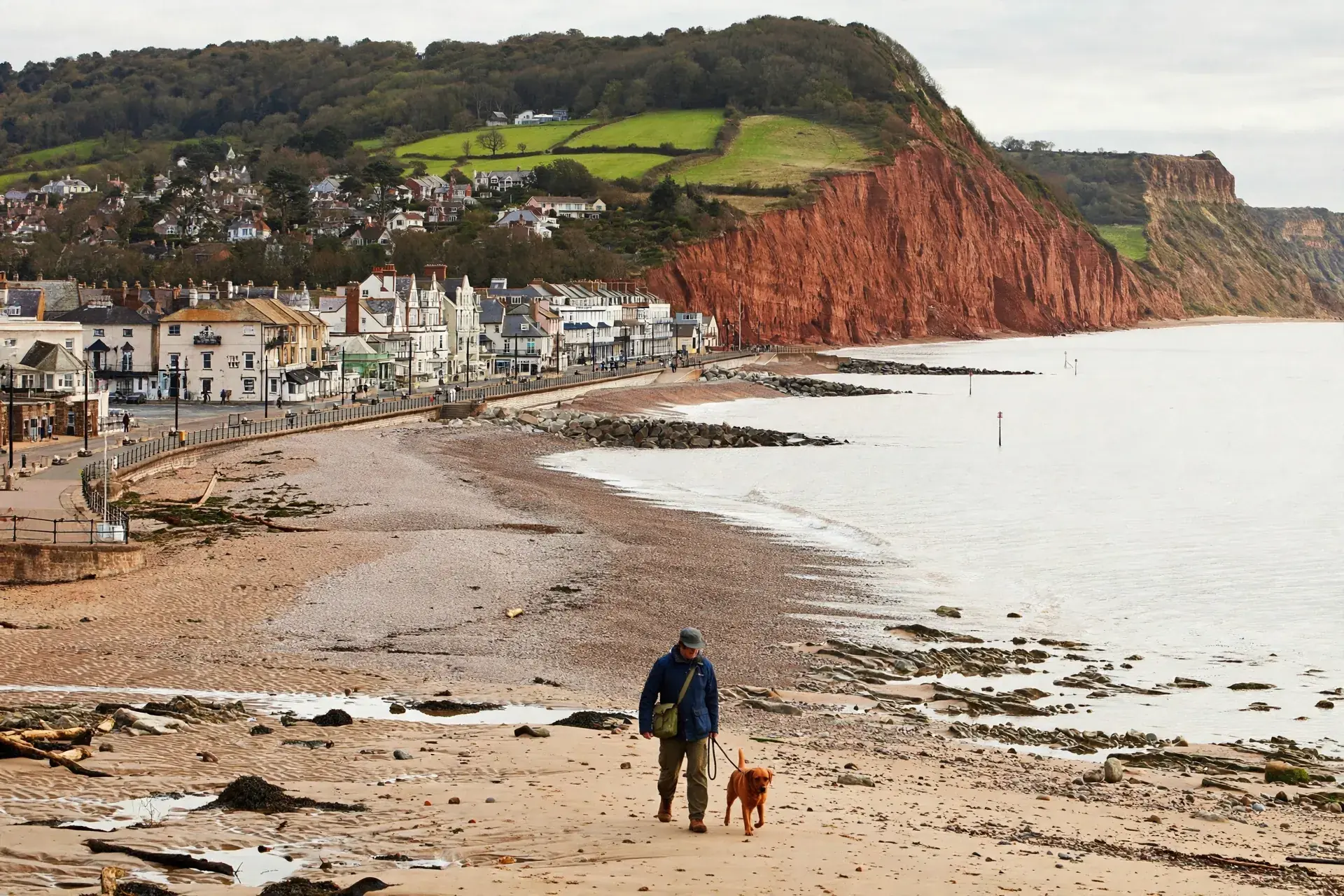
Sidmouth is best understood from the colour of its cliffs. The town sits in a shallow bay on the East Devon coast, where deep red sandstone rises above the shore and gives the whole seafront its warm, almost Mediterranean glow on a sunny morning. That colour is not decoration. It is the visible edge of the Jurassic Coast, a stretch of coastline recognised for the geological story written into its rocks, and it explains why a walk here feels different from a walk on a flat sandy beach in another county. The cliffs are tall, they are crumbly in places, and they change the light, the wind and the route in front of you all at once.
For a dog owner, the first lesson of the red cliffs is distance. Keep a generous gap between your dog and the cliff base, even when the shore looks wide and inviting. Rockfalls are a real feature of this coast, not a theoretical warning on a sign, and loose material can come down without an obvious trigger after rain, frost or a dry spell that has loosened the surface. Do not let a dog sniff, dig or chase a ball right up against the cliff foot, and do not stop for a long rest directly beneath an overhang or a fresh scar of fallen rock. The safest photographs are taken from well back, with the cliffs as a backdrop rather than a wall at your shoulder. If a section of beach is fenced, signed or cordoned off, treat that closure as final for the day, however tempting the empty sand beyond it looks.
The second lesson is wind. A cliff-top path that feels sheltered in the town can turn exposed within a few minutes of climbing, and a small dog can be buffeted sideways by a gust that barely bothers a human walker. Watch your dog's body language on the first rise: ears flattening, a lowered head, a sudden reluctance to go forward, or a habit of hugging the inland side of the path are all useful signals. There is no prize for reaching a viewpoint in a gale. Turn back, drop to the Esplanade, and try again on a calmer morning. The cliffs will still be red tomorrow, and a dog that had a good walk is far more likely to enjoy the next one.
Geology also shapes the ground underfoot. The shore at Sidmouth is not a single uniform surface, and the cliffs above it shed material that mixes with sand, pebbles and seaweed at the waterline. That mixture is interesting for a sniffing dog and tiring for a running one. A dog that charges across dry sand at full speed will slow on shingle, and a dog that loves to dig may find stones that jar its paws. Build the shore session gradually rather than letting the first ten minutes set the pace for the whole day. A short, happy outing on mixed ground beats a long outing that ends with a limping dog and a long walk back to the car.
Finally, use the cliffs as a navigation aid rather than a challenge to conquer. When you can see the red headlands to the east and west, you can judge how far along the bay you have walked, how much shore remains before the next headland, and whether the tide is narrowing your options. Teach yourself to glance back towards the town as well as forward towards the next viewpoint. A walk that is easy in one direction, with the wind behind you and the tide falling, can feel much longer on the return, into the wind and uphill. Plan the outward leg to be the easier one whenever you have a choice, and keep enough energy in reserve for the walk home.
The beach and the Esplanade
Sidmouth beach and the Esplanade work best as a pair. The beach gives a dog sand, sea smells, space to sniff and a proper paddle. The Esplanade gives the owner a flat, predictable surface, easy access points, benches, shade in places, and a dignified way home when paws are tired or the tide has other ideas. Most successful Sidmouth dog days use both, rather than treating the beach as the whole outing and the promenade as an afterthought.
Start with the rules, because they are the part most likely to have changed since the last guide you read. Sidmouth beach has seasonal and zoned arrangements for dogs, and the exact stretch, dates and signage matter more than any general statement that the beach is dog-friendly. Check the official guidance before you travel, look for the signs at the access points you actually use, and do not assume that a rule you remember from a winter visit still applies in summer, or that a rule at one end of the bay applies at the other. If you are unsure, ask locally or choose the Esplanade and a clearly signed section rather than guessing on a busy beach. A short, confident walk in the right place is better than a long, anxious walk in the wrong one.
On the beach itself, think about the tide before you think about distance. At low tide the shore opens up and a dog can roam, sniff seaweed, paddle in shallow pools and meet other dogs at a comfortable range. As the tide rises, that space shrinks towards the cliffs and the Esplanade wall, and the walk that felt spacious an hour ago can become a narrow corridor of wet shingle with nowhere easy to step aside. Check tide times for your exact day, plan the shore session around low water, and leave a wide margin for the return. If you find yourself hurrying along a narrowing strip with the water at your ankles, you have left it too late. Head for the nearest steps up to the Esplanade while the choice is still easy.
The Esplanade deserves more credit than it usually gets in seaside guides. It is level, it is wide enough for a dog to walk beside you without constant negotiation, and it lets an older dog, a dog in a buggy, a dog on a short lead after surgery, or a puppy still learning loose-lead manners enjoy the seaside without the demands of sand and surf. It is also the social spine of the town: walkers, runners, families, pushchairs, mobility scooters and other dogs all share it. Keep your dog close at pinch points, shorten the lead near cafes and seating areas, and step aside where the promenade narrows. A dog that walks calmly on the Esplanade is a dog that can be taken almost anywhere in Sidmouth.
Water and shade need planning even on a cool Devon day. Sea water is not drinking water, and a dog that laps salt water after running on the beach can end up with an upset stomach. Carry fresh water and a collapsible bowl, offer it regularly rather than waiting for obvious thirst, and rinse sandy paws before the walk home if you can. On a warm day, remember that the Esplanade can reflect heat and that shingle holds warmth; check the ground with your own hand if your dog is small, elderly or reluctant to walk. A shaded rest, a drink and a few minutes of doing nothing are part of the walk, not a failure of it.
Meeting other dogs on a beach is different from meeting them on a narrow path. On open sand there is room to arc around, to let two dogs approach on a curve rather than head-on, and to call a dog back before the greeting becomes a wrestling match. Use that space. If your dog is nervous, reactive or simply tired, walk a wide line, keep moving, and do not force a greeting because the other owner expects one. A polite wave and a wide berth preserve more holidays than a forced introduction ever will. If your dog is off lead where that is allowed, keep recall sharp with short, rewarding check-ins, and put the lead back on well before a busy access point, a group of children, or a dog that is clearly on lead for a reason.
The Salcombe Regis cliff walk
The walk from Sidmouth towards Salcombe Regis is the natural next step once the Esplanade feels easy. It takes you east along the coast, up onto the cliff path, and into the kind of open, salty air that makes the Jurassic Coast famous. It is not a long expedition by coastal-path standards, but it is a genuine climb, and it should be treated as a walk in its own right rather than as an extension tacked onto an already long beach session.
Begin by deciding how far you actually want to go, not how far the map suggests you could go. The honest version of this walk for most dogs is an out-and-back section: up from Sidmouth, along the cliff path for as long as the dog is enjoying it, then back the same way while energy is still in reserve. That approach has three advantages. First, you know the ground on the return, so there are no surprises. Second, you can turn at a viewpoint, a bench or a natural stopping point without feeling committed to a full loop. Third, a dog that is tired on the way back is walking downhill towards home, not uphill away from it. If you prefer a longer route, check the official guidance before you travel, confirm the path is open, and plan transport or a return route in advance rather than improvising at the far end with a tired dog.
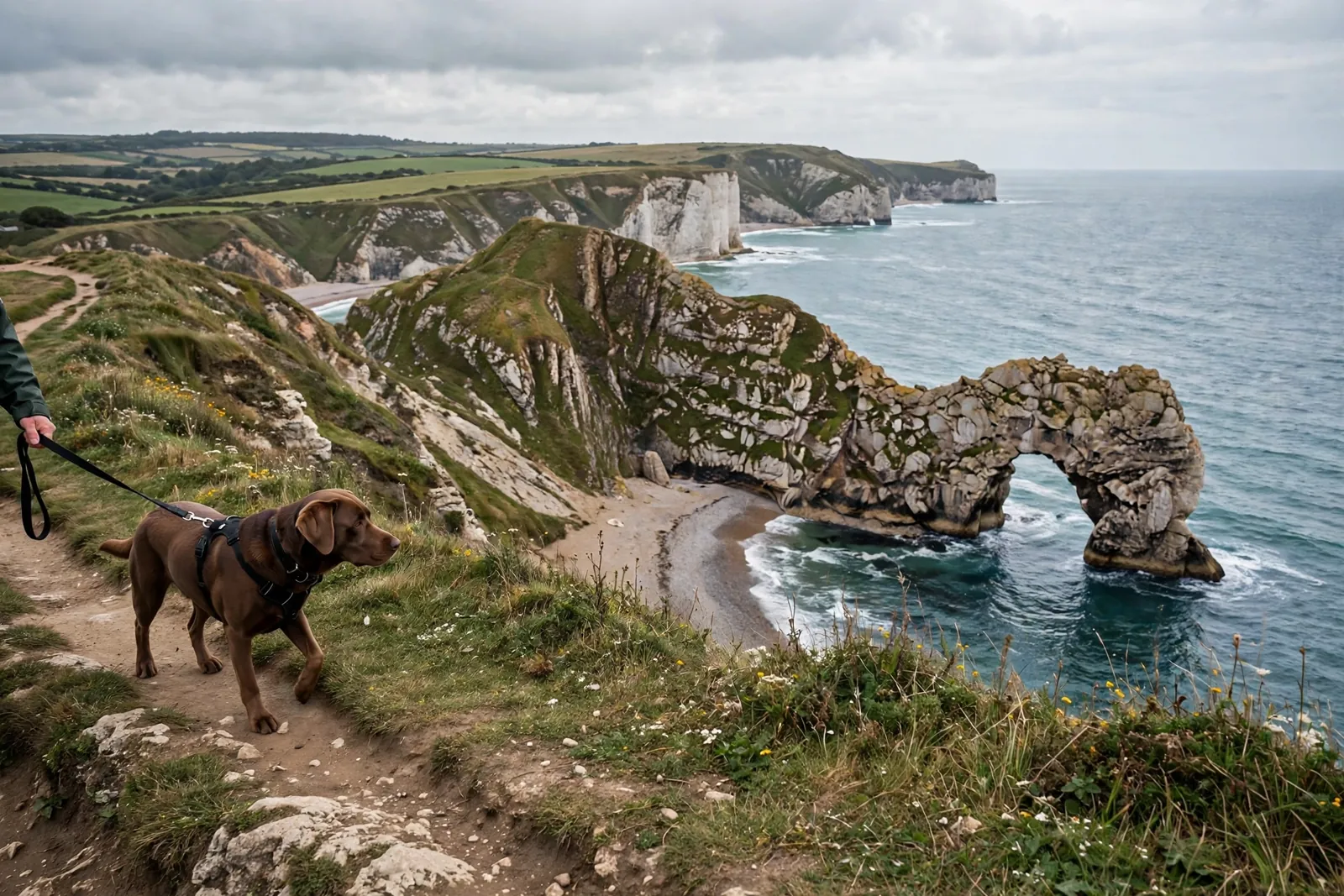
The path itself demands a lead and attention. Cliff paths in East Devon are narrow in places, uneven underfoot, and shared with walkers coming the other way, some of whom will have dogs, children or walking poles. Keep your dog on a lead on the cliff section, even if your dog is usually reliable off lead on a beach. A sudden pheasant, a rabbit, a gust of wind or another dog appearing around a bend can send an otherwise calm dog towards the edge or into a tangle with a stranger. A short lead, a harness that fits well, and a steady pace give you control without turning the walk into a tug-of-war. If your dog pulls hard on climbs, practise on the Esplanade first; a cliff path is a poor place to start lead training.
Look for the small details that make this walk memorable for a dog, not just for a photographer. The smell of gorse and sea air, the sound of waves far below, the change from town noise to wind and gulls, and the open grass where a dog can sniff a whole new set of scents are the real rewards. Let the dog stop and sniff. A cliff walk measured only in miles misses the point for a dog, whose walk is measured in smells, pauses and choices. Build in sniffing stops, offer water at the top of a climb, and sit for a few minutes at a viewpoint so the dog can settle and watch the world rather than simply passing through it.
Weather changes the character of this route more than it changes the Esplanade. Rain makes cliff-path surfaces slippery, especially on muddy or chalky sections, and wind makes the exposed stretches harder for small and light dogs. Fog or low cloud can remove the view entirely and make navigation less obvious, which matters if you are relying on landmarks rather than a map. Check the forecast, carry a phone with charge, and be ready to swap the cliff walk for a valley walk or a longer Esplanade outing if conditions turn. The coast rewards flexibility; it punishes stubbornness.
On the return, watch for the signs of a dog that has done enough. A dog that was pulling happily at the start may start to lag, to lie down, to pant heavily even after a rest, or to seek shade and water repeatedly. Those are not signs of laziness. They are information. Shorten the walk, offer water, and walk the last stretch slowly. If you drove to Sidmouth, a towel, fresh water and a few minutes sitting in the shade before the drive home will make the journey calmer for everyone. The best cliff walk is one that ends with a dog that is tired in a good way, not exhausted.
Behind the cliffs: the valley route
Not every good Sidmouth dog walk needs to be on a cliff edge. Behind the red cliffs, the valley that runs inland towards Salcombe Regis offers a quieter, greener alternative, and it is the walk to choose when the wind is high, the cliff path is wet, or your dog simply prefers fields, hedges and woodland smells to open sea air. A valley walk also gives a dog a different kind of exercise: steadier, less exposed, and easier to shorten if the weather or the dog changes its mind.
Valley walking brings its own courtesies. Fields may hold livestock, even when no animals are visible at the gate, and a dog that chases sheep can cause serious harm and legal trouble. Keep your dog on a lead through farmland, close gates behind you, and stay on the marked path rather than cutting across crops or meadows. If you meet horses, give them a wide berth and keep your dog calm and close; a nervous horse and an excited dog are a poor combination on a narrow lane. Where a path passes a house or garden, keep the dog close and the noise down. Country walking works because walkers respect the working landscape they are passing through.
Salcombe Regis itself is a small, quiet settlement rather than a resort, and that quietness is part of its charm for dogs. There is no promenade crowd, no arcade noise, and no pressure to keep moving. That also means fewer facilities, so do not arrive expecting a cafe on every corner or a dog-wash station at the end of the lane. Carry water, carry waste bags, and plan your refreshment stop back in Sidmouth or at a place you have confirmed in advance. A village walk rewards self-sufficiency: a dog that has water, a snack and a shade break will enjoy a quiet lane far more than a dog that is thirsty and looking for a tap that does not exist.
Combining the valley with the cliff walk, on different days rather than in one heroic loop, is often the best way to experience both. Walk the cliff path on a calm, dry morning when the views are clear and the dog is fresh. Walk the valley on a windy afternoon, a wet morning, or a day when the dog is a little stiff after the previous outing. That two-day pattern gives a dog variety without overload, and it gives you a reason to return to Sidmouth rather than trying to compress the whole coast into a single afternoon. Dogs, like people, remember a place better when they have visited it twice at a relaxed pace.
If you are staying for a week, use the valley route as your recovery walk. After a long beach day, a short valley outing the next morning lets stiff muscles loosen, lets paws recover from shingle, and lets a dog that was overstimulated by other beach dogs settle back into a calmer rhythm. Recovery walks are not wasted days. They are what make a longer holiday sustainable, especially for older dogs, puppies in their first holiday season, or rescue dogs still learning that a new place is safe. A holiday that alternates a big day with a gentle day will feel longer and happier than a holiday that tries to make every day a big day.
A day shaped by the tide
The most useful way to plan a Sidmouth dog day is to let the tide set the timetable and fit everything else around it. That sounds restrictive, but in practice it creates a natural rhythm: a shore session when the beach is open, a promenade and town session when the tide is high, and a cliff or valley walk when the light and wind suit it best. A tide-shaped day also stops the commonest mistake, which is to arrive at the beach at the most crowded and most restricted time and then try to force a walk into a space that is shrinking by the minute.
A practical pattern starts with a morning check. Look up the tide times, the forecast and the current beach signs before you leave your accommodation, not after you have parked and unloaded the dog. If low tide falls in the morning, make the beach your first outing, while the dog is fresh and the shore is quiet. Let the dog paddle, sniff and run in short bursts, then move up to the Esplanade for a calmer walk back. If low tide falls in the afternoon, reverse the order: start with the Esplanade and a gentle town walk, save the beach for the afternoon window, and keep the morning free for a valley walk or a rest. Either way, the dog gets a varied day and you avoid the frustration of arriving at a beach that is already disappearing.
Lunch and rest are part of the plan, not an interruption to it. A dog that has had a beach session, a drink and a proper rest will enjoy an afternoon cliff walk far more than a dog dragged from one outing to the next without a break. If you are staying in Sidmouth, return to your accommodation for a midday rest, especially in warm weather or after a long drive. If you are visiting for the day, find a shaded, quiet spot where the dog can lie down, drink and decompress for at least half an hour. Dogs that rest properly between outings are calmer in cafes, steadier on leads and less likely to become reactive when they meet another dog later in the day.
The afternoon is the right time for the Salcombe Regis cliff section on many days, provided the wind has eased and the path is dry. By afternoon you will know how your dog has coped with the morning, how its paws have handled the shingle, and whether it still has energy for a climb. If the answer is yes, walk the cliff path as an out-and-back and enjoy the changing light on the red cliffs. If the answer is no, choose the valley route or a second Esplanade walk and save the cliff path for another day. There is no penalty for changing the plan; there is a real cost to pushing a tired dog up a cliff path because the itinerary said so.
Evening in Sidmouth has its own appeal for dogs. The Esplanade quiets, the light on the cliffs softens, and a short, slow evening walk can be the perfect end to the day. Keep the evening walk short and familiar, especially if your dog is tired. A last toilet walk on a known route, a drink, and a settle for the night are worth more than a final ambitious outing. A dog that ends the day calmly will sleep well, and a dog that sleeps well will be ready for whatever the tide offers tomorrow.
For visitors planning a longer stay in Devon, it helps to place Sidmouth in a wider coastal context. The Jurassic Coast continues in both directions, and neighbouring stretches have their own beach rules, cliff characters and walking demands. Our wider Dorset with a dog guide explains how the same Jurassic Coast changes character further east, with different beaches, headlands and lead rules to compare. Reading it before a multi-day trip helps you choose which stretches suit your dog and which are better admired from a promenade rather than walked at length. Sidmouth itself, though, is complete as a single destination: beach, promenade, cliff and valley in one small bay, without needing a long drive to find variety.
Older, small and less mobile dogs
Sidmouth is kinder to older and smaller dogs than many cliff destinations, precisely because the Esplanade exists. A dog that can no longer manage a cliff climb can still have a full seaside day: a level walk, sea smells, other dogs at a distance, a bench rest, and a paddle if the beach access and rules allow it. The key is to treat the Esplanade as the main walk, not as a consolation prize, and to build the day around short, frequent outings rather than one long expedition.
For older dogs, surface matters more than distance. Sand can be hard work for arthritic legs, shingle can be painful for worn pads, and a steep descent can be harder than the climb that preceded it. Walk the Esplanade first, test the beach surface with a short session, and watch how the dog moves afterwards. A dog that is stiff the morning after a beach day has told you something useful: shorten the next shore session, choose a softer stretch, or stick to the promenade for a day. Ramps, harnesses with a handle, and a dog buggy or stroller for longer promenade outings are all legitimate tools, not signs of failure. They extend a dog's seaside life by years when used thoughtfully.
Small dogs face a different set of challenges on this coast. Wind on the cliff path, deep shingle, cold sea water and the sheer scale of other beach dogs can all feel overwhelming. Carry a small dog up the steepest or most exposed section if needed, keep it on a lead near larger dogs until you know the other dog is gentle, and offer a warm, dry place to rest after a paddle. Small dogs also chill faster after swimming or paddling, so a drying coat and a towel in the car are essential even in summer. A small dog that is warm, dry and close to its owner will enjoy Sidmouth as much as any spaniel.
Puppies need a Sidmouth plan of their own. A puppy's first seaside visit should be short, calm and positive: a few minutes on the Esplanade, a brief sniff of sand, a paddle only if the puppy chooses it, and then home for a rest. Do not let a puppy run for miles on shingle, climb a cliff path, or meet dozens of strange dogs in one outing. Socialisation is about quality, not quantity, and a puppy that has one calm beach experience will look forward to the next. Keep vaccinations, lead training and recall practice in mind, and check the official guidance before you travel if you are unsure about any local rule that affects puppies.
Dogs recovering from illness, surgery or injury should have a veterinary conversation before a coastal holiday, and Sidmouth should be planned around that advice. The Esplanade, with its level surface and easy exit points, is often the safest option, while cliff paths, deep sand and cold-water swimming may need to wait. Bring any medication, keep to the exercise limits your vet has set, and do not let a well-meaning fellow walker persuade you that a little extra climb will do no harm. A holiday that respects a recovery plan is a holiday that protects the next holiday too.
Food, water and rest stops
Food planning for a Sidmouth dog day starts before you leave home. Feed the dog at its normal time, in its normal amount, and do not change its diet on holiday. A new treat, a rich cafe snack or a piece of dropped food on the beach can upset a stomach that was perfectly settled at home, and a dog with an upset stomach on a coastal walk is miserable for everyone. Carry the dog's usual food if you are staying overnight, portion it in advance, and keep treats small, familiar and easy to carry. A pocket full of the dog's normal kibble is more useful than a bag of exotic holiday treats.
Water is the single most important item to carry, and the easiest to forget. Bring more than you think you need, especially on a warm day or a cliff walk where there may be no tap at the top. Offer water at regular intervals, not only when the dog is panting heavily, and carry a bowl the dog is used to drinking from. Some dogs will not drink from an unfamiliar bowl or a running tap on a busy promenade, so practise at home if your dog is fussy. After a beach session, offer fresh water before the walk home, and rinse the dog's mouth and paws if sand has collected around them.
Cafes and pubs in Sidmouth vary in their dog policies, and policies can change between seasons, between indoor and outdoor areas, and between one visit and the next. Do not assume that a place that welcomed dogs last year still does, or that a terrace welcome extends indoors in rain. Check before you sit down, keep the dog on a lead and under the table or beside your chair, and bring a mat or blanket for the dog to lie on. A dog that has a defined place to settle, a chew or a quiet activity, and a drink will be far calmer than a dog left to wander around tables, beg from strangers and investigate every passing plate.
Rest stops should be chosen for the dog, not just for the view. A bench in full sun on a hot day, a windy cliff-top seat, or a crowded cafe terrace may look appealing to a human and feel stressful to a dog. Look for shade, shelter from wind, space away from foot traffic, and a surface the dog can lie on comfortably. A few minutes of genuine rest, with the dog lying down rather than standing and scanning, will recharge a walk far better than a longer stop where the dog remains alert and tense. Learn to recognise your dog's settled body language: a soft sigh, a head on paws, a relaxed tail, and slow blinking are all signs that the rest is working.
If you are comparing Sidmouth with other Devon destinations for a longer stay, the practical costs and rhythms of a Devon week are worth understanding in advance. Our Devon dog holiday cost guide sets out a week's budget, including pet fees, accommodation styles and travel costs, so you can judge whether a Sidmouth base, a touring week or a single-destination stay fits your budget and your dog's routine. Sidmouth itself rewards a slower, base-based stay: one bay, explored properly over several days, often gives a dog a better holiday than a different beach every day.
Kit, leads and cliff courtesy
A Sidmouth kit list does not need to be long, but it does need to be complete. Start with a lead, and then a second option: a short lead for the Esplanade and cliff path, and a longer lead or long line for a quiet beach section where that is allowed and safe. A harness that fits well, without rubbing under the front legs, matters more on a cliff climb than on a flat park walk, so check the fit before you travel. Add waste bags, and then a few more than you think you need; a coastal walk with no bin in sight is no excuse, and carrying a used bag to the next bin is part of the deal.
Towels are not optional on this coast. Bring at least two: one for paws and belly after the beach, and one for the car seat on the way home. A drying coat is worth its weight for a dog that paddles or swims, especially in cooler months, and a spare lead, a spare bowl and a basic first-aid kit complete the essentials. First aid for a coastal walk means, at minimum, a way to clean a small cut, a bandage or wrap, tweezers for a thorn or grit, and your vet's phone number saved in your phone. Know where the nearest veterinary practice is before you need it, and save the number rather than relying on a signal on a cliff path.
Lead courtesy on a shared coast is simple but not always obvious. On a narrow cliff path, step aside for walkers coming downhill, keep your dog on the inland side, and shorten the lead before a blind bend. On the Esplanade, keep the dog close at cafe seating, at access steps and where children are playing. On the beach, call your dog back before it reaches another dog, another family or a group of birds, rather than after. A dog that is recalled early, rewarded and released again learns that coming back does not end the fun. A dog that is only recalled when trouble is already happening learns that recall means the end of everything good.
Wildlife deserves the same respect as other walkers. Coastal birds nest on cliffs and shingle, and a dog running through a nesting area can cause abandonment even without catching anything. Keep dogs away from nesting birds, seals hauled out on a shore, and any wildlife that is clearly resting or injured. If you see a seal, keep a wide distance, keep the dog on a lead, and do not approach for a photograph. If you find an injured animal, do not handle it yourself unless you know what you are doing; contact a local wildlife rescue service or a vet for advice. The coast belongs to its wildlife first, and a dog holiday that respects that will be welcomed back.
Finally, leave the beach and the path as you found them, or better. Take all waste home if bins are full, pick up any litter your dog investigates, and do not leave food, toys or balls behind. A ball lost on a cliff path or in the sea can become litter or a hazard for wildlife, so use a bright, floating toy on the beach and keep count of what you brought. Small acts of tidiness add up: a coast that is cared for by its visitors stays open, welcoming and safe for dogs, and a dog that learns to leave a place clean is a dog that can be taken anywhere.
Arriving, parking and getting around
Arriving in Sidmouth with a dog is easiest when you plan the last mile, not just the main journey. The town is compact, the seafront is walkable, and most of the best dog walking starts from the Esplanade itself, so you do not need to drive between walks once you are there. That compactness is a gift for dogs, who settle faster when the car journey ends and the walking begins, but it also means parking and access deserve a quick check before you arrive, especially on a busy weekend or in school holidays.
Check parking arrangements, charges and walking distances in advance, and choose a car park that leaves a short, level walk to the Esplanade rather than a long, steep descent with a tired or excited dog. If you are staying overnight, confirm where you can park, whether dogs are allowed in the accommodation, and whether there is a practical toilet area nearby for early morning and late-night outings. A beautiful cottage at the top of a steep hill is a poor choice for an older dog that needs a midnight outing, however charming it looks in photographs. Ask the specific questions, not just the general ones, and get the answers in writing with your booking.
For a day visit, arrive early if you can. An early start gives you quieter parking, a quieter beach, a cooler walk for the dog, and a choice of routes before the crowds arrive. It also gives you time to read the beach signs, check the tide, and settle the dog with a calm Esplanade walk before the main outing. A dog that arrives at a busy seafront in the middle of the day, straight from a long car journey, is starting its holiday at a disadvantage. A dog that arrives early, walks calmly and rests properly is starting its holiday well.
Getting around Sidmouth on foot is the point of the visit, but have a backup for the return journey. If your dog becomes tired, lame, wet or simply done for the day, you need a way back that does not involve another long walk. Know where the nearest taxi or bus option is, or where you parked, and do not be embarrassed to cut a walk short and take the easy route home. A short walk that ends well is worth more than a long walk that ends with a carried dog and a stressed owner. For a wider Devon trip, our Dartmouth with a dog guide shows how a river town, with ferries and embankment walks, offers a different kind of dog day when you want a change from cliffs and shingle. Sidmouth and Dartmouth together make a good Devon pair: one red-cliff bay, one river estuary, and two very different kinds of water for a dog to enjoy.
Before you travel, run through a final checklist. Tide times checked. Beach rules checked. Forecast checked. Water, bowl, lead, harness, waste bags and towels packed. Vet number saved. Accommodation dog rules confirmed. Cliff path chosen for the dog you have, not the dog you wish you had. If every item on that list is ticked, you are ready. If one item is uncertain, check the official guidance before you travel rather than hoping it will resolve itself on the day. Sidmouth rewards preparation with a rare combination: dramatic geology, a level promenade, a genuine cliff walk, and a quiet valley, all within a single small bay. That is a lot of coast for one dog, and it is best enjoyed slowly.
Practical questions
Before you go
Can dogs go on Sidmouth beach all year?
Sidmouth beach has seasonal and zoned dog rules that can change, so do not rely on a single remembered date. Check the official guidance before you travel, confirm which stretch of beach applies on your dates, and keep a lead ready for the Esplanade and any restricted section.
Is the Salcombe Regis walk suitable for an older dog?
The flat Esplanade suits most older dogs, but the cliff path towards Salcombe Regis adds height, uneven ground and exposure. Choose the shorter out-and-back section, turn back at the first sign of tiredness, and save the full cliff route for a fitter dog on a calm day.
What should I do about tides on the Sidmouth shore?
Check the tide times for your exact day before setting out, walk the shore on a falling or low tide, and leave a wide margin for the return. Never let a dog cut across a headland or a narrowing strip of shore as the tide turns, and head for the Esplanade steps well before the water reaches the cliff base.
Are dogs allowed on the Esplanade at Sidmouth?
The Esplanade is the practical level route for dogs, but local rules, seasonal signs and busy periods still apply. Keep your dog on a lead where other walkers, cyclists and families are close, give way at narrow points, and check the official guidance before you travel if you plan a long stay.
Is Sidmouth beach sand or shingle, and does it matter for paws?
Sidmouth shore mixes sand and shingle, with pebbles that can tire small paws and hide sharp edges. Start with a short shore session, rinse paws afterwards, check between the toes, and use the Esplanade for the longer part of the walk if your dog starts to pick up its feet.