This guide is independent and contains no paid placement. If affiliate links are added later, they will be clearly marked and will not change our editorial checks.
Beer suits dogs best as a short, steep, sensory village break: a pebble beach to sniff rather than sprint on, a working harbour shore to respect, caves to plan around rather than assume, and chalk-cliff walks taken in short out-and-back sections. Keep the dog on a lead where people, boats and cliff edges meet, bring a thick mat for the shingle, and check the official guidance before you travel for beach rules, cave admission and path closures.
A village that runs downhill to the sea
Beer is best understood as a slope, not a map. The village drops from the inland lanes down a single main street to a narrow opening in the cliffs, and then stops at the pebbles. That shape decides almost everything about a dog trip here: the walk down is easy and inviting, the walk back up is the real exercise, and the beach itself is small enough that a dog can take in the whole scene — boats, gulls, fishermen, children, other dogs — in a single glance. If your dog is the sort that gets excited by everything at once, that first glance is the moment to manage, not the moment to let go of the lead.
The slope also explains why Beer feels different from a flat seaside town. There is no long promenade to spread out along, no wide sandy strip where dogs can run far from people, and no easy escape route if a dog becomes overwhelmed. Instead there is a compact centre where everything happens close together: the beach, the slipway area, the cafes and the cliff paths all sit within a short walk of each other. That compactness is a gift when it is planned well, because toilet walks, water, shade and a quiet retreat are never far away. It becomes a problem only when visitors treat Beer like a large resort and expect space that the village simply does not have.
Start by walking the village without expecting the beach to do all the work. Let the dog sniff the street edges, the stone walls and the quieter side lanes first, and use that slow descent as a warm-up. A dog that arrives at the pebbles already settled, already toileted and already used to the smells of fish, boats and seaweed will behave very differently from a dog that is unloaded straight onto the shingle and asked to cope with everything at once. The same principle applies in reverse at the end of the day: the climb back up is steep, so give an older or smaller dog time, water and rest stops, and do not turn the final hill into a race against a parking deadline.
Parking and arrival deserve the same slope-first thinking. The village centre is tight, and the walk from a car to the beach can involve a hill, a narrow pavement and a busy junction of pedestrians and vehicles. Arrive early if you can, allow far more time than the distance on a map suggests, and settle the dog in the car with water before you attempt the descent on foot. If your dog travels badly, or if the hill will be too much on the way back, plan a shorter beach visit and a longer, flatter walk elsewhere in the day rather than forcing the whole trip to hinge on one steep return journey.
Beer sits on the East Devon coast within the Jurassic Coast stretch of shoreline, and that wider setting matters for expectations. This is a coastline shaped by geology as much as by tourism: chalk and limestone cliffs, landslips, fossil-bearing rocks and a sea that has carved coves out of hard stone. Dogs are welcome in the landscape, but the landscape is not softened for them. Paths can be uneven, cliff edges can be unfenced, and the ground underfoot changes from tarmac to pebble to chalk path within a few minutes. A dog trip to Beer is therefore a trip that rewards preparation — a lead, a mat, water, a paw check — far more than it rewards speed or distance.
The pebble beach, read as a dog owner
A pebble beach is a different surface from sand, and dogs notice the difference immediately. Pebbles shift underfoot, they are hard on joints, they trap small stones between toes, and they offer no soft place to lie down. Some dogs love the texture and the new smells; others pick their way delicately, stop often, or refuse to settle at all. Neither reaction is wrong, and the first visit should be treated as a test, not a test of endurance. Ten calm minutes on the shingle, with a mat to lie on and a reason to sniff rather than run, tells you more about your dog than an hour of restless pacing.
The practical rules of the beach also need checking rather than assuming. Seasonal dog restrictions apply on many British beaches, and the exact rule for Beer — which dates, which part of the shore, and whether a lead is required — can change, so check the official guidance before you travel. Do not rely on a memory of a previous visit, a photograph of another dog on the beach, or a general claim that a beach is dog-friendly. The safe habit is to check the current rule for your dates, keep the dog on a lead on the busiest stretches even where off-lead walking is allowed, and have a second walk ready in case the beach rule for your visit is stricter than you hoped.
Tides shape the pebble beach more than most visitors expect. At high tide the shingle narrows sharply, leaving little room between the water and the cliff or sea defences, and the space that remains is shared with everyone else who had the same idea. At low tide there is more room to explore, but also more exposed rock, rockpools and slippery weed to navigate. Check tide times before you go, plan the beach visit for a falling or low tide when the shore is at its widest, and never let a dog chase a ball or another dog towards the waterline without noticing how fast the tide is returning. A dog that is happy paddling in calm shallows still needs an owner who is watching the sea, not just the dog.
Rockpools deserve a specific word of caution. They are fascinating for dogs — full of smells, movement and cold water — but they can also hide sharp barnacles, broken shell, fishing line and slippery rock. Keep a dog on a lead near rockpools until you know how it reacts, watch for cut paws after any scramble, and rinse paws with fresh water afterwards. The same care applies to the cliff base: falling stones and landslips are a real feature of this coastline, so keep dogs away from the immediate foot of the cliffs, do not let them dig or scramble at the cliff face, and move on promptly if you see fresh rockfall or warning signs.
Finally, think about comfort on the pebble as a whole system, not a single item. A thick mat or blanket gives a dog a place to lie that is not shifting stone. Fresh water and a bowl matter because sea water is not drinking water, and a dog that laps at the sea will often be sick later. A towel is for drying salt and grit from paws and belly before the car journey home, and a waste bag is essential on a small beach where every mess is noticed. With those four things — mat, water, towel, bag — a short pebble visit becomes a pleasure rather than a chore, and the dog learns that the beach is a calm place to be, not a surface to endure.
A working fishing village, not a resort beach
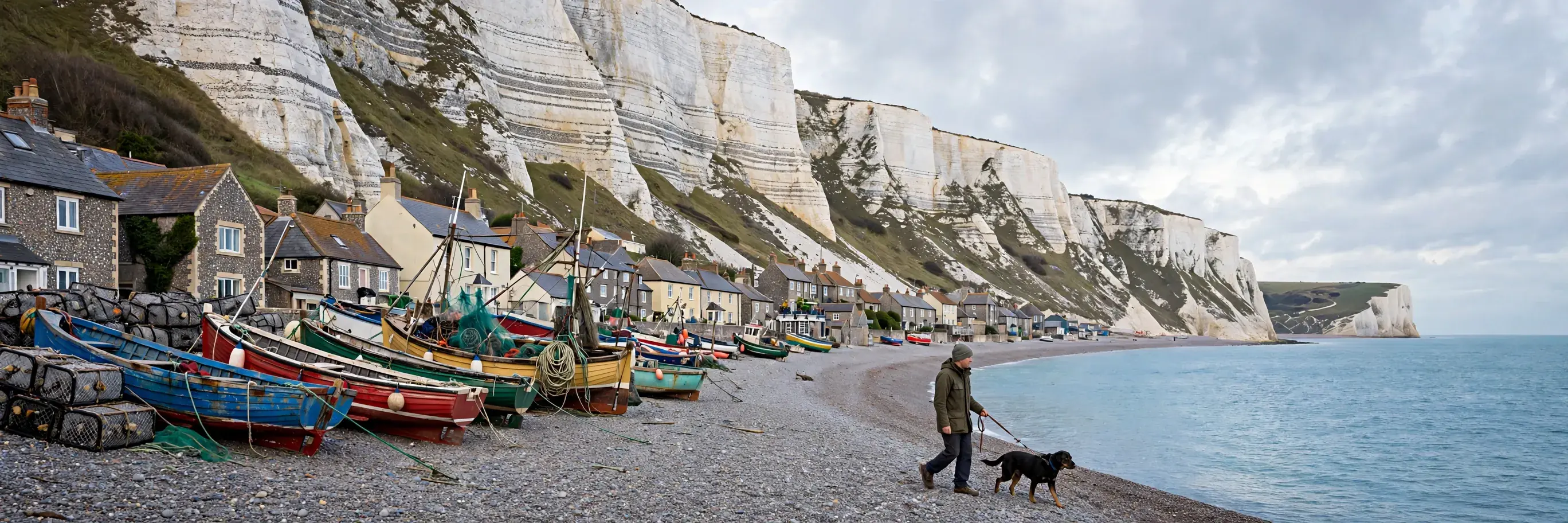
Beer is still a working fishing village, and that fact should shape how dogs behave on the shore. Fishing boats are hauled up onto the pebbles, nets and gear are stored and repaired in the open, and fishermen work around the slipway and the beach in ways that a resort beach never requires. A dog running loose among boats can trip over ropes, step on hooks or bait, knock over equipment, or frighten someone carrying a heavy catch. The respectful rule is simple: keep the dog close, keep it on a lead around boats and gear, and treat the working shore as someone else's workplace that you are visiting, not as a playground that exists for your dog.
That working character is also what makes Beer interesting. Children watch boats being launched, visitors buy fresh fish, and the village smells of salt, diesel and seaweed in a way that no purpose-built resort can copy. For a dog, that richness is both a joy and a challenge. Fish smells are intensely attractive, dropped bait and food scraps are tempting, and gulls are a constant distraction. Train the habit before you arrive: a reliable leave command, a short lead in busy areas, and a pocket of high-value treats that can compete with fish smells. If your dog cannot yet leave food on the ground, keep the beach visit short and the lead short, and reward calm sniffing rather than expecting perfect obedience in the most distracting place in the village.
The village street rewards the same slow approach. Beer has cafes, pubs and small shops along its main descent to the sea, and many of them welcome dogs, but the welcome is set place by place. One cafe may welcome dogs inside, another may allow them only on a terrace, and a pub may welcome dogs in the bar but not in the dining room. Ask before you sit down, rather than assuming from a sticker or a previous visit, and make the dog easy to welcome: a mat under the table, a bowl of water, a lead short enough that the dog cannot wander into a walkway or another table, and a chew or settled activity for a long lunch. A dog that lies quietly under a table will be welcomed back; a dog that begs, barks or roams will quietly close a door for the next visitor.
Eating outside has its own Beer-specific risks. Food dropped on a terrace, fish and chips eaten on the pebbles, and ice cream shared on the beach all create moments when a dog can snatch something unsuitable or get underfoot. Keep food above dog height where you can, clean up dropped food promptly, and remember that cooked bones, onion, chocolate and rich fried food are all best kept far from a dog, however hopeful the eyes. If you plan a fish supper on the beach, bring the dog's own food or treats so it has something legitimate to enjoy while you eat, and keep the meal short enough that the dog stays settled.
For a wider sense of how the Jurassic Coast handles dogs, the neighbouring county guide is a useful comparison, because the rules, cliff safety and beach habits described there apply in spirit to Beer as well. Read Dorset with a dog before you travel if you plan to continue along the Jurassic Coast, and note where its advice on leads near cliff edges, seasonal beach rules and rockfall matches what you will meet in East Devon. The two counties are different places, but the coastline logic — check the rule, respect the working shore, keep back from the edge — is shared.
Beer Quarry Caves, from the surface
Beer Quarry Caves are the hidden half of the village, and they change how a Beer trip should be planned. The caves are a vast underground network of man-made quarries, worked for centuries for the pale Beer stone that built churches, cathedrals and grand houses far beyond Devon. The stone was cut by hand, hauled out through tunnels, and shipped from the beach below, so the caves and the fishing village are not two separate attractions: they are the same story told above ground and below it. A dog trip that only sees the beach misses the reason the village exists in its present form, even if the dog itself never goes underground.
The key planning question is admission, and it must be checked rather than assumed. Underground tours have group sizes, safety briefings, uneven floors, steps and low passages, and the rules for dogs can be strict or simply impractical for a nervous animal, even where a site is generally welcoming. Check the official guidance before you travel for the current dog policy, tour times and any restrictions on the day you plan to visit. If dogs cannot go in, plan the visit as a split trip: one person tours the caves while the other walks the dog on a quiet village lane or a short cliff section, then swap, or visit the caves on a day when the dog can stay comfortably in dog-friendly accommodation. Do not leave a dog alone in a car while you tour underground, especially on a warm day, and do not assume a short tour will stay short if a group moves slowly.
Even from the surface, the caves shape a dog walk in useful ways. The quarry landscape above and around the caves is wooded, cool and shaded, which makes it a valuable alternative on a hot day when the pebble beach is glaring and the cliff path is exposed. A shaded lane walk before or after a cave visit gives a dog a calm, sniff-rich outing without the heat, the crowds or the cliff edge, and it breaks up a day that might otherwise be all beach and all hill. Use that shade deliberately: if the beach visit is planned for the morning, the wooded lanes can be the afternoon walk, and vice versa, so the dog never has to cope with the hardest conditions twice in one day.
For dogs that are nervous in dark, enclosed or echoing places, the caves are a reason to be cautious even about the entrance area. Underground spaces amplify sound, smell strongly of damp stone, and can unsettle a dog that is perfectly confident outdoors. If you do take a dog near the caves, keep the visit brief, watch for stress signals such as panting, pacing, tucked tail or refusal to move, and leave promptly if the dog is unhappy. There is no prize for completing a tour with a distressed dog, and the village above ground offers plenty of alternative walks that will suit that dog far better.
The stone story also gives children and adults a reason to slow down in the village itself. Look for Beer stone in the church, in older cottages and in walls along the lanes, and notice how the pale stone contrasts with the white chalk of the cliffs and the dark pebbles of the beach. A dog walk that pauses to look at stone, rather than rushing from car park to beach and back, is a better walk for the dog as well: more sniffing, more resting, more time to take in a place that was built stone by stone over centuries. The caves may be underground, but their effect on Beer is visible everywhere once you start looking.
White chalk cliffs and Beer Head
Beer is framed by white chalk cliffs, and those cliffs are the most dramatic part of any dog walk here. The chalk rises steeply on both sides of the beach, bright in sunlight, stark against the sea, and visible from the village street long before you reach the shore. That brightness is beautiful, but it is also a warning: chalk cliffs are crumbly, they erode, and the edge can be closer than it looks, especially where grass overhangs a drop or where a path runs near an unfenced rim. Keep dogs on a lead near cliff edges at all times, keep well back from the rim even for a photograph, and never let a dog chase a ball, a bird or another dog towards an edge.
Beer Head, the headland to the east of the village, is the natural goal for a cliff walk, but it should be treated as a destination to approach gradually, not as a distance to conquer. The path climbs from the beach area, and the reward is a wide view along the coast, across the bay and back to the village tucked into its cove. For a fit dog on a cool day, that climb is a pleasure. For an older dog, a small dog, a dog with joint problems, or any dog on a hot day, the same climb can be too much, and the kindest plan is a shorter section with a turn-back point agreed in advance. A walk that ends with a tired but happy dog at a viewpoint is a success; a walk that ends with a limping dog halfway up a hill is not.
Chalk also affects the ground underfoot. Chalk paths can be dusty and hard in dry weather, slippery when wet, and uneven where the surface has broken away. Dogs with sensitive paws may find chalk dust irritating, and dogs that run on hard chalk can jar joints that would cope happily on grass or sand. Walk chalk sections at a steady pace, check paws afterwards for cuts or soreness, and carry water even on a short cliff walk, because there is little shade on an exposed headland and the wind can hide how hot a dog is becoming. A dog that is panting hard on a chalk ridge needs shade, water and rest, not encouragement to push on to the next viewpoint.
Wildlife adds another layer to cliff walking. Gulls nest on ledges, other seabirds use the cliffs through the breeding season, and sheep or cattle may graze on nearby headland grass. A dog that chases birds or livestock is a danger to wildlife, to itself and to the farmer's livelihood, so keep the lead on where birds are nesting or livestock are present, and do not let a dog approach a cliff ledge where birds are sitting. The South West Coast Path guidance and local signs will often warn of nesting seasons and grazing animals; follow those signs rather than relying on what you can see, because a nesting bird on a ledge below the path is easy to miss and easy to disturb.
Photographs on the cliffs deserve a brief, practical note. The white chalk, the blue sea and a dog on a lead make a striking picture, but the best photographs are taken well back from the edge, with the dog on a lead and a second person holding it if necessary. Do not lift a dog onto a wall, a rock or a cliff-edge feature for a photograph, do not let a dog sit on an overhang, and do not step backwards while framing a shot near a drop. The cliffs will still be there for a photograph taken from a safe distance; a dog that slips from an edge will not be recovered by a good camera angle.
The South West Coast Path, in both directions
The South West Coast Path passes through Beer, and that gives a dog walker two very different choices from the same starting point. To the east, the path climbs towards Beer Head and on towards Seaton, with chalk cliffs, wide views and a sense of height. To the west, the path leads towards Branscombe, with a different mix of cliffs, combes and village approaches. Neither direction is simply better; they suit different dogs, different weather and different energy levels, and the wise plan is to choose one direction for the day rather than trying to do both and returning exhausted.
Before you set out on either direction, check the official guidance before you travel for path closures, diversions and cliff safety notices. Coast paths are living routes: sections close after landslips, diversions appear after storms, and a path that was open last year may be rerouted inland this year. A short check saves a long, frustrating backtrack with a tired dog, and it also tells you whether the section you planned is suitable for your dog at all. If a diversion adds a steep inland climb, an older dog may be better served by a shorter village walk that day.
Walk the coast path as a series of out-and-back sections rather than as a through-route. That single habit transforms a Beer coast walk for dogs. An out-and-back walk lets you turn around at the first sign of tiredness, heat, lameness or anxiety, it keeps the car and water within a known distance, and it avoids the problem of a linear walk that leaves you miles from the start with a dog that has had enough. Choose a turn-back point before you start — a gate, a viewpoint, a bench — and honour it even if the path looks inviting beyond it. The coast path is long; Beer is one small, beautiful part of it, and there is no need to prove anything by walking further than the dog enjoys.
Lead discipline on the coast path is not a minor detail. The path is shared with walkers, runners, families and other dogs, it narrows in places, and it runs close to cliff edges, livestock fields and busy road crossings at its ends. A long lead can be a hazard on a narrow cliff section, tangling around other walkers or pulling a dog towards an edge, while a short lead gives control without removing the dog's ability to sniff. Use a short lead on narrow, exposed or busy sections, and only consider a longer lead on wide, safe, open ground where you can see well ahead and recall is reliable. If recall is not reliable, the coast path is not the place to test it.
Finally, think about the return journey as part of the walk, not as an afterthought. Coast path walks from Beer often end with a descent back into the village, and a tired dog descending a steep path is more likely to slip, stumble or pull than a fresh dog climbing it. Slow the pace on the descent, keep the lead short, offer water before the steepest section, and allow rest stops on the way down. If the dog is limping, lagging or refusing to move on the return, stop, rest and consider whether a shorter route back is possible. A good coast path day ends with a dog that is tired in a contented way, not a dog that is relieved simply to have survived the walk home.
A village day that fits a dog
A good Beer day with a dog is built around rhythm, not mileage. Start with a quiet village walk and a toilet stop before breakfast crowds arrive, then take the beach visit when the tide and the crowds suit the dog, not when a timetable says you should. Follow the beach with a rest — in shade, with water, on a mat — before any cliff walk, and finish with a short, sniff-rich lane walk in the evening when the village is quieter. That rhythm gives the dog three different kinds of outing — village, beach, cliff or lane — without stacking them into one exhausting block.
Meals fit into that rhythm more easily than most visitors expect, provided the dog is part of the plan rather than an afterthought. A cafe or pub lunch works best after the dog has already walked and toileted, when it is ready to settle under a table. Bring the mat, the bowl and a chew, order promptly, and keep the meal to a length the dog can manage. If the dog is restless after an hour, that is information, not disobedience: the next meal can be a takeaway eaten on a quiet bench or back at your accommodation, where the dog can relax properly. Beer is small enough that a takeaway lunch is not a compromise; it is often the calmer choice.
Staying overnight in or near Beer changes the day again, for the better. A dog that can return to the same room, the same bed and the same routine each evening will settle faster than a dog that is dragged from attraction to attraction. When you choose accommodation, ask the same questions you would ask anywhere: where is the toilet walk after dark, is there a secure outdoor space, are dogs welcome in the eating areas, and what happens if the dog barks? A cottage with a small enclosed garden near the village will suit many dogs better than a larger property further away that requires a car journey for every toilet trip. For a wider Devon budget, including pet fees and cottage costs, see Devon dog holiday cost before you book, and compare its weekly figures with the price of the specific Beer stay you are considering.
Multi-dog households need a little extra planning in Beer. A small beach, a narrow street and a busy terrace all become harder with two or three dogs, especially if one dog is reactive or one is much older than the others. Walk the dogs together only where you can control them all, split the group if one dog needs a quieter outing, and do not assume that a cafe that welcomes one dog will welcome three. If you travel with several dogs, a longer, quieter lane or cliff walk may suit the group better than a crowded beach visit, and a second person makes the whole day easier, from holding leads at a cafe table to waiting with the dogs while one person visits the caves.
Children and dogs together in Beer deserve a moment of thought as well. The beach is small, the boats are fascinating, and children will naturally want to run, splash and explore. That energy is wonderful, but it can overwhelm a nervous dog or excite a boisterous one. Agree the rules before you reach the pebbles: children stay with an adult near boats and gear, dogs stay on a lead in busy areas, and everyone watches the tide and the cliff base. A family day that starts with those simple agreements will be calmer for the dog, safer for the children, and far more enjoyable for the adults who would otherwise spend the day managing two kinds of excitement at once.
Older, small and nervous dogs in Beer
Beer can be a kind village for older dogs, provided the trip is planned around their limits rather than around a younger dog's itinerary. The village itself offers short, interesting walks with plenty of smells and rest stops, and a short beach visit on a mat can be a pleasure for an older dog that no longer wants a long cliff walk. The problems arise only when an older dog is expected to climb to Beer Head, descend a steep path and then climb back to the car in one outing. Split that ambition: let the older dog enjoy the village and the beach, and let the fitter walkers do the headland walk separately, or choose a short, flat section of coast path and turn back early.
Small dogs face a different set of Beer challenges. Pebbles that are a minor inconvenience to a large dog can be a real obstacle to a small one, with stones shifting under tiny paws and gaps that trap small feet. A small dog may also be intimidated by larger dogs on a narrow beach, by gulls swooping low, or by the sheer scale of the cliffs overhead. Carry a small dog over the worst of the shingle if necessary, keep it on a lead where larger dogs are running, and give it a raised mat or a lap to sit on in a cafe so it can see what is happening without feeling overwhelmed. A small dog that is carried when it needs to be is not spoiled; it is a dog whose owner has read the terrain correctly.
Nervous and reactive dogs need the quiet version of Beer. That means early mornings, weekday visits where possible, quieter lanes rather than the main beach at midday, and a clear exit route from every outing. If your dog reacts to other dogs, keep it on a short lead, cross to the other side of a lane when another dog approaches, and reward calm behaviour before the other dog gets close. If your dog is frightened by loud noises, remember that a fishing village has boats, gulls, machinery and children, all of which can startle a sensitive animal. A nervous dog that has a calm, short, successful outing in Beer will gain confidence; a nervous dog that is overwhelmed on a crowded beach will take much longer to recover.
Puppies in Beer need the same care, with an added emphasis on socialisation done gently. A puppy's first pebble beach should be short, positive and full of treats, not a long, tiring march. Let the puppy sniff the pebbles, hear the gulls, see a boat from a safe distance, and then go home happy. Avoid letting a puppy drink sea water, chew pebbles, eat fish scraps or approach strange dogs without checking first, and keep the puppy on a lead near the water, the cliff edge and the working shore. A puppy that learns Beer as a calm, interesting place will enjoy returning as an adult; a puppy that is overwhelmed on its first visit may associate the whole village with stress.
For all of these dogs — older, small, nervous, young — the most important Beer skill is knowing when to stop. Turn back before the dog is exhausted, leave the beach before the dog is overstimulated, and choose the shorter walk when in doubt. Beer will still be there tomorrow, and a dog that ends the day happy is far more likely to enjoy the next visit than a dog that ends the day sore, frightened or overtired. The village rewards restraint more than it rewards distance, and that is a lesson that applies to every kind of dog.
Pebble kit, paws and the journey home
The kit for Beer is short, but every item earns its place. A short lead for the village and the cliffs, a longer lead only for safe open ground, a thick mat for the pebbles, fresh water and a bowl, a towel for salt and grit, waste bags, high-value treats for fish-smell distractions, and a basic paw check routine. Add a drying coat or a spare towel for a wet day, a bottle of fresh water for rinsing paws after rockpools, and a torch for an evening toilet walk on unlit lanes. That is the whole list, and it fits in a single bag that can stay by the door for the entire trip.
Paw care on pebbles deserves more attention than it usually gets. Check paws before the beach visit, between the toes for existing soreness, and after the visit for cuts, trapped stones, cracked pads or limping. Rinse paws with fresh water after sea contact, dry them thoroughly, and check again after the car journey home, when a small cut may have become sore. Dogs that are new to pebbles may benefit from a gradual introduction — a few minutes on the first day, a little longer on the second — rather than a full hour on day one. If a dog is limping on pebbles, stop the beach visit, rest the dog, and try a grass or lane walk instead. Limping is not stubbornness; it is information about the surface.
The journey home from Beer is part of the dog trip, not an afterthought. A dog that has walked on pebbles, paddled in salt water and climbed a hill will be tired, thirsty and possibly sandy or muddy. Offer water before the car journey, towel the dog down, check paws once more, and settle the dog on a familiar blanket in the car. If the journey is long, plan a comfort stop on a grass verge or in a quiet layby rather than expecting the dog to hold on until home. A calm car journey preserves the good memories of the day; a rushed, uncomfortable journey can undo them.
Seasonal kit changes matter in Beer as well. In summer, add sun awareness: chalk cliffs reflect light, pebbles radiate heat, and a dog can overheat on an exposed cliff walk even when the sea breeze feels cool to a human. Walk in the morning or evening, carry extra water, and watch for heavy panting, drooling or reluctance to move. In winter, add warmth and visibility: a coat for a short-coated or older dog, a light or reflective lead for dark lanes, and a towel for the inevitable mud and rain. In spring and autumn, when the village is quieter and the light is softer, Beer is often at its best for dogs, with fewer crowds, cooler temperatures and a beach that feels spacious rather than shared.
Finally, leave Beer as you found it. Pick up waste even on a pebble beach where it is tempting to think it will wash away, take all food packaging home, keep dogs away from nesting birds and livestock, and respect any temporary closures or signs. A small fishing village notices every visitor, and dog owners who leave no trace, keep dogs under control and thank the people who welcome them will find Beer welcoming again next time. That is the quiet contract of a working village: visitors enjoy the place, and in return they help keep it working.
When the pebble is wet and the wind is up
Rain changes Beer completely, and a dog trip that has no rain plan will feel it. Wet pebbles are slippery, wet chalk paths are treacherous, and a strong wind on an exposed headland can be frightening for a small or nervous dog. The answer is not to cancel the day, but to change its shape: swap the cliff walk for a wooded lane walk, swap the beach visit for a short, sheltered village outing, and use cafes, accommodation and indoor rest as part of the day rather than as a failure of it. A dog does not need a perfect day; it needs a day with walks, rest, food and calm, and rain does not remove any of those.
Wind deserves special attention on the cliffs. A dog that is confident on a calm headland may be anxious in a gusting wind, with ears back, tail low and a reluctance to walk near the edge. That is a sensible reaction, not cowardice, and the right response is to leave the exposed section and walk inland. Check the forecast before a cliff walk, avoid exposed headlands in strong winds, and keep the lead short so a gust cannot push a dog towards an edge or into a fence. If the forecast is for severe weather, choose a village day and save the headland for another visit. The cliffs are not going anywhere, and a dog that is safe indoors is better than a dog that is frightened on a ridge.
Wet-weather gear for Beer is practical rather than fashionable. A waterproof coat for the dog if it will wear one, a towel for every outing, a mat that can cope with wet pebbles, and a drying routine back at your accommodation that includes paws, belly and ears. Dry the dog thoroughly after a wet walk, check for ticks after wooded or grassy sections in warmer months, and give the dog a warm, dry bed to recover in. A wet dog that is left damp in a cold room will be miserable; a wet dog that is dried, fed and settled will often sleep better than on a dry day.
For a broader sense of how to handle coastal weather with a dog, including tide safety, cold care and post-walk routines, the winter coastal walks guide is a useful companion, even outside winter. Its advice on visibility, wet ground and drying applies to a rainy Beer day just as well as to a January beach walk, and it is worth reading before a trip where the forecast is uncertain. The link below in the related reads will take you there, alongside the Devon and Dorset guides that frame Beer in its wider coastline.
Above all, let the weather set the pace. Beer in rain, with a dog trotting happily along a quiet lane, a warm cafe stop and a short beach sniff between showers, can be a better day than Beer in sunshine with a dog dragged up a hot, crowded cliff path. The village is small, the walks are short, and the best Beer days are often the ones where nobody tried to do everything. Choose one good walk, one good rest and one good meal, and let the rest of the day be whatever the weather and the dog suggest.
Practical questions
Before you go
Can dogs go on Beer Beach all year?
Beach rules can change by season and by the part of the shore you are on, so check the official guidance before you travel. Plan for a lead on the busiest stretches, keep your dog clear of fishing boats and working gear, and have a non-beach walk ready if the rule for your dates is stricter than you expected.
Can dogs go into Beer Quarry Caves?
Do not assume dogs are admitted to the caves. Underground tours have their own safety and group rules, and these can change. Check the official guidance before you travel, and plan the visit so one person can wait outside with the dog on a village or cliff walk if dogs cannot go in.
Is the South West Coast Path from Beer suitable for older dogs?
Some stretches suit older dogs and some do not, because the path climbs, drops and narrows near the cliffs. Choose a short out-and-back section, walk it in the cooler part of the day, and turn back before your dog tires. Check the official guidance before you travel for closures, diversions and exposed sections.
Are dogs welcome in Beer village cafes and pubs?
Many village places welcome dogs, but the rule is set place by place and can differ between a bar, a dining room and a terrace. Ask before you sit down, keep your dog on a lead under the table, and bring a mat and water so a busy lunchtime stays calm for everyone.
What should I pack for a pebble beach with a dog?
Pack a long lead, a thick mat or blanket, fresh water and a bowl, a towel, a paw check routine for cuts and trapped stones, and a bag for waste. Pebbles are hard on paws and awkward for lying down, so the mat matters as much as the lead, and a short first visit tells you how long your dog is comfortable on the shingle.