This guide is independent and contains no paid placement. If affiliate links are added later, they will be clearly marked and will not change our editorial checks.
Start at Bungay Castle and its grassy grounds, drop down to Falcon Meadow and Outney Common for the river walk, then loop back through the Market Place for lunch. The town is compact enough to explore on foot, and the Angles Way gives you a longer valley walk whenever you want one.
Stand on the castle mound at Bungay and the whole shape of the town makes sense at once. Below you lie the roofs of a small Suffolk market town, gathered around its churches and Market Place; beyond them, the River Waveney curves through flat green meadows towards Norfolk on one side and the Suffolk broads country on the other. It is a view that explains why this spot mattered: a river crossing, a market, and a stronghold watching over both. Dogs are part of the picture here rather than an afterthought. The castle grounds are a place to wander, the commons below are made for proper walks, and the town itself is small enough that a dog can trot from a riverside path to a cafe doorway without a car journey in between.
Bungay rewards a slow approach. It is not a resort town with a single headline attraction, and that is exactly its charm for dog owners. The pleasures stack up quietly: stone walls softened by centuries of weather, narrow lanes that bend away from traffic, meadow paths where the river glints between willows, and a market square where you can sit outside with a dog at your feet. This guide follows that natural order. It begins with the castle, because the castle is where the town's story starts, then works down to the river, around the old town, out along the valley, and finishes with the practical details that make the day run smoothly.
A word about the town's darker legend belongs right at the start, because every visitor hears it sooner or later. On 4 August 1577, during a violent thunderstorm, the church of St Mary is said to have been visited by Black Shuck, a great black hound of East Anglian folklore, whose scorched paw marks were long pointed out on the church door. The tale is folklore, not history, but it has become part of Bungay's identity, and dog owners tend to enjoy the irony of walking a perfectly ordinary, well-behaved dog past the church where the most famous dog in Suffolk legend is supposed to have appeared. Keep the story in its place, though: it is a fireside tale for the walk home, not a reason to hurry past a beautiful church.
Bungay Castle and its grounds: where the town began
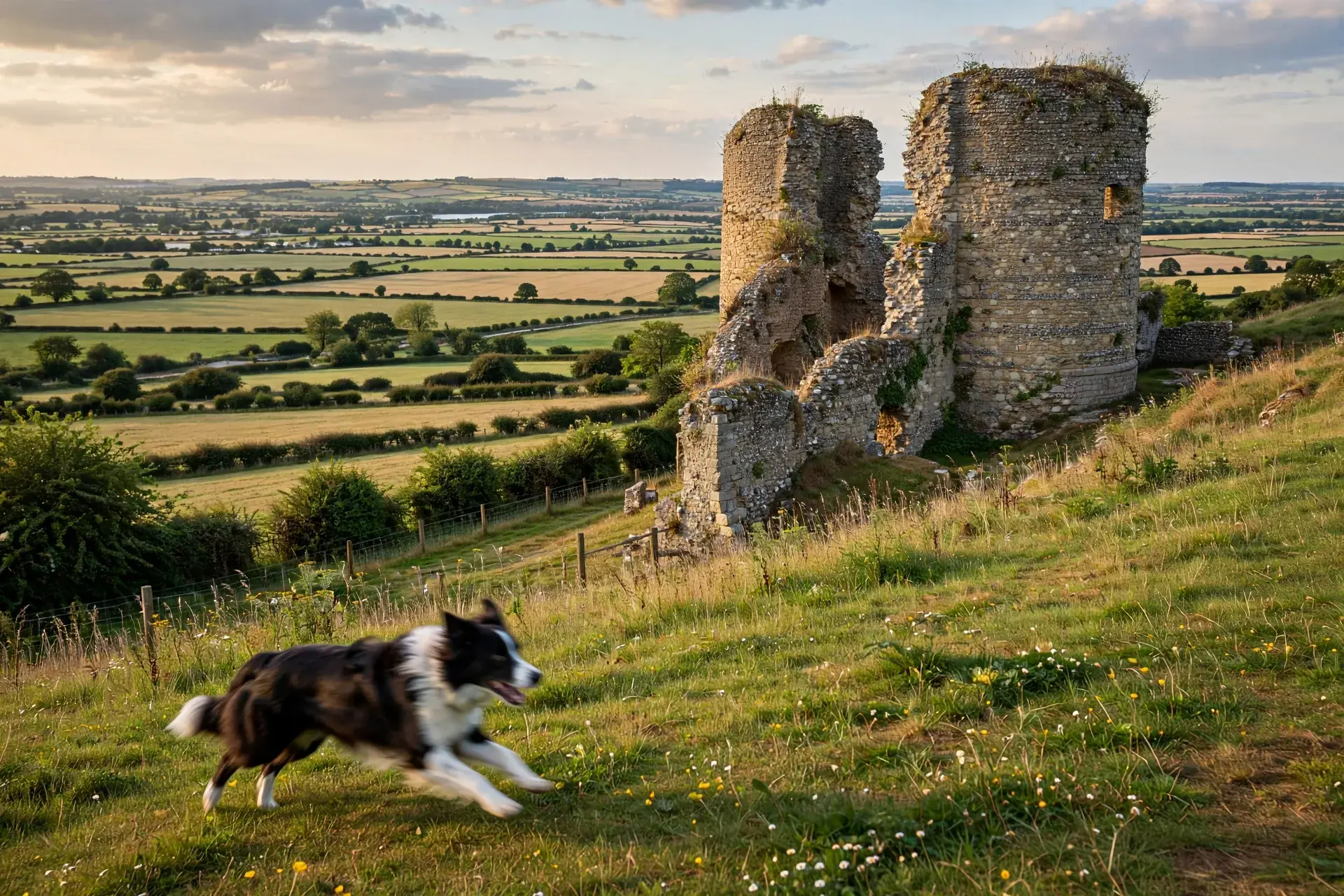
Bungay Castle was raised by the Bigod family, powerful Norman lords who held much of East Anglia, and its surviving stonework dates largely from the twelfth century. What you see today is a ruin in the best sense of the word: substantial curtain walls, the footings and lower courses of towers, and a great grassy mound that still gives the castle its commanding position over the town and the Waveney valley. It is not a polished heritage attraction with costumed guides and a gift shop at every turn, and dog owners usually prefer it that way. The grounds feel like a public green with history built into the edges, a place where a dog can sniff along old walls while you try to picture the hall, chapel and kitchens that once stood inside them.
Begin your visit by walking the grounds rather than rushing to the highest point. The outer walls and towers reward a slow circuit: look for the thickness of the masonry, the way the stone changes colour where later repairs were made, and the gaps where windows and doorways once opened onto courtyards. Dogs on a lead are well suited to this kind of exploring, because the ground is uneven in places and the walls themselves demand respect. Keep your dog away from loose stonework and from any fenced or cordoned sections, and do not let a dog scramble on the masonry. Ruins are fragile, and a paw on a crumbling wall edge is bad for the wall and worse for the dog.
The mound itself is the obvious viewpoint, and it is worth the climb for the panorama alone. From the top, the Waveney valley opens out in both directions, with meadows, hedgerows and church towers marking the villages along the river. On a clear day you can trace the route of your later riverside walk from up here, which is a satisfying way to plan the rest of the morning. The slope is grassy and can be steep and slippery after rain, so take it steadily with a dog on a short lead, especially with older dogs or puppies whose legs are still finding their confidence. In summer the grass is often dry and easy; in winter it can be muddy enough to justify the towel you packed.
Opening arrangements for the castle grounds can vary with the season, with volunteer staffing and with special events, so check the official guidance before you travel rather than assuming the gates will be open at a particular hour. The same caution applies to dog rules: dogs are generally welcome in the grounds on a lead, but a special event or a conservation closure can change that for a day, and the signs at the entrance are the final word. If you arrive to find the grounds closed, do not treat the trip as wasted. The castle is impressive from the lanes around its base too, and the walk down to the river meadows below is the natural next step in any case.
Allow time to simply sit in the grounds with your dog. Castle visits with dogs go wrong when they become a forced march between photo stops; they go right when the dog gets time to settle on the grass while you look at the walls properly. Bring water in warm weather, because there is little shade on the mound itself, and bring a blanket or a mat if your dog likes a defined place to lie down. A settled dog in a castle ground is a contented dog, and a contented dog is the one that walks politely through the town afterwards instead of pulling towards every new smell.
Before you leave the castle area, look at the town from the castle's point of view one more time. The church towers of St Mary and Holy Trinity rise close together, which is unusual and tells you something about Bungay's medieval wealth: this was a town rich enough to support two great churches within a stone's throw of each other. The lanes between them, the Market Place beyond, and the river below are the three parts of the day that follows, and each of them is within easy walking distance of where you are standing.
The Waveney meadows and common walks: Falcon Meadow and Outney Common
From the castle, the land drops towards the River Waveney, and this is where Bungay becomes a walker's town in earnest. Falcon Meadow and Outney Common form the green riverside heart of the area: open grassland, riverside paths, willow trees and wide skies, all within a few minutes of the town centre. For a dog, the change of scenery is immediate and obvious. The enclosed lanes and stone walls of the castle give way to open ground, long grass, river smells and the kind of space where a ball or a long line actually makes sense.
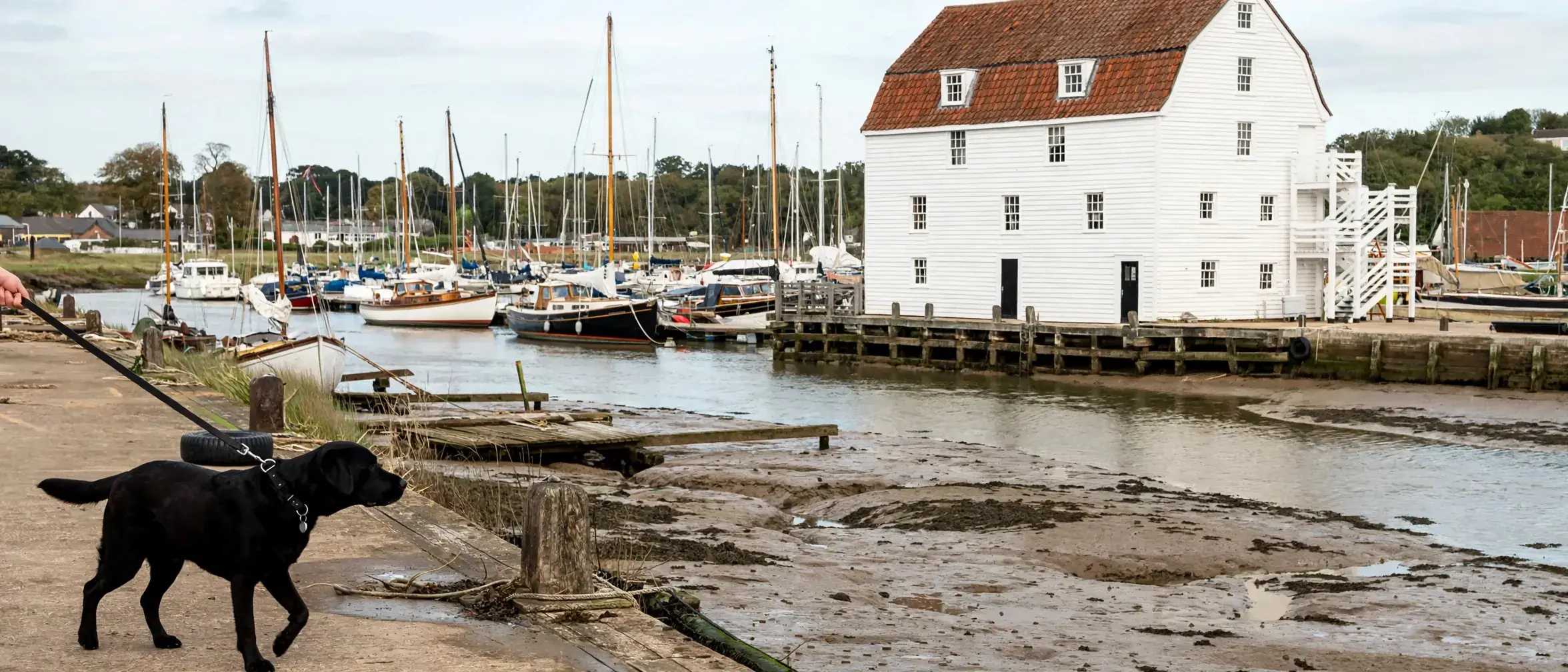
Falcon Meadow is the gentler introduction. It sits close to the town, its paths are easy to follow, and it makes a natural first riverside stop after the castle. Walk the meadow edge along the river and you will see the Waveney at its most characteristic: slow, green-brown water sliding between banks of reeds and willow, with moorhens picking along the margins and, if you are lucky and quiet, a kingfisher flashing past at water level. Dogs that like water will be interested at once, so decide your river rules before you arrive. The Waveney has a current, steep banks in places and muddy edges after rain, and not every stretch is safe or suitable for swimming. A dog that paddles at a shallow, firm-edged spot under your supervision is a different proposition from a dog charging into deep water from a high bank.
Outney Common is larger, wilder and more open, and it is the walk to choose when your dog still has energy to burn. The common is grazed at times, which keeps the grassland rich in wildflowers and good for wildlife, but it also means you must be ready to put your dog on a lead around livestock. Cattle are generally calm, but a loose dog running around them is a welfare problem for the animals and a safety problem for the dog, so watch for grazing animals as you enter the common and clip the lead on early rather than late. The same rule applies to other walkers, cyclists and horse riders sharing the paths: a dog under close control is welcome everywhere, while a dog ranging far ahead is not.
Season changes the commons more than it changes the town. In spring, the meadows fill with buttercups, cuckooflower and the first damselflies along the ditches, and ground-nesting birds may be present in the longer grass, which is a good reason to keep dogs on paths through the tallest vegetation. Summer brings long light evenings, dragonflies over the river and shade that is patchy rather than generous, so carry water and plan a midday rest if you are walking in heat. Autumn is arguably the best season: firm ground, low sun across the meadows, fungi along the hedgerows and fewer biting insects. Winter can be beautiful and bleak in equal measure, with floodwater sometimes spreading across the lowest meadows after heavy rain. If the river is high or the paths are under water, do not push through: flooded meadows hide ditches and currents, and a wet dog in cold wind loses heat fast.
The practicalities of the commons are simple but worth stating plainly. There are no guarantees of bins at every path junction, so carry bags and take waste home if you cannot find a bin. Ticks are present in long grass and riverside vegetation through the warmer months, so check your dog after the walk and remove any ticks promptly. Keep to waymarked paths where they exist, close gates behind you, and remember that the commons are working landscapes as well as leisure grounds: grazing, hay cutting and conservation work all happen here, and a dog owner who respects that work is part of why dogs stay welcome.
A satisfying circular route is to walk from the town down to Falcon Meadow, follow the river to Outney Common, cross the open ground, and return by a different path or lane. The distance can be stretched or shortened easily, which makes it a good walk for mixed groups where one dog is young and another is old, or where the weather turns halfway round. If you have a dog that needs a long run, this is the place to give it to them; if you have a dog that prefers a slow sniff along a riverbank, the same ground serves that dog just as well. Either way, finish the walk with a drink for the dog and a few minutes sitting by the river before you head back up into town.
The town trail: churches, Market Place and lanes
Back in the town, Bungay's trail is best walked without a timetable. The historic core is compact, the streets are mostly quiet, and the pleasure lies in looking up at timber-framed facades, ducking down narrow lanes and finding the small details that a car driver never sees. Start at St Mary's Church, the church of the Black Shuck legend, and give it the attention it deserves. The building is a fine Suffolk church with a tall tower, and its churchyard is a calm, green pause between the castle and the Market Place. Dogs are not generally expected inside churches unless a particular service or event says otherwise, so plan for one person to wait outside with the dog while the other looks in, or simply enjoy the exterior, the tower and the churchyard together.
The Black Shuck story deserves a clear telling, because it is told in many versions. On a stormy Sunday in August 1577, according to the contemporary account, a great black dog burst into St Mary's during a service, killed two worshippers and left scorch marks, traditionally pointed out on the church door, before vanishing onwards to Blythburgh church, where it is said to have killed two more people. Historians debate how much of the tale is embellished, and folklorists note that black dog legends appear all over East Anglia, but the Bungay version is the most famous of them all. Modern Bungay leans into the legend affectionately: you will find the hound on signs, in shop names and in local art. Walk your own dog past St Mary's with a smile, and keep the spooky part of the story for the pub afterwards.
A few steps away stands Holy Trinity Church, Bungay's other great medieval church, and the pairing of the two is the town's most distinctive feature. Where many market towns have one parish church, Bungay has two towers rising close together, a reminder of a time when the town's wool and market wealth supported two parishes side by side. The walk between them takes only minutes, but it passes some of the town's most attractive streetscape, and it is worth slowing down for. Look for the mix of Georgian brick, older timber framing and Victorian shopfronts, and notice how the lanes narrow and bend: this is a medieval street pattern that was never straightened for traffic, which is why it suits walking with a dog so well.
The Market Place is the natural centre of the town trail and the right place for a break. Bungay holds a regular weekly market, and on market days the square fills with stalls, shoppers and the general cheerful noise that dogs either love or merely tolerate. If your dog is nervous in crowds, plan your Market Place visit for a quieter hour or skirt the busiest stalls; if your dog is sociable, the market is a fine place for a calm, leaded wander and a chat with stallholders. Check the official guidance before you travel for the current market day and hours, because market schedules can change. Either way, the square is ringed with cafes and pubs, and sitting outside with a dog at your feet is one of the simplest pleasures Bungay offers.
From the Market Place, the old town lanes fan out in several directions, and each is worth a short detour. Look for the Butter Cross, the historic market cross that once marked the butter market, and for the small courtyards and alleyways that lead off the main streets. Some lanes are narrow enough that a dog on a long lead becomes a trip hazard for other pedestrians, so shorten the lead in the tightest spots and keep to one side. Independent shops line these streets: bookshops, antique shops, food shops and craft outlets that give Bungay its character. Not every shop welcomes dogs inside, and policies vary, so ask at the door rather than assuming, and never tie a dog up outside a shop and leave it unattended in a busy street.
The town trail also has a cultural stop worth noting. The Fisher Theatre, housed in a historic building near the Market Place, is a community theatre and arts venue that anchors Bungay's cultural life. Evening performances are generally not dog-friendly occasions, but the building and its place in the town's story are part of the walk, and its cafe and events programme can be worth checking when you plan a longer stay. As with churches and shops, the rule is simple: enjoy the outside and the atmosphere with your dog, and treat indoor admission as something to check in advance rather than assume.
Longer valley routes and day trips: the Angles Way and beyond
When the town and the commons have been explored, the Angles Way is waiting. This long-distance trail follows the Waveney valley for much of its length, and Bungay sits conveniently on it, which means you can step onto a waymarked national-quality route without driving anywhere. The Angles Way runs roughly from Great Yarmouth on the Norfolk coast inland through the Waveney valley to Thetford, and the Bungay stages are among its most attractive: flat riverside walking, waterside villages, church towers on the horizon and pubs at sensible intervals. For a day walk, you do not need to tackle the whole trail. Pick a single stage, walk it in one direction, and arrange your return in advance, whether that means retracing your steps, catching a bus, or leaving a second car at the far end.
Towards Beccles, the Angles Way follows the valley downstream through a landscape of grazing marshes, drainage ditches and big skies. Beccles itself is a handsome market town with its own riverside quay, church tower and cluster of dog-friendly pubs and cafes, and it makes a natural destination for a longer day out. The distance between Bungay and Beccles is a serious walk rather than a stroll, so check the route length and the state of the paths before you set off, and be honest about your dog's fitness. A fit adult dog in cool weather will enjoy a long valley stage; a puppy, an elderly dog or a dog unaccustomed to distance will enjoy a shorter section just as much, and there is no prize for overdoing it.
In the other direction, the valley leads towards Harleston and on towards Diss, through quieter villages and farmland where the river narrows and the walking becomes more intimate. This direction suits walkers who prefer lanes, field paths and village churches to open marsh, and it offers easy shortening points where a lane leads back to a road. Whichever direction you choose, the practical rules are the same: follow the waymarks, keep dogs on a lead through farmyards and around livestock, close gates, and be ready for stiles. Some stiles are dog-friendly with a gap or a nearby gate, but others are awkward for large or stiff dogs, so check the official guidance before you travel if your dog cannot manage stiles easily, and choose a stage with gates rather than one that forces a lift over every stile.
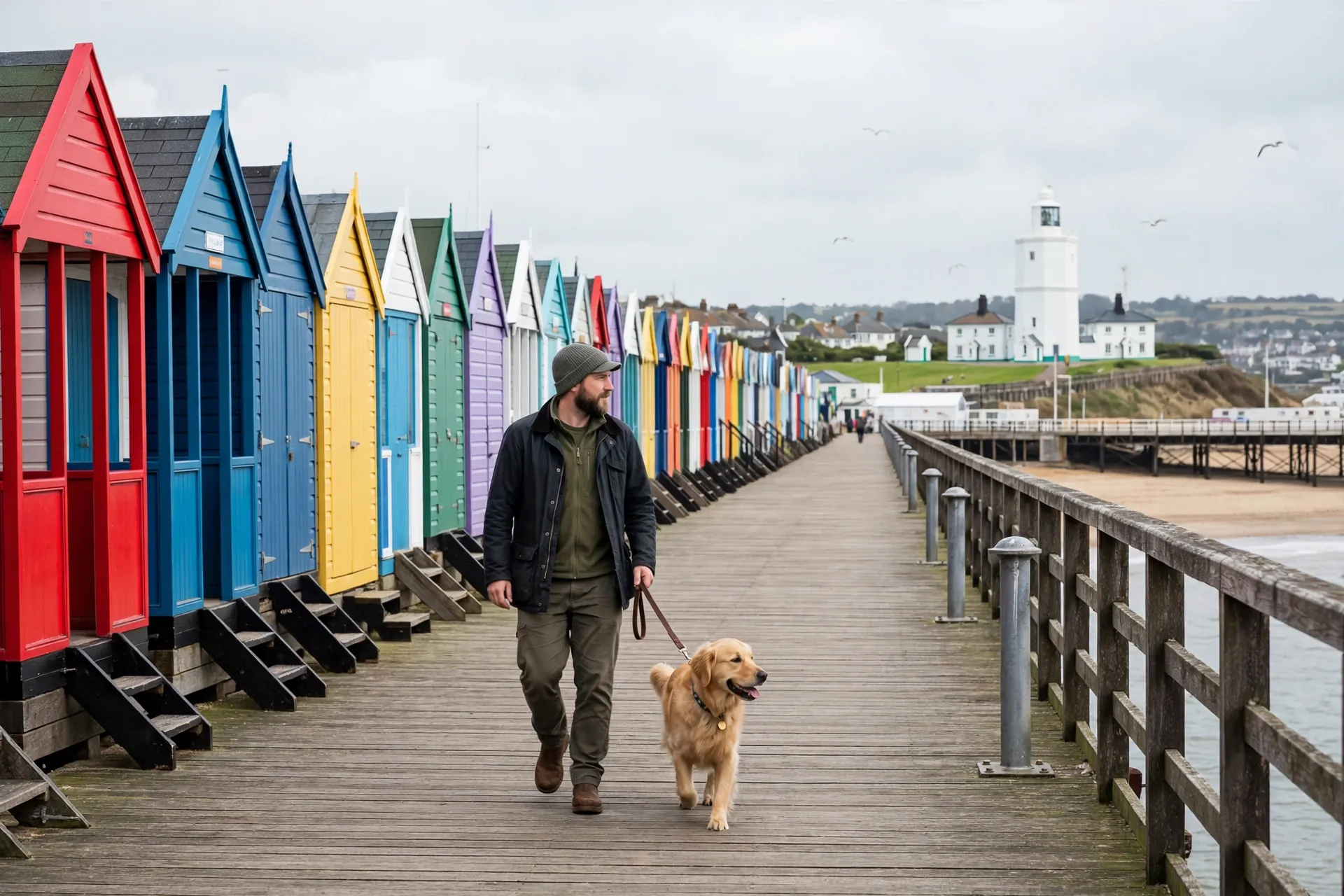
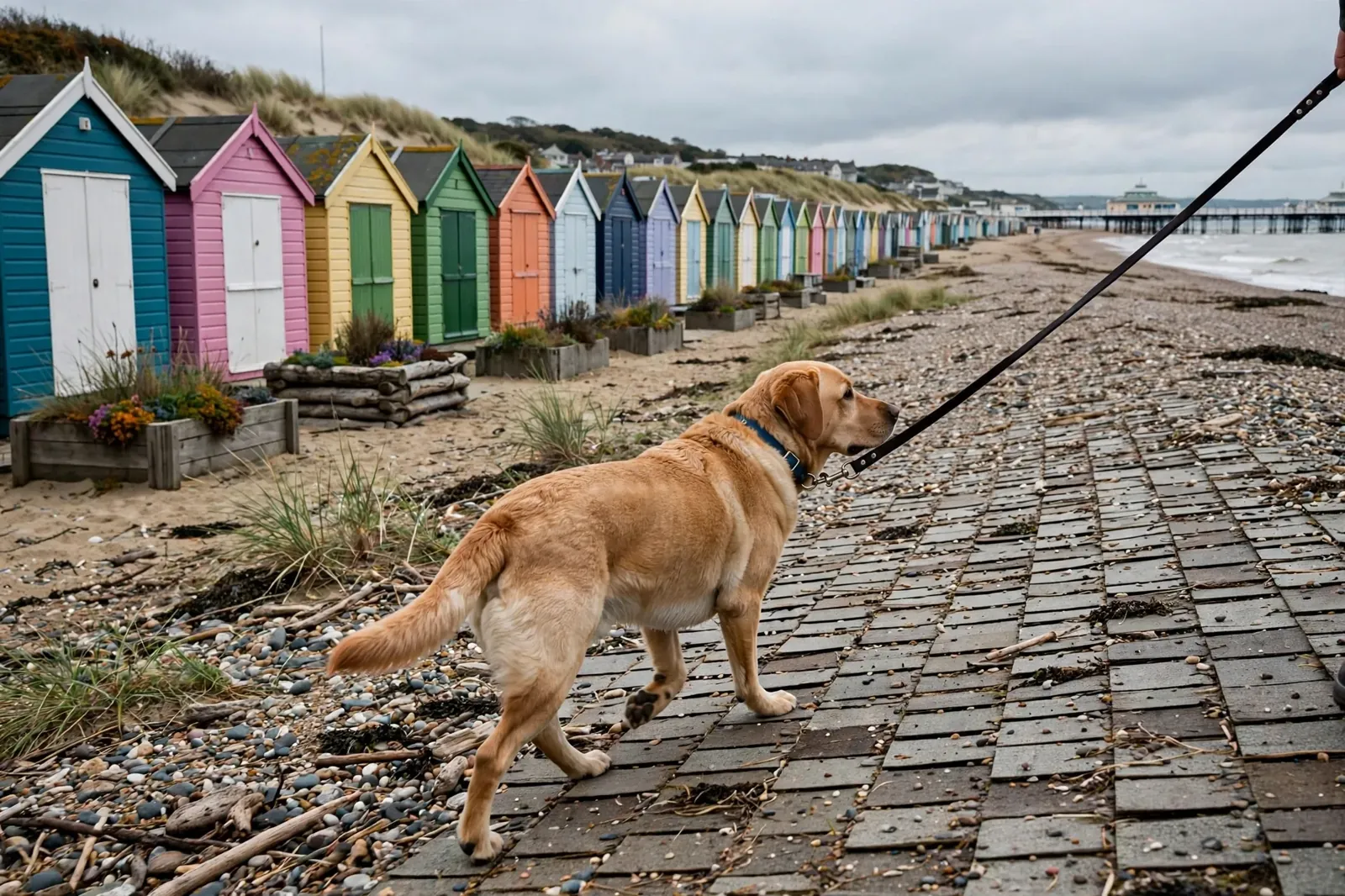
Beyond the Angles Way, Bungay makes a good base for day trips across the Suffolk and Norfolk border country. The market town of Harleston, a short drive away, offers its own lanes and a quieter shopping street. Beccles and the southern Broads give you bigger water, boat traffic and riverside paths where dogs need close control near moorings. For a coastal contrast, a day trip to the Suffolk coast pairs perfectly with a Bungay stay: our Southwold with a dog guide covers pier walks, lighthouse trails and beach-by-beach rules, and the wider Suffolk coast dog guide explains which beaches stay open all year and where seasonal restrictions apply. The coast is roughly an hour's drive from Bungay, which makes it a full day out rather than a casual add-on, so plan it as its own trip with its own tide and parking checks.
Closer to home, the villages around Bungay repay a short drive and a walk. Earsham and Ditchingham, just across the river in Norfolk, have quiet lanes and church walks; Mettingham, a few miles to the south-east, has the remains of its own castle, a smaller and more overgrown cousin of Bungay's that appeals to walkers who like their ruins properly romantic. Bungay also sits within reach of the Broads National Park's southern edge, where the rivers Yare and Waveney meet a landscape of reedbeds, windpumps and boat traffic. Broads paths are generally flat and easy, but they bring their own dog rules: keep dogs out of reedbeds where birds nest, on leads near moorings and boat traffic, and well away from water where the bank is soft or the current is strong.
Whatever longer route you choose, pack for the valley rather than for the town. The Waveney valley is flat, which makes distances deceptive: a walk that looks easy on the map can still tire a dog through sheer length, especially in warm weather with little shade on the marshes. Carry more water than you think you need, plus a bowl, a lead and a long line for the open stretches, and a towel for muddy banks. Mobile signal can be patchy in the valley bottom, so download or print your route before you leave Bungay, and tell someone your planned route and return time if you are walking alone. A well-planned valley stage is one of the best dog walks in East Anglia; an unplanned one, with a tired dog miles from the car, is a lesson nobody enjoys learning.
Practical planning: parking, pubs, vets and wet weather
Parking in Bungay is straightforward by market-town standards, and the town's car parks put you close to everything in this guide. The car parks near the castle and the Market Place are the most practical starting points: from them you can reach the castle grounds, the river meadows and the town trail on foot, without moving the car between stops. Check the signs on arrival for time limits, charges and any maximum stay, because these details change, and a ticket bought for two hours is no help on a four-hour walk. On market days and during popular events, the central car parks fill earlier, so arrive in the morning if you want a central space, or accept a slightly longer walk from a quieter street. Never leave a dog in a parked car in warm weather, even with a window cracked: a car heats dangerously fast, and a dog left in one is at risk within minutes.
For food and drink, Bungay's pubs and cafes around the Market Place and the old lanes are the heart of the dog-friendly offer. Several venues welcome dogs, often with a water bowl by the door and a quiet corner where a dog can settle under a table. Policies vary from venue to venue and can change with ownership or with the season, so the reliable approach is to ask before you settle in, keep your dog on a lead, and choose a table where the dog is out of the main walkway. A dog that can lie quietly for half an hour while you eat is a dog that will be welcomed back; a dog that barks at every passing plate or begs from neighbouring tables is a dog that tests a landlord's patience. If your dog struggles to settle in busy rooms, pick a quieter hour, sit outside when the weather allows, or take food away and eat it on a bench by the river instead.
Self-catering visitors should plan around the town's food shops and the weekly market. Bungay's independent food shops and market stalls cover most daily needs, but a dog's special diet, medication or preferred food is not something to assume you can buy locally at short notice, so bring it with you. The same applies to practical kit: spare leads, poo bags, a towel, a drying coat and any regular medication should travel with the dog, not sit in a bag back at the accommodation. A small day bag packed the night before makes the difference between a relaxed morning and a series of small errands that eat into walking time.
Veterinary cover is a detail to sort before you need it. Bungay has veterinary provision in and around the town, and larger practices serve the Waveney valley from Beccles, Harleston and Norwich. Before your trip, save the number of a local practice and the number of the nearest out-of-hours emergency service, and check the official guidance before you travel for current opening hours. If your dog takes regular medication, bring a supply plus a day or two extra, and carry a note of the dosage and your own vet's number. River walks add their own health notes: check for ticks after commons and meadow walks, watch for cuts from flint and broken stone around the castle, and keep an eye out for blue-green algae warnings on slow rivers in warm weather, when dogs should be kept out of affected water entirely.
Wet weather in Bungay is not a reason to cancel, but it does change the plan. The town trail holds up well in rain: the lanes are surfaced, the churches and Market Place can be enjoyed from doorways and covered spots, and cafes become the natural refuge. The castle grounds and the commons, by contrast, turn muddy quickly, and the lowest meadows can flood after heavy rain. On a wet day, shorten the riverside walk, stick to the firmest paths, and save the full Outney Common circuit for a drier day. Pack a drying coat or two towels, a waterproof mat for the car boot, and a change of socks for yourself: the walker who plans for mud enjoys the walk, while the walker who does not spends it regretting thin shoes.
Finally, a note on seasons and timing. Spring and autumn are the sweet spots for Bungay with a dog: firm paths, mild temperatures, wildflowers or autumn colour, and fewer crowds. Summer brings the best market atmosphere and the longest evenings, but also heat on the castle mound, limited shade on the commons and the need for early or late walks. Winter offers quiet streets and crisp valley light, with mud and short days as the trade-off. Whichever season you choose, Bungay's formula stays the same: castle first, river second, town third, and a pub or a bench at the end of it all. It is a small town that understands dogs without making a fuss about it, and that, for most dog owners, is exactly the point.
Practical questions
Before you go
Can dogs go into the grounds of Bungay Castle?
Dogs are generally welcome in the castle grounds on a lead, but opening days and any conditions can change with the season and with events, so check the official guidance before you travel and keep your dog close around the ruins, other visitors and the uneven stonework.
Is Outney Common safe for dogs off the lead?
Outney Common suits off-lead walking when the ground is dry and no livestock is grazing nearby, but cattle graze the common at times and the River Waveney runs alongside it, so use a lead near animals, the riverbank and other walkers, and recall your dog before you reach the water.
Where is the best place to park in Bungay with a dog?
The town car parks near the castle and the Market Place are the most practical starting points, because they put you within a short walk of the castle grounds, the river meadows and the town trail; check the signs on arrival for time limits and charges, as these can change.
Are dogs welcome in Bungay pubs and cafes?
Several pubs and cafes around the Market Place and the old town lanes welcome dogs, often with a water bowl and a quiet corner, but policies vary by venue and can change, so ask before you settle in and keep your dog on a lead under the table.
What is the best longer walk from Bungay with a dog?
The Angles Way along the Waveney valley is the classic longer option, with waymarked stages towards Beccles in one direction and towards Harleston and Diss in the other; pick a single stage for a day walk, plan your return route in advance, and carry water, because riverside stretches have little shade on hot days.