This guide is independent and contains no paid placement. If affiliate links are added later, they will be clearly marked and will not change our editorial checks.
Woodbridge is a tide-timed town visit: check tide times before you go, keep the dog on a lead on the quay and near mud, enjoy the mill and the market streets, and save the longer river walks for a safe tide and firm ground.
Read the tide before you walk
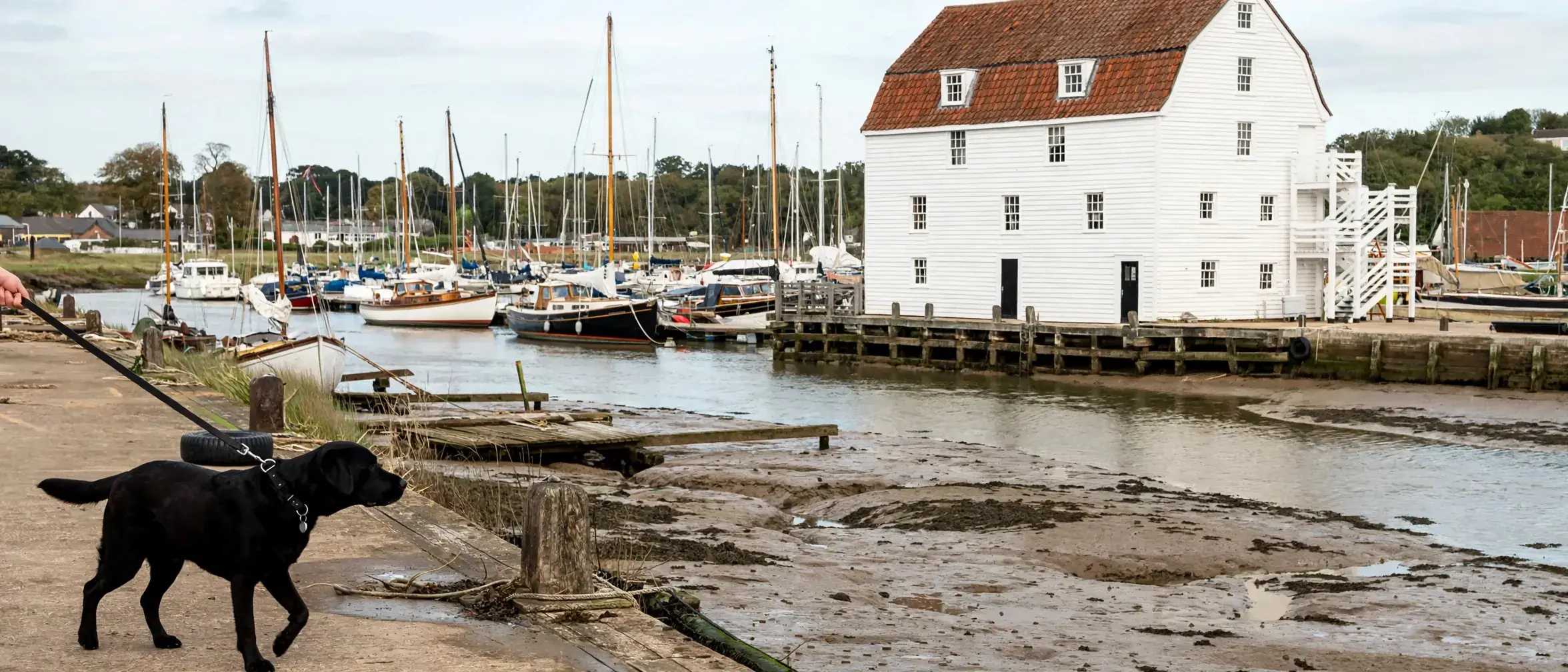
Woodbridge does not run on shop hours; it runs on the Deben. Twice a day the river climbs the quay wall, floats the yachts that were leaning in the mud, and fills the Tide Mill pond, and twice a day it drains away again, leaving grey mudflats, feeding redshanks and a narrow channel threading toward the estuary mouth. The board on the quay posts that day's high and low water, and the notice at the Tide Mill door states when the wheel is turning; those two Woodbridge postings outrank anything written in this guide. Plan the walk from them, because a quay that looks like a harbour at noon can look like a muddy valley by late afternoon, and the dog's walk changes with it.
High water and low water give a dog two different Woodbridges, and neither needs the foreshore to be enjoyable. At high water the Deben laps the quay wall, dinghies bob beside their parent yachts, and a dog can watch the whole working river from stone that stays dry underfoot. At low water the same stretch becomes a birdwatching gallery: curlews probe the mud, egrets stand in the remaining pools, and the Tide Mill stands white and exposed against the empty riverbed. The riverside track above the mud suits both states, because it keeps paws on firm ground while the river changes below, and it lets a dog that loves water watch it without stepping into a tide that is already on its way back.
The tide also sets the rhythm for everything beyond the quay. A walk that starts beside a floating fleet can end beside stranded hulls, and the light on the Deben changes with the water level as much as with the hour. Morning high water brings gulls, ropes and the smell of salt into the town centre, while an evening low water leaves long shadows across the mudflats and a quieter quay for a slower sniffing walk. Neither hour is wasted, provided the walk is shaped around the quay board's times rather than squeezed into a gap between other plans. Woodbridge rewards a visitor who lets the Deben decide the order of the day.
The quay and the Tide Mill
The quay at Woodbridge is a working strip, not a promenade built for strolling, and its character comes from that fact. Yachts sit on the mud at low water with their keels exposed, boatyard cranes and stacked timber mark the working end, and the white Tide Mill anchors the far end where the mill pond meets the river. A dog walking here passes coiled ropes, mooring chains, fish boxes and boat owners carrying sails, and every one of those objects belongs to a working river rather than to a visitor attraction. The pleasure is in watching a tidal town do its ordinary business, with the dog close beside the quay wall and away from the water's edge where the stone drops to mud or open water.
The Tide Mill gives the quay its story, because it is a mill driven by the Deben itself rather than by a stream. Incoming tide fills the pond behind the mill, and the stored water is then released through the wheel, so milling follows the river's timetable instead of a fixed opening routine. The notice at the Tide Mill door states when the wheel is turning and whether dogs step inside that day, and that Woodbridge notice, together with the quay tide board, outranks anything written in this guide. Even from outside, the mill repays a pause: the pond, the sluices and the white weatherboarded building explain why this stretch of river has fed and employed the town for centuries.
Quay surfaces deserve a dog owner's attention in a way that a town pavement does not. Wet stone near the slipway, algae on the lower steps, loose gravel beside moorings and the sudden drop from quay to mud all punish a lunging dog more than a steady one. Gulls will tempt a chase, a moored yacht's halyard will clink in the wind, and a heron standing motionless in the channel will hold a dog's gaze. Holding the lead short here is less about obedience than about geometry: the quay is narrow, the water is close, and a dog that darts sideways meets either a rope, a passer-by with boat gear, or the river itself.
Market streets and shops
From the quay, Woodbridge climbs uphill into the Thoroughfare, and the change of slope marks a change of mood. The river's ropes and gulls give way to butchers, bakers, bookshops, delicatessens and antique rooms packed along one long market street, with side lanes dropping back toward the Deben and the church tower watching over the rooftops. Dogs here meet a denser world: prams, shopping baskets, delivery trolleys, café chairs spilling onto pavements and the overlapping smells of fresh bread, coffee and river air carried uphill. A dog that walks the Thoroughfare well is a dog that can hold a steady pace past all of that without pulling toward every doorway.
On a market day the Thoroughfare fills in a specifically Woodbridge way, with stalls extending the shopfronts rather than replacing them, so the street becomes a slow-moving queue of neighbours, visitors and dogs. The crowds gather where the street narrows, where a stallholder is chatting, or where the pavement dips toward a side lane, and a dog can be squeezed between a stall and a shopper. Choosing the wider stretches, stepping into a side lane when the press thickens, and keeping the walk to the length the dog genuinely enjoys all matter more here than covering the whole street. A short Thoroughfare wander that ends at a café is a better Woodbridge morning than a forced march from quay to church and back.
Shopping from the quay upward also means carrying everything uphill on the return, and a dog owner feels that slope twice: once with the lead in one hand and once with bags in the other. The sensible Woodbridge pattern is to walk the river first, browse the Thoroughfare second, and buy last, so that heavy bags do not turn the downhill return into a tug-of-war beside moored boats. Market food belongs in a bag rather than in a dog's mouth, because Thoroughfare delicatessen counters sell spiced, salted and rich food made for people, and a dog that samples its way along the street arrives at the quay with a stomach already complaining. The street rewards browsing slowly and buying late.
Sutton Hoo and the wider landscape
Sutton Hoo sits across the Deben from Woodbridge, reached over Wilford Bridge and then across heathland that looks out over the river valley, and it changes the scale of a Woodbridge day entirely. Where the quay is compact and tidal, Sutton Hoo is open and still: grassy burial mounds rising from heath and woodland, wide Suffolk skies, and viewpoints where the Deben appears as a silver thread below. The mounds themselves are the walk, low and unadorned, and their power comes from what lies beneath them, an Anglo-Saxon ship burial that rewrote what historians thought early England could build. A dog walking the mound field walks through a landscape that is simultaneously a nature reserve, a farm edge and a burial ground.
The ground at Sutton Hoo asks for a different kind of attention than the quay. Heathland paths cross open grass where skylarks sing overhead, woodland tracks dip into shade, and the river viewpoints invite a long stand rather than a quick photograph. Grazing animals, ground-nesting birds in season and other walkers all share ground that is deliberately left looking unmanaged, so a dog that ranges wide here disturbs more than it would on a town pavement. Keeping the dog close on the mound field and the heath paths protects both the archaeology underfoot and the wildlife overhead, and it leaves the long views intact for everyone who has come to stand quietly among the mounds.
A Sutton Hoo walk pairs best with a Woodbridge day when it is treated as the day's second landscape rather than as an extra attraction bolted onto a town morning. The exhibition building and the house are a separate indoor stop with their own arrangements, distinct from the mound field and heath paths, and a visitor who wants to see them should plan that stop around the dog rather than expecting the dog to wait through it. For many dogs the better rhythm is quay and Thoroughfare in the morning, a rest, and then the mound field in softer afternoon light, when the heath is quieter and the views across the Deben toward Woodbridge are at their best.
River walks beyond the town
Upstream from Woodbridge, the Deben narrows into a quieter river, and the riverside track follows it past reedbeds, grazing marshes and willow-lined banks toward Melton. This is the walk for a dog that has had enough of quay stone and Thoroughfare pavements and wants grass, water smells and distance. The track stays above the mud for most of its length, which matters, because the river below it is tidal all the way upstream and the foreshore beside it is the same soft Deben mud that traps boots at the quay. Views back toward Woodbridge open at every bend: the Tide Mill white against the trees, the church tower above the rooftops, and yachts making their slow way downriver on a rising tide.
Downstream, the river widens toward its estuary mouth, and the walking changes with it. The banks become more exposed, the water takes on the full breadth of the estuary, and sailing boats appear in greater numbers as the channel deepens toward the sea. Saltmarsh plants fringe the path, waders work the mud in large flocks, and the far bank carries the low outline of the coast beyond the river mouth. This downstream stretch suits a dog that enjoys wind, open sky and the sound of rigging, but it also exposes a walker to weather in a way the sheltered upstream track does not, so a downstream walk chosen on a still morning can feel like a different route by afternoon if the estuary wind rises.
Both directions share one Woodbridge discipline: walk out along the firm track, and return by the same firm track, rather than improvising a loop across fields or foreshore. Farm tracks beside the Deben change with cropping and grazing, field gates lead into working land rather than public loops, and a shortcut that looks dry on a map may end at a flooded ditch or a tidal creek. A river walk measured by enjoyment rather than distance suits the Deben best: walk until the dog is happily tired rather than exhausted, turn at a bridge or a viewpoint, and finish back on the quay where the town, the water and a resting place are all within a few minutes of each other.
Boats, pontoons and water manners
Woodbridge earns its sailing reputation on the Deben, and a dog owner sees that reputation most clearly in the moorings that line the river. Yachts of every size sit on the mud at low water, their masts forming a forest above the quay, and at high water the same fleet floats free, with dinghies ferrying owners between shore and boat. Boatyards work along the river, with hulls ashore for painting, masts stepped and unstepped, and the sounds of sawing and rigging drifting across the water. A dog watching this from the quay wall is watching a working river, not a marina display, and the boats, gear and slipways are all part of somebody's livelihood rather than scenery arranged for visitors.
A pontoon at Woodbridge is a private gangway, not a public pier, and that distinction shapes how a dog should meet the sailing world. Gangways slope with the tide, decks move underfoot, and a yacht's cockpit is a small, enclosed space where a wet, excited dog can damage sails, cushions and instruments in seconds. Dogs belong on the quay wall watching boats, not on pontoons, decks or slipways unless the boat's owner has invited them aboard by name. The gap between quay and yacht is also a genuine hazard: a dog that leaps for a deck and misses lands in tidal water between stone and hull, where the current, the hull and the quay wall leave little room for a dignified rescue.
The Deben's other river users complete the picture, and they pass close enough to the quay that a dog notices every one. Rowers slide past in near silence, kayakers launch from the slipway and paddle into the channel, anglers stand along the banks with lines in the water, and sailing races on a fair weekend fill the river with white sails tacking between moorings. A dog that barks at a passing dinghy, lunges toward a rower or splashes after a kayak turns a working river into a hazard for everyone on it. Watching from the quay wall, with the dog settled beside its owner while boats pass, is the Woodbridge way of joining the sailing town without getting in its way.
Mud, tides and keeping safe
Deben mud is not beach sand, and the difference is the single most important safety fact in this guide. The grey mud that appears at low water around Woodbridge looks flat and walkable from the quay wall, but much of it is soft, deep and glutinous, holding a boot, a paw or a leg with a suction that strengthens as the walker struggles. Channels cut through the flats fill first on a rising tide, so a dog that runs happily across apparently firm mud can find itself separated from the quay by a fast-filling creek within minutes. The mudflats belong to waders and wildfowl, built for them, and a dog's enthusiasm is no qualification for walking where curlews feed.
If a dog does run onto the Deben mud, the worst response is to follow it. A person who steps onto the same soft ground adds a second rescue problem to the first, and the tide that is coming for the dog is coming for its owner too. The safer Woodbridge response is to stay on the quay wall or the firm riverside track, call the dog back toward solid ground in a steady voice, and shout for help from quay bystanders or harbour workers if the dog cannot free itself. Emergency responders and people who know the Deben's channels deal with mud incidents regularly, and a stuck dog with its owner calling from firm ground is far safer than a dog and an owner both stuck in the same flat.
After any Deben walk, a dog's paws tell the story of where it has been, and Woodbridge mud writes a long one. Salt, silt and small sharp shells cling to paws and belly fur, and the same mud that looks harmless from the quay can hide debris washed downriver. A rinse with clean water at the end of the walk, a check between the toes for shells and grit, and a towel for the belly before the car all belong to the Deben routine. A dog that has swallowed river water or mud during a paddle should be watched for stomach upset afterward, and persistent sickness after a Deben walk is a matter for a vet rather than for waiting it out at home.
Pubs, cafes and a settled stop
Woodbridge's pubs and cafes divide naturally into two kinds of stop, and a dog owner can choose between them by mood and by tide. Quay-side rooms look out over moored yachts and the Tide Mill, with windows framing the Deben as it rises and falls, while Thoroughfare cafes sit amid the market street's bustle, with bakery smells, bookshop browsers and the sound of the town going about its day. Both kinds of room welcome dogs in many of their spaces, but the welcome is a matter of each room's own arrangement rather than a town-wide rule, and the sign at the door of each Woodbridge pub or café shows that day's arrangement more reliably than any general statement.
The rhythm of a Woodbridge pub or café stop follows the walk that preceded it. A dog that has covered the quay and the Thoroughfare arrives ready to lie down, and a stop that matches that tiredness, with time to watch the tide from a window, suits it far better than a long meal in a crowded room. Lunchtime on the quay brings boat owners, walkers and shoppers together in a small space, while a late afternoon stop, when the tide is turning and the light softens over the Deben, gives a dog a quieter room and a calmer end to the day. Choosing the quieter hour is a kindness to a dog that has already spent its energy on the river.
Evening in Woodbridge belongs to the quay, and a final pub or café stop there has a character no inland town can copy. As the tide fills the river again, yachts lift off the mud one by one, the Tide Mill stands reflected in the returning water, and the quay's lights come on over boats that were stranded hours earlier. A dog that has watched that transformation from a quayside window has had the full Woodbridge day: mud, boats, market street, river air and the return of the water. Ending the visit at that hour, rather than rushing for the road while the river is still changing, lets the dog finish the day as it began it, beside the Deben and watching the tide.
Parking and staying overnight
Parking in Woodbridge is arranged around the town rather than around the river, and that geography is worth understanding before driving in. Signed town car parks sit back from the quay, up toward the Thoroughfare and its side streets, and the walk from them to the river is downhill, short and part of the visit in itself. The quay itself is a working harbour edge, kept clear for boat trailers, boatyard vehicles and the turning space that sailing needs, and it is not a place to leave a car while its owner walks the town. Each Woodbridge car park posts its own tariff and time limits at its entrance, and market-day arrangements differ from ordinary weekdays.
Staying overnight turns Woodbridge from a day trip into a tidal routine, and the town rewards that slower pace. Early morning on the quay, before the shops open, belongs to boat owners, gulls and dog walkers, while evening brings the returning tide and a quieter Thoroughfare as the day's visitors leave. Woodbridge also works as a base for the wider Suffolk coast: follow the Deben toward its mouth and then north along the coast for a Deben-mouth-to-Aldeburgh day on the Suffolk shore, or continue further up the same coastline for a run north to Southwold's pier and lighthouse town. Returning afterward to a familiar quay, a familiar mill and a familiar pub is the particular pleasure of a Woodbridge base.
A day visit to Woodbridge needs no grand finale, because the river provides one on its own schedule. A last loop of the quay at slack water, watching the yachts settle or lift with the tide, gives a dog a calm ending after the excitements of mud smells, market street and river track. Paws rinsed of Deben silt, a belly towelled after a riverside track, and a dog settled in the car with the quay behind it make for a quiet drive home. Woodbridge does not need to be exhausted in a single visit: the Deben will run its tides tomorrow, the Tide Mill will turn again, and the quay will be there, changed and unchanged, for the next walk.
Practical questions
Before you go
Is the River Deben at Woodbridge safe for dogs to paddle in?
Shallow water at the quay edge at slack water is the only sensible paddling place, and the Deben's channel and mud rule it out for much of the day. The quay tide board shows when the river is slack, and a dog should paddle only where the bottom is firm stone, never where grey mud begins or the channel current runs.
Can dogs walk on the quay and around the Tide Mill?
Yes, the quay and the outside of the Tide Mill are a dog walk in themselves, with the mill, the pond and the moored fleet visible from the quay wall. The notice at the Tide Mill door states whether dogs step inside that day, and that Woodbridge notice, together with the quay tide board, outranks anything written in this guide.
Are dogs allowed at Sutton Hoo near Woodbridge?
The mound field, heath paths and viewpoints at Sutton Hoo are the dog walk, with burial mounds, woodland tracks and views across the Deben valley. The exhibition building and the house are a separate indoor stop with their own arrangements, distinct from the open ground, so plan the indoor stop around the dog rather than expecting the dog to wait through it.
Where is the best place to park in Woodbridge with a dog?
Use a signed town car park set back from the quay, up toward the Thoroughfare, and walk downhill to the river from there. The quay edge itself stays clear for boat trailers and boatyard vehicles, and each car park posts its own tariff and time limits at its entrance for that day.
What is the biggest hazard for dogs on the Deben mudflats?
Soft, sinking Deben mud combined with a fast incoming tide that fills the channels first. A dog that runs onto the flats can be cut off from the quay within minutes, and a person who follows adds a second rescue problem, so stay on the quay wall or the firm riverside track and call for help from firm ground.
Are pubs and cafes in Woodbridge dog-friendly?
Many rooms on the quay and along the Thoroughfare welcome dogs, especially quayside rooms overlooking the moored fleet. The sign at the door of each Woodbridge pub or café shows that day's arrangement, and a dog that settles at its owner's feet with the river or the street to watch has found the town's version of a rest.