This guide is independent and contains no paid placement. If affiliate links are added later, they will be clearly marked and will not change our editorial checks.
The Suffolk coast works brilliantly with a dog if you plan by section, not by town name. Some shingle stretches welcome dogs all year, the busiest resort fronts often restrict dogs in season, Dunwich needs cliff-aware walking, and RSPB Minsmere generally limits dogs — so check the official latest guidance before you travel and read every entrance sign on the day.
Why Suffolk suits dogs — and where it catches people out
The Suffolk coast has a particular rhythm that suits many dogs: long shingle beaches, wide skies, fishing towns with proper promenades, and heathland and forest sitting just behind the shore. Distances between highlights are short by car, so a day can combine a beach walk, a town lunch and a shaded inland loop without a long drive in between. For dogs that dislike the intensity of larger resorts, the quieter stretches between the main towns are often the highlight of the whole trip.
What catches people out is the assumption that one town means one rule. On this coast, dog access is usually managed by section: a central, lifeguarded or promenade-front stretch may restrict dogs in the main season while the beach a ten-minute walk away welcomes them. Add eroding cliffs around Dunwich, protected heathland where ground-nesting birds breed in spring and summer, and a major nature reserve at Minsmere with strict limits for dogs, and the coast rewards a little homework. None of this is complicated once you know to look for it — but it does mean the entrance sign, not a social media post from last year, is the authority on the day.
This guide separates what is generally reliable from what you must verify locally. Where rules vary by season, tide or conservation need, it says so plainly and advises checking the official latest guidance before you travel. For the national picture on bans, fines and how restrictions are enforced, read our guide to dog-friendly beaches in the UK: rules, bans and fines explained alongside this one, then apply the Suffolk detail below.
Beaches open all year: how to find the reliable stretches
Year-round dog access on the Suffolk coast is most commonly found away from the busiest central fronts: the quieter ends of resort beaches, less-developed shingle stretches between towns, and beaches without a formal promenade scene. These are rarely secret, but they are also rarely the section photographed on postcards. The practical method is to pick your town, then look at the map board at the beach entrance, which normally shows the dog zone, any lead requirement and the seasonal dates in force. If no board is visible, walk the promenade until you find one rather than guessing from where other dogs happen to be.
Dunwich beach, away from any cliff-edge concerns covered below, is often valued precisely because it feels spacious and unhurried, with room for dogs to settle without constant passing traffic. Quieter stretches north and south of the main Southwold front, and less central sections around Felixstowe, can offer a similar feel outside restricted zones — but treat every named beach in this guide as “check the current signs” rather than a permanent promise, because councils review zones and dates. A beach that was open to dogs last October may have a revised order this year, and enforcement follows the current order, not your memory.
Tide matters almost as much as the rules. Much of the Suffolk shore is shingle that shelves steeply, and at high tide the usable strip can narrow dramatically, pushing everyone — dogs, families and anglers — into the same band. Plan beach time around mid to low tide for space, carry water because shingle reflects heat in summer, and note that soft paws can struggle on sharp shingle over long distances. A short beach session plus a heath or forest walk often suits a dog better than an entire day on stones, however appealing the sea looks.
Swimming deserves a cautious word. Steep shingle shelves can drop quickly, currents strengthen around groynes and river mouths, and cold water affects dogs as well as people. Keep dogs out in rough conditions, avoid throwing balls into deep water off a shelving beach, and rinse salt and shingle grit from coats and paws afterwards. If your dog is a determined swimmer, a long line and a harness give you control without a chase along the tide line.
Seasonal restrictions explained: Aldeburgh, Southwold and Felixstowe
Seasonal restrictions exist for understandable reasons: the central beach in a resort town in August is crowded, hot and full of picnics, and a dog ban or lead zone on that specific section reduces conflict for everyone. The mistake is to read “dogs restricted at Southwold” as “no dogs in Southwold”, or the reverse — to assume that because dogs are visible on one stretch, the whole beach is open. Restrictions are normally drawn on a map with clear start and end points, often a groyne, a slipway, steps or a named landmark, and they usually apply only for the main season, commonly spring through early autumn. Exact dates, zones and whether a ban means no dogs at all or dogs on leads only are set locally, so check the official latest guidance before you travel and confirm on the entrance sign.
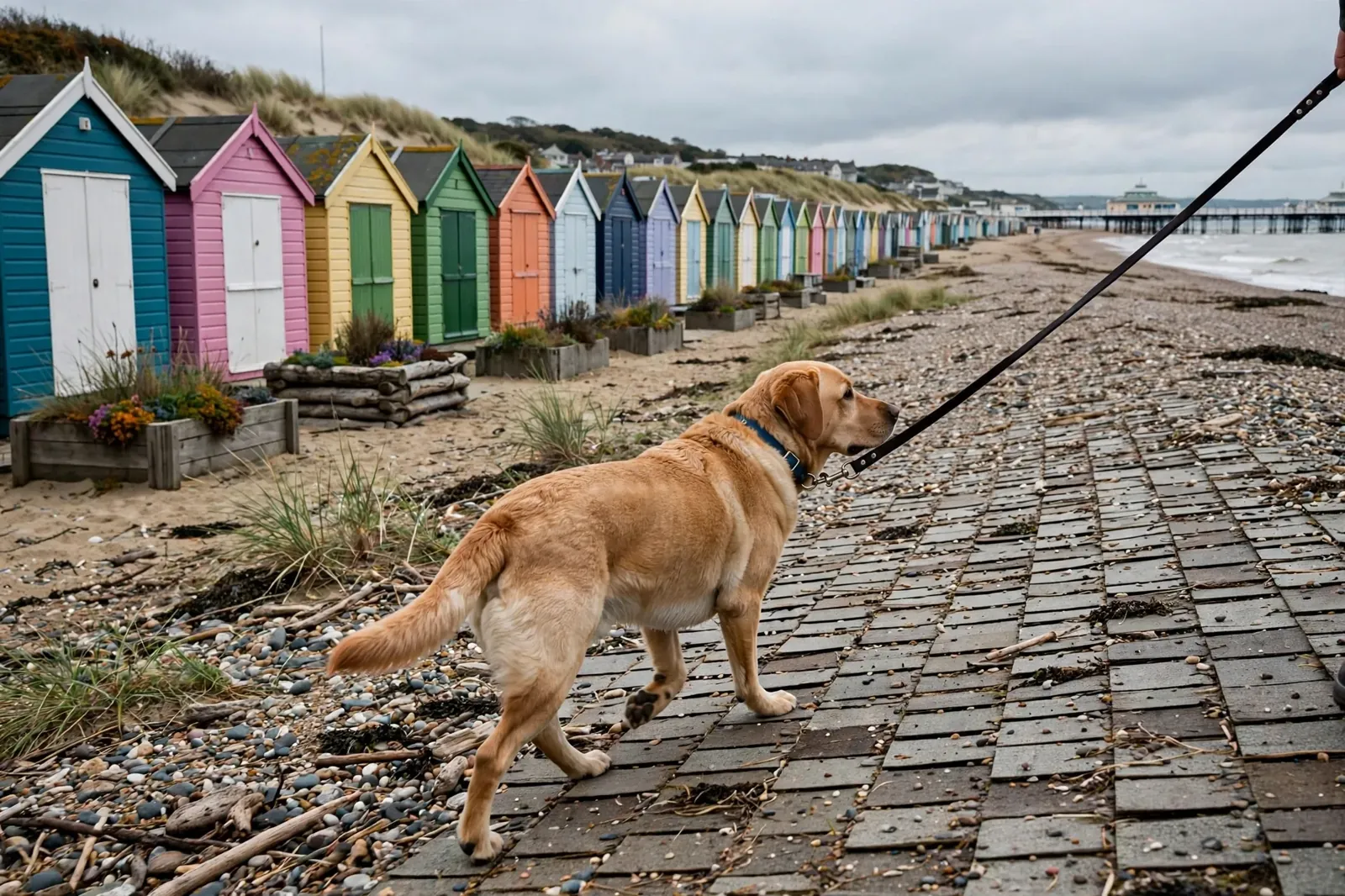
At Southwold, the famous beach huts and pier area form the busiest core, and that core is where seasonal controls are most likely. The useful approach is to arrive knowing there may be a restricted central section and a more dog-welcoming stretch within walking distance, then navigate by the signs rather than by hope. The promenade itself has its own expectations — dogs on leads, close control around the huts and cafés — even where the beach beyond is open. Treat hut rows as someone else’s front garden: no tying leads to hut steps, no dogs wandering onto verandas, and no ball games weaving between them.
Aldeburgh follows a similar pattern in miniature: a working shingle beach, fishing boats, a lively high street set back from the shore, and a central section where seasonal rules need the most care. North and south of the busiest part, the character changes quickly, and the walk towards Thorpeness along the shore or inland paths is a popular way to give a dog a longer, quieter outing — with the same warning about reading signs at each access point, because a boundary can sit partway along what looks like one continuous beach. Felixstowe, larger and more traditional as a resort, again concentrates its controls around the busiest leisure and promenade sections, with quieter stretches towards the edges of town and towards Felixstowe Ferry. In all three towns, the pattern is identical even though the maps differ: centre equals caution, edges equal space, signs equal truth.
If you are travelling in high season with a dog that needs off-lead exercise, build the day around it deliberately. Do the big beach run early, before heat and crowds, on a section you have verified is open, then switch to lead-on town time, shade and water for the middle of the day. Our round-up of dog friendly cafes in the UK explains how to judge whether a café genuinely welcomes dogs or merely tolerates them at the door — a distinction that matters in busy Suffolk towns where terrace space fills fast.
Dunwich: erosion, cliffs and a lost town beneath the sea
Dunwich is the Suffolk coast at its most atmospheric and its most fragile. The small present-day village sits beside the remains of a once-significant medieval port, much of which has been lost to coastal erosion over centuries, and the process has not stopped. The cliffs here are soft, crumbling and actively eroding. That single fact should shape every walk with a dog: this is lead-on, edge-aware country, not a place for a dog to race along a cliff top or scramble at a cliff base.
Keep dogs on a lead anywhere near the cliff top, stay well back from any cracked, slumped or undercut edge — further back than feels necessary, because soft cliffs can fail beyond the visible crack line — and avoid walking close beneath the cliffs on the beach, where material can fall without warning. After heavy rain or storms, be extra cautious, follow any closure or diversion signs, and accept a shorter walk. On the beach itself, keep clear of fresh falls: dogs love investigating new mounds of earth, and a slip or a secondary fall is a genuine risk. If a path is fenced or signed as closed, the closure is there because the ground has moved, not as a formality, so retrace your steps rather than ducking around it.
None of this should put you off Dunwich; it should simply set the terms. The beach walk at a sensible distance from the cliff base, the heath behind the village, the ruins and the museum story of the lost town, and a village pub stop make a memorable half day at a dog’s pace. What it does not suit is autopilot walking — phone in hand, dog ranging ahead along the edge. Give the cliffs your attention, keep the lead short near any drop, and Dunwich gives back one of the most distinctive coastal walks in Suffolk.
Pack for the terrain as well as the view. Shingle and cliff-top paths can be exposed with little shade, so carry water for the dog, plan rest stops off the edge paths, and check paws for grit and small stones after shingle sections. In winter, wind off the North Sea makes this coast feel colder than the forecast suggests, for dogs as well as people; an older or thin-coated dog may appreciate a coat here even if it never wears one at home.
RSPB Minsmere and dogs: plan for very limited access
RSPB Minsmere, between Dunwich and Sizewell, is one of Britain’s best-known nature reserves, protecting reedbeds, lagoons and heath that support breeding and wintering birds of national importance. That status is exactly why dog access is generally very limited. As a rule of thumb, dogs are not part of a normal Minsmere visit: most reserve trails, hides and wildlife-watching routes are not open to pet dogs, and any exceptions are narrow, specific and liable to change. Check the official latest guidance before you travel — specifically the RSPB’s own Minsmere visiting information — and do not build a day around bringing a dog onto the reserve without confirming the current position.
The practical solution is to split the day rather than force it. If some of your group want proper birdwatching time at Minsmere, pair it with a separate dog walk on nearby coast or heath where dogs are welcome under control, and take turns rather than leaving a dog in a car — never an option in warm weather, and a poor one in any weather. Alternatively, choose a different focus for a dog-centred day: the Dunwich area, heathland walks outside the reserve’s restricted trails, and town time in Southwold or Aldeburgh give a full day without testing reserve rules at the gate.
Surrounding a famous reserve, you will also meet tighter expectations on neighbouring land during breeding season: leads on heath, staying on paths, and giving roped or signed areas a wide berth. Treat those requests as part of visiting a living landscape rather than red tape. A dog under close control here protects species that nest on the ground in the open — birds a walker may never see until a dog is almost on top of them. If your dog’s recall falters around wildlife, Minsmere’s wider neighbourhood is long-line territory, full stop.
Piers, towns and practical stops: Southwold, Aldeburgh, Felixstowe
Suffolk’s coastal towns are a strength for dog owners because the practical bits — parking, water, food, shade, a shorter alternative walk — are close to the beach. Southwold’s pier is the obvious landmark: a working pier with amusements and food, busy at peak times, and best approached with dogs on short leads and realistic expectations. Whether dogs can go onto a pier, into arcades or inside cafés varies by venue and can change, so check venue signs and ask at the door rather than assuming; promenade and outdoor seating are the dependable options, and a dog that settles under a table will have a far better town day than one expected to enjoy a crowded arcade.
In Southwold town, plan around pinch points: narrow pavements near the high street, queues outside popular food shops, and a promenade that mixes cyclists, children and hut owners carrying deckchairs. Early or late in the day suits reactive dogs far better. Aldeburgh offers a slightly calmer version of the same pattern, with the bonus of a high street where independent shops and food stops sit a short lead-walk from the shingle, plus cultural landmarks for the humans while the dog rests in shade. Felixstowe adds a larger resort promenade, gardens above the beach and the very different, quieter hamlet feel of Felixstowe Ferry at the mouth of the Deben — worth knowing about for a calmer walk, with strong currents near the river mouth making it a keep-dogs-out-of-the-water spot without local knowledge.
Practicalities that make or break a Suffolk beach day are unglamorous. Parking near popular fronts fills by late morning in season, so arrive early or use town car parks and walk in. Carry poo bags beyond the minimum — promenade bins exist but beach stretches may have none for a mile — and carry water, because beach cafés queue and dogs cannot wait as patiently as people. Note where the nearest vet is before you need one, especially if you are staying rurally. Finally, rinse and dry the dog properly back at base: salt, sand and shingle dust in ears, armpits and between toes cause more post-holiday vet visits than any dramatic incident.
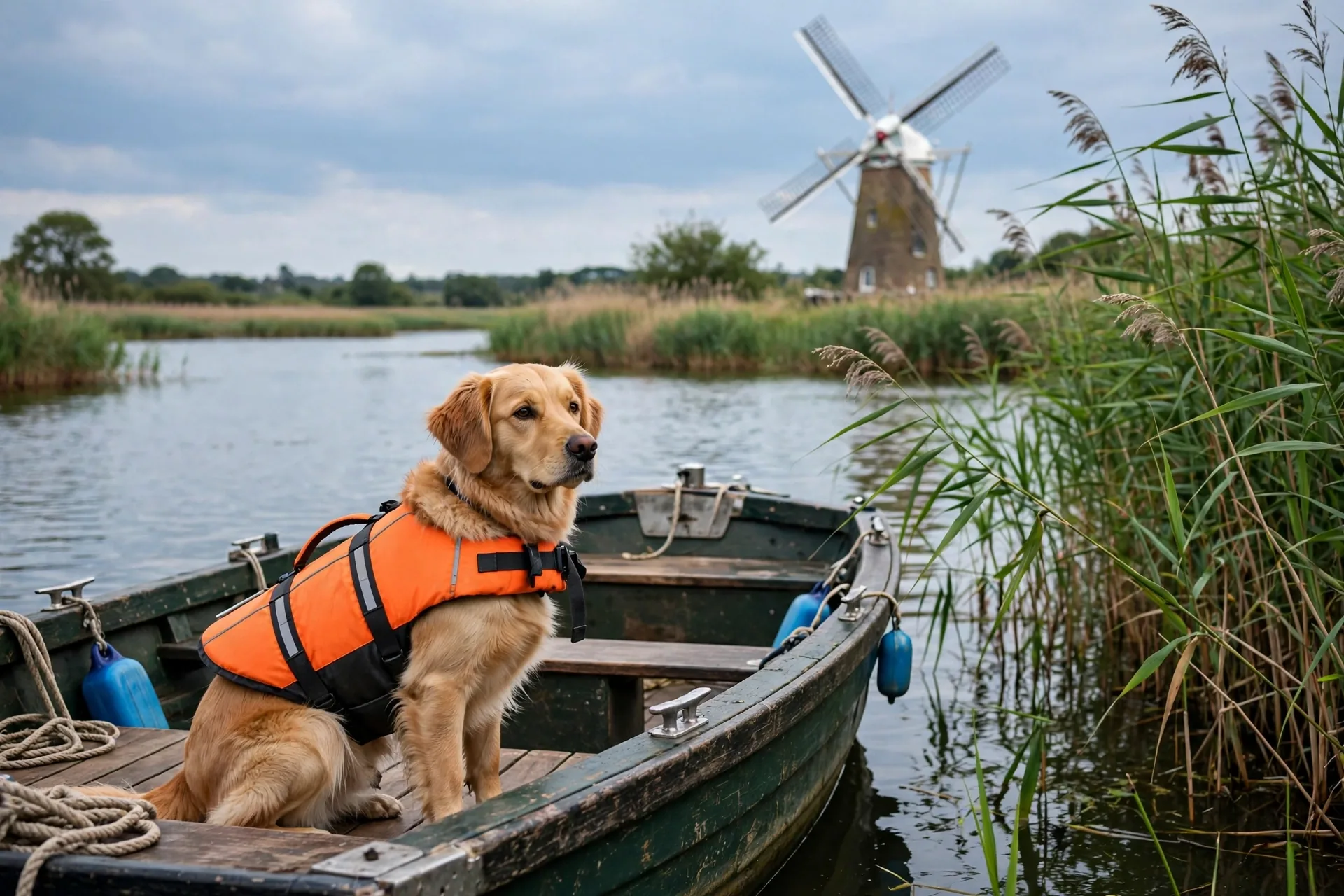
If you are extending east-coast time into Norfolk, the neighbouring guide to the Norfolk Broads with a dog covers boat hire, bank-side walks and water safety in a landscape that pairs naturally with a Suffolk coast stay.
Heathland and nesting season: the short-lead rule that matters
Behind the Suffolk shore lies a strip of lowland heath — the Sandlings — a rare and fragile habitat of heather, gorse and open sandy ground. It is beautiful walking and, in spring and summer, it is a nursery. Birds such as nightjars, woodlarks and Dartford warblers nest on or near the ground here, exquisitely camouflaged and extremely vulnerable to disturbance. A dog does not need to catch anything to cause harm: putting a bird up repeatedly can expose eggs or chicks to predators and weather, and nests can be abandoned after close encounters.
The expectation during nesting season, broadly spring into summer with exact dates set locally, is simple: dogs on a short lead, walkers on clear paths, and no ranging across open heath, however empty it looks. Outside nesting season, some heaths allow more freedom, but many reserves and commons ask for leads or close control year-round near livestock, on restoration areas or around ponds. Read the car park board — heath entrances almost always have one — and treat its map as your plan. Check the official latest guidance before you travel if your trip depends on a specific heath walk in spring.
Heathland has two other dog-specific notes. Adders live in this habitat and are most active in warmer months; a lead and staying on the path are the best prevention, and any suspected bite is an immediate vet emergency — carry the dog if you can and go straight, do not wait to see. Second, heath offers little shade and sandy paths heat up; early morning and evening walks suit dogs best in a hot spell, with forest blocks such as Rendlesham and Tunstall offering shaded alternatives nearby for the middle of the day, subject to their own signs about leads, forestry work and wildlife.
Handled this way, heath walks become a highlight rather than a restriction: skylarks overhead, the smell of warm gorse, and a dog trotting a sandy track on a short lead, content with scent alone. The lead is not a lesser walk here — it is what makes the walk possible in a landscape this sensitive.
A practical Suffolk day plan with a dog
A reliable pattern for a Suffolk coast day starts early on the beach, rests through the busy middle and finishes with a gentle town or heath stroll. Aim to be on a verified dog-welcoming section by mid-morning at the latest in season, when the tide gives you width and the temperature is kind. Give the dog the day’s main exercise then: swimming only if conditions are calm and the section allows it, ball play away from other beach users, and plenty of unhurried sniffing on the shingle and along the promenade planting, where half the interest of a beach lives for a dog.
By late morning, move into town mode: lead on, water offered, a café or pub stop where dogs are genuinely welcome, and a shaded rest while the beach is at its busiest and hottest. This is the moment to re-check the plan against reality — a tired, warm dog does not need a heath walk at noon in July. Use the afternoon for the second, shorter outing: a heath or forest loop on a lead, a quieter beach section as the crowds thin, or the walk between two towns at an amble, with a final swim or paddle if the tide and signs allow.
Build a wet-weather and a high-wind fallback before you need them. Onshore winds make exposed shingle unpleasant fast, and a dog that loves the beach in calm weather may hate it in a gale. Forest trails, town browsing with dog-welcoming shops, and a long lunch where the dog can settle are proper plans, not consolation prizes. And on any day, the closing routine is the same: paws checked and rinsed, fresh water, food at the usual time, and a note of which section, car park and café actually worked — because the single best Suffolk dog guide for your next visit is the record of this one.
Staying for a week rather than a day, rotate the coast rather than repeating one beach: a Southwold-centred day, an Aldeburgh and Thorpeness day, a Dunwich and heath day with Minsmere handled as a human-only or split visit if birdwatching calls, and a Felixstowe day if you are based south. Rotation spreads the walking, varies the scent landscape for the dog, and means a seasonal restriction or a closed path on one morning never sinks the holiday — you simply swap the order and go elsewhere.
New Suffolk town guides, published 2 November 2026
For town-by-town detail, start with the new guides for the places named below. Each one covers local walks, seasonal rules, parking and pubs for that town, and links back to this coast overview.
- Beccles with a Dog: River and Quay Walks
- Bungay with a Dog: Castle Ruins and Waveney Walks
- Eye, Suffolk with a Dog: Castle Park Town Guide
- Saxmundham with a Dog: Market Town Base Guide
- Orford with a Dog: Castle, Estuary & Quay Guide
- Walberswick with a Dog: Beach, Marsh & Ferry Guide
- Dunwich with a Dog: Cliffs, Heath & Lost City Guide
- Thorpeness with a Dog: Mere, Beach & Village Guide
- Kessingland with a Dog: Beach, Dunes & Coast Path
- Lowestoft with a Dog: Easternmost Beach Guide
Practical questions
Before you go
Are dogs allowed on Suffolk beaches all year?
On some stretches, yes, but not everywhere. Quieter shingle beaches and sections away from the main resort fronts often welcome dogs year-round, while central sections at places such as Southwold, Aldeburgh and Felixstowe commonly have seasonal restrictions. Always check the signs at the beach entrance on the day, and check the official latest guidance before you travel, because zones and dates can change.
Which Suffolk beaches have seasonal dog restrictions?
Seasonal restrictions most often apply to the busiest central sections of resort beaches, typically during the main holiday season, while ends of the same beach may remain open to dogs on a lead or off lead. Southwold, Aldeburgh and Felixstowe are the places to check most carefully. Read the map on the entrance sign rather than assuming the whole beach follows one rule.
Is Dunwich beach safe for dogs?
Dunwich can be a rewarding walk with a dog, but treat the cliffs and eroding edges with real respect. Keep dogs on a lead near cliff tops, stay away from cracked or undercut edges, and do not walk close to the base of cliffs where falls can happen without warning. After storms, give the area extra caution and follow any local closure signs.
Can I take my dog to RSPB Minsmere?
Access for dogs at RSPB Minsmere is generally very limited because the reserve protects sensitive wildlife. Dogs are typically not permitted on most reserve trails, with limited exceptions that can change. Check the official RSPB guidance for Minsmere before you travel, plan an alternative walk nearby, and never assume a dog can enter hides or the visitor routes.
Do dogs need to be on a lead on Suffolk heathland?
During ground-nesting bird season, usually spring and summer, keep dogs on a short lead on heathland and stay on clear paths. Even a friendly dog can flush a nesting bird without touching it. Follow reserve and heath signs, use a lead whenever asked, and check the official latest guidance before you travel for current dates.