This guide is independent and contains no paid placement. If affiliate links are added later, they will be clearly marked and will not change our editorial checks.
Begin at the far end of Southwold Pier and look back: the lighthouse, the painted beach huts, the church tower and the harbour mouth all line up from there, and the layout of the whole dog day suddenly makes sense. Then walk back along the pier, follow the seafront to the lighthouse, and pick your beach stretch deliberately, because Southwold's dog rules change from one section of sand to the next and with the season.
The view from the end of the pier
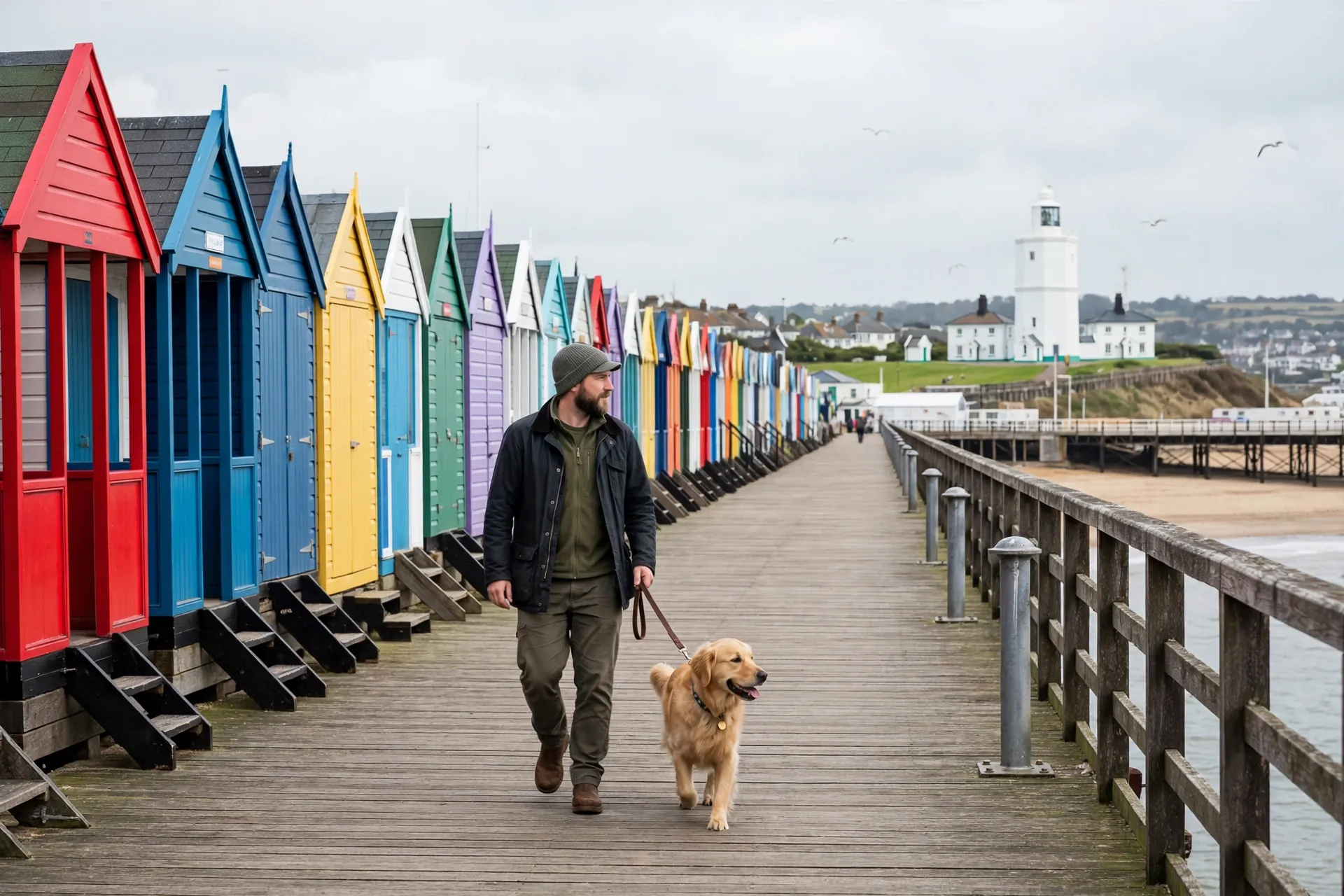
Most visitors meet Southwold from the car park or the High Street, street by street, and only gradually work out where the sea is. Dogs do better with the opposite approach. Walk straight out to the end of the pier first, stand at the rail with your dog beside you, and turn around. From out there, the town reads like a map. To one side runs the long line of brightly painted beach huts along the promenade, backed by the white tower of the lighthouse rising above the rooftops. Inland, the church tower marks the old town centre, and to the south the harbour mouth and the River Blyth cut the coastline where the ferry crosses to Walberswick. Once you have seen that whole shape in one glance, every later decision, which beach to aim for, which street leads back to the car, where the wind is coming from, becomes easier.
The pier-end view also tells you something useful about the wind and the water before your dog's feet ever touch sand. The North Sea off Suffolk is open and exposed, and the breeze at the pier end is usually stronger than it feels in the sheltered streets behind the seafront. If your dog is small, elderly or noise-sensitive, that first gust is advance warning: choose the sheltered side of the beach huts for the first walk, keep the lead short on the boardwalk, and save the open cliff-top stretch for the calmer part of the day. If the sea is flat and the sky is clear, the long walk north along the beach becomes the obvious prize. Either way, five unhurried minutes at the pier end replaces half an hour of uncertain wandering in town.
There is a practical reason to start here too. The pier is the one place in Southwold where dogs, people, amusements, food smells and other dogs all arrive at once, and it is the best low-stakes test of your dog's mood for the day. A dog that settles on the boardwalk, watches the gulls without lunging and walks calmly past other dogs will cope happily with the promenade and the town. A dog that is already over-aroused at the pier end is telling you to skip the busy central beach, head for the quieter northern or southern stretches, and keep the town centre for a calmer moment later. Listen to that first read, and the rest of the day arranges itself around the dog you actually have rather than the itinerary you imagined.
Walking the pier with a dog
Southwold Pier is a working pleasure pier, not a quiet boardwalk, and that distinction shapes how to walk it with a dog. The deck is long, wooden and busy in season, with shops, amusements, a restaurant and food outlets along its length, and the famous water-clock amusements that draw crowds. Dogs are commonly welcome on the pier itself on a lead, but individual businesses set their own rules, so a dog that is fine on the open deck may not be welcome inside a particular shop or eatery. Keep your dog on a short lead throughout, keep to one side of the deck so other visitors can pass, and be ready to step aside near doorways where queues form. Check the official guidance before you travel, because pier rules and opening times can change with the season.
Timing matters more on the pier than anywhere else in Southwold. Early morning, before the day-trippers arrive, the pier is a calm, breezy walk with room for a dog to sniff the railings and watch the fishing boats. Mid-afternoon on a summer Saturday it is a different place: pushchairs, ice creams, dropped food, excited children and other dogs in close quarters. Neither version is wrong, but they suit different dogs. A confident, sociable dog will enjoy the buzz; a reactive or nervous dog will do better with the early slot, or with skipping the pier interior altogether and walking the promenade beneath it instead. The under-pier beach and the promenade give you the same sea air without the bottleneck.
A few pier-specific habits keep the walk smooth. Wipe or rinse paws afterwards if your dog has walked on wet boards, because salt and splinters are both possible on weathered timber. Carry water rather than relying on a bowl at a food outlet, and do not tie a lead to a railing while you go inside somewhere: a tied dog on a busy pier is stressed, in the way, and at risk from passing dogs. If you want a sit-down meal on the pier, check the dog policy of that specific restaurant before queuing, and have a promenade picnic as your fallback. The fallback matters, because nothing sours a dog day faster than a hungry owner arguing about a rule at a doorway.
Finally, treat the pier as a route, not a destination to be endured. Walk out, enjoy the view back towards town described above, and walk back. The round trip is short enough to fit before a beach walk, long enough to tire a small dog, and it gives you a natural decision point: from the pier foot you can turn north towards the quieter sands, south towards the harbour, or inland into town. Every good Southwold dog day starts with that choice made deliberately rather than by drift.
The lighthouse walk
From the pier, the lighthouse walk follows the seafront north past the beach huts, and it is the most photogenic stretch of the whole town for a dog walk. The lighthouse itself, a white tower built in the late nineteenth century, stands slightly inland from the promenade among the town's streets, and its striped top is visible from almost everywhere along the seafront. The walk to it is flat, paved and easy underfoot, which makes it ideal for older dogs, puppies on short outings and anyone pushing a dog buggy. Dogs stay on a lead along the promenade, which is shared with walkers, runners and cyclists, so keep to the seaward side where there is room and give cyclists a clear line.
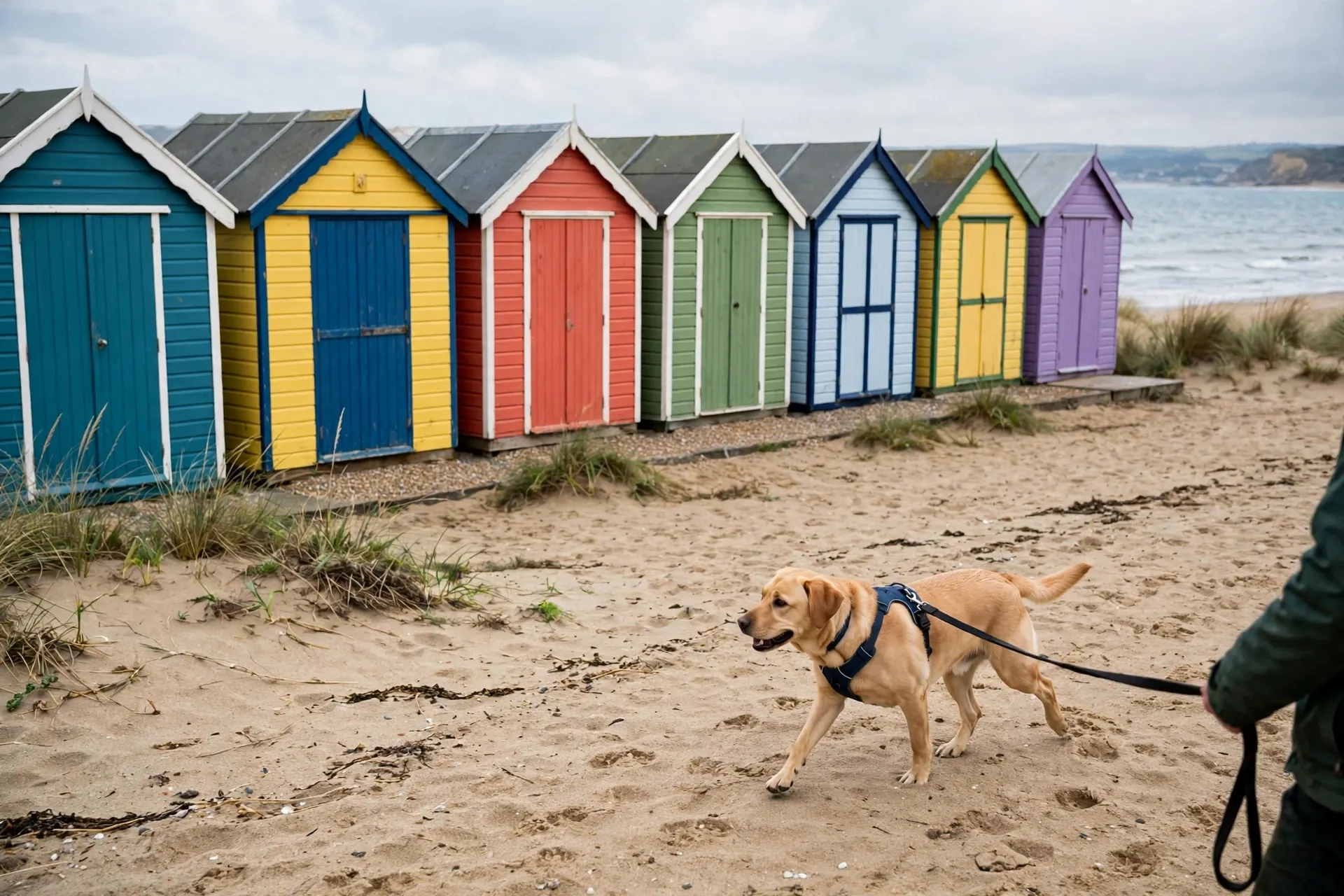
The beach huts deserve a slower look than most visitors give them. Painted in a long row of bright colours, they are privately owned and mostly used by their owners rather than rented by the day, but the row itself is part of the walk's character, and dogs photograph beautifully against it in morning light. Do not let your dog cock a leg on a hut door or nose at somebody's private deck: the huts are people's property, and a little lead discipline here is the difference between a welcome dog and a nuisance. If your group is curious about renting a hut for a day elsewhere on the coast, our guide to dog-friendly beach huts in the UK explains how hut rules, beach restrictions and costs usually work.
The lighthouse is a working navigational aid operated by Trinity House, and public tours run on selected days rather than all year. Tours are not designed around dogs, so if your group wants to climb the tower, plan for one person to wait outside with the dog and enjoy the streets around the lighthouse instead. That is no hardship: the surrounding lanes, with their flint cottages and small greens, are among the prettiest dog-walking streets in Suffolk, and a slow loop around the lighthouse, down to the promenade and back, makes a perfect twenty-minute leg-stretcher between beach and lunch. Check the official guidance before you travel for current tour days, because they vary by season.
Extend the lighthouse walk north and the town thins out pleasantly. The promenade gives way to the open beach and the dunes towards the northern stretches, and the crowds fall away with them. This is where a dog that needs a proper run, rather than a polite promenade stroll, finally gets its chance, subject always to the beach section rules covered next. Walk until the beach huts end, then judge by your dog: a dog that is still pulling for the horizon wants the open sand, while a dog that is already flagging wants the short loop back through town. Either choice is a good walk; the mistake is pressing on because the map says the walk continues.
Beach by beach: where dogs can go
Southwold's beach is not one beach with one rule. It is a long sweep of sand and shingle divided, in practice and in local regulation, into sections, and the dog rules differ from one section to the next and between summer and winter. That is the single most important fact in this guide, and it is why generic advice such as "Southwold beach is dog-friendly" or "dogs are banned" is both unhelpfully vague and often wrong for the stretch you happen to be standing on. Think in segments: the central beach by the pier and promenade, the northern beach beyond the beach huts, and the southern beach towards the harbour and Gun Hill. Each has its own character, its own crowds and, in season, its own restrictions.
The central beach, in front of the promenade and the pier, is the family beach: lifeguarded in season, close to cafes and toilets, and busy on summer days. Seasonal dog restrictions typically apply to this central stretch during the summer months, which is the usual pattern for popular English seaside towns, and it is the section where a dog owner is most likely to be asked to move on. The practical response is simple rather than resentful: treat the central beach as a winter and shoulder-season playground, and in high summer walk five or ten minutes in either direction to a stretch where dogs are welcome. You lose nothing by doing so, because the sand, the sea and the light are the same, and your dog gains space.
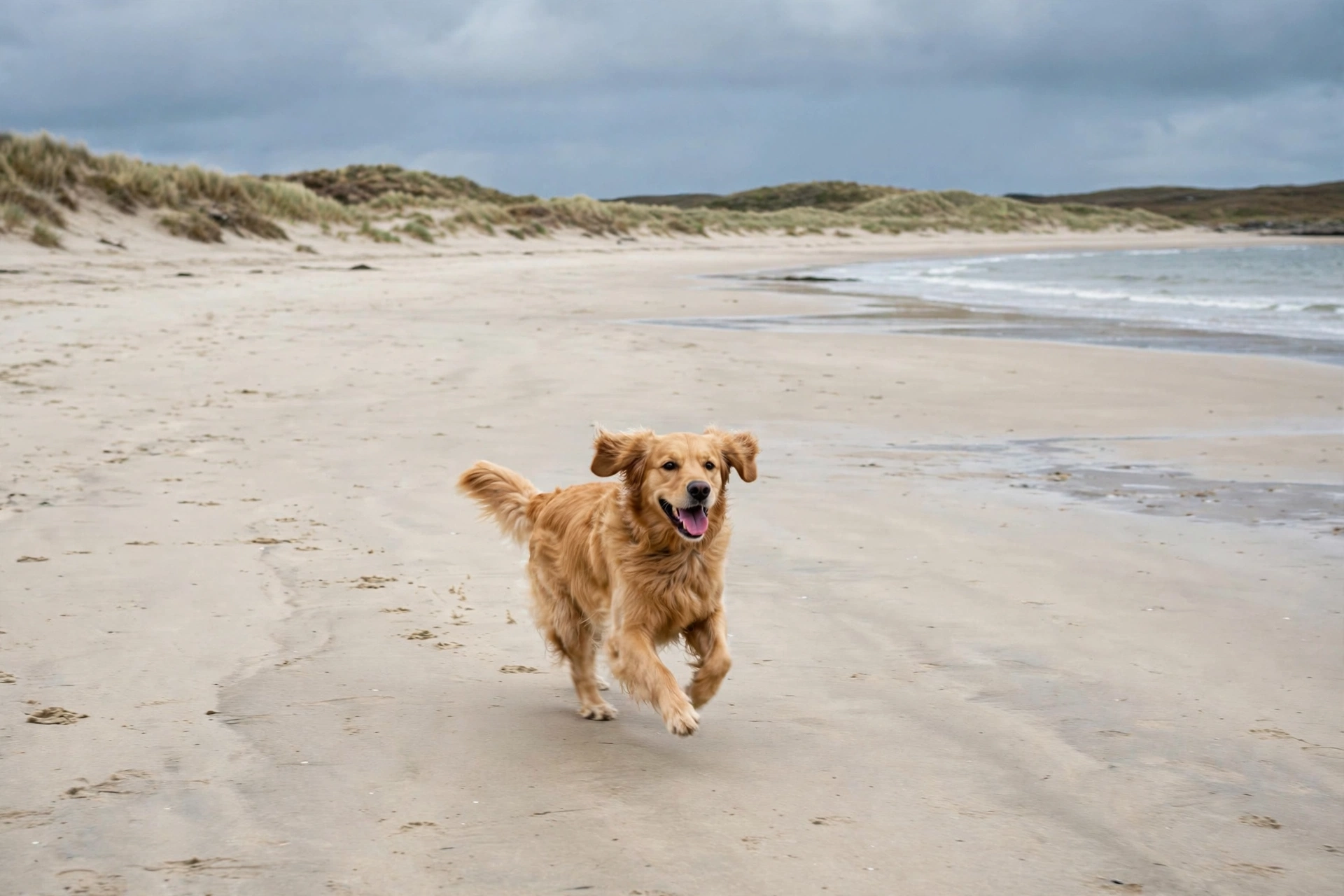
The northern beach, beyond the end of the beach huts, is usually the best all-round choice for dogs. It is wider, quieter and less managed, with room for a long-line run, a game of fetch away from sunbathers, and a proper sniff along the tideline. The trade-off is fewer facilities: no cafe immediately behind you, no lifeguard post in the same way, and a longer walk back to the car if the weather turns. Carry water, a bowl and a lead, and keep your dog away from the base of any low cliffs or dune edges where the ground can be unstable. The northern stretch also connects, for strong walkers, towards the open coast beyond the town, but do not turn a town beach day into a long-distance hike without checking tide times and your dog's fitness first.
The southern beach, towards the harbour mouth, the ferry crossing to Walberswick and Gun Hill, has a different feel again: working harbour, fishing boats, moored craft and the river meeting the sea. Dogs on leads are the norm here because of boats, vehicles, slipways and fishing gear, and the water near the harbour mouth can run fast. This stretch suits a lead walk with plenty to watch rather than an off-lead run, and it pairs naturally with a harbour-side lunch or a ferry-side wander. Keep dogs clear of nets, ropes, fish boxes and bait, and do not let a dog drink from harbour water or eat anything washed up near the quayside. For a broader picture of how seasonal beach rules vary around Britain, see our guide to dog-friendly beaches and UK rules.
Reading the signs on the day
Because beach rules are set locally and can change, the signs at each beach access point outrank any guide, including this one. Before you let your dog off the lead on any stretch of Southwold beach, stop at the access point and read the sign: it will state the section boundary, the dates of any seasonal restriction, and whether dogs must be on a lead even where they are allowed. Photograph the sign if you want a record, and if you are unsure which section you are in, ask a beach attendant, a lifeguard in season, or a local dog walker. Regulars know the boundaries by heart and are usually happy to point them out. Check the official guidance before you travel as well, because a guide written months earlier cannot know about a temporary closure, a nesting-bird restriction or a change of dates.
Seasonal restrictions, where they apply, usually follow the familiar English pattern of a summer window, but the exact dates and the exact boundary markers are local decisions, and neighbouring towns on the Suffolk coast do not all use the same dates. Do not assume that because dogs were welcome on a stretch last October, the same stretch is open in July, and do not assume that a ban in one town applies in the next. The same caution applies to dog control orders and public space protection orders, which can add lead requirements or fouling rules on top of the beach rules. A lead in your pocket and a bag in your hand cost nothing and solve almost every version of these rules.
Fouling rules apply on every stretch, in every season, whether or not dogs are otherwise welcome. Bag it, bin it, and if the nearest bin is full or missing, carry it to the next one rather than leaving it on the beach or hanging it on a fence. On a busy summer beach this is also a matter of simple neighbourliness: one unpicked-up mess near a family's picnic does more damage to the reputation of dog owners than a hundred well-behaved dogs do good. The same applies to the promenade, the pier approach and the town greens, where bins are plentiful and there is no excuse. If your dog is unwell with an upset stomach, skip the beach altogether for the day and choose a quiet lane walk instead.
Finally, remember that "dogs allowed" does not always mean "dogs off lead". Several stretches permit dogs only on a lead, particularly near the harbour, the pier and the busiest promenade sections, and a long line is often a good compromise where a full off-lead run is not permitted. A long line gives a dog room to sniff and explore while keeping you in control near other dogs, children and cyclists. Practise with it before the trip if your dog is not used to one, because a tangled long line on a crowded promenade is worse than a short lead handled well.
Promenade, green and High Street
Between beach walks, Southwold town itself is a pleasure to explore with a dog, provided you keep the pace slow and the lead short. The promenade runs the length of the seafront and links the pier, the beach huts and the lighthouse walk into one level route, while inland the town green, the churchyard paths and the High Street offer shade, water bowls outside many shops, and plenty of sniffing interest. The High Street is narrow and busy in season, with delivery vehicles and pavement displays, so walk on the quieter side, keep your dog close at crossings, and step into a doorway rather than blocking the pavement when you stop to look at a window.
The town green, a large open space near the seafront, is a useful pressure valve on a busy day. Dogs can stretch their legs there on a lead, children play at a distance, and there is room to sit and regroup before the next beach stretch. It is also a good meeting point if your group splits, with one party visiting a shop that does not welcome dogs and the other waiting outside with the dog. As with the beach huts, the rule is simple: a dog on a lead, under control, and not left tied to a bench while its owner disappears, is welcome almost everywhere in town. A dog left tied outside a shop, barking at passers-by, is the fastest way to turn a dog-friendly town less friendly.
Shops in Southwold vary in their dog policies, and the honest position is that you should ask at each door rather than assume. Many independent shops welcome dogs, some ask that dogs wait outside, and food shops understandably draw a line. The pattern that works is to send one person in while the other walks the dog around the green or the nearest lane, then swap. Nobody misses out, the dog is never left alone, and you avoid the awkward moment of being asked to leave a shop with a basket half full. The same swap system works for the lighthouse tour, for any museum visit, and for a restaurant that turns out to be dogs-outside-only.
Church and heritage sites around the town deserve the same respect. St Edmund's Church, with its famously tall tower, is a landmark worth seeing from the green and the lanes, but a dog's place is outside on a lead while the group takes turns inside, unless the site explicitly welcomes dogs. Heritage buildings often have fragile floors, narrow stairs and quiet interiors where a dog's nails and barking carry, and a short wait outside is a small price for keeping these places welcoming to future dog visitors. Plan the swap before you arrive at the door, not after you are already standing in it.
Pubs, cafes and fish and chips
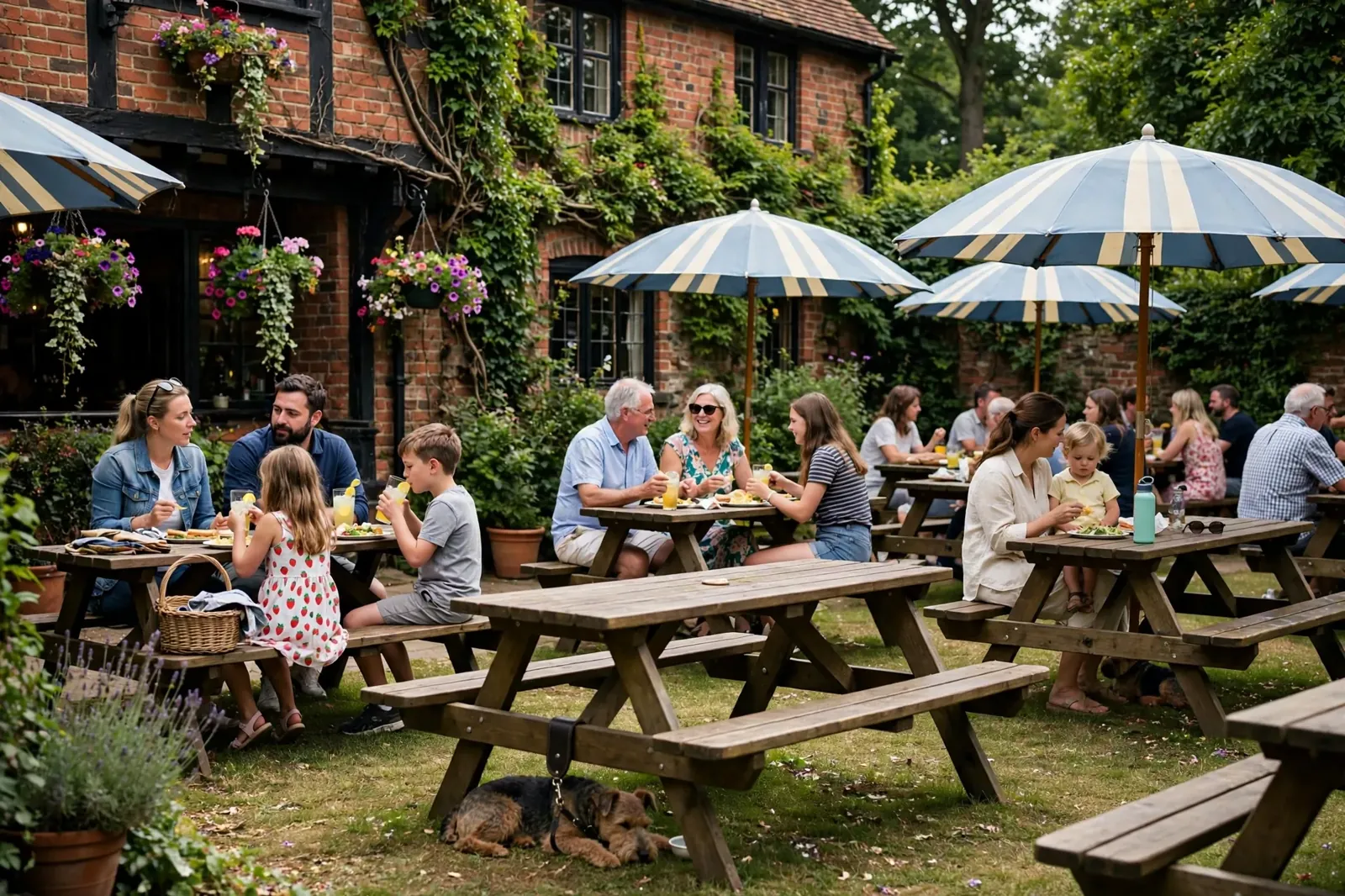
Southwold is a brewing town, home to the Adnams brewery, and its pubs are central to the social life of a dog trip here. Many pubs in town welcome dogs, often in the bar area or a designated section, and several have gardens where dogs are welcome outside. Policies differ by pub, by room and by time of day, and a pub that welcomes dogs in the bar at lunchtime may restrict them in the restaurant in the evening, so always check the specific room and the specific sitting. A dog that settles under a table with a water bowl and a chew is a pub dog; a dog that paces, barks at every new arrival or begs from neighbouring tables is a dog that needs a shorter visit and a walk first. Our guide to dogs in pub gardens and etiquette covers leads, tables, water bowls and leaving no trace in more detail, and the habits there transfer directly to Southwold's pub gardens.
Fish and chips eaten on the seafront is a Southwold ritual, and it is also one of the easiest dog-friendly meals available, because nobody needs to book a table or negotiate a policy. Buy from a takeaway, find a bench or a spot on the promenade wall away from the main flow of people, and keep your dog on a lead at your feet while you eat. Do not feed your dog chips, batter or tartare sauce: salt, fat and onion are all unhelpful for dogs, and a dog that learns that seaside chips are shared will beg at every bench for the rest of the trip. Bring the dog's own treats, keep them in a pocket, and reward calm lying-down behaviour rather than staring and whining.
Cafes along the seafront and High Street are generally more relaxed about dogs than formal restaurants, and many put water bowls outside as a matter of course. Morning coffee after the first beach walk is the sweet spot: the dog is tired, the cafe is quiet, and a settled dog under the table is no trouble to anyone. Lunchtime on a summer Saturday is the harder slot, with queues, pushchairs and other dogs in a small space. If the cafe is full and your dog is restless, take the coffee to go and drink it on the green instead. A takeaway coffee drunk calmly on a bench beats a sit-down coffee spent apologising for a barking dog.
One practical note on brewery and food tours: tastings and production tours are generally not dog outings, however dog-friendly the town feels. Plan them as a swap visit, with one person touring and the other walking the dog, or leave them for a child-free, dog-free return trip. The same applies to any indoor attraction with timed entry. Southwold rewards the visitor who treats the outdoors, the pier, the beach, the promenade and the green, as the main event, and the indoors as a pleasant extra rather than the plan the whole day depends on.
Parking and arriving well
Arriving well in Southwold means parking once and walking everywhere, because the town centre streets are narrow, one-way in places, and congested on summer weekends. Use the larger car parks on the edge of the town centre and walk in, rather than circling the pier area looking for a kerbside space that probably does not exist. Arrive early on summer weekends and bank holidays, when the town fills quickly, and have a second car park in mind in case the first is full. The walk from the car park to the pier is short, flat and part of the day, not a chore to be minimised by hunting for a closer space.
The first ten minutes after parking set the tone for the dog. Before you head for the pier or the shops, give your dog a calm toilet walk on a quiet lane or green, offer water, and let them sniff the new place without hurrying. Dogs that are rushed straight from a car into a busy pier or a crowded beach are more likely to pull, bark and toilet in the wrong place. A dog that has already emptied, drunk and sniffed arrives at the pier as a settled animal rather than a bursting one. This is especially true after a long drive down the Suffolk lanes, where a dog may have been in the car for an hour or more without a break.
Never leave a dog alone in a parked car on a warm day, even with a window cracked and even for a short errand. Cars heat up far faster than people expect, and a Southwold summer day with the sun on a windscreen is no exception. If your group needs to visit somewhere dogs cannot go, use the swap system described earlier, with one person staying with the dog. On colder days the same principle holds in reverse: a dog left in a cold car while the group has a long lunch is miserable and may bark, drawing attention and complaints. Plan the day so the dog is never the loose end.
For visitors arriving by public transport, Southwold is reached by bus from nearby railway stations, and the walk from the bus stop into town is short and dog-friendly. Keep the dog on a lead at the stop and on the bus, carry a blanket for the seat if your dog travels on one, and check the bus operator's dog policy before travelling, because policies vary. Cyclists arriving with a dog in a trailer or basket should use the promenade with care, dismounting in busy sections, and lock bikes where they will not block the pavement for other walkers and dogs.
Tides, the harbour and sea safety
The tide shapes a Southwold beach day more than most visitors expect. At high tide the sand narrows, the water reaches the sea wall in places, and the beach that looked endless in the morning becomes a thin strip where dogs, walkers and waves compete for room. At low tide the sand opens up, rock pools and wet sand appear, and the walk north becomes long and easy. Check tide times before you set out, and plan the long beach walk for a falling or low tide rather than a rising one. A dog that has to be called back from a narrowing beach because the tide has cut off the route home is a dog that has learned that the beach ends in a hurry.
Sea safety for dogs deserves the same attention as for children. The North Sea off Suffolk is cold even in high summer, and a dog that swims enthusiastically for twenty minutes can chill quickly, especially a small, lean or elderly dog. Keep swims short, dry the dog afterwards, and watch for strong currents near the harbour mouth, the pier legs and any groyne. Do not let a dog swim near fishing boats, moorings or slipways, and keep a lead on near the harbour where vehicles, ropes and fish boxes create hazards that a swimming dog cannot see. After any swim, rinse with fresh water, check paws for cuts from shells or shingle, and check ears for trapped sand and salt water.
The harbour area, where the River Blyth meets the sea, is worth a dedicated lead walk even if you do not cross on the ferry. Fishing boats land their catch here, the ferry to Walberswick runs across the river mouth, and the whole area hums with working harbour life that dogs find fascinating and that owners need to manage. Keep dogs on a short lead, away from the water's edge where there is no barrier, and away from fish boxes, nets and bait. If you take the ferry with a dog, check the ferry's dog policy before queuing, keep the dog on a lead on board, and be ready for a short, exposed crossing where wind and spray are part of the experience.
Cliff and dune safety matters on the stretches beyond the town beach. The Suffolk coast is low-lying rather than dramatically cliffed at Southwold, but dune edges and low banks can still be unstable after heavy rain, and dogs should not be allowed to dig into banks or scramble on crumbling edges. Keep to the marked paths on any cliff-top or dune section, keep dogs on a lead where the path runs close to an edge, and do not let a dog chase rabbits or birds into dune scrub where ticks and adders are a seasonal possibility in long grass. A quick tick check after a dune walk is a sensible habit from spring to autumn.
Seasons in Southwold
Spring in Southwold is a dog owner's sweet spot. The town wakes up, the beach huts reopen, the days lengthen, and the summer beach restrictions have usually not yet begun, so the central beach is still an option for a quiet morning walk. The wind can still be sharp off the sea, and spring tides and rain can leave the promenade wet, but the crowds are thin and the pubs are welcoming. Pack a waterproof coat for the dog as well as for yourself, because a spring shower on an exposed promenade soaks a short-coated dog fast, and a wet dog in a car for the drive home is nobody's idea of a good end to the day.
Summer is Southwold at its busiest and its most rule-bound. The central beach restrictions apply, the pier and promenade are crowded, parking is competitive, and every cafe has a queue. None of that makes summer a bad dog trip, but it does make it a trip that rewards early starts, the northern and southern beach stretches, and a willingness to eat takeaway fish and chips on a bench rather than fight for a table. Book accommodation early if you are staying over, because dog-friendly rooms in Southwold sell out well ahead in school holidays, and confirm the dog policy of the specific room, not just the property, before paying. Heat is a real consideration too: the shingle and promenade can be hot underfoot, shade on the open beach is scarce, and the car rule above applies with full force.
Autumn, especially September and October, is arguably the best season of all for dogs in Southwold. The summer restrictions lift, the light turns golden, the sea is at its warmest, and the town is still lively without being crowded. This is the season for the long northern beach walk, for a slow lighthouse loop in low sun, and for pub lunches where the dog is genuinely welcome rather than merely tolerated. The trade-offs are shorter days and the first autumn storms, which can close the pier or make the promenade unpleasant, so check the forecast and have a town-centre fallback walk ready. October half term brings families back for a week, but nothing like the summer peak.
Winter in Southwold is quiet, bracing and, for many dogs, the happiest season. The beaches are usually open to dogs without seasonal restriction, the town's pubs and cafes are at their cosiest, and a brisk walk along the pier followed by a fire-side rest is a perfect dog day. The costs are obvious: short daylight, strong winds, cold rain and muddy paths, and some attractions and food outlets run reduced winter hours. Pack a drying coat and a spare towel, plan the main walk for the middle of the day when the light is best, and check the official guidance before you travel for winter opening times. A winter dog trip to Southwold is not a consolation prize; for a dog that loves wind, waves and empty sand, it is the main event.
Two ready-made day plans
The pier-first day suits a first visit and a dog that enjoys people. Park on the edge of town, give the dog a toilet walk on the green, then walk straight out to the end of the pier and take in the view back towards town. Walk back along the pier, follow the promenade north past the beach huts to the lighthouse area, and loop through the lanes back to the High Street for lunch. After lunch, choose your beach stretch by the season and the signs: the northern beach for a proper run in summer, the central beach for a quiet paddle out of season. Finish with a promenade stroll back towards the pier as the light softens, and a final toilet walk before the drive home. The whole day is flat, flexible and easy to shorten at any point, which is exactly what a first visit needs.
The harbour-and-southern-beach day suits a return visit and a dog that prefers watching the world to running on sand. Start at the harbour end of town, walk the quay on a lead past the fishing boats, and watch the ferry crossing the river mouth. Follow the southern beach as far as suits your dog, keeping to the lead near boats and slipways, then cut inland through the town's quieter southern lanes to the green. Lunch is a takeaway eaten on a bench or a pub garden where dogs are welcome, followed by a slow High Street wander with the swap system for any shop that does not welcome dogs. End with the pier-end view as a finale rather than an opening, so the day closes with the whole town laid out in front of you and your dog. Both plans work in any season with the beach section adjusted to the signs on the day, and both leave room for a dog that is tired, wet or simply done to call it a day early without spoiling anything.
Whichever plan you choose, build in two rest stops that have nothing to do with sightseeing. Dogs on a seaside day trip are processing new smells, sounds, people and dogs for hours, and mental tiredness shows up as pulling, barking and inability to settle long before physical tiredness does. A twenty-minute sit on the green with a chew, or a quiet ten minutes in the car with the doors open and a bowl of water before the drive home, resets a dog more effectively than another half hour of walking. The best Southwold dog days are not the longest ones; they are the ones where the dog comes home tired, dry and calm, and the owners come home wanting to return.
Packing list and dog safety
Pack for Southwold as a seaside town, not as a generic day out. The list that covers almost every situation is short: a lead and a long line, a harness that fits over a drying coat, poo bags and a spare roll, a water bottle and a collapsible bowl, a towel and a drying coat, the dog's usual treats and a chew for pub stops, a basic first-aid kit with a tick remover, and a blanket for the car seat. Add a waterproof dog coat in spring, autumn and winter, and a cooling mat or shade cloth in high summer, when the open beach offers little natural shade. A spare lead lives in the car, because leads break, get dropped in the sea, or get chewed through at exactly the wrong moment.
Safety on the day comes down to a handful of habits. Keep the dog on a lead near the harbour, the pier, the promenade crowds and any road crossing, and only let them off where the signs allow and the space is genuinely open. Watch for fishing hooks and bait near the harbour, broken glass and fish bones on the beach, and dead birds or fish washed up on the tideline, all of which dogs investigate with their mouths. After a beach walk, check paws for cuts, ears for sand and water, and the coat for ticks after any dune or long-grass walk. If your dog eats something suspicious on the beach, note what it was and call a vet promptly rather than waiting to see if they are unwell, and save the number of a local vet before you travel, because a seaside town's practices can be a drive away and may close early.
Finally, a word on other dogs. Southwold's beaches and promenade are popular with dog owners, which means your dog will meet many other dogs, some off lead, some on long lines, some reactive, some over-friendly. Not every meeting needs to become a greeting. A short lead, a wide arc around an unknown dog, and a cheerful "not today, thanks" to an owner whose dog is rushing yours are all polite, normal dog-owner behaviour, and they keep a good day good. The dogs that enjoy Southwold most are not the ones that play with every dog on the beach; they are the ones whose owners read the beach, the signs, the wind and the dog in front of them, and choose the right stretch, the right walk and the right moment to stop. Start at the end of the pier, look back at the town, and let that view, and that dog, decide the day.
Practical questions
Before you go
Are dogs allowed on Southwold Pier?
Dogs are commonly welcome on Southwold Pier on a lead, but the pier is a working attraction with shops, amusements and food outlets, so individual businesses may set their own rules. Keep your dog on a short lead, stay clear of the amusement machines and food counters, and check the official guidance before you travel, because pier rules and opening times can change.
Which part of Southwold beach allows dogs all year?
Southwold's beach is managed in sections, and the dog rules differ from one stretch to the next, with seasonal restrictions typically applying to the central beach in the summer months. The stretches further from the town centre are generally the more dog-tolerant option, but boundaries and dates change, so check the official guidance before you travel and look for the signs posted at each beach access point on the day.
Can dogs walk to the lighthouse?
Yes, dogs can enjoy the streets and promenade walk around the lighthouse area on a lead. The lighthouse itself is a working navigational aid with guided tours that are not designed around dogs, so plan for one person to wait outside with the dog if your group wants to go inside. The walk to it, past the colourful beach huts and along the seafront, is the real reward for most dogs.
Is Southwold good for dogs in winter?
Winter is often the easiest season for a dog trip to Southwold: the beaches are quieter, seasonal beach restrictions are usually lifted outside the summer months, and the town's pubs and cafes are at their cosiest. The trade-offs are shorter daylight, stronger winds off the North Sea and muddier cliff-top paths, so pack a drying coat, plan a shorter route and check the official guidance before you travel.
Where should I park in Southwold with a dog?
Use the larger car parks on the edge of the town centre and walk in, rather than circling the narrow streets near the pier looking for a kerbside space. Arriving early matters on summer weekends, when the town fills quickly. Leave the car cool and shaded, never leave a dog alone in a parked car on a warm day, and build in a toilet walk before you head into the shops.
What should I do if my dog swims in the sea at Southwold?
Rinse your dog with fresh water afterwards, check paws and ears for sand and salt, and dry them before getting back in the car. The North Sea here is cold even in summer, so keep swims short, watch for strong currents near the harbour mouth and pier legs, and keep your dog on a lead near fishing boats, moorings and slipways.