This guide is independent and contains no paid placement. If affiliate links are added later, they will be clearly marked and will not change our editorial checks.
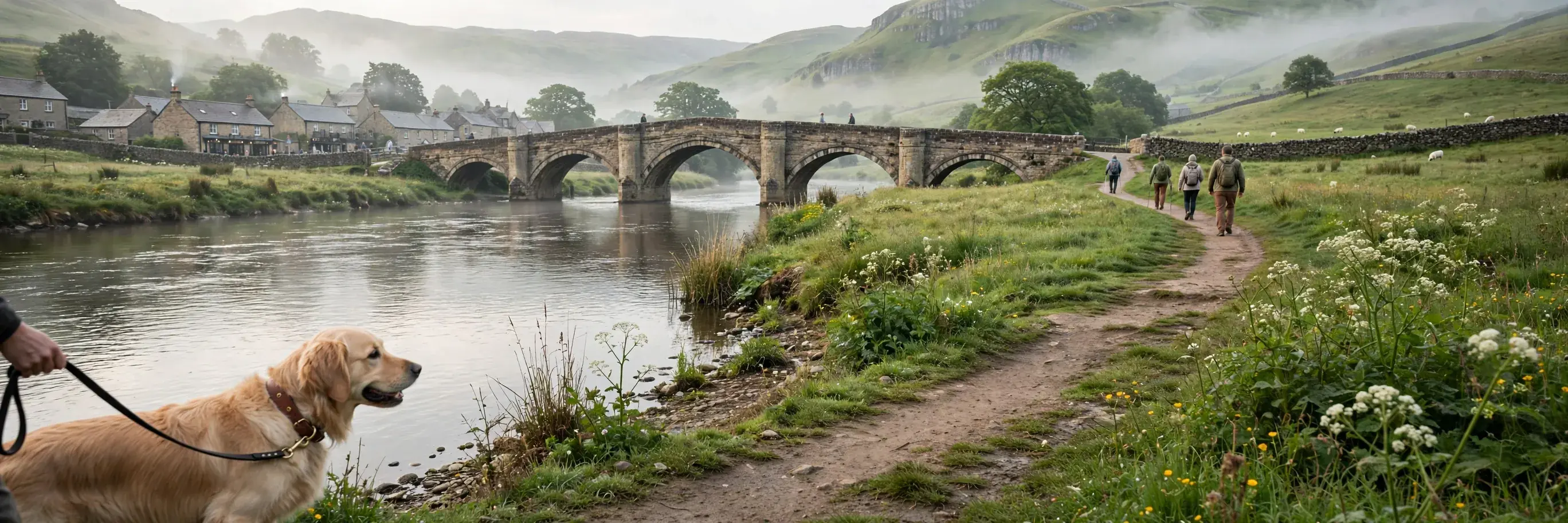
Burnsall works best as a river-first visit: park in the village, look at the Wharfe before you promise the dog a long walk, use the bridge when the water is high, and keep the dog on a lead near the bridge, the stones and any livestock.
Let the bridge decide the day
Burnsall is not a village you need to decode. You arrive, you see the green, the church and the river, and within a few minutes you understand the shape of the day. That simplicity is exactly why it suits dogs, but it also hides one decision that matters more than any other: how is the River Wharfe behaving today. A calm, low river makes the village feel open and easy, with flat riverside paths, space to sniff and a gentle loop that suits most dogs. A fast, brown river after rain changes the same paths into a place for leads, distance and restraint, and the stepping stones become a feature to admire from the bank rather than a crossing to attempt. Making that judgement before you unload the dog saves a wet, stressed start and keeps the whole visit in proportion.
The practical habit is simple. Walk to the bridge on your own first, or keep the dog close on a short lead while you look. Notice the speed of the water, whether the stones are fully visible and dry, how much bank is left beside the path, and whether other walkers are crossing comfortably or turning back. If anything feels borderline, treat it as a no. Dogs do not need to cross stepping stones to enjoy Burnsall, and the bridge gives you the same views without the risk of a slip, a fright or a sudden swim. This is also the moment to decide the length of the walk. A dog that has travelled, waited in the car or already had a busy morning may be happier with the short riverside loop, while a rested, fit dog can stretch towards Grassington and back. Let the river and the dog agree, and the rest of the village will fall into place.
Burnsall rewards a slower reading of a small place. The village green is a natural meeting point, but it is also a working village space with roads, parked cars and people coming and going, so it is not an off-lead playground. Keep the dog close there, let them sniff the edges, and use the green as a pause rather than a destination. The churchyard and the lanes behind the village are quieter, and they give a nervous dog time to settle before the more open riverside. If you are staying nearby, the same logic applies in reverse: a short evening loop after the day visitors have gone can be calmer than a midday walk, though light, river levels and livestock still set the limits. In short, Burnsall is a village where the best plan is a flexible one, built around water, weather and the dog in front of you.
The riverside loop, step by step
The classic Burnsall walk follows the River Wharfe on fairly level ground, which is why it appeals to so many different dogs. Start at the village and head for the riverbank, keeping the dog on a lead until you can see how busy the path is and how close the water sits to the walking line. The surface is generally good, but after rain it can be soft, muddy and slippery in places, so a lead gives you control if the dog lunges towards ducks, other dogs or a tempting stretch of water. Walk at the dog's sniffing pace rather than marching to a distance target. Riverside walks are rich in scent, and a dog that is allowed to investigate properly will often be more tired, and more settled, after a short loop than after a long, hurried march.
Plan the loop as a series of choices rather than a fixed circuit. The first choice is whether to cross by the bridge or to stay on the same bank and return the way you came. The second is how far to go before turning back: a short out-and-back suits puppies, older dogs and dogs that are still learning to walk calmly past strangers, while the longer route towards Grassington suits fit, confident dogs with reliable recall. The third choice is where to pause. A quiet stretch of bank, away from the bridge bottleneck, is better for a drink and a rest than the busiest viewpoint, where dogs, children and cyclists all arrive at once. Carry water even on a cool day, because river water is not a safe substitute, and bring a towel for paws and belly after a muddy stretch. If you meet a dog that is clearly reactive, step off the path, shorten the lead and wait; the riverside is narrow enough that a polite pause prevents most friction.
Think about the return leg as carefully as the outward leg. Dogs often pull more on the way back, especially if they know the car or the pub is near, and tired dogs can be less careful on uneven ground. Slow the pace, keep the lead short near the village, and give the dog a final sniffing stop before the green. If the walk has been longer than planned, do not add a second loop just because the weather is pleasant. A dog that finishes slightly keen is a dog that will enjoy the pub stop and the journey home; a dog that finishes exhausted may be restless, sore or unsettled later. The riverside loop is generous enough that you do not need to use all of it to have a proper day out, and returning early is a good decision, not a failed walk.
Stepping stones and water safety
The stepping stones at Burnsall are famous because they look simple in photographs and feel adventurous in person, but they deserve a cautious, dog-centred assessment. Stones can be wet, algae-covered, unevenly spaced or partly submerged, and a dog that jumps confidently between them on a dry day may hesitate, slip or panic when the river is higher. Small dogs face a different problem: the gaps can be wide relative to their legs, and a small dog carried across in arms is not necessarily safer if the carrier also slips. Older dogs with stiff joints, dogs with poor depth perception and dogs that dislike water should not be asked to cross at all. There is no prize for using the stones, and the bridge is a perfectly good route that keeps the dog dry, calm and safe.
If the river is low, the stones are dry and your dog is confident, cross slowly and deliberately. Keep the dog on a lead, but hold it loosely enough that a stumble does not pull you both off balance, and step one stone at a time rather than rushing. Watch the dog's body language: a low body, flattened ears, frozen steps or repeated looking back are all signals to stop and return to the bank. Do not let other walkers pressure you into crossing, and do not let a dog swim across beside you as an alternative unless you know the current is genuinely slow and the exit point is safe. Fast water, deep channels, weirs and submerged obstacles are all hazards that are hard to judge from the bank, and a dog in a strong current can be swept downstream faster than a person can follow on foot. When in doubt, check the official guidance before you travel, and choose the bridge.
Water safety continues after the crossing. Dogs that paddle should be rinsed if possible, especially after a muddy or silty stretch, and checked for cuts on paws from stones or debris. Do not let a dog drink large amounts of river water, and watch for signs of stomach upset later in the day. Swimming is not a requirement of a good riverside visit, and many dogs enjoy paddling at the edge far more than a full swim. If your dog does swim, choose a calm, shallow entry with a gentle exit, stay close, and call them out before they tire. A life jacket can help a dog that swims often, but it is not a substitute for supervision, and it should be fitted properly before the trip rather than tried for the first time at the river. Burnsall is at its best when the water is treated with respect rather than as a playground.
Fields, gates and livestock
Burnsall sits in working farmland, so the fields around the village are not empty scenery. Sheep and cattle may be grazing close to the path, and the rules that protect them also protect your dog. Keep the dog on a lead through any field with livestock, even if the animals look distant or uninterested, and keep the lead short if the dog has a strong chase instinct. Close every gate behind you, even if it was open when you arrived, and check that the latch has caught before you walk on. A dog that slips through an unlatched gate into a field of sheep can cause real harm and real trouble, and the consequences fall on the dog owner. If livestock are on the path itself, give them a wide berth, keep the dog close and quiet, and do not try to shoo animals out of the way.
Field paths also change with the farming year. Lambing season calls for extra care and sometimes for temporary route changes, while cattle with calves deserve more distance than a calm herd in summer. Muddy gateways are a practical hazard too: they are slippery for people and dogs, they collect standing water, and they are often where dogs pick up the most mud. A towel, a spare lead and a bag for waste are more useful here than any gadget. Pick up after your dog in every field, including the edges and the long grass, because farm dogs, livestock and other walkers all use the same ground. If a path is closed or diverted, follow the diversion rather than improvising a shortcut through a crop or a yard; the diversion exists for a reason, and a dog on a lead is easier to manage on a marked route than on an unmarked one.
Think about the dog's fitness for field walking as well as the rules. Uneven ground, stiles and kissing gates can be awkward for small dogs, older dogs and dogs recovering from injury. A stile that is easy for a person can be a barrier for a dog, and lifting a large dog over a stile is not always safe. Choose routes with gates rather than stiles when you can, and be ready to turn back if the next section looks unsuitable. A shorter, well-chosen field loop that ends with a settled dog is better than a longer route that ends with a lifted, stressed dog and a muddy car. Burnsall gives you that choice, because the riverside and the village loops let you adjust the day without losing the pleasure of being out.
The village green, pubs and cafes
After the walk, the village green is where Burnsall slows down. Dogs are usually welcome in at least some of the village pubs and cafes, often in a bar area or outside, but the details vary and can change with the season, so ask before you settle rather than assuming. A good pub stop for a dog is not just a place that allows dogs; it is a place where the dog has space under or beside the table, water is offered without fuss, and the staff are relaxed about a dog lying quietly on a blanket. Bring that blanket, a bowl and a chew or a quiet toy, and keep the dog on a lead throughout. A dog that has just walked beside a river will often settle quickly if the routine is familiar: water first, a short sniff around the table, then a mat to lie on.
Order with the dog in mind. A long lunch in a busy room can be hard for a young or excitable dog, while a shorter stop with a drink and a snack suits most dogs better. If the dog is restless, take a brief walk around the green before sitting down again, rather than expecting the dog to settle on command in a new room. Be careful with food at dog height: dropped chips, bones and plates left on low tables are all temptations, and a polite request for a corner table away from the main traffic can prevent most problems. If you are visiting with another dog-owning party, keep the dogs apart unless you know they are comfortable together, and do not let leads tangle across a walkway. A calm pub stop is part of the day, not a test the dog has to pass.
Cafes and tea rooms follow the same logic on a smaller scale. Outdoor seating is often the easiest option in good weather, but shade, rain and passing dogs all affect whether it works. Indoors, choose a table near the door if the dog is still settling, so you can step outside quickly if needed. Do not leave a dog tied outside a shop or pub while you go in, especially in warm weather or on a busy road; it is stressful for the dog and unfair to passers-by. If a venue says no to dogs, accept it graciously and move on. Burnsall is small, but the pleasure of the village is in its quiet, unhurried atmosphere, and a dog that is welcomed in one place and settled there contributes to that atmosphere far more than a dog dragged through every doorway.
Parking and a calm arrival
Parking in Burnsall is straightforward on a quiet weekday and competitive on a sunny weekend, so arrival time shapes the visit. Use the village car park rather than squeezing into a lane, blocking a farm gate or parking on grass that may be soft after rain. Leave room for farm vehicles and emergency access, and remember that a car parked badly in a small village causes more friction than the same car parked badly in a town. Check the official guidance before you travel for current charges, time limits and any seasonal restrictions, because signs and prices change and this guide cannot guarantee them. Arriving early also gives the dog a calmer start: fewer cars, fewer dogs and a quieter green make the first walk easier for a nervous or excitable dog.
Make the car itself part of the plan. Never leave a dog alone in a parked car in warm weather, and on a cool day keep any wait as short as possible, with shade, ventilation and water available. Before you set off, give the dog a toilet break away from the green and the churchyard, and check paws, lead, collar and waste bags. A harness that fits properly and a lead that is long enough for sniffing but short enough for control near the road will serve you better than a retractable lead on a narrow riverside path. If the car park is full, consider a later start or a different day rather than circling the village and building frustration for both of you. Burnsall is not going anywhere, and a calm arrival is worth more than an extra hour on a crowded bank.
If you are travelling by public transport or on foot from a nearby village, the same calm-arrival logic applies. Keep the dog close on the road into the village, because Dales lanes are narrow, fast in places and shared with tractors, cyclists and walkers. Let the dog settle with a short sniffing walk before the main riverside loop, and carry everything you need for the walk rather than assuming a shop will be open. Village shops have limited hours, and a forgotten water bottle or waste bag can turn a pleasant walk into an awkward one. A little preparation before you reach the river is the difference between a day that feels easy and a day that feels improvised.
River levels through the seasons
The Wharfe at Burnsall is a different river in each season, and planning around that change makes the visit safer and more enjoyable. In late spring and summer, low water usually means clear stepping stones, easy banks and plenty of paddling spots, but it also means more visitors, more dogs and more competition for quiet stretches. Early mornings and weekday visits are the simplest way to enjoy summer Burnsall without the crowds. In autumn, the light is softer, the village is quieter and the paths can be leaf-covered and slippery, so footwear and a steady pace matter more. Winter brings short days, cold water and a higher chance of a swollen river, so walks should be shorter, higher and closer to the village.
After heavy rain in any season, treat the river as the decision-maker. A river that looks only slightly high from the bridge may still be fast in the middle channel, and water levels can rise again if rain falls upstream while you are walking. Check the forecast for the whole catchment, not just Burnsall, and be ready to abandon the riverside plan for a village and field loop. Flooding can also leave silt, debris and slippery surfaces on paths that look dry from a distance. If you are staying for several days, use the first day to learn the river at its current level, and only extend walks on later days when you know what normal looks like. That patience is especially important for dogs that love water, because enthusiasm is not a safety assessment.
Seasonal wildlife and farming also shape the walk. Spring brings lambs and nesting birds, summer brings insects and warm ground, autumn brings fallen branches and mud, and winter brings ice on stone steps and shaded paths. None of these should stop a visit, but each calls for a small adjustment: a lead in lambing fields, insect checks after a summer walk, a towel and a torch in winter, and a slower pace on leaf-covered stone. If you are unsure about a seasonal rule, check the official guidance before you travel. Burnsall is a year-round village, but the best version of it in any season is the version that respects the river and the land around it.
Small, older and nervous dogs
Burnsall can be a kind village for dogs that do not want a big, bold day out, provided the walk is chosen for them rather than for the photograph. Small dogs do well on the short riverside loop, where the ground is fairly level and the distances are easy to adjust. Carry a small dog over the stepping stones if you choose to cross at all, and be honest about whether the dog wants to be carried or would rather stay on the bank. Older dogs benefit from the same short loop, with frequent pauses, a soft place to rest and no pressure to keep up with faster dogs. A dog that stiffens after a walk, lags behind or lies down repeatedly is telling you the walk was too long, and the next visit should be shorter.
Nervous dogs need a different kind of planning. The bridge area and the green can be busy, with strangers, children and other dogs arriving from several directions, so approach them slowly and give the dog space to observe before joining the flow. A quiet stretch of bank, reached by a less popular path, is often better than the main viewpoint, and a walk at a quiet time of day can transform the experience. Do not force greetings with other dogs, and do not let strangers feed or fuss over a nervous dog without checking first. A long lead on an open stretch can give a nervous dog room to move without feeling trapped, but near the road, the bridge and other dogs it should be shortened. The goal is a dog that comes home relaxed, not a dog that merely endured the outing.
For dogs with mobility problems, think about surfaces and steps as well as distance. Smooth riverside paths are kinder than rocky banks, and a village loop on lanes may be kinder still on a wet day. A portable ramp is rarely needed in Burnsall itself, but a dog that struggles with steps may find some stiles and stone steps awkward, so choose gate routes where possible. Bring a drying coat for a dog that chills easily, and watch for cold after paddling, even in summer. If the dog is recovering from illness or surgery, ask your vet about suitable walk lengths before the trip, and keep the visit short and close to the car. Burnsall's strength is that a short visit still feels complete, and that is exactly what a small, older or nervous dog needs.
A rainy-day version of Burnsall
Rain does not ruin Burnsall, but it does change the best route. On a wet day, skip the stepping stones entirely, stay on the higher, surfaced paths, and treat the walk as a short, brisk loop rather than a long riverside expedition. Mud will be the main challenge: gateways, field edges and shaded banks become slippery, and a dog that loves mud will need a towel, a drying coat and a car protected with a blanket or a crate liner. Walk before the heaviest rain if the forecast allows, and keep the dog on a lead near the river, because wet banks and fast water are a poor combination. A rainy-day visit that ends with a dry, settled dog in a pub is a success, even if the walk was only twenty minutes.
Use the village itself as the wet-weather attraction. A slow wander around the green, a look at the church and a longer pub or cafe stop can fill a morning without a long walk, and the dog will often prefer the warmth and the smells of a pub to a second soaking. If the rain clears, a short riverside stroll afterwards feels like a bonus rather than a duty. If it does not clear, consider a short drive to a nearby town for a covered wander; our Ilkley with a dog guide covers moor, riverside and town options that work well when the Dales weather turns, and the town setting gives you more shelter and more places to pause. Do not feel obliged to complete a planned route in poor weather. The river will still be there on a better day, and a dog that is forced through a miserable walk learns nothing useful from it.
Packing for rain is simple but worth doing properly. A waterproof coat for the person, a drying coat or towel for the dog, a spare lead, waste bags and a bottle of water cover most situations. Wet paws should be checked for grit and small cuts after the walk, and long-coated dogs may need a brush once they are dry to prevent matting. In the car, a wet dog on a blanket is safer and more comfortable than a wet dog on a bare seat, and the journey home is a good time for the dog to rest rather than to be fussed over. Rainy Burnsall, done slowly and with a pub at the end, is one of the most honest Dales experiences: no crowds, no pressure and a dog that is genuinely glad to be out, briefly, in the weather.
Burnsall and Grassington in one day
For a fit, confident dog, Burnsall pairs naturally with Grassington, the larger village a few miles along the Wharfe. The walk between the two follows the river and gives the dog a longer, more varied outing, with open meadows, wooded stretches and the pleasure of arriving in a village with more shops and cafes. Plan it as a one-way walk with a lift or a bus back if that suits your dog, or as an out-and-back with a clear turning point, rather than assuming the dog will happily walk the full distance twice. Carry more water than you think you need, plan a rest stop halfway, and watch the dog's pace: a dog that starts fast and fades halfway is a dog that needed a shorter route.
Grassington itself is worth the walk, with a market square, independent shops and places to sit with a dog, but the same rules apply as in Burnsall: keep the dog on a lead in the village, ask before entering a pub or cafe, and do not leave the dog tied outside while you shop. If the dog is tired on arrival, a short wander and a drink are enough; you do not need to explore every street to justify the walk. For dogs that prefer towns to long walks, the reverse plan works well: drive to Grassington, enjoy the village, and take a short riverside stroll towards Burnsall before turning back. Either way, the two villages together show the Dales at two scales, small and larger, and the contrast is part of the pleasure.
If you have a second day, the wider Dales open up without losing the calm base that Burnsall provides. A spa-town day in Harrogate with a dog offers gardens, the Stray and a different kind of town walk, and it suits dogs that have had a long riverside day and need something gentler. Returning to Burnsall afterwards, with its small green and its river, often feels like coming home, which is a good sign that the base was well chosen. Keep the overall trip balanced: one long day, one short day, and a pub stop that both of you enjoy. That rhythm, more than any single route, is what makes a Dales break with a dog feel unhurried and successful, and Burnsall is an ideal place to practise it.
Practical questions
Before you go
Can dogs cross the stepping stones at Burnsall?
Many dogs can, but only when the river is low, calm and the stones are dry. Keep the dog on a lead, cross slowly, and use the bridge instead if the water is fast, the stones are slippery, or your dog is nervous, small, elderly or unsteady.
Is Burnsall a good base for a first Yorkshire Dales walk with a dog?
Yes, because the riverside paths are fairly level, the village is small and easy to read, and there are short loops as well as a longer walk to Grassington. Start short, check the river, and only extend the walk if your dog is still relaxed and keen.
Are dogs allowed off the lead beside the River Wharfe at Burnsall?
Some open stretches allow it, but the sensible rule is to keep the dog on a lead near the bridge, the stepping stones, other walkers, livestock and the road. Let the dog off only on a wide, quiet stretch where you can see ahead and recall is reliable.
Where can I park in Burnsall with a dog?
Use the village car park and walk to the river from there, rather than blocking narrow lanes or farm access. Arrive early on sunny weekends, leave space for farm vehicles, and check the official guidance before you travel for current charges and any restrictions.
What should I do if the River Wharfe is high after rain?
Do not use the stepping stones and do not let the dog swim in fast water. Use the bridge, stay on higher riverside paths, shorten the walk, and choose a field or village loop instead. If in doubt, check the official guidance before you travel.
Can dogs go into pubs and cafes in Burnsall?
Some village pubs and cafes welcome dogs, often in a bar area or outside, but rules vary by venue and season. Ask before you sit down, keep the dog under the table on a lead, and bring water and a blanket so the dog can settle.