This guide is independent and contains no paid placement. If affiliate links are added later, they will be clearly marked and will not change our editorial checks.
Caernarfon suits a dog day built around the water. Walk the quay and the castle walls on a lead, treat the castle grounds as a lead-only visit, save the running for Dinas Dinlle beach a few miles away, and check the tide times before any walk near the strait.
Let the tide set the plan
Most castle towns are planned around their streets. Caernarfon is planned around its water. The town sits where the River Seiont meets the Menai Strait, the narrow channel that separates mainland Wales from Anglesey, and the tide changes the place twice a day: boats float on the quay at high water and rest on the mud at low water, the strait narrows and widens, and the light on the castle walls shifts from grey stone to warm gold as the afternoon goes on. A dog day here works best when you let that rhythm decide the order of things rather than fighting it.
The practical consequence is simple. Do the town and the castle when the tide is low and the quay is quiet, and save the beach for the hours either side of low water, when the sand at Dinas Dinlle is at its widest. If you arrive at high tide, start with the waterfront and the castle walls, when the strait is full and the boats are afloat, and leave the foreshore walks for later. The town is compact enough that you can rearrange the day on the spot, which is exactly what a dog trip needs: no long drives between stops, no complicated logistics, just a small walled town where everything is a ten-minute walk from everything else.
Caernarfon is also a working town rather than a museum piece. Fishing boats still use the quay, the narrow streets inside the walls hold butchers, bakers, cafes and independent shops, and Welsh is heard everywhere — Caernarfon is one of the strongest Welsh-speaking towns in Wales, and you will see bilingual signs on every corner. That matters for dog owners because it shapes the pace: this is not a polished resort with a single visitor trail, but a real town that happens to have one of the most famous castles in Britain at its centre. The dog will notice the difference too, in the form of smells, other dogs, market-day crowds and the gulls that work the quay all day long.
Before anything else, sort out the one thing that catches people out: the castle is the headline, but it is not the whole day, and a dog cannot do all of it. Dogs are generally welcome in the castle grounds on a lead, but the interiors — the museum and exhibition spaces inside the towers — are not open to dogs, so a couple or a group needs a plan for taking turns. Check the official guidance before you travel for the current rules, because access policies can change between seasons. The good news is that the parts of Caernarfon a dog enjoys most are free and outside anyway: the quay, the walls, the waterfront paths and the long beach a short drive away.
The castle and the town walls
Caernarfon Castle is one of the great set pieces of British history. Built from 1283 by Edward I as part of his conquest of Wales, it was designed as both a fortress and a statement: the banded stonework and polygonal towers were deliberately modelled on the walls of Constantinople, and the castle and the town walls around it are now part of a UNESCO World Heritage Site. For a dog owner, the important thing is not the history lesson but the shape of the visit — a big stone enclosure with courtyards, wall walks and open ground, best taken slowly, on a lead, with frequent stops.
The castle grounds are the dog-friendly part. The courtyards and the open spaces inside the walls give a dog room to sniff and look around, and the scale of the place means there is usually somewhere quieter to stand even on a busy day. Keep the lead short here: the ground is uneven in places, the steps between levels are steep, and there are drops from the wall walks that are not fenced in the way a modern visitor attraction would fence them. Dogs should not climb the towers or the wall walks — the narrow spiral stairs and exposed edges are not safe for them, and the interiors are off limits in any case. Plan on one person staying in the grounds with the dog while the other climbs, then swapping if you both want the view.
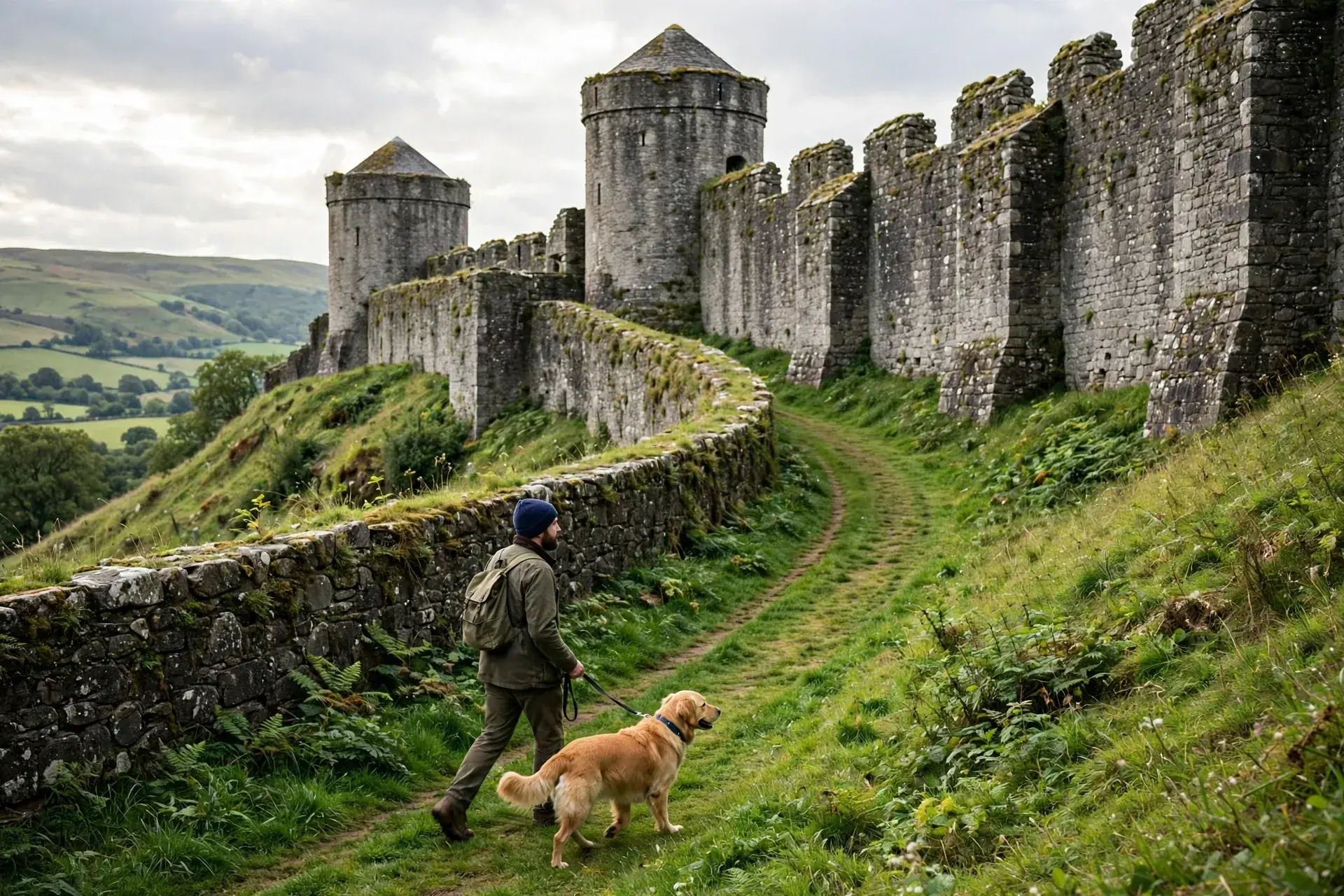
The wall walks are the best free view in town, and they are the part many visitors miss. The medieval town walls still ring the old town, and walking their circuit gives a completely different sense of the place than standing in the castle courtyard: you look down on the narrow streets, across the roofs to the strait, and along the full length of the quay. Dogs can walk the lower, flatter sections on a lead, but the wall walk itself has narrow stretches, steps and unguarded edges, so judge it by your own dog. A confident, steady dog on a short lead is fine; a pully, reactive or very small dog is better kept at ground level, where the streets inside the walls are just as rewarding and much calmer.
Timing matters more than most people expect. The castle is busiest between late morning and mid-afternoon, especially on summer weekends and school holidays, when the queue at the entrance can stretch along the wall and the courtyards fill with tour groups. An early start — arriving as the castle opens — gives you quieter grounds, cooler stone underfoot for paws in summer, and a much calmer dog. Late afternoon is the other sweet spot, when the coach groups have gone and the low sun lights up the banded masonry. Either way, avoid the middle of a hot day: there is little shade inside the castle, the stone holds the heat, and a dog that has already walked the quay will be happier resting in the shade of the walls than climbing steps in full sun.
Our wider guide to dog-friendly castles in Wales sets out which castle sites welcome dogs and where leads are required, and it is worth reading before you plan a multi-castle trip — Caernarfon pairs naturally with Conwy and Beaumaris, and the rules are not identical at each one. If you are building a castle tour, Caernarfon is the one to do first, because it is the most demanding on leads and timing, and getting it right sets the pattern for the rest.
The quay, the Seiont and the strait
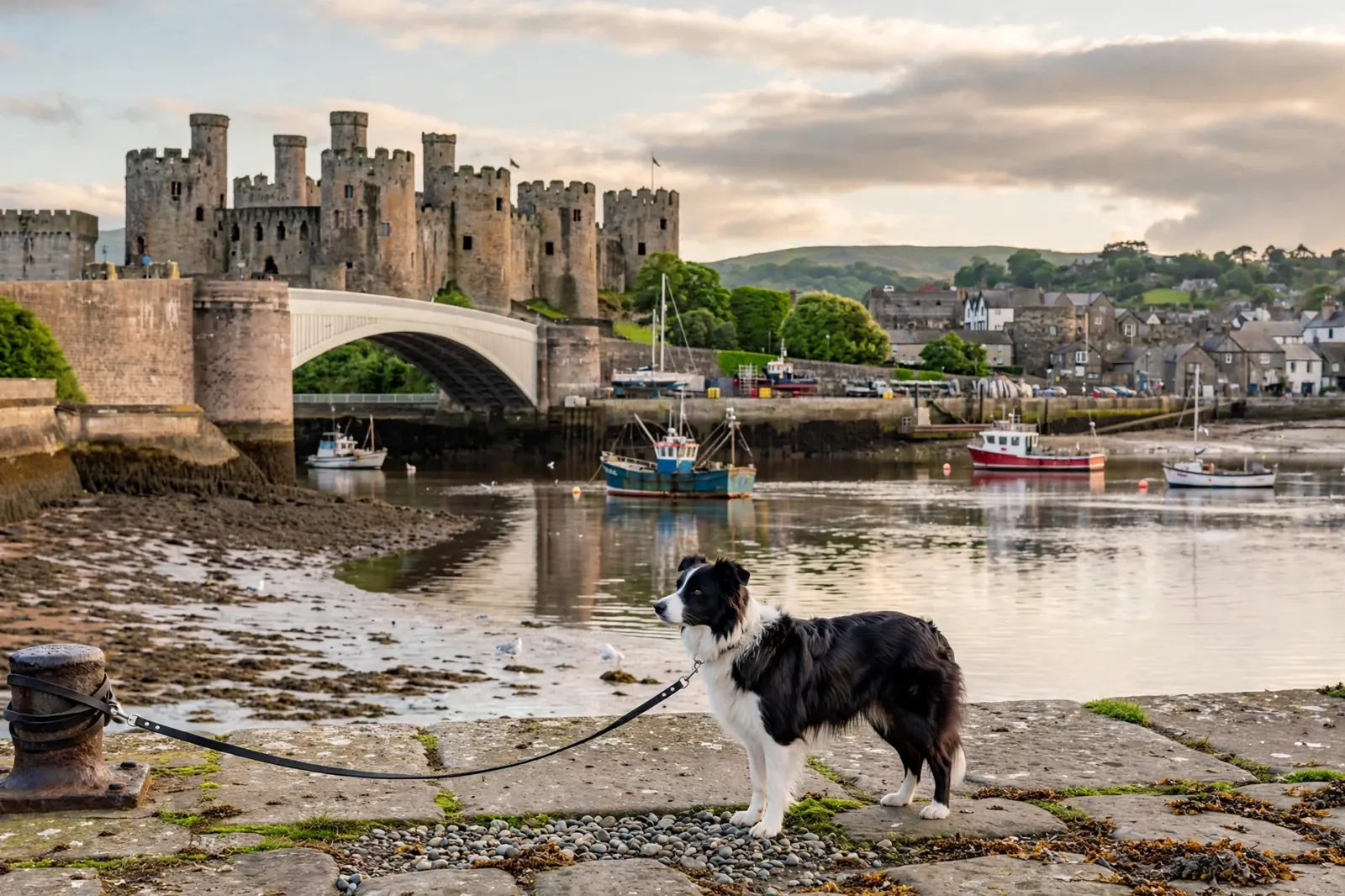
The quay is where Caernarfon earns its keep as a dog destination. The Slate Quay and the waterfront around Victoria Dock form a level, traffic-light promenade where a dog can walk on a lead, watch the boats, smell the tide and meet other dogs at a civilised distance. The surface is mostly flat paving and tarmac, which is kind to older dogs and to paws in wet weather, and there are benches along the water where you can sit and let the dog settle while the strait does its work in front of you.
The River Seiont runs into the strait right beside the castle, and the meeting of river and tide is one of the most interesting things to watch in the town. At low water the river shrinks to a channel between wide mudflats, and wading birds pick over the mud; at high water the whole basin fills and the boats float again. Dogs are drawn to the mud — it smells of everything — so keep a close eye and a short lead near the edges, and do not let a dog down onto the foreshore. The mud is deep and sticky in places, the tide returns faster than it looks, and the currents in the strait are famously strong. This is a place to look at the water, not to swim in it.
The strait itself is the reason the town exists where it does. The Menai Strait is a narrow, tidal channel, and the currents through it run hard in both directions — strong enough that the water can look like a river in full flood even on a calm day. That is part of the spectacle from the quay, and part of the reason for caution: never let a dog swim in the strait, never throw a ball towards the water, and keep dogs on a lead along the unfenced stretches of the waterfront. The quay edge is low in places, and an excited dog chasing a gull can be over the edge before you have time to react. A short lead and a bit of attention are all it takes, but they are not optional.
For a longer waterfront walk, follow the path south-west from the quay towards the mouth of the Seiont and the open coast, where the town gives way to the estuary and the views open out towards Anglesey. This is a good stretch for a dog that has had enough of crowds: the path is quieter, the ground is flatter, and there are places to stop and watch the water without other people pressing past. In the other direction, the waterfront continues towards the marina and the boatyards, where the smell of rope, diesel and fish will keep a dog occupied for longer than you might expect. Either way, keep the lead on — this is still a working waterfront with vehicles, cranes and moored boats, not a park.
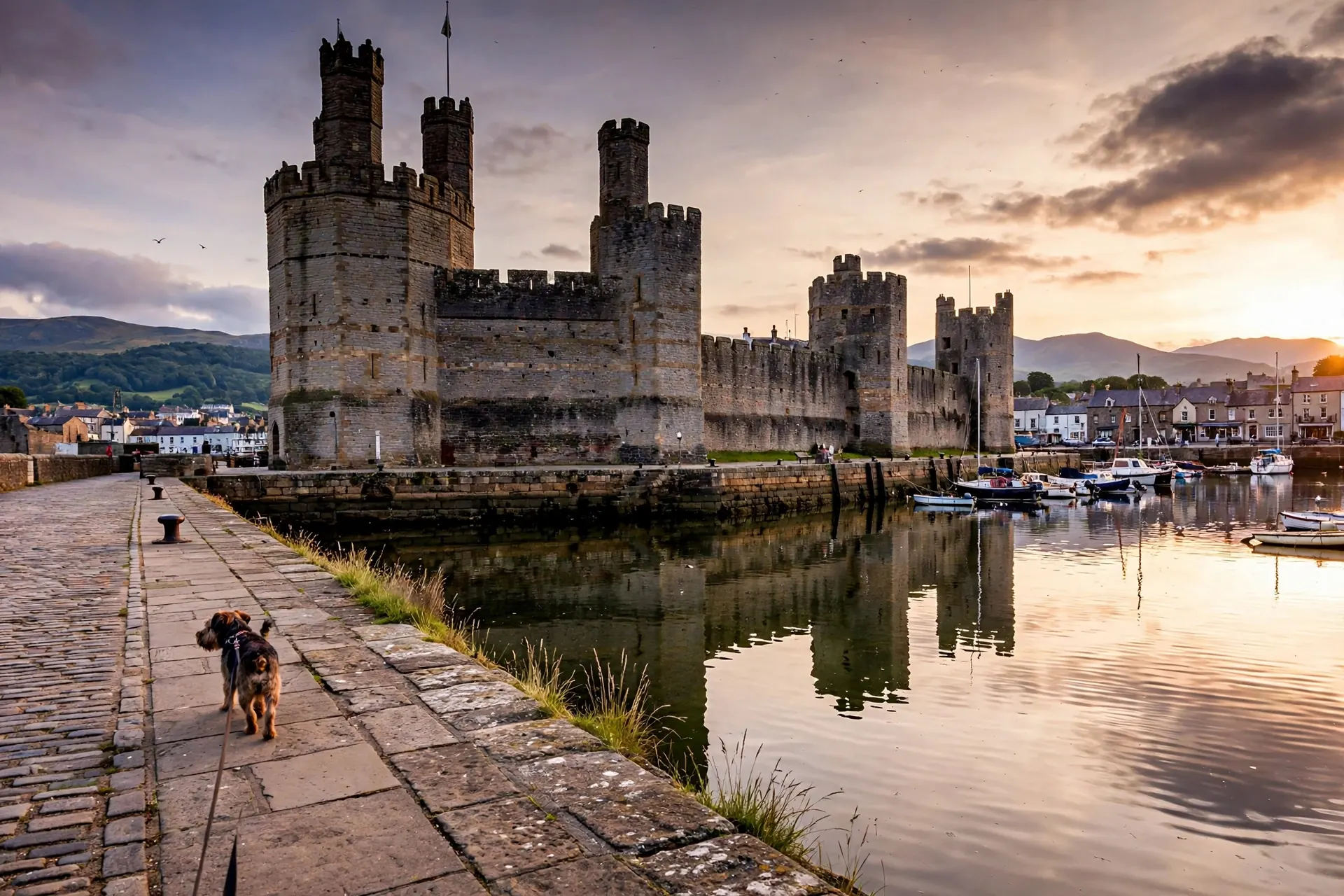
Evening is the quay at its best. As the light drops, the castle walls turn gold, the water goes flat, and the crowds thin out. This is the time for a slow circuit with a tired dog, a last toilet walk before dinner, and the photograph that every visitor takes: the polygonal towers reflected in the strait, a dog on the promenade in the foreground, and the whole town settling for the night. If you are staying overnight, this is the walk to repeat — it is short, flat and calm, and it is the one your dog will remember.
Town streets, shops and cafes
Inside the walls, Caernarfon is a small grid of narrow streets that rewards slow walking. Palace Street, Castle Square and the lanes around the market cross are the heart of it: independent shops, a traditional market hall, butchers and delis, and the kind of small businesses that have served the town for decades rather than seasons. For a dog owner, the narrow streets are both the charm and the challenge — they are full of smells and other dogs, but they are also tight, and a long lead is a liability when a pram, a delivery van and another dog all arrive at the same corner.
Keep the lead short and the dog on your inside, away from the road, and treat the town centre as a sniffing walk rather than a march. The streets are mostly flat, the pavements are narrow in places, and the best approach is to wander rather than to follow a route: let the dog set the pace through the market area, stop at the shops that interest you, and duck into the castle grounds or out to the quay whenever the streets get busy. On market days and summer Saturdays the town can feel crowded, and a nervous or reactive dog will do better on the waterfront paths, where there is room to pass other dogs at a comfortable distance.
Shops vary in their dog policies, as they do everywhere, and the honest answer is to ask at the door rather than assume. Many independent shops in Caernarfon are happy to have a well-behaved dog inside, and some keep a water bowl and a biscuit jar by the till, but larger stores and food shops are generally dogs-out. The practical rule is to shop in turns if you need to go into a shop that does not take dogs, and to keep visits short in warm weather — a dog left tied outside a shop in the sun is a welfare problem, not a convenience, and the town has enough outdoor seating that you can usually sit with the dog while one person goes inside.
The town has a good range of dog-friendly cafes and pubs, particularly around Castle Square and the quay, where outdoor seating is common and dogs are usually welcome on the terrace. Look for the places with water bowls already out — that is the clearest sign that dogs are genuinely welcome rather than merely tolerated. Indoors, policies vary: some cafes welcome dogs throughout, others restrict them to a particular area, and a few are dogs-out entirely. Ask before you sit down, keep the dog settled under the table rather than in the walkway, and bring a mat or blanket so the dog has its own place to lie. A dog that can settle in a cafe is a dog that can enjoy a full day out, and Caernarfon is a good town to practise in, because the distances are short and you are never far from the open air.
One local detail worth knowing is the Welsh language. Caernarfon is a strongly Welsh-speaking town, and you will hear Welsh in the shops, the cafes and on the street. That changes nothing about the dog rules, but it does mean that signs, menus and conversations may be bilingual, and that a friendly greeting in Welsh is always appreciated. Dogs, of course, are indifferent to language, but their owners will find the town noticeably warmer for making the effort.
Walks from the town
Caernarfon is not a walking destination in the way Snowdonia is, but it has a useful set of short walks that suit a dog day, and the best of them start from the town centre without a car. The simplest is the waterfront circuit: quay, castle walls, the Seiont footbridge and back along the water. It is flat, it is about an hour at a sniffing pace, and it gives a dog the full range of the town — boats, gulls, other dogs, market smells and the castle — without any serious climbing or rough ground.
For a longer walk, head for Coed Helen, the wooded hillside above the town to the south-west, which offers a proper woodland loop with views back over the castle and the strait. The paths climb steadily through trees, so this is the walk for a fit dog and a dry day: after rain the paths can be muddy and slippery, and the climb is enough to tire an older dog. The reward is the viewpoint, where the whole town, the castle and the strait lie below you, and where you can see at a glance how the town fits into its landscape — the castle at the water's edge, the walls around the old town, and the strait opening out towards Anglesey. Take water for the dog, because there is none on the hill, and keep the lead on: the woods are used by walkers, cyclists and other dogs, and the paths are narrow.
Another good option is the coast path south-west from the town towards Dinas Dinlle, which follows the shore through a mixture of farmland, dunes and beach. This is a longer, more open walk, and it suits a dog that wants to run — but only in the sections where the path is wide and the ground is firm. Check the official guidance before you travel for the current route and any diversions, because coastal paths change with erosion and land management, and do not attempt the foreshore sections at high tide. The same applies to the Wales Coast Path sections around Caernarfon: they are well marked and well worth walking, but they are working coast, with livestock in the fields beside the path, and dogs should be on a lead near sheep and cattle at all times.
For dogs that need a proper run, the honest advice is to drive to the beach rather than to try to find off-lead space in the town. Caernarfon is a compact, built-up place, and there is no large enclosed park or dog field in the centre where a dog can safely run free. The beaches nearby fill that gap, and the short drive is worth it: a dog that has had a good run on the sand will settle happily in a cafe afterwards, while a dog that has spent the whole day on a lead in town will be restless by the afternoon. Plan the day around that trade — town in the morning, beach in the middle of the day, quay at dusk — and both of you will enjoy it more.
Whatever walk you choose, carry the basics: water and a bowl, poo bags, a spare lead, and a towel for a dog that has found mud or water. There are bins along the waterfront and in the town centre, but they are not on every path, so be prepared to carry bags until the next one. The town has a vet practice for emergencies, and it is worth saving the number before you set out, particularly if you are walking the coast path or driving to the more remote beaches, where phone signal can be patchy.
Beaches near Caernarfon
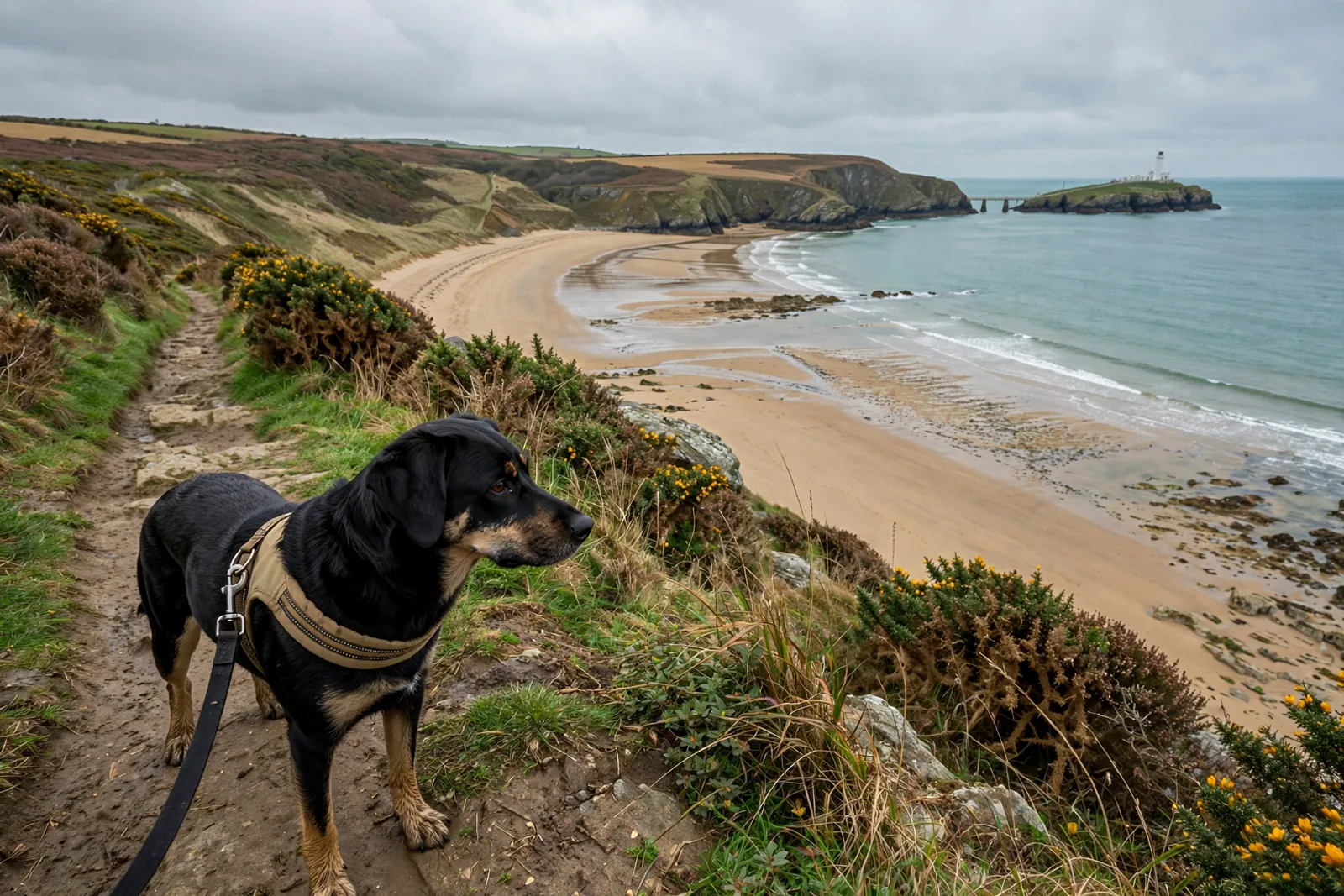
The nearest beach, and the one most Caernarfon visitors use, is Dinas Dinlle, a few miles south-west of the town along the coast road. It is a long, wide sandy beach backed by dunes, with a small car park, a cafe in season and a big sky that makes it feel a world away from the walled town. Dogs are welcome here, and at low tide the sand stretches far enough for a proper run, a game of fetch and a paddle at the water's edge. The beach faces south-west, so it catches the afternoon sun, and on a calm day it is one of the most pleasant places in Gwynedd to spend an afternoon with a dog.
The cautions are the usual ones for a Welsh beach, and they matter here. Check the tide times before you go, because the tide covers a wide flat beach quickly and can cut off the far end if you walk too far. Keep dogs on a lead near the car park and the access paths, where other beach users, children and cars all converge, and watch for the small stream that crosses the beach — dogs love it, but it can be deep after rain. In summer, check the official guidance before you travel for any seasonal restrictions, and remember that there is little shade on the beach: bring water, a shade option for the dog, and do not leave a dog in a car in the sun, even for a few minutes.
Across the strait, Anglesey offers a different scale of beach day. Newborough, on the south-west coast of the island, has a vast beach and the pine forest of Newborough Warren behind it, and it is one of the best dog walks in North Wales — a long, open beach, forest tracks for shade, and views back across the strait to the mountains of Snowdonia. Dogs are restricted on part of the beach during the summer season, so check the current rules before you go, but outside the peak months the whole beach is open. Our Anglesey dog guide covers Newborough, the coast path, the ferries at Holyhead and the rest of the island in detail, and it is the natural companion to this guide if you are staying in the area for more than a day.
Closer to Caernarfon, the coast towards the Llyn Peninsula offers smaller, quieter beaches that suit dogs who prefer space to crowds. These are the beaches the locals use: smaller car parks, no cafes, no facilities, and a much better chance of having the sand to yourselves on a weekday. The trade-off is that they are less forgiving — rougher access, fewer bins, no lifeguards, and livestock in the fields above the beach — so they suit experienced walkers with a reliable recall rather than a first trip with a new rescue. Whichever beach you choose, the rule is the same: check the tide, check the signs at the access point, and keep the lead handy even where dogs can run free, because other users, horses, and wildlife can appear without warning.
One more beach note, because it catches people out: the foreshore around Caernarfon itself is not a beach. The quay, the Seiont and the strait are working water, with mud, currents and boat traffic, and dogs should not be let down onto the mud or into the water there. The beaches are a short drive away for a reason, and the distinction matters — a dog that swims in the strait is in danger, while the same dog on Dinas Dinlle beach is having the best day of its life. Keep the two kinds of water separate in your planning, and the day will go well.
Eating and drinking with a dog
Caernarfon is a good town for eating with a dog, mainly because so much of it happens outdoors. The cafes and pubs around Castle Square and the quay mostly have terraces or pavement seating, and dogs are welcome at the outside tables as a matter of course. In the warmer months this is the default: you sit outside, the dog settles under the table, and nobody thinks twice about it. Indoors, the picture is more mixed, and the pattern follows the usual British rules — some places welcome dogs throughout, some have a dog-friendly area, and some are dogs-out. The only reliable way to know is to ask, and to look for the signs: a water bowl by the door, a dog asleep under a table, a biscuit jar on the counter.
Breakfast is the easiest meal with a dog in Caernarfon. The cafes around the town centre open early, the terraces are quiet before the tour groups arrive, and a dog that has had a morning walk on the quay will settle happily while you eat. Lunch is the busiest time, particularly on summer weekends, when the terraces fill and the queue for the popular spots can stretch down the street. If your dog is nervous in crowds, eat early or late, or choose a quieter cafe away from the castle — the streets a block back from the waterfront are noticeably calmer, and the food is often just as good.
Evening meals need a little more planning. The pubs and restaurants in the town centre vary widely in their dog policies after dark, and some that welcome dogs at lunchtime restrict them in the evening, when the dining room is full. If you have your heart set on a particular restaurant, phone ahead and ask — it takes a minute, and it saves the awkward moment of arriving with a tired dog and being turned away. Takeaways are a useful fallback: Caernarfon has fish and chips, pizza and other takeaway options, and eating them on the quay with the dog beside you is one of the simplest pleasures of a day here. Bring a blanket for the dog to lie on if the paving is cold, and keep the dog clear of the road while you eat.
The practical kit for eating out with a dog is the same here as anywhere: a mat or blanket, a water bowl, a chew or a stuffed Kong to keep the dog occupied while you eat, and a short lead that keeps the dog under the table rather than in the aisle. Train the settle before the trip if you can — a dog that can lie quietly for half an hour in a cafe is a dog that can enjoy a whole day out, while a dog that has never practised will spend the meal pulling, barking and begging, and will enjoy it less. Caernarfon, with its short distances and outdoor seating, is a forgiving place to practise, because you are never more than a few minutes from the open air if the dog needs a break.
One thing to watch is the heat. On a hot summer day, the stone paving around the castle and the quay holds the heat, and a dog lying on it for an hour while you eat lunch can overheat. Choose a table in the shade, put the mat down on the coolest surface you can find, offer water regularly, and watch for the signs of heat stress — heavy panting, drooling, restlessness. If the dog is struggling, move inside or to the shade of the castle walls, and cut the meal short. The town is small enough that you can always come back for a proper meal later, when the sun has dropped and the dog is comfortable again.
Arriving, parking and getting around
Caernarfon is reached by the A487 from the south and the A55 from the east, and the drive in is part of the experience: the road from Bangor follows the Menai Strait, with views across to Anglesey, and the castle appears suddenly as you round the last bend, which is a fine moment even for the most jaded driver. The town is small, and once you are there, everything is walkable — the castle, the quay, the shops and the station are all within a few minutes of each other on foot. That is the key planning point: park once, walk everywhere, and do not try to drive between stops inside the town.
Parking is the part that needs a plan. The streets inside the walls are narrow, the spaces are few, and in summer they fill early — do not plan on parking inside the walls on a summer weekend. The long-stay car parks on the edge of the old town are the practical choice: they put you a short, level walk from the castle and the quay, they have space for a dog to stretch its legs before you set off, and they avoid the stress of threading a car through streets built for horses. Arrive before mid-morning on a busy day, and check the official guidance before you travel for current charges and any changes to the car parks. Keep the car cool, never leave a dog in a parked car in warm weather, and remember that the car parks near the quay can be exposed to the wind off the strait — a good place to park, but not a good place to leave a dog waiting.
Public transport is workable, if not always simple. Buses connect Caernarfon with Bangor, Porthmadog and the Llyn Peninsula, and dogs are generally allowed on local buses at the driver's discretion, on a lead and kept off the seats. The railway picture is more distinctive, because Caernarfon is the northern terminus of the Welsh Highland Railway, the narrow-gauge line that runs south through the mountains to Porthmadog — and that is a trip in its own right, covered in the next section. For the main line, Bangor is the nearest station, about nine miles away, with trains to Chester, Crewe and London, and buses and taxis connect it with Caernarfon. If you are travelling without a car, base yourself in the town centre and use the buses and the narrow-gauge railway for day trips, rather than trying to reach the beaches by public transport, which is slow and infrequent.
Getting around the town itself is straightforward, but there are two things to know. First, the streets inside the walls are cobbled and uneven in places, and the pavements are narrow — a dog on a long lead will tangle with pedestrians, so keep the lead short and the dog close. Second, the castle and the quay are the two poles of the town, and the walk between them is only a few minutes, but it passes through the busiest part of the town, so a reactive dog may prefer the quieter route along the waterfront rather than through Castle Square. Learn the two routes on your first circuit, and use whichever suits your dog at the time of day.
Toilets and water are worth a mention, because they are the small things that make a day out work. There are public toilets near the quay and in the town centre, and most cafes will let you use theirs if you are a customer. Water for dogs is available at the cafes with bowls out, and at the taps along the waterfront, but carry your own bottle and bowl anyway — the town is small, but a thirsty dog on a hot day does not want to wait until the next cafe. Poo bag dispensers exist in some spots, but do not rely on them: bring your own, and use the bins along the quay and in the town centre.
The Welsh Highland Railway
One of the best reasons to visit Caernarfon with a dog is the railway that starts here. The Welsh Highland Railway runs from Caernarfon station, just outside the town walls, south through the foothills of Snowdonia to Porthmadog — a narrow-gauge journey through some of the most dramatic scenery in Wales, and one of the few heritage railways where dogs are genuinely part of the experience rather than an afterthought. Dogs are generally carried on the line, usually for a small fare and on a lead, but they may be restricted to certain carriages or areas, so confirm the policy when you book and check the official guidance before you travel.
The practicalities are straightforward. Book ahead, particularly in summer, when the trains fill up and the dog spaces are limited. Arrive early enough to settle the dog before boarding — the station is a short walk from the town centre, and the platform is a good place for a last toilet break. Bring a blanket for the dog to lie on in the carriage, keep the lead short, and be ready for the noise: the steam locomotives are loud, the tunnels are dark, and the carriage can be crowded, so a nervous dog may prefer a quieter carriage or a shorter journey. The full line to Porthmadog takes a couple of hours, so consider breaking the journey at one of the intermediate stations — Rhyd Ddu or Beddgelert, for example — where you can get off, walk the dog, and catch a later train back, rather than committing a dog that has never been on a train to a full return journey.
Beddgelert is the stop that most dog owners aim for, and for good reason. It is a small village in a wooded valley, with riverside walks, a famous dog's grave — the legend of Gelert, the hound of Prince Llywelyn — and a cluster of dog-friendly cafes and pubs. The walks from the village are some of the best in the area: riverside paths, woodland trails, and a climb to the viewpoint above the village for those with the energy. Check the official guidance before you travel for the current timetable, because the service is seasonal and the number of trains varies through the year, and plan the return carefully — missing the last train back to Caernarfon means a long and expensive taxi.
The railway is also a useful bad-weather option, which is not something you can say about many attractions. On a wet day, when the beach is unappealing and the castle walls are slippery, a train ride through the mountains is a warm, dry way to see the scenery with a dog that is happy to lie at your feet. Bring a towel for the dog, because the platform and the walk to the station will be wet, and be prepared for the carriage to be full of other wet dogs — the railway is popular with dog owners for exactly this reason, and the atmosphere is friendly rather than formal.
One caution: the railway is not a substitute for walking the dog. A dog that has spent two hours lying in a carriage needs a proper walk at the other end, not just a quick stop on the platform. Plan the day so the train is the middle of the trip, not the whole of it — a morning walk in Caernarfon, the train to Beddgelert, a long walk in the village, and the train back, with a last circuit of the quay in the evening. That is a full day, and a tired, happy dog at the end of it.
Tides, weather and safety
Caernarfon is a tidal town, and the tide is the safety issue that matters most. The Menai Strait has strong currents, the water level around the quay and the Seiont changes fast, and the mudflats at low water are deeper and stickier than they look. The rules are simple and worth repeating: never let a dog swim in the strait, never let a dog down onto the foreshore, keep dogs on a lead near the quay edge, and check the tide times before any walk on the foreshore or at the beach. The same applies at Dinas Dinlle and the other nearby beaches, where the tide can cover a wide flat beach quickly and cut off a walker who has gone too far.
The weather in North Wales changes fast, and Caernarfon, on the edge of the strait, gets the full range. A sunny morning can turn to rain by lunchtime, the wind off the strait can be strong even on a calm day inland, and the castle walls offer little shelter when the rain comes in sideways. Pack for the change: a waterproof coat for the dog if it has one, a towel in the car, and a plan for a wet afternoon — the railway, a long lunch in a dog-friendly pub, or a drive to a covered attraction. The town is small enough that you can always retreat to the car or to a cafe, but the walk back to the car park in a downpour is no fun for anyone, so keep the rain gear close rather than buried in the boot.
In summer, the risks are heat and sun. The stone of the castle and the quay holds the heat, there is little shade inside the castle grounds, and the beach at Dinas Dinlle has almost none. Offer water often, walk in the morning and the evening rather than the middle of the day, and watch for heat stress — heavy panting, drooling, restlessness, a dog that will not settle. If the dog is struggling, get it into the shade, wet its paws and belly with cool water, and cut the day short. Never leave a dog in a car in warm weather, even with the windows open — the temperature inside a parked car rises fast, and the car parks near the quay are exposed to the sun.
In winter, the risks are cold, wind and short days. The strait wind can be bitter, the stone of the castle is cold underfoot, and the light goes early, so plan a shorter day and bring a coat for a short-coated or older dog. The town is quieter in winter, which many dog owners prefer — fewer crowds, easier parking, and a calmer atmosphere in the cafes — but check opening times before you travel, because some cafes, shops and attractions reduce their hours or close for the season. The castle, the quay and the walls are open year-round, and a winter walk along the waterfront, with the castle in the low light and the strait running hard, is one of the best experiences Caernarfon offers.
Finally, the practical safety kit: save the number of the nearest vet before you set out, carry a basic first-aid kit for the dog, and keep the dog's identification and any medication with you. The town has a vet practice, and the larger practices in Bangor are a short drive away, but the coast path and the beaches are remote enough that you should not rely on finding help quickly. A dog that has cut a paw on a rock or eaten something it should not have on the beach needs you to be prepared, not lucky. Check the official guidance before you travel for any current hazards — algal blooms, livestock, or path closures — and take the local signs seriously when you arrive.
Staying overnight with a dog
Caernarfon works as an overnight base as well as a day trip, and it has a good range of dog-friendly places to stay: hotels and guesthouses in the town centre, self-catering cottages inside and outside the walls, and holiday parks and campsites in the surrounding countryside. The town centre options suit a short stay — you can walk to the castle, the quay and the restaurants, and the dog is never far from a toilet walk. The countryside options suit a longer stay, with gardens, enclosed space and direct access to the coast path, but they need a car for everything, including the evening meal.
When you book, ask the questions that matter for your dog rather than the ones the listing answers. Is the garden genuinely enclosed, and how high is the fence? Are dogs allowed in the bedroom, or only in a particular room? Is there a charge per dog, per night or per stay, and what does it cover? Where is the nearest practical toilet walk after dark, and is it lit? Is there somewhere to dry a wet dog, and somewhere to wash muddy paws? The answers will tell you more about the stay than the photographs will, and the places that answer clearly are the ones that have thought about dogs properly.
Self-catering is often the best choice for dog owners in Caernarfon, because it gives you a kitchen, a garden and the freedom to come and go without worrying about other guests. Look for cottages with an enclosed garden and a hard floor in the entrance, where a wet dog can be towelled down without damaging the carpet. Check the rules about leaving a dog alone in the property: many owners prohibit it, and some allow it only if the dog is crated, so plan as if the dog is coming with you everywhere, and choose a base where that is easy — which in Caernarfon, with its dog-friendly cafes and outdoor seating, it usually is.
Hotels and guesthouses in the town centre are a good option for a single night, particularly if you are arriving by train and do not have a car. Ask about the room: ground-floor rooms are easier for an older dog, rooms away from the main road are quieter, and a room with a window onto a courtyard is calmer than one facing the street. Some hotels charge a pet fee, some do not, and some restrict dogs to certain rooms, so confirm the details in writing before you arrive. Bring the dog's own bed and blanket — a familiar smell helps a dog settle in a strange room, and it protects the hotel's bedding as well.
Camping and caravanning are also worth considering, particularly in summer, when the sites around Caernarfon and the Llyn Peninsula are at their best. The sites vary widely in their dog rules — some welcome dogs throughout, some restrict them to certain pitches, and some have a dog exercise area — so check before you book, and ask about the nearest beach and the nearest walk that does not need a car. A campsite with a direct path to the coast is worth more than a campsite with a swimming pool, if the dog is the reason you are there. Whatever you choose, book early for summer weekends and school holidays: the best dog-friendly places in Caernarfon fill months ahead, and the town is small enough that the choice narrows quickly.
A one-day plan that works
The best Caernarfon day follows a simple shape: town in the morning, beach or railway in the middle of the day, quay at dusk. Start early, before the crowds, with a circuit of the quay and the castle walls, when the light is good and the dog is fresh. Walk the waterfront, look at the boats, and let the dog sniff its way around the castle grounds — on a lead, at a slow pace, with time to stop. If you want to go inside the castle, take turns, and keep the dog's visit to the grounds short and calm rather than long and tiring.
By late morning, move into the town for coffee and a wander through the streets, then decide the middle of the day by the weather and the tide. On a dry day with a low tide, drive to Dinas Dinlle for the beach: a long run on the sand, a paddle at the water's edge, and a late lunch at the beach cafe or back in town. On a wet day, or a day when the tide is wrong for the beach, take the Welsh Highland Railway to Beddgelert instead, and walk the riverside paths there. Either way, the middle of the day is the dog's time — a proper run, a proper walk, and a chance to be a dog rather than a tourist.
Come back to Caernarfon in the late afternoon, when the tour groups have gone and the town is quieter. Walk the waterfront again, slowly this time, and let the dog choose the pace. Find a table outside a pub or cafe for an early dinner, and watch the light change on the castle walls as the sun drops. The evening circuit of the quay — the same walk you did in the morning, but quieter, slower, and with a tired dog — is the best end to the day, and the one that will make you want to come back.
If you have a second day, use it to widen the circle. Conwy, with its own castle and walls, is a short drive east along the coast, and makes a natural pairing with Caernarfon — two walled castle towns, two very different characters, and a chance to compare them with the same dog. Or cross the strait to Anglesey, where the beaches and the coast path offer a full day of walking, and where our Anglesey guide will help you plan it. Caernarfon is the kind of town that rewards a slow visit: the castle is the reason you come, but the quay, the streets and the strait are the reasons you stay.
One last piece of advice, and it is the one that matters most: leave time for nothing. The best moments in Caernarfon are not on a timetable — a dog asleep in the sun on the quay, a boat coming in on the tide, the castle walls turning gold in the evening light. A day packed with activities leaves no room for them. Plan the morning, plan the middle of the day, and leave the evening open. The town will fill it.
Practical questions
Before you go
Can dogs go into Caernarfon Castle?
Dogs are generally welcome in the castle grounds on a lead, but they are not allowed inside the museum and exhibition spaces within the towers. Rules can change, so check the official guidance before you travel, and plan the visit so one person can stay outside with the dog while the other explores the interiors.
Where can dogs walk off the lead near Caernarfon?
The town centre, quay and castle walls are on-lead territory. The nearest reliable off-lead options are the beaches south-west of the town, such as Dinas Dinlle, where dogs can run at low tide away from the main access points. Always check local signs for seasonal restrictions, keep your dog in sight, and put the lead back on near roads, livestock and other beach users.
Is there a dog-friendly beach close to Caernarfon?
Yes. Dinas Dinlle, a few miles south-west of Caernarfon, is a long sandy beach where dogs are welcome, and it is the easiest beach day from the town. Newborough on Anglesey, across the Menai Strait, is another strong option with a huge beach and forest walks, though dogs are restricted on part of the beach in summer. Check the official guidance before you travel for current restrictions.
Can I take my dog on the Welsh Highland Railway from Caernarfon?
Dogs are generally carried on the Welsh Highland Railway from Caernarfon station, usually for a small fare and on a lead, but they may be restricted to certain carriages or areas. Book ahead, confirm the dog policy when you reserve, and bring a blanket for your dog to lie on. Check the official guidance before you travel, as conditions can change by season.
Where do I park in Caernarfon with a dog?
The most useful car parks for dog owners are the long-stay car parks on the edge of the walled town, such as the ones near the quay and the Balaclava Road area, which put you a short level walk from the castle and the waterfront. Avoid trying to park inside the walls in summer, when spaces are scarce and streets are narrow. Arrive early on weekends and check the official guidance before you travel for current charges.
What should I know about tides on the Menai Strait with a dog?
The Menai Strait has strong tidal currents, and the water level around Caernarfon quay and the River Seiont changes fast. Never let your dog swim in the strait, keep dogs on a lead near the quay edge, and check tide times before any walk on the foreshore so you are not cut off by a rising tide. The same applies at Dinas Dinlle and other nearby beaches, where the tide can cover a wide flat beach quickly.