This guide is independent and contains no paid placement. If affiliate links are added later, they will be clearly marked and will not change our editorial checks.
Camborne earns its place on a dog owner's map for three reasons that sit close together: the steam story that started here, the woods and lakes of Tehidy Country Park a few minutes out of town, and a north coast — Portreath, Hayle and Godrevy — that is a short drive north and west. The town itself is a working mining town rather than a resort, so you get proper shops, a market, pubs that know what a muddy dog looks like, and a station on the main line. Use it as a base, walk the woods in the morning, and let the tide tables decide which beach gets the afternoon.
Start with steam: Trevithick and the first locomotive
Begin at the statue in the middle of town. Richard Trevithick was born at Illogan, just up the road, in 1771, and on Christmas Eve 1801 his steam road carriage — the Puffing Devil — chugged through Camborne's streets, the first time a steam vehicle had carried passengers under its own power. Three years later, in 1804, his locomotive hauled ten tons of iron along a tramway at Pen-y-Darren in South Wales, the first railway journey by steam. The statue marks the spot where the story starts, and it makes a natural meeting point before a walk: stand there with the dog, look up Trelowarren Street, and you are looking at the town the steam age grew out of.
The mines explain the town. Copper and tin lay deep below Camborne, and getting them out needed engines — first to pump water from shafts hundreds of feet deep, then to wind ore to the surface, then to carry it to the ports. The engineers who built those engines became the best in the world, and when the Cornish mines began to close, the men who built and ran them took their skills to Australia, South Africa, Mexico and the Americas. The engine houses on the hills are what is left of that trade, and the chapels, institutes and rows of miners' cottages in the back streets are the town it paid for. Walk a dog through Camborne and you are walking through the place that taught the industrial world how to move.
Every April the town holds Trevithick Day, a street festival of steam engines, brass bands, dancers and stalls that fills the centre from morning to late afternoon. It is a joyful day and a hard one for a dog: the streets are narrow, the crowds are shoulder to shoulder, and the noise of engines and bands never really stops. A steady dog that is comfortable in crowds can cope if you arrive early and leave before the middle of the day, keeping to the wider stretches of Trelowarren Street and always having an escape route to a quiet side street. A nervous or reactive dog will not enjoy it, and there is nothing wrong with leaving that dog at your cottage for the day. If you do bring one, keep the lead short, carry water, and watch for tiredness — a dog that has had enough in a crowd will tell you before it tells the crowd.
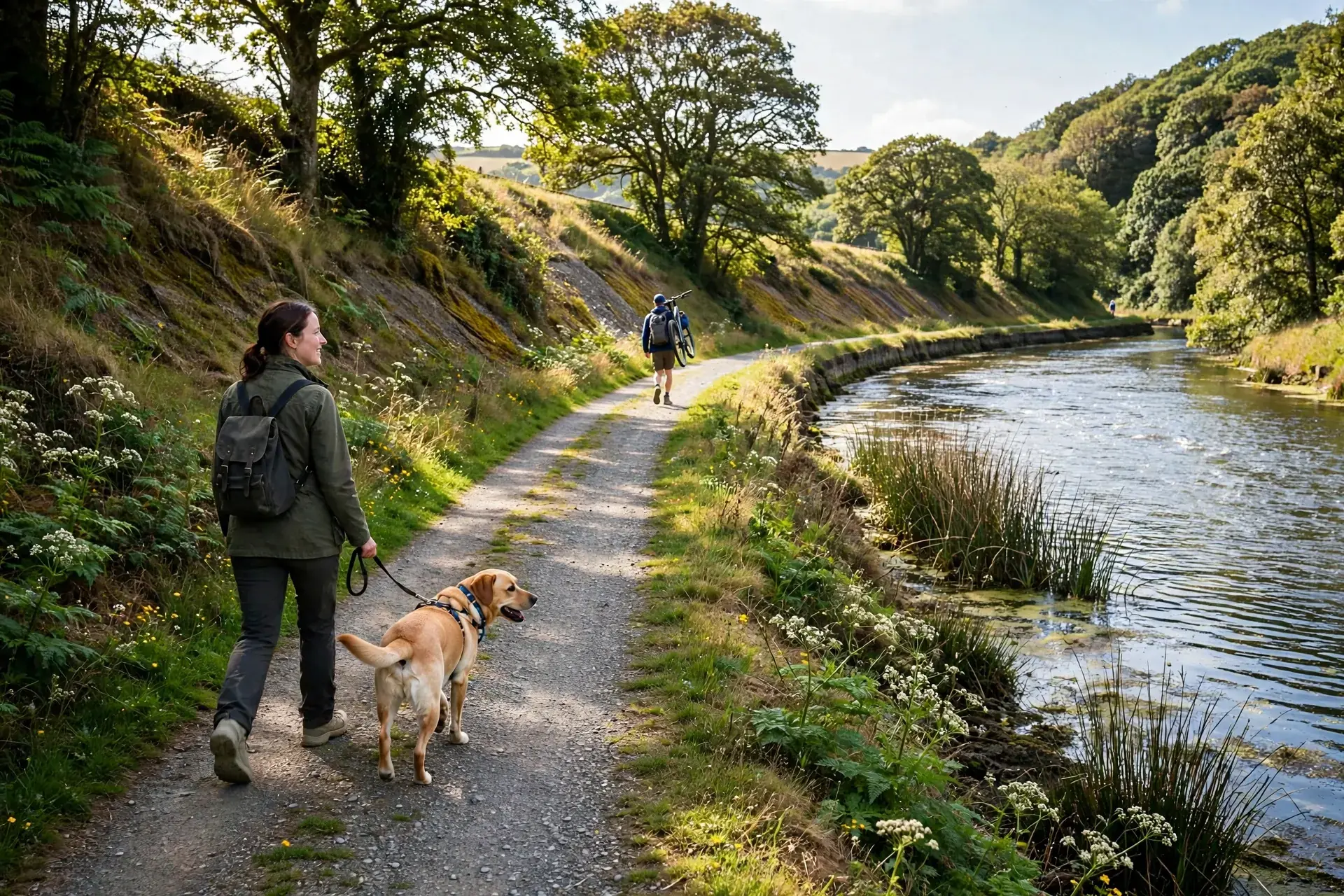
The old mineral tramways give Camborne one of its best dog walks. The lines that once carried ore from the mines down to the harbours at Portreath and Hayle now survive as flat, wide, traffic-free paths, and the gradients are so gentle that an older dog can manage them comfortably. The going is mostly firm and flat, and the path is wide enough that walkers, cyclists and pushchairs can pass a dog on a lead without anyone having to step aside into the hedge. The route ends at the sea — at Portreath harbour, where the ore boats once loaded. Walking the tramway with a dog is following the same line the copper took two centuries ago, and the harbour at the end of it makes a good place to stop for a drink and a sit-down before the walk back.
It is worth knowing that the story does not have a tidy ending. The 1804 locomotive broke the cast-iron rails it ran on, the ironworks that ordered it went under, and Trevithick himself died penniless in Kent in 1833, largely forgotten. Camborne celebrates him anyway, and the celebration is fair: the idea outlived the man, and the railways that followed changed the world. Treat the history as a good story rather than a monument, and let the dog have the practical part of it — the statue, the festival streets, the tramway paths and the harbour at the end.
A mining town that built the modern world
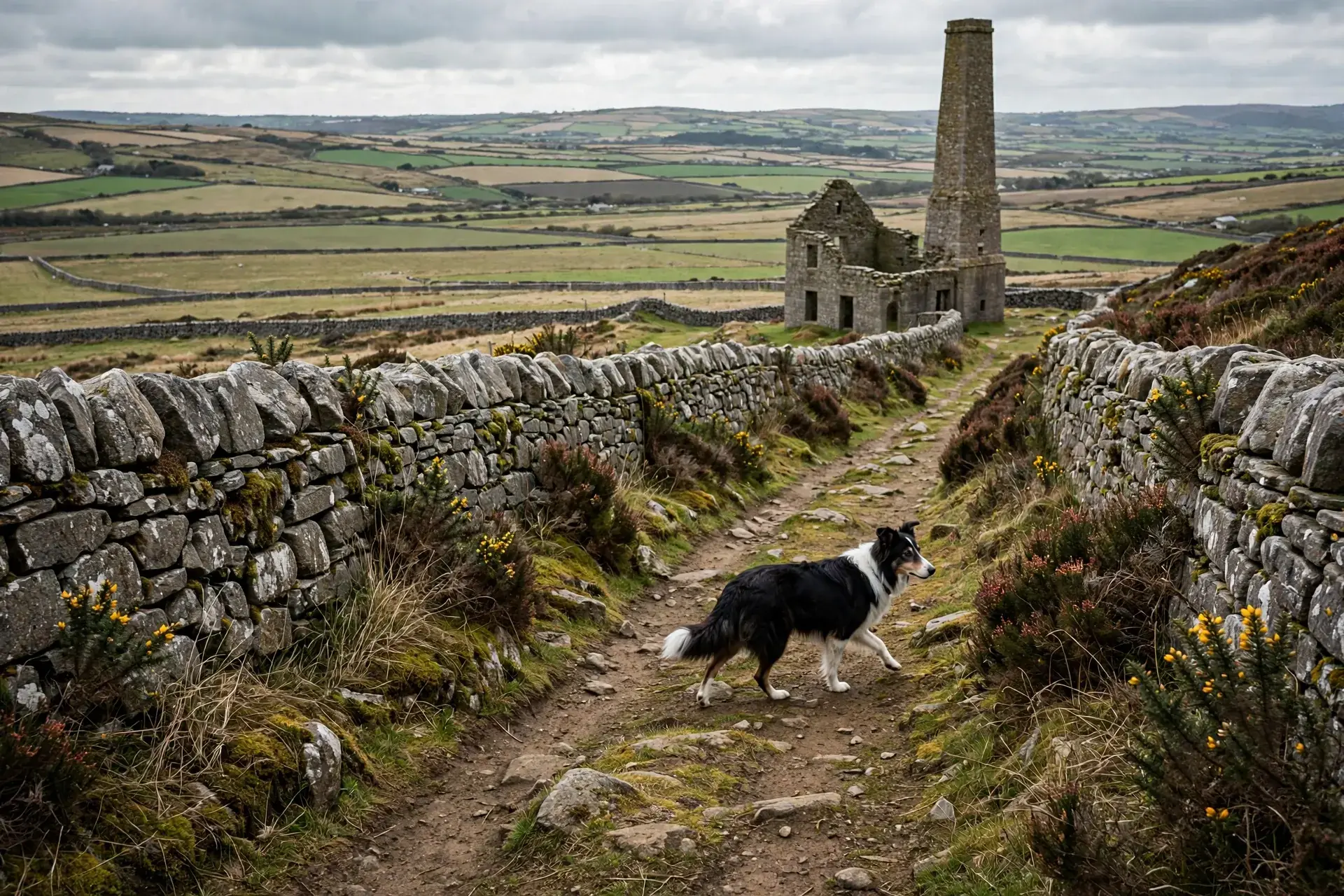
The ground around Camborne is protected as part of the Cornwall and West Devon Mining Landscape, a UNESCO World Heritage Site, and it shows: the hills are studded with engine houses, chimneys, spoil heaps and capped shafts, and the paths between them are informal, uneven and sometimes no more than a trodden line through gorse and heather. That roughness is part of the appeal, but it needs respect. Keep your dog on its lead anywhere near old mine workings — shafts can sit unfenced and half-hidden by bracken, and a dog that tumbles into one is in serious trouble. Don't let a dog scramble over ruined walls or engine-house remains, and stick to the paths that are actually marked rather than cutting across open ground where the earth may be hiding a hole.
The Camborne School of Mines, founded in 1888, is the institution that turned the town's hard-won know-how into something that could be taught, and it is still teaching — today as part of the University of Exeter, based at the Penryn campus near Falmouth. Its graduates have worked in mines from the Australian outback to the Zambian copperbelt, and the school's story is a reminder that Camborne exported knowledge as much as it exported ore. You won't find the school itself in the town any more, but its name turns up on plaques, in the mining institute buildings and in conversations with older residents who remember when the town trained the world's mining engineers.
When the Cornish mines closed, the miners left — to the goldfields of Australia, the copper mines of Michigan, the tin mines of Malaya and Bolivia — and they became known as Cousin Jacks, a nickname that travelled with them. They took their chapels, their brass bands, their pasties and their surnames, and whole Cornish communities grew up around mines on the other side of the world. Camborne's back streets still hold the houses those families left behind, and the town's pubs and chapel halls carry their names and their memory. Walking a dog through the quieter streets at dusk, past miners' cottages and the institute buildings, is a way of seeing the town as it was: a small place that sent its people everywhere.
Pool, the village strung along the main road between Camborne and Redruth, is where the mining landscape has been turned into somewhere you can spend an afternoon with a dog. Heartlands, built around the old Robinson's Shaft, holds gardens, play areas, exhibitions and a cafe, and dogs are allowed in the outdoor areas provided they stay on a lead. The cafe has outdoor seating where a dog can settle, and the site's paths are level and easy — a good choice for a dog that needs a gentle day after a long coast walk. Our Redruth guide covers Heartlands in more detail; the village itself is worth a slow pass too, a mix of miners' cottages, chapels and pubs that grew up around the mines.
Tuckingmill, on the edge of town, is the quieter option when Camborne itself feels too busy. It is a small valley village with a stream running through it, a church, and a handful of houses, and it feels a long way from the town centre even though it is only minutes away. The valley is wooded and shaded, the paths are short and easy, and it suits a dog that prefers cover to open ground. The stream once powered the mines, and old leats and tramway traces still show in the valley if you look for them. Keep the dog on its lead near the water, because the banks can be steep and slippery after rain, and don't let it drink its fill from the stream.
Tehidy Country Park: the woodland heart
Ask a Camborne dog owner where they walk and the answer is usually Tehidy. The country park sits between the town and Portreath: a large sweep of woodland, lakes and open parkland around the old Tehidy House, with a network of trails that lets you pick a walk to fit the dog in front of you — a short lakeside loop for an older dog, a long circuit through the trees for a fit one. Dogs are welcome here as long as they stay on a lead, and the walking suits dogs that like shade, cover and the smell of damp earth. It is also the best wet-weather walk in the area: the tree canopy takes the worst out of the rain, several paths are surfaced, and the lakes look their best under a grey sky.
The park is the legacy of the Basset family, who held the Tehidy estate for centuries and laid out the lakes, woods and gardens that still shape it. The house itself is now a private home, but the parkland around it is open to the public, and the lakes are the centrepiece — a chain of linked ponds that draw herons, egrets, ducks and kingfishers. The lakeside paths are superb, but the water is not for dogs: it is deep in places, the banks are soft and muddy, and the lakes are a protected habitat. Keep the lead on beside the water, and don't let the dog go after the birds.
The woods are the other half of Tehidy. The paths under the trees stay cool on a hot day, the ground is soft underfoot, and the woodland is full of birdsong. A dog that likes shade will love the tree-covered trails, and a dog that likes open space will love the parkland and the lakeside lawns. You can spend a whole morning in the park and still find paths you haven't tried. The car park fills up on sunny weekends, so get there early, and the cafe by the car park has outdoor seating where a dog can sit with you — look at its current hours before you go, as they shift with the seasons.
Tehidy rewards a dog that can settle and watch. Herons stand motionless at the lake edges, kingfishers flash along the streams, and the woods hold squirrels, badgers and deer. A dog that lunges at every heron will spend the whole walk being corrected, so this is a place for a calm, well-exercised dog that can walk past wildlife without making a scene. Stay on the paths with the lead on, and don't let the dog dig in the woodland floor — the ground is easily damaged, above all after heavy rain, and the park is managed as a protected landscape.
Tehidy changes with the seasons more than the town does. Spring brings bluebells and wild garlic across the woodland floor, the birds are at their loudest and the park is at its best. In summer the shade is deep, the lakes are full of life, and nowhere for miles is cooler on a hot day. In autumn the trees turn gold and copper, the crowds fall away and the low light makes for the best walking weather of the year. In winter the park empties, the lakes lie still and the woodland paths get muddy after heavy rain — keep a towel in the car. Whatever the season, look at the forecast and the notices at the entrance before you set out, because paths can close for forestry work.
Coast days: Portreath, Hayle and Godrevy
The sea is a short drive away, close enough that a beach fits into an ordinary day rather than needing a plan of its own. Portreath, about five miles north, is the beach that matters most to dog owners here — a sandy bay in a small harbour village, with a pub, cafes and a car park within a few steps of the sand. The main beach has a summer dog ban, so dogs are kept off it during the day in the busiest months; look at the signs at the beach entrance and the council's current beach pages before you go, because the dates and the exact stretch of sand covered can change. Outside the banned season, and on the quieter sand away from the harbour, dogs have far more freedom, and a winter or autumn visit to Portreath feels like a different beach altogether.
Hayle, a few miles west, is the beach the locals choose when they want space. Its sands run for miles along St Ives Bay — flat, firm and wide, with a harbour, a town and a causeway at one end and the open bay at the other. At low tide the sand stretches so far that a high-energy dog can run itself tired without ever reaching the water. A car park sits close to the sand, cafes are nearby, and the coast path follows the shore in both directions. The beach is exposed, though, and the sand stings on a breezy day, so pack a windbreak and a coat for a short-coated dog.
Godrevy, at the eastern end of the bay, is the wild card. It is a headland of cliffs, sea and sky, with the lighthouse standing on the island offshore — the one said to have inspired Virginia Woolf's To the Lighthouse — a cafe, and a beach that welcomes dogs outside the summer season. The site is National Trust, with a coast path and a car park, and the beach is tidal, so the day depends on the tide times — look them up before you set out. Godrevy is also the place for seals: they haul out on the rocks below the cliffs, and the headland is a good vantage point to watch them from a distance. Keep your dog close and on its lead up there, well back from the edge.
From Portreath the coast path heads both ways along cliff scenery that is among the best in Cornwall. Heading east towards Porthtowan and St Agnes, the path climbs steeply and runs exposed in places — a walk for a fit dog with solid recall, on a lead wherever it narrows. Heading west towards Hayle and Godrevy, the walking gets longer and wilder, enough for a full day with a strong dog. Both directions have unfenced drops, so keep your dog on its lead near the edges and well back from them. Our guide to dog-friendly beaches in the UK sets out how the summer bans and protection orders work and how to check the rules for a particular beach — read it before a summer trip to the Cornish coast, because every beach has its own dates and the fines are real.
Tides decide how good a beach day will be. Look them up the night before, because Portreath and Hayle change completely between high and low water — at high tide Portreath is a narrow strip of sand and much of Hayle is under water, while at low tide both are vast. Get there two or three hours ahead of low tide and you get the widest sand and the longest window before the water returns. Mind the wind as well as the forecast: the north coast can be rough when Camborne itself is calm, and a small dog struggles on a gusty beach. Pack drinking water for the dog, since seawater makes dogs ill, plus a towel and a drying coat for the drive home, and look at the car park charges and the dog rules at the entrance when you arrive.
This coast deserves respect as well as admiration. Keep dogs back from the cliff tops and from the foot of the cliffs, where rock can come down without warning. Don't let a dog swim where the current runs hard or near rocks, and treat the surf at Portreath with respect — it can be strong even when the sea looks calm. Keep an eye out for hooks and broken glass in the sand, and for dead fish and anything else a dog will try to eat, and for what too much seawater does to a dog — vomiting, diarrhoea and dullness are all reasons to see a vet. Once you are off the sand, rinse the dog down with fresh water, look over its paws for cuts, clear sand from its ears, and dry it properly before the drive home. A dog that sleeps all the way back to Camborne has had a good day.
The town: markets, Trelowarren Street and the old streets
Give the town centre a slow walk rather than a quick pass. Trelowarren Street runs through the middle of it, holding the essentials — shops, cafes, pubs, the market, the library — and the independent businesses that survive because local people use them every week. The street is mostly flat, which is kinder to an older dog than the steep streets of neighbouring Redruth, and the centre is compact enough to cover end to end in about fifteen minutes. Keep the dog on its lead: pavements narrow in places and the street carries traffic. Take your time — this is a street to look at, not to hurry through.
Market day is the best day to walk the town with a dog. Local producers set out vegetables, meat, cheese, bread, cakes, plants and crafts, and dogs on leads are simply part of the crowd. Go early if your dog is nervous in crowds, because the stalls fill up by mid-morning, and keep the dog close around the food stalls, where a stolen sample is amusing the first time and mortifying the second. It is also the place to gather supplies for a self-catering stay or a picnic: cheese from a Cornish dairy, a fresh loaf, pasties and fruit bought from the stalls will make a far better trail lunch than anything picked up in a rush. Look up the market days and times before you go, because they can shift with the season and with local events.
Look up as you walk and the town's past is in the buildings. Camborne was once among the richest towns in Cornwall, and the town hall, the old banks and the larger houses along Trelowarren Street still carry the scale of a place that mattered in the nineteenth century. The parish church of St Martin and St Meriadoc stands at the edge of town and is worth the walk; its churchyard is a quiet green spot to sit with a dog on a lead. Mining heritage turns up in street names, in old mine offices and in the miners' cottages climbing the hills around the centre. The back streets show Camborne as it actually is: a working town with a long memory and a strong sense of itself.
Camborne is also a town of music, and it is worth knowing that before you visit. Brass bands, male voice choirs and community music have a long history here, and the chapels and institutes built for the mining community still put on concerts and events. The cultural life here is not a visitor attraction in the usual sense — it happens for the people who live here — but walking the dog through town on a concert evening, with a brass band sounding out of a hall, is a reminder that Camborne is a living town rather than a museum. Look at the local listings before you go if you want to catch a concert, because the programme changes through the year.
Some of the shops in Camborne will let a dog in and some will not, so it helps to shop in pairs — one of you minds the dog while the other looks around. On your own, keep it brief: tie the dog somewhere you can watch it, somewhere safe, and don't leave it there long. The centre is small and the pavements are mostly broad enough for a dog and a pushchair to get past each other, but the main street can be busy with traffic, so walk with the dog on the building side and take care at the junctions. Our guide to Truro with a dog covers the city to the east and the River Fal, and it makes a useful contrast: Truro is the cathedral city, Camborne is the mining town, and the two together give you a fuller picture of Cornwall.
Eating and drinking in Camborne
Eating out with a dog in Camborne is easier than in most Cornish towns, and the reason is simple: this is a working town where people bring their dogs everywhere, so the cafes and pubs are used to it. Dogs are taken in outdoor seating areas and on terraces almost everywhere, and a good number of places let them inside as well. The result is that you can have a proper lunch, a decent coffee and a wander around the shops without leaving the dog in the car or tied to a railing outside. Not every Cornish town manages that, and it is one of the quiet pleasures of basing yourself here.
The cafes are the easiest place to start. Several in town treat dogs as customers rather than an inconvenience, and you can tell within seconds of walking in: a bowl of water by the door, a jar of biscuits on the counter, staff who say hello to the dog first. If there is no bowl in sight, ask before you sit — most places will find one, and the ones that can't will usually say so plainly. Pavement tables and terraces are the simplest option in summer. Inside, a corner table or one near the door works best, with a mat or blanket from home for the dog to settle on. Order quickly, and get the walk in first: a dog fresh off the Tehidy paths will sleep through lunch, while a dog that has spent the morning in the car will spend lunch looking for something to do.
The pubs are the other half of the story. Camborne has traditional Cornish pubs that take dogs, and a pub lunch after a woodland walk is one of the classic Cornish dog days. Gardens and terraces suit a larger dog best, since there is room to spread out without blocking anyone, and it is worth asking about the bar area if the weather turns — plenty of pubs welcome dogs in the bar while keeping them out of the dining room, and what is allowed at lunch may not be allowed at dinner. A dog that settles quietly under the table will be welcome back; one that barks at every arrival will not. Bring the dog's own blanket from home, pick something from the menu that won't arrive in a hurry, and keep the lead on, however relaxed the room feels. Pubs change their dog rules, above all in peak season, so look at the venue's own listing or ring ahead before you go, and check the same way if you are relying on a particular pub for dinner.
What makes or breaks a meal out is rarely the venue — it is the preparation. Feed the dog before you sit down, or bring a small portion of its usual food for under the table. Carry water and a portable bowl, since a busy cafe may not have a spare. A mat or blanket gives the dog a defined place to lie, and a chew or a stuffed toy keeps a puppy occupied. Keep the lead short and tucked under your chair rather than stretched across the walkway. And on a day when the dog is unsettled — barking, whining, tugging at everyone who walks past — don't push through it: take the food away, eat outside, or get a takeaway and eat it on a bench. There is no shame in that, and the dog will be happier for it.
Stay longer and the food becomes a reason to be here rather than just a convenience. A self-catering break in Camborne means walking to the shops, cooking with local produce, and eating out when you feel like it, all without starting the car. Book ahead for Friday and Saturday nights in summer, when the town's restaurants fill up, and mention the dog when you book — be straight about its size and temperament, because a quiet spaniel and a boisterous large dog are two very different propositions in a small dining room.
Staying over, parking and vets
The case for staying in Camborne rather than on the coast is a practical one. The coast villages are prettier, but they shut down early, their shops are thin, and a rainy Tuesday can leave you with nowhere to go. Camborne stays open: a supermarket, a pharmacy, cash machines, a choice of places to eat, all within a short walk of the centre, and a railway station on the main line if you arrive without a car. That matters with a dog, because a base where you can sort out food, a forgotten lead or a vet visit on foot takes the pressure off every day of the trip. You can walk out of your front door in the morning and be on a woodland path or a beach within twenty minutes, and come back to a town that is still awake in the evening.
Places to stay in and around Camborne run from hotels and bed and breakfasts in town to self-catering cottages and apartments, holiday parks and campsites in the countryside around it, and farm stays a short drive away. Dogs are taken in every one of those categories, but the terms change from place to place, so the questions you ask before booking matter more than the category you pick. Find out whether the dog is allowed in the actual room or cottage on offer, rather than somewhere else on the property. Find out the limit on numbers, what the extra charge is and whether it is charged per dog or per stay, and whether size or breed rules apply. Find out about the outdoor space — whether the garden is fenced all round, how high the fence runs, whether a gate can be nosed open. Find out whether the dog may be left alone indoors and for how long, since that decides whether dinner out is possible. And find out about floors and stairs: hard floors cope with muddy paws far better than pale carpets, and a ground-floor room suits an older dog better than one up a flight of stairs.
Self-catering usually suits a dog stay in Camborne best, because it hands you a kitchen, somewhere outdoors of your own, and the freedom to run the day around the dog instead of around hotel hours. When you choose, look for a fenced garden, a washing machine for muddy towels, and a doorstep that leads onto a footpath — a cottage on the edge of town with a path straight into Tehidy is worth more than a prettier one that needs a drive to every walk. Holiday parks and campsites around Camborne can work well too, above all for families, but go through the same checks: limits on dogs, charges, fenced space, and the rules on leaving dogs alone. If the place is a caravan or a lodge, look at the steps and the decking as well, because a dog that finds steps hard will find them hard every time it needs to go out.
Parking is straightforward if you think about it before you arrive. The car parks off Trelowarren Street are the sensible place to leave the car in town, a few minutes' walk from the shops and the centre. Prices and time limits there shift from time to time, so look at the current charges and maximum stays before you travel. At Tehidy and on the coast, the car parks are small and they fill fast on summer days — get there before ten in the morning or after four in the afternoon, once the crowds have thinned. And on a warm day, don't leave the dog waiting in the car, not even for a few minutes.
Sort out the practical details on arrival and the rest of the trip runs itself. Find the town's veterinary practice on your first walk and save its number, along with the out-of-hours service that covers the area — Redruth and Truro both have practices a short drive away, so a weekend problem is manageable if you know who to ring. Dog food is easy: the pet shops and the supermarket both stock it, so an empty bag is a ten-minute errand rather than a crisis. Phone signal holds up in town but fades on the wilder stretches of the coast path, so download your maps before you set out. Public toilets exist in the centre but not on every corner. And in winter, check opening hours before you count on a cafe or an attraction — several places around here cut back outside the summer season, and the Tehidy paths turn muddy after heavy rain.
Pack for two landscapes at once, because that is what Camborne gives you. The woodland wants a short lead and a long one, a harness that fits, a spare lead in case one comes back caked in mud, and a towel for the car — Tehidy has long stretches with no drinking water for dogs, so a bottle and a collapsible bowl go in the bag too. The beach wants a drying coat, a blanket for the car, a coat for a thin-coated dog when the wind or rain gets in, and sunscreen for a pale nose or thin coat in summer. Take more poo bags than you expect to use, and something to carry them in. Bring the dog's normal food and any medication, the vet's number and the insurance details. Patience matters too: the woodland is shared with other walkers, the coast fills up in summer, and the days that work best here are the slow ones.
Put it together as a weekend and the shape of the place becomes clear. Friday afternoon: arrive, park in town, and take a short evening stroll through the centre so the dog learns the smells before dark. Saturday: start early in Tehidy while the car park is still quiet, then drive north to Portreath for a pub lunch and an afternoon on the sands at Hayle. Sunday: Godrevy at low tide for the headland and the seals, a heritage walk and cafe lunch at Heartlands, and a last slow loop through Tehidy before the drive home. Woodland, beach and heritage, one a day, and nothing more than twenty minutes' drive between them. If the weather turns, swap the days around: the beach is best on a calm dry morning, Tehidy is the finest wet-weather walk for miles, and the town's cafes and shops make a genuine fallback rather than a consolation prize. Nothing here depends on a single plan working perfectly, which is exactly the kind of slack a trip with a dog calls for.
Practical questions
Before you go
Can dogs walk in Tehidy Country Park?
Yes. Dogs are welcome in Tehidy as long as they stay on a lead, and the park suits almost any dog — woodland paths, lakeside trails and open grass, with short loops and long circuits to choose from. Keep the dog on its lead beside the lakes and don't let it swim in them. Get there early in the morning, before the car park fills up, and you will have the place mostly to yourself.
Is Heartlands in Pool dog-friendly?
Yes. Heartlands at Pool is a free public park and heritage site built around the old Robinson's Shaft mine, with gardens, play areas, a cafe and exhibitions, and dogs are allowed in the outdoor areas on a lead. The cafe has outdoor seating where a dog can sit with you. Look at the site's own pages for current opening times before you go.
Which beaches near Camborne allow dogs all year?
Portreath and the quieter stretches of Hayle and Godrevy are the most reliable year-round choices near Camborne. The main beaches have summer dog bans, so look at the signs at the entrance and the council's beach pages before you travel. The coast path towards St Agnes has its own seasonal rules, so check those too.
Can I take my dog into pubs and cafes in Camborne?
Several pubs and cafes in and around Camborne take dogs, above all in gardens and bar areas, and a number let them inside as well. Rules change with the season, so look at the venue's own listing or ring ahead before you go, and bring a mat for the dog to settle on under the table.
Where is the best place to park in Camborne with a dog?
The town car parks near Trelowarren Street are the most useful choice, putting you within a short walk of the shops and the town centre. For Tehidy and the coast, use the park and beach car parks and get there early in summer, when they fill up. Look at the current charges before you travel, and on a warm day don't leave the dog waiting in the car.