This guide was written independently, with no paid placement. Should affiliate links be added later, they will be marked clearly and will not change how we check things.
Camelford suits dogs that like room to run: the open moor begins a few minutes outside town, the River Camel is still a narrow, quick stream here, and the north-coast sands at Trebarwith Strand and Tintagel are a short drive west. Build the trip around moor walks, Arthurian lanes and low-tide beaches — and plan for grazing animals, boggy patches, and the coast's seasonal dog rules.
Begin on the moor, not in the town
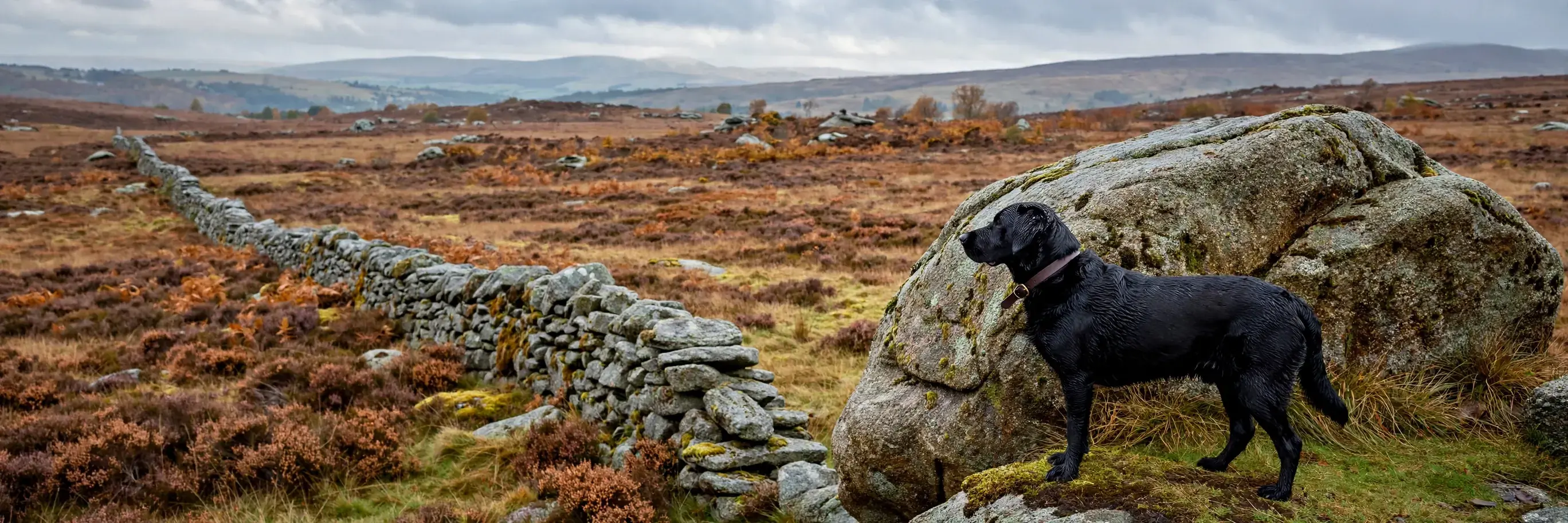
Start outside the town, not in it. Five minutes after leaving Camelford's main street the fields give way and you are on Bodmin Moor — stone walls end, the grass opens out, granite shows through the turf, and the horizon pulls a long way back. Roughtor stands to the south-west, Cornwall's second-highest hill, with Brown Willy, the county's highest, a little further along the same ridge. From the tops you can pick out most of north Cornwall on a clear day; on a misty one the moor folds in close and the walk turns into a navigation exercise, which is a different kind of pleasure and needs a different kind of preparation.
Roughtor is the walk to do first, and it doubles as a test of your dog's moor legs. A small car park sits below the hill, and from there the ground rises steadily over open grass before the granite boulders begin. The final pull to the summit tor is a scramble over uneven rock, past the ruined chapel and the stone-lined holy well tucked among the stones. Allow about an hour there and back at a comfortable pace. The wind at the top can be sharp even when the town below feels still, and the boulder field is hard work for short legs, older joints, or a dog that is unsure on rock. There is nothing wrong with stopping on the lower grass and letting the dog run there instead — the open slopes are the point, not the summit. On a quiet weekday morning you may have the whole hill to yourselves.
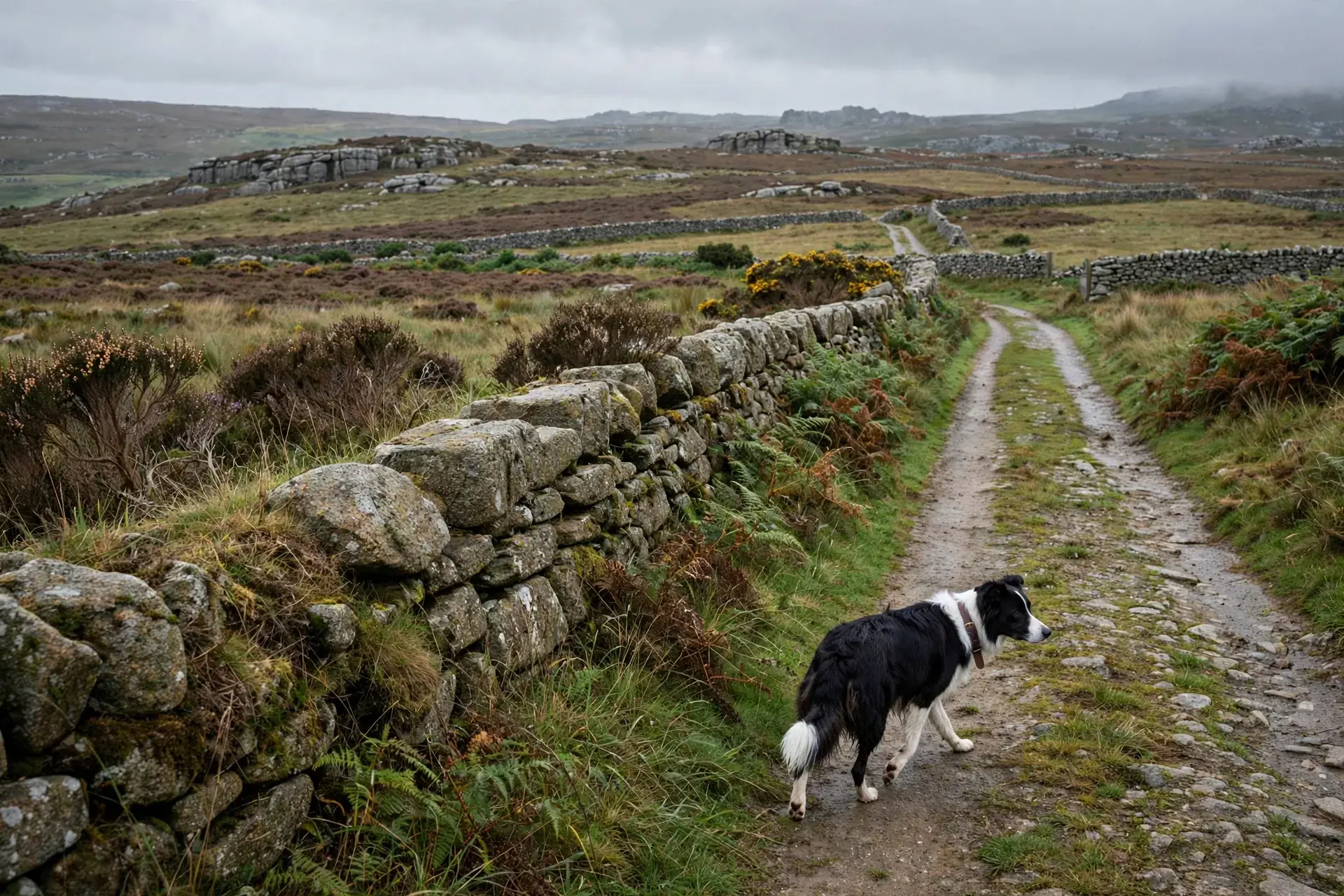
Brown Willy is the longer, wilder day: two to three hours across open moor with few landmarks and ground that changes underfoot every few minutes — springy turf, bare granite slabs, wet flushes, and soft patches that can swallow a boot. A dog that ranges ahead needs a recall you can trust, because the moor is grazed by sheep, cattle and ponies, and the law expects dogs to be kept under close control around livestock — in practice that means a lead whenever animals are in sight. Ponies catch visitors out: they look sleepy and unbothered, but a loose dog harrying a pony can provoke a kick that hurts both animals. Keep the lead in your hand even when the ground ahead looks empty; stock appears over every rise on this moor.
Much of the moor has no fences and no worn paths, so you walk by landmarks, sun and map. Download the map for offline use before you leave town: the signal is thin up here at the best of times and vanishes altogether in the dips between hills. Weather moves fast — a bright morning in Camelford can turn to driving rain and thick mist on the tops inside half an hour, and a dog that is comfortable in the valley may shiver on an exposed ridge. Carry water for the dog as well as for yourself, pack a coat for a small or short-coated dog, and keep a towel in the car, because the streams and boggy ground will leave most dogs wet and muddy. A drying coat earns its keep on Bodmin Moor more than anywhere else in the county.
The moor repays a slower walk with a map in hand. The tors are natural granite, but the stone circles, hut circles, burial mounds and old field systems scattered between them are Bronze Age, and Fernacre stone circle, near Roughtor, is among the best-preserved on the moor. Cairns and standing stones mark the ridges, and the trackways are older still. Dogs are indifferent to archaeology, but the open ground that holds these sites is the same ground that makes the moor so good for them: long sightlines, new smells at every step, and room to move. Keep the dog close or on a lead around the scheduled monuments — the turf around them is fragile, and the grazing animals there do not welcome being chased.
The seasons change the moor more than they change the town. Spring brings green grass, skylarks overhead and lambs in the fields below the moor edge. Summer is the busiest time: the small car parks fill on sunny weekends, and the heat on the bare tors is serious for dogs, with almost no shade anywhere — start early, carry more water than you think you will need, and watch for overheating. Autumn turns the bracken copper and gold, the crowds thin, and the light softens into the best walking weather of the year. Winter is the wildest season: snow is rare, but frost and high wind are common, the ground is wet underfoot, and the short days demand an early start and a finish in daylight. Whatever the season, read the forecast before you set out, tell someone your route if you are going far, and look up current access advice before travelling.
The young River Camel
Camelford is named for the river, and here the Camel is a young river: narrow, quick, and shallow, running between stone walls and under small bridges through the town. It rises on the moor above Camelford, gathers pace down the valley, and runs south through wooded country towards Bodmin and the wide tidal estuary it becomes at Wadebridge and Padstow. Walking beside it at Camelford is an enclosed, shaded experience — the opposite of the open moor — and it suits dogs that like cover, damp earth smells and birdsong more than wind and big skies.
The paths along the river in and around the town make an easy, level outing for dogs of every age. There are no steep climbs and no long distances, so older dogs and puppies cope well, and there are benches to sit on at intervals along the way. Early morning is the best time, when the town is still quiet and the valley is full of birdsong; evening is good too, when the light drops into the valley and the river turns dark and reflective. The water is shallow, and on a warm day most dogs will want a paddle. A quick splash does no harm, but do not let your dog lap up great mouthfuls of river water, and give it a rinse afterwards if it has been in after heavy rain, when field runoff can wash into the stream.
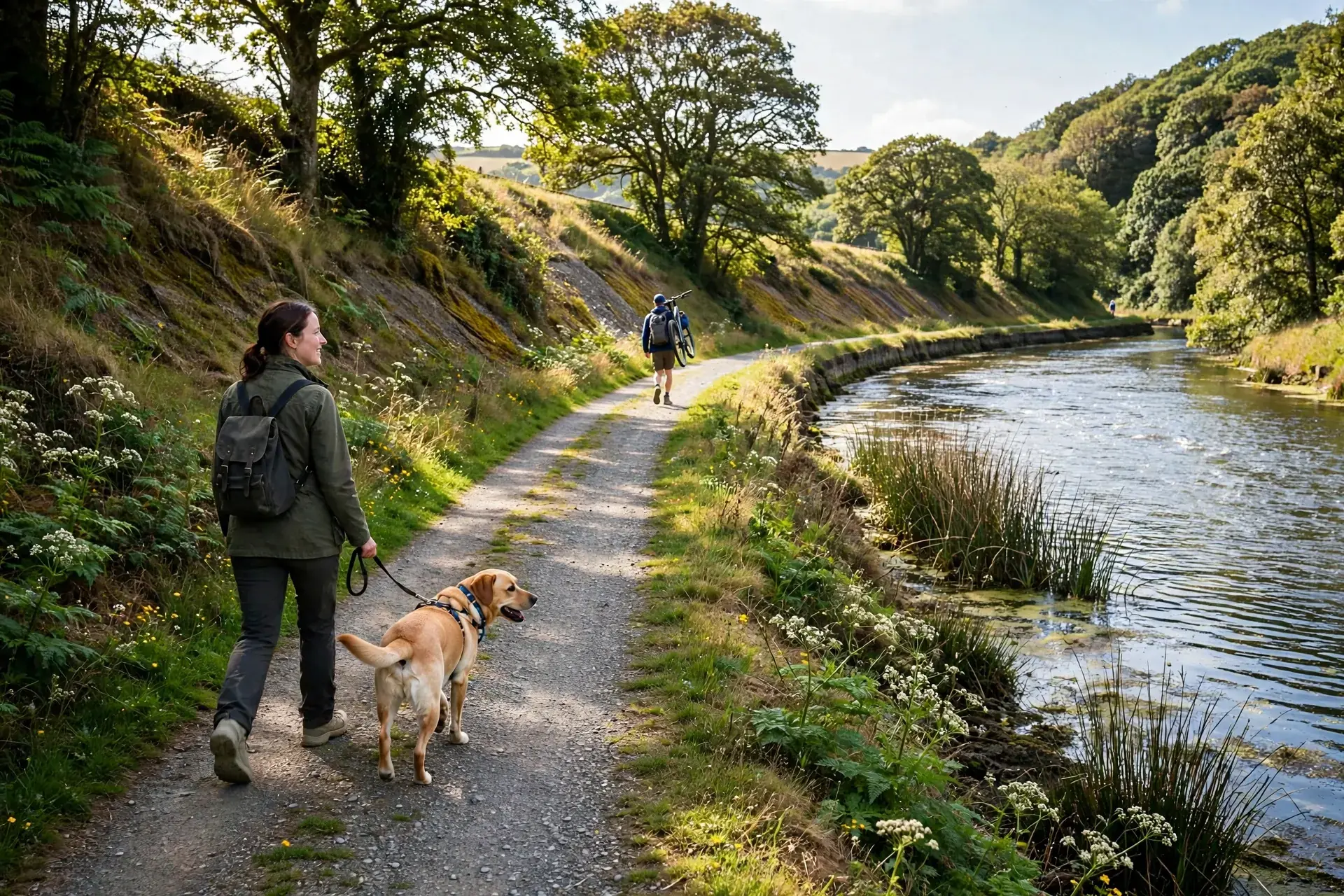
South of Camelford the valley deepens, and the walking changes with it. The Camel Trail runs along the disused railway between Padstow and Wenfordbridge, and the length from Wenfordbridge towards Bodmin is the quietest part of the whole route — tree-lined, calm, and shaded where the busy estuary half near Padstow is open and crowded. It is a kinder choice for a nervous dog, for one that barks at bicycles, and for hot days when shade matters. The surface is even and mostly flat, which is gentle on paws, and there are hedgerow edges where a dog can stop and sniff without blocking the path. Our Wadebridge guide covers the trail in full, estuary half and hire shops included, and it pairs well with this one if you want to walk the trail in both directions.
The valley is the place to look for wildlife. Dippers and grey wagtails work the fast water, kingfishers flash along the narrower reaches, and herons stand motionless where the river slows. A dog that can sit quietly and watch is a far better companion for this kind of walk than one that charges at every heron it spots, so tire the dog out first and let the river do the entertaining. Keep it on a lead beside the water, and remember the banks turn slick and steep once it has rained. If your dog is a keen swimmer, save the proper swim for the beaches at Trebarwith Strand and Tintagel, which the coast section covers below.
One thing to remember about the valley is that its weather is not the moor's weather. Mist can sit in the valley while the tops above are clear, or the moor can be windy and cold while the town below stays calm and sunny. A short-coated dog that is happy in town may shiver on an exposed ridge, and one that loves the sun can be wretched in driving rain with nowhere to shelter. Pack a dog coat, keep a towel in the car, and know when to turn back early. You are never far from town, so cutting a walk short costs nothing — a brief walk in sunshine beats a long one in a storm. After heavy rain, check water levels and access before setting out.
A small market town that still works
Camelford is not a resort town, and that is a large part of its appeal with a dog. It is a working market town of a few thousand people, built along a single main street that carries the A39 through its middle, with shops that serve the farms and villages around it rather than visitors. The pace is slower, the pavements are quieter, and a dog on a lead is unremarkable here. There is no single grand attraction in the town, and it does not need one — Camelford works as a base and a breather between the moor and the coast, and it rewards a slow look rather than a quick pass through.
Walk the main street and you will find the essentials: a supermarket, a butcher, a bakery, a pharmacy, a post office, cafes and pubs, and independent shops that stay open because the people round here shop in them every week. Some welcome a dog through the door and some do not, so a proper shop is easiest with two of you — one minding the lead, one browsing the shelves. Alone, keep the errand brief, tether the dog somewhere visible and out of the way, and do not leave it tied up for long. The main street carries through traffic, so walk on the pavement side with the dog and take care at the junctions, particularly where lorries and farm vehicles swing close to the kerb.
The town's history is written into its buildings. Camelford was once a parliamentary borough, and the town hall and the older houses along the main street still carry the proportions of a place that mattered more in the eighteenth century than it does now. The parish church of St Thomas Becket, at the edge of town, is worth the walk, and its churchyard is a quiet green spot to rest with a dog beside you on its lead. The market heritage survives in the wide main street and in the regular markets and events that still draw the surrounding villages into town. Find out the market day before you go: a market day changes Camelford completely — busier, livelier, harder to park — and it is also the best day to see the town as it actually is.
After a morning on Roughtor, the question is where to eat with a muddy dog, and Camelford answers it in the old way: the pubs and cafes here are used to walkers coming in off the moor, and several welcome dogs, most readily in a garden, on a terrace, or in the bar. A few let dogs into the dining room as well, but the bar is usually the safer bet, and lunchtime and evening rules are not always the same — ask at the door rather than assuming. In summer the outdoor tables are the easiest option, especially for a large dog that needs floor space; in bad weather the bar, a corner table, and a blanket on the floor will do. Arrive with the dog already walked and settled, shake the worst of the moor mud off at the door, and ask for a water bowl if one is not offered. Policies shift with the season, so a quick look at the venue's own page or a phone call before you set out saves an awkward arrival.
What turns a pub lunch from relaxing to stressful is rarely the venue — it is the small habits. Give the dog its meal before you leave, or carry a portion of its usual food to serve under the table once you are seated. Take your own water and a collapsible bowl, since a busy cafe may have none to lend. Give the dog a mat or blanket as its own patch of floor, hold the lead short beneath your chair instead of letting it trail across a walkway, and pack a chew or a stuffed toy to keep a young dog busy. When the dog is unsettled — barking at everyone who passes, whining, tugging towards every table — do not push through it: ask for the food to go, or eat it outside on a bench beside the river. A takeaway by the Camel, dog settled at your feet, is a better lunch than a tense one indoors.
Arthurian country: Slaughterbridge and Tintagel
Camelford sits at the heart of Arthurian Cornwall, and the stories belong to the landscape rather than being laid on top of it. Slaughterbridge, just outside the town, is traditionally named as the place of Arthur's last battle, where he is said to have fought Mordred and fallen. The old Cornish name is thought to mean something close to “the bridge of the slaughter”, and the place has drawn visitors, storytellers and the curious for centuries. The bridge crosses the Camel where it runs shallow and quick, and the fields around it are quiet farmland now, with no sign of a battle beyond the name and the stones. Walk it with a dog on a lead, stay on the paths, and treat it as a story you are walking through rather than a site you are ticking off.
The Arthurian thread runs from Slaughterbridge to Tintagel, about eight miles west, where the castle ruins stand on the headland above the sea and legend says Arthur was conceived. Tintagel is a very different experience: one of the most visited places in Cornwall, with a castle, a village, a beach, a famous footbridge and a steady flow of visitors in summer. The castle is managed by English Heritage, and dogs are welcome in the grounds on a lead, though not inside the visitor centre or the exhibition — opening times and rules change, so look them up before you go. The coast path around the castle is spectacular and exposed: keep dogs on a lead near the cliff edges and away from the unfenced drops.
Boscastle, a few miles further north, is the quieter of the two coastal villages and often the better choice with a dog. The harbour is a narrow, sheltered inlet between high cliffs, the village is small and walkable, and the coast path runs both ways along some of the finest cliff scenery in Cornwall. The path south towards Tintagel is a proper cliff walk with steep climbs and exposed stretches, for fit dogs with a good recall and a lead for the narrow parts. The path north towards Crackington Haven is longer and wilder, a full day out for a strong dog. Boscastle has cafes and pubs that welcome dogs, and the harbour is a good place to sit and watch the boats while the dog rests. The village was badly flooded in 2004, and the rebuilding is a reminder that Cornish rivers can rise fast after heavy rain — worth remembering when you walk the river valleys with a dog.
The stories matter less than the walking, but they shape how you see the ground. Moor, river, castle and coast all belong to the same tale, and a day that links two or three of them feels more like a journey than a loop. A pattern that works well is a morning on the moor, a midday stop at Slaughterbridge, and an afternoon on the coast at Tintagel or Boscastle, with the dog resting in the car between stops and a proper walk at each one. That gives the dog variety — open grass, river valley, cliff top — and gives you different scenery each time, never more than twenty minutes' drive apart. If the weather turns, swap the order round: keep the coast for a calm dry day, the moor for clear weather, and head for the river valley when it rains.
A word of honesty about the legends: nobody knows where Arthur fought his last battle, or whether he existed at all, and historians still argue about it. What is certain is that the ground around Camelford has been fought over, farmed, mined and walked for thousands of years, and that the stories are a way of remembering that. Enjoy them as stories, look up the practical details before you travel, and let the dog enjoy the walking, which is real enough whatever the history says.
Slate, farms and the working landscape
The country around Camelford is a working landscape, and understanding it makes the walking better. The most visible industry is slate: Delabole, a few miles west, holds one of the oldest and deepest slate quarries in Britain, a vast pit worked since the seventeenth century and still active today. The quarry is not a visitor attraction, and you cannot wander into it, but the village of Delabole and the roads around it are full of slate — roofs, walls, gateposts, and the dark grey stone that colours the whole area. A dog walk through Delabole is a walk through an industrial landscape that never quite stopped being industrial, and the contrast with the moor a few miles away is striking: one open and ancient, the other carved and still working.
Farming is the other half of the story. The fields around Camelford are a patchwork of pasture and arable land, divided by Cornish hedges — stone-faced banks topped with grass and wildflowers — among the most distinctive features of the Cornish countryside. These hedges are wildlife corridors, field boundaries and stock barriers at once, and they are also a hazard for dogs: one that jumps a hedge into a field of sheep is a problem, and one that runs along the top of a hedge can drop into a ditch on the far side. Keep dogs on the paths and on a lead near livestock, and teach the dog that a hedge is a boundary, not an invitation. The fields are private land, so stick to public rights of way and permissive paths, and shut every gate you open — a gate left open on a farm is a genuine nuisance, and a loose dog through an open gate is worse.
The old railway is the third thread in the working landscape. The North Cornwall Railway once ran through Camelford, carrying slate, china clay and farm produce to the coast, and the line closed in the 1960s. Parts of the old trackbed survive as paths and farm tracks, and the Camel Trail further south follows the same idea — a railway turned into a walking and cycling route. That history is useful to know when you are choosing walks, because it explains why some of the best routes here are flat, wide and free of traffic: the railways were built on gentle gradients, and the paths that replaced them kept them. Wherever you find an old railway line in Cornwall you will usually find a good dog walk, and the Camel Trail is the best of them. Bodmin with a dog covers the moor gateway town to the south and the steam railway there, and it pairs well with this guide if you are planning a longer stay.
Davidstow, on the moor above Camelford, adds another layer: a wartime airfield, now returned to farmland, and the village church known locally as the Cathedral of the Moorlands, a large and handsome building that seems out of proportion to the small village around it. The airfield is a reminder that this quiet corner of Cornwall was once a busy military station, and the wide open spaces of Davidstow Moor still carry that feeling of exposure and scale. Walk the lanes around Davidstow with a dog and you will see moor, fields and distant coast in a single view, and you will understand why this part of Cornwall feels so different from the busy south coast. The lanes are narrow and carry farm traffic, so keep the dog on a lead and step into a gateway when a tractor comes through.
Coast days: Trebarwith, Tintagel and Port Isaac
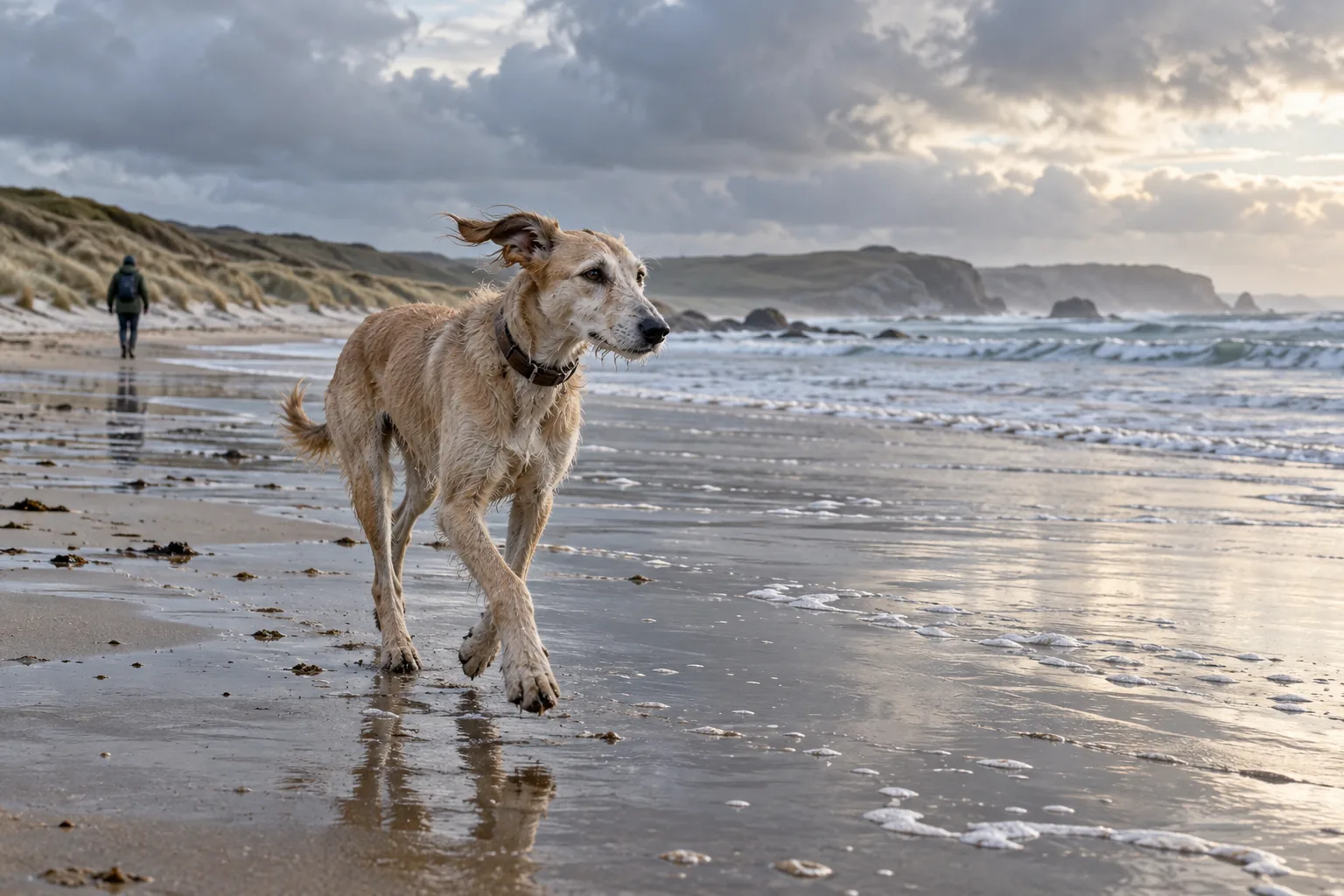
Camelford is not on the coast, but the sea is near enough that a beach day is a short drive, not an expedition. Trebarwith Strand, about eight miles west, is the beach dog owners here come back to most: a wide, sandy beach at low tide, backed by cliffs, with a small village, a pub and a cafe behind it, and generally open to dogs all year. At high tide the beach almost disappears, so the visit lives or dies on the tide times — get there a couple of hours before low water and you will have the widest sand and the longest before the sea returns. Look up the tides the night before, because Trebarwith changes completely between high and low water, and a dog that arrives at high tide will find a narrow strip of sand and a lot of disappointment.
Tintagel's beach is smaller and wilder. It sits below the castle, reached by steep steps, a cove of sand and rock pools rather than a broad open beach. Dogs are welcome outside the main summer season, but the seasonal rules apply in the summer months, so read the signs and look up the current rules before you go. The steps down are steep and uneven, and older dogs or stiff-jointed ones may struggle with them, and the beach is rocky at high tide, so time the visit for low water. The reward is a beach with a castle above it and a cave below — Merlin's Cave, which you can reach at low tide — and a dog that can paddle in the rock pools while you look up at one of the most photographed headlands in Britain.
Port Isaac, a little further along the coast, is a different kind of day out. It is a working fishing village of narrow streets, whitewashed cottages and a harbour that still lands fish, and it is famous as the filming location for a television series about a country doctor. The village is small and steep, the streets are narrow, and a dog on a lead fits in — but the crowds in summer can be intense, and a nervous dog will find the lanes stressful when they are full of people. Come early in the morning or out of season and Port Isaac is a delight: a harbour to sit beside, a coast path in both directions, and cafes that welcome dogs. The path south towards Port Quin is a fine cliff walk for a fit dog, and the one north towards Port Gaverne is shorter and gentler. How seasonal bans and public space protection orders work, and how to read them before you go, is covered in our UK beach-rules guide — worth a look before any summer beach trip in Cornwall, since the rules change from place to place and the fines are real.
The north Cornish coast is beautiful and unforgiving in the same breath, so a beach day here asks for more care than a flat sandy bay. Keep the dog well back from cliff edges and clear of the cliff foot, where rock can come down without warning. Do not let it swim where the current pulls hard or close to rocks, and treat Trebarwith's surf with respect — it can be strong on a day that looks gentle from the car park. On the sand, keep an eye out for fishing hooks, broken glass, and dead fish or other carrion the dog will want to eat. And watch for the signs of too much swallowed seawater after a swim: sickness, diarrhoea and listlessness mean a vet, not a wait-and-see. At the end of the day, wash the salt off with fresh water, look over the paws for cuts and the ears for sand, and get the dog dry before the drive home. A dog that sleeps all the way back to Camelford has had the day it came for.
Other beaches are close by if you want a change: a small harbour beach at Boscastle, a shingle and sand cove with a cafe at Crackington Haven, and the coves around Port Isaac, which are best reached on foot. Staying several days, it helps to ring the changes — a moor day, then a beach day, then a town day, then a coast-path day somewhere new. The dog gets fresh ground, you get fresh scenery, and nobody tires of the same walk. Look up each beach's current dog rules before you go, since the seasonal dates and the exact stretches covered can shift from year to year.
Staying over, parking and vets
Staying in Camelford means staying somewhere that works, not somewhere that performs. Everything a dog owner needs for a week is on one street: food shopping, a pharmacy, cash machines, a place for breakfast and a place for supper, all a short walk from wherever you park. That sounds dull next to a seaside village, and it is exactly the point. A base inland means no circling for a space in a crowded harbour car park, no carrying shopping up a steep lane, and an evening river walk that starts at your front door. The coast is a twenty-minute drive when you want it, and the moor is five minutes the other way — the town sits between them, doing the quiet, useful jobs in the middle.
Sleeping options in and around Camelford run the usual range — small hotels and bed and breakfasts in town, self-catering cottages, holiday parks and campsites in the countryside, farm stays a short drive off — and dogs are taken in all of them somewhere, but the detail is where a stay succeeds or fails. Pin down whether dogs are allowed in the very room or cottage you are booking, rather than merely on the premises, and how many dogs the booking covers. Find out if the fee is charged per dog or per stay, and whether size or breed conditions apply. Ask about the outside space: is the garden fully enclosed, how high is the fencing, and could a determined dog nose the gate open? Ask whether the dog may be left alone indoors, and for how long, because that decides if you can go out to dinner. And ask what is underfoot — after a wet morning on Roughtor, hard floors and somewhere to leave boots count for far more than light-coloured carpet, and a ground-floor room spares an older dog the stairs.
A self-catering cottage usually suits a Camelford stay best, because it lets the dog set the timetable: your own kitchen, a garden or terrace to sit in, and nobody minding what time you come and go. The ones worth the money have a fenced garden, a washing machine for muddy towels, and a door that opens straight onto a footpath or the river — a plain cottage at the edge of town with a direct route to the moor is a better buy than a prettier one that needs a drive to every walk. Holiday parks and campsites near Camelford can suit families well, but put them through the same checks: how many dogs, what it costs, whether the outside space is enclosed, and the rules on dogs left alone. In a caravan or a lodge, study the steps and the decking before booking — a dog that finds steps hard will find them hard every single time it needs to go out.
Parking in Camelford is straightforward if you think about it in advance. The car park off the main street is the sensible choice: it leaves you a short walk from the river and the shops, and the rest of the town is on foot from there. Charges and time limits apply and they do change, so look up the current prices and the longest stay allowed before you travel. For moor walks, the small car parks at Roughtor and the other moor access points are the obvious starting points, and they fill on sunny weekends — arrive early. On the coast, the car parks at Trebarwith Strand and Tintagel are small and fill fast in summer; aim for before ten in the morning or after four in the afternoon, once the crowds have thinned. A dog should never be left in a parked car when it is warm, even for a few minutes.
Get the unglamorous details sorted on arrival and the rest of the stay looks after itself. Find the vet first — there is one in Camelford, with others in Bodmin and Launceston and an out-of-hours service covering the area — and save the number in your phone before you need it in a hurry. Dog food is not a worry: the supermarket carries it and there are pet shops nearby. Signal is the thing to plan around rather than assume: it is fine in town, thin on the moor, and gone altogether on the remoter stretches of the coast path, so put an offline map on your phone before leaving. The town has public toilets, but not on every corner. And in winter, do not assume summer hours: cafes, pubs and attractions shorten their days outside the season, and the moor after heavy rain is a muddy, windswept place that demands a shorter walk and a warmer coat.
Pack as if the moor and the beach might both happen in one day, because around Camelford they often do. Bring a short lead and a long one, a harness that fits properly, and a spare in case one snaps or comes home caked in mud. Bring water and a collapsible bowl — there are long stretches of open moor with nothing for a dog to drink. Bring a towel, a drying coat and a blanket for the car, and more poo bags than you expect to need, plus something to carry them in. A coat earns its place for a short-coated dog in wind or rain, and a dab of sunscreen helps a pale-nosed or thin-coated dog in summer. Pack the dog's usual food and any medicine, the vet's number, and the insurance details. And pack patience: the moor belongs to livestock as much as to walkers, the coast fills up in summer, and the best days here are the ones you do not hurry.
Here is how a weekend can hang together. Arrive on Friday afternoon, leave the car in town, and wander along the river for a short evening stroll, letting the dog learn the smell of the place before dark. Saturday, get up early and climb Roughtor while the moor is still quiet, then come back into town for a pub lunch that welcomes dogs and spend the afternoon at Slaughterbridge and in the river valley. On Sunday, make Trebarwith Strand the morning, timed for low water, then call at Tintagel for the castle walk and a cafe lunch, and finish with a short stroll on the moor edge before driving home. The dog gets a moor day, a beach day and a town day, you get different scenery each time, and no drive is longer than twenty minutes. If the weather turns, shuffle the days: keep the beach for a calm dry morning, take the river valley when it rains, and lean on the town's cafes and shops, which are a real fallback rather than a consolation prize. Basing yourself in Camelford means nothing is far away and nothing hangs on a single plan working — the kind of slack a dog trip needs.
Practical questions
Before you go
Can dogs walk on Bodmin Moor near Camelford off lead?
Yes, on the open ground — provided your dog comes back when called and there is no livestock in sight. Sheep, cattle and ponies graze the whole moor, and the law requires a lead near livestock; a lead is also sensible near boggy ground and old mine workings. Keep the dog close among the tors and let it range on a long lead over the open grass.
Is the Camel Trail accessible from Camelford?
Yes — the trail's southern end at Wenfordbridge is a short drive south of Camelford, and the length from Wenfordbridge towards Bodmin is the quietest part of the whole trail. The path is level and free of traffic, so it suits dogs of every size. Look up current access and any temporary closures before you set out.
Which beaches near Camelford allow dogs all year?
Trebarwith Strand is the safest bet for a year-round beach day near Camelford — a broad stretch of sand once the tide is out. Tintagel and Boscastle have small beaches and harbour corners that come under seasonal rules, so read the signs on the day. Port Isaac and the smaller coves change through the year.
Can I take my dog into pubs and cafes in Camelford?
Yes — several pubs and cafes in and around the town welcome dogs, most readily in gardens and bar areas, and a few allow them inside as well. House rules vary and can shift with the season, so check the venue's own page or ring ahead first, and settle the dog on a mat under the table.
Where is the best place to park in Camelford with a dog?
The town car park off the main street is the practical choice, a short walk from the river and the shops. For the moor, use the small car parks at Roughtor and the other access points, and get there early in summer. Look up the charges before you set out, and never leave a dog shut in a parked car on a warm day.