This guide is independent and contains no paid placement. Prices and product ranges change, so confirm dimensions and fixings with the maker for your exact car model and year before ordering.
Choose the guard by fit first and design second: measure width, height, seat angle and tailgate slope, pick a design that braces solidly without crushing trim, then pair it with a harness, divider or secured crate if you want protection in a sudden stop as well as separation on ordinary journeys.
The braking test nobody plans for
Most people buy a boot guard to solve an everyday problem: a dog that climbs over the rear seats, muddies the upholstery or tries to supervise the driver. The purchase earns its keep, though, on the one journey nobody schedules — the hard brake on a wet dual carriageway when the car in front stops without warning. In that moment an unrestrained dog keeps travelling at the speed the car was doing, and a loose dog in the cabin is a danger to everyone in it, quite apart from the injury to the dog itself.
That single fact explains why fit matters more than looks. A guard that is two centimetres too narrow leaves a shoulder-wide gap at one side. A guard braced only by friction can bow under the weight of a large dog leaning into a bend. A guard fitted at the wrong angle may look tidy with the tailgate open and then foul the glass the moment it closes. None of these faults show up in the driveway; all of them show up at forty miles an hour. The sections below treat the guard as safety equipment that also happens to keep the seats clean, which is the right way round.
It also helps to be clear about what a guard does not do. It separates spaces; it does not cushion an impact, and it does not hold a dog in place within the boot. A dog can still slide, roll or be thrown against the guard itself. That is why experienced owners often layer systems — guard plus something else — and why our wider dog car safety comparison of harnesses and crates is worth reading alongside this one before you spend anything.
Four guard designs, honestly compared
Headrest-mounted universal guards clamp to the metal posts of the rear headrests and adjust for width with sliding side panels. They are the cheapest route in, typically the easiest to move between cars, and the design most hire-car and second-car owners choose. Their weakness is leverage: a tall guard on short headrest posts can flex, and a determined large dog leaning centrally can work fixings loose over weeks. They suit small to medium dogs and calmer travellers best.
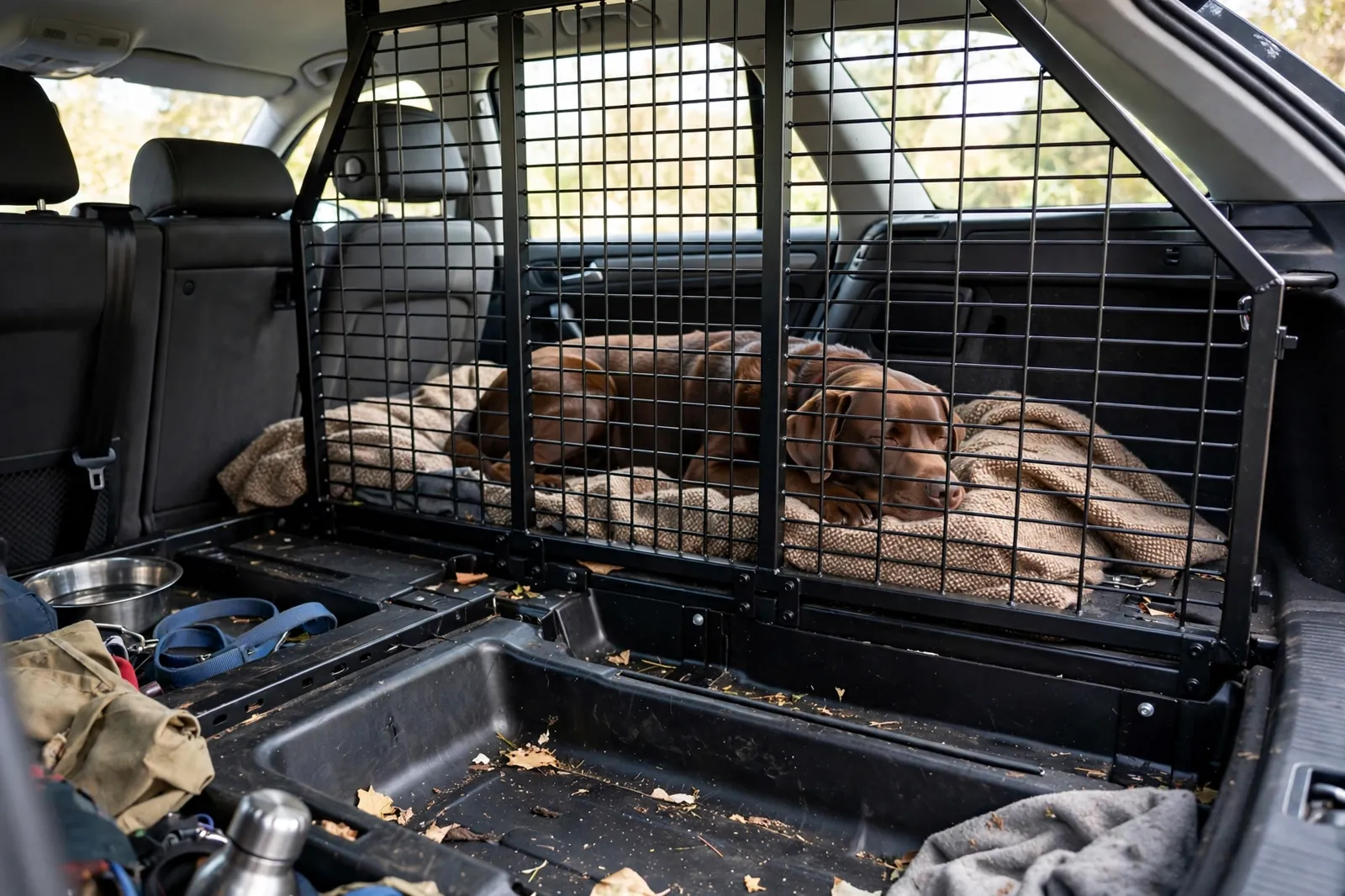
Pressure-fit and brace-fit guards stand on the boot floor and brace upward to the roof lining or sideways into the boot walls, sometimes with legs extending to the rear seat backs. Done well, they feel noticeably more solid than headrest designs and do not depend on headrest spacing, which makes them the fallback for cars with integrated or fixed rear headrests. Done badly, the feet wander on a smooth boot liner and the top pads mark the headlining. A rubber boot mat underneath transforms their grip.
Tailored guards are made for a specific model and year of car, following its roof curve and window line precisely. They cost more — often two to three times a universal guard — but the fit is in another league: no gaps at the edges, no rattles, and usually stronger mounting points that use existing fittings in the boot. If you keep cars for years and travel weekly with a big dog, the tailored route usually repays itself in silence alone. If you change cars often, it becomes an expensive habit.
Mesh and fabric barriers stretch between headrests or hooks and block the visual route into the cabin more than the physical one. They can deter a casual climber and keep a small dog from squeezing through a gap, but they are not a meaningful barrier to a motivated dog and offer nothing in a sudden stop. Treat them as a supplement to a real guard or harness, never as the system itself — and be wary of any listing that photographs a mesh panel as if it were structural.
Measure the boot you actually have
Manufacturers size guards by car model lists, but model lists hide mid-life facelifts, trim differences and optional extras that change the space. Measure your own car with a tape, in daylight, with the boot empty and the rear seats in the position you actually drive with. Four numbers decide almost every purchase.
First, the width at the guard line: measure between the inner trims at the height where the guard top will sit, not at the widest floor point, because boots taper. Second, the height from the boot floor — including any mat or liner you will keep — up to the roof lining at that same line. Third, the angle of the rear seat backs, since a strongly reclined seat pushes the guard top backwards into the tailgate arc. Fourth, the tailgate slope itself: close the boot gently with a rolled towel at guard-top height if you need to test clearance, rather than discovering the clash with the guard already bought.
Then measure the dog, which owners forget surprisingly often. A guard divides space; the space left behind it must let the dog stand, turn and lie fully stretched, with the tailgate closed, alongside anything else that lives in the boot. For two dogs, check the combined lying footprint, not just the head count. If the remaining area only works with the dog curled tightly, the honest answer is a divider rearrangement, a bigger car conversation, or travelling with less luggage in the boot — not a smaller opinion of the dog. Our guide to travelling with a large dog covers space planning for the biggest breeds in more depth.
Fitting without wrecking the trim
Fit the guard on a dry day with time in hand, because the first fitting always takes twice as long as the video suggests. Start by cleaning the contact points: grit under a brace foot will grind into trim with every mile. Assemble the guard loosely outside the car, check every sliding panel moves, and confirm you have all the rubber pads and caps — they are functional parts that spread load and kill rattles, not packaging spares.
Offer the guard into position and tighten fixings gradually, alternating sides like wheel nuts, so the frame squares itself instead of twisting toward whichever side you tightened first. Aim for firm, not maximal: over-tightened headrest clamps can bend posts or crack plastic collars, and pressure feet wound out too hard will dent headlining foam that never fully recovers. Once fitted, push and pull the guard hard in every direction an excited dog could manage. Movement of a few millimetres at the top is normal flex; movement at a fixing point is a fault to fix now, not monitor.
Finally, run the closing checks with the dog still in the house. Close the tailgate slowly and watch the top corners. Sit in the driver seat and check the rear view — a guard bar across the exact centre of the rear window is legal but wearing, and many guards allow a small height adjustment that moves it. Take a ten-minute test drive over imperfect roads and listen. Any tick, buzz or rattle you hear today will be ten times more annoying on a three-hour holiday drive, and it is far easier to cure on the driveway than at a motorway service station.
What the rules actually require
The Highway Code states that when dogs are in a vehicle they should be suitably restrained so they cannot distract the driver or injure anyone — including themselves — if the car stops quickly, and it lists a seat belt harness, pet carrier, dog cage or dog guard as ways of doing that. That wording matters: the rule is about the outcome, suitable restraint, rather than a certificate for a particular product. A guard that genuinely confines the dog to the boot is a recognised method; a decorative barrier that a dog can bypass arguably is not restraint at all.
Beyond the Code, driving with an unrestrained dog that interferes with your control can contribute to careless-driving allegations after an incident, and insurers may scrutinise whether an animal contributed to a crash. Police forces periodically remind owners of exactly this during holiday traffic campaigns. None of this requires panic — it requires a setup you could calmly defend: dog confined, guard secure, driver undistracted. For the full legal picture including Rule 57 and penalties, read our dedicated guide to UK dog car law and restraint rules, and check the latest official guidance before you travel, because wording and enforcement campaigns change.
One grey area deserves honesty. A boot guard alone does not restrain the dog within the boot, and in a severe collision a dog can be injured against the guard itself. Some owners therefore add a harness tethered to a boot anchor point, or place a secured crate behind the guard. There is no single official ranking of these combinations, so choose based on your dog, your car and the journeys you make — but do not assume the most expensive option is automatically the safest for a dog that panics when confined.
Guard plus harness, crate or divider
A divider is the natural partner: it splits the boot lengthways so the dog gets one side and luggage, shopping or a pushchair gets the other. Dividers attach to the guard and are usually model-specific even when the guard is universal, so order them as a matched pair and check compatibility by car year. For two dogs that travel better apart — a common arrangement with a youngster and an older dog — a divider also removes the low-level squabbling that makes long drives tense.
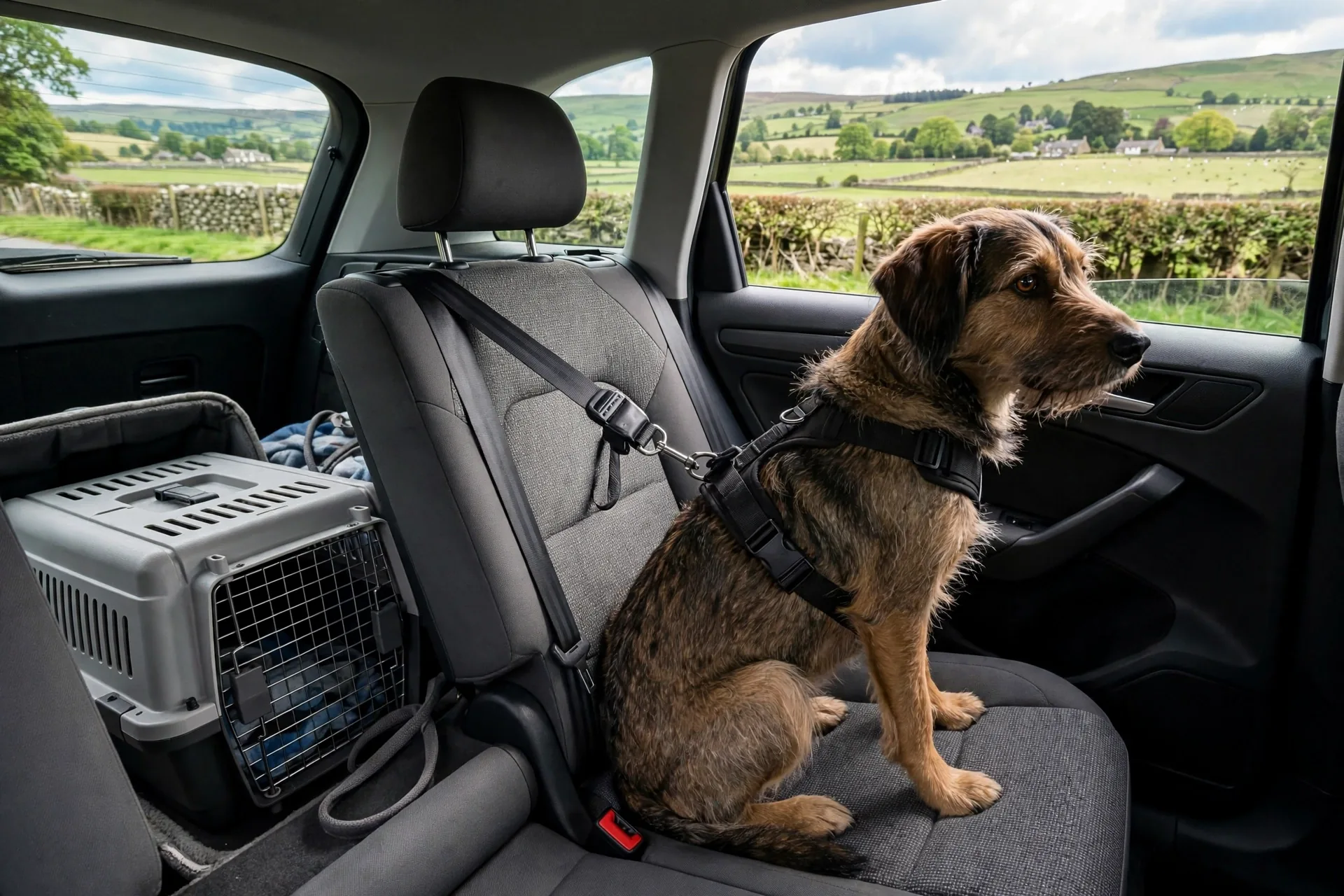
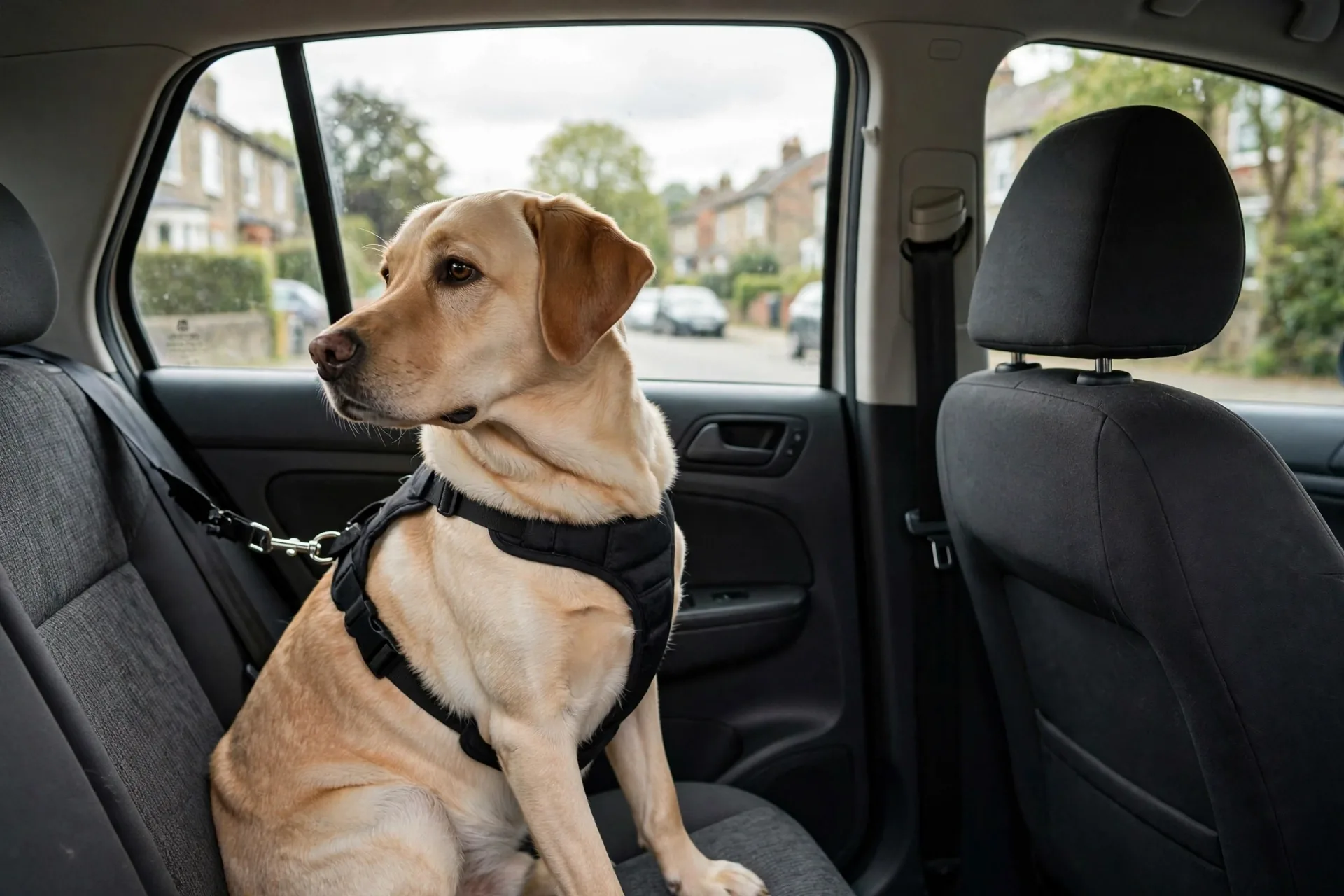
A harness and tether behind a guard adds restraint within the space. Use a proper car harness fitted snugly, attach to a structural anchor or load eye rather than a trim hook, and keep the tether short enough to prevent the dog reaching the guard with momentum but long enough to lie down in any position. Never tether by the collar: in a sudden stop the load goes through the neck. Test the arrangement stationary first, because some dogs rotate and wrap themselves in any tether within minutes, which turns a safety device into a tangle hazard.
A crate behind a guard is belt-and-braces, most common for small dogs in big boots where an unsecured crate would slide. The crate must itself be strapped or wedged so it cannot move, the door must open fully within the boot for safe loading, and ventilation must reach it — a crate pushed against a solid divider in a hot boot is a poor place. If you go this route, compare crate sizes against our harness versus crate safety guide before buying, because boot apertures, not boot volumes, usually decide what fits.
Space, airflow and temperature in the boot
A guard solves separation; the owner still has to solve comfort. Boots are the least ventilated part of most cars, and in estates and hatchbacks the rear glass turns the area into a greenhouse on sunny days. Check where the cabin air actually reaches: many cars have vents or a useful flow under the rear seats, but a solid parcel shelf or a boot packed to the roof with luggage can block it entirely. Leave an air path, crack the routine of stopping every couple of hours for water and a leg stretch, and never treat a guard as making a parked car safe — a dog behind a guard in a stationary car in summer is in exactly the same danger as a dog anywhere else in that car.
Bedding matters more behind a guard because the dog cannot choose a different spot. A low, non-slip bed or mat that does not bunch into corners gives the dog a defined place to settle and insulates against a cold metal floor in winter. Raised beds suit some older dogs but reduce headroom under a sloping tailgate. Water for the journey should be offered at stops rather than left in a bowl that will soak the bedding at the first roundabout; spill-proof travel bowls are the exception if your dog drinks little and often. A familiar-smelling blanket from home, rotated but not washed to sterility before every trip, genuinely helps many dogs switch off behind the guard.
Noise is the comfort factor owners underestimate. The boot sits over the rear wheels, so road roar is louder there than in the cabin, and a guard that transmits vibration adds to it. A rubber boot liner under the bedding, correctly tightened fixings and a route that avoids an hour of coarse motorway surface where a quieter A-road exists all add up. If your dog arrives wired and panting despite a sensible setup, work through our guidance on calming anxious dog travel rather than assuming a different guard will fix what is really a confidence problem.
Teaching a dog to settle behind a guard
Dogs that have always ridden on a seat often object to the boot for reasons that have nothing to do with the guard: it is further from you, it sounds different, and the first journey is usually a long one. Build the association in slices. Start with the car stationary on the drive, tailgate open, bedding in place, and let the dog hop in for treats and a chew, then get out again. Repeat across several days until the boot predicts good things and mild boredom rather than departure.
Next, close the tailgate for seconds, then minutes, staying visible through the glass and rewarding calm behaviour. Follow with engine-on stationary time, then a five-minute loop, then twenty minutes to somewhere the dog loves. If the dog barks or digs at the guard, you have moved a step too fast — shorten the previous stage rather than battling through, because a dog that practises panic behind a guard gets better at panicking. Most dogs need days to a couple of weeks of this; a rescue dog with unknown car history may need longer, and that investment pays back on every journey for years.
Position routines help once you are travelling. Load the dog last and unload first where safe, keep a consistent cue for settling, and avoid feeding a full meal in the hour before departure if your dog travels queasily. On arrival, give the dog a chance to toilet and decompress on a lead before expecting café manners or campsite calm. The guard keeps the journey contained; the routine around it is what makes the journey feel ordinary, and ordinary is the goal for every dog passenger.
Cleaning, checks and common failures
Guards live in the dirtiest corner of the car and quietly accumulate problems. Mud and grit work into sliding joints until width adjustment seizes. Hair packs around brace feet and hides a fixing that has backed off. A tailgate strut weakens with age until the boot lid rests a few millimetres lower — exactly where your guard top sits. Build a monthly two-minute check into your routine: shake test, fixing torque by hand, pad condition, and a wipe of the joints with a damp cloth followed by a drop of suitable lubricant on metal sliders if the maker allows it.
The failures owners report most share a pattern of being small, progressive and ignored. A faint new rattle becomes a loose guard over a season. A puppy that could not reach the side gap becomes an adolescent that can, so re-check gaps against the dog you have now, not the dog you measured in spring. Chewed pads and scratched trim protection should be replaced rather than tolerated, because the next thing chewed may be a seat belt webbing or wiring loom routed through the boot — repairs that cost far more than the guard did.
When you sell the car or the guard, be honest about which it fits. Universal guards transfer well but wear at the clamps; tailored guards are valuable to the next owner of the same model only if every fitting and pad is present. Keep the instructions and any model-specific brackets in a labelled bag in the boot from day one. It sounds like admin for its own sake, right up until you are trying to refit a guard in a rainy holiday-cottage car park using a phone torch and guesswork.
Practical questions
Before you buy
Does a boot guard on its own satisfy UK car rules for dogs?
A well-fitted guard that genuinely prevents the dog leaving the boot area is widely treated as a suitable restraint, but the Highway Code wording is about suitable restraint rather than naming one product. Many owners combine a guard with a harness or a secured crate for stronger protection in a sudden stop. Check the latest official guidance before you travel.
How do I measure my boot for a dog guard?
Measure the width between the rear headrest posts, the height from boot floor to roof lining at the guard line, and the angle of the rear seats and tailgate. Note wheel-arch intrusions and any slope. Compare all four measurements with the guard maker range, not just the headline width, and leave clearance so trim is not crushed.
Can I still fold the rear seats down with a guard fitted?
Usually not without removing or loosening the guard, because most guards brace against the headrests or boot sides that move when seats fold. Some quick-release designs come out in a couple of minutes. If you fold seats weekly for bikes or tip runs, prioritise a tool-free removal design and practise taking it out before you need to do it in a car park.
Is a guard or a crate better for a nervous dog?
A crate often suits a nervous dog better because the smaller, den-like space limits sliding and visual stimulation, provided the dog is already crate-trained. A guard suits confident dogs that like to stand, turn and watch. Never force a dog that panics in a crate into one for travel; build positive associations gradually at home first.
How do I stop a boot guard rattling?
Most rattles come from a loose brace foot, a wing nut backed off a quarter turn, or metal touching trim. Re-tighten all fixings after the first few journeys, add the rubber pads supplied, and check that the guard is not flexing against the tailgate glass. If one corner still taps, a small piece of self-adhesive foam on the contact point usually ends it.