This guide is independent and contains no paid placement. If affiliate links are added later, they will be clearly marked and will not change our editorial checks.
Cardigan rewards a slow pace: walk the Teifi estuary first, explore the castle grounds on a lead, then head to a high coastal viewpoint for dolphins. Check tide times and beach restrictions before you travel, keep your dog on a lead near cliffs, livestock and mud, and treat the town as a place to linger rather than rush through.
Where Cardigan sits, and why dogs suit it
Cardigan, known in Welsh as Aberteifi, sits where the River Teifi meets Cardigan Bay on the west coast of Wales, in the county of Ceredigion. It is an old market town rather than a resort, which is exactly why it works so well with a dog. The streets are compact enough to explore on foot, the river is never far away, and the open water of the bay begins just beyond the town. You can build a whole day from three ingredients — water, grass and a place to sit — without driving anywhere, and that simplicity suits most dogs far better than a packed itinerary.
The town grew up around the river and the castle, and its history is still visible in the shape of the place. The Teifi was once a working river, carrying trade in and out of the town, and the quayside still gives Cardigan its character: boats, gulls, tidal mud and wide skies. Cardigan Castle stands above the river on the edge of the town centre, and its grounds are now a green, open space rather than a fortress you only admire from a distance. For a dog, the appeal is straightforward. There are smells from the river, open ground to explore on a lead, shade under trees, and plenty of benches where a tired dog can settle while you look at the water.
Cardigan also makes a good base for the wider coast. New Quay, Aberporth, Mwnt and the long sweep of Cardigan Bay are all within a short drive, and the Pembrokeshire border lies to the south. That matters because a dog holiday rarely depends on one town alone: you want a comfortable base, a few reliable walks, and the option to drive ten or twenty minutes to a beach when the mood takes you. Cardigan gives you all three, plus the practical things that dog owners actually need — car parks, a vet, shops, cafes with outdoor seating and places to buy forgotten poo bags.
The town is small enough that you can plan loosely and still get things right. Park once, walk the river, visit the castle grounds, wander the high street, and finish with a longer coastal walk or a beach. The sections below follow that shape, but they are designed to be rearranged. If your dog is older, start with the castle grounds and a short riverside loop. If your dog is young and energetic, add a beach and a cliff-top path. If the weather turns, swap the coast for the town and a cafe. Cardigan does not demand a perfect plan; it rewards a flexible one.
A first morning: the river before the town wakes
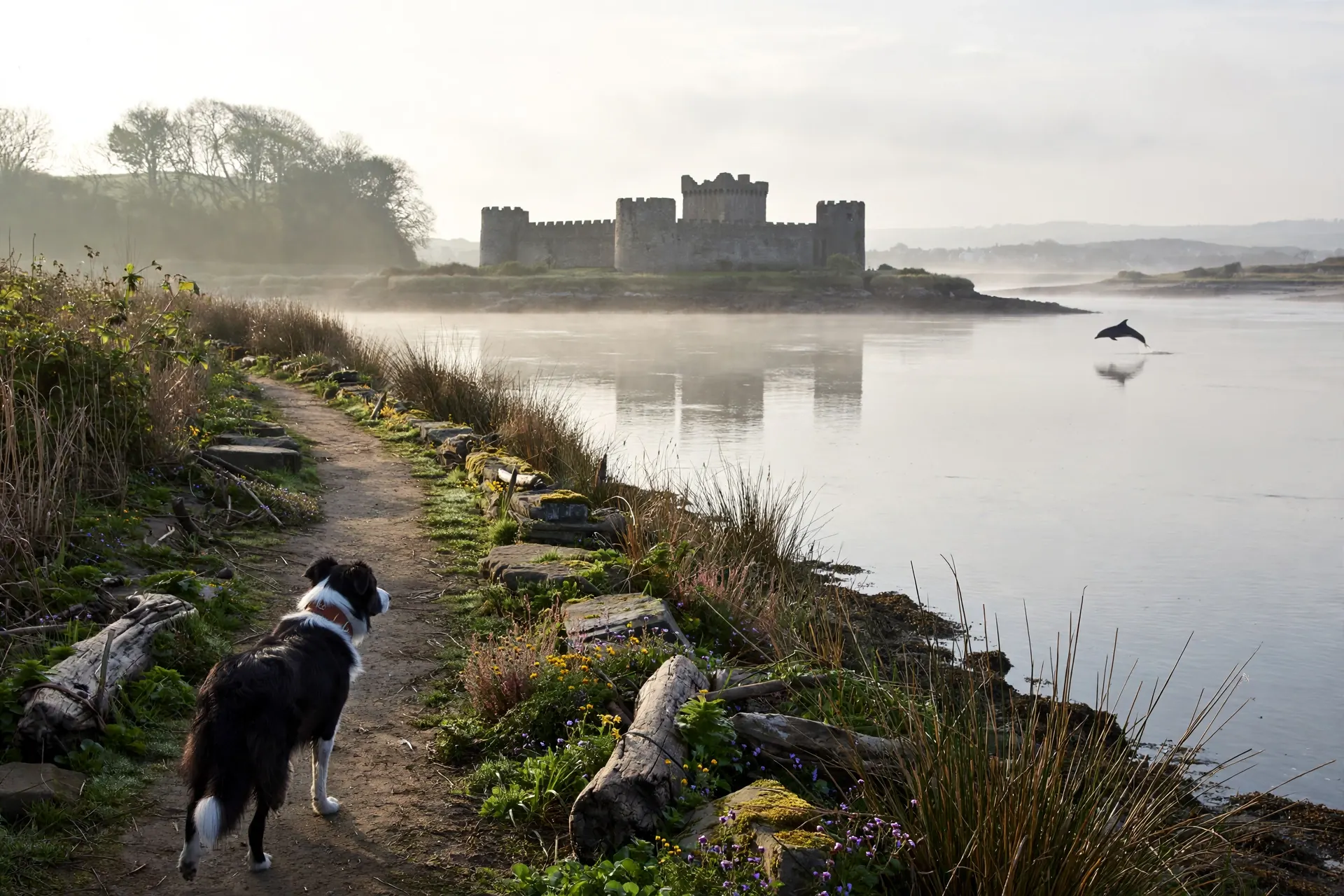
The best time to meet Cardigan with a dog is early in the morning, when the river is quiet and the town is still waking up. Start at the quayside and the riverside paths near the town centre, where the Teifi slides past moored boats and the air smells of salt and mud. An early walk does three useful things at once: it gives your dog a proper toilet walk before breakfast, it lets you read the tide and the weather without an audience, and it shows you which paths are firm underfoot and which are soft after rain. Walk slowly, let your dog sniff, and use the time to plan the rest of the day rather than rushing into it.
Morning light on the estuary is one of the pleasures of Cardigan, and it changes with the tide. At low water the river narrows, mud banks appear, and wading birds pick their way across the exposed shore. At high water the river looks broad and calm, and the far bank seems much closer. Both states are worth seeing, but they call for different care. Low tide exposes mud that can be deep and sticky, so keep your dog on the path and do not let them chase birds across the flats. High tide brings the water closer to the path, so watch for slippery edges and keep a firm grip on the lead where the path runs beside the river without a fence.
Use the first walk to settle the practical questions. Where is the nearest bin for poo bags? Where can your dog drink safely — from a bottle and bowl you carry, not from the tidal river? Which stretches of path are shared with cyclists, and where does the path narrow beside the road? A ten-minute reconnaissance walk answers all of these, and it also tells you how your dog is coping with the new place. A dog that is relaxed on the quayside will usually be relaxed in the castle grounds; a dog that is unsettled by traffic noise or gulls may need a quieter route, a longer lead, or a slower start.
After the first loop, give your dog water and a short rest before breakfast or coffee. Dogs that arrive straight from a car journey often need twenty minutes to drink, sniff and settle before they are ready for a longer walk, and Cardigan is a good place to give them that time. Find a bench with a view of the river, let your dog lie down, and watch the town wake up. The rest of the day will go better for it, and you will have seen Cardigan at its quietest, which is when the town feels most itself.
Cardigan Castle with a dog
Cardigan Castle is the town's best-known landmark, and it is also one of its most dog-friendly green spaces. The castle stands on a site with a long history — a Norman castle was first built here in the twelfth century, and the site has been fought over, rebuilt and restored across the centuries. Today the castle and its grounds have been restored as a public space, with gardens, open lawns, paths and views over the Teifi. For a dog owner, the grounds are the point: a contained, green place in the middle of town where a dog on a lead can walk, sniff and rest while you take in the history.
Dogs on leads are generally welcome in the castle grounds, which is where most dog owners will spend their time. Access to indoor rooms, exhibitions and the cafe can be restricted, so do not plan the visit around going inside with your dog. Check the official guidance before you travel, because rules can change for events, private hire and seasonal opening. The practical approach is to treat the castle as an outdoor visit: walk the grounds, look at the stone walls and the river views, read the information boards, and enjoy the gardens. If part of the site is closed to dogs on the day, the riverside paths beside the castle still give you a good walk and a good view.
The grounds suit a slow visit. The paths are mostly level and surfaced, which helps older dogs and dogs that struggle with steps, but there are slopes and uneven ground in places, so take your time and watch your footing after rain. Keep your dog on a short lead near the walls and drops, and away from planted beds and other visitors' picnics. The lawns are a good place for a rest, but they are shared space, so keep your dog close and pick up after them promptly. If your dog is reactive, visit early or late in the day, when the grounds are quieter, and stick to the wider paths where you can see other visitors coming.
Cardigan Castle also makes a useful anchor for the rest of the town. From the grounds you can look down to the river and across to the far bank, which helps you get your bearings before you walk on. The castle's story — its medieval origins, its later life as a private house, and its community-led restoration — is worth a few minutes of reading, and the information boards do a good job of explaining it without overwhelming you. If you are building a wider castle trip, our guide to dog-friendly castles in Wales sets out which sites welcome dogs, where leads are required and how castle zones differ, so you can plan a second castle day without repeating the same checks.
Estuary walks: the Teifi on a lead
The Teifi estuary is the walk that defines Cardigan, and it is best enjoyed as a series of short, level loops rather than one long march. The riverside paths near the town give you water, birds and open sky without any climbing, and they connect naturally to the castle, the quayside and the town centre. For most dogs this is the ideal shape: a walk with plenty to sniff, regular places to stop, and no pressure to keep going when the dog has had enough. Plan for an hour rather than a half-day, and add a second loop later if your dog is still keen.
Tides are the one thing you must respect on the estuary. The Teifi is tidal at Cardigan, which means the water level, the width of the river and the firmness of the banks all change through the day. Check tide times before you set out, and avoid walking on exposed mud or letting your dog enter the water where the current is strong. Estuary mud can look firm and then hold a paw — or a boot — fast, and tidal water can rise across a flat bank faster than it looks. The safe rule is simple: stay on marked paths, keep your dog on a lead near the water's edge, and treat any invitation to wade as a reason to stop and think rather than follow.
Wildlife is part of the pleasure and part of the responsibility. The estuary attracts herons, egrets, oystercatchers, curlews and gulls, and in the right season you may see salmon or sea trout moving in the river. Dogs that chase birds need a short lead and a watchful owner here, not a long line and a hope for the best. Keep your dog out of the reed beds and away from nesting areas, and remember that livestock may graze on fields beside the estuary paths. If you meet sheep or cattle, put your dog on a short lead, walk calmly past at a distance, and do not let them approach or bark at the animals.
What to carry on an estuary walk is worth a moment of thought. Bring water and a bowl, because tidal river water is not a safe drink for a dog, and bring more poo bags than you think you need, since bins can be spaced out along the paths. A towel is useful after rain or mud, and a drying coat helps a short-coated dog on a windy day. In summer, carry shade in the form of a plan — walk early or late, rest under trees, and watch for overheating on a dog that is panting hard or slowing down. In winter, the same paths can be muddy and slippery, so wear boots with grip and expect to wash paws afterwards. The estuary rewards preparation, and it punishes the assumption that a riverside path is always an easy one.
Dolphin watching in Cardigan Bay
Cardigan Bay is one of the best places in Britain to see bottlenose dolphins, and Cardigan sits at the southern edge of that bay. A resident population of bottlenose dolphins lives in these waters, and they are seen regularly from the coast around Cardigan, New Quay and Aberporth, particularly in the warmer months. No sighting is ever guaranteed — dolphins are wild animals, not a scheduled attraction — but the chance is real, and it changes the feeling of a coastal walk. You are not just looking at the sea; you are watching it, and that makes even a quiet hour on a headland feel worthwhile.
The best approach for a dog owner is to pick a high viewpoint, settle down, and watch patiently. Dolphins are most often spotted from cliff tops and headlands, where you can see a wide stretch of water and pick out the curve of a back or the splash of a tail. Calm, clear days give the best chances, because a flat sea makes movement easier to see, and early morning or late afternoon light can help as well. Bring binoculars if you have them — they turn a distant splash into a shape you can actually follow — and bring a blanket or a mat so your dog can lie down comfortably while you watch. A dog that can settle for twenty minutes is a better dolphin-watching companion than a dog that needs constant movement, so choose a spot with shade and a view, and keep the session short if your dog gets restless.
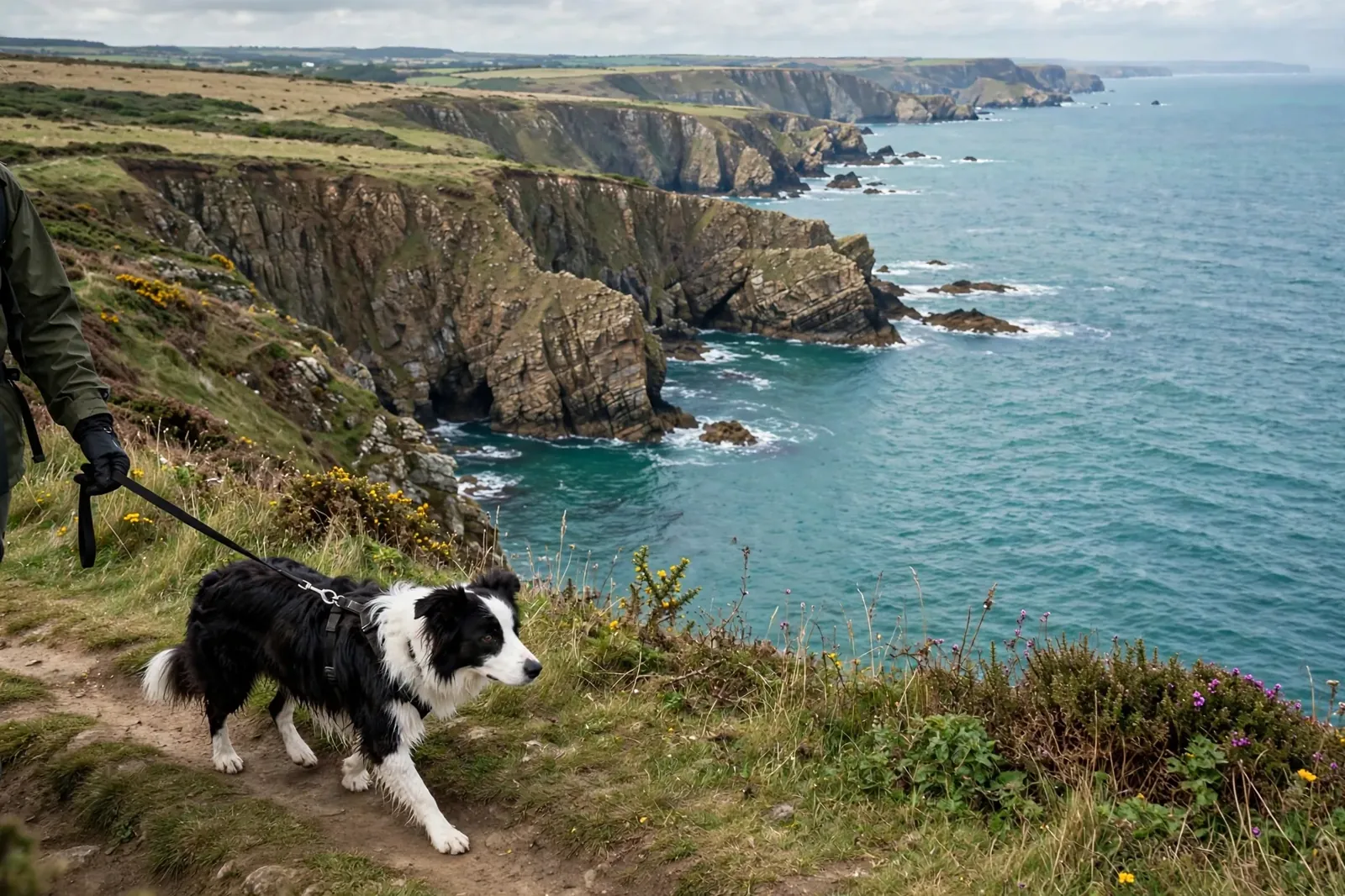
Safety comes first on any coastal viewpoint. Keep your dog on a lead at all times near cliff edges, and keep well back from unfenced drops, even if your dog seems calm. Coastal paths can be narrow, the wind can be strong, and a sudden movement — a gull, a rabbit, another dog — can pull a dog towards the edge faster than you expect. If you walk between viewpoints, stay on the marked coast path, watch for eroded edges after rain, and do not let your dog scramble down to the shore from a cliff. The viewing points around Mwnt, Aberporth and New Quay are all worth the short drive from Cardigan, and each one gives a different angle on the same bay, so try more than one if the first is quiet.
Boat trips are the other option, and they need a separate check. Several harbours along Cardigan Bay run wildlife-watching boat trips in season, and some may welcome dogs while others do not. Check the official guidance before you travel, and ask the operator directly about dogs, life jackets, boarding steps and how long the trip lasts. A dog that is happy on a boat and can settle for an hour or two may enjoy it; a nervous dog, a dog that dislikes water, or a dog that barks at engine noise will be happier waiting on shore. If you do go out on the water, follow the operator's instructions, keep your dog secure, and remember that the bay can be choppy even on a calm-looking day. For most visitors, the headland watch is the better plan: it costs nothing, it suits the dog, and it leaves you free to move on when the sea goes quiet.
Beaches near Cardigan for dogs
The beaches near Cardigan are the reason many dog owners drive here, and they range from wide sandy bays to small rocky coves. Poppit Sands, at the mouth of the Teifi a short drive from the town, is the nearest large beach, with a broad sweep of sand at low tide and dunes behind it. Mwnt, a little further up the coast, is a smaller, sheltered cove with a headland walk and a famous view back towards Cardigan. Aberporth, to the north, offers two sandy beaches and a village with cafes and parking. Each one suits a different kind of dog day, and the right choice depends on the tide, the season and how far your dog wants to walk.
Seasonal restrictions are the detail that catches people out. Some beaches near Cardigan welcome dogs all year, while others restrict dogs during the summer months, usually from around May to September, and sometimes only on part of the beach. The dates and the exact areas can change from year to year, and the signs at the beach entrance are the final word on the day. Always read them when you arrive, and check the official guidance before you travel if you are planning around a particular beach. A beach that was dog-friendly in October may have a ban in July, and a beach with a summer restriction may still allow dogs on a clearly marked section, so do not assume — check.
Tides matter on the beach as much as on the estuary. At low tide, Poppit Sands and the other wide beaches open up into long, flat expanses that are ideal for a run and a game, but the tide comes back across flat sand quickly, and channels can fill behind you. Check tide times, keep an eye on the water, and stay near the access point if you are unsure. At high tide, the same beaches shrink to a narrow strip, and the walk back to the car park can be along a busy road or a steep path, so plan your arrival and departure around the tide rather than fighting it. Dogs that swim need the same care as on the estuary: strong currents, cold water and waves are all real risks, and a dog should never be encouraged to swim alone or far from shore.
Beach safety for dogs is mostly common sense, applied carefully. Bring fresh water, because a dog that drinks seawater can become ill, and bring shade or a windbreak on a sunny day, since there is often no natural cover on an open beach. Watch for sharp shells, fishing line and discarded food, and keep your dog away from dead fish or seabirds, which can carry disease. After the beach, rinse sand and salt from paws and coat, check between the toes, and dry your dog properly before the drive home. A sandy car and a damp dog are part of the deal, but a towel, a blanket and a few minutes of care at the car park make the journey home much more comfortable for everyone.
Eating and drinking in town with a dog
Cardigan's high street and quayside are compact enough to explore with a dog, and the town has a good range of cafes, pubs and small restaurants for its size. The practical question is not whether Cardigan has places to eat — it does — but where your dog is welcome, and in what part of the building. Many cafes and pubs welcome dogs in outdoor seating areas and on terraces, fewer welcome them inside, and policies can change with the season, the time of day and whether food is being served. The safest plan is to look for outdoor seating first, ask before you sit down, and have a backup in mind if the first place is full or the dog is not welcome inside on a rainy day.
Outdoor seating suits most dogs, provided you think about the details. Choose a table with space for your dog to lie down out of the walkway, bring a blanket or mat so your dog is not lying on cold stone, and order water for the dog as well as for yourself. A dog that can settle under a table for half an hour is a pleasure to eat with; a dog that barks at every passer-by, pulls towards other tables or begs from strangers will make the meal stressful for everyone. If your dog is still learning to settle in busy places, start with a short coffee stop rather than a long lunch, and build up from there. Cardigan's quieter side streets and the quayside are better for a first cafe stop than the busiest part of the high street at lunchtime.
The town also rewards a slower kind of browsing with a dog. Cardigan has independent shops, a market tradition and a creative, small-town feel, with galleries, bookshops and food shops that are worth a wander. Not every shop welcomes dogs inside, so check the sign on the door and ask if you are unsure — many small shops are happy to welcome a calm dog on a lead, while others, particularly food shops, may ask you to wait outside. Keep visits short, keep your dog close in narrow aisles, and do not let them sniff stock or jump up at other customers. A dog that waits patiently outside a shop for two minutes while you buy something is a useful skill to practise here, where the streets are quiet enough to make it easy.
Market days and events change the feel of the town, and they are worth planning around. A busy market brings more people, more food smells, more noise and more dogs, which can be exciting for a confident dog and overwhelming for a nervous one. If your dog struggles in crowds, visit the market early, stick to the edges, and leave before the busiest hour. If your dog loves people, a market morning can be a highlight — but keep the lead short, watch for dropped food, and remember that not every stallholder or shopper wants a dog's attention. Cardigan is a friendly town, and a little courtesy goes a long way: pick up after your dog, keep them off other people's picnics, and thank the staff who welcome you both.
A rainy-day plan that still works
Rain is a normal part of a Welsh coastal trip, and Cardigan handles it better than many seaside towns because the town itself is the attraction, not just the beach. A rainy day here is not a wasted day; it is a slower day, with shorter walks, longer cafe stops and more time in the car or the accommodation. The key is to plan for rain before it arrives, so you are not standing in a car park in a downpour trying to decide what to do. Pack waterproofs for you and a drying coat for the dog, keep a towel in the car, and accept that you will get wet — the question is how much, and for how long.
Start with a short, sheltered walk rather than a long exposed one. The riverside paths near the town give you water and air without the wind of the open coast, and the castle grounds offer trees and walls that break the worst of the rain. A twenty-minute loop, a towel dry, and a warm drink is a better rainy-day pattern than a two-hour coastal walk that leaves a cold, wet dog shivering in the car. If the rain is heavy, walk in the morning when it may ease, or wait for a gap between showers and use the dry window well. Weather forecasts for the Ceredigion coast can change quickly, so check again in the morning rather than trusting yesterday's forecast.
Use the middle of a rainy day for the town. Browse the shops, visit a cafe with a covered terrace, and let your dog rest somewhere warm and dry. Dogs that have been out in the rain need time to dry and warm up, and a cafe stop is a good place to do it — provided the dog is welcome and can settle. Bring a blanket for the dog to lie on, and a spare towel for the floor if they drip. If you are staying overnight, the accommodation is the other rainy-day asset: a warm room, a dry bed and a quiet afternoon can turn a wet day into a restful one, and many dogs sleep better after a short wet walk and a long dry rest than after a forced march in the rain.
Driving is the rainy-day fallback that still feels like a trip. The coast road north towards Aberporth and New Quay, and south towards the Pembrokeshire border, gives you bay views from the car and short stops at viewpoints where you can watch the sea without a long walk. Our guide to the Pembrokeshire Coast Path with a dog covers the longer coastal walking to the south, including section-by-section tips and cliff safety, which is useful if a dry day follows the rain and you want to extend the trip. On a wet day, though, keep the driving short, the stops brief, and the dog dry — the coast will still be there tomorrow, and it looks better in sunshine anyway.
Staying overnight near Cardigan
Cardigan works as a day trip, but it works better as an overnight stay, because the town changes in the evening and the coast is at its best early in the morning. Staying overnight gives you a quiet evening walk along the river, a morning walk before the day visitors arrive, and the freedom to choose your beach by the tide rather than by the clock. It also gives your dog a proper rest between walks, which matters more than most people realise: a dog that sleeps well overnight will walk better the next day, and a dog that is driven home tired after a long day is more likely to be stiff and grumpy the next morning.
The area around Cardigan offers the usual Welsh mix of accommodation: hotels and guest houses in the town, bed and breakfasts in the surrounding villages, self-catering cottages, and holiday parks and caravan sites within a short drive. Dog-friendly options exist in all of these, but the details vary widely, so check the dog policy before you book rather than assuming that a place that accepts dogs accepts your dog. Ask how many dogs are allowed, whether there is an extra charge, whether the dog can be left alone in the room, and where the nearest toilet walk is after dark. A place that welcomes dogs in principle but has no outdoor space, no nearby walk and a strict alone-time rule may be a poor fit for your dog, however pretty the listing looks.
Self-catering cottages and holiday parks suit many dog owners because they give you a kitchen, a door you can open for a quick toilet trip, and space for a dog bed and a drying area. Our guide to dog-friendly holiday parks in Wales sets out how to choose by coast access, livestock rules, secure boundaries and realistic travel time, and the same checks apply to cottages near Cardigan: is the garden enclosed, how high is the fence, is there a road nearby, and where is the nearest walk that needs no car? A cottage a ten-minute drive from the beach is a different holiday from a cottage a ten-minute walk from the river, and the difference matters every morning and every evening.
When you stay overnight, think about the first and last hour as carefully as the middle of the day. Arrive in daylight if you can, walk the boundary of the garden or the route to the toilet area before dark, and settle your dog with familiar bedding and the same feeding routine as at home. In the morning, give your dog a short toilet walk before breakfast, then a longer walk once they have eaten and rested. If you are staying for more than one night, keep one day light — a town morning and a beach afternoon, rather than two long coastal walks back to back — so your dog has time to recover. Cardigan rewards that rhythm, and a rested dog is a happier travelling companion.
Practical planning: parking, tides and seasons
Parking in Cardigan is straightforward if you arrive with a plan. The town has several public car parks within a short walk of the river, the castle and the town centre, including car parks near the Quay and the town centre, and on-street parking in the surrounding streets. Arrive early in summer, on market days and on bank holidays, when the town fills up and the nearest car parks go first. Check the official guidance before you travel for current charges, time limits and any changes to parking arrangements, and keep coins or a payment app ready if the machines require them. Never leave a dog in a hot car, even for a few minutes, and on a warm day park in shade, leave windows open for ventilation if you stay with the car, and take the dog with you whenever you can.
Tides and seasons shape the trip more than any single attraction. The Teifi is tidal, the beaches change with the tide, and the best walking hours are often the hours around low water, when the sand is wide and the paths are dry. Check tide times for Cardigan and for the beach you plan to visit, and build the day around them rather than against them. Seasons change the deal as well: spring brings wildflowers and quieter paths, summer brings long days, warm water and beach restrictions, autumn brings colour, migrating birds and empty beaches, and winter brings storms, big seas and a town that feels properly local. Each season suits a different kind of dog, and the best time to visit depends on your dog as much as on the weather.
Health and safety planning is unglamorous and essential. Save the number of the nearest vet in your phone before you travel, and know where the nearest out-of-hours vet is, because rural practices can be some distance away and may close early. Carry a small first-aid kit for the dog — tweezers for ticks, a bandage, saline for eyes, and any regular medication — and check your dog for ticks after walks through long grass and woodland. In summer, watch for heat: walk early or late, carry water, and never exercise a dog hard in the middle of a hot day. In winter, watch for cold water, icy paths and salt on roads, and dry your dog properly after every wet walk. A little preparation here saves a lot of worry later.
Getting to Cardigan is part of the plan, and the drive itself deserves thought. The town is reached by A-roads through the Welsh countryside, and the journey from the east or the south can take several hours, so plan stops for your dog every two hours or so, with water, a toilet break and a short stretch. Keep your dog secure in the car with a harness, crate or guard, and never let them travel loose in the boot or on a passenger's lap. If you are using public transport, check the official guidance before you travel, because bus and train rules for dogs vary, and a rural service may have limited space. Whatever way you travel, arrive with a dog that has had a break, a drink and a walk, and the town will feel welcoming from the first minute.
A relaxed two-day plan
Day one starts with the town. Arrive in the morning, park near the Quay, and take a short riverside walk to settle your dog and read the tide. Visit the castle grounds on a lead, walk the gardens slowly, and look out over the Teifi from the walls. Wander the high street, find a cafe with outdoor seating for a late breakfast or an early lunch, and let your dog rest under the table. In the afternoon, drive to Poppit Sands for a beach walk at low tide, or to Mwnt for a shorter cove walk and a headland view. Finish with an evening riverside stroll near your accommodation, a quiet dinner, and an early night — the dog will thank you for it.
Day two is the coast day. Start early with a short toilet walk, then drive north to Aberporth or New Quay for a headland dolphin watch. Pick a viewpoint, settle with binoculars and a blanket, and give the sea twenty or thirty minutes of your attention. If the dolphins do not show, the walk and the view are still worth the drive, and you can try a second viewpoint before lunch. After the coast, return to Cardigan for a late lunch and a final riverside walk, or stop at a second beach on the way back if your dog still has energy. Leave in the late afternoon, when the light is soft and the roads are quieter, and give your dog a break on the drive home.
The plan is deliberately light, because the best Cardigan trips leave room for the unexpected. A dolphin sighting, a quiet beach at low tide, a cafe that welcomes your dog like an old friend — these are the moments that make the trip, and they do not appear on a timetable. If your dog is tired, cut the second beach. If the weather turns, swap the coast for the town. If you find a walk you love, do it twice rather than ticking off a new one. Cardigan is a town that rewards returning to the same river, the same castle walls and the same stretch of coast, and seeing them differently each time. That is the real reason to bring a dog here: not to cover ground, but to slow down and notice it.
Before you go, run through a short checklist. Tide times checked for the beach and the estuary? Beach restrictions checked for the season? Castle opening and dog rules checked? Vet number saved, water and bowl packed, poo bags and towel in the car? Accommodation dog policy confirmed in writing? If the answer to each is yes, you are ready. Cardigan does not ask for much more than that — a lead, a little patience, and a willingness to let the river set the pace. Give it those, and the town, the castle and the bay will do the rest.
Practical questions
Before you go
Can dogs visit Cardigan Castle?
Dogs on leads are generally welcome in the castle grounds, which are the main attraction for most dog owners, but access to indoor rooms, exhibitions and the cafe can be restricted. Check the official guidance before you travel, because rules can change for events, and plan the visit as a grounds and riverside walk with the buildings as a bonus.
Where is the best place to watch for dolphins near Cardigan with a dog?
The Cardigan Bay coastline around Cardigan, New Quay and Aberporth is known for bottlenose dolphins, and the best chances usually come from a high viewpoint on a calm day. Keep your dog on a lead near cliff edges, bring binoculars, and treat every sighting as luck rather than a guarantee. Boat trips from nearby harbours may have their own dog policies, so check before booking.
Are the beaches near Cardigan dog-friendly all year?
It depends on the beach. Some beaches near Cardigan welcome dogs all year, while others have seasonal restrictions in the summer months, usually from around May to September. Always read the signs at the beach entrance and check the official guidance before you travel, because restrictions and dates can change from year to year.
Is the Teifi estuary walk suitable for dogs?
Yes, for most dogs, provided you plan around the tide and keep your dog on a lead near roads, livestock and muddy banks. The riverside paths are mostly level and easy going, but estuary mud can be deep and tidal water rises quickly. Stick to marked paths, carry water, and avoid letting your dog swim in strong tidal currents.
Where can I park in Cardigan with a dog?
Cardigan has several public car parks within a short walk of the river, the castle and the town centre, including car parks near the Quay and the town centre. Arrive early in summer and on market days, keep your dog shaded and ventilated if you leave them briefly in the car, and never leave a dog in a hot car. Check the official guidance before you travel for current charges and time limits.
What should I pack for a dog day out in Cardigan?
Pack a lead and a long line, water and a bowl, poo bags, a towel, a drying coat in wet weather, and a blanket for cafe stops. Add binoculars if you hope to spot dolphins, a torch for early or late walks, and your vet's number saved in your phone. A spare lead and a first-aid kit are useful on longer coastal walks.