This guide is independent and contains no paid placement. If affiliate links are added later, they will be clearly marked and will not change our editorial checks.
Castle Douglas is one of the easiest Galloway bases for a dog holiday: a flat loch walk starts at the edge of town, the compact high street is built for browsing with a dog, Threave Garden is a short drive away, and the coast and the Galloway Forest are both within day-trip distance. Arrive by the A75, park by the loch, walk the water first and let the town do the rest.
Castle Douglas at a glance
Castle Douglas is a small planned market town in Dumfries and Galloway, in the south-west of Scotland, sitting on the A75 between Dumfries to the east and the Galloway coast to the west. It was laid out in the late eighteenth century on a grid of wide streets around a central market square, and that planned shape is still the reason it works so well for a dog visit: the centre is flat, compact and easy to cross on foot, with a loch at one edge and open countryside a short walk in almost every direction.
The town calls itself the food town of Scotland, and the claim is visible on the high street rather than just on a sign. Independent butchers, bakers, delicatessens and food shops line King Street and the streets around Market Hill, and the town is known for its food producers and its annual food festival. For a dog owner this matters in a practical way: a town built around food shopping is a town where people are out on foot, where cafes expect walkers to stop, and where a morning errand can easily double as a dog walk. You can browse, buy supplies for a self-catering stay and give the dog a proper outing without getting back in the car.
Scale is part of the appeal. Castle Douglas is a town of a few thousand people, large enough to have supermarkets, a good range of independent shops, cafes, pubs and a veterinary practice, and small enough that nothing is far. The loch, the high street, the car parks and most of the places to stay are within a short walk of each other. If you are used to dog holidays where every outing starts with a drive, that alone changes the shape of the day: the first and last walks can both happen from the front door.
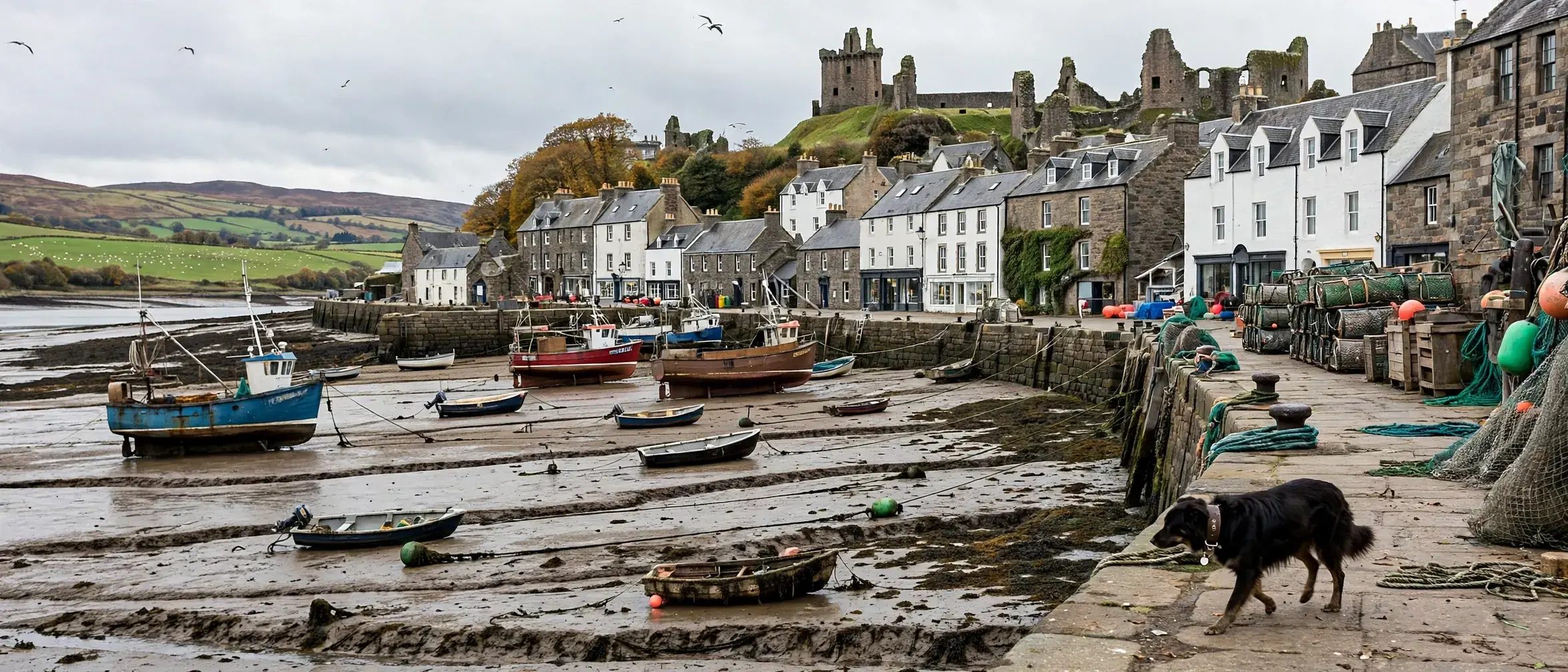
Its position makes it a genuinely useful base rather than just a pleasant stop. Dumfries is roughly eighteen miles to the east, Kirkcudbright about ten miles to the south-west, and the Solway coast and the Galloway Forest Park are both within easy reach by car. That puts Castle Douglas at the centre of the region's three best kinds of dog walking — loch and riverside, coast, and forest — with a comfortable town to come back to at the end of the day. Many visitors use it exactly that way: one town as a base, a different landscape each day.
This guide covers the town as a dog owner will actually use it: the loch walk in detail, the high street and where dogs are welcome, the Threave estate, the longer walks that start nearby, places to eat and stay, and the practical points — parking, vets, livestock, midges and seasons — that decide whether a trip runs smoothly. Where a rule can change, such as access to a garden or a seasonal restriction, the guide says so and asks you to check the official guidance before you travel, because a policy printed a year ago is not a promise for this weekend.
Carlingwark Loch: the walk to start with
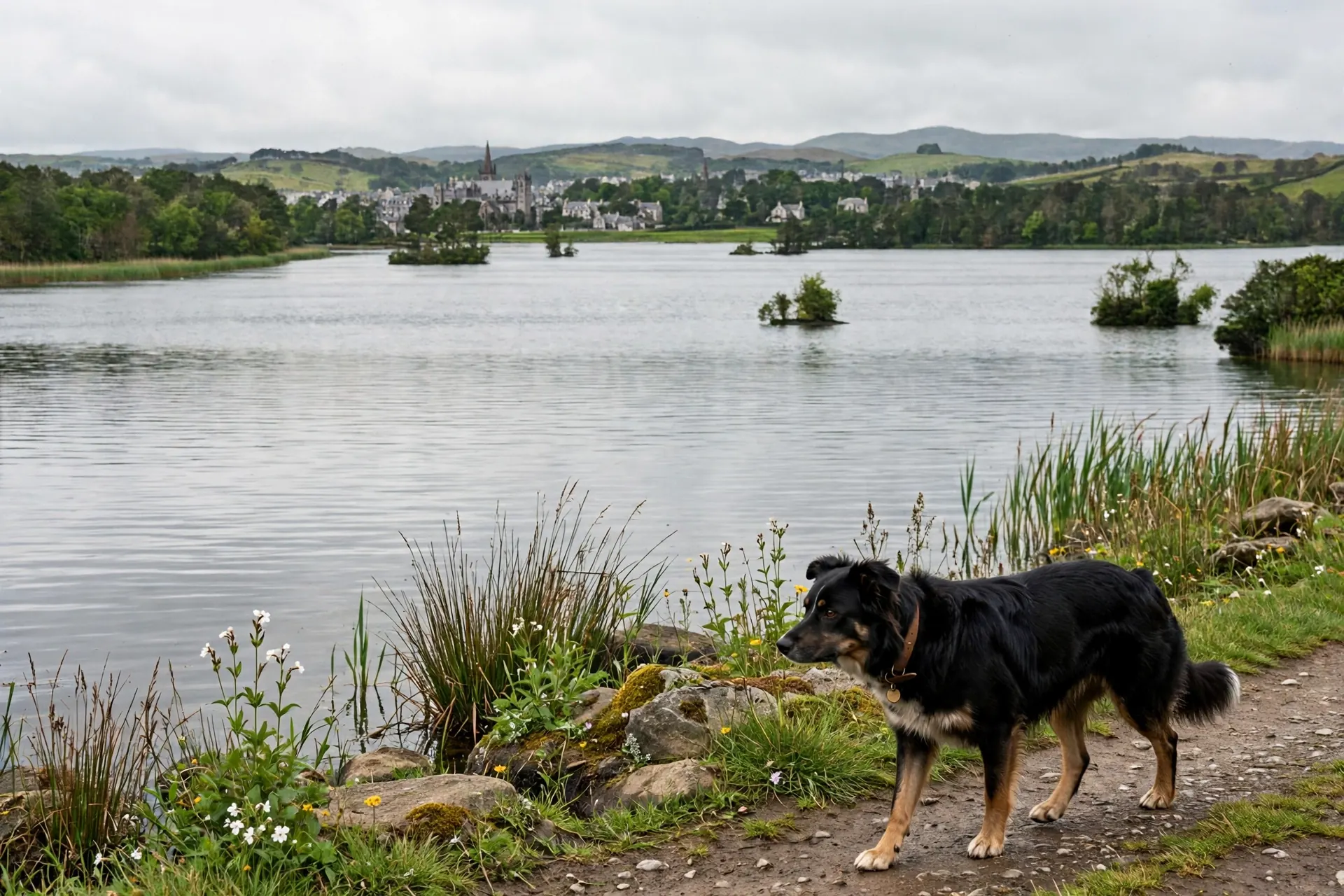
Carlingwark Loch is the walk that defines a dog trip to Castle Douglas. It is a shallow freshwater loch on the southern edge of the town, and a path runs around much of its shore, so the walk starts where the streets end. The full loop is roughly two and a half miles, mostly flat, and takes most people with a dog somewhere between an hour and an hour and a half at a sniffing pace. That makes it long enough to tire a dog properly and short enough to fit before breakfast or after an afternoon in town.
The character of the walk changes as you go round. On the town side the path is open, with views across the water to the far shore and back towards the rooftops. On the far side it feels more like a nature reserve: reeds, willow and alder crowd the bank, and the path passes hides and quieter stretches where water birds gather. The loch is known for its birdlife, including swans, ducks and grebes, and in spring and summer the reed beds are busy with warblers. For a dog this is a scent-rich walk rather than a fast one, and the dogs that enjoy it most are the ones allowed to take their time.
The surface is a mixed path rather than a paved promenade. Parts are firm and easy underfoot, while other stretches, especially after rain, are soft, muddy or puddled. In a wet Galloway winter the far side can be slippery, and after heavy rain some low sections hold water. Sensible footwear is worth more than any other piece of kit here, and a towel in the car is a good idea for most of the year. The path is shared with other walkers, joggers, families and anglers, so keep your dog on a lead where people are about, and be ready to step aside on the narrower stretches.
Dogs do paddle and swim from the loch shore, and on a warm day the shallows look inviting. Treat the water as wild water, not a managed bathing spot. The loch is shallow and can warm up in summer, which is when blue-green algae can appear, so check the water before you let your dog in: if it looks green, cloudy or scummy, or if there are warning notices, keep your dog out entirely. Rinse your dog off after a swim, and do not let them drink from the loch if you can avoid it. Anglers fish the loch, so watch for discarded line and hooks near the bank, and keep your dog from snatching at tackle.
The best time for the loop depends on what your dog likes. Early morning is the quietest, with the water often still and the town not yet awake; it is also the best time for birdwatching from the hides. Late afternoon light across the loch is the prettiest, but the path is busier with after-work walkers. Midges can be a nuisance near still water at dawn and dusk in the summer months, so a calm mid-morning walk is often the most comfortable compromise, and a light breeze off the water helps. In winter the loch path is a good short, flat option on a day when the hills are out of the question, though daylight is short and the ground can be heavy.
Start the loop from the lochside car park on the southern side of town, which puts you straight onto the path without crossing busy roads. If you are staying in the centre, you can walk to the loch from the high street in a few minutes, which makes it a genuine doorstep walk rather than a drive-to destination. Either way, build in a few minutes at the start to let the dog settle: the first stretch past the car park is the busiest, and a dog that has had a chance to sniff and calm down will cope better with the joggers and other dogs further round. Finish the loop the same way you started it, with a drink of water and a check of paws for mud and thorns, and the dog will be ready for the cafe stop that follows.
The town centre and food-town high street
The centre of Castle Douglas is built around Market Hill and King Street, a grid of wide streets that is easy to navigate with a dog on a lead. There is no steep climb in the centre, pavements are generally broad, and the distances are short: you can cross the shopping area in a few minutes, which means a dog is never far from the car, the accommodation or a quiet side street if it needs a break. The market square is the natural meeting point, and on market days it fills with stalls and shoppers, so a nervous dog will do better on a quieter weekday or in the early morning.
The food-town reputation is the high street's main attraction. The town has a cluster of independent food shops — butchers, bakers, a delicatessen and specialist producers — alongside the usual high-street shops, and browsing them is one of the pleasures of a stay here. Dogs are not generally allowed inside food shops, which is normal and fair, so the workable approach is to take turns if you are travelling as a pair, or to keep shopping trips short and leave the dog with a companion outside. Many shops have a spot outside where a dog can wait in the shade, and staff are used to dog owners popping in and out. Check the official guidance before you travel if a particular shop's policy matters to your plans, because individual shops set their own rules.
Several of the town's cafes and pubs welcome dogs, and the details change often enough that the safest approach is to check the door, the website or a quick phone call before you settle in. As a rule, the places most likely to welcome a dog are the ones with outdoor seating in the warmer months and a ground-floor room or a bar area where a dog can lie under a table. Bring a mat or a blanket so your dog has its own spot, order at the counter where that is the system, and keep the lead short and the dog settled. A dog that has just walked the loch will usually sleep through a coffee stop; a dog that has been in the car all morning will not, so walk first and eat second.
Beyond food, the town centre rewards a slow wander. There are gift shops, bookshops, outdoor and country clothing shops, and a handful of galleries, and the grid layout makes it easy to do a loop and end up back where you started. The town's history shows in its architecture: the planned streets, the market square and the older stone buildings around it. Castle Douglas was founded as a new town in the 1790s on the estate of a local landowner, and the name comes from a small castle on an island in Carlingwark Loch, the remains of which can still be seen from the loch path. That little piece of history is worth knowing because it connects the town, the loch and the name in a way that makes the walk feel like more than a circuit of the water.
Practical shopping for a self-catering stay is easy here. The town has supermarkets as well as the independent food shops, so you can stock up on dog food, treats and anything you forgot to pack. If your dog eats a particular brand, bring enough from home for the first day and buy the rest once you have seen what the shops stock, because a small-town supermarket may not carry every specialist diet. A local butcher is also a useful stop for a raw-fed dog, but ask in advance and bring a cool bag if you plan to buy fresh meat for the week.
If your dog finds town centres stressful, Castle Douglas is a forgiving place to practise. The streets are wide, traffic is light compared with a city, and quiet side streets and the loch path are always close by. Start with a short loop, reward calm behaviour, and retreat to the loch if the dog's stress shows. The town is small enough that a bad ten minutes does not ruin the day: you can be back on a quiet waterside path within minutes, and that is exactly the kind of safety valve that makes a market town a better dog destination than a busy city centre.
Threave Garden and Estate
Threave Garden and Estate is the big day out on the edge of Castle Douglas, and it is the place most visitors with a dog will want to plan around. The estate lies just south-west of the town, across the River Dee, and it is run by the National Trust for Scotland. It combines a large walled garden, a rock garden, woodland walks, open parkland and a riverside path to Threave Castle, a ruined fifteenth-century tower house standing on an island in the river. The whole estate is a landscape that was designed to be walked, and it suits a dog that enjoys a long, varied outing.
Dog access is generous on the estate but not unlimited, so it pays to know the split before you arrive. Dogs on leads are welcome on the wider estate and its walks, including the woodland and the riverside path, while access to the walled garden itself is restricted. Check the official guidance before you travel, because the rules for the garden and for the visitor buildings can change with the season and with events. The practical way to enjoy Threave with a dog is to treat the estate walks as the main event and the garden as an optional extra that may need one person to stay outside with the dog.
The riverside walk to Threave Castle is the highlight for dog owners. The path follows the River Dee through parkland and trees to a point opposite the castle island, where the ruined tower stands in the water. The walk is mostly flat and easy underfoot, with open grass where a dog on a long lead can sniff and explore, and benches where you can sit and look at the castle across the river. In spring the parkland is full of daffodils and the woodland paths are carpeted with bluebells and wild garlic; in autumn the trees turn and the river runs high. Allow at least an hour and a half for the walk out and back, longer if your dog likes to dawdle, and bring water because there is little shade-free drinking water on the far stretches.
Livestock may be grazing on the estate, and the paths cross open grass where sheep or cattle can be present, so keep your dog on a lead throughout the estate walks. The same applies on the riverbank, where the water is deep and fast in places and the bank can be slippery after rain. Do not let your dog swim in the Dee here: the current is stronger than it looks, and the river is a working salmon river with anglers and boats. A lead, a watchful eye on the bank and a dog that comes back when called are the three things that keep this walk safe.
Facilities at Threave include a visitor centre, a cafe and toilets, and the estate has car parking. The cafe is a useful stop after a long walk, but check its dog policy before you plan lunch there, and be ready to use the outdoor seating or take a drink away if dogs are not allowed inside. The estate also runs events through the year, from garden days to family activities, and on event days the car park and paths are busier, so a reactive dog will do better on an ordinary weekday. If you want a quieter visit, go early: the estate walks are at their best in the first hour after opening, when the light is good and the paths are empty.
For visitors with limited time, Threave is worth half a day rather than a quick stop. Combine the riverside walk with a wander through the woodland paths and a look at the garden from the outside, and you will have seen the best of it. For a longer stay, the estate rewards repeat visits in different seasons: the garden planting changes through the year, the woodland is different in spring and autumn, and the river is a different character after rain. Either way, it is the nearest thing Castle Douglas has to a full day out that starts almost on the doorstep.
More walks from town: lochs, woods and the Galloway coast
Castle Douglas is a good walking base because the variety starts so close to town. Beyond the loch and the Threave estate, there are woodland trails, riverside paths and quiet country lanes within a short drive, and the Galloway Forest Park and the Solway coast are both close enough for a half-day or full-day trip. The walks below are the ones that fit most naturally around a stay in the town, ordered from the easiest to the most ambitious.
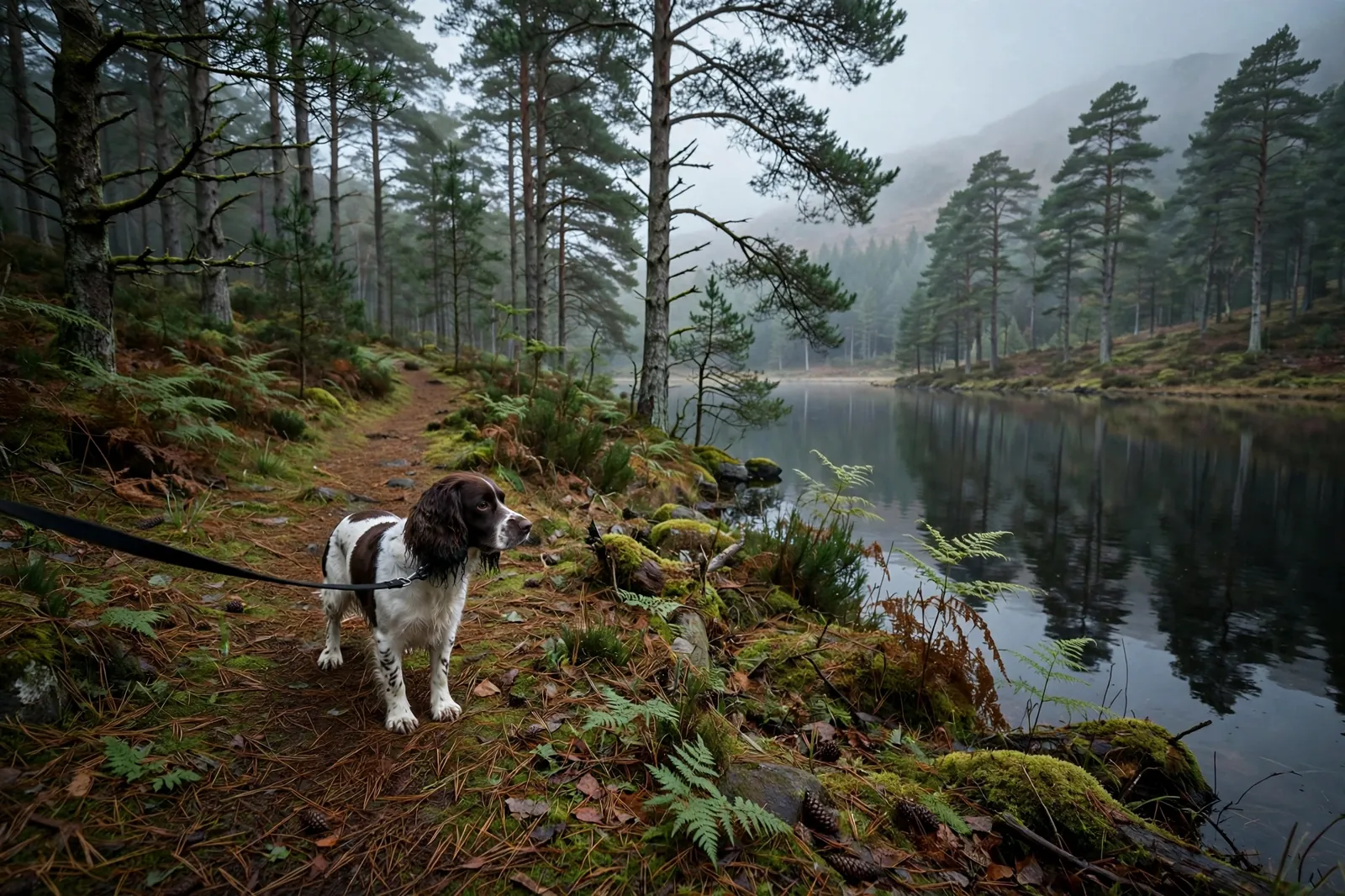
The nearest woodland option is the network of forest paths around the town and the wider area, where forestry tracks and waymarked trails run through pine and mixed woodland. These are the walks to choose on a wet day, because forest tracks drain better than open fields and the tree cover keeps some of the rain off. Keep your dog on a lead where forestry work is under way, watch for cyclists and horse riders on shared tracks, and be ready for mud at the track edges. A forest walk is also a good choice for a dog that needs a long, steady outing without the distractions of a town path: the scent of the woods is endlessly interesting, and the ground is usually kind to paws.
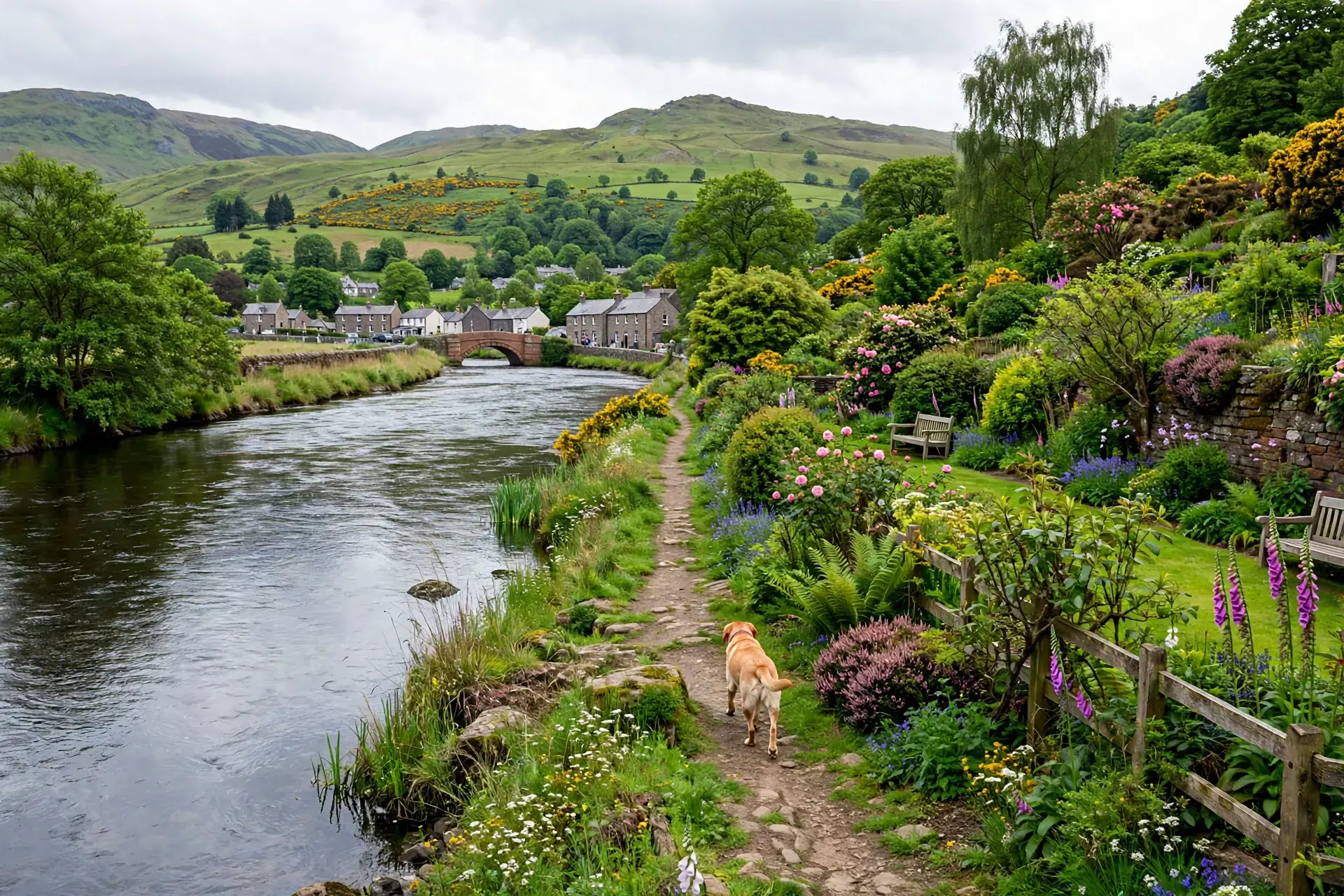
Riverside walking is the other local strength. The River Dee runs past the town and through the Threave estate, and there are stretches of riverside path where a dog can walk beside the water. The river is a salmon river, so anglers are part of the scene, and the banks can be steep or slippery in places. Keep your dog on a lead near the water, give anglers a wide berth, and do not let the dog disturb the river. In summer the riverside is cooler than the open loch path, which makes it a good hot-weather option, while in winter the same path can be muddy and the river high, so check the ground before you commit to a long stretch.
For a bigger day, the Galloway Forest Park is the obvious target. It is one of the largest forest parks in Britain, with waymarked trails, visitor centres and lochs, and it is within an hour's drive of Castle Douglas. The forest offers everything from short, flat lochside strolls to longer hill walks, and the trails are well signed. Dogs are welcome on the trails on a lead, and the park's visitor centres are a useful source of maps and local advice. Choose a trail that matches your dog's fitness and the weather: forest paths are forgiving, but the hills are real, and a dog that is fine on a two-mile loch loop may struggle on a six-mile forest climb. The park is also a Dark Sky Park, which matters less for the dog than for you, but a clear night walk near the forest is one of the quieter pleasures of a Galloway stay.
The Solway coast is the other direction, and it gives a completely different kind of walk. The shore around Kirkcudbright and the wider Solway is a mix of rocky bays, sandy beaches and salt marsh, with big skies and a working fishing and farming landscape. Some beaches have seasonal dog restrictions in the summer months, so check the official guidance before you travel, and always check the tide times before you walk on a beach or a tidal shore: the Solway tide comes in fast and can cut off a walk more quickly than you expect. On a beach, keep your dog away from shellfish beds and fishing gear, watch for discarded fishing line, and rinse the dog off after a swim in salt water. A coastal walk after a forest day is a good way to balance a holiday: different ground, different smells, and a dog that comes home tired in a different way.
A few practical rules apply to all of these walks. First, livestock is part of the Galloway landscape, and sheep, cattle and horses are common on farmland and on estate ground, so keep your dog on a lead near any grazing animal and be ready to shorten the lead on a narrow lane. Second, ticks are present in Galloway woodland and long grass, especially from spring to autumn, so check your dog after every walk and carry a tick remover. Third, the weather changes fast in the south-west of Scotland: a sunny morning can turn to rain by lunchtime, so carry a waterproof for yourself and a drying coat for the dog, and always have a shorter route in mind if the weather turns. The walks are at their best when you plan for the weather you might get, not just the weather you can see.
Eating out with your dog
Castle Douglas earns its food-town name at the table as well as in the shops, and eating out with a dog is part of the trip rather than a problem to solve. The town has cafes, tearooms, pubs and restaurants within a short walk of each other, and the general pattern is the familiar Scottish one: dogs are welcome in many bar areas and on outdoor terraces, less often in formal dining rooms, and almost always on a lead and under the table. Policies change, so check before you travel if a particular place matters, and have a second choice in mind in case the first is full or the dog is not welcome that day.
Cafes are the easiest option, and the town's cafe culture is built around walkers. A typical Castle Douglas cafe stop is a coffee and a cake after the loch walk, or a light lunch between outings, and most cafes are used to dogs settling under a table while their owners eat. The ones with outdoor seating are the most reliable in the warmer months, and a sunny morning on a pavement table with a dog at your feet is one of the town's small pleasures. Bring a mat, a water bowl or a collapsible bowl, and a chew to keep the dog occupied while you eat. Order at the counter where that is the system, and keep the lead short so the dog does not trip staff or other customers.
Pubs are the better option for an evening meal, especially the ones with a bar area where dogs are welcome. A dog that has had a long walk will usually settle quickly in a pub, and the bar area is often quieter and more relaxed than a restaurant. Ask when you arrive whether dogs are welcome and where they should sit, and respect the answer: a pub that welcomes dogs in the bar may still ask you to keep the dog out of the dining room. If you are staying in self-catering accommodation, a pub supper is also a useful fallback on a wet evening when cooking feels like too much effort.
The food-town trail itself is worth planning around. The town's independent food shops sell local produce, and a self-catering stay can be built around a daily shop: bread from the baker, meat from the butcher, cheese and deli goods from the delicatessen, and something sweet for the evening. Eating well in Castle Douglas does not need a restaurant booking every night. It needs a good walk in the morning, a browse of the food shops, and a kitchen where you can cook what you bought. That rhythm suits a dog holiday particularly well, because the dog gets a walk, a browse and a quiet evening in the same day.
For a special meal, look to the restaurants and hotels in and around the town, and book ahead. A dog-friendly restaurant is more likely to welcome a well-behaved dog if you mention the dog when you book, ask for a quiet table, and arrive with a dog that has already been walked. Be honest about your dog: a large dog, a nervous dog or a dog that barks at strangers needs a different table from a small, settled dog, and a restaurant that knows in advance can usually find a spot. If the dog cannot settle, be ready to take the meal away or to cut the evening short. A short, happy meal is better than a long, stressful one, for the dog, for you and for the other diners.
Finally, remember that eating out is only half the food story here. The town's food festival, held in the summer, fills the streets with stalls and producers, and it is a lively day out for a dog owner who does not mind a crowd. On a festival day the town is busier and louder than usual, so a nervous dog will do better on the loch path while the festival is at its peak, and a confident dog will enjoy the smells and the people. Check the festival dates before you travel, because a festival weekend changes the town completely, and a quiet weekday visit is a very different trip from a festival Saturday.
Where to stay with your dog
Castle Douglas has a good range of dog-friendly places to stay for a town of its size, and the choice matters more than the price. The main options are self-catering cottages and apartments in and around the town, bed and breakfasts and small hotels, and holiday parks and lodges on the edge of town and in the surrounding countryside. Each suits a different kind of dog, so choose by the dog's needs rather than by the photographs.
Self-catering is usually the best fit for a dog holiday. A cottage with a garden or a yard gives the dog somewhere to toilet first thing and last thing without a lead and a road, and a kitchen lets you keep the dog's feeding routine exactly as it is at home. When you book, ask the specific questions that matter: is the garden genuinely enclosed, and how high is the fence; are there steps to the front door; is there a hard floor or a washable rug for muddy paws; and is there a place to dry a wet dog. A cottage a short walk from the loch is worth more than a prettier one that needs a drive for every walk, because the first and last outings of the day set the tone for the whole stay.
Bed and breakfasts and small hotels can work well for a short stay, especially for a calm, settled dog. Ask whether the dog can stay in the room, whether there is a charge, and whether the dog is welcome in the breakfast room or the bar. A small hotel with a garden is a better bet than one on a busy road, and a ground-floor room saves a nervous dog from a staircase. Book directly where you can, mention the dog by name and by size, and get the dog policy in writing with the confirmation. A host who knows the dog is coming is a host who has already thought about where the dog will sleep.
Holiday parks and lodges around Castle Douglas offer a different kind of stay: more space, often a private deck or garden, and a rural setting. Our guide to dog-friendly holiday parks in the UK covers the questions to ask before booking one, including pet fees, boundaries and what happens if the dog barks. The same logic applies here: a lodge with a fenced garden and a short walk to a field is worth more than a larger lodge beside a play area, and the total cost with the pet fee is the number that matters, not the headline price.
Whatever you book, ask about the pet fee, the number of dogs allowed and any breed or size conditions before you pay. Pet fees in the area are usually charged per dog per stay or per week, and the range is wide, so get the all-in figure in writing. Declare your dog honestly: a booking that hides a second dog or a large breed is a booking that can be cancelled on arrival, and that is a miserable start to a holiday. Assistance dogs are a separate category and should not incur pet fees or count against pet limits.
On arrival, give the dog a tour of the accommodation before you unpack. Check the garden fence and gates, look for gaps under fences and hedges, move cleaning products and anything chewable out of reach, and set up the dog's bed in a quiet corner. The first hour in a new place should be boring: a short walk, a drink, a familiar bed and a quiet evening. A dog that settles on the first night will enjoy the rest of the week; a dog that is overstimulated on arrival will take a day to recover. Castle Douglas makes this easy, because the loch walk is a calm first outing and the town is quiet in the evening.
Practical planning: parking, vets, seasons and livestock
Parking in Castle Douglas is straightforward. The town has car parks around the centre, including near Market Hill and the loch, and on-street parking on the main streets. The lochside car park is the most useful starting point for the Carlingwark Loch walk because it puts you straight onto the path, and the town-centre car parks are the best base for a high-street browse. Check the signs for time limits and charges before you leave the car, because restrictions vary between car parks, and never leave a dog in a parked car on a warm day: even a mild day can turn a car into an oven in minutes, and the loch walk is not a reason to risk it.
Getting there is part of the planning. Castle Douglas sits on the A75, the main road across the south of Scotland from Gretna to Stranraer, and most visitors arrive by car. The nearest railway stations are at Dumfries and at Lockerbie, both a drive away, so a car is almost essential for a dog holiday here: the loch and the town are walkable, but Threave, the forest and the coast all need a drive. If you are travelling by public transport, check the bus services from Dumfries before you book, and confirm the dog policy with the operator, because not every service carries dogs in the same way. Check the official guidance before you travel for the latest timetables.
Veterinary cover is available in the town, and it is worth knowing where the practice is before you need it. Save the number of the local vet and the nearest out-of-hours emergency vet in your phone when you arrive, and keep your dog's vaccination record and any medication with you. Rural practices can close early and the nearest emergency cover may be a drive away, so a small first-aid kit — a tick remover, saline for eyes, a bandage and any regular medication — is worth packing. If your dog has a condition that might flare up, tell the accommodation host and the vet's name in advance, so nobody is searching for a number in a hurry.
Seasons change the trip more than the town does. Late spring and early autumn are usually the best balance: the loch paths are dry, the gardens are at their best, the midges are fewer than in high summer and the town is quieter than in the school holidays. Summer brings the liveliest atmosphere and the longest evenings, but also more visitors, more dogs on the paths and midges near water at dawn and dusk. Winter walks are possible on the loch path and the estate, but the ground can be muddy, daylight is short and some attractions reduce their hours, so plan a shorter loop and a warm cafe stop. Whatever the season, pack a waterproof, a drying coat and a towel, because Galloway rain arrives without much warning.
Livestock deserves a paragraph of its own. Sheep, cattle and horses are part of the Galloway landscape, and you will meet them on farmland, on estate ground and on country lanes. Keep your dog on a lead near any grazing animal, and if you meet cattle on a path, give them a wide berth and keep the dog close. Farmers in the area are used to walkers with dogs, but they expect the dog to be under control, and a dog that chases livestock can be in serious trouble. The same applies on the loch path and the estate: a lead is the courteous and the safe choice, and a dog that has reliable recall is a dog that can be let off only where the ground is clear and the signs allow it.
A last practical point is phone signal and cash. Mobile coverage in the town is generally good, but it can be patchy on forest trails and on the coast, so download offline maps before a longer walk and do not rely on the phone for navigation in the forest. Most shops and cafes take cards, but a small amount of cash is useful for car parks, honesty boxes and market stalls. And keep the dog's lead, water and a few treats in a small bag every time you leave the accommodation: Castle Douglas is the kind of town where a short errand turns into a long walk, and a dog that is equipped for a long walk is a dog that enjoys it.
Day trips from Castle Douglas
One of the best reasons to base a dog holiday in Castle Douglas is that the day trips are so varied. Within an hour's drive you can be on a beach, in a forest, in an artists' town or on a hill, and each of those days feels like a different holiday. The three below are the ones that work best with a dog, and they cover the coast, the town and the forest between them.
Kirkcudbright is the nearest coastal town, about ten miles to the south-west, and it is a natural first day trip. The harbour, the artists' galleries and the Tolbooth history give the town a character quite different from Castle Douglas, and the coast paths around it are quiet and scenic. Our guide to Kirkcudbright with a dog covers the harbour walks, the cafes and the practical points in detail, including where to park and which paths suit a dog. A Kirkcudbright day pairs well with a morning at the loch: walk the water at home, drive to the coast for lunch, and walk the harbour in the afternoon.
For a forest day, head for the Galloway Forest Park and the wider Dumfries and Galloway countryside. The forest has waymarked trails of every length, visitor centres with maps and advice, and lochs where a dog can paddle. Choose a trail that matches the dog's fitness and the weather, and allow a full day rather than trying to squeeze the forest into a morning. The drive into the forest is part of the experience: the roads narrow, the trees close in, and the landscape changes from farmland to moorland to forest in a single journey. Pack lunch and water, because the forest is a place where a short walk easily becomes a long one.
For a quieter day, drive south to Gatehouse of Fleet, a small garden town on the River Fleet with riverside walks, a bay and a castle of its own. Our guide to Gatehouse of Fleet with a dog covers the garden-town walks, the Fleet Bay tides and the riverside trails. Gatehouse is a good choice for a dog that has had a busy day or two and needs something gentler: the walks are short and flat, the town is small and calm, and the riverside is a pleasant place to sit while the dog sniffs the bank. It is also a good wet-weather fallback, because the town's cafes and the short riverside loop make a satisfying outing even in the rain.
If you have a longer stay, Dumfries is worth a day in its own right. The county town is about eighteen miles east on the A75, with riverside walks along the Nith, a museum, gardens and a larger range of shops and cafes than Castle Douglas. It is a busier town, so a nervous dog will do better on a quiet weekday and on the riverside paths rather than in the shopping centre. Wigtown, Scotland's National Book Town, is another option for a slow day: bookshops, a quiet market square and the marshes of Wigtown Bay, with birdwatching that rewards a patient dog owner. Each of these towns is a different flavour of Galloway, and the variety is the point: a week based in Castle Douglas can include a loch, a forest, a coast and two or three towns without ever driving more than an hour.
A relaxed one-day and two-day plan
For a single day in Castle Douglas, keep the plan simple and let the loch do the work. Arrive in the morning and park by the loch, then walk the Carlingwark loop at a sniffing pace, allowing an hour to an hour and a half. Follow it with a coffee and a cake in a dog-friendly cafe in the town centre, then browse the food shops and buy supplies for the evening. After lunch, drive the short distance to Threave and walk the riverside path to the castle, allowing an hour and a half to two hours. Finish with a pub supper in town and a short last walk by the loch before dark. That is a full day, and a dog that has walked the loch, browsed the town and explored an estate will sleep well.
For two days, add a coast day and keep the pace the same. On the first day, follow the one-day plan above, but skip Threave and save it for a longer stay. On the second day, drive to Kirkcudbright in the morning, walk the harbour and the coast path, have lunch in a dog-friendly cafe, and drive back through the countryside in the afternoon. Stop at a farm shop or a viewpoint on the way home, and finish with a short evening walk by the loch. Two days is enough to see the town, the loch and the coast, and to get a real sense of Galloway without rushing.
For a longer stay, rotate the landscapes: a loch day, a forest day, a coast day and a town day, with a rest day in the middle where the only walk is the loch loop and the only plan is a cafe and a browse. Dogs, like people, enjoy a holiday more when the days are not all the same, and a rest day is not a wasted day: it is the day the dog recovers, the washing gets done and the next outing is planned properly. Build in a wet-weather fallback for every day, because Galloway rain is a matter of when, not if, and a forest walk or a cafe afternoon is a better plan than a forced march in a downpour.
Whatever length of stay you choose, the same three habits make the trip work. Walk the dog before you eat, so the dog is settled at the table. Check the rules before you go somewhere new, because a policy that changed last month is not a promise for this weekend. And leave time for the unplanned: a viewpoint, a farm shop, a quiet stretch of riverbank. Castle Douglas rewards the unplanned walk more than most towns, because the loch, the river and the forest are all close enough that a spare hour is never wasted.
Practical questions
Before you go
Can dogs swim in Carlingwark Loch?
Dogs do paddle and swim from the loch shore, but the water is not a managed bathing spot and conditions change with the seasons. Keep your dog in the shallows, watch for blue-green algae in warm weather, and rinse off afterwards. If the water looks green, cloudy or scummy, keep your dog out entirely and check the official guidance before you travel.
Are dogs allowed in Threave Garden?
Dogs on leads are welcome in the wider Threave Estate and on the estate walks, while access to the walled garden itself is restricted, so check the official guidance before you travel. The estate paths, the riverside walk to Threave Castle and the open parkland are the parts most dog owners use, and livestock may be grazing on the estate, so keep your dog on a lead.
Is Castle Douglas a good base for a dog holiday in Galloway?
Yes. Castle Douglas sits on the A75 between Dumfries and the Galloway coast, with a loch walk from the edge of town, Threave Garden a short drive away and Kirkcudbright, the Galloway Forest and the Solway shore all within easy day-trip distance. It has supermarkets, cafes, vets and parking in one compact market town, which makes it a practical base for a dog holiday.
Where can I park in Castle Douglas with a dog?
The town has car parks around the centre, including near the Market Hill and the loch, and on-street parking on the main streets. The lochside car park is the most useful starting point for the Carlingwark Loch walk because it puts you straight onto the path. Check signs for time limits and charges before you leave the car, and never leave a dog in a parked car on a warm day.
What is the best time of year to visit Castle Douglas with a dog?
Late spring and early autumn are usually the best balance: the loch paths are dry, the gardens are at their best and the town is quieter than in the school holidays. Summer brings the liveliest food-town atmosphere and the longest evenings, but also more visitors and midges near water at dawn and dusk. Winter walks are possible on the loch path, but the ground can be muddy and daylight is short, so plan a shorter loop and a warm cafe stop.
Do I need to keep my dog on a lead around Castle Douglas?
Keep your dog on a lead in the town centre, on the loch path where other walkers and anglers are about, and anywhere near livestock. The loch walk is a shared path, so a lead is the courteous choice even where no rule is posted. On the wider estate and forest trails, only let your dog off the lead if you have reliable recall, the ground is clear of livestock and other dogs, and local signs allow it.