This guide was written independently, with no paid placement and no venue paying for a mention. Where a rule or opening time is quoted, it comes from public listings for Charlestown and the surrounding coast, and the harbour, council and venue pages are the final word on the day you travel.
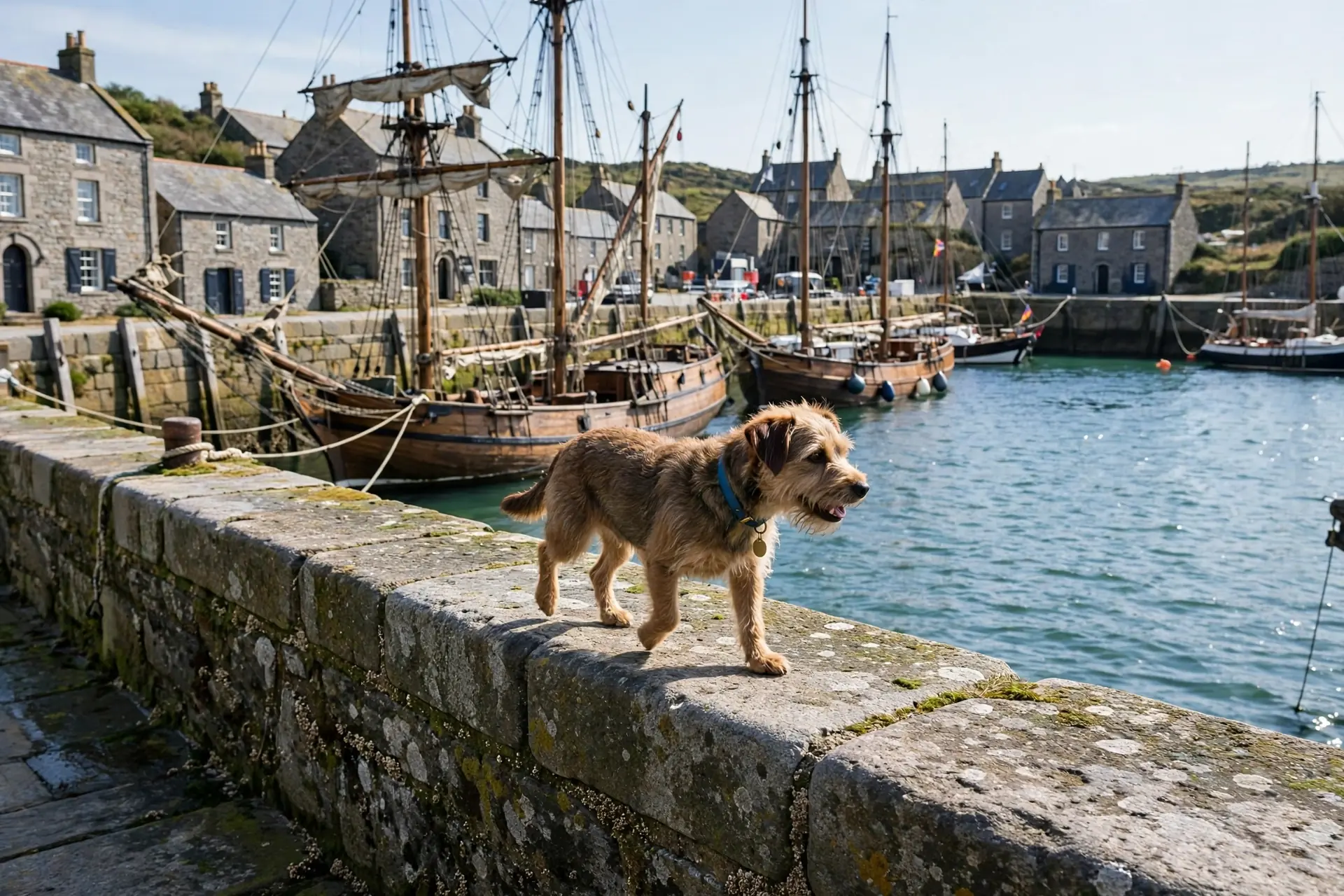
Charlestown rewards a dog that likes harbours: a compact Georgian quay where tall ships tie up, a short flat circuit around the basin, a pocket of shingle that appears at low tide, and the coast path leaving the village in both directions, east towards Duporth and west towards Porthpean. Arrive early on summer weekends, mind the tide, keep a short lead near the water and the mooring lines, and treat the nearby beaches as separate visits with their own seasonal rules.
Start with the ships
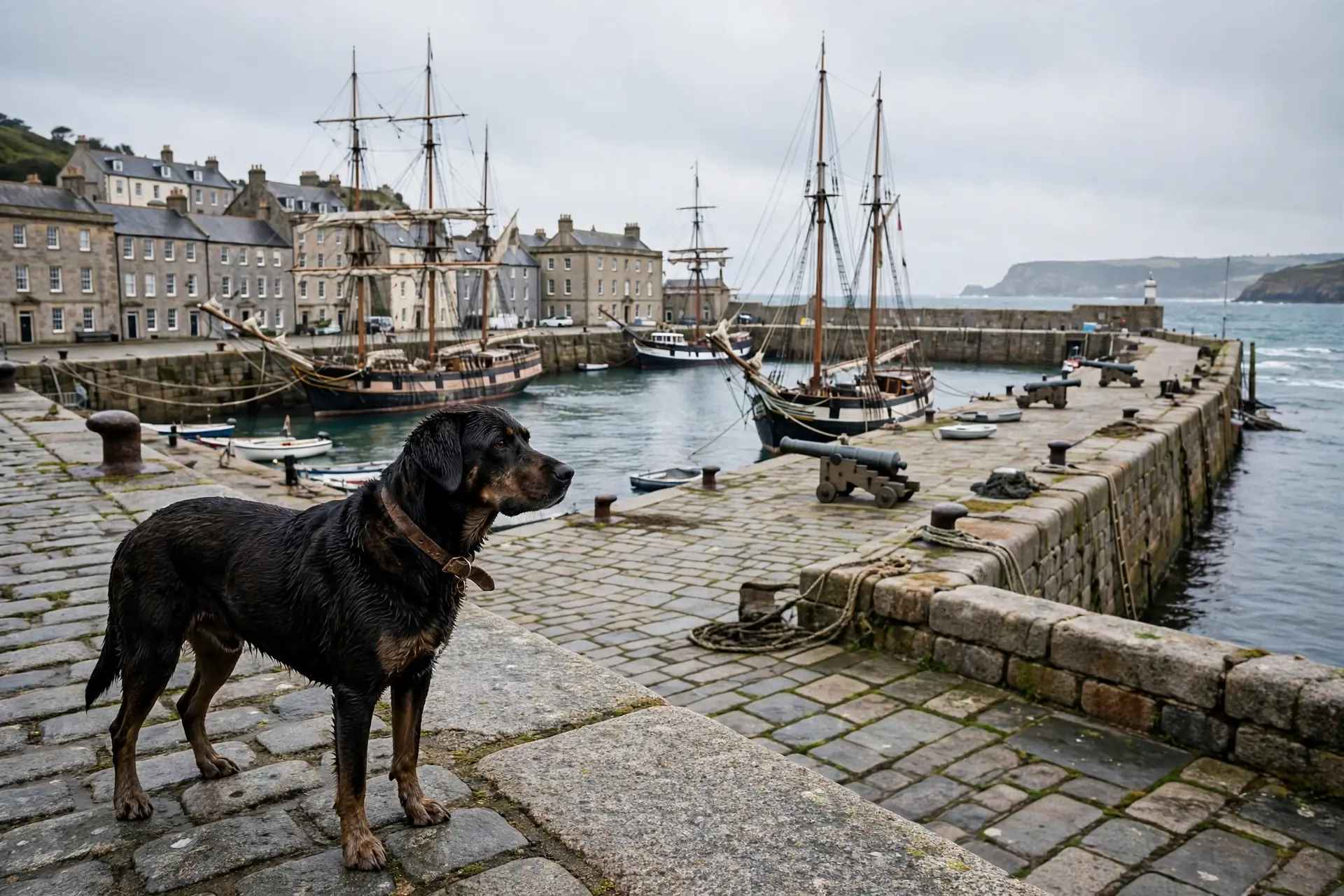
Begin at the harbour wall and let the masts do the talking. Square-rigged hulls lie alongside the granite quay, their yards crossing the sky above the warehouses, ropes humming when the wind picks up and gulls wheeling around the mastheads. Tar, wet timber and salt hang in the air, and for a dog the quay is a rush of unfamiliar scent: fish boxes, coiled rope, diesel from a workboat, seaweed drying on stone. Stand still for a few minutes before you walk anywhere, because the harbour rewards a slow start, and a dog that has sniffed the first stretch of quay settles far better than one hurried past the ships.
These are working sailing ships rather than exhibits behind a rope. The fleet based here, run from the harbour by the Square Sail company, sails for film work, sail training and charter voyages, so the line-up on the quay shifts with the season and with filming schedules. Some years you will find two or three big hulls in the basin; on other visits the berths may be empty while the vessels are away at sea. Charlestown has doubled as a period port on screen, notably in Poldark, and the ships are a large part of why cameras keep coming back. If a particular vessel is the reason for your trip, look at the harbour's own notices before you set off, because no one can promise which hulls will be alongside on a given morning.
A harbour full of ships changes how you handle a dog. Keep the lead short and the dog on the landward side of the quay, away from mooring lines, chains, bollards and the stacks of gear that crews leave near the gangways. The granite sets are slick after rain and after a high tide, and the edge of the quay drops straight into deep water in places where there is no rail. Crowds gather wherever a hull makes a good photograph, and people step backwards into the path without looking, so a reactive or nervous dog does best at the edges of the crowd, or early in the morning before the day visitors arrive. Let the dog watch a crew at work from a distance rather than pulling towards the action.
The basin itself dates from the 1790s, when Charles Rashleigh cut a harbour out of this cove to ship china clay from the pits around Hensbarrow down to the potteries. Everything around the water was built for that trade at the same time: the quay and the inner basin, the warehouses for storing clay, the limekiln, the ropewalk, and the rows of cottages for the men who loaded the ships. The clay trade faded, the buildings stayed, and that is why the village reads as one complete piece of industrial history instead of a harbour with a few old houses attached. Knowing that the quay was a workplace first makes sense of the ropes, the bollards and the working boats that still share the water with the tall ships.
Photographers arrive in numbers on fine weekends, and the quays can feel busy by late morning, particularly around the pier end and the viewpoints facing the ships. If your dog dislikes crowds, walk the harbour at first light, when the water is flat and the village is still quiet, or return after the day visitors have left, when the lamps come on along the quay and the hulls stand dark against the evening sky. Dusk is the finest hour here, and it asks nothing of a dog except a short lead, a bench to sit beside you, and no hurry to be anywhere else.
The Georgian harbour village
Charlestown fits into a single unhurried hour on foot, and the shape of the place makes that easy. One main street drops from the top of the village to the quay, short lanes branch off between granite cottages, and every route eventually leads back to the water. The houses are plain Georgian stone under slate, built for harbour workers rather than for show, and the village has kept the look of a place where people live and work instead of a resort dressed up for visitors. That working feel is exactly what makes it comfortable with a dog: nobody minds a muddy paw on the quay, and dogs are part of the daily traffic.
Slow down and the details start to land. The long warehouse ranges beside the inner basin, the round limekiln at the harbour side, the ropewalk building, the sash windows and slate roofs of the cottages, the way a lane narrows and turns as it climbs away from the water. Boards around the harbour explain the clay trade and the ships, and the Shipwreck Treasure Museum sits close to the quay with its collection of objects raised from wrecks. Dogs stay outside the museum, so take turns if two of you are travelling: one goes in while the other walks the quay with the dog, and the visit is short enough that nobody waits long.
Shopping here is a browse rather than a mission. A few galleries and small shops cluster near the harbour, and some welcome dogs inside while others ask you to wait at the door. Two people make it simple, one to hold the lead and one to look around; on your own, keep it brief, choose the shops with an open door and a water bowl outside, and only tie a dog where you can see it, where it cannot reach the road, and for a few minutes at most. Pavements are broad enough on the main street, but the lanes near the water are narrow, delivery vans squeeze through, and a dog walking on the road side of a corner is in the wrong place.
Compared with the fishing harbours further along the coast, Charlestown feels different because nothing here was added as decoration. Mevagissey still lands fish, Polperro still trades on smuggling stories, and Charlestown still looks like the industrial port Rashleigh built, with its warehouses, kiln, cottages and ships all belonging to the same working picture. For a dog owner that completeness has a practical payoff: the village is flat around the water, the walks start at the quay, and the dog is welcome in the middle of village life instead of being an afterthought at the edge of it. The rough edges are the attraction, from wet granite and coiled rope to gulls and the smell of the harbour at low water.
Winter strips the village back to its quiet self. The ships sit in mist, the quays empty out, and the harbour is at its most atmospheric, but cafes and small shops cut their hours outside summer, so check opening times before you rely on any one place for lunch. The coast path stays walkable through the colder months, though the cliff stretches turn muddy after rain and the wind bites on the headlands, so a coat helps a small or thin-coated dog, and a walk that felt easy in July may need cutting short in January.
Walking the harbour and the quays
The circuit of the basin is the gentlest walk in the village, and the right first walk for an older dog, a young puppy, or anyone arriving after a long drive. Leave the car park, drop down to the quay, and follow the harbour wall around the water, past the warehouses and the moored hulls, out to the pier end where St Austell Bay opens up. Done without stopping it takes about twenty minutes; done properly, with benches and pauses to watch the boats, it takes closer to an hour, and the pauses are the point. There is nearly always something moving: a workboat coming in, a crew tending rigging, a fisherman mending gear in the sun.
The harbour divides into two characters. The inner basin is the sheltered part, where the tall ships berth close enough to study the planking, the rigging and the names painted on the sterns. The outer harbour opens towards the sea, holds the smaller fishing boats and pleasure craft, and feels wilder when the wind gets up. Walking from one to the other takes you past the slipway and the harbour buildings, and gives a sense of how the whole place works as a port. Keep the lead short the entire way: the quays are a workplace, the stone is slippery when wet, and ropes, chains and mooring bollards sit exactly at a dog's nose height.
From the pier end the view takes in the full picture, the basin and its ships behind you, the village climbing away from the water, and the coastline running in both directions, west across St Austell Bay and east towards Duporth and the headlands beyond. On a calm day it is a postcard; on a rough day the sea breaking against the pier is worth the walk on its own. Hold the lead firmly here, because the wind funnels along the pier, the stone can be wet underfoot, and the drop into the water is unforgiving. Keep the dog from drinking out of puddles on the quay, where fuel and fish waste collect, and do not let it jump into the water: the walls are high, the harbour is deep, and getting a wet dog back up onto the stone is far harder than it looks from above.
Beside the harbour sits a small shingle beach, worth knowing about even though it will not fill a beach day. At low water it shows a strip of shingle and sand where a dog can paddle and a nervous swimmer can try the water for the first time; at high water it vanishes under the tide and the harbour is stone and water again. Dogs are generally welcome on it, but read the sign at the entrance before you let one off the lead, and remember it sits next to a working harbour, so keep clear of boats and gear. The longer beach days from Charlestown lie a short walk or drive away, and they have their own section below.
Tide times shape everything here, so check them the evening before. At high water the basin fills, the ships float level with the quay, and the village seems to sit on the water. At low water the hulls rest on the harbour bottom, weed and mud show between the stones, and the place turns back into a working yard. Both states are worth seeing, and the change between them is the best free entertainment in the village, so time at least one walk for a rising tide and one for the ebb.
Coast path to Duporth and Porthpean
East from the harbour, the South West Coast Path climbs out of Charlestown, crosses the headland and drops into Duporth, a small cove about a mile and a half away. The walk takes roughly forty minutes each way, with views back over the harbour and its masts for the first stretch, then open water and the cliffs ahead. It is the easier of the two directions from the village, well waymarked, and it ends somewhere worth arriving at: a shingle cove with houses tucked behind it, a bench or two, and a beach to paddle on before turning for home. For a first cliff walk with a dog, this is the one to try first.
West from the harbour, the path follows the cliff top above St Austell Bay towards Porthpean, a longer outing of about an hour each way. The views run across the bay to the white clay tips on the horizon, and Porthpean itself is a small village with a sandy beach, a car park and a cafe, a natural turning point for a half-day walk. The beach there is popular with families, and dogs are subject to seasonal rules, so read the sign at the entrance and look at the council's current beach pages before you count on a swim. This direction has more height in it, more steps, and longer stretches without shade, so set off early when it is hot, or save it for the softer light of late afternoon.
On both directions the lead stays on for the cliff sections, and that is not a suggestion to negotiate. Edges are unfenced in places, the path narrows where it rounds a headland, and cattle and sheep graze the coastal fields. A long lead works on the flat open stretches, but shorten it at every stile, gate and drop, and wherever the path runs close to the edge. After rain the descents turn slick, especially on the drop into Duporth, so wear boots with a proper grip and take the downhill stretches slowly. Shut every gate behind you, and lift a dog over a stile only if there is a proper dog gate beside it, rather than hoisting it over a fence.
Wildlife is the reward for walking slowly. Fulmars and kittiwakes work the cliffs, cormorants dry their wings on the rocks below, and gulls trail the fishing boats in and out of the bay. Dolphins and porpoises pass along this coast, and the way to see them is to stop, sit on the grass, and watch the water for ten unhurried minutes instead of marching on. Ground-nesting birds use the cliff tops in spring and summer, so keep a dog close to the path and out of the scrub and long grass. In spring the hedgerows along the inland stretches fill with wildflowers, and in late afternoon the low sun turns the clay tips across the bay a pale gold.
The return follows the same path, and it deserves as much time as the outward leg, because the climbs back into Charlestown are steeper than they look on the way down. If the dog flags, slow down, stop often, and turn back early without a second thought: a shorter walk that ends with a contented dog beats a longer one that ends with a sore and exhausted one. Cliff falls and maintenance can close a stretch at short notice, so look at the coast path notices before you set out, and keep a fallback in mind. A good rhythm for a stay is Duporth one day, Porthpean the next, and a harbour day between them, so the dog gets different ground under its paws each morning.
A day in St Austell and the Eden Project
St Austell lies a short drive inland from Charlestown, about ten minutes by car, and it is the town that supplies everything the village does not: a supermarket, a pharmacy, a vet, a pet shop, and a choice of cafes and pubs. It is a working market town rather than a resort, built on a hill, and its centre is compact enough to walk with a dog, though the streets climb more than the flat quays of Charlestown. St Austell with a dog covers the town in detail, including the Eden Project rules, the Clay Country trails, the town cafes, the stays and the parking, and it is the guide to read before a town day.
The Eden Project needs its own plan, because the dog rules are specific. Dogs are welcome in the outdoor areas, the paths and the gardens, but they are not allowed inside the biomes, the Core building or the cafes and restaurants, with the usual exception for assistance dogs. That means a visit works best in turns: one person takes the dog around the gardens while the other sees the biomes, then you swap. Or keep the visit short and make the outdoor planting the whole point of it, which is a fine way to see Eden with a dog, because the gardens and the paths are extensive and a dog that has walked them happily will settle while you swap over. The Eden Project's own website carries the current rules, and those are the ones to follow, since they can change between seasons.
The Clay Country trails are the half of a St Austell day that dogs enjoy most. The waymarked routes run through the old china clay workings, past the great white tips, the flooded pits, the woodland and the heathland, across a landscape that is part industrial, part wild, and unlike anywhere else in Britain. The walking is mostly level and the surfaces are good, which makes it a useful change from cliff paths. Keep a dog away from the edges of the pits and tips, which are not fenced everywhere, and do not let a dog swim in the flooded pits, where the water is deep and its quality is uncertain. Local dog walkers use these trails in numbers, so expect to meet other dogs, and keep yours close until you can see what is coming around the next bend.
St Austell town centre is worth an hour or two on its own, for the market, the shops, and the cafes and pubs that welcome dogs in their outdoor seating. The hill makes the walking harder work than the harbour circuit, so plan a route that climbs once and comes back down gently, and build in a stop for water. Green spaces sit on the edge of town where a dog can stretch its legs after the pavements, and the town is a practical place to stock up on supplies, visit the vet if you need to, and eat somewhere different in the evening. A town day between coast days gives the dog a change of ground and gives you a change of scene.
Getting between the two places is simplest by car, about ten minutes each way, with town car parks at the St Austell end and charges and time limits to check in advance. Buses run between the village and the town, but fitting a dog around bus times is not always easy, so most visitors drive. Walking is possible along the lanes and the coast path, but it is a hilly route and a proper walk rather than a stroll, so allow plenty of time and carry water for the dog. The easy pattern is to drive to St Austell in the morning, spend the day there, and come back to Charlestown for a slow circuit of the quays at dusk.
Beaches near Charlestown
Charlestown's own shingle strip is small and tidal, so plan beach days as separate outings and pick the beach to match the day. Duporth, a mile and a half east on the coast path, has a shingle beach that local dog walkers use all year, reached by a steep path with no facilities at the bottom, which makes it a short-visit beach rather than a place to set up for the afternoon. Porthpean, an hour west on the same path, has a sandy beach that families favour, with a car park and a cafe, and dogs are restricted there in the summer season. One is a quiet cove, the other is a family beach, and that contrast is the point of trying both.
The seasonal pattern across Cornwall follows a familiar shape, though the dates and the exact stretch of sand they cover are set beach by beach. The busiest beaches restrict dogs during the daytime through the summer, commonly from Easter or from 1 May until 30 September, with the main sands closed to dogs and the quieter ends or the neighbouring coves left open. A beach that welcomed dogs last summer can carry different rules this year, because the local council sets the dates under a public space protection order and can revise them. The guide to dog-friendly beaches in the UK on this site sets out how these orders work, the fines that can follow a breach, and the checks worth making before a summer trip to the Cornish coast. The routine that never fails is simple: read the sign at the entrance, look at the council's beach pages, and never rely on a memory from a previous summer.
Further along St Austell Bay, the choice widens. Pentewan Sands, a short drive west of Charlestown, is a long sandy beach that is generally open to dogs all year, and it is the most reliable dog beach in the area when the summer rules bite elsewhere. Par Sands, by the town of Par, is a long flat beach that dog walkers favour, though its rules can change, so read the signs on the day. Carlyon Bay, closer to St Austell, is a wide beach with seasonal rules of its own to check. The pattern holds across the bay: busy sands tend to carry summer restrictions, while quiet coves tend to stay open to dogs all year. Plan every beach day around the tide and the season, and keep a backup, the coast path, the harbour, or the Clay Country trails, for the day the beach you wanted is closed to dogs.
Beach safety around Charlestown deserves the same care as anywhere on the Cornish coast. Keep dogs back from the foot of the cliffs, where rock can come down without warning, and off the cliff edge on the path above the beach. Strong currents and rocks make poor swimming spots, and the surf can tug hard at a small dog even when the sea looks calm. Scan the sand for hooks, broken glass and dead fish, all of which a dog will try to eat. A dog that drinks a lot of sea water may start vomiting, develop diarrhoea and go lethargic, which calls for a vet rather than a wait and see. Rinse the dog with fresh water when you get back, look over its paws for cuts and its ears for sand, and get it dry before the drive home, because a wet dog in a cold car is a miserable end to a good day.
The coves here are small, and the tide makes a bigger difference than it does on the wide north-coast sands. Duporth shows a proper beach for a few hours either side of low water and shrinks to a strip of shingle as the tide comes in; Porthpean spreads wide at the ebb and narrows quickly as the water returns. Look at a tide table the night before, plan to arrive while the tide is still going out, and keep the dog out of deep water and away from a rising tide. A ball thrown too far on a falling tide can end up in water that is suddenly too deep, so play the fetching games on the dry sand and let the dog paddle at the water's edge.
Eating and drinking by the harbour
Food in Charlestown is eaten with a view of the masts. The village has a small set of pubs and cafes facing the water, and several of them welcome dogs, usually on the terraces and outdoor seats above the quay. That means lunch, a morning coffee and an evening drink are all possible without leaving the dog in the car or tied outside a door, which is more than many Cornish villages manage.
Charlestown's pubs are the old-fashioned kind, low beams, slate floors, a fire in the colder months, and most of them are happy to have a dog lying by the bar. Order at the bar, find a table where the lead will not trip anyone, and settle the dog on a rug you brought along before the food arrives. In summer the benches outside the pubs, facing the quay, are the easiest seats of all, because the dog can lie in the open air and watch the harbour while you eat. In winter, ask inside whether the bar area takes dogs, because the dining room often does not. Sunday lunches get busy, so a weekday evening or a late lunch is a calmer choice for a dog that is still learning pub manners.
Coffee comes first for most visitors, and the harbour cafes serve it with a view of the masts. Mornings are the best time: walk the quay circuit, then sit down with the dog while the village wakes up. Some cafes put out a bowl of water and a jar of treats without being asked, which is usually a good sign, and a window seat on a wet day lets a dog watch the harbour without getting wet twice. Cakes and pastries are the local strength, so a mid-morning stop doubles as a rest for the dog's legs. If the cafe is crowded, take the coffee outside to a bench instead of squeezing a large dog between tables.
Evenings in Charlestown are simple: fish and chips eaten on the harbour wall, or a pub supper, or a meal cooked back at the cottage with supplies from St Austell. The town's market and supermarkets are a ten-minute drive, and a self-catering cottage with a kitchen makes it easy to mix eating out with eating in. For a change of scene over a longer stay, Truro is the nearest city, and Truro with a dog covers its cathedral green, river walks and markets for a day out with the dog. Whatever you choose, feed the dog first, carry a bowl and water, and keep an eye on the time, because a tired dog will tell you when the evening has gone on long enough.
Staying over and parking
As a base, Charlestown has one great advantage: the car can stay parked. The harbour, the coast path and the village all sit within a short walk of each other, and St Austell is ten minutes away when you need shops or a vet. That makes a week here feel unhurried, because each day starts on foot from the front door rather than with a drive to find a walk. A cottage near the quay, a hotel room in the village, or a lodge a little inland all work, as long as the dog's walks do not depend on the car.
Before you book anywhere, pin down the dog rules in writing. Confirm that dogs are allowed in the room or cottage itself rather than somewhere else on the site, how many dogs the booking covers, what the charge is and whether it is charged once or per animal, and whether any size or breed limits apply. Then ask about the outdoor space: is the garden fully fenced, how high is the fencing, and does the gate latch properly? Find out whether the dog can be left alone while you go for dinner, and what the house rules say about muddy paws and wet coats. A ground-floor room suits an older dog, and hard floors cope with a wet walk far better than light-coloured carpet. Our guide to dog-friendly holiday parks in Cornwall walks through the same questions for parks, with notes on layout, beach rules and driving times in August.
Self-catering suits most dog owners here, because the day runs on the dog's clock: early walks, breakfast when you get back, and no hotel mealtimes to work around. Look for a place with somewhere to dry a wet dog, a washing machine for towels and muddy leads, and a garden or yard that is properly enclosed. A cottage a few minutes from the quay is worth more than a grander house that needs a drive every morning. Campsites and holiday parks nearby can work well for families, but run the same checks first: how many dogs, what it costs, whether the pitch or lodge is fenced, and what happens if the dog is left alone. In a lodge or caravan, look at the steps up to the door before you book, because a dog with stiff joints will face them several times a day.
Parking is the one thing to sort out before you arrive. The streets in the centre are narrow, on-street spaces are scarce, and turning a larger vehicle around is a chore, so most visitors use the pay-and-display car park beside the harbour and walk down to the water from there. Charges apply and the tariffs change, so look them up before the trip rather than guessing at the machine. On summer weekends and bank holidays the car park fills by mid-morning, so an early start pays off. If you are staying in the village, ask the host whether a space comes with the booking, because some cottages include one and others do not. And on a warm day, never leave the dog in the car while you pop into a shop: a parked car heats up fast, even with a window cracked open.
Sort out the practical details on the first day. Save the number of a vet in St Austell in your phone before you need it, and note the nearest out-of-hours clinic as well, because a cut paw on a Sunday evening is no time to start searching. Dog food, treats and spare leads are easy to find in St Austell's shops, and the supermarket there covers most gaps. Phone signal holds up well in the village but drops away on the coast path, so save an offline map before a longer walk. Pack for a Cornish harbour: a short lead and a longer one, a harness, drinking water and a bowl that folds flat, a towel and a drying coat, a rug for the car, poo bags, a coat for a thin-coated dog, and the dog's usual food and medicine. Some cafes and pubs shorten their hours in winter, so check before you set out in the colder months, and expect mud on the cliff paths after heavy rain.
Two days in Charlestown could run like this. Friday evening: park by the harbour, wander the quays as the light fades, and let the dog learn the place by nose before supper. Saturday: an early start along the cliff path to Porthpean, lunch at the far end, and a slow walk back while the afternoon light softens over the bay. Sunday: a low-tide morning at Duporth, then a drive into St Austell for the market and a coffee, and a final turn around the harbour as the lamps come on. That gives the dog a long cliff walk, a cove to paddle in, and a harbour day, without much driving at all. If rain arrives, swap the plan: the Clay Country trails stay walkable in the wet, the harbour cafes take the strain, and the village looks just as good under grey skies. The freedom here is that no single day has to work perfectly for the trip to work.
Practical questions
Before you go
Can dogs walk around Charlestown harbour?
Yes, provided the dog stays on a lead. The quays, lanes and coast path are all open to dogs, but Charlestown is a working harbour in private ownership, so keep your dog beside you near the water, the moored ships and anyone working on the quay, and keep it away from ropes, chains and stacked equipment. Granite sets turn slick in the wet, and parts of the quay edge have no rail, so watch the signs and give crews room to work.
Are dogs allowed on Charlestown beach?
The harbour has a small shingle beach where dogs are generally welcome, but it is tidal, vanishing under high water, so think of it as a place for a paddle rather than a day on the sand. Duporth and Porthpean are the nearest larger beaches, a short walk or drive away, and each has its own seasonal rules. Read the notice at the entrance wherever you go, and check the council's beach pages for the current dates before you travel.
Can I walk the coast path from Charlestown with a dog?
Yes. The coast path runs out of Charlestown in both directions, west along the cliffs to Porthpean and St Austell Bay, and east to Duporth and beyond. Expect moderate cliff walking with steep stretches and unfenced edges in places, so hold the lead short near drops and grazing animals, carry drinking water, wear grippy boots, and check the path notices before setting out in case a section is closed or diverted.
Can I take my dog into pubs and cafes in Charlestown?
Several harbour pubs and cafes welcome dogs, above all on the outdoor terraces above the water, and some let dogs into the bar area as well. What is allowed varies from one venue to the next and can change with the season, so check the venue's own listing or phone ahead, above all if you are relying on a particular pub for dinner.
Where should I park in Charlestown with a dog?
The car park beside the harbour is the sensible choice. Streets in the centre are narrow and spaces there are scarce, so park by the water and walk to the quays with the dog. Summer weekends fill the village fast, so arrive early. Look up the current charges before you travel, and never leave a dog waiting in a parked car on a warm day.