This guide is independent and contains no paid placement. If affiliate links are added later, they will be clearly marked and will not change our editorial checks.
Cheltenham is one of the easier English spa towns to visit with a dog. Start on the wide, flat Promenade, spend the long walk in Pittville Park, eat in Montpellier, and save the hills at Cleeve and Leckhampton for a dry day. Avoid the town during the March Festival unless you have booked well ahead, and keep your dog on a lead near roads, lakes, livestock and crowds.
Start in the middle: a first hour on the Promenade
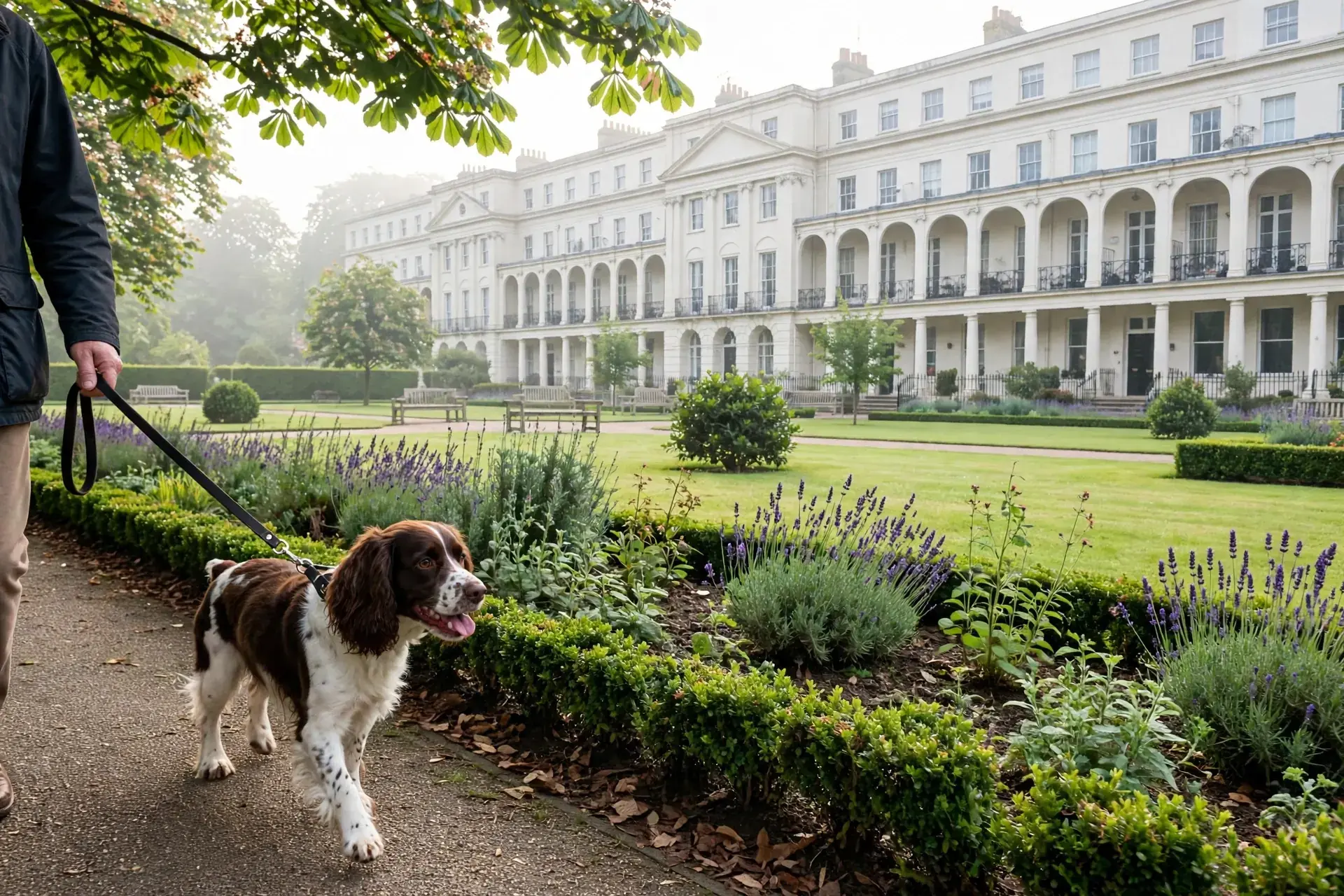
Cheltenham rewards a simple plan. It is a Regency spa town in Gloucestershire, on the western edge of the Cotswolds, and its centre is unusually open and flat for a historic town. The best way to learn it with a dog is to start in the middle and walk outwards, rather than driving between scattered sights. The Promenade is the spine of that plan: a broad, tree-lined boulevard of white stucco terraces, shops and gardens that runs through the heart of town, and it is the single most useful piece of ground in this guide.
The town grew up around its mineral springs. The waters were discovered in 1716, and Cheltenham became fashionable after King George III visited in 1788, which is why so much of the centre still looks like a stage set of Regency terraces, crescents and garden squares. That history matters to a dog owner for a practical reason, not a romantic one: Regency towns were built for strolling. Pavements are wide, the streets are straight, there are gardens every few minutes, and there is almost always a bench, a patch of grass or a quiet side street within easy reach when a dog needs a pause. Compare that with a medieval town centre, where narrow lanes, cobbles and crowds leave a nervous dog with nowhere to go, and the difference is obvious within ten minutes.
Use the first hour as a test walk, not a sightseeing march. Park or arrive, give the dog water, and walk the length of the Promenade at the dog's pace, letting it sniff the railings, the tree pits and the garden edges. The Promenade is planted with trees and lined with gardens, so there is shade in summer and shelter from light rain, and the width of the pavement means you can give other dogs a wide berth without stepping into traffic. If your dog is the sort that watches everything, this is a good place to practise: you can see other dogs coming from a long way off, cross to the other side, or duck into one of the side streets that lead towards Montpellier or the High Street.
Three small habits make that first hour work. First, walk the Promenade in the morning if you can, when it is quieter and the light is softer; by midday on a Saturday it fills with shoppers, pushchairs and other dogs, and the same street feels twice as busy. Second, keep the lead short but loose through the busiest stretch, and save the long line for the parks, where it belongs. Third, end the first hour somewhere the dog can settle: a garden bench, a cafe terrace in Montpellier, or the grass of Imperial Gardens, which sits just off the Promenade and gives a dog a proper sniff and a lie-down before you ask for more walking. A dog that has had a calm first hour will cope with the rest of the day; a dog that has been dragged through a crowded high street at noon will not, and no amount of treats later will undo it.
Before you go further, it is worth knowing the shape of the town. The High Street runs roughly east to west, the Promenade runs south from it towards Montpellier, and Pittville Park sits to the north, about a twenty-minute walk from the centre. The racecourse is out to the north-west, at Prestbury Park, and the hills — Cleeve Hill and Leckhampton Hill — rise to the east and south. The River Chelt threads through the town, mostly out of sight, and the Cotswold Way, the long-distance trail that runs for 102 miles from Chipping Campden to Bath, passes over the hills above the town. You do not need to remember any of that while you walk. You only need to know that the flat, easy ground is in the middle, the big park is to the north, and the wild, open ground is up on the hills — and that this guide works through them in exactly that order.
Pittville Park and the Pump Room
Pittville Park is the walk that justifies the trip. It is the largest park in Cheltenham, laid out in the 1820s as part of the Pittville estate, and it still feels like a piece of Regency planning rather than a modern municipal park: long avenues, two lakes, open lawns, and the Pittville Pump Room standing at the southern end like a small Greek temple. The Pump Room, built between 1825 and 1830, is the grandest of the town's spa buildings, and the park around it is where Cheltenham dog owners spend most of their walking time. If you only have one long walk in the town, make it this one.
The loop is the thing to learn. Start at the Pump Room end, where there is a car park and the widest lawns, and follow the paths around the lakes. The boating lake and the smaller lake attract ducks, geese and swans, so keep your dog on a lead near the water unless you are certain of its recall around birds — a dog that has never seen a swan up close will not be improved by meeting one at full speed. The paths are surfaced and mostly flat, which suits older dogs, puppies and dogs that are still building fitness, and the loop is long enough to tire a medium-sized dog without needing a car or a hill. Allow an hour for a relaxed circuit with sniffing stops, longer if your dog likes to watch the water.
Pittville works in all weathers, but it changes character with them. On a dry spring morning the lawns fill with ball games and picnics, and the open grass is good for a gentle game of fetch away from the paths. After heavy rain the lower paths near the lakes can be soft and muddy, so bring a towel and a drying coat, and expect to wash paws before the dog gets back in the car. In summer, the avenues give shade but the open lawns get hot; walk early, carry water, and remember that a dog in a dark coat will feel the sun on the south-facing grass long before you do. In autumn the avenues are at their best, and the fallen leaves give a scent-rich walk that most dogs prefer to any amount of open running.
There are a few practical points worth knowing before you go. Dogs are walked off lead in the open grass areas of the park, but there is no single rule for the whole park, and the sensible default is to keep your dog on a lead near the lakes, the Pump Room, the play areas and the roads that cross the park. Check the signs at each entrance and the official guidance before you travel, because local rules can change. The park has play areas and a cafe near the lakes, and the paths are shared with runners, cyclists and families, so a long line needs managing: reel it in at path junctions and whenever children or cyclists are approaching. Pick up after your dog everywhere in the park, and use the bins provided rather than leaving bags on fences or under trees — the park is well used, and the bins are emptied regularly.
If your dog needs more than one loop, Pittville connects naturally to the rest of the town. From the northern end of the park you can walk out towards the quieter residential streets of Pittville itself, with its Regency villas and garden squares, and from the southern end you are a short walk from the town centre. That makes it easy to build a half-day: a long loop in the park, a coffee on the way back, and a short rest before the afternoon. Dogs that are still learning to settle in busy places do better with this shape — one big, calm walk, then a break — than with a day chopped into half a dozen short, stimulating stops.
One more thing to note: the Pump Room itself is an events venue, and it hosts weddings, concerts and festivals through the year. On event days the area around it is busier and sometimes fenced off, so if you arrive to find marquees and vans, simply start your loop from the lake end instead. The park is large enough that an event at one end barely touches the other, and the lakeside paths stay quiet even when the Pump Room is full.
Montpellier and Imperial Gardens
Montpellier is Cheltenham's cafe quarter, and it is where the town feels most like a holiday. The district sits just south of the Promenade, around Montpellier Gardens and Montpellier Walk, with its colonnaded shops, independent cafes and restaurants. The architecture is the same white stucco Regency as the Promenade, but the scale is smaller and the pace is slower, which suits dogs. This is the part of town to head for when the walking is done and you want to sit down.
Imperial Gardens, at the southern end of the Promenade and on the edge of Montpellier, is the town's pocket of green in the centre. It is smaller than Pittville and more formal — lawns, flower beds, paths and benches — but it is exactly the right size for a dog that needs a break between streets. Dogs should be kept on a lead here, and it is not a place for off-lead play; think of it as a garden to pass through and rest in, not a park to exercise in. In summer the gardens host events and the Cheltenham festivals use the space, so check what is on before you plan a quiet sit-down, and expect the gardens to be busier during festival weeks.
Montpellier Walk itself is worth a slow wander. The colonnade gives shade and shelter, the pavements are wide, and the shopfronts are the sort that invite a slow pace rather than a rush. Dogs on leads are a normal sight here, and many of the cafes and restaurants have outdoor seating where a dog can lie under a table. The gardens opposite give you somewhere to wait with the dog while one person goes inside to order, which is a small kindness that matters when you are travelling with a dog that does not settle in queues.
For dogs that find town centres stressful, Montpellier has one useful advantage over the High Street: it is easy to leave. The residential streets around it are quiet, tree-lined and full of front gardens to sniff, so if your dog starts to flag you can turn down any side street and be in calm within a minute. The same is true of the streets around Imperial Gardens. Use that escape route freely. A five-minute detour down a quiet street is always better than pushing a tired dog through another busy junction, and Cheltenham's grid of Regency streets makes detours easy.
While you are in this part of town, look up at the buildings as well as down at the dog. Montpellier was developed in the 19th century as a fashionable residential and shopping district, and the stucco fronts, ironwork and garden squares are among the best-preserved Regency streetscapes in England. You do not need a guidebook to enjoy them; a slow walk with a dog, stopping when the dog stops, is a perfectly good way to see a historic town. The dog sets the pace, and the pace is right.
The racecourse edge: Prestbury Park
Cheltenham Racecourse, at Prestbury Park to the north-west of the town, is the reason many people have heard of Cheltenham at all. It is the home of jump racing in Britain, and the Cheltenham Festival in March — four days of racing culminating in the Gold Cup on the Friday — is one of the biggest sporting events in the country. The racecourse estate covers roughly 350 acres of parkland, and on a quiet day outside the racing season it is a very different place from the Festival crowds: open grass, long views, and the hills rising behind it.
The important thing to understand is the difference between racedays and ordinary days. On racedays, the racecourse is a ticketed event with tens of thousands of people, and it is not a place for a dog. Do not try to take a dog to the Festival, and do not leave a dog in a car at the racecourse on a raceday. Outside racedays, the public footpaths and bridleways around the racecourse estate can be walked, and the surrounding lanes and hills are popular with local dog walkers. Check the official guidance before you travel, because access changes around events, during the Festival, and when the course is being prepared or rested.
The walks around Prestbury Park are a good middle ground between the town parks and the high hills. The lanes are quiet, the hedgerows are thick with scent, and the views back towards the town and across to the Cotswold escarpment open up quickly once you gain a little height. This is proper countryside walking, not park walking: expect mud after rain, livestock in some fields, and stiles or gates that need a hand. Keep your dog on a lead where there are horses or livestock, and on the lanes themselves, where traffic moves faster than it looks and there is often no pavement.
If you walk here in March, be aware that the Festival changes the whole area for a week. Roads close or clog, parking disappears, and the town fills with visitors. That is not a reason to avoid Cheltenham in March — the atmosphere is extraordinary — but it is a reason to plan differently: stay outside the town, walk early, and do your long walks on the hills rather than near the racecourse. The rest of the year, the racecourse area is one of the quietest places to walk a dog near the town, and on a weekday morning you may have the lanes almost to yourself.
One practical note: the racecourse is also a venue for concerts, conferences and other events through the year, so a quiet Tuesday can turn busy without warning. Check the racecourse's own listings before you set off, and have a backup walk in mind — Pittville Park is always there, and the hills above the town are rarely crowded. A dog walk that depends on one exact location is a fragile plan; a dog walk with a backup is a good one.
Cleeve Hill and Leckhampton Hill
Above Cheltenham, to the east and south, the land rises into the Cotswold escarpment, and the two hills every local dog walker knows are Cleeve Hill and Leckhampton Hill. They are the wild counterweight to the Regency town below: open common land, limestone grassland, scrub, quarries and long views across the Severn Vale to the Malverns and the Welsh hills on a clear day. If Pittville is the everyday walk, these hills are the weekend walk, and they are the reason Cheltenham works as a base for a longer break rather than just a town stop.
Cleeve Hill is the higher of the two, at 330 metres, and it is the highest point in the Cotswolds. It is common land, crossed by the Cotswold Way, and it feels properly open: wide grass, gorse, rocky outcrops and a golf course on the top. The views from the edge are the best in the area, and on a clear day you can see for miles. The walking is easy underfoot on the main paths but the ground is exposed, so wind and rain arrive fast and there is little shelter. Bring a windproof layer for yourself and a drying coat for the dog, and do not rely on phone signal in the dips.
Leckhampton Hill, at 295 metres, is smaller and more varied. It is known for the Devil's Chimney, a tall limestone pillar left standing after quarrying, and for its old quarries, beech woods and scrub. The hill is also crossed by the Cotswold Way, and the paths through the woods give shade in summer and shelter in wind, which makes it a better choice than Cleeve Hill on a blustery day. The quarries and drops need care: keep dogs on a lead near the edges and the old quarry faces, and keep children and dogs together on the narrower paths.
Both hills have livestock at times of the year, including sheep and cattle grazing the common, so the Countryside Code applies in full: keep your dog on a lead near livestock, and under close control at all times. During the spring lambing season, from roughly March to July, this is not a courtesy but a necessity — a loose dog among lambs can cause serious harm and can be dealt with severely by the farmer. Even outside lambing, a dog that chases sheep is a danger to itself and to the flock. If your dog has a strong chase instinct, keep it on a long line on the hills and let it run only in the open, livestock-free stretches where you can see a long way in every direction.
Getting to the hills is part of the plan. Both have car parks, but they are small and fill quickly on sunny weekends, so arrive early or walk up from the town. From the town centre, the walk up to Leckhampton Hill takes you through residential streets and then up a steady climb; allow at least an hour each way for a fit dog, and carry water, because there is no reliable water on the hill tops. From Cleeve Hill, the walk down towards the town is long and steady, and the paths can be slippery with loose limestone after rain, so good footwear matters for you and good paw care matters for the dog. Check paws after a hill walk: limestone chips and dry grass seed can lodge between toes, and a quick check at the car saves a limp later.
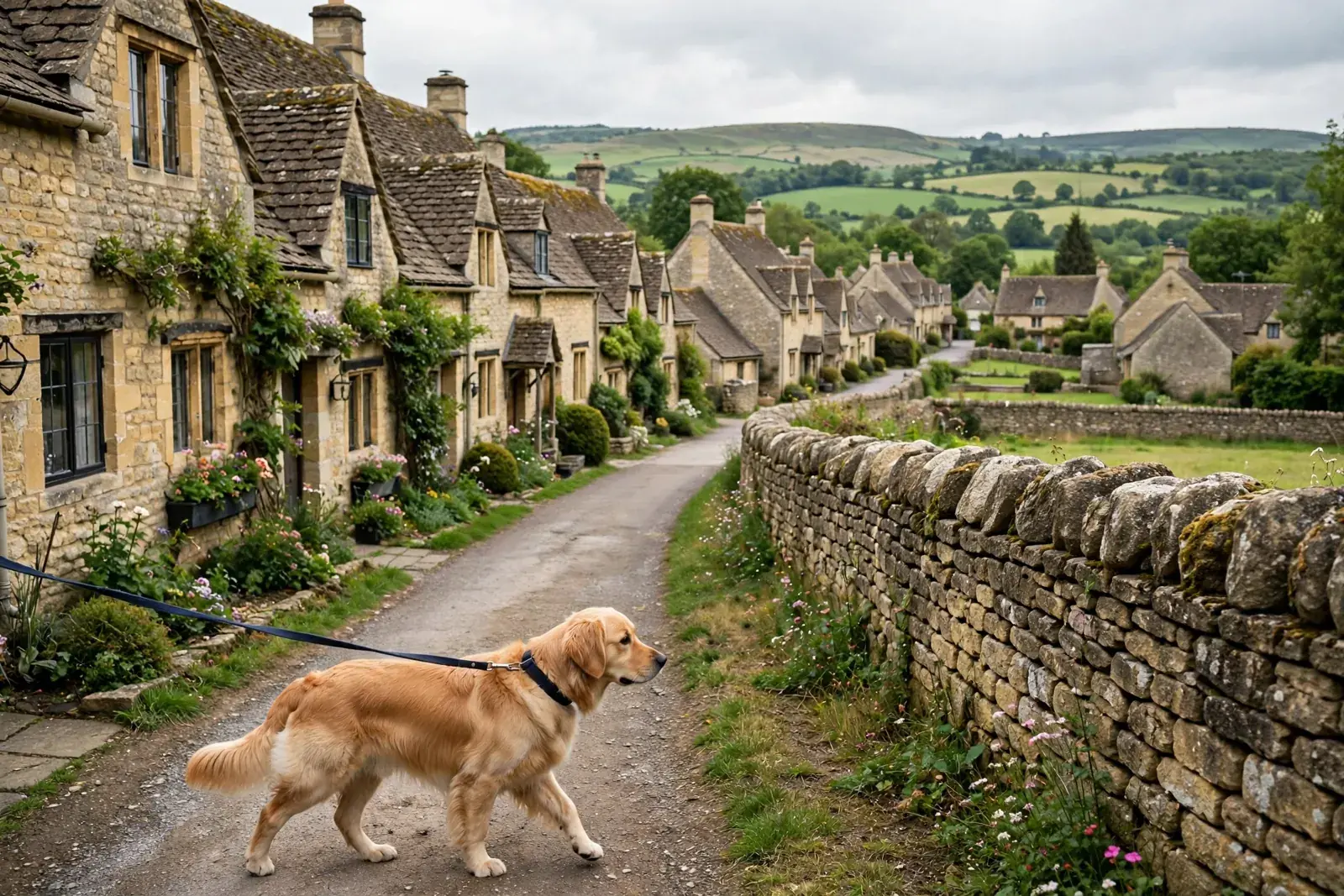
For a longer day, the Cotswold Way itself is the obvious extension. The trail runs for 102 miles from Chipping Campden to Bath, and the sections over Cleeve Hill and Leckhampton Hill are among the most dramatic on the whole route. You do not need to walk the whole trail to enjoy it; a linear section with a car at each end, or an out-and-back from one of the hill car parks, gives you a proper taste. If you are planning a multi-day Cotswold walk with a dog, our wider Cotswolds with a dog guide covers villages, commons, livestock and pub stays across the whole area, and it pairs naturally with this Cheltenham guide.
Eating and drinking with a dog
Cheltenham is a good town for eating out with a dog, because so much of its eating happens outdoors or in informal rooms where a dog under a table is normal. The cafes and pubs of Montpellier are the natural starting point, and the Promenade and the streets around it have plenty of places with terraces and gardens. The rule, as everywhere in Britain, is that policies change, and the only reliable way to know is to check the official guidance before you travel or to ask at the door. A place that welcomed dogs last year may have changed its policy, and a place that looks unwelcoming may have a dog-friendly garden you cannot see from the street.
A few habits make eating out with a dog much easier. First, carry a mat. A dog that has its own mat knows where to lie, settles faster, and is less likely to wander into a walkway or under a neighbouring table. Second, bring water and a small chew or a stuffed Kong for the wait between ordering and eating; a bored dog is a noisy dog, and a dog with something to do is invisible. Third, feed the dog before you sit down, or at least give it a proper walk first. A dog that has already walked and eaten is a dog that can sleep through a meal. A dog that has been in the car all morning and is bursting with energy is not.
Choose the right kind of place for the dog you have. A quiet cafe with a garden suits almost any dog. A busy pub at Friday lunchtime, with food being carried past at dog height and children running between tables, suits very few. If your dog is reactive, pick a table at the edge of a terrace rather than in the middle, and sit with your back to a wall so the dog has only one direction to watch. If your dog is nervous, pick somewhere with a garden rather than an enclosed room, so the dog can see the way out. And if your dog barks, be honest about it: a short visit to a quiet cafe is a training opportunity, but a long lunch in a crowded pub is a test the dog is likely to fail, and everyone at the next table will remember it.
Breakfast is often the easiest meal with a dog. Cafes open early, terraces are quiet, and a dog that has just had a morning walk will settle well. Lunch is the busiest meal, especially on Saturdays, so book ahead if you can and say you have a dog when you book — it avoids an awkward conversation at the door. Dinner is more variable: some pubs welcome dogs in the bar area in the evening, others restrict dogs to the garden, and some do not allow dogs after a certain hour. Check the official guidance before you travel, and have a backup plan, such as a takeaway eaten on a bench in Imperial Gardens or back at your accommodation.
Two more practical points. Many Cheltenham pubs have beer gardens, but a beer garden is not automatically a dog garden: check whether dogs are allowed in the garden, whether the garden is enclosed, and whether there are gaps in the fence a small dog could slip through. And remember that food on low tables is a temptation. Pubs that serve food at dog height need a dog that can settle and leave it alone, so practise "leave it" at home before you practise it in a pub. A dog that has stolen a sausage from a stranger's plate has not ruined the holiday, but it has made the rest of the meal much harder.
If you are self-catering, Cheltenham's shops and markets make it easy. The town has supermarkets, delis and a market, and the High Street and the Promenade have food shops within a short walk of most central accommodation. Buy the dog's food before you arrive if your dog eats a specialist diet, because a small-town supermarket may not stock your brand, and a hungry dog with an upset stomach is a poor travelling companion. Pack the dog's usual food, a spare lead, poo bags, a towel and any medication in the car, not in a suitcase buried under luggage.
Staying overnight: what to ask
Cheltenham has a good range of places to stay with a dog, from hotels and guest houses in the Regency centre to self-catering cottages and farm stays on the edge of town and out towards the Cotswolds. The town's size works in your favour: there are enough options that you can be choosy, and enough competition that dog-friendly policies are common. The trap, as with holiday parks anywhere, is assuming that "dog-friendly" means the same thing in every place. It does not, and the differences are exactly the things that matter once you arrive.
Ask these questions before you book, and get the answers in writing. First, how many dogs are allowed, and is there a charge per dog per night or per stay? A charge of a few pounds a night is normal; a charge that doubles the room rate is not, and you should know which it is before you pay. Second, can the dog be left alone in the room, and for how long? Many hotels prohibit unattended dogs outright, while others allow it only if the dog is crated and quiet. Third, where does the dog sleep, and is there a ground-floor room available? A dog that needs a 3am toilet trip will thank you for a ground-floor room near a door, and so will you. Fourth, is there somewhere to walk the dog nearby without crossing a busy road, and is there a secure garden or an enclosed area? Fifth, are dogs allowed in the restaurant, the bar or the breakfast room, or only in the bedroom? If you plan to eat at the hotel, this answer changes the trip.
Self-catering has different questions. Ask about the garden: is it enclosed, how high is the fence, and is there a gate a dog can push open? Ask about the flooring: a cottage with hard floors is easier to clean after a muddy hill walk than one with pale carpets. Ask about the stairs: steep, open-tread stairs are a problem for older dogs and for dogs that are nervous of heights. Ask about the neighbours: a cottage in a quiet village is a different stay from a flat above a busy pub. And ask about the check-in and check-out times, because arriving in daylight gives you time to walk the garden, check the fences and settle the dog before dark.
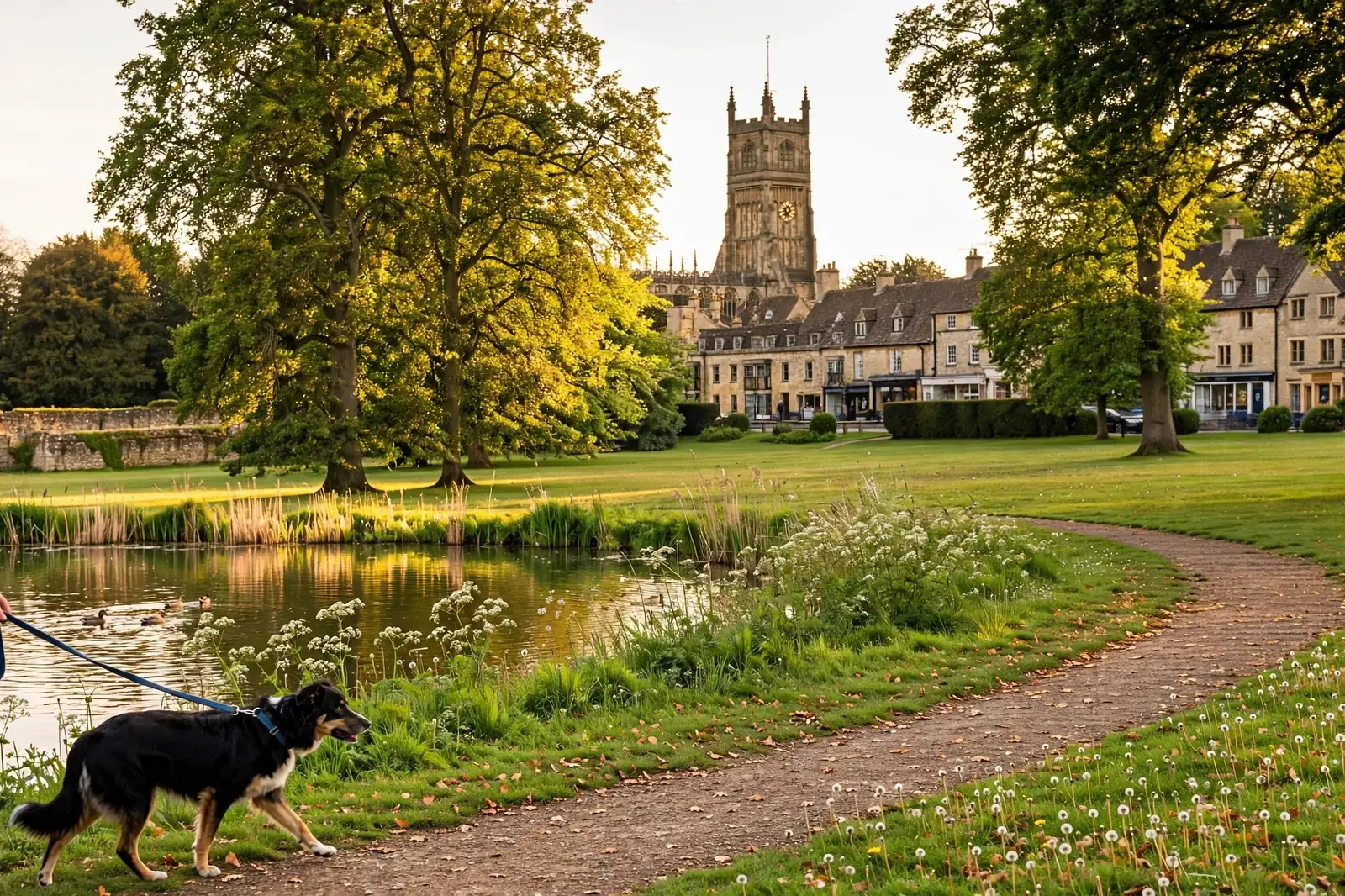
Where you stay in Cheltenham also shapes the walks you can do without a car. A central hotel puts you on the Promenade in minutes and in Pittville Park in twenty, but it also puts you in the busiest part of town at the busiest times. A place on the edge of town, towards Pittville or Prestbury, gives you quieter mornings and a shorter drive to the hills, but a longer walk to dinner. A place out in the Cotswolds, in a village like Bourton-on-the-Water or Broadway, gives you countryside on the doorstep and a drive into town for the day. There is no wrong answer, only a trade-off, and the right answer depends on your dog: a nervous dog does better on the edge of town, a social dog does fine in the centre, and a dog that needs long runs does best in a village with fields outside the door. If you are weighing a village stay against a town stay, our Cirencester with a dog guide covers the Cotswold capital just down the road, and it is a useful comparison for what village and small-town stays feel like in this area.
Book early for the busy times. The Festival in March, the literature festival in October, and the summer weekends all fill the dog-friendly rooms first, and the best rooms — ground floor, garden access, quiet location — go months ahead. If you are visiting during a festival, check the festival dates before you book, and expect higher prices and a livelier town. If you can be flexible, a weekday stay is quieter and cheaper than a weekend, and a shoulder-season stay in May or September gives you the best of the parks without the crowds. And whatever you book, save the confirmation, the pet policy and the phone number in your phone before you travel, so a question at check-in can be answered from the booking rather than from memory.
Finally, think about the car. Cheltenham's central car parks are convenient, but a car left in the sun with a dog inside is dangerous, and a car in a multi-storey car park can be stressful for a nervous dog. If you are staying centrally, ask whether the hotel has parking, and whether it is on site or a short walk away. If you are driving in for the day, park once and walk, rather than moving the car between sights. The town is compact enough that walking is faster than driving and parking twice, and the dog will be happier for it.
Seasons, festivals and March
Cheltenham is a year-round town, but it is not the same town in every season, and the differences matter for a dog. The town's calendar is dominated by its festivals — the race Festival in March, the jazz, science, music and literature festivals through the year — and by the English weather, which gives the hills their green and their mud in equal measure. Plan with the season, not against it, and the trip gets much easier.
Spring is the kindest season for a dog visit. From late March into May, the days lengthen, the parks come back to life, and the hills dry out after winter. The exception is Festival week in March, when the town is at its busiest and the racecourse area should be avoided with a dog. If you visit in March, come the week before or the week after the Festival, when the town is still lively but the crowds have gone. Lambing season runs through spring, so keep dogs on leads near livestock, and watch for ground-nesting birds on the hills, where dogs should stay on paths.
Summer brings the longest days and the most visitors. The parks are at their best, the cafe terraces are full, and the hills are dry underfoot. It also brings heat, and heat is the main risk for a dog in Cheltenham in summer. The town centre has little natural water for a dog to cool off in, the south-facing lawns of Pittville get hot by midday, and the limestone paths on the hills reflect heat. Walk early, before 10am, and again in the evening. Carry water on every walk, even a short one. Never leave a dog in a parked car, even for a few minutes, even with a window open — a car in summer sun heats to dangerous temperatures far faster than most people expect. And watch for cut grass and dry grass seed on the hills, which can lodge in paws and ears.
Autumn is, for many dog owners, the best season of all. September and October bring mild weather, quieter streets, and the trees of Pittville and the Promenade turning colour. The literature festival in October brings visitors, but nothing like the March crowds, and the town feels calm and bookish rather than frantic. The hills are still dry enough to walk comfortably, the light is low and golden, and the pubs light their fires. The main hazard is mud after rain, and the shortening days: by late October, a walk that started in daylight can end in dusk, so carry a light and a reflective lead or collar.
Winter is quiet and atmospheric, and it suits dogs that like cold weather and empty parks. The Regency terraces look their best in frost, the hills are dramatic under a low sky, and the town centre is calm outside the Christmas shopping weeks. But winter walking needs more care: the paths on Cleeve Hill and Leckhampton Hill get muddy and exposed, the wind on the tops is biting, and the daylight is short. Pack a drying coat and a towel, walk in the middle of the day, and have a warm, dry place to go afterwards. If your dog is older or arthritic, winter hills may be too much, and the flat loops of Pittville are a kinder choice.
Whatever the season, check the forecast the night before and again in the morning, and check the festival calendar before you book. Cheltenham's festivals are a joy to be near and a nuisance to be caught in unprepared, and the difference is almost entirely a matter of knowing the dates. Check the official guidance before you travel for current event dates, road closures and park arrangements, because a festival can change parking, access and crowds in a single weekend.
Getting there, parking and getting around
Cheltenham is easy to reach, which is part of its appeal as a dog break. It sits just off the M5, between junctions 10 and 11, and the A40 runs through the town towards Oxford and Gloucester. From London the drive is roughly two hours in good traffic; from Birmingham it is under an hour; from Bristol it is under an hour. Cheltenham Spa station, on the line between Birmingham and Bristol, has direct trains from London Paddington, usually with a change, and from the north and the south-west. If you are travelling by train with a dog, check the train operator's rules before you travel: dogs travel free on most British trains, but they must be on a lead or in a carrier, and they are not allowed on seats.
Once you arrive, the town is best explored on foot. The centre is compact and flat, the Promenade and Montpellier are a short walk from the station, and Pittville Park is about twenty minutes on foot from the centre. That compactness is a gift for a dog owner, because it means you can park once, walk everywhere, and avoid the stress of moving a dog in and out of the car all day. If you do need to drive between sights — to the racecourse, to Cleeve Hill or to a village in the Cotswolds — the drives are short, but the lanes are narrow, so take them slowly and expect to meet tractors, horses and walkers.
Parking deserves a little planning. The town-centre car parks, including the Regent Arcade car park, put you within a short walk of the Promenade and Imperial Gardens, and Pittville Park has its own car parks beside the lakes. The hill car parks at Cleeve Hill and Leckhampton Hill are small and fill quickly on sunny weekends, so arrive early or walk up from the town. If your dog is nervous in multi-storey car parks — the noise, the echoes, the ramps — park at Pittville or on the edge of town and walk in. Check the official guidance before you travel for current charges, time limits and any changes to car park arrangements, because prices and rules are updated regularly.
Public transport with a dog in Cheltenham is workable but limited. Local buses generally allow dogs at the driver's discretion, but a large dog on a busy bus is a challenge, and the routes that serve the hills are infrequent. For most visitors, the practical answer is to walk in town and drive to the hills, rather than to rely on buses. Taxis that accept dogs exist in the town, but book ahead and say you have a dog when you book — not every driver will take one, and a taxi that arrives and refuses a dog is a problem you do not need at the end of a long day.
Two more practical points. First, save the location of the nearest vet before you need it, and keep the number in your phone. Cheltenham has veterinary practices in and around the town, but opening hours vary, and an out-of-hours emergency vet may be a drive away. Second, if you are driving in from the Cotswolds, remember that the lanes around the town are used by walkers, cyclists and horse riders, and that a dog loose on a lane is a hazard to everyone. Keep the dog in the car until you are parked and ready, and clip the lead on before you open the door.
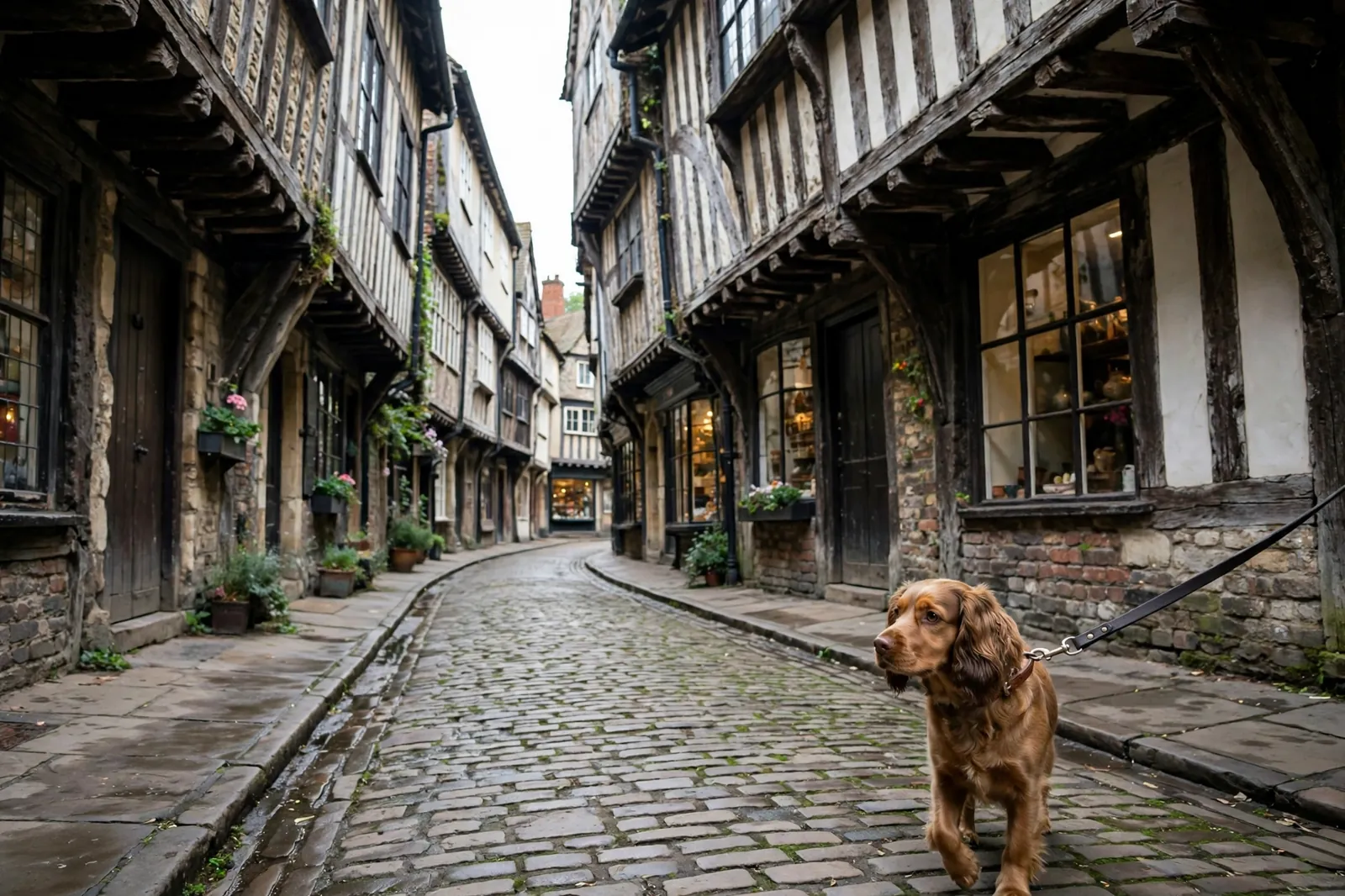
If you are combining Cheltenham with a longer trip, the town makes a good base for the north Cotswolds and for the cities nearby. York is a very different kind of city break — medieval streets, a river, and walls to walk — and if you are weighing a spa town against a historic city, our York with a dog guide covers the walls, the riverside and the rules for a city break with a dog, and it is a useful contrast to Cheltenham's open, Regency feel.
Lead rules, livestock and etiquette
Cheltenham does not have one set of dog rules for the whole town, and that is the first thing to accept. The parks, the streets, the hills and the countryside around the racecourse each have their own expectations, and the signs at each place are the authority. The general principles, though, are the same everywhere in England, and they are worth stating plainly, because they are the rules that keep dogs, livestock, wildlife and other people safe.
On leads, the rule of thumb is simple: on a lead near roads, near livestock, near horses, near children playing, near lakes with waterfowl, and in any place where the signs say so. Off lead only where it is clearly normal, where you can see a long way, and where your dog will come back when called. A long line is a good compromise on the hills and in the parks: it gives a dog freedom to sniff and explore without giving it the freedom to chase a deer, a sheep or a cyclist. If your dog's recall is not reliable, do not test it on Cleeve Hill with sheep in the next field. Test it in Pittville Park, where the boundaries are clear and the stakes are low.
Livestock deserves a paragraph of its own, because the hills above Cheltenham are working farmland as well as open access land. Sheep and cattle graze the commons, and the fields around the racecourse and the villages hold horses and livestock through the year. The Countryside Code is clear: keep dogs on a lead near livestock, and keep them under close control at all times. During lambing season, roughly March to July, this is critical. A dog that worries sheep can cause ewes to miscarry, lambs to be separated, and, in the worst cases, the farmer is legally entitled to shoot a dog that is worrying livestock. That is a stark sentence, but it is the law, and it is better to know it before a walk than to learn it after one.
Fouling is the other rule that matters every day. Pick up after your dog everywhere — in the parks, on the pavements, on the hills, on the lanes. Bag it and bin it, and use the bins provided. On the hills, where bins are scarce, carry the bag with you until you find one; leaving a bag by a path or hanging it on a fence is littering, and it is the behaviour that turns other walkers against dog owners. Cheltenham's parks are well provided with bins, so there is no excuse in town, and on the hills a spare bag and a little patience are all it takes.
Etiquette in town is mostly common sense, but it is worth spelling out. Keep your dog off the flower beds in Imperial Gardens and out of the planting on the Promenade. Keep it on a short lead in shops and cafes, and do not let it approach other people's tables or children without being invited. If your dog is reactive, say so early and clearly — "my dog needs space, please" — and most people will help. If another dog approaches yours off lead and yours is on a lead, do not be shy about asking the other owner to call their dog back. A dog on a lead cannot run away from a dog that rushes it, and the owner of the loose dog is the one who needs to manage the situation.
Finally, a word about the law. Under the Dangerous Dogs Act 1991, certain types of dog are banned in the UK, and under the Animal Welfare Act 2006 owners have a duty to meet their dogs' needs. More relevant to a visitor, many local authorities use Public Spaces Protection Orders to set dog rules in parks and town centres, including where dogs must be on leads and where they are excluded altogether. Cheltenham's rules can change, and they are set out in the council's own orders and signage. Check the official guidance before you travel, read the signs at each park and green space, and follow them even when other people do not. The signs are the rule, not the crowd.
A one-day plan and a wet-weather backup
Here is a day that works for most dogs, built from the pieces above. It is a template, not a timetable: adjust it to your dog's energy, the weather and the season, and cut it short without guilt if the dog tells you it has had enough.
Start early, before 9am, with a loop in Pittville Park. Park at the Pump Room end, walk the lakes, let the dog sniff and stretch, and give it a proper hour. This is the longest walk of the day, and doing it first means the dog has already had its main exercise before the town gets busy. From the park, walk back towards the centre through the quiet streets of Pittville, and stop for breakfast in Montpellier or on the Promenade. By now the dog has walked, eaten and settled, and it will sleep under a cafe table while you eat.
Mid-morning, walk the Promenade at a strolling pace, with a detour through Imperial Gardens. This is the sightseeing part of the day: the terraces, the shops, the gardens. Keep it short — forty-five minutes at most — and watch the dog. If it is flagging, head back to the car or the hotel for a rest. A midday rest is not wasted time; it is what makes the afternoon possible. Dogs that rest at midday walk better in the afternoon than dogs that are dragged through a second long walk on tired legs.
In the afternoon, drive to one hill, not two. Choose Leckhampton Hill for woods and shelter, or Cleeve Hill for open views and big skies, and walk for an hour to ninety minutes. Keep the dog on a lead near livestock and near the quarry edges, and let it run only where you can see clearly. Finish with a drink in a pub garden on the way back, if the dog is settled enough, or head straight back to your accommodation for a quiet evening.
The wet-weather backup is simple: Pittville Park in a drying coat, a long lunch in a dog-friendly pub, and a slow wander through the covered parts of Montpellier. Cheltenham's Regency colonnades and shop awnings give more shelter than most towns, and the parks are still walkable in rain — the paths are surfaced and the trees give cover. What does not work in rain is the hills: the limestone gets slippery, the wind on the tops is cold, and a wet dog on an exposed hill is a miserable dog. Save the hills for a dry day, and do not feel you have missed out. The town is the point of Cheltenham; the hills are the bonus.
Packing for the day is straightforward, and it is worth listing because it is easy to forget something small that matters. Bring water and a bowl, poo bags, a towel, a drying coat, a spare lead, treats, a mat for cafes, and any medication the dog needs. Bring a torch and a reflective lead if you might be out after dusk. Bring a first-aid kit with tick removers and paw balm if you are walking the hills. And bring the number of the nearest vet, saved in your phone before you leave. None of this is heavy, and all of it is cheaper to pack than to buy in a hurry.
One last piece of advice: leave the town the way you arrived, with a calm dog. The best Cheltenham days end not with a rush to the car but with a last quiet loop — a short walk in Pittville, or a sit on a bench on the Promenade — so the dog's last memory of the town is a calm one. Dogs remember how a day ends, and a calm ending makes the next trip easier. Cheltenham, with its wide pavements, its big park and its hills on the doorstep, is a town that makes calm endings easy. Use it.
Practical questions
Before you go
Can dogs go off lead in Pittville Park?
In the open grass areas many dogs are walked off lead, but there is no single rule for the whole park, and dogs should be kept on a lead near the lakes, the Pump Room, the play areas and the roads that cross the park. Check the signs at each entrance and the official guidance before you travel, and keep a lead in your hand even where off-lead walking is normal.
Is the Promenade a good walk for a reactive dog?
It can be, if you pick your hour. The Promenade is wide, straight and easy to read, so you can see other dogs coming and cross to the other side or step into a side street. At midday on a Saturday it is busy with shoppers, pushchairs and other dogs, so reactive dogs do better early in the morning or in the evening, or on the quieter parallel streets.
Can I take my dog to Cheltenham Racecourse?
Not on racedays, when the racecourse is a ticketed event with large crowds. Outside racedays, the public footpaths and bridleways around the racecourse estate at Prestbury Park can be walked, and the surrounding lanes and hills are popular with dog walkers. Check the official guidance before you travel, because access changes around events and during the Festival in March.
Where can I park in Cheltenham with a dog?
The town-centre car parks, including the Regent Arcade car park, put you within a short walk of the Promenade and Imperial Gardens, while Pittville Park has its own car parks beside the lakes. If your dog is nervous in multi-storey car parks, park at Pittville or on the edge of town and walk in. Check the official guidance before you travel for current charges and time limits.
What is the best time of year to visit Cheltenham with a dog?
Late spring and early autumn are usually the easiest: mild weather, long daylight and parks at their best, without the March Festival crowds or the summer heat. Winter is quiet and the hills are dramatic, but paths on Cleeve Hill and Leckhampton Hill get muddy and exposed, so pack a drying coat and check the forecast.
Are dogs welcome in Cheltenham cafes and pubs?
Many cafes and pubs in Montpellier, on the Promenade and around the town centre welcome dogs, often with water bowls and treats, but policies change and some places allow dogs only in a garden, a bar area or outside. Always check the official guidance before you travel or ask at the door, and carry a mat so your dog can settle.