This guide is independent and contains no paid placement. If affiliate links are added later, they will be clearly marked and will not change our editorial checks.
Christchurch is a town of water: the Avon and the Stour meet here, flow into a sheltered harbour, and reach the sea at Mudeford. Walk the Quay, visit the Priory churchyard, climb Hengistbury Head for the views, and end at Mudeford for the beach. Keep the dog on a lead by the water, check the tide before you walk the spit, and check the signs for the current beach rules.
Where two rivers meet
Christchurch is defined by a meeting. The River Avon, flowing down from Salisbury and the Wiltshire chalk, meets the River Stour, flowing down from the Dorset downs, and the two rivers join to form Christchurch Harbour, a shallow, sheltered stretch of water that reaches the sea at Mudeford. The town grew up at that meeting point, and its history — as a Saxon burh, a Norman port, a market town and a resort — is the history of people using the rivers to trade, to fish and to travel.
For a dog owner, the meeting of the rivers is a gift. It means that almost every walk in Christchurch involves water: the Quay, the riverside paths, the harbour shoreline, the beach at Mudeford and the headland at Hengistbury Head are all within a short walk or drive of each other, and each one has a different character. The rivers are slow and green in the town, the harbour is wide and tidal, and the sea at Mudeford is open and bright. A dog that loves water will be in heaven; a dog that prefers dry land will still find plenty of paths, gardens and headland to explore.
The town itself is compact and walkable, with a long high street, a historic priory, a castle ruin and a quay that feels like the centre of everything. The pace is slower than Bournemouth, which is only a few miles west, and the crowds are thinner, especially out of season. Christchurch suits visitors who want a Dorset town with a real history and a real harbour, rather than a resort, and it suits dogs that enjoy a mix of town, river and coast in a single day. Our Dorset with a dog guide sets Christchurch beside the rest of the county’s coast if you are planning a longer trip.
One fact to plan around before you set out: Christchurch is tidal, and the tide changes what you can do. The harbour empties at low tide to wide mudflats, the spit at Mudeford can be cut off at high water, and the riverside paths turn to mud after rain. Look up the day’s tide table for Christchurch Harbour before you leave, confirm the season’s beach and ferry arrangements on the council and operator pages, and build the day around the tide rather than fighting it.
The Priory and the old town
Christchurch Priory is the town's great building, and it dominates the skyline from every approach. The Priory church, with its long nave, its Norman tower and its mixture of architectural styles, is one of the largest parish churches in England, and it has been at the heart of Christchurch for nearly a thousand years. Dogs are not generally allowed inside, so treat the visit as a turn-taking exercise: one person goes in while the other walks the dog around the churchyard and the Priory grounds, then swap.
The churchyard and the grounds around the Priory are worth the time in their own right. There are mature trees, old tombs, views of the church from every angle, and the quiet of a place that has been a centre of worship for centuries. Walk the dog on its lead through the churchyard, steer it away from the graves and the flower beds, and keep barking to a minimum. The Priory is a place of quiet for many people, and a well-behaved dog is part of that quiet.
From the Priory, the old town unfolds along the High Street and the lanes that lead down to the Quay. The High Street is a mix of independent shops, cafes, pubs and historic buildings, including the old town hall and the castle ruins, which stand on a mound above the rivers. The castle, now a ruin, is a reminder of Christchurch's Norman past, and the grounds around it are a pleasant place for a short walk with a dog on a lead.
An hour on foot covers the old town, from the Priory churchyard down Castle Street to the Quay and back along the High Street, with benches for a pause. A nervous dog does better if you walk the High Street first thing, while the shutters are still coming up and the pavements are quiet. Dog-friendly shops along the High Street and the lanes off it tend to put a water bowl by the door or a sign in the window; where neither is visible, pop your head in and ask, and be ready to wait on a bench if the answer is no.
The Quay and the harbour
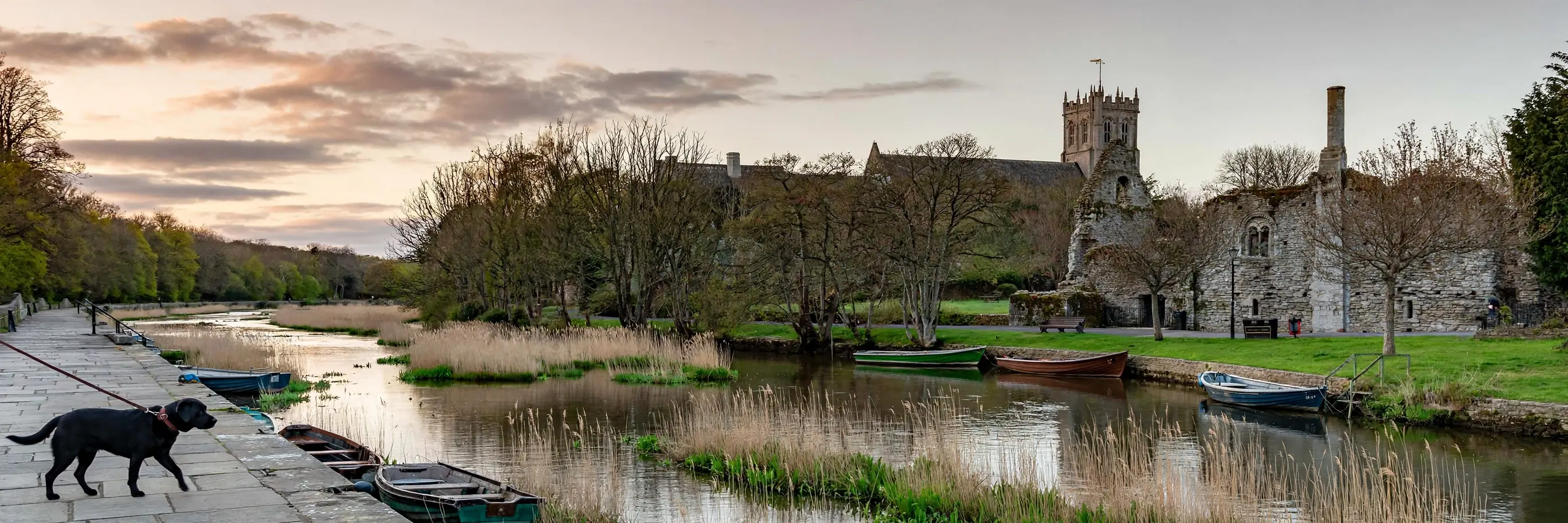
Christchurch Quay is the town's waterfront, and it is a genuinely good dog walk. The Quay is flat, wide and paved, with the river on one side and a row of historic buildings, a cafe and a pub on the other. The walk along the Quay takes about twenty minutes at a dog's pace, and there is always something to watch: swans and ducks on the river, rowing boats and kayaks, anglers on the bank, and the ferry that crosses the harbour in summer. Hold the lead short here, because the edge of the Quay drops straight into the river and the road runs close to the pavement.
The harbour beyond the Quay is a shallow, sheltered stretch of water, popular with sailors, kayakers and paddleboarders, and important for wading birds. The shoreline paths around the harbour give a different kind of walk from the Quay: flat, grassy and open, with views across the water to Hengistbury Head and the Purbeck hills. At low tide the harbour empties to wide mudflats, and the birds come in to feed; at high tide the water comes up to the Quay and the harbour feels like a lake.
Harbour boat trips run through the summer, and a few take dogs — ask the operator when you book. The ferry over to Mudeford cuts out a long walk around the harbour in summer, but dog rules and sailing times vary by operator and season, so look at the ferry operator’s own current notices before you decide. Skip the boats entirely and the Quay still fills a day: the harbour paths, the moored boats and the sunset from the Quay are among the best in Dorset.
Watch for the details that make the Quay special: the old town bridge, the weir where the rivers meet, the swans that nest on the river in spring, and the way the light changes as the tide turns. Christchurch is a working harbour town, not a theme park, and that is its charm. A dog that can settle on the Quay has learned one of the best skills a travelling dog can have: how to be calm in a busy, interesting place.
Hengistbury Head
Hengistbury Head is the standout dog walk in Christchurch, and it is one of the best headland walks on the south coast. The Head is a long, low headland that juts into the sea at the eastern end of Christchurch Bay, with cliff paths, heathland, grassland and views across the harbour, the bay and the Isle of Wight. The round trip from the car park to the end of the Head and back runs to roughly two hours with a dog setting the pace, and it earns every minute.
The paths on the Head are mostly flat and well surfaced, but there are steep sections near the cliff edge, so hold the dog close beside the cliff edge and watch for crumbling ground after rain. The heathland is home to ground-nesting birds in spring and summer, and to adders in warm weather, so keep the dog on the path and under control, and check the dog for ticks after the walk. The views from the top of the Head are superb: west across the bay to Bournemouth and Poole, east along the coast to the Isle of Wight, and south across the Channel.
At the foot of the Head, the beach at Hengistbury is a long, shingle and sand beach that suits dogs out of season, when the restrictions are lifted. Read the signs at the beach entrance that morning, because the dog zones change with the season. The visitor centre at Hengistbury has information about the Head's history and wildlife, and the cafe nearby is a good place for a rest after the walk. Dogs are generally welcome outside the cafe, and the area around it is a good place to settle.
Hengistbury is popular, especially at weekends, so arrive early or late in the day for the quietest paths. The car park fills in summer, and the path from the car park to the Head feels longer than it looks once the dog is excited. Carry water and bags, wear shoes that can cope with uneven paths and mud after rain, and look at the visitor centre’s current notices for opening hours and any events that could make the Head busier than usual.
Mudeford and the spit
Mudeford is a small fishing village at the mouth of Christchurch Harbour, and it is one of the most characterful places on the Dorset coast. The village has a quay, a cluster of beach huts, a pub and a cafe, and a long spit of sand that runs out into the sea. The spit is a favourite with walkers, anglers and dog owners, but it is tidal, and the tide can cut it off at high water, so look up the harbour tide table before you leave the Quay end and be ready to turn back.
The beach at Mudeford has areas where dogs are welcome, but the rules vary by stretch and by season, so read the notice boards at each access point that morning and confirm the seasonal zones on the council’s beach pages. Keep the lead on around the car parks, the quay and the spit, where the paths are narrow and the crowds are close together. The water at Mudeford is shallow and calm on the harbour side, and more open and lively on the sea side, so choose the side that suits your dog.
The stroll from Mudeford Quay along the spit runs to roughly half an hour with a dog setting the pace, and the views are lovely. The spit is exposed, so dress for the wind, and carry water in summer, because there is no shade. The beach huts along the spit are famous — some of the most expensive in Britain — and they give the spit a distinctive, colourful character.
For a longer walk, the coastal path from Mudeford runs west to Hengistbury Head and on to Southbourne and Bournemouth, and east along the coast towards the New Forest. The path is flat and well surfaced in places, but it can be busy in summer, so walk early or late in the day. Our Salisbury with a dog guide covers the Avon valley upstream, if you want to follow the river from Christchurch back to its source.
Pubs, cafes and the Quay
Food and drink are half the pleasure of a Christchurch day out, and plenty of the town’s pubs and cafes make room for dogs. The Quay-side and old-town pubs suit a wet dog best: tables outside with the river in view, staff who bring a water bowl without being asked, and menus built around fish and chips, pies and ploughman’s lunches. Expect the dog to be seated in the bar or the garden rather than the dining room, and take whatever table the staff suggest — they know which corners stay out of the way.
The cafe at the Quay does a steady trade in coffee and cake while dogs doze under the tables, and the High Street cafes are mostly happy with dogs at the outside tables. What a place allows can shift with the season and whoever is on duty, so ask afresh each time instead of assuming last summer’s answer still holds. Bring a collapsible bowl and a mat, and pick food you can manage one-handed while the lead stays in the other. Gulls over the Quay are bold, so keep plates covered and sit the dog on the far side of the table from the food.
Mudeford has a pub and a cafe that welcome dogs, and they are a good place to stop after a walk along the spit. The pub at Mudeford Quay is a traditional harbour pub, with a view of the boats and the harbour, and it is a good place for a drink while the dog rests. If the pub is full, a takeaway coffee on a bench by the quay works just as well, and the harbour view beats any interior.
In a Christchurch pub, settle the dog first and order second. Pick a corner table in a Quay-side or High Street bar where the lead lies flat on the floorboards, not trailing where servers walk, and slip the dog out to the riverside path for a toilet stop before food arrives. A quiet dog under a table goes unnoticed, and that is the point.
Parking, buses and the railway
For a dog day out, Christchurch offers a handful of car parks in useful spots. The town centre car parks are the closest to the Priory and the High Street, the car park at the Quay serves the waterfront, and the car parks at Hengistbury Head and Mudeford serve the headland and the beach. Choose the car park that matches the walk you plan to do, rather than parking in the town centre and walking everywhere, because the distances between the Quay, Hengistbury and Mudeford are longer than they look.
Get there early on a summer weekend: the car parks at Hengistbury and Mudeford fill quickly, and the town centre car parks fill during events and market days. Look at the council’s parking pages the night before for current charges, time limits and any seasonal changes. A car parked in sunshine heats fast even on a mild spring or autumn day, so do not leave the dog waiting in it while you walk the Quay.
By public transport, Christchurch is served by buses from Bournemouth, Poole and the surrounding villages, and by trains from London Waterloo, Bournemouth and Southampton. The railway station sits a short stroll from the town centre, and dogs may travel on trains on a lead. Buses run to Hengistbury Head and Mudeford in summer, but services are less frequent in winter, so look up the current timetables on the bus operator’s site before you rely on them.
Drivers reach Christchurch off the A35 and the A338, and the town centre is signposted from both. Around the Priory and the Quay the streets narrow to a single lane in places, so follow the car-park signs instead of threading through the middle of town. Satnav may send you down the shortest residential cut-through; the signposted loop is calmer, and a settled dog in the back arrives in a better mood.
Tides, estuary safety and wildlife
Nothing else in Christchurch matters as much as the tide. The harbour is shallow, so at low water the channels shrink to ribbons and wide flats of soft mud appear between Stanpit Marsh and the Mudeford spit, and the flood comes back across those flats faster than it looks. Before a walk from the Quay or out along the spit, read the day’s harbour tide table, tell someone which shore path you are taking, and hold the dog back from the exposed mud altogether. That mud grips like wet clay: a dog that wades in can sink to its belly, panic, and tire itself out before anyone reaches it.
Along the Quay, hold the lead short and keep the dog back from the stone edge, above all when the harbour ferry is manoeuvring. The river runs deep right against the Quay wall, and the stonework gives a wet dog almost nothing to grip, so a dog that slips in will tire fast trying to climb out. Should it happen, stay on dry land unless the water is plainly safe; shout for help and lower a lead or rope to guide the dog to the slipway by the Quay or the steps near the town bridge. Around Mudeford, give the harbour mouth a wide berth, where the current runs hardest, and steer the dog clear of anglers’ lines, hooks and bait.
Stanpit Marsh and the shore hold curlew, redshank, oystercatcher and brent geese in the cold months, and a dog dashing across the flats can scatter a flock that flew hundreds of miles to feed there. When the tide is out around Stanpit and the Mudeford shore, clip the lead on and walk the marked paths, above all from autumn to early spring, when the birds are hungriest and least able to spare the energy. In the breeding months, steer clear of the reedbeds and the saltmarsh edges where warblers and moorhens nest, and give the swans along the Avon a berth in spring, while they guard cygnets.
After a circuit of Hengistbury Head or its heathland, run your hands over the dog’s ears, belly and legs for ticks, above all in spring and summer, and lift any you find out straight away. Warm months can also turn the harbour’s still backwaters and the ponds around Stanpit green: do not let the dog lap or paddle where the surface looks pea-soupy or has a scummy film, and look at the Environment Agency’s current harbour notices if the water looks doubtful. A fresh-water rinse after Mudeford beach stops salt drying on the coat, and a quick check between the toes clears out sand.
Staying over and day trips
Christchurch sleeps dogs well: town-centre inns and guest houses, self-catering cottages, and flats near the Quay and at Mudeford. Summer weekends and school holidays fill the dog-friendly rooms first, so book ahead and get the dog terms in writing — how many dogs, any charge, whether a dog may be left alone, and where the last toilet walk goes after dark. For a longer stay, a cottage with a garden earns its keep: the dog eats at its usual hour, and you slip in and out without working around restaurant hours.
On arrival, walk the dog around the neighbourhood before the bags come in: down to the Quay for a riverside sniff, or along the Priory grounds, so the evening’s last walk already has a route. Check the boundary of any garden or courtyard, note where the fencing is low, and save the address of the nearest vet practice in town. Pack the dog’s familiar bed, its usual food and bowls, and the blanket it sleeps on at home, because a known smell settles a dog faster than any new room can. Rooms facing the Quay stay lively on summer evenings, so a sound-sensitive dog may rest better at the back.
Day trips from Christchurch are easy. Bournemouth's beaches and gardens are a short drive west, and the New Forest is within half an hour, with its open heathland, woodland and free-roaming ponies — keep the lead clipped on around the ponies and the livestock, and look up the New Forest’s current dog rules on the forest authority’s pages before you go. East along the coast, the beaches and villages of the New Forest coast offer quieter walking, and north towards Salisbury, the Avon valley and the water meadows make a calm half-day.
Build a day out from Christchurch around what the dog has left in its legs: a morning circuit of Hengistbury Head and one unhurried stop, a pub garden at Mudeford or a bench on the Quay, makes a better day than three half-seen places, and a dog that walked well in the morning will doze through the drive back along the A35. Stash a towel, water and a spare lead in the boot, and read the season’s beach rules and the ferry’s dog arrangements before setting off, because both are enforced in summer. Our Brighton with a dog guide covers another south-coast resort if you want to compare the two towns.
Practical questions
Before you go
Can dogs go inside Christchurch Priory?
No — the Priory keeps its interior dog-free, so take turns at the door: one of you steps inside to see the Norman nave while the other walks the dog around the churchyard and the Priory grounds, then swap over. Assistance dogs are the exception. Service times and concert arrangements shift through the year, so look at the Priory’s own current notices before you set out.
Where is the best dog walk in Christchurch?
Hengistbury Head, without question: the path from the car park out to the headland gives cliff views, heathland and a look back across the whole harbour to the Priory. If the dog needs something gentler, the riverside loop from the Quay along the Avon and the Stour stays flat, stays close to the town, and suits an older dog or a short evening walk.
Are dogs allowed at Mudeford beach?
Some stretches welcome dogs all year and others are seasonal, so read the notice boards at each beach entrance on the day and confirm the current zones on the council’s beach pages before you go. Keep the lead on around the car parks, the quay and the narrow spit path, and time your crossing by the harbour tide table — high water can cut the spit off.
Is Christchurch Quay dog-friendly?
Yes — the Quay is one of the easiest dog walks in town, a level paved stretch with boats, swans and a cafe and pub within a few steps. Hold the lead short beside the stone edge and the road, and watch for cyclists and other dogs on the riverside paths, which narrow towards the town bridge.
Where can I park in Christchurch with a dog?
Park in the town centre for the Priory and the High Street, at the Quay for the waterfront, or at Hengistbury Head and Mudeford for the coast walks — pick the one nearest the walk you actually plan. Summer weekends fill all of them by late morning, so come early. A car parked in sunshine heats fast even on a mild day, so never leave the dog waiting inside it.
When is the best time to visit Christchurch with a dog?
Late spring and early autumn suit dogs best: mild days, quieter quays, and the heathland on Hengistbury Head at its finest. Summer is lively but crowded, so take the early walk and leave the middle of the day to the beach crowds. Winter brings an empty Quay and big skies, though the Avon paths turn muddy after rain, so bring boots that can take it.