This guide is independent and contains no paid placement. Venue dog rules change for services, events and conservation work, so check the latest information from Salisbury Cathedral and English Heritage before you travel.
Dog friendly Salisbury works best outdoors: walk the Cathedral Close on a lead, cross the Harnham Water Meadows on the Town Path, explore Old Sarum's grassy earthworks, and treat Stonehenge as a landscape-and-turn-taking visit. Pet dogs do not normally go inside the cathedral or into every part of Stonehenge; assistance dogs are a separate category and are welcome much more widely. Plan those distinctions in advance and the day becomes relaxed rather than disappointing.
Start with the spire view, not the ticket queue
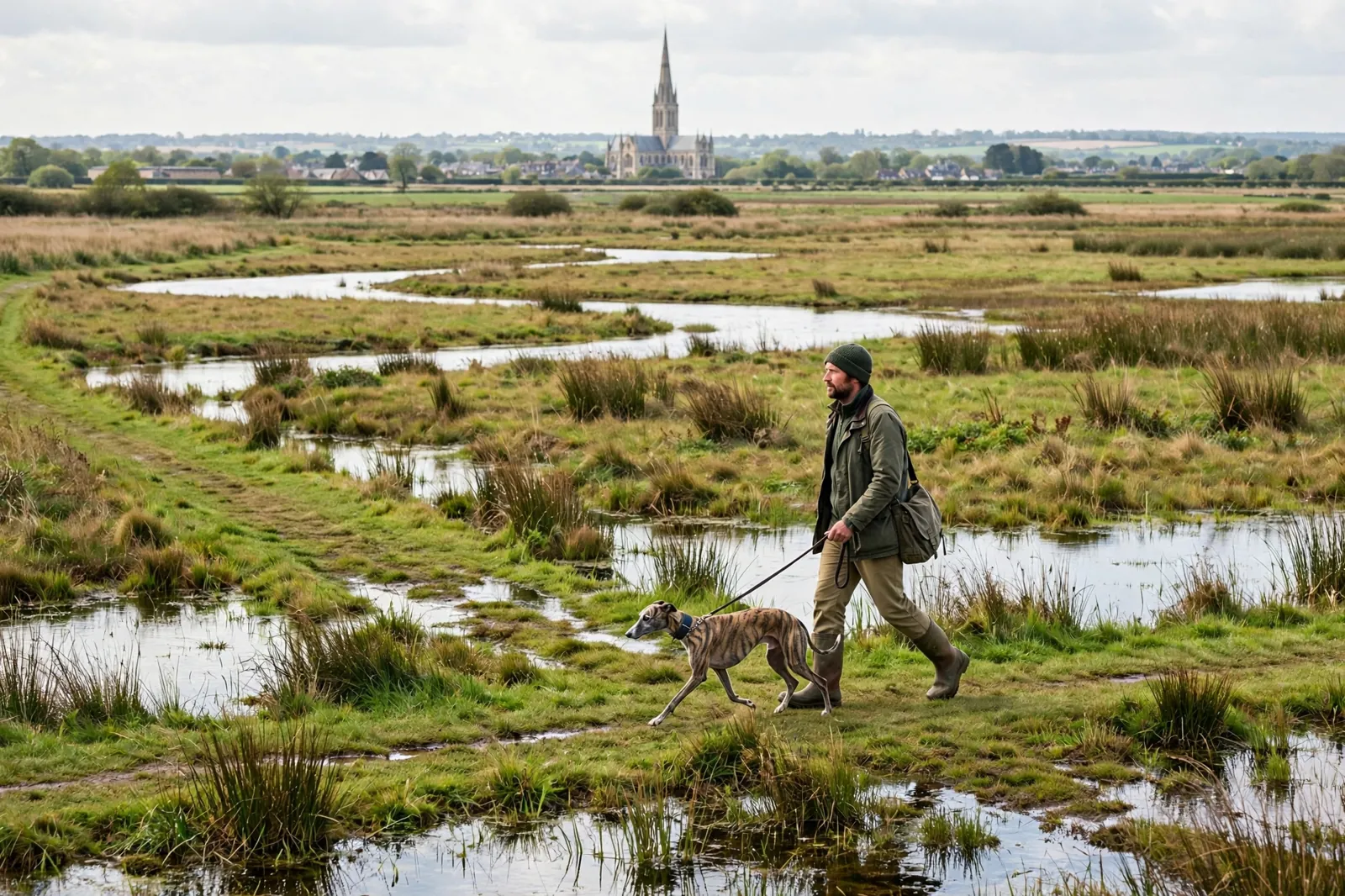
The best way to begin Salisbury with a dog is not at a doorway, checking whether your dog may cross it. It is out on the water meadows, looking back. From the flat paths south-west of the centre, the cathedral spire rises cleanly above trees, roofs and river channels — at 123 metres, the tallest church spire in Britain — and for a few unhurried minutes the whole trip makes sense. Your dog gets a proper walk on a real path, you get the postcard view without a crowd, and the city reveals its scale: compact, low, green at the edges, and organised around water as much as stone.
That opening matters because Salisbury rewards a different order of operations from many cathedral cities. Do the landscape first and the interiors second, in turns if you are travelling with another adult. A dog that has already sniffed along the River Avon, crossed a meadow path and settled under a bench in the Close will wait far more calmly while one person steps inside the cathedral than a dog taken straight from a car park to a busy entrance. Solo travellers need the same honesty in reverse: if there is nobody to hold the lead, the cathedral interior and Magna Carta are probably not part of this trip, and Salisbury still offers a full, satisfying day without them.
Geography helps. The historic centre is small enough to cross on foot in well under half an hour, the station is a manageable walk from the Close, and the two big excursions — Old Sarum to the north and Stonehenge to the north-west near Amesbury — are short drives or bus journeys rather than expeditions. Five rivers meet in and around Salisbury — the Avon, Bourne, Ebble, Nadder and Wylye — which explains both the lush meadows and the one recurring practical warning in this guide: after sustained rain, low paths can be wet, muddy or closed by flooding. Check conditions locally, build in a surfaced alternative, and never assume a meadow route that was dry in June will behave the same in January.
The Cathedral Close: Salisbury's outdoor living room
The Cathedral Close is one of the largest in England, a walled precinct of lawns, mature trees, historic houses and quiet roads entered through gates such as the High Street Gate and St Ann's Gate. For a dog owner it is the single most useful space in the city. Pet dogs on leads can be walked around the Close outdoors, taking in the west front of the cathedral, the green open spaces and the handsome perimeter buildings, without needing to enter any interior at all. On a calm morning it feels less like a tourist attraction and more like a shared living room for the city — people crossing to work, children taking the long way to school, and dogs doing respectful circuits of the grass edges.
Respect is the operative word. Keep your dog on a short lead throughout the Close, stay off flower beds and any areas signed as private, and give services, weddings and school groups plenty of space. The Close is a working religious precinct and a residential area, not a dog park: there is no off-lead exercise area here, no ball throwing on the lawns, and no tying a dog to railings while you slip inside. Carry water even on a short visit, because a warm day on pale stone and tarmac is harder on paws than the distance suggests, and always clean up — bins in busy historic precincts fill quickly, so carry bags out to a street bin if you need to.
Build the Close into your day twice, at different times. A morning circuit gives you orientation: where the cathedral entrances are, where the cafes with outdoor seating sit, which gates lead back to the centre and where the Town Path begins. An early-evening circuit, when day visitors have gone and the stone warms in low light, is often the walk dogs enjoy most — quieter pavements, cooler ground and far fewer dropped ice creams to investigate. If your dog is reactive, the evening visit is also the kinder choice, because the Close at midday in summer can funnel tour groups, school parties and other dogs through the same narrow gates.
Look beyond the cathedral itself while you are there. The Close contains museums and historic houses, most of which should be treated as no-dog interiors for pet dogs unless their own current visitor information says otherwise. That does not diminish them for a turn-taking group: one person can visit an exhibition while the other does a slow, genuinely pleasant lap with the dog. What it does rule out is the improvised plan — arriving with a dog, no partner and an expectation of seeing everything indoors. Salisbury is generous to dog owners outdoors and clear about its boundaries indoors, and planning around that clarity is the whole skill.
Inside the cathedral: the honest rules for dogs
Salisbury Cathedral is famous for more than its spire. It is an early English Gothic cathedral with the best-preserved of the four surviving original 1215 Magna Carta manuscripts, displayed in the Chapter House, and it draws visitors who may have travelled a long way for that room alone. It is therefore important to state the dog position plainly, without softening it into false hope: pet dogs are not normally admitted inside the cathedral building, and that includes the Chapter House display. Do not build a plan that depends on carrying a small dog in, pushing a dog in a buggy, or asking at the door on the day.
Assistance dogs are different, and the distinction is not a loophole. A trained assistance dog working with its handler is welcome inside, as assistance dogs are across the venues in this guide, because the dog is performing essential tasks and is trained to settle in public spaces. If you travel with an assistance dog, the cathedral's own visitor information and access pages are still worth checking before you go for current details on services, tours and any parts of the building affected by works — and the same applies at Stonehenge and Old Sarum. If you travel with a pet dog, emotional support animal or a dog in training that is not yet a qualified assistance dog, assume the pet rules apply unless the venue has confirmed otherwise in writing for your visit.
For couples, families and groups, turn-taking at the cathedral works smoothly if you organise it like a relay rather than a negotiation outside the door. Decide in advance who goes in first, agree a meeting point in the Close that is shaded and away from the main entrance flow, and give the person outside a real walk to do — a full Close circuit plus the start of the Town Path fills the time far better than standing still with a restless dog watching the door. Keep phones on, because services or events can change entry timings, and be realistic about duration: a thorough visit including Magna Carta takes longer than a quick look down the nave, especially at busy times with timed or queued entry.
Solo travellers have three honest options. The first is to enjoy Salisbury as an outdoor city this time and save the interior for a trip without the dog. The second is to use a reputable local dog sitter or boarding service booked well in advance — researched, reviewed and met beforehand, never improvised with a stranger in a car park. The third is to check whether the cathedral is running any specific outdoor tours, trails or events on your dates that suit a person with a dog outside. What is never an option is leaving a dog in a car while you visit, in any weather, or unattended outside the building. The guide's wider advice on English Heritage sites with dogs covers the same turn-taking discipline at historic properties across England, and it applies here just as well.
One more practical point: the cathedral is a place of worship first. Services run through the day, concerts and graduations fill the Close at certain times of year, and access arrangements can tighten with little notice. Before travelling, check the cathedral's official latest visitor information for opening, service times and dog guidance, and treat that page — not any blog, including this one — as the final word for your date.
Water meadows and the Harnham walk: the Town Path done properly
If the Close is Salisbury's living room, the water meadows are its lungs. The Harnham Water Meadows, a historic system of irrigated grassland threaded by channels of the River Nadder and the Avon, lie immediately south-west of the centre, and the Town Path crosses them from near the city towards Harnham and Mill Road. This is the walk in the opening photograph of countless Salisbury visits: a flat, surfaced path, water on either side in places, grazing meadows beyond fences, and that uninterrupted view back to the spire that seems to follow you as you walk.
For dogs, the Town Path has three virtues and three cautions. The virtues are flatness, scenery and proximity — no drive, no steep climb, and a genuine sense of countryside within minutes of the cathedral. It suits older dogs, dogs recovering fitness on veterinary advice, and owners who want a leg-stretch before a long drive home. The cautions are sharing, water and weather. The path is popular with cyclists, runners, pushchairs and other dogs, so a short lead is the right default for the whole crossing, not just at gates. The channels and riverbanks are not dog swimming spots on this route: banks can be steep, currents and water quality vary, and meadow management depends on dogs staying on the path. And after heavy rain the meadows do the job they were designed for — holding water — which can leave sections flooded or impassable. If the path is flooded, turn back rather than wading through with a dog; floodwater hides dips, debris and pollutants.
Continue into Harnham for a natural loop rather than a simple there-and-back. Harnham has a village feel despite being part of the city, with its own pubs and green spaces, and routes back towards the centre via Harnham Road or alongside the river give you a change of scene. Watch traffic carefully on any road sections, because the contrast between the traffic-free meadow path and a busy pavement is exactly where concentration lapses. In summer, carry water for the dog — there is little shade on the open meadow crossing at midday — and in winter bring a towel for afterwards, because a clean path can still mean a wet, mud-splashed dog from verges and gateways.
Timing changes the experience completely. Early morning on the meadows can mean mist on the water, birdsong and the spire appearing and disappearing as you walk — and, for a nervous dog, far fewer cyclists. Late afternoon gives the classic golden view towards the cathedral and a natural finish at a pub garden in Harnham or back in the centre. Midday in high summer is the least kind option for both ends of the lead: hot, busy and exposed. Whatever the hour, keep dogs out of the managed meadow channels, respect any grazing livestock and temporary signs, and follow the Countryside Code — close gates, take litter home and keep well away from cattle, especially cows with calves, by leaving the path area altogether if animals are on or near your route.
Old Sarum: ramparts, ruins and a big-sky dog walk
Two miles north of the modern city, Old Sarum is where Salisbury began: an Iron Age hillfort reused by Romans, Saxons and Normans, with a castle, the remains of the first Salisbury cathedral, and enormous grassy ramparts looking back towards the present-day spire. Managed by English Heritage, it is one of the most satisfying dog walks in the area precisely because its interest is outdoors. Dogs on leads are generally welcome in the grounds, so unlike the cathedral interior, this is a site a pet dog can genuinely share with you — walking the banks and ditches, circling the inner bailey and taking in views that explain, at a glance, why the settlement eventually moved down to the river plain.
Plan Old Sarum as a walk with history attached, not a quick photo stop. The ground is open, grassy and exposed: wonderful on a breezy spring day, demanding in summer heat or winter wind. There is little shade on the ramparts, so bring water, keep midday summer visits short, and check paws after dry spells when the ground bakes hard. Earthworks mean slopes. Fit dogs manage the banks happily on a lead, but older or unsteady dogs are better kept to gentler circuits around the lower areas, and pushchair-style dog buggies will struggle on steeper grass. Leads should stay short around the ruins and other visitors, and dogs should be kept off fragile masonry and any areas signed as restricted for conservation.
Practicalities are straightforward but worth checking in advance. Old Sarum has seasonal opening arrangements and a car park whose charges and membership arrangements vary, so consult English Heritage's current page for the site before setting off. Toilets and facilities are limited compared with a major visitor centre, so treat it as a self-sufficient outing: water, bags, towel and a plan for afterwards. Combining Old Sarum with the city works well by car or bus, and energetic walkers can link it to riverside paths along the Avon, but do not underestimate the road sections — use pavements and crossings, and keep the dog close in traffic.
The pairing of Old Sarum and the modern cathedral is what makes a Salisbury day feel complete with a dog. In the morning you stand on the hill where the first cathedral stood, dog at your feet, looking towards the spire that replaced it; in the afternoon you walk the Close around that spire, understanding the move downhill to water, trade and space. Few English cities let you read eight centuries of relocation in two dog walks. For more sites where this outdoor-first model works, see our guide to dog-friendly National Trust places alongside the English Heritage guide linked earlier — the lead, grazing and interior rules rhyme across both organisations, even though each property sets its own details.
Stonehenge with a dog: plan the landscape, not just the stones
Stonehenge sits on Salisbury Plain roughly nine miles north-west of the city, and it is the part of this trip where honest planning matters most. The image most people carry — standing among the stones with a dog at their side — is not the visit a pet dog can have. Access for pet dogs to the Stone Circle enclosure and indoor parts of the visitor experience is restricted, and the monument is viewed from a designated path around the circle rather than by walking among the stones, for everyone. Assistance dogs, by contrast, are welcome throughout the site with their handlers. Before booking anything, read English Heritage's latest information on dogs at Stonehenge for your date: timed entry, membership and booking arrangements, shuttle details and any event-day restrictions all change over time, and that official page overrides any general guide.
That still leaves two good ways to include Stonehenge in a dog trip. The first is turn-taking, exactly as at the cathedral. Book your timed entry, travel together to the visitor centre area, and agree who visits the stones first while the other explores the outdoor areas and nearby landscape routes with the dog, then swap. Build in generous time: the visitor centre and the stone circle are not side by side — a shuttle bus or a walk of around twenty to thirty minutes each way connects them, depending on route and pace — and a pet dog's access to transport and indoor spaces cannot be assumed. Ask English Heritage in advance what the current arrangement is for a person waiting with a pet dog, where they may wait, and which outdoor areas are open to them, so nobody is improvising at a barrier.
The second approach is to make the wider Stonehenge landscape the visit. The chalk downland around the monument, cared for largely by the National Trust, holds avenues, barrows and long views that put the stones in their prehistoric setting, with permissive routes where dogs under close control — and on leads where signs, livestock or wildlife require — can walk for miles. This is serious open country: no shade, changeable weather, grazing animals in places, ground-nesting birds in season, and military training area boundaries not far away around Salisbury Plain. Follow local signs exactly, keep to marked routes, keep dogs on leads around livestock and during the bird breeding season where requested, and carry everything you need, including far more water than feels necessary on a cool morning.
What not to do at Stonehenge deserves its own paragraph, because the car park tempts people every summer. Never leave a dog in a car while you visit the stones — not for twenty minutes, not with a window cracked, not on a cloudy day. If your group cannot organise turn-taking and nobody can stay with the dog, Stonehenge is the element to drop or rebook for a dog-free day, not the dog's comfort. Similarly, do not tie a dog outside the visitor centre, do not assume the cafe interior or exhibition is open to pet dogs, and do not arrive without a booking in peak season expecting to sort it out on the spot. Stonehenge is one of England's most managed visitor sites; it rewards people who read the rules early and punishes improvisation.
Logistics from Salisbury are simple in outline. Driving is the most flexible option with a dog, giving you control over shade, water stops and departure if the weather turns. Tour buses and local bus services link Salisbury and Amesbury with the Stonehenge area, but a pet dog's carriage is at the operator's discretion and conditions, and a tour format rarely suits turn-taking — check directly with the operator before relying on it, and consider whether a scheduled tour that includes interiors and timed stops is a sensible product for a dog owner at all. Cyclists and walkers use longer routes across the Plain, but those are full expeditions, not a casual add-on to a cathedral day. However you travel, aim for the earliest or latest slot your party can manage in summer: cooler ground, softer light on the stones, and a dog who finishes the day comfortable rather than merely coped-with.
More walks in and around the city
A weekend in Salisbury should not end with the greatest hits. Queen Elizabeth Gardens, close to the centre by the River Avon, offers a gentler green space for a short lead walk and a sit in the shade — a useful decompression stop for a dog who finds the market-day centre intense. Riverside paths along the Avon in both directions extend that idea: flat, scenic and good for steady, sniff-rich walking, provided you respect anglers, swans and other waterbirds, keep dogs out of the water where signs ask, and stay alert to flooding after rain. Always check for blue-green algae warnings in still water in summer and keep dogs out of suspect water entirely.
The city centre itself is a walk worth doing deliberately. Salisbury's medieval street plan, market place and independent shops are best explored early, before crowds build, with a dog who is comfortable around people, pigeons and cafe furniture. Market days bring extra smells, dropped food and tight pavements; a street-confident dog may love the theatre of it, while a nervous dog is better taken to the meadows and reintroduced to the centre at a quieter hour. Paws on pavements in summer need the usual check — if the surface is too hot for your hand, it is too hot for a prolonged town walk — and winter brings grit and de-icer to rinse off paws afterwards.
For a longer half-day, look to the chalk downland and valleys around the city rather than driving far. The Avon Valley and the Woodford Valley to the north-west, the Ebble valley to the south-west towards Broad Chalke, and routes towards Clarendon and Pitton to the east all offer the classic Wiltshire combination of river path, village pub and high chalk views — but they are working farmland landscapes. Research your specific route before you go, park considerately in villages, keep dogs on leads around livestock and on field paths through crops, and treat any route description, including in print guidebooks, as a starting point to verify against current maps and signs. If you are extending the trip south, our Dorset dog guide covers the Jurassic Coast days that many Salisbury visitors add next.
Where to stay with a dog in Salisbury
Salisbury has the full range of dog-welcoming stays in miniature: city-centre hotels that accept dogs in selected rooms, inns with rooms in and around the Close and Harnham, bed and breakfasts in residential streets a short walk from the station, and self-catering cottages and holiday parks in the villages and valleys beyond. The right choice depends less on star ratings than on three dog-specific questions. Where will the last walk of the day happen — a garden, a pavement circuit or a dark country lane? Where will a wet dog be dried and fed without stress? And what exactly does the property mean by dog-friendly: dogs in bedrooms only, dogs in a bar or lounge, a charge per dog per night, a limit on number or size?
In the centre, you trade a garden for convenience. A hotel or inn room puts the Close, the meadows and evening dining within a short walk, which suits a settled dog who toilets happily on a lead on pavements and grass verges. Ask about lift access or stairs to your floor, whether dogs may be left alone in the room — many properties say no, or only if crated — and where the nearest patch of grass actually is at 11pm, because a beautiful hotel on a busy square can mean a longer night walk than expected. Outside the centre, village stays and self-catering usually give you the garden and the drying space, at the cost of driving or bussing in and planning parking. For a Stonehenge-focused trip, staying near Amesbury or in the Woodford Valley shortens that leg; for a cathedral-focused weekend, Harnham and the streets south of the centre give you the meadows on your doorstep.
Whichever style you choose, get the dog details in writing before you pay: the per-dog charge and what it includes, whether bedding, bowls or treats are provided or are marketing garnish, any areas of the property that are out of bounds, and the policy if another guest complains about barking. Mention your dog's size and breed accurately, ask whether the room allocated to dog owners differs from the standard rooms, and check cancellation terms — as with any UK break, the cheapest rate is often the least flexible when a dog is ill or the weather closes the meadows. A short drive west or south also opens up the stays covered in our Bath with a dog guide if you are building a two-city Wiltshire and Somerset itinerary.
Eating and drinking with a dog, in general terms
Salisbury is a market city with a good spread of pubs, cafes and restaurants, and many welcome dogs in at least part of the premises — but the pattern varies too much by venue, season and even room within a venue to trust any static list, including this one. The reliable method is the general one that works across Britain. Pubs are usually the safest bet, especially those with gardens in Harnham, the centre and the surrounding villages, but always check at the door or online whether dogs are welcome in the bar only, throughout, or in the garden only. Cafes often welcome dogs at outdoor tables and sometimes inside, and are likelier to restrict space at busy lunchtimes. Restaurants are the most variable: some have a dog-friendly section or terrace, others are assistance-dogs-only indoors, and neither position is unreasonable — what matters is knowing before you are standing hungry at the host desk with a dog.
Make the experience easy for the venue and the welcome tends to extend. Arrive with a dog who has been walked and toileted, bring a settle mat or blanket so the dog has a defined place that is not a walkway, keep the lead short and attached to you rather than to table legs that can be dragged, and keep dogs off chairs and banquettes unless staff explicitly invite it. Order water for the dog if none is offered, but feed meals back at your accommodation rather than from the table, and be ready to take a restless dog outside rather than letting whining become the soundtrack to other people's lunch. In gardens, watch for dropped glass, chicken bones and other dogs arriving at close quarters between tables.
For picnic days, Salisbury is well set up. Buy food in the centre — market days are especially good for local produce — and eat in the meadows or gardens where dogs are already welcome, keeping all food waste and packaging with you and dogs away from other picnics. A picnic also solves the Stonehenge and Old Sarum problem elegantly: no venue rules to negotiate, shade chosen by you, and a dog who can settle on a blanket after a proper walk. Carry drinking water for the dog regardless, because pub bowls and cafe offers are a bonus, not a hydration plan.
Getting there and practical details
By train, Salisbury station has direct services from London Waterloo, Exeter, Bristol, Bath, Southampton and Portsmouth among others, making a car-free visit realistic for a dog who travels well by rail. Dogs generally travel free on National Rail services subject to the operator's conditions — keep them on a lead or in a carrier, off seats, and be ready for busy peak services through the city. The station is roughly a fifteen-minute walk from the Close; plan that walk as your dog's first toilet and water opportunity, and allow longer if you are arriving with luggage. Our guide to taking a dog on UK trains covers preparation, etiquette and what to pack for longer journeys.
By car, Salisbury sits on routes including the A36, A30 and A338, with signed city-centre car parks and park-and-ride options whose current charges, height limits and dog policies on buses should be checked before travel. The Close and central streets are not places to hunt for casual parking with a restless dog in the back: choose a car park in advance, note its walking route to the Close or meadows, and remember that Stonehenge and Old Sarum have their own parking arrangements entirely — a city park-and-ride ticket does not solve either. In summer, the car rule bears repeating for every car park in this guide: a dog is never left in the car while you visit an interior, a shop or a stone circle.
Pack for a river city and an exposed plain in the same bag. Lead plus a spare, poo bags in every pocket, water and a portable bowl, a towel and drying coat for meadow mud and river splashes, a settle mat for pubs and turn-taking waits, and paw balm or a rinse plan for winter grit. In summer add shade planning and heat judgement: chalk downland at Stonehenge and Old Sarum reflects heat and offers nowhere to hide from it, so be willing to shorten a walk that a fit dog would demolish in April. In winter add a waterproof layer for you and a coat for thin-coated or older dogs on the ramparts, plus a torch for early darkness on unlit village pavements. Finally, save the numbers that matter before you need them: your accommodation, a local veterinary practice in Salisbury for emergencies, and the official pages for the cathedral and English Heritage, checked on the morning of each visit.
A one-day plan that works for both ends of the lead
Start early on the water meadows. Park or walk out from your stay, cross the Town Path while the light is good and the cyclists are few, and let the spire view do its work. Double back through Harnham or return along the path, toilet and water the dog thoroughly, and arrive at the Cathedral Close by mid-morning with a dog who is ready to walk slowly and settle. Do a full Close circuit together first — west front, lawns, gates — so the dog's experience of Salisbury's centrepiece is shared, not waited through.
Late morning is the turn-taking window. One person visits the cathedral interior and Magna Carta while the other takes a second, slower Close lap and a coffee at an outdoor table where dogs are welcome. Swap if you both want to go in. If you are solo, replace this window with the museums' exteriors, a longer garden stop and an early lunch — and feel no gap in the day, because the next stop is the one your dog will rate highest.
After lunch, drive or take the bus to Old Sarum. Walk the ramparts, read the site as the original Salisbury, and give the dog the big-sky exercise that balances a pavement morning. Allow a good hour or more, longer if the weather is fine and the dog is enjoying the grass, and keep water and shade discipline even though the site feels breezy. Back in the city, finish with the early-evening Close circuit and a pub garden supper in Harnham or the centre where you have confirmed dogs are welcome.
Where does Stonehenge fit? Honestly: on a one-day trip based in Salisbury, Stonehenge deserves to replace Old Sarum rather than be added after it, unless you have booked an early slot and planned turn-taking in writing. The stronger two-day pattern is Salisbury city plus Old Sarum on day one, then Stonehenge landscape and a valley walk on day two, travelling home from Amesbury or back through the city. Dogs remember days as sequences of comfort, novelty and rest, not as lists of sights completed — and a Salisbury trip built on meadows, Close, ramparts and one well-planned wonder will satisfy the humans on exactly the same terms.
Practical questions
Before you go
Can dogs go inside Salisbury Cathedral?
Pet dogs are not normally admitted inside the cathedral building, including the Chapter House where Magna Carta is displayed. Assistance dogs are welcome inside. Pet dogs on leads can enjoy the Cathedral Close and the surrounding lawns and streets outdoors, so groups often take turns: one person visits inside while the other walks the dog around the Close. Check the cathedral's latest visitor information before you travel, as arrangements can change for services and events.
Can I take my dog to Stonehenge?
You can build a rewarding Stonehenge visit with a dog, but do not expect a pet dog to have the same access as a person. Assistance dogs are welcome throughout the site. For pet dogs, outdoor areas and the wider Stonehenge landscape are the realistic focus, while access to the Stone Circle enclosure and indoor areas is restricted. Many owners take turns at the stones or focus on the landscape walks. Always check English Heritage's latest dog information for Stonehenge before booking, because rules and timed entry arrangements can change.
Is Old Sarum dog-friendly?
Yes, in the outdoor sense that matters most for a walk. Dogs on leads are generally welcome in the grounds of Old Sarum, the English Heritage hillfort and former cathedral site just north of Salisbury, while assistance dogs have wider access. Keep leads short around earthworks, other visitors and any livestock nearby, and check English Heritage's current page for Old Sarum before you go for opening times and any temporary restrictions.
Where is the best dog walk in central Salisbury?
For most visitors it is the Town Path across the Harnham Water Meadows to Mill Road and Harnham, with the classic view back to the cathedral spire. It is flat, scenic and close to the centre, but it is a shared path, can flood after heavy rain, and passes water and grazing areas, so keep your dog on a lead, watch for cyclists, and check conditions after wet weather.
Can I do Salisbury and Stonehenge in one day with a dog?
Yes, if you plan it as two outdoor-focused halves rather than trying to do every interior. Start with the water meadows and Cathedral Close in the morning, allow time for Old Sarum if your dog still has energy, and book Stonehenge for a timed slot with a clear plan for taking turns or walking the landscape. In summer, do the exposed Stonehenge landscape earlier or later in the day, provide shade and water, and never leave a dog in a parked car.