This guide is independent and contains no paid placement. Seasonal opening hours, events and services change, so check the official latest guidance before you travel.
Walk long and early, set up a quiet room before the first guest knocks, and move every festive food hazard — chocolate, mince pies, cooked bones, alcohol — out of reach before cooking starts. Know your emergency vet arrangement before the evening, because normal practices close early on 24 December and cover passes to out-of-hours providers.
Christmas Eve, hour by hour
Seven in the morning: the dog does not know what day it is, and that is your advantage. While the house is still quiet, feed at the normal time, in the normal place, with the normal food. Routine is the anaesthetic for everything that follows. Resist the kind impulse to offer a special festive breakfast; rich, unfamiliar food on the busiest day of the year is how avoidable stomach upsets begin, and a dog with an unsettled stomach at midnight helps nobody.
Eight to ten: this is the main walk of the day, and it should be the longest one the dog gets until Boxing Day. Go further than usual, let sniffing happen at the dog's pace rather than yours, and choose a route away from town centres, last-minute shoppers and delivery vans mounting kerbs. A dog that has genuinely used up energy in the morning will sleep through a remarkable amount of afternoon chaos. If the weather is foul, still go — a wet hour now buys a calmer evening than any toy bought in panic later.
Late morning belongs to boring logistics. Top up water bowls, wash the muddy towel, lay out the evening chew and the familiar blanket, and put the dog's lead, torch and poo bags by the door you will actually use at dusk. Deliveries and supermarket runs should happen in this window too, with the dog settled at home rather than waiting in a car outside a shop with a closing time nobody has checked. Midday: a short garden break, a small ordinary lunch if your dog normally has one, and then the house shifts into cooking mode — which is where the next sections earn their keep.
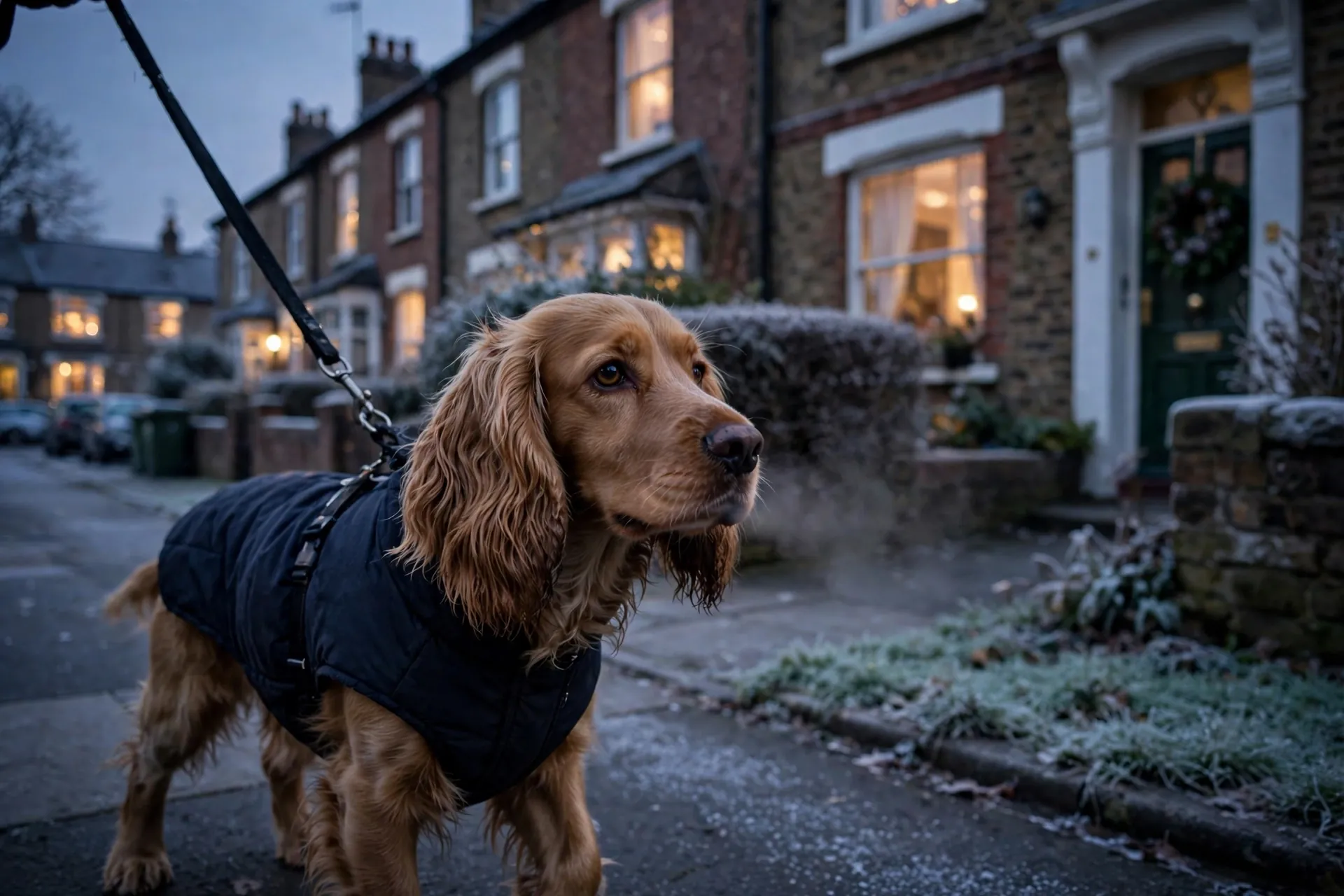
By four o'clock it is already getting dark across most of Britain, so the second walk needs to start in the last of the light. Keep it shorter and closer than the morning walk, finish the toilet break thoroughly, and be home before guests, carol singers and neighbours with trays begin moving between houses. From five onwards, the dog's world should shrink deliberately: quiet room ready, hazards cleared, one named person in charge. The evening section below covers what happens after that. Treat this timetable as a spine, not a script — shift every block an hour earlier if your guests arrive early, and protect the two walks above everything else on the list.
The morning walk that buys a calm evening
The logic of the long morning walk is not simply tiredness. A dog that has explored, sniffed and toileted properly carries a lower level of background restlessness into the afternoon, which means the doorbell, the wrapping paper and the smell of roasting meat register as interest rather than overload. Choose duration over intensity: ninety unhurried minutes on a lead with plenty of sniffing stops will settle most dogs better than twenty frantic minutes of ball throwing, which winds some dogs up rather than down. If your dog is elderly, very young or recovering from anything, scale the walk to what is normal-plus-a-little for that dog, and split it into two outings rather than forcing one expedition.
Pick the route with Christmas Eve specifically in mind. Parks will hold other dogs whose owners have had exactly the same idea, which is fine for social dogs and too much for nervous ones. Avoid routes past pubs filling up at lunchtime, church services spilling out, and retail parks where the traffic behaves unpredictably. Carry water even in December if the walk is long, and a towel for the return, because a dog that comes home clean and dry can settle straight away, while a dog that needs hosing, towelling and fuss arrives back in the house already aroused.
If you are staying away from home — with family, or in festive accommodation — the same principle applies in an unfamiliar place: scout the walk earlier in your stay if you can, and keep to routes you already know rather than exploring on the one morning when time pressure is real. Our guide to dog friendly Christmas stays covers choosing festive accommodation with exactly these routines in mind, including garden access and quiet corners. Wherever you are, the rule is identical: the walk happens before the day accelerates, not in a gap that may never appear.
Food hazards: chocolate, mince pies and the rest of the table
Christmas Eve concentrates more dog-poisoning risks in one kitchen than the rest of the year manages in a month, and most of them arrive disguised as treats. Chocolate is the best known: it contains theobromine, which dogs process slowly, and dark chocolate and cocoa powder are far more concentrated than milk chocolate. Advent calendars left within reach, chocolate coins in stockings hung at dog height, selection boxes under the tree and a box of truffles on a low coffee table are the classic routes in. Move all of it up, behind doors, or into closed cupboards before cooking starts — not after the first near miss.
Mince pies, Christmas pudding and Christmas cake carry a quieter danger: raisins, sultanas and currants, which can cause serious kidney injury in some dogs even in modest amounts, and where the individual sensitivity is unpredictable enough that vets treat any ingestion seriously. The same applies to stollen, panettone and the bowl of mixed dried fruit put out for guests. Add cooked bones from any bird or joint — cooked bone splinters and should never be given, however traditional the image of the dog with a bone may be — plus alcohol left in glasses at floor level, rich fatty scraps that can trigger pancreatitis, onions and garlic in stuffing and gravy, and the skewers, string and foil that make rubbish bags worth raiding.
The practical system is unglamorous and total. One lidded bin, emptied often, ideally outside the kitchen. One rule, explained to every guest including children, that nobody feeds the dog anything at all except the person in charge. Food gifts arrive and go straight to a closed room, not onto the hall floor. Wrapping happens on a table, not the carpet, because Sellotape, ribbon and the silica gel packets from new toys all end up chewed. If the worst happens anyway — you find the empty foil, the missing mince pie, the raided bin — do not wait to see whether the dog seems fine. Phone your vet or the out-of-hours service straight away with the packaging in your hand, because treatment decisions depend on what was eaten, how much, and the dog's weight, and early advice is what keeps a scare from becoming an emergency.
Setting up the quiet room before guests arrive
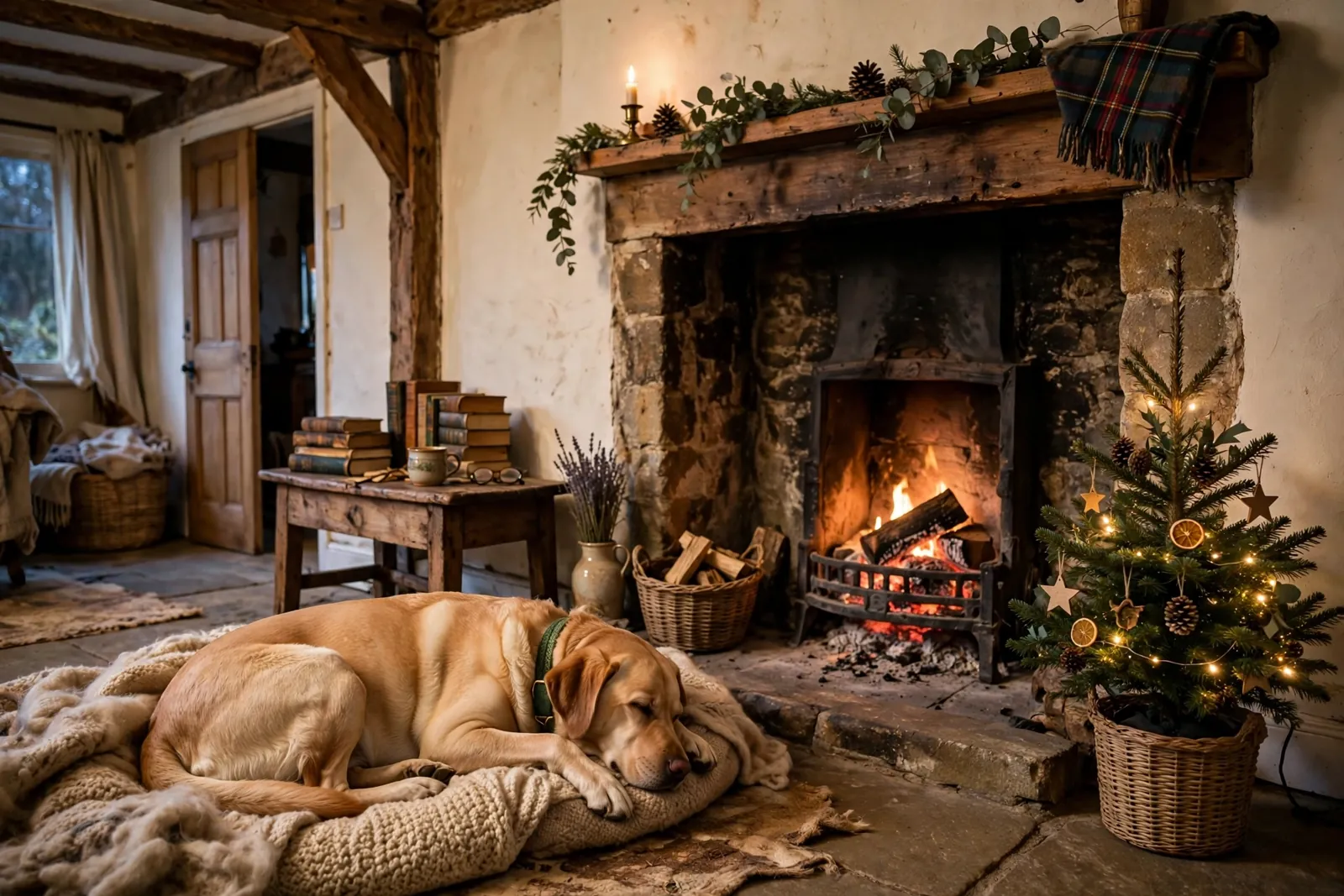
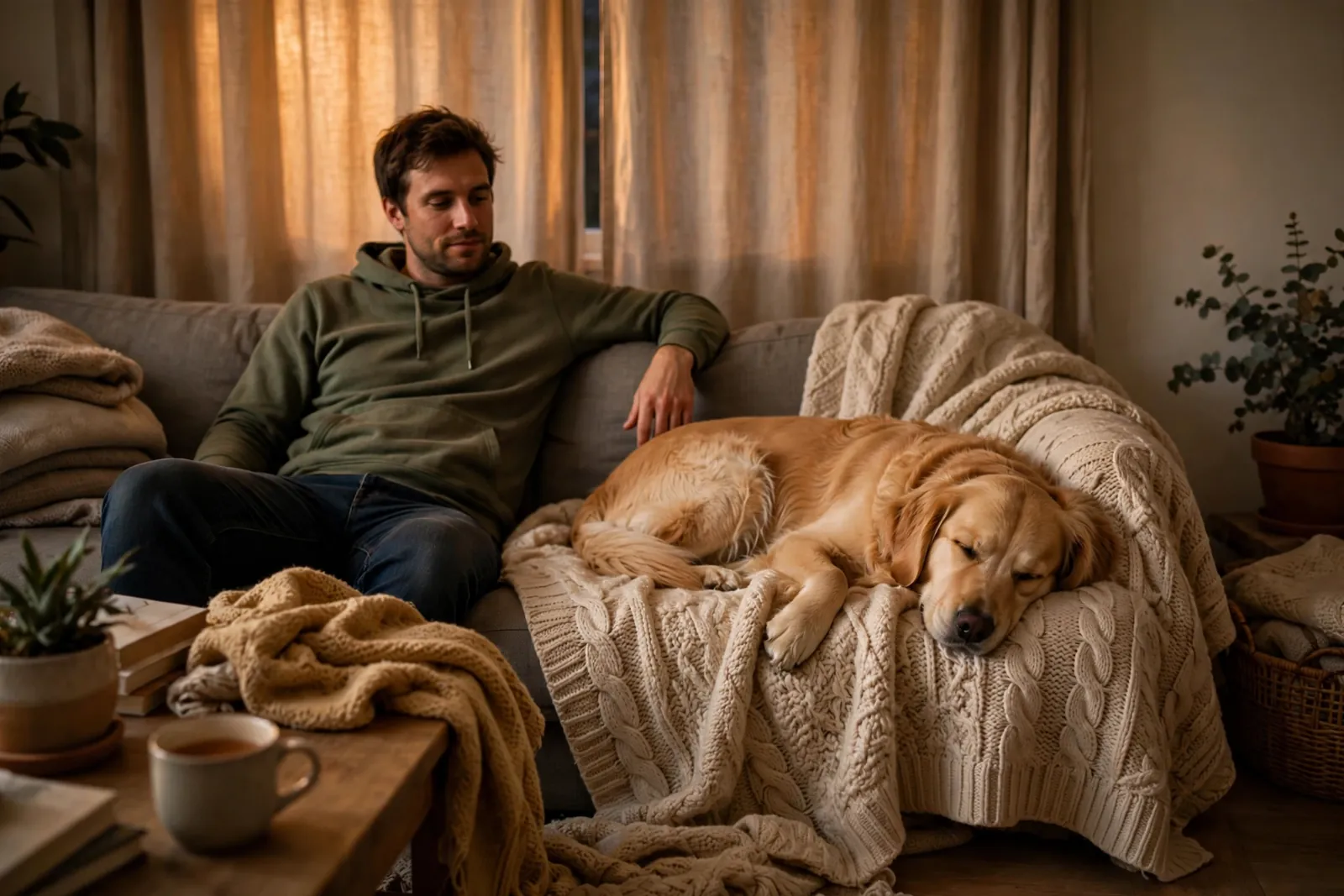
Every dog benefits from one room on Christmas Eve that is not part of the party, and it needs to be ready before the first knock at the door, because a refuge assembled in a panic, with the dog being carried through a crowd to reach it, teaches the dog that the room is where the trouble ends rather than where calm lives. Choose the room the dog already likes — often your bedroom, or a study where the dog naps — rather than the most convenient empty space. Put the usual bed or crate there with bedding that smells of ordinary days, a water bowl, one durable chew and one familiar soft toy. A radio or television left on at low volume with ordinary voices masks doorbells and bursts of laughter better than silence does.
Test the room in the afternoon. Settle the dog there with a chew while you are still moving around the house, go in and out a few times without ceremony, and let the dog choose to stay. If your dog normally objects to closed doors, use a baby gate or leave the door ajar with the room clearly out of the guest route; the point is separation from the noise and the food, not isolation. Put a small sign or simply tell guests plainly: that room is the dog's, nobody visits uninvited, and children especially do not follow the dog in there. A dog that retreats is communicating, and the retreat only works if it is respected.
Temperature and air matter more than people expect. A room next to a kitchen running ovens all day can become uncomfortably warm, and a dog shut in with a roaring fire or a radiator on full will pant and fret for reasons that look like anxiety. Check the room at teatime as if you were the one sleeping there. Also remove the hazards you just cleared from the rest of the house: handbags containing chocolate or medication, coats with treats in the pockets, and gift bags waiting to be wrapped all migrate into spare rooms at Christmas, so sweep the quiet room last, after the migration has finished.
Guests, doors and the escaping-dog problem
Christmas Eve is statistically a door-heavy evening: arrivals with armfuls of presents, departures for church or the pub, neighbours popping in, takeaway or taxi drivers at the step. Every opening of the front door is an opportunity for a dog — especially a young, sociable or startled one — to be in the street, in the dark, among cars whose drivers are thinking about other things. The fix is architectural, not disciplinary. Keep the dog behind a closed door, gate or lead held by a named person whenever the front door is open, and make that arrangement automatic rather than negotiated each time the bell rings.
Greetings deserve a plan of their own. Many dogs who are perfectly civilised on a normal Tuesday become leaping, barking greeters when six excited people arrive at once wearing rustling coats and smelling of other houses. Let guests come in, take coats off and settle for ten minutes before any introduction, and then bring the dog in on a lead to say hello briefly before returning to the quiet room or a settle mat. Visitors who are nervous of dogs, and visitors who adore dogs and will feed them from the table, both need the same sentence delivered kindly and early: the dog has its own room and its own dinner, and that is how the evening works. If you are the guest rather than the host, our wider festive guidance in the Christmas stays guide covers raising these arrangements with hosts before you arrive, which is always easier than improvising them on the doorstep.
Check identification while you are thinking about doors. A collar tag with a current mobile number is the fastest route home for a dog found by a neighbour, and microchip details only work if the registered phone number still reaches you. Do the check on Christmas Eve morning, not after an escape. Keep a torch by the door and the lead on a hook rather than in a drawer, because if a dog does slip out, the first three minutes are spent by people who are calm and equipped, and a household that knows where its torch is has a head start.
Evening and emergency vet cover on Christmas Eve
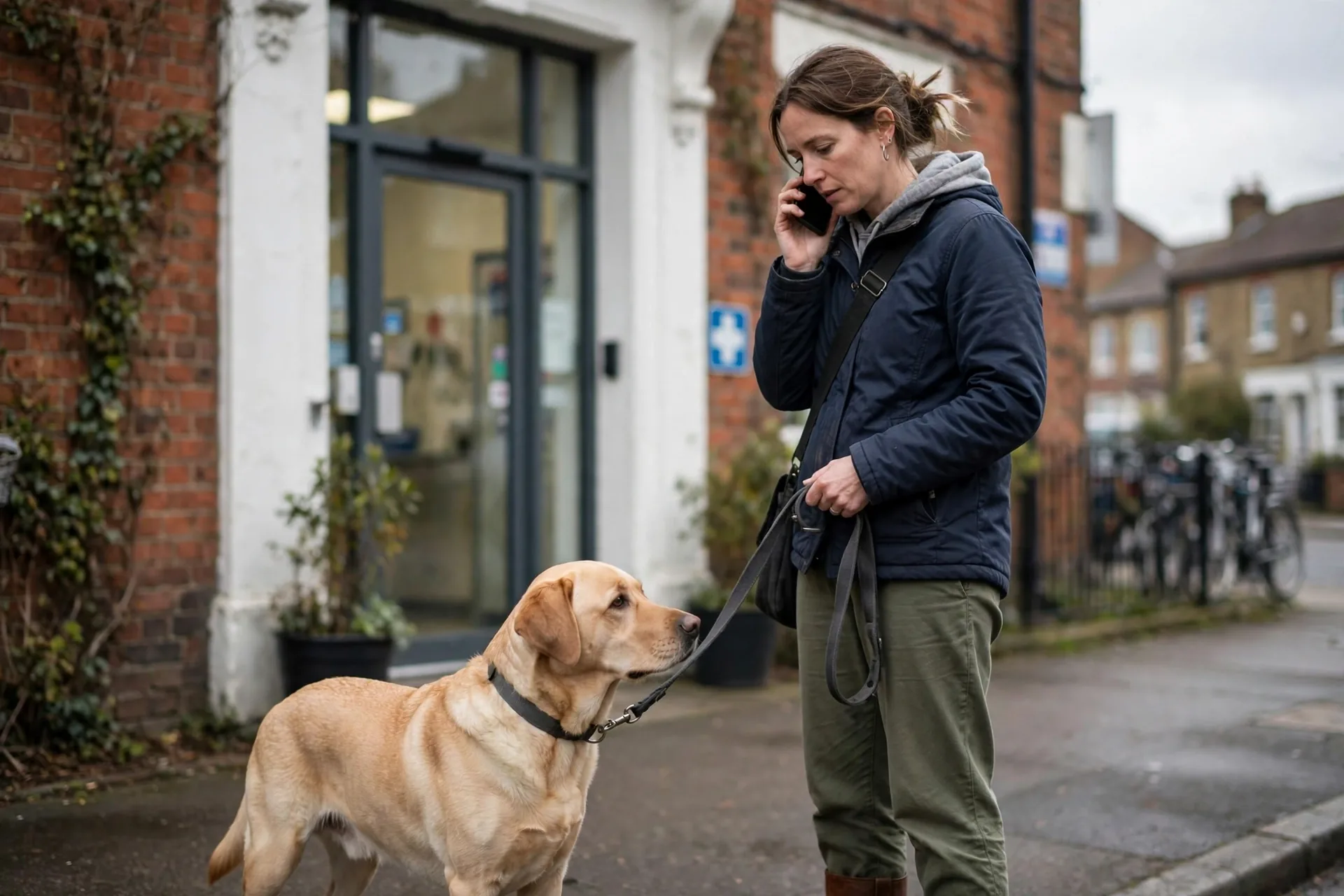
Here is the fact that catches people out every year: most veterinary practices close early on Christmas Eve, many by mid-afternoon, and calls after that are diverted to an out-of-hours provider who may be in a different town, working from a different building, with no access to your dog's history beyond what you can tell them. None of that is a criticism of the system — it is how emergency cover works across the holidays — but it means the time to learn your arrangements is the morning of 24 December, not at ten o'clock at night with a dog that has eaten a fruit cake. Check your own practice's festive hours and its recorded out-of-hours number, and save both numbers in your phone under a name you will find while flustered.
Hosts and visitors both need this done. If you are staying with family, your home practice's out-of-hours service is no use three counties away; look up the emergency arrangement local to the address where the dog will actually be sleeping, and note the postcode of the building as well as the number, because directions matter at midnight. Our guide to finding an emergency vet on holiday walks through how out-of-hours cover is organised, what information to have ready and how costs and insurance typically work, and it is worth reading before any festive stay away from home.
Know also what genuinely counts as urgent tonight. Chocolate, dried fruit, alcohol or bone ingestion, repeated vomiting, a swollen or painful abdomen, difficulty breathing, collapse, seizures, uncontrolled bleeding and a dog that cannot urinate or is straining in pain all justify an immediate call, even on Christmas Eve — phones are staffed precisely for this. Minor matters, a single loose stool in an otherwise bright dog, can usually wait for advice lines rather than a journey. When you call, say what was eaten or what happened, when, the dog's breed, weight and age, and any medication or known conditions. Do not induce vomiting unless a vet tells you to, and take packaging, wrappers or a photo of the remains with you if you are asked to go in. Finally, keep the car usable: fuel in it, the dog's blanket and lead in it, and at least one adult in the house who has not been drinking and can drive. That last detail is arranged at lunchtime, with a nod, and it is one of the kindest bits of planning on this page.
The evening itself: settling, supper and the last garden break
Feed the dog its ordinary dinner at its ordinary time, in or near the quiet room, away from the dining table. Festive generosity at the table — a slice of turkey here, a pig in a blanket there, six people each assuming they are the only one — is how dogs end Christmas Day at the vet with pancreatitis instead of at home with a mild grumble. If the household wants the dog to share something, decide on one small, plain, dog-safe portion in advance, put it in the dog's own bowl, and let that be the whole of it. Carrots, a little plain cooked turkey meat without skin or bone, and a spoonful of plain vegetables are the usual sensible candidates; gravy, stuffing, sauces and anything cooked with onion are not.
Structure the evening in blocks the dog can predict. A settle in the quiet room while guests arrive and drinks happen. A brief, calm appearance on a lead if the dog enjoys company and the company enjoys the dog. A garden toilet break on the lead — even in your own garden, because fireworks are not unknown on Christmas Eve, and a startled dog can clear a fence it has ignored all year — and then back to the quiet room with a fresh chew for the noisiest part of the night. Check in every hour or so without turning each check into a reunion; a quiet word, a water top-up and a door closed again is the rhythm you are after.
Late evening is when tired households make sloppy decisions, so decide the end of the night now. When the last guest leaves, the dog gets a final garden break on the lead, the front door stays shut until the dog is settled, and all food — every plate, board and bin bag — is cleared into the closed kitchen before anyone goes to bed. The number of Christmas night emergencies that begin with a dog alone in a kitchen full of cooling leftovers at two in the morning is not small. Ten minutes of clearing is the cheapest insurance of the whole day.
Waking up on Boxing Day without a backlog
A good Christmas Eve ends with a Boxing Day morning that needs no apology and no vet visit, and mostly that outcome is already decided by the choices above. Still, run three quick checks before the day gets going. Appetite: a dog that refuses breakfast after a day of excitement may simply be tired, but a dog that refuses food and is quiet, drooling, vomiting or guarding its belly needs a call to the vet, who will be running an emergency service on Boxing Day too. Stools: festive stress loosens many dogs for a day; blood, black stools or repeated straining do not belong in the wait-and-see category. Energy: most dogs are gloriously tired on Boxing Day morning, which is normal — a dog that cannot be roused properly is not tired, it is unwell, and that distinction justifies a phone call every time.
Then give the dog the day it actually wants, which is a long, unhurried walk in the quietest part of the morning, ordinary food, and a house that has lowered its voice. Boxing Day walks are a British institution and the popular routes will be busy by eleven, so go early, keep reactive dogs on leads around unknown groups, and be thoughtful about the debris of the night before: party poppers, broken glass near pubs, discarded food and the occasional dropped chocolate all line the festive pavements. A muzzle-trained scavenger may genuinely be happier wearing the muzzle for this one walk.
Finally, debrief yourself while it is fresh. What worked about the quiet room, which guest needed reminding, whether the morning walk was long enough — write it on the calendar for next year, because Christmas Eve will ask exactly the same questions again, and the household that answers them from notes rather than memory has a calmer dog and a calmer cook. The whole day, done well, is unremarkable from the dog's point of view, and unremarkable is the highest praise a Christmas Eve can earn.
Practical questions
Before you go
What time should I walk my dog on Christmas Eve?
Walk long in the morning — ideally a proper outing of an hour or more finishing by late morning — and again in the last of the daylight, around mid-afternoon in most of Britain, before guests arrive. After dark, keep outings to short lead walks or garden breaks, because doors, visitors and occasional fireworks make evenings unpredictable.
Which Christmas foods are most dangerous for dogs?
Chocolate, raisins and sultanas in mince pies, pudding and cake, cooked bones, alcohol, onions and garlic in stuffing and gravy, and rich fatty scraps are the main hazards. Keep them out of reach, brief guests not to feed the dog, and phone your vet or the out-of-hours service immediately if any of them are eaten.
What should I do if my dog eats chocolate on Christmas Eve?
Phone your vet straight away, or the out-of-hours number if the practice has closed — do not wait for symptoms. Have the packaging ready so you can say the type of chocolate, roughly how much was eaten, when it happened and your dog's weight. Do not make the dog vomit unless a vet instructs you to.
How do I keep my dog calm when guests arrive on Christmas Eve?
Set up a quiet room in advance with the dog's own bed, water and a chew, settle the dog there before the first arrival, and keep the dog behind a door or gate whenever the front door opens. Let greetings happen later, briefly and on a lead, once guests have coats off and voices down.
Is my usual vet open on Christmas Eve evening?
Most practices close early on 24 December and transfer cover to an out-of-hours provider, which may be based elsewhere. Check your practice's festive hours in the morning, save the out-of-hours number, and if you are staying away from home, find the emergency arrangement local to where the dog is sleeping. Check the official latest guidance before you travel.