This guide is independent and contains no paid placement. If affiliate links are added later, they will be clearly marked and will not change our editorial checks.
Do not pick the destination first. If your dog startles at traffic, fixates on strangers or needs a long time to settle after a surprise, a quiet countryside base or a small, green-edged city suits them best. If your dog explodes with excitement at open fields, livestock, cyclists and off-lead dogs, a city with predictable pavements, short loops and cafe rests may actually be calmer. Test first, book second.
The five-minute personality test
Most city-versus-countryside advice starts with the wrong question. It asks what the humans want to look at, then tries to fit the dog around it. Turn the order around. A break is only as good as the dog's worst hour on it, and that worst hour is almost always caused by one specific trigger, not by a whole landscape. Find the trigger, and the destination almost chooses itself.
Think of dogs as falling, for holiday purposes, into two broad tendencies. A city-sensitive dog is overloaded by density: traffic noise, buses braking, crowds pressing close on narrow pavements, strangers reaching out to touch, sudden sirens, and the feeling that there is nowhere to step aside. A countryside-excitable dog is overloaded by freedom: a field full of smells, a rabbit breaking cover, sheep behind a thin fence, a cyclist appearing silently on a bridleway, or another dog racing over a hill with no owner in sight. Both dogs can be perfectly well behaved at home. Both can have a miserable holiday in the wrong setting. The labels are about what overwhelms them, not about whether they are good dogs.
You do not need a professional assessment to tell them apart. You need two honest day tests, done close to home before you spend anything. First, take a busy high-street walk: pavements, a bus stop, a shop doorway, then twenty minutes sitting outside a cafe while people pass. Second, take an open walk with distance triggers: a field path, livestock visible but fenced, other dogs at a distance, and a stretch where your dog can be on a long line rather than a short lead. In each test, watch one thing above all: recovery time. How long after the surprise does your dog return to loose-lead walking, soft body language and interest in a treat? A dog that startles and recovers in ten seconds is coping. A dog that stays tense, scanning, pulling or panting for ten minutes after the trigger has passed is telling you something important, even if nothing dramatic happened.
Score each test with five simple observations. First, threshold: how close did the trigger get before your dog reacted? Second, intensity: was it a glance, a freeze, a bark, a lunge, or a full loss of focus? Third, recovery: seconds, minutes, or the rest of the walk? Fourth, settling: could the dog lie down and relax at the cafe or in the car afterwards, or did the arousal stay switched on? Fifth, the next morning: did the dog wake up keen and loose, or still edgy from yesterday? Write the answers down. Memory softens difficult walks within a week, and booking decisions made on softened memory are how families end up in a city centre with a dog that has not slept properly since Friday.
Age, breed tendencies and history all feed into this, but none of them decides it alone. A young spaniel may be countryside-excitable at eighteen months and a calm city companion at five. A rescue greyhound may be famously lazy indoors yet deeply city-sensitive outdoors because traffic was never part of its early life. An older terrier may cope beautifully with a busy market because it has done it for years, yet fall apart at the sight of sheep because it never learned to ignore them. Treat breed guides as background and your own two tests as evidence. If a result surprises you, trust the test: it is the closest thing you have to a preview of the holiday itself.
There is one more question worth asking before you move on, and it concerns the humans, not the dog. Who in the group will handle the dog when the plan gets hard? A city break needs someone willing to cut a museum visit short, wait outside a shop, or walk the long way around a crowd. A countryside break needs someone willing to shorten a ridge walk, turn back from a field of sheep, or keep a dog on lead when everyone else wants to let theirs run. If nobody wants that job, no destination will fix it. If someone does, say so out loud now, because that person is the real reason the trip works.
The city-sensitive dog
The city-sensitive dog is usually easy to live with and hard to holiday with in a crowd. At home this dog may be affectionate, quiet and well trained. On a busy street, the same dog scans constantly, walks with a high head and tight lead, startles at a bus air brake, and cannot settle at a table because every passer-by is a decision to make. Nothing has gone wrong in a dramatic sense. The dog is simply processing too much, too fast, with no off switch, and by evening it is exhausted in the way that makes the next day worse rather than better.
City sensitivity has several distinct flavours, and it helps to know which one yours has. Noise-sensitive dogs react to sirens, roadworks, bus engines and sudden bangs; they may cope with people perfectly well but fall apart near a main road. Crowd-sensitive dogs react to density and proximity: narrow pavements, queues, markets and stations where strangers brush past. Touch-sensitive dogs cope with all of that until a stranger reaches for their head, at which point they duck, snap the air or retreat behind their owner. Motion-sensitive dogs fixate on cyclists, runners, skateboards and scooters, the fast-moving things that a city throws at a dog every few seconds. Most city-sensitive dogs have one dominant flavour and one secondary one. Name both, because they decide which cities are possible and which streets to avoid inside them.
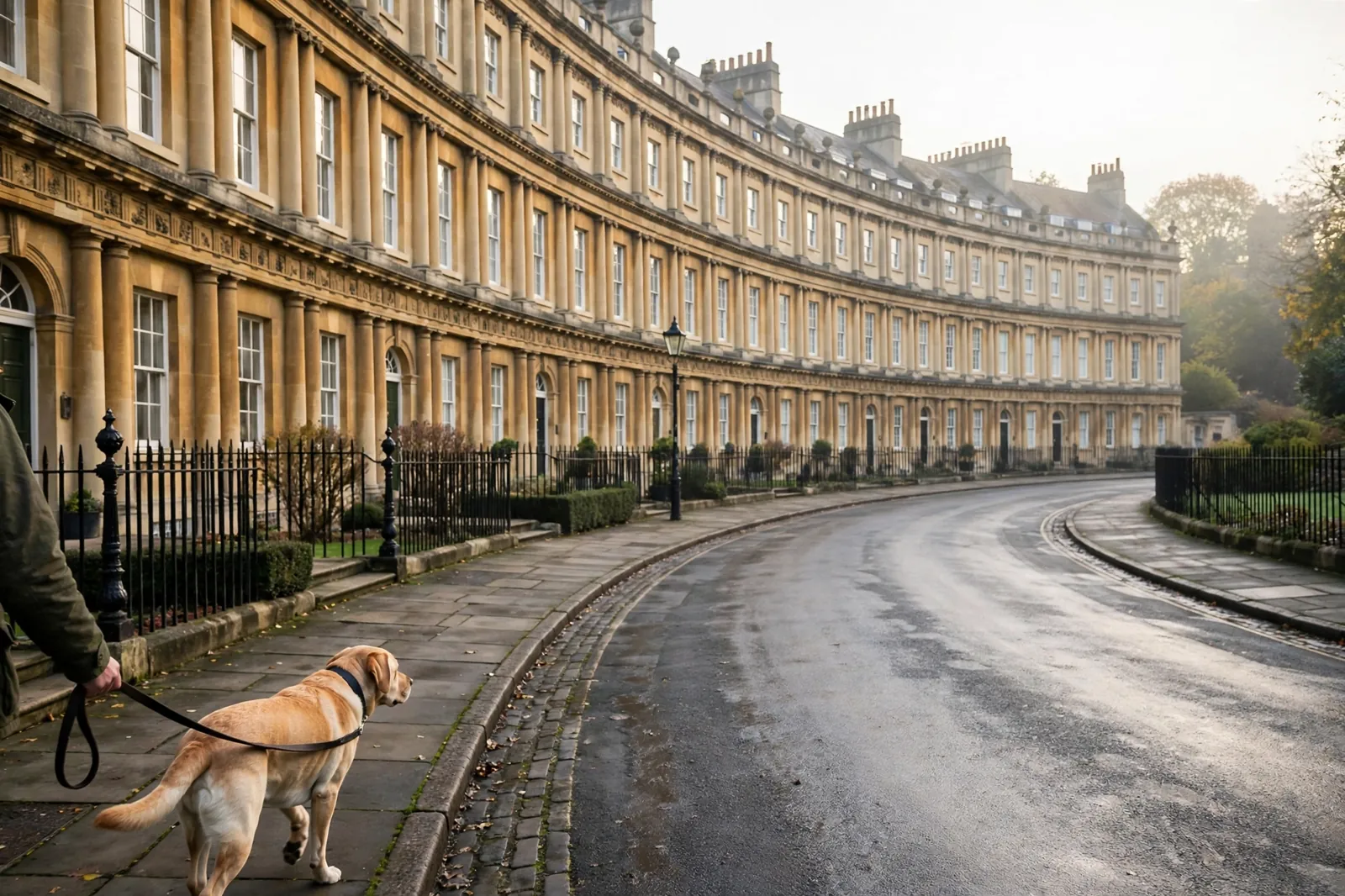
For this dog, the best city is rarely the biggest one. A compact, walkable city with a river path, a large park and quiet residential streets beats a capital city with a famous centre every time. Think of the shape of the place rather than its name: can you walk from your accommodation to a green space without crossing a major road? Can you reach a cafe with outdoor space that is set back from the pavement rather than perched on it? Is there a residential loop where the dog can toilet, sniff and decompress before the day's outing begins? Bath is a useful example of this shape, with Georgian streets that are busy in pockets but calmer a few streets away, and skyline walks that let a dog decompress above the city rather than inside it. Our Bath with a dog guide shows how a city break can be built around quiet streets and green edges rather than a single crowded centre.
The daily rhythm matters more than the itinerary for a city-sensitive dog. Walk early, before the delivery vans and school run peak, and walk late, after the evening crowd thins. Use the middle of the day for a long cafe rest, a nap back at the base, or a slow park loop where the dog can move at sniffing pace. Avoid the three classic overload points: rush-hour stations, covered markets at lunchtime, and any pavement where the dog cannot step aside because of railings, roadworks or a queue. When you must pass through a busy stretch, keep it short, keep moving, and reward the dog on the other side rather than asking it to sit and pose in the middle of it. A city-sensitive dog does not need to see everything. It needs to see a little, recover, and then see a little more.
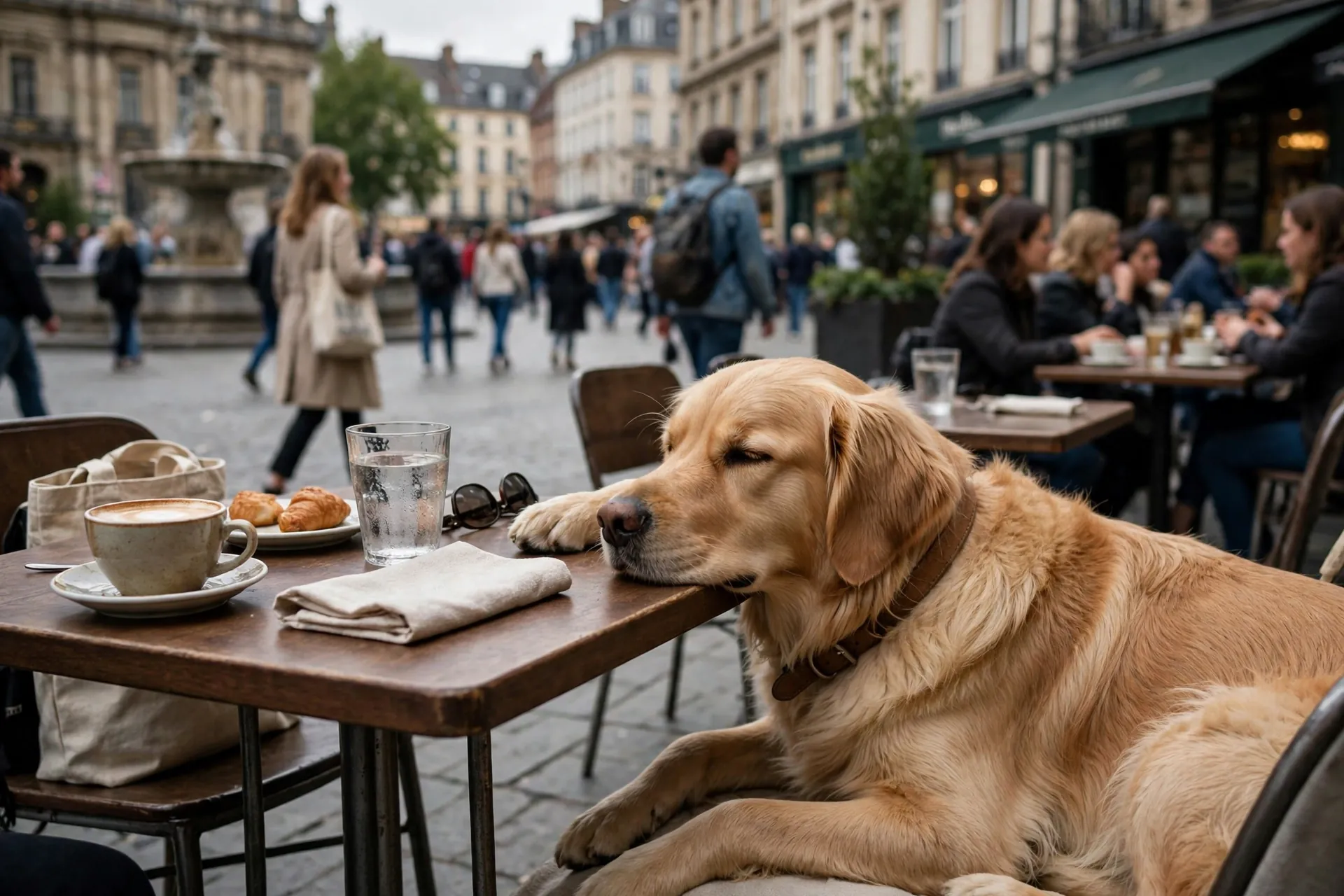
Settling is the skill to practise before you go, because it is the skill the whole trip depends on. A dog that can lie on a mat in a cafe for twenty minutes while life passes by will enjoy a city. A dog that cannot will spend the trip rehearsing frustration, and no amount of sightseeing compensates for that. Practise in stages: first a quiet cafe at an off-peak hour, then a busier one, then a table near a pavement rather than tucked inside. Bring the dog's own mat, a long-lasting chew for the table, and water. If the dog cannot settle after twenty minutes, leave gracefully and try again tomorrow rather than pushing through; the goal is a dog that learns cafes mean rest, not a dog that endures them.
There is a kinder truth here too. Many city-sensitive dogs are wonderful countryside dogs, but not automatically. A dog that hates traffic may still chase sheep, and a dog that hates crowds may still panic at a loose dog racing towards it across a field. City sensitivity points you away from density, but it does not remove the need for the countryside test. Run both tests, even when the first one already feels decisive.
The countryside-excitable dog
The countryside-excitable dog is the mirror image. In a city this dog may walk beautifully: pavements give structure, the lead stays short, smells arrive one at a time, and there is always a kerb, a wall or a shop doorway to create a boundary. Take the same dog to an open hillside and it transforms. The lead goes tight, the nose goes up, the body goes forward, and every new smell is an invitation that the dog cannot decline. Owners often describe this dog as loving the countryside, and the dog certainly looks thrilled. Thrilled and coping are not the same thing, and a dog that spends three hours in a state of high arousal will often come home wired, sleepless and harder to live with the next day.
Excitability in the countryside usually comes from prey drive, social excitement, or both. Prey-driven dogs fixate on rabbits, pheasants, deer and sheep; the trigger is movement at a distance, and the dog's whole body commits before the owner has time to react. Socially excitable dogs fixate on other dogs, especially off-lead dogs that appear suddenly over a rise; the trigger is not aggression but greeting at full speed, which is frightening for the other dog and dangerous near roads, cliffs or livestock. Some dogs have a third flavour: sound excitement, where a distant gunshot, a quad bike or a farm dog barking sets off a chain of arousal that lasts long after the sound stops. Knowing which flavour yours has changes the walk you choose: prey-driven dogs need enclosed, sightline-short routes; socially excitable dogs need wide, open routes where other dogs are visible early; sound-sensitive dogs need routes away from shooting estates in season.
For this dog, the countryside is not automatically the answer, and the city is not automatically the punishment. A structured city, with its pavements, short loops, cafe stops and clear rules, can be deeply calming for a dog that falls apart in open space. The dog gets novelty in small, manageable doses: a new street, a new park, a new cafe, each followed by rest. There is no field of sheep to fixate on, no rabbit warren to guard, and no off-lead dog appearing from nowhere. Many owners are surprised to discover that their wild countryside dog is a model city dog, and that surprise is worth testing rather than assuming away.
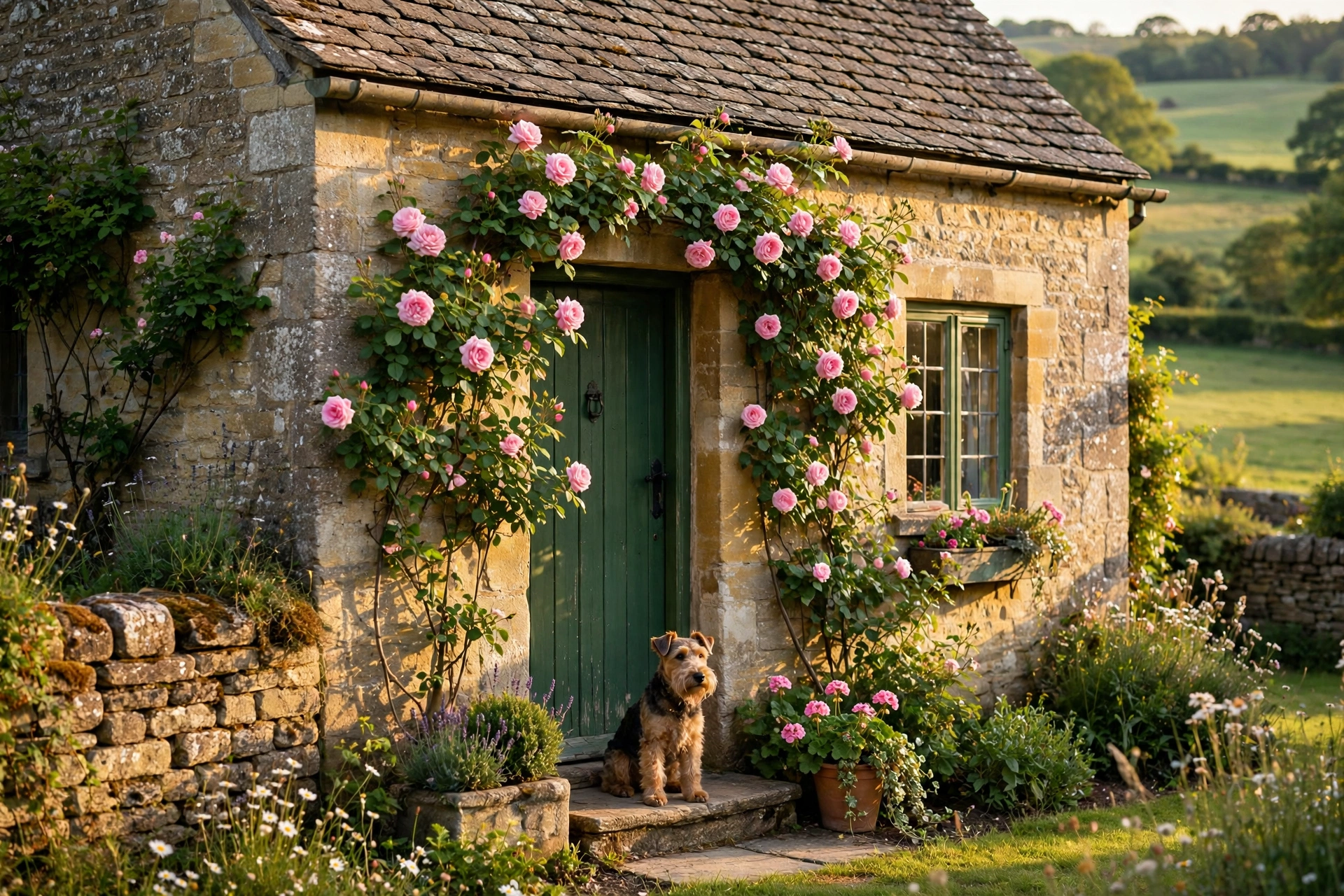
If you do take a countryside-excitable dog to the countryside, choose the landscape the way you would choose a training ground. Favour enclosed woods with clear paths over open moorland, walled lanes over unfenced hills, and waymarked trails where other dogs are visible from a distance over narrow tracks with blind corners. A long line is the single most useful tool here: it gives the dog room to sniff and move while keeping you in control near livestock, roads and cliff edges. Practise long-line handling before the trip, because a tangled line around a stile is nobody's idea of a holiday, and a dog that has never walked on one will spend the first day learning the equipment instead of enjoying the walk.
Livestock deserves its own paragraph, because it is where countryside holidays most often go seriously wrong. Keep dogs on a short lead near sheep, cattle and horses, even if your dog has never shown interest before, and even if the field looks empty; sheep can be behind a hedge and cattle can move quickly when startled. If cattle approach and you feel threatened, the official advice in England and Wales has long been to release the dog and move to safety, because a dog that can run away is safer than a person trapped between a dog and a herd; check the official guidance before you travel for the current wording, since advice can change. Never let a dog chase livestock, and never assume that a friendly farm dog means your dog is welcome off lead. Farmers have the right to protect their animals, and a single incident can end a holiday and damage a dog's future welcome in the area.
Finally, watch the evening. Countryside-excitable dogs often look fine during the walk and fall apart afterwards: pacing at the cottage door, whining at every sound outside, unable to settle because the day's arousal never fully switched off. Build a decompression routine into the evening: a short, boring toilet walk on lead, a chew or a lick mat, a familiar bed in a quiet corner, and no further excitement after supper. A dog that can switch off in the evening is a dog that can enjoy the next day's walk. A dog that cannot is telling you the walks were too much, however beautiful they were.
Dogs who do not fit either box
Many dogs refuse to fit neatly into either category, and that is normal rather than a failure of the test. Some dogs are city-sensitive on a Saturday and perfectly calm on a Tuesday, because the trigger is density rather than the city itself. Some are countryside-excitable only in spring, when young livestock, nesting birds and long daylight hours stack together, and calm by autumn. Some are fine with everything except one specific thing: a particular breed of dog, a particular sound, or a particular surface such as a metal bridge or a busy station floor. A single strong trigger does not make a dog a category; it makes that trigger a planning constraint, and planning constraints are much easier to design around than whole temperaments.
Older dogs form a large part of this middle group. An older dog may be less excitable than it once was, but also less resilient: it copes with a city morning and then needs a long afternoon sleep, or it enjoys a countryside walk but cannot manage the distance it once could. For older dogs, the deciding factor is rarely temperament at all. It is access: level walks, short distances to a toilet spot, somewhere to rest that is not a long drive away, and accommodation without steep steps. A city with a flat riverside loop can beat a hilly countryside cottage for an older dog, even if that dog has always been a country dog in its heart.
Puppies are another middle group, and the honest answer for puppies is to keep the trip short whatever you choose. A puppy's world is still expanding, and every new experience costs energy. A weekend is plenty. A quiet base with a garden, one anchor outing a day, frequent toilet breaks and long naps will teach a puppy more about travelling well than a packed itinerary ever will. If you take a puppy to a city, choose off-peak hours and a base near a park. If you take a puppy to the countryside, choose a garden and short, enclosed walks over a long trail. In both cases, the trip is training, and training works best in small doses.
Multi-dog households add a further layer, because two dogs rarely share a temperament. One may be city-sensitive while the other is countryside-excitable, and the trip has to work for the more vulnerable dog on each day, not for the average of the two. Sometimes the answer is to split the group for part of a day: one adult takes the excitable dog to an enclosed field while the other takes the sensitive dog on a quiet loop, then everyone meets for a cafe lunch. Sometimes the answer is a hybrid base where both dogs get their best walk on alternate days. What does not work is choosing the trip that suits one dog and hoping the other one copes. Dogs do not cope by hope; they cope by design.
If your dog genuinely sits in the middle, with moderate reactions in both tests and quick recovery in both, congratulations: you have the easiest decision in this guide. Choose the trip the humans most want, keep the days moderate, and keep one escape route in reserve. A middle dog still benefits from early walks, cafe rests and a decompression evening, but it will not punish you for a slightly ambitious day. Book the trip you want, and spend the planning energy on the base, the walks and the weather instead.
What a good city day actually looks like
A good city day with a dog is shaped like a wave: a peak of activity, a long trough of rest, and a smaller peak later. It starts early, with a toilet walk and a sniffing loop in a park or along a river before the city wakes up properly. Breakfast follows at a cafe with outdoor space, ideally one where the dog can lie on its mat rather than sit under a table in a crush. The main outing of the day comes next, and it is one thing, not three: a riverside walk, a park, a quiet neighbourhood, or a single attraction that genuinely welcomes dogs, with the rest of the group splitting if the attraction does not.
The middle of the day belongs to rest. This is the part most city itineraries get wrong, because it feels like wasted sightseeing time. It is not wasted. A dog that naps for two hours in the middle of the day will enjoy the evening; a dog dragged through four more hours of pavements will not, and neither will its owner by the end of it. Use the rest period properly: back at the base, in a quiet corner of a large park, or at a calm cafe where the dog has already learned to settle. If the group wants to do something the dog cannot join, this is the moment to split, with one adult staying with the dog or the dog resting at the base if, and only if, it genuinely settles alone there.
The evening peak is smaller and slower: a second park loop, a stroll through a quieter neighbourhood, supper at a dog-friendly restaurant or pub garden, and a final toilet walk before bed. Choose the evening route for calm, not for novelty. The dog has already had its new experiences for the day; what it needs now is familiarity, a chance to toilet without pressure, and a predictable path back to bed. Avoid the temptation to fit in one more famous street after supper. Famous streets are at their most crowded in the early evening, and a tired dog in a crowd is a dog rehearsing the exact behaviours you spent the day avoiding.
Transport inside a city deserves planning of its own. Buses, trams and trains each have their own rules for dogs, and those rules vary by operator; check the official guidance before you travel rather than assuming a dog that rides one city's buses can ride another's. In general, favour walking and short taxi rides over complex interchanges, and avoid underground trains at rush hour with a dog that is already near its limit. If you must use public transport, travel off peak, choose a quiet carriage or section, keep the dog close and settled, and have a walking alternative ready if the first attempt is too much. A city break that depends on a single stressful journey each day is a fragile plan; a city break with walking alternatives is a resilient one.
Cafes and restaurants are not a footnote in a city break; they are half the trip, because they are where the dog spends the most time being still. Learn the difference between places that tolerate dogs and places that welcome them. A welcoming place has water bowls without being asked, space between tables, staff who greet the dog calmly rather than fussing over it, and a floor the dog can lie on without blocking a walkway. A tolerating place has a dog on the terrace in the rain and a sigh when you ask for water. Our guide to dog-friendly cafes in the UK explains how to tell the two apart before you sit down, and it is worth reading before you choose where to eat. The best city cafes for dogs are rarely the most famous ones; they are the quiet neighbourhood ones a few streets from the centre, and finding them is part of the pleasure.
What a good countryside day actually looks like
A good countryside day is shaped differently: a slow start, one substantial walk, and a long, lazy afternoon. It starts with a garden toilet break and breakfast without urgency, because there is no city to beat to the crowds. The main walk comes in the late morning, when the light is good and the dog is awake but not yet over-aroused. Choose one walk and do it well, rather than stringing three walks together into a route that nobody enjoys by the end. A walk of sixty to ninety minutes, with sniffing time built in, suits most dogs better than a forced march of three hours, and it leaves the afternoon free for the part of a countryside break that cities cannot offer: doing very little, very pleasantly.
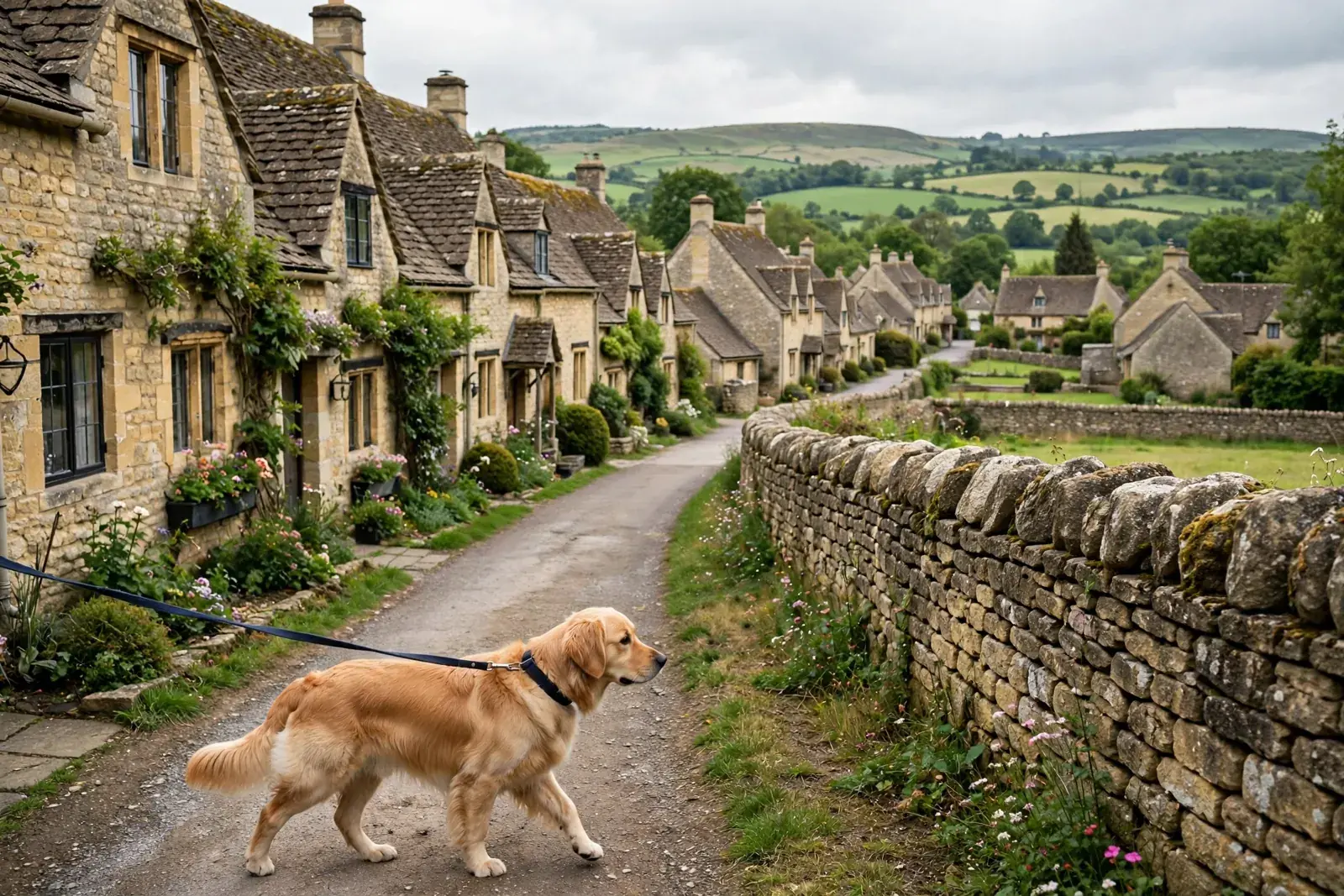
The walk itself needs more planning than a city stroll, because the countryside does not come with signposts for dog owners. Check the route for livestock, for sections where dogs must be on lead, for stiles that a small or older dog cannot manage, and for any seasonal restrictions such as lambing, nesting birds or shooting. Look for a route with an escape point halfway: a lane back to the village, a car park, or a pub where you can stop if the weather turns or the dog tires. The Cotswolds offer a good model here, with village-to-village walks, commons where the rules are visible, and pubs that expect muddy dogs; our Cotswolds dog guide shows how village walks, livestock awareness and pub stops fit together into a day that works for the dog rather than just for the walker.
Water and weather shape a countryside walk more than distance does. Carry water for the dog even on a cool day, because streams are not always safe to drink from and a dog that has run hard needs to drink before it gets home. In summer, walk early or late and watch for heat on exposed hillsides; in winter, watch for ice on stiles, flooded paths and short daylight that turns a pleasant walk into a dark walk home. After rain, clay paths and riverside meadows can be deep in mud, which matters for paws, for a car boot, and for a dog that hates being cleaned. Pack a drying coat, two towels and a boot liner, and treat the post-walk routine as part of the walk, not as an afterthought.
The afternoon is the countryside's gift, and it is worth protecting. A dog that has walked well in the morning does not need a second big walk in the afternoon; it needs a garden, a sunny spot, a chew, and the company of its people doing quiet things. This is also when a countryside break pays off for the humans: reading, cooking, a village pub, a garden, a view that does not need to be earned by walking to it. If the group wants a second outing, make it a short, boring one: a village loop, a visit to a farm shop, a drive to a viewpoint where the dog can stay on lead and look. The dogs that struggle most in the countryside are rarely the ones that walked too little; they are the ones that never got to switch off.
Evenings in the countryside are quieter than city evenings, and that quiet is part of the treatment for an excitable dog. A short toilet walk at dusk, supper, a settle routine, and an early night suit most dogs well. Be aware of the sounds that carry in the countryside at night: farm machinery, a distant dog barking, owls, or fireworks from a village event. A dog that is sound-sensitive may need a familiar bed in an inner room rather than a draughty porch, and a radio or white noise at low volume can mask sudden rural sounds. If your dog is noise-sensitive in a specific way, ask the host about nearby events, shooting days and farm activity before you book, not after you arrive.
Travel and arrival, by temperament
The journey to the break is the first test of the trip, and it is often the one that sets the tone for everything after it. A city-sensitive dog that has endured a stressful train journey with station crowds, escalators and a packed carriage will arrive in the city already over its limit. A countryside-excitable dog that has spent two hours in a car watching fields flash past the window may arrive at the cottage already aroused and ready to explode into the garden. Plan the journey for the dog's temperament, not just for the humans' convenience, and the arrival will be easier for everyone.
For most dogs, a car journey is the most controllable option, because you control the stops, the temperature, the noise and the timing. Plan a stop every two hours at most, in a quiet place where the dog can toilet, drink and sniff without meeting a stream of other dogs. A motorway service area at peak time is a poor stop for a city-sensitive dog; a village layby or a quiet country lane is better, provided it is safe to park. Keep the car cool, keep the dog secure with a guard, crate or harness, and never leave a dog alone in a car on a warm day, even briefly. If the journey is long, consider breaking it with an overnight stop rather than pushing through, because a tired, stressed dog arriving late at night is a dog that will not settle, whatever the destination.
Train journeys need more homework. Dogs travel free or cheaply on most British trains, but the experience varies enormously by route, time of day and station. A quiet rural branch line with a window seat is a different experience from a crowded commuter train into a major terminus, and a dog that copes with one may not cope with the other. Travel off peak, choose a direct service over one with a tight connection, sit near a door if the dog needs space, and bring a mat, water and something to chew. If the dog has never travelled by train, practise with a short local journey first; a first train journey should not also be the first day of a holiday. Check the official guidance before you travel for the rules of the specific operator, since assistance dogs and pet dogs are treated differently and some services have their own conditions.
Arrival itself should be deliberately boring, whatever the destination. Give the dog a toilet break first, then a slow sniff around the immediate area: the garden, the street outside, the path to the park. Let the dog learn the smells of the base before you ask it to learn a whole city or a whole hillside. Unpack the dog's things first: bed, bowls, mat, familiar toy, and any medication. Keep the first evening close to the home routine for feeding, walking and bedtime. A boring arrival is not a wasted evening; it is the foundation that makes the next three days possible, and dogs that arrive calm tend to stay calm.
Safety and seasons, by trigger
Seasons change the triggers, not just the weather, and a trip that works in May may fail in August for reasons that have nothing to do with temperature. In spring, the countryside brings lambing, nesting birds and young livestock that must not be disturbed; dogs should be on lead near livestock at all times in this season, and some paths carry temporary restrictions. In summer, the city brings heat, crowded pavements, outdoor events and fireworks from festivals, while the countryside brings long daylight that tempts owners into walks that are too long for the dog. In autumn, the countryside brings shooting season, fallen fruit that can upset a dog's stomach, and mushrooms that should never be eaten; the city brings darker evenings and busier indoor spaces as outdoor seating closes. In winter, both settings bring short days, wet ground, fireworks around early November, and the particular challenge of a dog that needs to toilet in the dark in an unfamiliar place.
Heat deserves emphasis, because it affects city and countryside dogs differently. A city dog walks on pavements that hold heat, with little shade and few water stops, and a brachycephalic dog or an older dog can overheat on a walk that looks easy to a human. A countryside dog runs on open ground with no shade and may not stop when it should, because excitement overrides the signals that would normally make it slow down. In both settings, walk early or late on hot days, carry water, watch for heavy panting, drooling or a reluctance to move, and cut the walk short rather than pushing on to a planned destination. Never leave a dog in a parked car in warm weather, and check the official guidance before you travel if you are unsure about the signs of heatstroke.
Water safety is the countryside trigger that surprises most owners, because a dog that swims happily at home may face a different river on holiday. Fast currents, weirs, steep banks and cold water can turn a paddle into a rescue, and blue-green algae in still water in warm weather can be seriously harmful; if you see a green scum on a lake or slow river, keep the dog out and check the official guidance before you travel for current local warnings. On the coast, check tide times, cliff paths and seasonal dog restrictions on beaches, since a beach that welcomes dogs in winter may restrict them in summer. In a city, the equivalent hazard is less dramatic but still real: a dog that drinks from a puddle near a road, eats discarded food in a park, or steps on broken glass on a pavement. Both settings reward the same habit: watch what the dog puts in its mouth, and carry water so it does not need to drink from unknown sources.
Emergency planning is the unglamorous part of this section, and it is worth doing before you leave home. Save the number and address of a vet near your base, and check its opening hours, because a rural practice may close early and a city practice may be a taxi ride away. Carry a basic first-aid kit: a lead, a muzzle that the dog has worn before, a towel, tick removers, and any regular medication with a spare day's supply. Make sure the dog's identification is current and the microchip details are up to date, since a lost dog in an unfamiliar place is harder to recover than a lost dog at home. None of this is dramatic, and none of it should put you off travelling. It is simply the difference between a problem and a crisis, and it takes ten minutes to arrange.
Choosing a base by temperament
Accommodation advice usually starts with the type of place: hotel, cottage, caravan, or apartment. Start instead with the dog's needs, and let the type follow. A city-sensitive dog needs a base with a quiet approach, a place to toilet without crossing a busy road, and a room where the dog can rest without hearing every corridor footstep. A countryside-excitable dog needs a base with a secure garden or enclosed outdoor space, a place to dry off after a walk, and a quiet corner where arousal can switch off. The building type matters far less than these three things: approach, toilet access, and a rest space.
Ask the host or hotel specific questions before you book, and judge the answers by their detail. Is the outdoor space enclosed, and how high is the boundary? Where is the nearest toilet spot after dark, and is it lit? Are dogs allowed in the breakfast room, the bar, or only on the terrace? Is there a limit on how long a dog can be left alone, and what happens if the dog barks? Is the room near a lift, a stairwell or a busy corridor, or is it in a quieter part of the building? A host who answers these questions precisely has thought about dogs. A host who answers with a general assurance has probably not, and you will discover the difference at midnight when the dog needs to go out.
Location within a destination matters as much as the destination itself. In a city, a base a fifteen-minute walk from the centre, near a park and on a quiet street, will usually serve a dog better than a base in the centre itself, because the dog starts each day calm rather than already stimulated. In the countryside, a base in or near a village, with a shop, a pub and a short loop from the door, will usually serve a dog better than an isolated cottage at the end of a long track, because the after-dark toilet walk and the rainy-day walk both need to be easy. The most beautiful base is not always the most practical one, and practicality is what the dog experiences. Our weekend breaks plan makes the same point for short trips: a realistic base and a calm arrival beat an ambitious location every time.
Finally, think about the humans' sleeping arrangements as well as the dog's. A dog that sleeps in the bedroom will settle faster in a new place, but it will also wake the household if it hears a corridor noise or a farm sound. A dog that sleeps in a separate room may settle more slowly on the first night but sleep better thereafter. There is no universal answer; there is only your dog's habit at home, carried over as faithfully as possible. Bring the dog's own bed, keep the bedtime routine the same, and do not introduce a new sleeping arrangement and a new destination on the same night. Familiarity is the cheapest calming aid there is, and it travels in a car boot.
The hybrid break that saves most arguments
When a family cannot agree, or when the dog's tests are genuinely mixed, the hybrid break is not a compromise. It is often the best trip of all, because it gives the dog variety in manageable doses and gives the humans both experiences without forcing either one to carry the whole weekend. The simplest hybrid is a city-edge base: a quiet neighbourhood, a small town or a village on the edge of a city, with fields in one direction and streets in the other. The dog gets a countryside walk in the morning and a city cafe in the afternoon, or the reverse, and nobody has to pack up and move house halfway through the trip.
The second hybrid is a countryside base with one planned city day. Drive or take the train into the city for a single day, keep the city day short, and return to the quiet base for the night. The dog experiences the city without having to sleep in it, which matters enormously for a dog that finds cities stimulating but not restful. Plan the city day around a single green anchor: a large park, a riverside walk, or a quiet neighbourhood, with a cafe rest in the middle and an early finish. A city day that ends at four o'clock with a calm dog is a success. A city day that ends at nine o'clock with an exhausted dog is a warning.
The third hybrid is the split stay: two nights in the countryside and two nights in a city, or the reverse. This suits longer breaks and confident dogs, because it gives each setting a proper chance rather than a rushed taste. It also suits families where different members want different things, because each person gets their favourite nights. The cost is packing, unpacking and two arrivals, so only choose a split stay if both dogs settle quickly in new places. If your dog needs a full day to settle anywhere, a split stay will spend half the trip settling, and a single base with day trips will serve you better.
Whichever hybrid you choose, keep one rule: the dog's hardest day should never be the last day. End the trip on an easy note, with a familiar walk, a calm morning and a journey home that starts early rather than late. Dogs remember the end of an experience disproportionately, and so do owners. A trip that ends calmly is a trip you will want to repeat. A trip that ends with a stressed dog in a traffic jam is a trip that puts everyone off travelling for months, however good the middle days were.
The decision worksheet
Put the tests, the triggers and the humans together on one page before you book. First, write down your dog's dominant trigger and its recovery time in each test. Second, write down the one trigger you most want to avoid on this trip, because avoiding one big trigger matters more than optimising five small ones. Third, write down who will handle the dog on the hardest day, and what that person will do if the plan needs to change. Fourth, write down the base requirements that follow from the trigger: quiet approach, enclosed garden, park nearby, or village loop. Fifth, write down the escape route: the quiet walk, the early finish, or the day trip that lets you retreat without cancelling the trip.
Then apply the worksheet to the shortlist. If the dog is city-sensitive with slow recovery, shortlist quiet countryside bases and small, green-edged cities, and remove busy city centres and festival weekends. If the dog is countryside-excitable with slow recovery, shortlist structured cities and enclosed countryside routes, and remove open moorland, unfenced hills and busy off-lead beaches. If the dog is in the middle, shortlist the trip the humans want and add one moderation rule, such as one anchor outing a day or an early finish on the busiest day. If the family is split, shortlist hybrids and let the dog's hardest trigger decide which half comes first.
Before you pay, run the booking through three final checks. First, the midnight check: can the dog toilet easily, safely and without a car journey at midnight in the rain? Second, the bad-weather check: is there a walk, a cafe and an indoor option that still work when the weather turns? Third, the split check: if one adult takes the dog out, can the rest of the group still enjoy their plan, and if the dog cannot join an activity, is there a kind alternative for the dog rather than a long wait alone? A booking that passes all three checks is a booking worth making. A booking that fails one of them is not necessarily wrong, but it needs a plan for that failure before you pay, not after you arrive.
It is worth ending with the thought that started this guide. The best trip is not the most beautiful one, or the most famous one, or the one your friends enjoyed with a different dog. It is the one your dog can enjoy from the first morning to the last evening, with energy left over for the journey home. Test the dog, trust the test, choose the setting that fits, and then enjoy the break without spending it managing a dog that is out of its depth. That is what a good city break and a good countryside break have in common, and it is the only comparison that matters.
Practical questions
Before you go
My dog is calm at home but pulls hard in new places - city or countryside?
Start with the quieter countryside option, or a small city with green edges. Pulling in new places usually means the dog is over-aroused, not badly behaved, and open space with a long line gives you room to practise calm walking before you add city traffic, crowds and narrow pavements. Keep the first day short, reward calm walking often, and build up to busier settings only if recovery stays fast.
Can a reactive dog ever enjoy a city break?
Yes, with the right city and the right rhythm. Choose a smaller city, stay near a park or river path, walk early and late, use quiet side streets, and build in long cafe rests. Avoid rush-hour pavements, busy markets and underground trains at peak times, and check the official guidance before you travel if you plan to use public transport with a reactive dog.
Is the countryside always the safer choice for a nervous dog?
Not always. Open countryside brings its own triggers: livestock, off-lead dogs appearing over a hill, pheasants, cyclists on bridleways and gunfire in season. A nervous dog may do better on a predictable city park loop than on an unfenced moor, so match the trigger, not just the scenery, and keep the dog on lead where you cannot see what is coming.
How do I test my dog before booking anything?
Run two short day tests at home first: one busy high-street walk with cafe sitting, and one open-field walk with livestock in the distance and other dogs around. Note recovery time after each surprise, not just the first reaction. The test where your dog settles fastest tells you which break to book first, and repeating the tests after a few weeks shows whether training is changing the answer.
What if our family wants the city and the dog wants the countryside?
Book a hybrid break: a city-edge base with a fast escape to fields, or a countryside base with one planned city day. Split the days rather than splitting the group, keep the dog's hardest day short, and let one adult take the dog out while the others do the activity the dog cannot join. End on an easy day so the trip finishes calmly.
Should I book a city break or a countryside break for a puppy?
Keep it short either way and favour predictability. Puppies tire quickly, need frequent toilet breaks and are still learning to settle, so a quiet countryside cottage with a garden usually beats a full city weekend. If you choose a city, plan one anchor outing a day and plenty of naps, and check the official guidance before you travel on vaccination and socialisation advice for young puppies.