This guide is independent and contains no paid placement. If affiliate links are added later, they will be clearly marked and will not change our editorial checks.
Cley is a marsh-and-coast visit for a dog on a lead: use the boardwalks and signed paths, keep a generous distance from birds and seals, save the long beach walk for a calm day, and finish in the village.
Start by listening to the marsh
The first thing Cley gives a dog is not a view but a sound. Wind combs the reed beds between the village and the sea, water ticks in the drainage ditches, gulls argue overhead, and waders call across the open scrapes. A dog arriving from a car hears all of it at once, so the useful start is a pause at the first reed edge, before any boardwalk, while the dog sniffs the air and works out where the water, the birds and the wind sit. That pause is not wasted time. It lets a dog that has travelled settle into a landscape with almost no walls, fences or corners, and it shows which way the wind blows before a path is chosen.
Exposure shapes everything at Cley, because there is almost no shelter between the village lanes and the shingle bank. A bright day can still carry a hard wind off the sea, and a dog that trots happily along a reed path can chill quickly once it stops to watch birds, while a long coat picks up reed seeds and damp from brushing the stems. The answer is a shorter reed loop on a windy day, with the village lanes kept in mind as the way back, rather than a long march that leaves the dog cold and wind-battered. Cley rewards a walk that matches the wind, not one that tries to outlast it.
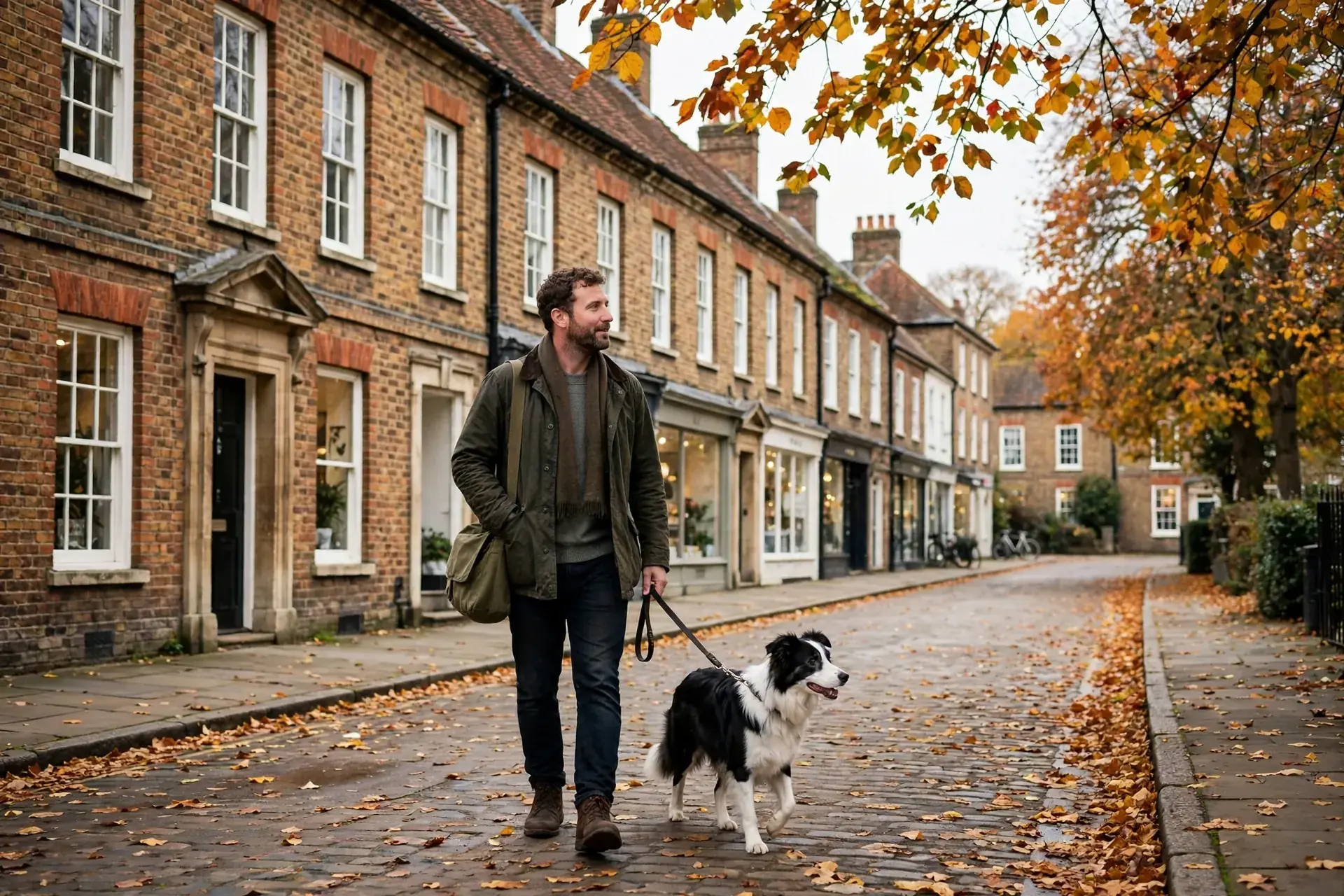
The walk in from the village is part of the experience, not just a way to reach the marsh. Flint cottages and narrow lanes give way, step by step, to open reeds, and the white windmill stays in sight as a landmark for finding the way back. Lanes here are shared with cyclists, walkers and traffic on the coast road, so a dog walks beside its owner through the village stretch, sniffing hedgerows, flint walls and gateways, before the ground opens out into reeds and sky. That gradual change, from enclosed lane to wide marsh, suits a dog far better than being lifted straight from a car into wind and open water.
Boardwalks and reserve paths
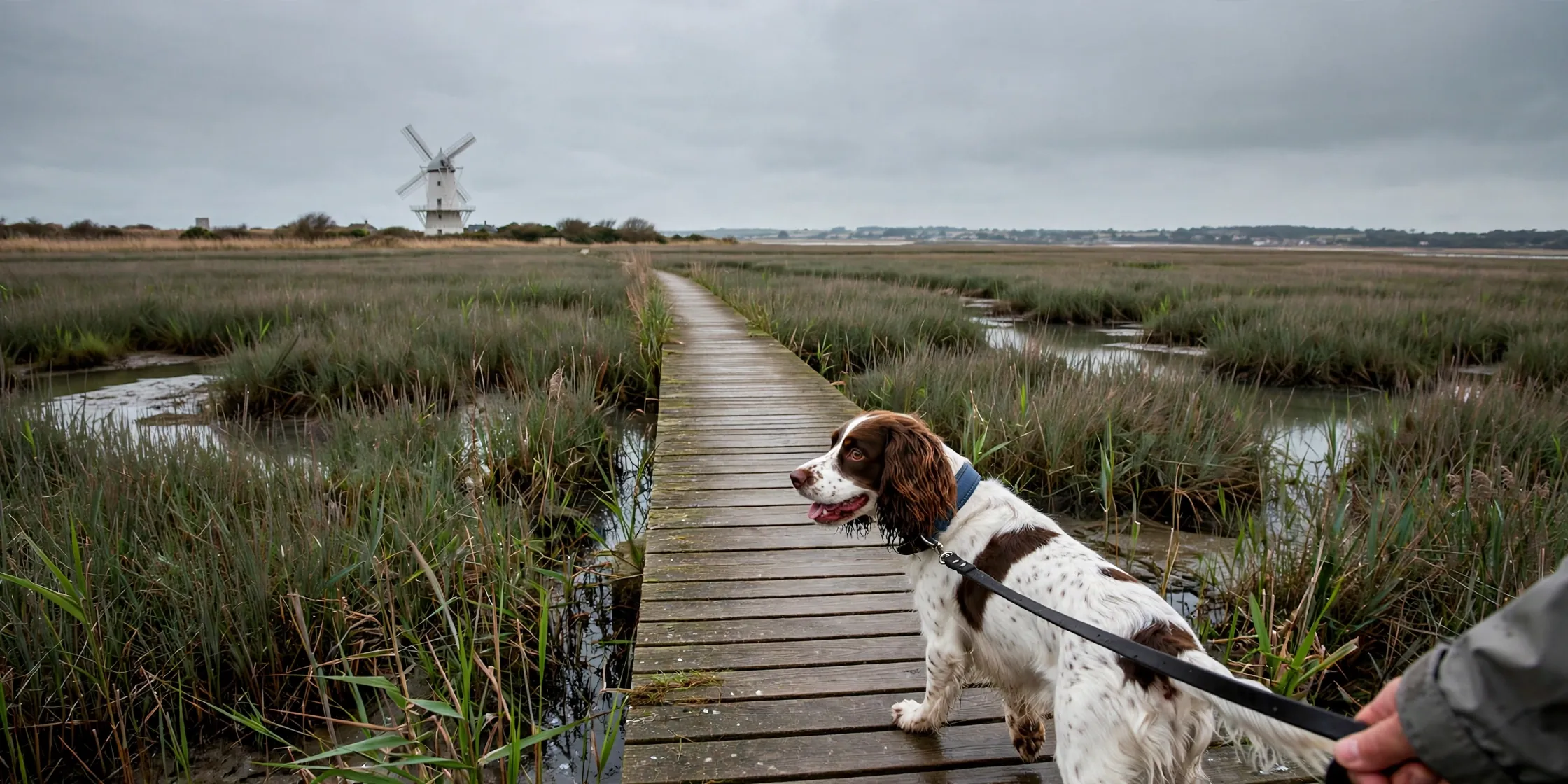
The boardwalks at Cley run above wet ground, over ditches and through reed beds where a grass path would sink, and they change how a dog must walk. Boards narrow without warning, turn slick after rain or sea mist, and pass birdwatchers standing motionless with binoculars and tripods, so the dog walks at its owner's side, at boardwalk pace, with the lead already clipped on before the reeds close in. A dog lunging eagerly at a reed edge, splashing noisily into a ditch or barking loudly across a reed-fringed scrape spoils the very quiet the boardwalk was built to protect, and the boards offer no room to sort out a loose dog on a narrow walkway.
Reserve paths at Cley do not all carry the same permission, and the difference matters most around scrapes and hides. Some reed paths stay open while a neighbouring scrape is closed for breeding birds, and some hides admit no dogs at all on a given day, so the day's arrangement is what counts, and the notice posted that day at the reserve car park and on the hide doors takes precedence over anything written here. Planning the walk around the boardwalks and scrape edges, rather than around entering every hide, loses nothing, because the open marsh, with its wide sky and its waders, is the main sight, and a hide door is only one way of looking at it.
Nothing can be left behind on a reed path, because there is no bin at every boardwalk junction and the litter of a marsh walk sinks into wet ground. Waste goes in a bag and back to a bin in the village, and a dog that has paddled a ditch or brushed wet reeds is brushed down before the lane walk home, so reed seeds and marsh mud do not travel into a pub or a car. Meeting other walkers on a narrow boardwalk means stepping onto a passing place, drawing the dog close to the reed edge and letting tripods and telescopes pass, which is how a dog walk fits into a working reserve instead of interrupting it.
The shingle beach
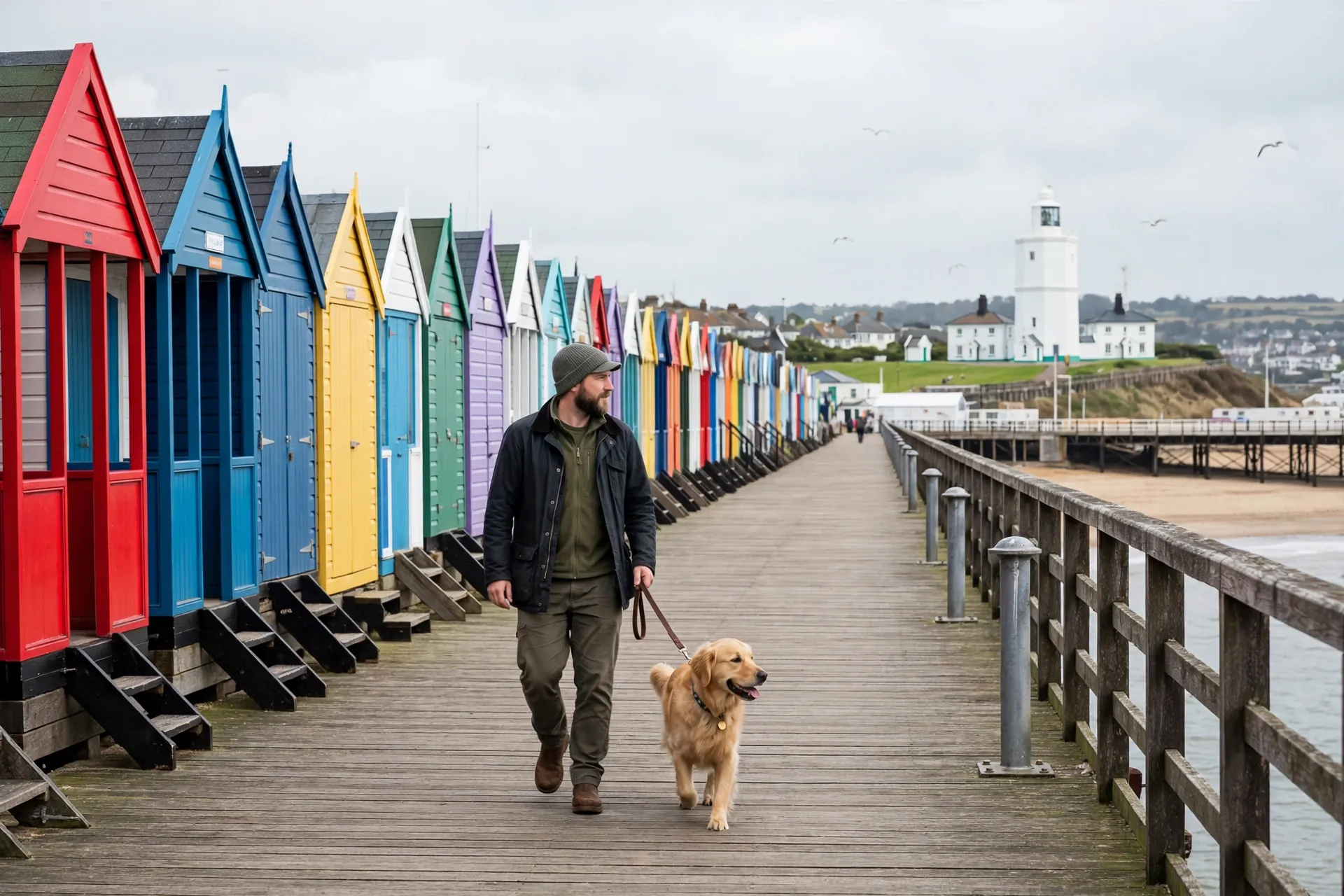
Cley beach is not a sandy bay but a long shingle bank, a ridge of loose stones with the sea on one side and the marsh on the other, and the walk to the water from the marsh side is longer than first-time visitors expect. There is no shade on the bank, no cafe on the stones and no shelter if the wind stiffens, so the beach walk is a proper outing for a fit dog that enjoys open ground and shallow water at the tideline, and a hard outing for a small, older or unfit dog that must pick its way over shifting stones. Judging the dog in front of you, against the wind on the day, decides whether the shingle bank is a pleasure or a slog.
Shingle itself is the dog's main problem on this beach. Stones shift under paws, lodge between toes and abrade pads that are used to grass and lanes, and salt water dries on the coat after a paddle at the tideline. A pause halfway along the bank to check paws for trapped stones and soreness is worth more than pushing on to the far end, and the lead clips back on wherever feeding waders gather along the tideline or other beach users come into view. In wind, a shouted recall across open shingle carries badly, so a dog that ranges far along the bank is a dog that may not hear its way back.
The return along the shingle bank is the part of the walk most often underestimated, because it runs into the wind, over the same loose stones, with a dog that has already swum or run. Turning back while the dog still has energy in reserve, rather than at the point of tiredness, keeps the walk home through the marsh and lanes pleasant, and adding a full reed loop on top of a long beach walk turns a good day into an exhausted one. Cley's bank is long enough that a short stretch of it, walked well, gives the whole flavour of the place, and the far end will still be there on a calmer day.
The windmill and the village
Cley Windmill stands white against the marsh sky and works as the village's compass point, visible from the reed paths, the lanes and the shingle bank alike. It is a working building with its own rooms and visitors, not an open landmark to wander through, so the photograph and the pause belong on the lane or the marsh path, with the dog beside its owner and the windmill framed against reeds. Photographing it from private ground, or blocking a lane gateway for a picture, trades a moment's view for a nuisance, and the best windmill pictures at Cley are the ones taken while walking past, not while trespassing for a closer angle.
The village itself is a small knot of flint lanes around a church, with a handful of shops and galleries tucked between cottages, and it asks for a slow pace. The coast road runs through it, so traffic moves fast between quiet stretches, and a dog walks beside its owner along the lanes, pausing at gateways and churchyard walls, rather than ranging ahead around blind corners. Doorway signs in the lanes say which rooms take dogs that day, and those signs, room by room, are a better guide than any assumption carried in from another village, because Cley's shops and galleries are small and their arrangements change with the season.
A longer village day can stretch along the coast road towards Salthouse in one direction or Blakeney in the other, but each of those walks is a separate outing with its own distance, tide and wind, not an automatic extra tagged onto a Cley marsh walk. Salthouse gives a quieter shingle and heath edge, Blakeney gives a harbour and a busier quay, and both change the dog's day from a marsh walk into a coastal trek. Keeping them as their own days, with the windmill lanes as the familiar return, lets Cley stay a village to come back to, rather than a starting line to rush away from in search of somewhere else.
Blakeney Point: a decision, not a duty
Blakeney Point is the long shingle spit across the harbour from Cley, and it tempts many visitors because its seals are famous, yet the trip to reach it is a serious undertaking for a dog. On foot it means miles of loose shingle with no shade, no fresh water and a return leg into the wind, while by boat it means a crossing governed by tide and weather, with a dog that must sit calmly on a pitching deck while seals appear. Neither version is a duty that completes a Cley visit, and a dog that is uneasy on boats, or that barks at seals, will enjoy neither the walk nor the crossing.
On the Point itself, seals haul out on sandbanks and shingle to rest, moult and raise pups, and a dog's job is to watch them from a long way off. Pups that look alone usually have a mother nearby, and a dog running towards them, barking at them or pulling its owner closer, can push the whole group into the water and separate mothers from young. If seals start shifting towards the water, lifting their heads in alarm or shuffling away as a dog approaches, the party is already too close, and the right move is a quiet retreat back along the shingle, not a closer look or a photograph taken at the seals' expense.
Many Cley days are complete without the Point at all, because a reed walk, a stretch of shingle bank and a warm stop in the windmill lanes already give a dog the marsh, the sea and the village in one day. Blakeney Point fits a second day, when the tide, the wind and the dog's fitness all point the same way, and when a calm dog can watch seals from a distance without excitement. If those conditions do not line up, skipping the Point is not missing Cley, it is choosing the Cley that the dog in front of you can actually enjoy, on a day when the marsh, the shingle and the village are enough.
Birdwatching etiquette with a dog
Birdwatching at Cley means sharing reed edges and scrape banks with birds that react to movement, noise and a dog-shaped silhouette long before a walker notices them. Waders probing the mud of a scrape, wildfowl rafting on open water and a marsh harrier quartering low over the reeds all flush or shift when a dog runs ahead, barks from a boardwalk or crashes through a reed edge, and a flushed flock may not return to that scrape for hours. The dog therefore walks at heel along the reed path, below the skyline of the bank where possible, and the watching happens from a still pause, not from a moving dog at the end of a long lead.
Seasons change what the birds need from a dog walker at Cley, even though the reed paths look the same. Spring brings breeding birds on the scrapes that abandon a nest if disturbed repeatedly, summer brings young birds that cannot yet fly far from a reed edge, autumn brings migrants that must feed without interruption before moving on, and winter brings large flocks that need undisturbed rest on open water. A path that felt quiet in one season can be sensitive in the next, so the walker reads the scrape in front of them, steps back from a bank where birds are alert, and takes a wider reed path rather than pressing closer for a better view.
If barking starts on the approach to a hide, the answer is not to push on to the hide door but to turn onto the next reed path and let the birds settle, because a barking dog outside a hide disturbs the watchers inside as surely as one inside would. Some hides admit no dogs on a given day, and the notice posted that day at the reserve car park and on the hide doors takes precedence over anything written here. A scrape-edge path gives the same waders and wildfowl without a hide at all, so a day that never enters a hide can still be a full birdwatching day, with the dog walking the reeds while the birds stay on the water where they belong.
Seals, distance and calm
Grey and common seals haul out around the north Norfolk coast to rest, moult and breed, and the sandbanks and shingle near Blakeney Point are among their most sensitive places. A seal that looks idle is often resting after feeding or nursing, and disturbance costs it energy, warmth and, for a pup, contact with its mother, so the encounter is designed around distance: a long view from the shingle, a dog settled at its owner's feet with the lead clipped on, and no attempt to close the gap for a photograph. Distance is not a disappointment here, it is what makes a seal sighting at Cley feel wild rather than staged, because the animals carry on as if the watchers were not there.
A seal encountered unexpectedly on the Cley shingle bank calls for the same response as a planned sighting, only faster. The walker stops, gives the haul-out a wide berth along the stones, and moves on without approaching, touching or feeding any animal, above all a pup lying alone on the shingle, whose mother is likely nearby in the water or on the next bank. Curiosity from a seal is not an invitation, and a dog that rushes forward, even playfully, can injure itself on teeth and claws as well as frightening the group. A short, quiet detour around the haul-out costs a few minutes and leaves the seals exactly where they were found.
For how seasonal rules for shingle beaches treat seal haul-outs and feeding birds, see how seasonal shingle-beach rules treat seal haul-outs and feeding birds, which explains the pattern that applies on the Cley bank through breeding and moulting periods. The Cley bank is not governed by one fixed rule for the whole year, because the birds on the tideline and the seals on the sandbanks change what a stretch of shingle needs in each season. Knowing that pattern before setting out along the bank lets a walker choose a quieter stretch on a sensitive day, instead of discovering a closed or crowded haul-out only after the dog has already run towards it.
Pubs, cafes and a warm stop
After wind on the marsh or stones on the shingle bank, a warm stop in the windmill lanes is the natural end of a Cley walk, and the village's small pubs and cafes are built for exactly that pause. Flagstone floors, draughty doorways and rooms that fill quickly mean a dog settles best after a short lane loop that shakes off the last of the shingle wind, rather than straight from a run along the bank into a crowded room. A dog that comes in damp from a ditch or dusty from shingle is brushed down at the door, so reed seeds and marsh mud stay out of the room, and the stop becomes a rest, with water and quiet, before the lane walk back.
Cafe and pub rooms in Cley are small, and their dog arrangements differ room by room and season by season, which is why the doorway sign on the day matters more than a habit brought from elsewhere. Outdoor seating in the lanes looks tempting on a sunny day but sits in the same wind that blows across the marsh, and a dog in a lane seat meets every passing dog, cyclist and walker that the indoor rooms keep at a distance. Indoors, a corner away from the main doorway keeps a dog out of the draught and the traffic of people coming in from the marsh, and a short stay suits a dog that has already walked reeds and shingle better than a long afternoon indoors.
If one lane stop cannot take a dog that day, the village offers a short walk to the next one, past the church and the windmill lanes, rather than a reason to argue or to linger outside a doorway. Cley's stops are close together, and a refusal is a matter of a few minutes' walk, not a ruined afternoon, especially when the dog still has a lane wander and a marsh path left in it. Ending the day with a second, quieter stop, or with a takeaway eaten on a sheltered lane bench, keeps the visit about the marsh and the village, not about a single room, and the dog goes home having rested where the village itself rests.
Parking, wind and weather
Parking for Cley means the signed car parks in the village and near the marshes, with the walk to the reeds, the boardwalks and the shingle bank starting on foot from there. The coast road through the village is narrow, with cottages close to the carriageway and passing places that farm traffic and reserve vehicles need, so parking on the road, across a gateway or at a reserve entrance creates friction that a signed car park avoids entirely. A car left considerately, with lanes and gateways clear, gives the day a calm base, and the walk from the village lanes to the marsh is itself the gradual introduction a dog needs before open reeds.
Wind is the weather that decides a Cley day more than rain, because a forecast that looks dry can still bring a hard wind off the sea that makes the shingle bank exhausting, the boardwalks cold and the marsh paths chilling for a small dog. On such a day the sheltered village lanes, the church lanes and a shorter reed loop give a better walk than a forced march along the bank, and a windy day is also the day to consider a wooded Holt day with shops and shelter when the Cley wind makes the shingle bank miserable. Returning to Cley on a calmer day, with the reeds still and the shingle walkable, beats spending a windy day fighting the coast and calling it a visit.
Cley works as a base for several days on the north Norfolk coast, with a different flavour each day, and the village rewards a return in another season. Winter brings wildfowl rafting on the marsh scrapes and a quieter shingle bank, summer brings waders and young birds on the reed edges and busier lanes, and the sound of the reeds themselves changes with the wind and the water level. A marsh day, a shingle day and a village-lane day, spread across a stay rather than crammed into one outing, let a dog learn the place in stages, and each return walk, from the windmill lanes to the boardwalk, feels familiar without ever being quite the same walk twice.
Practical questions
Before you go
Can dogs walk on the marshes at Cley-next-the-Sea?
Dogs walk the boardwalks and signed reed paths at Cley, while sensitive scrapes and hides carry their own arrangements for the day. The notice posted that day at the reserve car park and on the hide doors takes precedence over anything written here, so the scrape-edge paths, rather than every hide, are the reliable core of a marsh walk.
Is Cley beach good for dogs?
Cley beach is a long, exposed shingle bank, not a sandy beach, and it suits a fit dog that enjoys open ground, wind and shallow water at the tideline. There is no shade and no shelter on the stones, so the walk is judged against the wind and the dog's paws, with a turn back while energy remains.
How close can dogs get to seals at Blakeney Point?
Dogs watch seals from a long way off and never approach, feed or touch them, above all pups, whose mothers are usually nearby. If seals lift their heads, shuffle away or slip towards the water as a party approaches, that party is too close and should retreat quietly back along the shingle.
Are dogs allowed in bird hides at Cley?
Some hides admit dogs and some do not, so the notice posted that day at the reserve car park and on the hide doors takes precedence over anything written here. A walk that never enters a hide still gives full birdwatching from the scrape-edge paths, where waders and wildfowl stay undisturbed on the water.
Where do I park for Cley-next-the-Sea with a dog?
Park in a signed car park in the village or near the marshes and walk to the reeds, the boardwalks and the shingle bank from there. The coast road through Cley is narrow, with cottages close to the carriageway, so road parking, blocked gateways and reserve entrances cause friction that a signed car park avoids.
What should I do if my dog barks at birds on the marsh?
If a dog barks at birds on the marsh, move away from the scrape edge onto a quieter reed path and let the birds settle, rather than pressing closer to a hide or a bank. A dog that chases or flushes waders and wildfowl ruins the watching for everyone and disturbs birds that may be feeding, resting or raising young.