This guide is independent and contains no paid placement. If affiliate links are added later, they will be clearly marked and will not change our editorial checks.
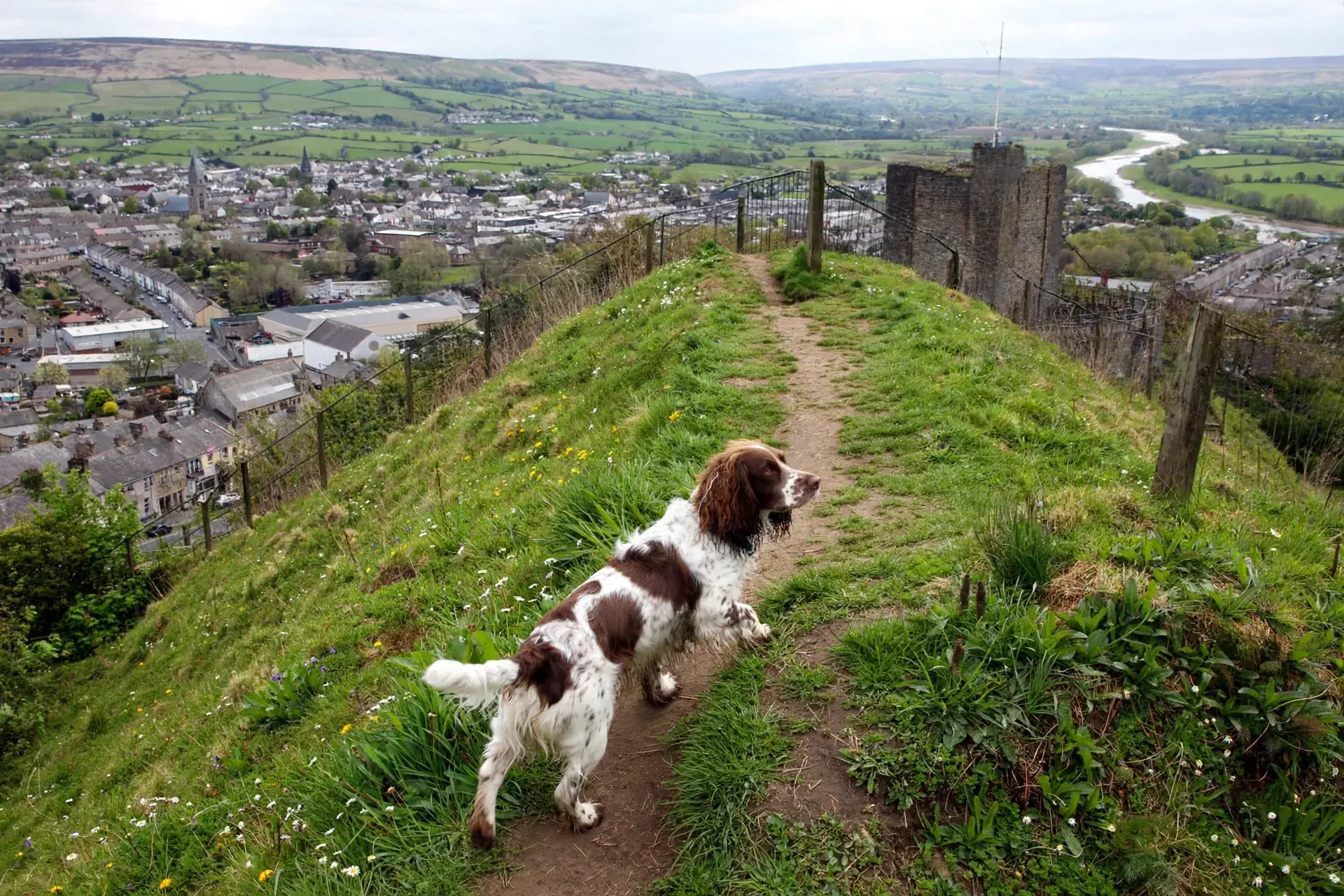
Start at Clitheroe Castle grounds for views and a short climb, then walk down to the River Ribble at Edisford Bridge or Brungerley Park for a flat riverside loop. Save Pendle Hill for a fit dog on a settled day, keep dogs on a lead near livestock, and plan market days for confident dogs only.
Why Clitheroe works with a dog
Clitheroe is a small market town in the Ribble Valley in Lancashire, in the north west of England, and it suits dog owners because everything useful is close together. The castle sits on a grassy mound in the middle of town, the River Ribble runs along the edge of town, the market fills the centre on Tuesdays, Thursdays and Saturdays, and the railway station is a short walk from the high street. That compact layout matters when you are travelling with a dog: you can park once, walk to the castle, drop down to the river, come back through town for lunch, and still have time for a longer walk in the afternoon without driving between every stop.
The town is also a good base for the wider Ribble Valley and the Forest of Bowland, a protected landscape of fells, valleys, villages and reservoirs. Pendle Hill, the most famous hill in the area, rises to 557 metres and dominates the view to the south east of town. On a clear day you can see it from the castle grounds, and on a settled day a fit dog can walk to its summit from Clitheroe on a long circular route. If that sounds too much, the same landscape offers much gentler options: riverside paths, a sculpture trail in woodland, village lanes around Downham and Chatburn, and the Tolkien Trail at Hurst Green, a few miles to the south west. Clitheroe therefore works for a single easy day out and for a longer stay, because you can scale the walking up or down without changing your base.
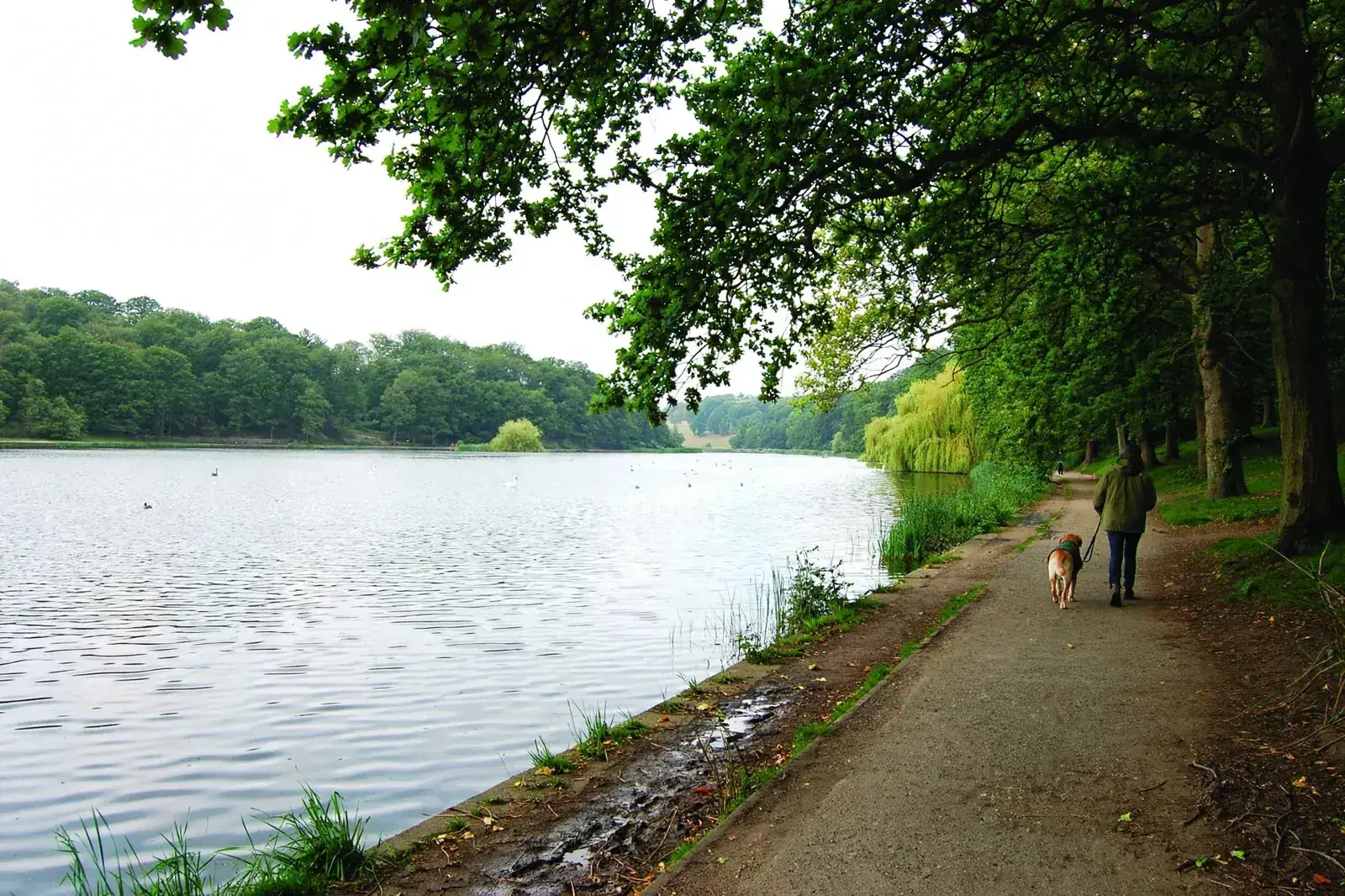
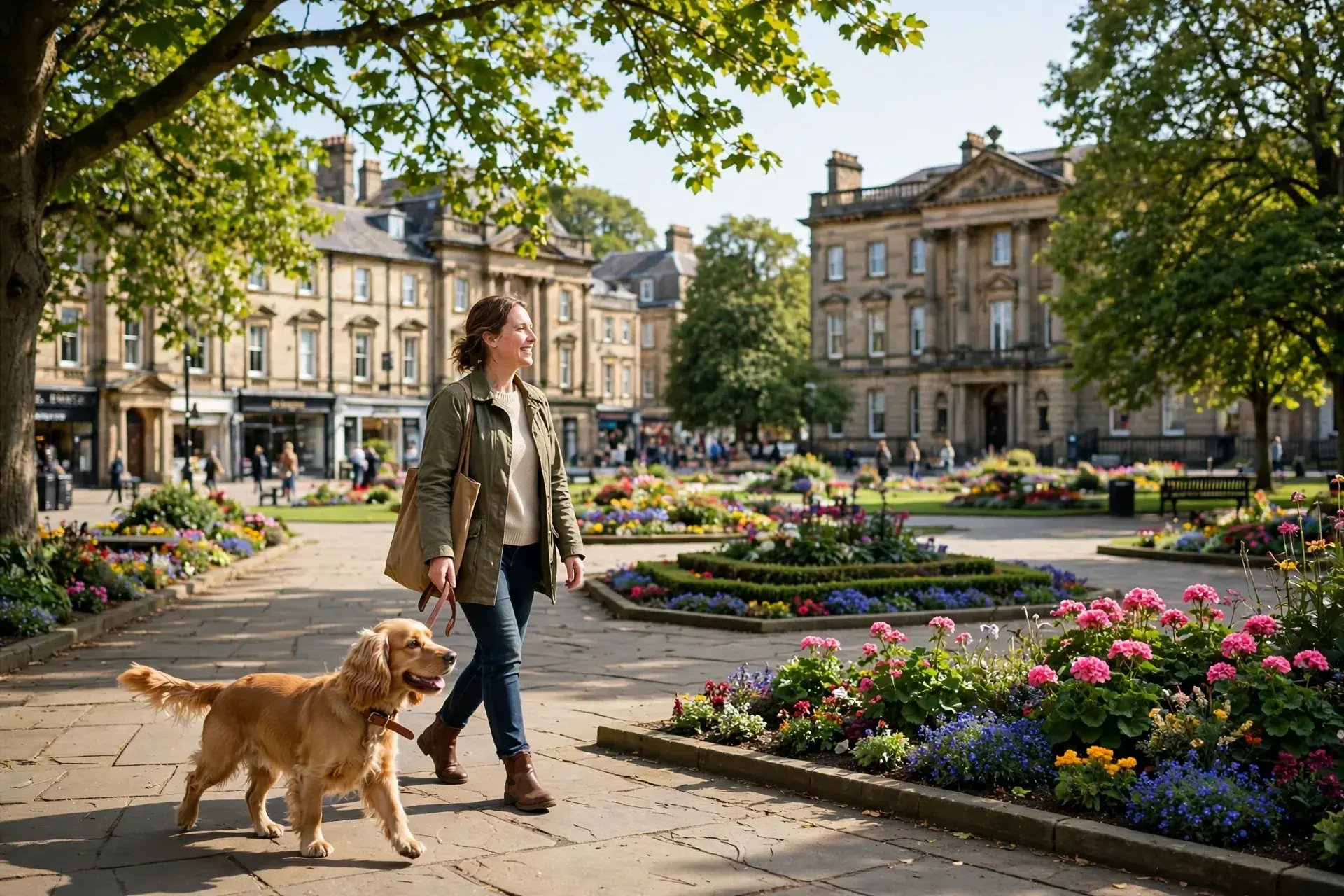
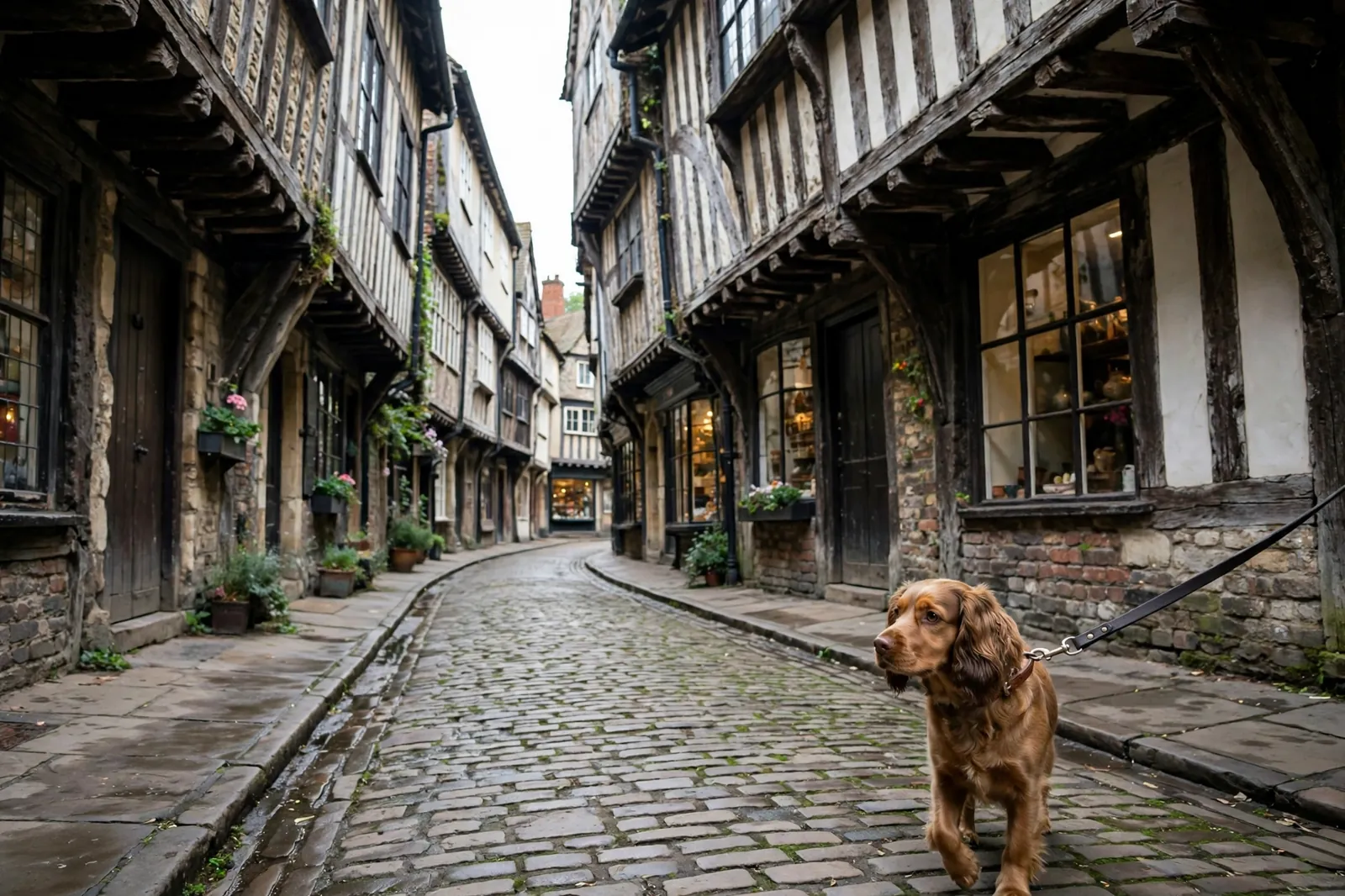
Clitheroe is not a big city, and that is part of its appeal. Compared with a city break in Leeds with a dog, where the best walks are a park and a canal and the day needs more planning around traffic and crowds, Clitheroe lets a dog step from a town street onto a riverside path in a few minutes. Compared with Harrogate with a dog, which is a polished spa town with formal gardens and a long promenade, Clitheroe feels rougher and more rural: muddy field paths, stone stiles, sheep in the next field, and a river that changes with the rain. Compared with York with a dog, where the walls, the Minster and the medieval streets are the main draw, Clitheroe is quieter and easier to navigate with a dog that finds crowds tiring. None of those places is better in an absolute sense; they suit different dogs and different moods, and Clitheroe suits the dog that is happiest with open air, a river to sniff along, and a pub at the end of the walk.
Before you plan the detail, it helps to be honest about your dog. A young spaniel that needs an hour of running will be bored by a single loop of the castle grounds, while an older dog with stiff joints will be unhappy on the steep steps up to the keep or on a long Pendle Hill climb. A nervous dog may cope well with a quiet weekday riverside walk and struggle on a busy Saturday market. A dog that chases sheep or cannot be recalled reliably needs a lead for almost every rural path around Clitheroe, because livestock graze in most of the fields. This guide is organised so you can pick the right walk for the dog in front of you, rather than assuming one route fits every dog.
Clitheroe Castle and its grounds
Clitheroe Castle is the obvious first stop, and it is also the best introduction to the town. The Norman castle was built by the de Lacy family in around 1100, and its stone keep still stands on a small limestone mound above the town. The castle grounds cover about 16 acres of parkland, with lawns, gardens, a bandstand, a bowling green, a children's playground, a sports court and a skate park, as well as wooded slopes and viewpoints over the town, the Ribble Valley, the Forest of Bowland and Pendle Hill. The castle and grounds are free to visit and open daily, although the grounds close on 24 to 26 December and 31 December to 2 January, so check the official guidance before you travel if you are visiting over Christmas and New Year.
Dogs are welcome in the grounds, in the Steward's Gallery and in the museum shop, while assistance dogs are welcome in the museum itself. That distinction matters: you can walk the dog around the grounds, up the mound and through the gardens, but you should not plan to take a pet dog inside the museum. The museum itself has an admission charge and seasonal opening hours. In the warmer months it is generally open daily, while in winter it opens on fewer days and closes on Wednesdays and Thursdays in the November to February period, so check the official guidance before you travel rather than assuming the hours you saw last summer still apply.
The walk up to the castle is short but steep in places. A surfaced path climbs the mound from the town, and there are stone steps up to the keep itself. Dogs that are fit and sure-footed will manage the climb easily, but older dogs, very small dogs and dogs with joint problems may find the steps hard, especially after rain when stone can be slippery. There are seats and a sensory area near the top, so you can rest, let the dog settle, and take in the view before you decide whether to climb further. Keep the dog on a lead in the grounds: the site is shared with families, children, other dogs and visitors, and the lawns and gardens are not an off-lead exercise field.
What makes the castle worth more than a quick photograph is the way it frames the rest of the day. From the top you can pick out the River Ribble below, the roofline of the town, the railway line, and Pendle Hill in the distance. That view helps you understand the geography: the river to the north and west, the market and the high street below the castle, and the open countryside beyond. If you are staying for a weekend, come up here first and use it as an orientation point. If you are only here for a few hours, a slow loop of the grounds, a pause at the viewpoint, and a walk back down through the gardens is a complete short outing in itself, and it leaves the dog warmed up rather than tired out.
There are a few practical points worth knowing. The grounds are popular on sunny weekends and school holidays, so arrive early if your dog dislikes crowds or if you want a quieter first walk. Bring poo bags and use the bins provided, because the lawns are used for picnics and play. In wet weather the grassy slopes can be muddy and the paths can be slick, so wear boots with grip and keep a towel in the car. In hot weather, remember that there is limited shade on the open mound, and the stone steps and surfaced paths can be warm underfoot; carry water for the dog and take the shaded wooded paths on the way down. Finally, treat the keep and the museum as a split visit if you want to go inside: one person stays with the dog in the grounds while the other visits, then swap, rather than leaving the dog tied up outside or alone in a car.
River Ribble walks from town
The River Ribble is the second half of the Clitheroe dog walk, and for many dogs it is the better half. The river runs along the northern and western edge of town, wide and calm in dry weather, faster and higher after rain. The best-known riverside walk is the Clitheroe to Edisford Bridge route, which follows the river from the edge of town to the historic Edisford Bridge, a short distance to the north west. The bridge itself is a stone bridge over the Ribble, and the pub of the same name sits beside it, which makes it a natural turning point for a walk that ends with lunch or a drink.
A longer circular option is the Clitheroe River Ribble Circular, a route of about 12.5 kilometres that starts at Edisford Bridge, follows the south side of the river, crosses at Gindleton, and returns along the north side. That distance takes most walkers about three hours, and it is a proper half-day walk rather than a short stroll. It is described as easy in gradient, with only a small amount of ascent, but it crosses farmland, uses field paths and stiles, and can be muddy after rain. Dogs should be on a lead for the farmland sections, because livestock graze in most of the fields, and you should check the official guidance before you travel if you are unsure about the current path conditions, river levels or any temporary closures.
For a shorter riverside walk, the Edisford Bridge to Brungerley Bridge section is a good choice. It follows the river along the edge of town, passes Waddow Hall on the way, and gives you river views without committing to a long circular route. You can walk out and back, or arrange a shorter loop, and you can shorten it further by turning back at any point. This is the walk to choose for a first visit, for an older dog, for a puppy that is still building stamina, or for a wet day when you want a surfaced or well-used path rather than a long field crossing.
River safety deserves a paragraph of its own, because the Ribble looks inviting and can be dangerous. In dry weather, shallow edges near Edisford Bridge and Brungerley Park attract paddling dogs, and many dogs enjoy a splash on a warm day. After heavy rain, however, the river rises quickly, the current strengthens, and banks become slippery. Stepping stones on some riverside routes can be impassable when the river is in spate, and weirs and bridge piers create currents that are not obvious from the bank. Never let a dog swim after heavy rain, near a weir, or where the current is fast. If in doubt, keep the dog on a lead and let it paddle only at a calm, shallow edge where you can see the bottom and where the dog can get out easily. Carry a towel and a drying coat in colder months, because a wet dog that then walks in wind will chill quickly.
On every riverside walk, the lead rules are the same: on a lead near livestock, on a lead near roads and bridges, and on a lead where the path runs close to a steep bank. Off-lead time, if your dog has a reliable recall and the area is safe, is best saved for open grassland away from the river edge and away from other dogs and walkers. Bring more poo bags than you think you need, because bins are not always where you expect them on a long circular route, and carry the bags until you find one. That is a small inconvenience, but it is what keeps riverside paths usable for everyone.
Brungerley Park and the sculpture trail
Brungerley Park, just outside Clitheroe on Waddington Road, is the town's best woodland dog walk, and it is easy to miss if you only follow the castle and the high street. The park is a linear park along the River Ribble, with woodland, meadows, quarry stone and river views, and it is home to the Ribble Valley Sculpture Trail, a trail of about 1.5 miles with 22 pieces of art displayed along the woodland paths. The trail is a good length for most dogs: long enough to feel like a proper walk, short enough to fit into a morning, and varied enough to keep a sniffy dog interested for the whole route.
The paths in Brungerley Park are generally well maintained, and some sections are suitable for prams and wheelchairs, although other parts are steep and uneven. That mix means you should choose your section with care. If you are walking with an older dog, a dog that struggles with slopes, or a pushchair, stay on the easier sections near the start and turn back before the steeper ground. If your dog is fit and you want a longer walk, continue along the trail and link it to the riverside path towards Brungerley Bridge. There are benches along the trail, places to sit by the river, and bins for dog waste, but parking is limited to a small number of spaces near Brungerley Bridge, so arrive early on a sunny weekend or walk in from town instead.
The sculpture trail itself is a gentle way to slow a walk down. The sculptures are set into the woodland, so you will find a kingfisher and other pieces among the trees, and the trail encourages you to look around rather than march from one end to the other. That suits dogs that like to sniff and explore, and it suits owners who want a walk with a bit of interest beyond the path itself. Keep dogs on a lead or under close control here, because the paths are shared with other walkers, families and cyclists, and because the woodland edges drop towards the river in places. A long line is a good compromise on the wider sections: it gives the dog room to sniff while keeping you in control near the river and near other people.
Brungerley Park is also a good wet-weather option, because the woodland gives some shelter from light rain and the main paths hold up better than open field paths after a shower. After prolonged rain, however, the riverside sections can be muddy and the lower paths can be wet, so wear waterproof boots and expect to towel the dog down afterwards. In spring and summer, the meadows and woodland are at their best, with wildflowers, birdsong and dappled shade, but also with more insects, so check the dog for ticks after a woodland walk and keep to the paths during bird nesting season in the wider moorland areas. In autumn, the woodland colour is a good reason to visit, but fallen leaves can hide mud, roots and uneven ground, so watch your footing on the steeper sections.
If you want to extend the walk, the park links naturally to the wider Ribble Valley network. From Brungerley you can follow the river towards Waddow Hall and Edisford Bridge, or you can head out towards Waddington and the village lanes beyond. Both extensions add distance and farmland, so they are better for a second walk than for a first visit. For a first visit, do the sculpture trail as a there-and-back walk, sit by the river for a few minutes, and let the dog have a sniff and a rest before you head back to town. That is enough for most dogs, and it leaves energy for a pub lunch or a castle visit later in the day.
Pendle Hill: the big walk, done properly
Pendle Hill is the walk that many visitors to Clitheroe have in mind, and it is the one that needs the most respect. The hill rises to 557 metres, and it is famous for its views over the Ribble Valley, the Yorkshire Dales and the Forest of Bowland, and for its association with the Pendle witches of 1612. From Clitheroe, the full circular route to the summit and back is about 12 miles, or 18.8 kilometres on some listings, and it typically takes five to six hours. That is a long day for a dog as well as for a walker, and it should not be attempted as a casual add-on to a town visit.
The route from Clitheroe climbs gradually through farmland and valleys, known locally as cloughs, before reaching the summit plateau. The terrain is varied: field paths, muddy sections, moorland, and steep climbs near the top, with zig-zag paths that ease the gradient in places. After rain, the moorland sections can be boggy, and the paths can be slippery. The summit itself is exposed, with little shelter, and the weather can change quickly: wind, rain and low cloud can arrive while the town below is still sunny. That is why the hill walk needs a proper check of the forecast, a map or a downloaded route, water for the dog, and a willingness to turn back if conditions change.
Dogs can do Pendle Hill, and many do, but the rules are stricter than on a town walk. Keep the dog on a lead near livestock, which graze in most of the fields, and especially during lambing season. Expect stiles, and be ready to lift a smaller dog over them or to find a gate. Carry water for the dog, because there is no reliable water supply on the higher ground, and carry a lead, a towel and a basic first-aid kit. A dog that is unfit, very young, very old, or recovering from injury should not attempt the full Clitheroe circular; a shorter approach is a better choice.
The shorter approach most walkers use starts from Barley village, on the other side of the hill. From Barley, the climb to the summit is about 2.5 miles, and it is much more manageable for families, for dogs that are fit but not hill-fit, and for walkers who want the summit view without a five-hour day. Another shorter option is the walk from the Nick of Pendle, which gives immediate views and a circular route of about 6.6 miles taking around two and a half hours. Both are still hill walks, with steep sections and exposed ground, so they need the same preparation as the longer route, just for a shorter time.
If you do walk Pendle Hill from Clitheroe, plan it as the main event of the day. Start early, eat before you set off, and save the town and the pub for afterwards. Tell someone your route and your expected return time if you are walking alone. Check the official guidance before you travel for any path closures, access restrictions or local advice, and check the weather forecast on the morning of the walk, not the night before. If the forecast is poor, choose a riverside walk instead and save Pendle for a settled day. The hill will still be there, and a dog that has a good day on the river is better than a dog that has a miserable day on a wet, windy summit.
For dogs that cannot do the hill, you can still enjoy Pendle from below. The village of Downham, a few miles from Clitheroe, sits in the shadow of the hill and is often described as one of the prettiest villages in the area. A short walk around Downham, with views of Pendle Hill above the village, gives you the landscape without the climb. The Assheton Arms in Downham has a large outdoor seating area with views of the hill, and walks from the village take in farmland, becks and open views. That is a good compromise for a mixed group, where one person wants a hill view and the dog wants a gentle walk.
The market town: streets, market and Holmes Mill
Clitheroe town centre is compact and walkable, with a high street, independent shops, cafes and a market that has been held since the Norman Conquest in the 12th century. The market is open on Tuesdays, Thursdays and Saturdays, from 9am to 4pm, on Station Road and New Market Street, close to the railway station. On market days the town is at its liveliest, with stalls selling fresh produce, meat, cheese, bread, fish, clothes and household goods, as well as street food and artisan stalls. That is a good day for a confident dog that enjoys people, smells and noise, and a poor day for a nervous or reactive dog, which will find the crowds and the food smells overwhelming.
On a market day, plan the town walk with the dog in mind. Walk the market early, before the crowds build, or late, when stalls are packing up. Keep the dog on a short lead, close to your side, and away from food stalls, hot food and dropped food. Do not let the dog eat from the ground, because market food, bones and packaging can be harmful. If the dog is struggling, step out of the market into a quieter side street or back towards the castle grounds for a break. A short market visit followed by a riverside walk is a better plan than a long market visit that leaves the dog tired and stressed before lunch.
On non-market days, the town centre is quieter and easier for a dog. You can walk the high street, look in the independent shops, and find a cafe with outdoor seating. The Clitheroe Country Market, a separate cooperative market held on Tuesday mornings in the United Reformed Church, sells home-grown, home-baked and hand-crafted produce, and it is a calmer, smaller alternative to the main market. Check the official guidance before you travel for its current dates, because it runs seasonally and takes a winter break.
Holmes Mill is the town's best-known food and drink destination, and it is worth understanding before you visit. The restored Victorian textile mill on Greenacre Street is home to the Bowland Beer Hall, the Bowland Brewery, a food hall, a hotel and event spaces, and it is described as allowing dogs. The Beer Hall and the food hall are the most dog-relevant parts, but policies can change between the bar, the food hall and the hotel, and they can change between indoor and outdoor areas, so check the official guidance before you travel and ask on arrival where dogs are welcome. The mill is also the starting point for a short riverside walk: an easy route from Holmes Mill through the castle grounds to the River Ribble, with only about 100 metres of ascent on good paths and a few stiles, makes a good pre-lunch or post-lunch walk.
Beyond Holmes Mill, the town has a good spread of independent cafes, bakeries and shops, many of which welcome dogs outside or in a designated area. Do not assume every cafe welcomes dogs inside; ask at the door, look for a sign, and be ready to sit outside if that is the rule. A dog that can settle under a table is a pleasure in a cafe, while a dog that barks, pulls or begs will make the visit hard for everyone. Bring a mat or a blanket for the dog to lie on, a chew or a stuffed Kong to keep it occupied, and water if the cafe does not provide it. If you are visiting with two people, one can order while the other stays with the dog outside, which is often the simplest solution in a busy cafe.
The town also rewards a slow walk rather than a checklist. Look for the stone buildings, the narrow lanes, the church, and the views from the castle mound. The railway station, the market and the castle are all within a short walk of each other, so you can build a loop that takes in the station, the market, the high street and the castle without ever needing a car. That is the best way to see Clitheroe with a dog: on foot, at the dog's pace, with time to stop and sniff.
Split visits: the museum and other indoor stops
Not every attraction in Clitheroe welcomes pet dogs indoors, and that is normal for a historic town. The best way to handle it is to plan split visits in advance, rather than discovering the rule at the door. A split visit means one person visits the indoor attraction while the other stays outside with the dog, then you swap. It takes a little longer, but it means the dog is never left alone in a car or tied up outside, and everyone gets to see what they want to see.
Clitheroe Castle Museum is the main split visit in town. The museum, in the castle grounds, covers local history from 350 million years ago to the present day, with displays on the castle, the town and the Ribble Valley. Dogs are welcome in the grounds, the Steward's Gallery and the museum shop, but only assistance dogs are welcome in the museum itself. There is an admission charge for the museum, and the opening hours change with the season, so check the official guidance before you travel. If you want to visit the museum, plan for one person to stay with the dog in the grounds, where there are seats, gardens and views to enjoy while you wait.
Other indoor stops need the same approach. Shops in the town centre vary: some welcome dogs, some welcome dogs only in certain areas, and some do not welcome dogs at all. Ask at the door rather than assuming, and do not take a dog into a food shop where dogs are not allowed. Churches and other historic buildings also vary, and many ask for dogs to be kept outside or on a lead in the churchyard. If you are visiting with a dog, treat indoor stops as optional extras, not as the main event, and let the outdoor walks carry the day.
There is also a practical point about leaving a dog alone. Never leave a dog alone in a car, even for a short time, because cars heat up quickly in sun and cool down quickly in cold weather, and a dog left alone in a car can become distressed. If you are staying in dog-friendly accommodation, check its rules about leaving a dog alone in the room: many places prohibit it outright, while others allow it only for a short period and only if the dog is crated and quiet. Plan as if the answer is no, and build your day around places where the dog can come along or where a split visit works.
For families, split visits work well with children as well as with dogs. One adult can take the children into the museum while the other walks the dog in the grounds, then swap. That gives everyone a break, and it avoids the situation where a child and a dog are both bored in the same place at the same time. If you are travelling alone with a dog, you will need to choose: either skip the indoor attraction, or visit it on a day when the dog is resting at your accommodation with a trusted person. That is a reasonable trade-off, and it is better than rushing a museum visit while worrying about a dog outside.
Where to eat and drink with a dog
Clitheroe and the villages around it have a good number of dog-friendly pubs, and they are an important part of a dog break here. The Castle, a pub in Clitheroe itself, welcomes well-behaved dogs both inside and outside, and it is only a two-minute walk from the market and the railway station, which makes it a convenient stop after a town walk. The Edisford Bridge Country Pub, on the banks of the River Ribble a short stroll from the centre, is proudly dog-friendly and welcomes four-legged friends after a riverside walk. Both are good examples of the local pattern: a pub that welcomes dogs, provides water, and expects dogs to be under control and settled.
Outside town, the options widen. The Dog Inn at Whalley, a traditional village inn a few miles to the south, is described as child-friendly and dog-friendly, with homemade food and a warm atmosphere. The Buck Country Pub at Paythorne, between Gisburn and Long Preston, has a designated dog-friendly area, a beer garden across the road, and views of Pendle Hill and the Ribble Valley. The Shireburn Arms at Hurst Green and the Aspinall Arms at Mitton are also starting points for riverside walks, and both are used by walkers with dogs. As with every pub, check the official guidance before you travel, because dog policies can change, and a pub that welcomed dogs last year may have changed its rules, its layout or its opening hours.
When you eat out with a dog, a few habits make the visit work for everyone. Arrive with a tired dog rather than a fresh one: a dog that has just had a good walk is far more likely to settle under a table than a dog that is still full of energy. Choose a table at the edge of the room or outside, where the dog is not in the main walkway and where other diners do not have to step over a lead. Keep the lead short and under your foot or tied to the table leg, so the dog cannot wander to other tables. Bring a mat for the dog to lie on, and a chew or a toy to keep it occupied while you eat. Order water for the dog if the pub does not offer it, and do not feed the dog from your plate, because pub food is often too rich, too salty or too spicy for a dog.
Cafes need the same approach, with one extra caution: many cafes are smaller than pubs, and a large dog in a small cafe can block the way for other customers. If the cafe is busy, consider a takeaway coffee and a bench outside instead. That is often a better experience for the dog, which can watch the world go by, and for you, because you are not worrying about the dog in a crowded room. In Clitheroe, a takeaway coffee and a walk to the castle or the river is a perfectly good lunch plan, especially on a sunny day.
Finally, remember that dog-friendly does not mean dog-ignored. Staff in a dog-friendly pub will usually welcome the dog, offer water and sometimes a biscuit, but they also expect the dog to be clean, dry and under control. A muddy dog that has just come off a riverside walk should be towelled down before it comes inside, and a wet dog should be dried as much as possible. If your dog is barking, pulling or jumping up, take it outside for a break rather than hoping it will settle. A short break outside is better than a long, stressful meal inside, for the dog and for everyone else in the pub.
Where to stay with a dog
Clitheroe has a range of dog-friendly places to stay, from hotels in converted mills to bed and breakfasts, cottages and caravan sites in the surrounding villages. Holmes Mill has a hotel as well as its food and drink spaces, which makes it a convenient base if you want to stay in the centre of town. Elsewhere in the Ribble Valley, there are dog-friendly cottages, farm stays and caravan and camping sites, including a Caravan and Camping Club site within walking distance of the town. The right choice depends on your dog: a cottage with an enclosed garden suits a dog that needs a secure toilet area, while a hotel room suits a dog that is used to settling in a new room and that can cope with corridors, lifts and other guests.
When you book, ask the specific questions that matter for your dog, and get the answers in writing. Ask whether dogs are allowed in the specific room or unit you are booking, not just in the property in general, because many places designate only selected rooms as dog-friendly. Ask how many dogs are allowed, whether there is a pet fee, and whether there is a size or breed condition. Ask whether the garden or outdoor area is enclosed, and how high the boundary is, because a low fence or a gap under a gate can be a problem for a small or determined dog. Ask whether dogs can be left alone in the room, and for how long, and whether dogs are welcome in the breakfast room, bar or terrace.
Also ask about the practical details that are easy to overlook. Is there a place to wash a muddy dog, or at least an outdoor tap? Is there a drying area, or a place to hang a wet lead and coat? Where is the nearest toilet walk after dark, and is it lit? Is parking beside the room, or in a communal car park? If you are staying in a cottage, is there a secure area for the dog at night, and is the garden checked for gaps? If you are staying in a hotel, is there a ground-floor room, and is there a lift if the dog cannot manage stairs? These questions sound fussy, but they are the difference between a stay that works and a stay where you spend the whole time managing problems.
For a longer stay, consider staying outside Clitheroe itself, in one of the villages in the Ribble Valley or the Forest of Bowland. Villages such as Downham, Chatburn, Waddington, Hurst Green and Whalley all have dog-friendly accommodation, and they give you direct access to field paths and riverside walks without driving into town each day. A village base also gives you a quieter evening walk, which suits a dog that finds town noise tiring. The trade-off is that you will need a car for most trips, and you will need to plan meals, because village pubs and shops may have shorter opening hours than town ones. Check the official guidance before you travel for opening hours and booking conditions, because rural accommodation can close seasonally.
Whatever you book, bring the dog's own bed, blanket and bowls, and keep the feeding and sleeping routine as close to home as possible. A familiar bed in a new room helps a dog settle, and a familiar feeding time helps it feel safe. On arrival, walk the boundary of the garden or the area around the property before you unload everything, check gates and fences, and give the dog water and a quiet sniffing walk. Photograph any existing damage and move cleaning products, medicines and food out of reach. A boring first hour in a new place is the fastest route to a settled first night.
Getting there, parking and getting around
Clitheroe is in the Ribble Valley in Lancashire, about 30 miles north of Manchester and about 10 miles north east of Blackburn, and it is reached by road on the A59 and by rail on the line from Blackburn. By car, the A59 runs through the Ribble Valley and connects Clitheroe to Preston, Blackburn and Skipton, and from there to the motorway network. The drive from Manchester takes about an hour in normal traffic, and the drive from Leeds takes about an hour and a half, depending on the route and the traffic. If you are driving, plan for the A59 to be busy on market days and on sunny weekends, and allow extra time for parking.
Parking in Clitheroe is in town centre car parks and on-street bays, with the market car park and the station area among the most convenient for a dog walk. Town centre parking is usually short-stay, so check the signs for time limits and charges before you leave the car. If you are planning a long walk, such as the Pendle Hill circular or the full Ribble circular, choose a car park that allows all-day parking, and check the official guidance before you travel for current charges and restrictions. For Brungerley Park, parking is limited to a small number of spaces near Brungerley Bridge, so it is often easier to walk in from town than to drive and hope for a space. For Edisford Bridge, there is parking near the bridge, but it can fill up on a sunny day, so arrive early or walk from town.
By train, Clitheroe station is on the line from Blackburn, with trains running to Blackburn and onward connections to Manchester Victoria and other towns. The station is a short walk from the market and the castle, which makes a car-free day out possible: you can arrive by train, walk to the castle, walk to the river, and walk back to the station without needing a car at all. Dogs travel free on most trains when they are kept on a lead and under control, but check the official guidance before you travel, because train operators can change their rules, and a busy service needs a calm, well-managed dog. If your dog is nervous on trains, choose a quieter service, sit in a less crowded carriage, and bring a mat for the dog to lie on.
By bus, local services connect Clitheroe to Blackburn, Preston, Skipton and the surrounding villages, but services can be infrequent, especially on Sundays and in the evenings, so check the timetable before you travel. Dogs are usually allowed on buses at the driver's discretion, but check the official guidance before you travel, because policies vary between operators. If you are relying on public transport for a walk that starts in a village, such as Barley or Downham, check the return bus times before you set off, so you are not left waiting with a tired dog.
Once you are in Clitheroe, the best way to get around is on foot. The town centre, the castle, the market, the station and the river are all within a short walk of each other, and walking is the only way to see the town at the dog's pace. For longer walks, you will need a car or a taxi to reach the start, especially for Pendle Hill from Barley or for the Tolkien Trail at Hurst Green. If you are using a taxi, check in advance whether the taxi company accepts dogs, because not all do, and bring a blanket to protect the seat. If you are walking on roads, keep the dog on a lead on the side away from traffic, and use pavements where they exist, because rural lanes around Clitheroe can be narrow, with fast traffic and no pavement.
Seasons, weather and river safety
Clitheroe is a year-round destination, but the experience changes with the seasons, and the best plan depends on the time of year. Spring, from March to May, is one of the best times to visit: the castle gardens are coming into flower, the woodland in Brungerley Park is fresh and green, the river is usually at a good level, and the weather is mild enough for a long walk. Lambing season falls in spring, so dogs must be on a lead near livestock, and you should be extra careful in fields with ewes and lambs. Spring can also be wet, so bring waterproofs and expect muddy paths.
Summer, from June to August, brings the longest days and the warmest weather, and it is the busiest time in town. Market days are crowded, the castle grounds are full, and the riverside paths are popular. That is good for a social dog, but it can be hard for a nervous dog. Heat is the main risk in summer: the open mound at the castle has limited shade, the stone paths can be warm, and a dog that is exercising in heat can overheat quickly. Walk early in the morning or late in the evening, carry water for the dog, and never leave a dog in a car. If the dog wants to paddle, choose a shallow, calm edge, and dry the dog afterwards so it does not chill in the evening wind.
Autumn, from September to November, is often the best season for a dog walk in Clitheroe. The crowds thin out, the woodland colour in Brungerley Park is at its best, the market is still busy but less crowded, and the weather is cool enough for a long walk without overheating. Autumn also brings more rain, so paths can be muddy and the river can rise quickly. Fireworks season around early November can unsettle noise-sensitive dogs, so check whether there are displays in the town or nearby, and plan a quiet evening walk if your dog is sensitive to bangs. After the clocks go back, it gets dark early, so bring a torch and a reflective lead or collar for evening walks.
Winter, from December to February, is the quietest season, and it has its own appeal: frosty mornings, clear views from the castle, and empty riverside paths. The museum has shorter opening hours in winter, and the castle grounds close over Christmas and New Year, so check the official guidance before you travel. Winter walks need more preparation: warm, waterproof clothing for you, a coat for a short-haired or older dog, and a towel for drying off afterwards. Paths can be icy, especially on the castle mound and on shaded woodland paths, so wear boots with grip and keep the dog on a lead on icy ground. Shorter days mean you should start walks earlier and finish before dark.
River safety applies in every season, but it is most important after rain. The Ribble rises quickly after heavy rain in the hills, and a path that was dry in the morning can be wet by the afternoon. Stepping stones can become impassable, and a calm-looking stretch of river can have a strong current below the surface. If you are unsure about the river level, ask locally, check the official guidance before you travel, or choose a walk away from the river. A dog that is wet and cold after a river paddle needs to be dried and warmed quickly, especially in winter, so carry a drying coat and a towel even on a short walk.
Easy day trips from Clitheroe
Clitheroe is a good base for day trips, because the Ribble Valley and the Forest of Bowland are full of villages, walks and pubs within a short drive. The easiest day trip is to Whalley, a village a few miles to the south west, with a ruined abbey, a village centre, and the Dog Inn, a traditional pub that welcomes dogs. Whalley also has a monthly artisan market on the last Sunday of the month, which is described as dog-friendly, and it is a good place for a gentle village walk followed by lunch. Check the official guidance before you travel for market dates and pub opening hours.
Hurst Green, a few miles to the south west of Clitheroe, is the starting point for the Tolkien Trail, a circular walk inspired by J. R. R. Tolkien's time in the Ribble Valley. The trail is well marked, suitable for all ages, and described as very dog-friendly, with well-maintained paths. It starts in the village, goes down to the River Ribble, follows the riverside for a stretch, climbs past Hobbit Hill, and returns to the village, where there is a pub and a cafe for refreshments afterwards. The trail can be muddy after heavy rain, and there are farm animals in some fields, so keep the dog on a lead where needed and wear waterproof boots.
Downham, a few miles to the east of Clitheroe, is a village that sits in the shadow of Pendle Hill and is often photographed for its stone cottages and village green. A walk around Downham, with views of the hill, is a gentle alternative to climbing the hill itself. The Assheton Arms in Downham has a large outdoor seating area with views of Pendle Hill, and walks from the village take in farmland, becks and open views. The Chatburn Circular, a walk of about 4.4 miles from the nearby village of Chatburn, explores fields and hills at the foot of Pendle Hill, passes through Downham and Worsaw, and returns via the Swanside Viaduct. It is described as easy, but it crosses farmland with livestock, so dogs need to be on a lead, and the paths can be muddy in winter.
Further afield, Gisburn Forest, to the north east of Clitheroe, offers forest trails, mountain biking and walking, with a cafe and a car park. Forest trails are generally good for dogs, because they are surfaced, waymarked and away from livestock, although you should keep the dog under control near cyclists and other walkers. Stocks Reservoir, at the head of the River Hodder in the Forest of Bowland, is another day trip: a circular walk of about 9.23 miles around the reservoir, taking just under four hours, with views of the reservoir and the surrounding fells. That is a long walk for a fit dog, and it needs the same preparation as a Pendle Hill walk: water, a map, and a check of the weather.
If you want a city day out from Clitheroe, the train to Blackburn and Manchester is the easiest option, and a day in a city with a dog needs a different plan. In that case, the guides to Leeds, Harrogate and York are useful for comparison, because they show how a city walk differs from a Ribble Valley walk: more pavements, more crowds, more split visits, and more planning around cafes and transport. Clitheroe is the quieter base, and the cities are the busier day out, so choose the day that suits your dog's energy and temperament.
A one-day plan and a weekend plan
For a one-day visit, start at Clitheroe Castle. Arrive early, park in town, and walk up to the castle grounds for a slow loop, a pause at the viewpoint, and a sniff around the gardens. That takes about an hour, and it warms the dog up without tiring it out. From the castle, walk down through town to the River Ribble, and follow the riverside path towards Edisford Bridge or Brungerley Park. Choose the shorter Edisford to Brungerley section if you want an easy walk, or the longer circular if you have time and a fit dog. Stop at the Edisford Bridge pub or at Holmes Mill for lunch, then walk back to town for a coffee and a look at the market if it is a market day. That is a full day, with a castle, a river, a pub and a town walk, and it leaves the dog tired but not exhausted.
For a weekend, use the first day for the town and the river, and the second day for a longer walk. On day one, follow the one-day plan above, but take it more slowly: castle in the morning, river in the late morning, lunch in town, and a quiet afternoon walk in Brungerley Park. On day two, choose one longer walk: Pendle Hill from Barley for a fit dog on a settled day, the Tolkien Trail at Hurst Green for a medium walk with a pub at the end, or the Chatburn and Downham circular for a village walk with views of Pendle Hill. Finish the weekend with a pub lunch, a short walk in the castle grounds, and a drive home while the dog sleeps in the car.
If you are visiting with a puppy, an older dog or a dog that is new to walking, shorten both plans. A puppy should not do a long Pendle Hill walk, and an older dog should not do steep steps or a long circular in one go. For a puppy, the castle grounds and a short riverside walk are enough, with plenty of rest and water. For an older dog, a flat riverside walk, a sit by the river, and a pub lunch are a complete day. The aim is not to cover the most distance, but to give the dog a good day that it can enjoy without becoming overtired or sore.
If the weather is poor, have a wet-weather plan. A wet day in Clitheroe can still be a good day if you choose the right walks: the castle grounds in light rain, Brungerley Park under the trees, and a pub lunch are all possible in wet weather, as long as you have waterproofs and a towel. A long Pendle Hill walk in heavy rain and wind is not a good wet-weather plan, and a riverside walk when the river is in spate is not a good plan either. Check the forecast on the morning, and be ready to swap a hill walk for a woodland walk, or a long circular for a short out-and-back walk. The dog will not mind the change of plan, as long as it gets a walk, a sniff and a rest.
Practical checklist before you go
Pack for the dog as well as for yourself. The essentials are a lead, a long line for safe off-lead sniffing, poo bags, water and a bowl, a towel, a drying coat in cold or wet weather, food and treats, and any medication the dog needs. Also pack a mat or blanket for cafes and pubs, a chew or a toy to keep the dog occupied, and a torch and reflective gear for evening walks in autumn and winter. If your dog is prone to car sickness, bring a blanket for the car seat and plan for breaks on the drive. If your dog has a health condition, bring the vet's phone number and any relevant paperwork.
Before you travel, save the number of a local vet. There are veterinary practices in Clitheroe and in the surrounding towns, including Blackburn and Preston, but rural practices can be some distance away and may close early, so save the number before you need it. Also save the number of your own vet, in case you need advice while you are away. If your dog has a medical emergency, call the nearest vet first, rather than driving around looking for one. Check the official guidance before you travel for the current opening hours of the vet you plan to use.
Livestock is the most important safety issue on rural walks around Clitheroe. Sheep and cattle graze in most of the fields, and dogs must be on a lead near livestock, especially during lambing season in spring. A dog that chases livestock can cause serious harm, and a farmer is entitled to protect livestock. Keep the dog on a lead in any field with animals, even if the animals are at a distance, and keep the dog under close control near gates and stiles. If you see a sign asking for dogs to be on a lead, follow it, even if you cannot see livestock at that moment.
Other practical points are simple but worth stating. Use poo bags on every walk, and carry them until you find a bin. Do not let the dog drink from the river if the water looks dirty or if there is algae, and do not let the dog eat from the ground in the market or in a pub garden. Check the dog for ticks after woodland and moorland walks, and check its paws after a long walk on stony or muddy ground. In summer, check for grass seeds between the toes, and in winter, wash mud and salt from the paws after a walk. Keep the dog's ID tag on its collar, with your mobile number, and make sure the microchip details are up to date before you travel.
Finally, check the official guidance before you travel for every specific claim in this guide that could change: castle and museum opening hours, market days, pub and cafe dog policies, train and bus times, parking charges, and path closures. Clitheroe is a small town, and its businesses and attractions can change their hours and rules with the season, so a quick check before you set off is the best way to avoid disappointment. With that check done, you can relax and enjoy the town, the river and the hill, at the dog's pace.
Clitheroe rewards a slow visit. It is not a place to rush through, ticking off attractions, but a place to walk, sit by the river, look at the hill, and let the dog sniff its way through a market town that has been doing the same thing for centuries. Start with the castle, follow the river, save Pendle for a settled day, and finish in a pub. That is the whole plan, and it is enough.
Practical questions
Before you go
Can dogs go into Clitheroe Castle and its grounds?
Dogs are welcome in the castle grounds, the Steward's Gallery and the museum shop, while assistance dogs are welcome in the museum itself. The castle and grounds are free to visit and open daily, although the museum has an admission charge and seasonal opening hours, so check the official guidance before you travel.
Where is the best easy dog walk in Clitheroe?
For an easy walk, start with the castle grounds and then follow the River Ribble from Edisford Bridge or through Brungerley Park. Both give flat or gently sloping riverside paths, places to sit, and a short loop that suits older dogs, puppies and first visits. Keep dogs on a lead near livestock and check river levels after heavy rain.
Is Pendle Hill suitable for dogs?
Yes, for fit dogs and fit walkers, but it is a serious hill walk rather than a town stroll. Pendle Hill rises to 557 metres, routes from Clitheroe are long, and the summit is exposed to wind and fast-changing weather. Shorter approaches start from Barley village. Keep dogs on a lead near livestock, carry water, and turn back if the weather closes in.
Can dogs swim in the River Ribble at Clitheroe?
Some dogs paddle at shallow edges near Edisford Bridge and Brungerley Park, but the Ribble is a real river with cold water, strong currents after rain and slippery banks. Never let a dog swim after heavy rain, near weirs or bridges, or where the current is fast. If in doubt, keep the dog on a lead and let it paddle only at a calm, shallow edge.
Which days is Clitheroe Market open?
Clitheroe Market is open on Tuesdays, Thursdays and Saturdays, from 9am to 4pm. Market days are the liveliest time to visit, so they suit confident dogs that cope with crowds, stalls and food smells. Nervous or reactive dogs will have a calmer visit on a non-market day, when the town centre is quieter.
Can I visit Clitheroe by train with a dog?
Yes. Clitheroe station is on the line from Blackburn, with connections onward to Manchester and other towns. Dogs travel free on most trains when kept on a lead and under control, but check the official guidance before you travel, because train operators can change their rules and busy services need a calm, well-managed dog.