This guide is independent and contains no paid placement. If affiliate links are added later, they will be clearly marked and will not change our editorial checks.
Coleraine suits dogs because the walking is flat and varied: the River Bann gives you surfaced riverside paths from the town centre, Mountsandel Wood adds sheltered woodland loops, and Portstewart Strand is one of Northern Ireland's best beaches for an off-lead run outside the summer zones. Use the town as a base, check beach rules before you travel, and keep dogs on a lead beside the river.
Start with the river, not the town centre
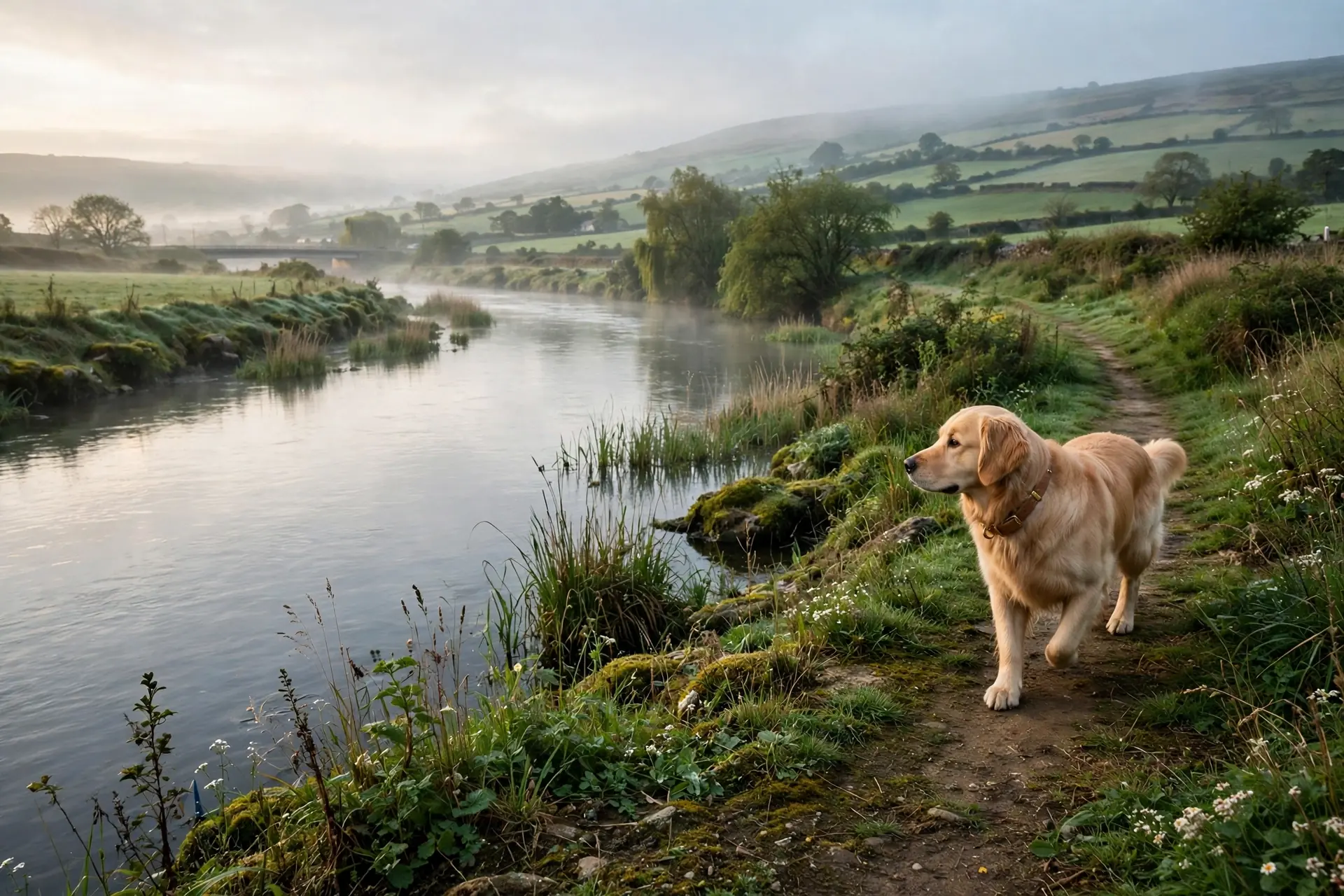
Coleraine is built around the River Bann, and the river is the right place to begin any visit with a dog. The Bann is one of Ireland's longest rivers, flowing north from Lough Neagh to the Atlantic at Portstewart, and it passes through Coleraine in a wide, deliberate curve that shapes the whole town. For a dog owner, that geography is a gift: flat, mostly surfaced paths follow the water on both banks, so a morning walk needs no car, no hill and no complicated navigation. You step out of the town centre and within minutes you are watching swans, herons and the occasional salmon angler, with the dog on a short lead and the town still in easy reach.
The river also explains why Coleraine feels different from the resort towns a few miles up the coast. Portrush and Portstewart are built for summer crowds, bright arcades and beach days. Coleraine is a working market town with a university campus, a busy high street and a long history as a crossing point on the Bann. That matters for dog owners because the town is open all year, the cafes and shops are not seasonal, and the walks do not shut down when the beach season ends. In February, when the coast is being battered by wind, the riverside paths are still walkable, the woodland still shelters you, and a dog can still have a proper outing without a forty-minute drive.
Before you plan anything else, get the shape of the river in your head. The Bann runs roughly north-south through the town, with the town centre on the eastern bank and Mountsandel on the western side. The main road bridge carries traffic across the river near the centre, and a footbridge further upstream gives walkers a way to loop between the banks. Downstream, the river widens towards the sea, passing the harbour area and the marshy ground near the estuary. Upstream, it narrows into the wooded valley around Mountsandel, where the paths feel rural within ten minutes of the shops. Most visitors only ever see the bridge and the town centre stretch, but the best dog walking is a short walk in either direction.
The river is also a working river, and that is worth respecting. Salmon run the Bann, and anglers fish its banks for much of the year. Dogs that charge into the water after a splash can disturb a fisherman's morning and, more importantly, can get into trouble in a current that looks gentle from the bank but runs fast in the middle. The Bann is deep in places, with steep, slippery banks and undercut edges that a dog cannot always climb back up. Treat the water as scenery, not a swimming pool: keep the lead on near the bank, let the dog paddle only in the shallow, slow margins you can see clearly, and carry a towel for the inevitable muddy-paw moment afterwards.
The riverside walks that make Coleraine work
The simplest walk in Coleraine starts at the town centre and follows the Bann downstream towards the harbour. The path is surfaced, flat and wide enough for a dog, a pushchair and a cyclist to pass each other without drama, and it gives you a steady hour of walking there and back without ever leaving the river. Along the way you pass the marina, the rowing club and the open green spaces where local dogs do their morning circuits. It is not a wild walk, and it does not pretend to be, but for an older dog, a puppy on its first holiday, or a dog that needs a gentle first walk after a long car journey, it is exactly right. The surface is kind on paws, the route is obvious, and there is always a bench or a patch of grass where a tired dog can stop.
Heading upstream from the town centre takes you into different territory. The path narrows, the trees close in, and the river starts to feel like a river again rather than a town feature. This is the stretch towards Mountsandel, where the Bann runs through woodland and the banks are lined with alder and willow. The walking here is still easy, but the atmosphere changes completely: fewer people, more birdsong, and the sense that you have left the town behind without actually doing so. Dogs that are nervous in busy places often settle on this stretch, because the encounters are spaced out and the path gives everyone room to pass at a comfortable distance.
Christie Park, on the edge of the town, is worth knowing about as a practical stop rather than a destination in itself. It is a green space with paths, trees and open grass where a dog can stretch its legs before or after a longer walk, and it sits close enough to the town centre to work as a lunchtime break. It is not a fenced dog park, so it suits dogs with a decent recall rather than dogs that need an enclosed space, but for a quick toilet walk and a sniff around the trees it does the job well. Pair it with the riverside path and you have a flexible two-hour outing that you can shorten or lengthen depending on the weather and the dog's energy.
A practical tip for the riverside paths: they are shared with cyclists, and the local cycling community uses them seriously, especially on weekend mornings. A dog on a long line across the path is a hazard for everyone, so keep the lead short on the busier stretches and move to one side when you hear a bell. Early mornings and weekday evenings are the quietest times, and they are also the best times for wildlife: herons fishing in the shallows, kingfishers flashing along the bank, and otters, if you are very lucky, in the quieter reaches upstream. Carry poo bags and use the bins provided, because the riverside is one of the most walked routes in the town and the locals notice when it is not looked after.
East Strand, Portstewart and seasonal beach rules
Coleraine itself has no beach, but two of Northern Ireland's best are within a fifteen-minute drive, and they could hardly be more different. East Strand at Portrush is the classic seaside beach: wide, sandy, backed by the town, and busy in summer with families, surfers and holidaymakers. Portstewart Strand, a couple of miles further west, is a two-mile sweep of sand managed by the National Trust, backed by dunes and far quieter, with a wilder, more open feel. Both are worth visiting with a dog, but they need different planning, and the rules change with the season, so check the official guidance before you travel rather than relying on what worked last year.
Portstewart Strand is the one most dog owners end up loving. Dogs are allowed on the beach year-round, but seasonal restrictions apply to parts of the strand during the summer months, and the restricted zones are signposted at the entrance. Outside those zones and outside the summer peak, a dog can run for a mile or more on firm, clean sand, with the dunes on one side and the Atlantic on the other. The beach is big enough that even on a busy day you can walk away from the crowds and find empty space, which makes it a good choice for dogs that need room or that are still learning to be calm around other dogs. The sand is fine and soft, so check paws afterwards, and bring fresh water, because there is no shade and a dog can dehydrate faster than you expect on a bright day.
East Strand at Portrush is a different proposition. It is a town beach, and in high summer it is crowded, with seasonal dog restrictions that limit where dogs can go during the busiest months. That does not make it useless for dog owners: outside the summer season it is a magnificent, wide beach with a long, flat walk to the harbour, and on a crisp autumn morning it can be almost empty. The promenade above the beach is a good alternative when the sand itself is restricted, giving you a long, level walk with sea views and plenty of places to stop for a coffee. If you are staying in Coleraine in July or August and want a beach walk, Portstewart Strand is usually the better bet, and East Strand is best saved for the quieter months.
Whichever beach you choose, the routine after the walk is the same. Rinse the sand and salt off the paws before the car journey home, because sand in a car is a problem that lasts longer than the walk did, and check the pads for cuts from shells and stones. Bring fresh water for the dog, because there is no shade on either beach and a dog running in the sun can dehydrate faster than you expect. Keep the dog away from the dune edges, where ground-nesting birds may be present in spring and summer, and remember that the sea here is cold, so a paddle is a better idea than a swim for most dogs.
Mountsandel Wood and the quieter inland loops
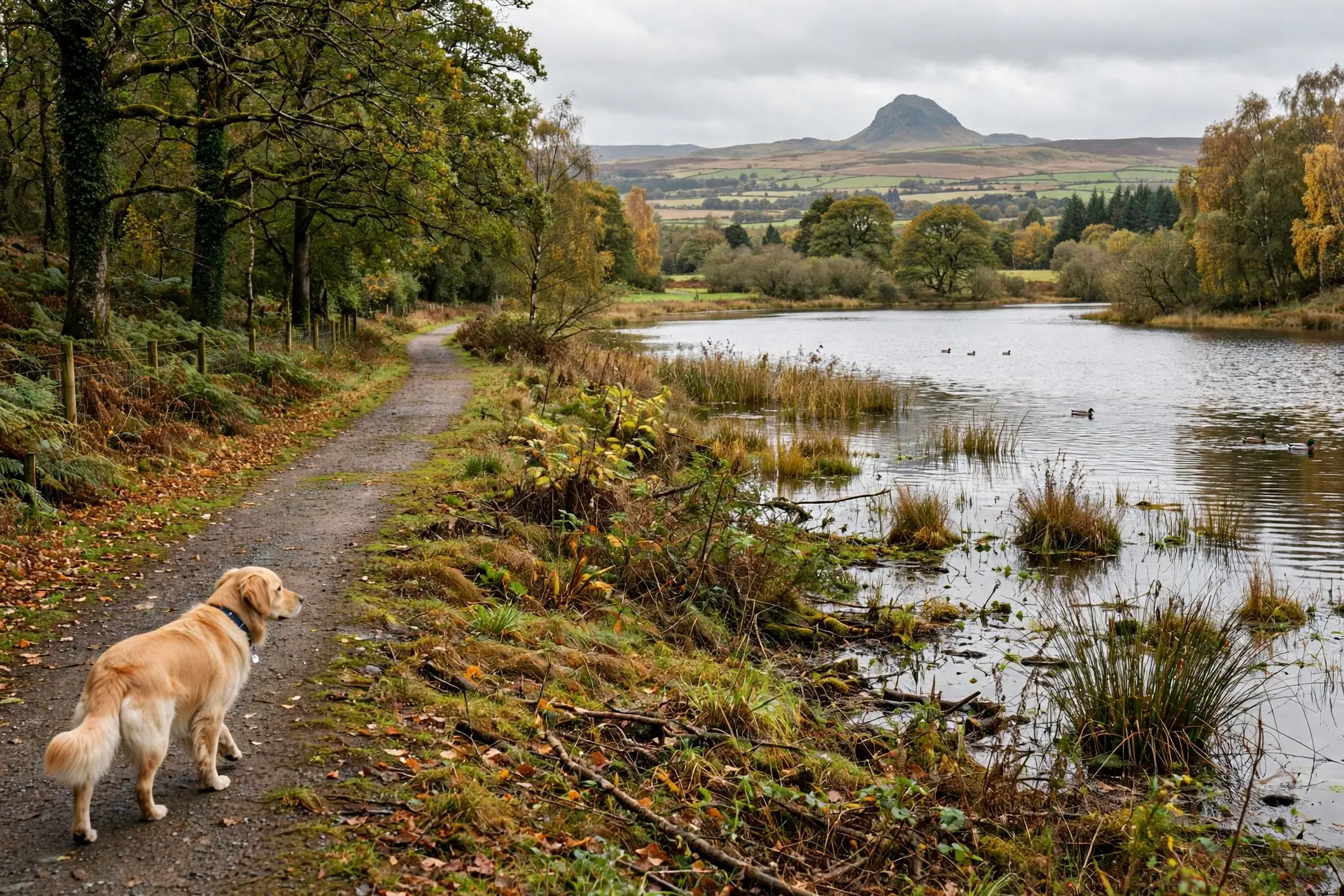
Mountsandel is the place Coleraine dog owners go when the coast is too windy or too busy. The wood sits on a bluff above the Bann on the western edge of the town, and its trails wind through mixed woodland with views down to the river and across to the town. The site is famous among archaeologists as one of the oldest known settlements in Ireland, with evidence of people living here around nine thousand years ago, but for a dog walker its appeal is simpler: sheltered paths, soft ground underfoot, and a network of loops that you can combine into anything from a twenty-minute circuit to a two-hour wander.
The main trails are well surfaced and easy to follow, with waymarkers at the junctions and benches at the viewpoints. The woodland floor is leaf litter and earth rather than tarmac, which is kinder on a dog's paws and more interesting for its nose, and the tree cover keeps the paths usable in rain and in summer heat alike. In spring the wood is full of bluebells and wild garlic, in autumn the leaf fall turns the paths gold, and in winter the bare branches open up views across the river that are hidden in summer. It is a year-round wood, and it rewards repeat visits, because the same loop looks completely different with the seasons.
Mountsandel works particularly well for dogs that need a calm, low-stimulus walk. There are no cliffs, no fast traffic and no crowds of beachgoers, and the encounters with other walkers are spaced out along the trails. That said, it is shared ground: joggers use the paths, families walk with children, and the woodland edge meets farmland, so keep your dog under control and on a lead where the path runs near fields or livestock. The wood is also a place where ticks can be present in the warmer months, so check your dog after a walk through the long grass and bracken at the woodland edge, and keep tick treatment up to date.
For a longer inland outing, combine Mountsandel with the riverside path to make a circular walk that takes in both the wood and the water. Cross the footbridge, climb into the wood, follow the upper trails, then drop back down to the river and return along the bank. The loop takes around two hours at a dog's pace with stops, and it gives you the best of both worlds: the shelter of the trees and the openness of the river. It is also a good wet-weather option, because the woodland paths drain better than the riverside grass and the tree canopy takes the worst out of a shower.
Coleraine town centre with a dog
Coleraine town centre is a working high street rather than a tourist showpiece, and that is actually an advantage when you are travelling with a dog. The streets are wide, the pavements are in good repair, and there are enough green spaces and quiet side streets to give a dog a break from the bustle. The main shopping area runs along the high street and the Diamond, the central square, and a walk through it takes you past the town hall, the market area and the older buildings that give the town its character. Dogs are welcome on the streets, of course, and many of the shops and cafes are relaxed about a well-behaved dog waiting outside or, in some cases, coming inside, but always ask first rather than assuming.
The practicalities of a town-centre visit with a dog are worth planning. Parking is available in several car parks around the centre, and the riverside paths are a short walk from most of them, so you can park once and do both the town and a walk without moving the car. If you are stopping for lunch, look for cafes with outdoor seating in the warmer months, and ask the staff about their dog policy before you settle in. Several places in the town are happy to bring a bowl of water for a dog, and a few have become known locally as dog-friendly stops, but policies change, so a quick check on arrival saves an awkward moment. Bring a mat or blanket for the dog to lie on if you plan to sit for a while, because a cold pavement is not a comfortable resting place.
The university campus on the edge of the town is another useful piece of the puzzle. Its grounds are open and green, with paths that are pleasant for a quiet walk, and the campus area is generally calmer than the high street, especially outside term time. It is not a designated dog-walking area, so keep the dog on a lead and be respectful of students and staff, but as a place to stretch legs between errands it works well. The campus also has the advantage of being close to the riverside paths, so you can link a campus loop with a river walk without any extra driving.
For supplies, Coleraine has everything a dog owner needs: supermarkets with pet sections, a pet shop or two, and a veterinary practice in the town for anything urgent. If you are staying for a week, it is worth knowing where the nearest vet is before you need it, and keeping the number saved in your phone. The town also has a good range of takeaways and restaurants, and if you are self-catering, the supermarkets on the edge of town are easy to reach by car and have large car parks where a dog can wait safely in the car for a short time in cool weather, though never in a hot car, even for a few minutes.
Day trips along the Causeway Coast
Coleraine's real strength as a base is its position. Within half an hour's drive you can reach the Giant's Causeway, the rope bridge at Carrick-a-Rede, the ruins of Dunluce Castle, the beaches of Portrush and Portstewart, and the harbour town of Ballycastle. For a dog owner, that means a week of completely different days without ever packing up and moving on. The trick is to plan each day trip around the dog, not around the attraction, because the most famous places are also the busiest, and a dog that is happy on a quiet beach may not enjoy a crowded clifftop path.
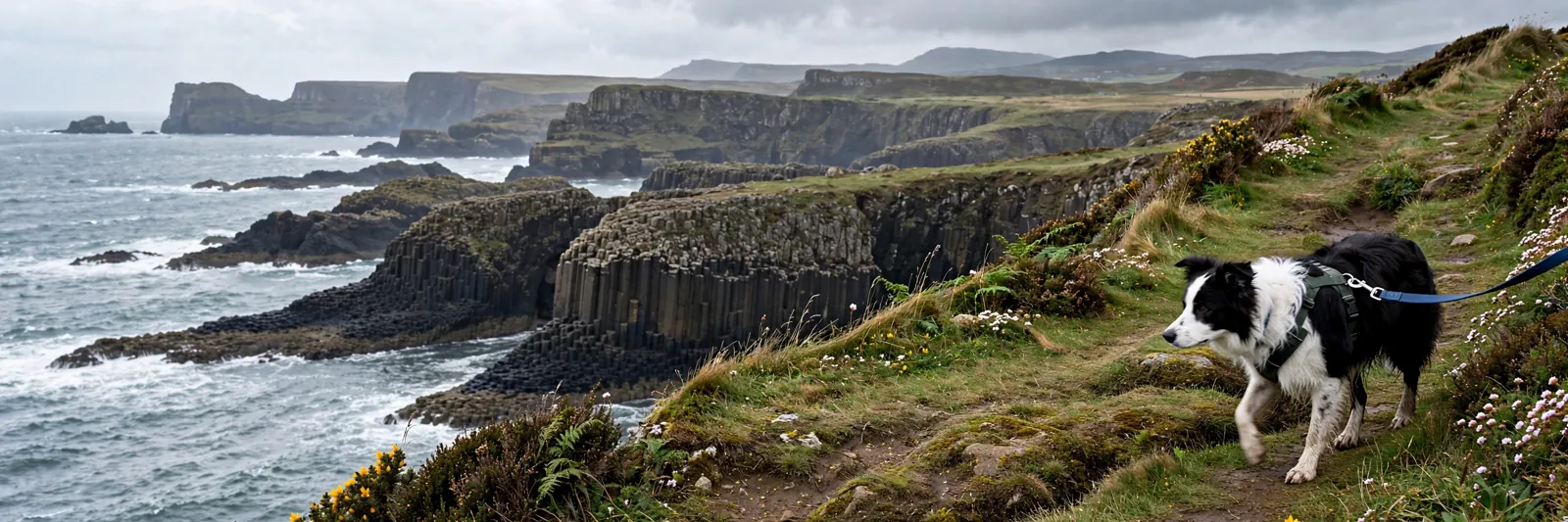
The Giant's Causeway is the obvious first trip, and it is genuinely dog-friendly in the ways that matter. Dogs on leads are welcome on the outdoor paths and the stones themselves, and the coastal walk from the visitor centre down to the causeway is a memorable outing for a fit dog. What dogs cannot do is go inside the visitor centre, apart from assistance dogs, so plan for one person to stay outside with the dog if you want to see the exhibition, or skip the centre entirely and head straight for the paths. The stones are uneven and can be slippery when wet, so keep the lead short and watch where the dog puts its feet. The upper cliff paths are more exposed and steeper, and they suit confident dogs on a calm day rather than nervous ones in a crowd.
Carrick-a-Rede is a different story, and honesty is important here. The rope bridge itself is not suitable for dogs, and dogs are not allowed to cross it. That does not mean the visit is pointless: the coastal path to the bridge is a beautiful walk with dramatic views, and a dog on a lead can enjoy the approach and the headland while one person crosses the bridge. The site is managed by the National Trust, and its rules are clearly signposted, so check the official guidance before you travel and plan the visit as a coastal walk with a bridge viewing, rather than a bridge crossing with a dog.
Dunluce Castle, perched on a cliff edge between Portrush and the Causeway, is best appreciated from the outside with a dog. The castle ruins themselves are a paid attraction with limited access, but the coastal path that runs past them gives you the view without the ticket queue, and the cliff-top walking here is some of the most dramatic on the coast. Keep the dog on a lead at all times on the cliffs, because the drops are unfenced in places and the wind can gust without warning. For a gentler day, Ballycastle and its harbour offer a quieter pace, with a beach, a promenade and the ferry to Rathlin Island, where dogs are welcome on the boat and the island's walking is superb for a dog that can cope with a short sea crossing.
Our guide to the Causeway Coast with a dog covers the beaches, towns and walks of this coastline in more detail, including the seasonal rules that change from place to place, and our Derry city guide is the right next read if you want to combine a coastal week with a day in a walled city.
Where to stay and eat with a dog
Coleraine has a good range of dog-friendly accommodation, and the choice you make shapes the trip more than almost anything else. Self-catering cottages and apartments in and around the town are the most flexible option, because they give the dog its own space, a garden or yard to use last thing at night, and a kitchen for preparing the dog's food exactly as at home. Holiday parks and lodges on the coast are a second option, with more space and often a fenced area, but they are further from the town and the riverside walks. Hotels and bed and breakfasts in the town centre are convenient for a short stay, but always confirm the dog policy in writing before you book, including any pet fee, size limit and whether the dog can be left alone in the room.
When you are comparing places to stay, ask the questions that actually matter. Is there a secure, enclosed area where the dog can be let out safely? Is there a tap or a hose for washing muddy paws? Is the flooring hard or carpeted, and is there a washing machine for dog bedding? How far is the nearest practical toilet walk after dark, and is it lit? These questions sound fussy, but they are the difference between a relaxing week and a week of improvising with towels and torches. A host who answers them clearly has usually thought about dogs properly, and a host who goes vague has usually not.
Eating out with a dog in Coleraine is straightforward if you plan ahead. The town has cafes and pubs with outdoor seating in the warmer months, and several are happy to welcome a dog on the terrace with a bowl of water. In the colder months, the options narrow, because few places allow dogs inside, so a self-catering stay with a kitchen becomes more attractive. If you are eating out in the evening, consider ordering a takeaway and eating back at your accommodation with the dog settled beside you, which is often more relaxing for everyone than a long restaurant meal with a dog under the table.
Budget for the dog as well as for yourself. Pet fees in the area typically run from a small nightly charge to a flat fee for the stay, and some places charge per dog, so a two-dog household should get the total in writing before paying a deposit. Factor in the cost of the beach car parks, the occasional paid attraction, and a vet visit if anything goes wrong, and you will have a realistic picture of the week. The town's supermarkets make self-catering affordable, and cooking for yourselves a few nights a week leaves more budget for the days out that matter.
Getting there and getting around
Coleraine is well connected for a town of its size, and that is part of its appeal as a dog-friendly base. The railway station sits on the line between Belfast and Derry-Londonderry, with regular services in both directions, and the journey from Belfast takes a little over an hour. Dogs are generally allowed on trains in Northern Ireland if they are well behaved and kept under control, but check the official guidance before you travel, because rules can differ between operators and services. The station is a short, flat walk from the town centre and the riverside paths, so a car-free arrival is genuinely practical, and the train ride itself, with its views along the coast and the river, is a pleasure rather than a chore.
By road, Coleraine is reached from Belfast on the A26, a straightforward drive of about an hour, and from Derry-Londonderry on the A2 and A37 in a similar time. The roads are good, the signage is clear, and the town has several car parks, including a large one near the town centre and smaller ones near the river. Parking at the beaches is a different matter: Portstewart Strand has a National Trust car park that fills up on summer weekends, and East Strand at Portrush has a large car park that is busy in the same way. Arrive early on a summer weekend, or visit on a weekday, and the parking problem mostly disappears.
Once you are in Coleraine, the bus network covers the coastal towns, with services to Portrush, Portstewart, Ballycastle and the Giant's Causeway, but the frequency drops outside the summer season, so check timetables in advance and allow extra time. Dogs are generally allowed on local buses if they are well behaved, but again, check the official guidance before you travel. For most visitors, a car is the most flexible option, because it lets you reach the quieter beaches and woodland walks that the buses do not serve, and it gives the dog a familiar resting place between walks. If you do bring a car, keep a towel, a spare lead and a bottle of water in the boot at all times, because the best walks in the area are the ones you find by chance.
Seasons, salmon and weather
Coleraine is a year-round destination, but the experience changes with the seasons in ways that matter for a dog. Late spring, from May into June, is arguably the best time to visit: the days are long, the riverside paths are green and full of birdsong, the beaches are quiet before the summer crowds arrive, and the weather is usually kind enough for long walks without the heat that makes a dog struggle. Early autumn, from September into October, is nearly as good, with the added bonus of the autumn colours in Mountsandel Wood and the beaches emptying as the school holidays end.
Summer brings the warmest weather and the longest days, but also the busiest beaches and the seasonal dog restrictions that limit where a dog can go on the sand. If you visit in July or August, plan your beach walks for early morning or late evening, when the crowds have thinned and the sand is cooler underfoot, and use the riverside paths and the woodland for the middle of the day, when the shade and the breeze make walking comfortable. Never leave a dog in a car in warm weather, even for a few minutes, and carry more water than you think you need, because a dog running on a beach in the sun can overheat quickly.
Winter in Coleraine is quiet, wild and, for the right dog, wonderful. The beaches are empty, the coastal paths are dramatic, and the town is calm, but the days are short, the rain is frequent and the wind off the Atlantic can be fierce. A waterproof coat for the dog, a drying coat for after the walk, and a warm place to dry off afterwards are not luxuries in winter, they are essentials. The salmon run in the Bann is a feature of the autumn, and the river is at its most dramatic after heavy rain, when the water runs high and fast and the banks need extra care. Whatever the season, check the forecast before you set out, dress for the weather you might meet rather than the weather you hope for, and remember that a short, happy walk in the rain beats a long, miserable one in a storm.
River, tide and livestock safety
The Bann is the hazard that visitors underestimate most, because it looks so calm from the bank. The water in the middle of the river runs fast, it is deep, and the banks are steep, slippery and undercut in places, so a dog that jumps in after a duck can be swept downstream before its owner can react, and may not be able to climb out where it went in. Keep the dog on a lead beside the water, let it paddle only where you can see a shallow, slow margin, and never throw a stick into the river for a dog to fetch. The same care applies at the harbour and the estuary, where the river current meets the tide and the water behaves unpredictably.
The two beaches need a different kind of attention. At Portstewart Strand and East Strand the sand is wide when the tide is out, and the water comes back in faster than a dog that has run half a mile along the beach can return. Look up the tide times in the morning, walk the beach while the tide is falling, and turn for home while there is still plenty of sand underfoot. The sea is cold, the currents are strong, and swimming is only for dogs that are confident in the water, in calm conditions, and well away from the harbour mouths. A dog that has been swimming needs a towel and a rinse, because salt water irritates skin and upsets stomachs when it is licked off.
Livestock is the third thing to plan for. The fields around Mountsandel and the farmland at the edge of the town hold sheep and cattle, and a dog that chases them can cause serious harm and put itself in danger. Keep the dog on a lead wherever livestock are visible, even if they seem far away, and be especially careful in spring, when lambs are in the fields and the ewes are protective. The law allows a farmer to shoot a dog that is worrying livestock, so this is not a rule to test. On the cliff paths at Dunluce and Carrick-a-Rede, keep the dog on a lead at all times, because the drops are unfenced in places and the wind can gust without warning, and in the dunes in spring and summer, keep to the paths, because ground-nesting birds are easily disturbed.
Practical questions
Before you go
Can dogs go on the beach at Portstewart Strand?
Portstewart Strand allows dogs year-round, but seasonal restrictions apply to parts of the beach during the summer months, so check the official guidance before you travel. Dogs must be kept under control at all times, and owners are expected to clean up after them. The National Trust manages the strand, and its signage at the entrance sets out the current rules for the section you are entering.
Is the River Bann riverside path in Coleraine suitable for dogs?
Yes, the riverside paths around Coleraine are generally flat, surfaced and easy for most dogs, including older dogs and puppies on shorter outings. Keep your dog on a lead near the water, because the Bann is a fast, deep river with steep banks in places. The paths are shared with cyclists and other walkers, so a short lead works better than a long line in the busier stretches.
Where can I walk my dog off the lead near Coleraine?
Mountsandel Wood and the wider riverside paths offer space for off-lead exercise where your dog has a reliable recall, but livestock, anglers and other walkers share the same ground. The beach at Portstewart Strand is the most popular open space for off-lead running outside the restricted summer zones. Always check local signage on arrival, because rules can change with the season.
Are dogs allowed at the Giant's Causeway from Coleraine?
Dogs on leads are welcome on the outdoor paths and stones at the Giant's Causeway, which is a short drive from Coleraine. They are not allowed inside the visitor centre, apart from assistance dogs. The coastal paths there are steep and exposed, so check the official guidance before you travel and plan your visit for a calm, dry day if your dog is nervous of heights or crowds.
What is the best time of year to visit Coleraine with a dog?
Late spring and early autumn usually suit dogs best: the days are long, the beaches are quieter outside the summer restrictions, and the riverside paths are at their greenest. Summer brings the warmest weather but also the busiest beaches and seasonal dog zones. Winter walking is perfectly possible, but expect short days, wet paths and strong winds on the coast.
Can I get to Coleraine by train with a dog?
Yes, Coleraine has a railway station on the line between Belfast and Derry-Londonderry, and dogs are generally allowed on trains in Northern Ireland if they are well behaved and kept under control. Check the official guidance before you travel, because rules can differ between operators and services. The station is a short walk from the town centre and the riverside paths.