This guide is independent and contains no paid placement. If affiliate links are added later, they will be clearly marked and will not change our editorial checks.
Base yourself inside or just outside the walls for a car-light break: walk the full wall circuit on a short lead in the morning, cross the Peace Bridge to the Waterside and St Columb's Park for the bigger leg-stretch, and keep one day spare for either the Inishowen Peninsula or the Causeway Coast. Confirm every stay and venue's current dog rules directly before you book or set off.
Why Derry suits dogs — and where it needs care
Most city breaks ask dog owners to choose between sightseeing and walking. Derry — also called Londonderry, with both names in everyday use across signs, maps and conversation — largely removes that choice, because its single most famous sight is itself a walk. The 17th-century walls form a complete circuit of roughly a mile around the old city, raised above the streets, traffic-light in feel and varied enough to hold a dog's interest from gate to gate. Below the ramparts, the River Foyle adds flat riverside paths on both banks, and the Peace Bridge ties the two halves of the city together into one continuous walking network. For a dog that needs a proper morning walk before it can settle in a café, that structure is worth more than any single dog-friendly listing.
The scale helps too. This is a small, legible city. From most central stays you can reach the walls in minutes, drop down to the quay without a car, and be in a real park on the Waterside within a short walk over the bridge. Nothing essential is spread across an hour of urban trudging, which means a nervous dog spends less time on crowded pavements and an older dog can do the headline sights in short, rewarding sections rather than one exhausting push. Evenings are similarly simple: a last circuit of a quiet stretch of wall or a flat loop along the river covers the night-time walk without route-planning.
There are, however, three things to plan around honestly. First, the walls are a shared, sometimes narrow public space with steps, ramps and regular guided groups; they reward a dog that can walk calmly on a short lead and frustrate one that needs distance from strangers. Second, this is a city with a serious and still-sensitive history, and some areas, murals and memorial spaces call for quiet, respectful behaviour — a boisterous dog and a long lead have no place there. Third, Northern Ireland's weather is Atlantic weather: wind along the river and rain on exposed ramparts can arrive in any month, so drying kit and a wet-weather fallback matter as much as they do on any coastal trip. None of this should put you off. It simply means Derry works best for owners who treat lead manners and timing as part of the itinerary, not an afterthought.
Walking the 17th-century city walls with a dog
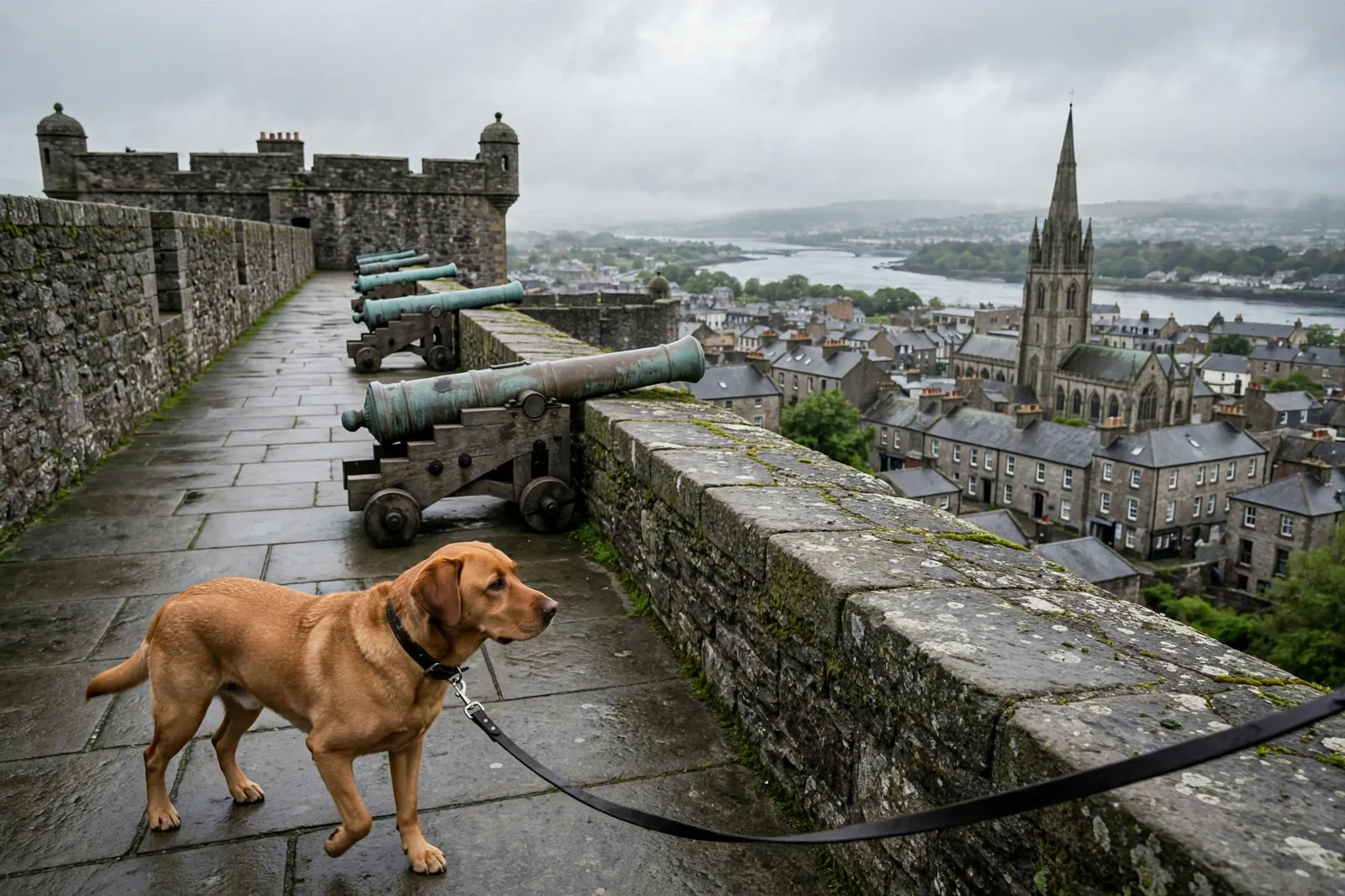
The walls were built in the early 1600s to defend the new walled city, and they remain remarkably complete: a full circuit of stone ramparts with gates, bastions and historic cannons still in place, looking out over rooftops, church spires and the river. For a dog walker, the practical facts matter as much as the history. The surface is mostly broad, paved and walkable in ordinary shoes, the circuit is short enough to complete comfortably in under an hour at sightseeing pace, and there are multiple access points — ramps and steps at various gates and streets — so you never have to finish the whole loop if your dog has had enough. You can join at one gate, walk two sides, and drop back into the streets for coffee.
Lead discipline is the whole game up here. Keep the lead short and fixed rather than extendable: the walkway is shared with tour groups that stop suddenly, children who run ahead, and other dogs coming the other way on the narrower stretches. Cannons and bastion corners create natural bottlenecks and tempting sniffing posts; walk your dog past on the outside, and do not let them climb on the historic stonework, walls or guns — it damages a fragile monument and photographs badly for every dog owner who follows you. Steps at some access points are stone and can be slippery after rain, so dogs that struggle with steps should use the gentler ramped entrances, and every dog should be walked, not carried or hurried, on wet stone.
Timing transforms the experience. Early morning is the connoisseur's slot: the light sits low over the Foyle, the ramparts are quiet enough for a reactive dog to manage, and you will share the circuit mainly with local walkers and runners. Late afternoon works well in summer for the same reason. Midday in high season, and any time a large event, parade or festival fills the old city, is when a worried dog will find the walls hardest — narrow points fill, groups bunch at the cannons, and dropping down into side streets is the sensible move rather than a defeat. Build the walls into your routine twice a day at quiet times and they become the backbone of the break; force them once at peak hour and they will feel like the worst walk of the trip. As with any historic site, access arrangements can change for works or events, so check the latest official guidance before you travel.
Orientation is easy once you are up there. One side looks inward over the compact old city and the Guildhall area; the outward faces give you the river, the Waterside across the water and, on clear days, hills in several directions. The gates punctuate the walk helpfully — each one is a decision point where you can continue, descend for the streets, or cut back to your accommodation. For a first circuit, allow longer than the distance suggests: dogs read the walls as a scent corridor as much as a viewpoint, and the stop-start rhythm of bastions, inscriptions and views is exactly what makes the walk satisfying rather than a march.
The Peace Bridge and River Foyle walks
If the walls are the city's headline, the Foyle is its breathing space. The Peace Bridge, the elegant curved foot and cycle bridge linking the city centre side with the Waterside, is the walk most dogs will enjoy most: wide, smooth, traffic-free and high enough over the river to feel like an outing in itself. On the far side, riverside paths and the green spaces around the Waterside connect naturally onward to St Columb's Park, while the city-side quays give flat, level walking that suits older dogs, pushchairs in the family group and anyone whose knees dislike the wall steps. Used together, bridge and quays let you build walks of almost any length — a twenty-minute leg-stretch before dinner or a full morning's out-and-back with a park at the far end.
Shared-path etiquette matters here more than anywhere else in the city. These routes carry cyclists, runners, scooters and other dogs, often approaching quietly and quickly from behind. Walk on one side, keep the lead short on the bridge itself where there is no verge to step onto, and never let an extendable lead drift across the path into a cyclist's line. A dog that startles at bikes will find the bridge easier at quieter times of day, and a dog that loves water needs reminding that the Foyle is a big, tidal, working river: there is no paddling, no swimming and no retrieving from the water here, whatever your dog thinks of the plan. Keep to the paths, keep the dog out of the river, and save swimming for a suitable beach on a day trip, with the usual safety checks.
The riverside also solves a practical problem every city break creates: the reliable, boring, essential walks. First thing in the morning and last thing at night, you do not want history or scenery — you want a flat, lit, predictable route near your bed where your dog can do what it needs to do. The quays and the lower paths serve exactly that purpose, and learning one short loop on arrival day pays off for the whole stay. Pack poo bags every time: bins exist along the main routes but spacing varies, and the rule everywhere in this guide is to carry waste to the next bin rather than leaving bags on walls, railings or path edges.
St Columb's Park and other green breaks
St Columb's Park, on the Waterside and reached easily via the Peace Bridge, is the green lung of a Derry dog break. It is a large, mature park with paths, open grass and enough space for the kind of longer, sniff-heavy potter that a rampart circuit cannot provide. This is where a young, energetic dog gets its real exercise, where a ball game in a quiet corner (keeping well away from sports use, other park users and any signed restrictions) can take the edge off a day of lead walking, and where the whole party can slow down. Treat it as the walls' necessary complement: stone and views in the morning, grass and trees in the afternoon. Keep dogs under close control throughout, respect any lead requirements signed on the day, clear up without exception, and check the latest official guidance before you travel if an event is scheduled in the park.
Smaller green breaks fill the gaps between the big walks. Churchyards, pocket gardens and the grassy areas around the old city's edges offer five-minute pauses rather than walks, and they matter more than they look: a dog that has had regular chances to sniff and settle on grass will walk the pavements and walls far more calmly than one marched from sight to sight. On the Waterside and in the suburbs, neighbourhood parks extend the options if you are staying further out — ask your accommodation host which local park regular dog walkers use, because that answer, given daily and honestly, beats any list. Wherever you go, the pattern to copy from local owners is unglamorous and effective: leads on around entrances, play areas and sports pitches, freedom only where space and sightlines genuinely allow it, and waste always bagged and binned.
Wet weather deserves a word here, because parks change character fastest. Grass that is firm in June can be saturated in November, paths under trees stay slick, and a white dog will not stay white. None of it is a problem with the right kit — a drying coat, a towel by the door of your accommodation and a spare lead — but it does affect route choice: on the worst days, the paved wall circuit and the quays will serve you better than any park, and the park can wait for a drier morning. Building that flexibility into each day, rather than fixing an itinerary that only works in sunshine, is the difference between a good Derry break and a damp argument.
The Guildhall area and the old streets with a dog
Down at street level, the Guildhall — the city's grand, red-sandstone civic building near the river and the main square — anchors the part of Derry you will cross most often. Dogs will generally not be going inside civic buildings, exhibitions or most indoor attractions, so plan the old city accordingly: one person walks the dog around the square and the nearby streets while the other looks inside, or the whole party enjoys the architecture from outside and moves on. This swap-and-share pattern, decided in advance rather than negotiated on the pavement, keeps the dog out of trouble and the humans out of resentment. The area around the Guildhall and the shopping streets inside the walls is also where pavements are busiest, so it is short-lead, close-heel territory, best tackled outside peak shopping hours with a dog that dislikes crowds.
The old streets repay slow walking. Within the walls, the street pattern still follows the original 17th-century layout, and the lanes, craft and café quarters and small independent shops make for good browsing at dog pace. Many smaller shops will tolerate or welcome a well-behaved dog, but permission is the owner's to give, never yours to assume — ask at the door, every time, and take a refusal gracefully. Outside the walls, the areas famous for their murals and history draw many visitors; if you walk them with a dog, go quietly, keep the dog close and under complete control, stay respectful around memorials and groups listening to guides, and be ready to give a tour space rather than weaving through it. A dog adds nothing to a sensitive place except risk, unless its behaviour is impeccable, in which case it adds nothing noticeable at all — which is the goal.
Practical streetcraft rounds this section out. City-centre bins are frequent enough that carrying bags is easy; pavement cafés exist but table spacing can be tight, so settle the dog under the table on a mat rather than in the walkway; and water is worth carrying even on short outings, because a dog walking on warm stone and pavement in summer heats up faster than its owner realises. If your wider trip includes the capital, our guide to Belfast with a dog pairs naturally with Derry — the two cities make a strong combined Northern Ireland break, with very different walking characters.
Where to stay with a dog in Derry
Choosing where to sleep in Derry is really choosing your walking pattern. A central hotel, guesthouse or apartment inside or just outside the walls suits short breaks and anyone travelling without a car: the wall circuit becomes your morning walk, the quays your evening one, and restaurants are minutes away. The trade-offs are the usual city ones — dog-friendly rooms may be limited in number and located where the hotel finds them convenient rather than where you would choose, gardens may be small or absent, and night-time toilet trips mean a lead walk on pavements rather than a door opened onto grass. Ask specifically which floor the dog rooms are on, whether the lift takes dogs, and where the nearest sensible patch of grass actually is; those three answers predict your stay better than any star rating.
A Waterside base, across the Peace Bridge, flips the balance. Parking is generally easier, streets are quieter at night, and St Columb's Park puts a real walk on your doorstep, while the bridge keeps the old city within walking distance for sightseeing and supper. Self-catering houses and apartments on either side suit multi-dog households and longer stays best of all: your own door, your own drying arrangements, and no corridor encounters with other guests' dogs at midnight. For any property type, the booking checks are identical and worth doing in writing: maximum number and size of dogs, the pet fee and whether it is per dog, per night or per stay, which areas are off limits, whether the dog may be left alone in the room at all, and whether there is any breed- or size-related condition. Policies change, listings lag behind them, and the only confirmation that counts is the property's own current answer.
Money and timing follow familiar rules. Central dog-friendly rooms are a minority of stock and sell first on event weekends, festival dates and summer Saturdays, so book the dog in at the same moment you book the room, not as a later email. Budget the pet fee into the total from the start — commonly a modest nightly or per-stay charge, but occasionally enough to change which property wins — and weigh it against what the location saves you in parking and driving. Finally, think about arrival: a dog that has travelled far arrives wired, so choose a property where the first walk can happen within minutes of parking the car, whether that is a quiet Waterside street or a first gentle half-circuit of the walls.
Eating and drinking with a dog
Derry's food scene works in a dog owner's favour if you plan around how the city actually eats. The most reliable options are the city's pubs and café terraces: traditional pubs in and around the old city often welcome dogs in bar areas, some cafés provide water bowls and outdoor seating where dogs are standard, and bakeries and coffee shops make good mid-walk stops. As everywhere in these guides, the word "often" is doing real work — policies vary by venue, by room within the venue and by how busy the night is, so ask at the door or phone ahead for a meal that matters, and have a second choice ready. A dog that settles under a table on a mat, ignores other tables and stays off the furniture will be welcomed back; the opposite kind shortens the list for everyone.
Structure the eating day around the walks and it plans itself. Coffee and something warm after the morning wall circuit; lunch where the dog can stay with you, rather than a fancier room that requires leaving it in accommodation (only ever an option if the property's rules and your dog's temperament both genuinely allow it, and never for long); dinner earlier rather than later if you want the dog welcome, because kitchens and bars both get stricter as they get busier. Carry a small kit that makes venues say yes: a lightweight mat that defines the dog's spot, a chew or lick mat to occupy it during the slow courses, water and a travel bowl, and bags for the inevitable pre- and post-meal pavement walks. In wet weather — expect at least some — a quick towel-dry before entering anywhere is basic courtesy and noticeably changes staff attitudes.
Self-catering solves the hardest cases honestly. Reactive dogs, giant breeds, multi-dog households and dogs that simply cannot settle in public all eat better at home, and Derry's shops and markets make stocking a kitchen easy. Mixing one planned meal out with relaxed cooking in is not a compromise version of the trip; for many dogs it is the trip working properly. Whichever pattern you choose, confirm current arrangements directly with venues before relying on them, and check the latest official guidance before you travel for anything that affects your plans.
Day trips: the Inishowen Peninsula and the Causeway Coast
Derry sits between two coastlines of very different character, and a dog break here is noticeably richer with one day given to each — or at least to the one that suits your dog. To the north, across the border in County Donegal, the Inishowen Peninsula offers the quieter day: big beaches, headlands, small harbour towns and the feeling of a coastline that has not been tidied for visitors. Dogs that need space and low stimulation thrive out here. Remember that you are crossing into Ireland, a different jurisdiction: keep the dog under close control, follow local beach and lead rules as signed, take all waste away, and carry whatever documents your own situation requires — check the latest official guidance before you travel, because cross-border arrangements for pets should always be verified rather than assumed.
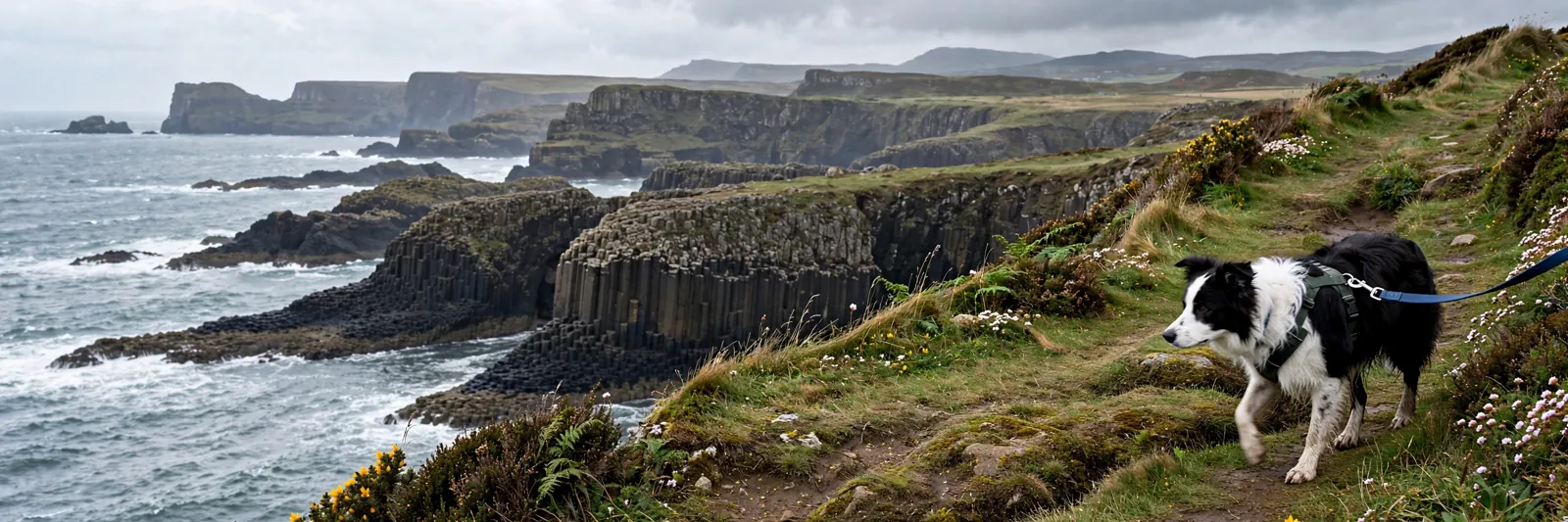
East along the north coast lies the famous alternative. The Causeway Coast strings together sandy beaches, harbour towns, castle ruins on cliff edges and, at its heart, the Giant's Causeway itself. It is busier, more structured and more spectacular in the postcard sense, and it makes a superb full day from Derry by car: a beach walk in the morning, a harbour town for lunch, and one headline sight done properly rather than three done breathlessly. Our dedicated guides cover the detail — start with the Causeway Coast with a dog for towns, beaches and dog zones, and the Giant's Causeway dog guide before visiting the stones themselves, where lead rules and visitor-centre arrangements decide how the visit works with a dog.
Choosing between the two with a dog in mind comes down to temperament and logistics. Take Inishowen for space, quiet beaches and a dog that finds crowds hard work; take the Causeway for variety, facilities and a dog that is happy around people, provided you time the famous stops early or late in the day. Either way, build the day properly: a real walk first, water and a bowl in the car, a drying towel that lives in the boot, and a hard rule that the dog is never left in a parked car while you visit anywhere it cannot go. On the way back, the Foyle-side roads return you to Derry in time for the evening wall walk — which, after a day of beaches, tends to be when owners decide this small city has quietly become one of their favourite dog bases in Ireland or Britain. For a greener inland contrast on a longer trip, the lakes and low hills covered in our Fermanagh Lakelands dog guide are also within reach.
A two-day Derry plan, plus the checklist that makes it work
Day one — the city on foot. Arrive, park once, and walk a short orientation loop: up onto the nearest stretch of wall, around two sides, and down again, so the dog learns the shape of the place. After lunch, cross the Peace Bridge to the Waterside, give the dog its proper exercise in St Columb's Park, and wander back across the river as the light changes. Eat somewhere the dog is expected, then finish with the short, flat quay loop you have designated as the night walk. Day one done well involves no driving after arrival and no moment where the dog has been asked to cope with too much novelty at once.
Day two — early walls, then the coast. Take the full wall circuit early, when it is quiet, and enjoy having the ramparts nearly to yourselves. Then choose your coast — Inishowen for quiet or the Causeway for spectacle — and give it the whole middle of the day rather than squeezing it. Back in Derry by evening, a dog that has had a beach day needs little more than food, a short pavement walk and sleep; owners get the city at its calmest. A third day, if you have it, is best spent repeating what worked — a favourite side of the walls, a longer Foyle walk, a slower morning in the park — because dogs visibly relax into places they have already learned, and owners notice more the second time around.
The checklist is short and unglamorous. Short fixed lead for the walls, bridge and streets, plus a longer line only for suitable open spaces. Poo bags in every pocket and a plan to carry waste to a bin. Water, a travel bowl, a drying coat or towel, and a mat that makes cafés and accommodation easier. The property's dog rules in writing, a saved note of the nearest veterinary practice to your base, and a weather forecast checked each morning with a plan B for the wettest hours. Do those basics, verify the few facts that change — opening arrangements, lead rules, event closures — against the latest official guidance before you travel, and Derry will do the rest: few cities in these islands hand a dog owner quite so much, quite so close together, as a circuit of old stone walls above a river.
Practical questions
Before you go
Can dogs walk on Derry's city walls?
Yes, dogs on short leads can walk the wall circuit in most circumstances, because the walls form a public walkway around the old city. Keep your dog close at gates, cannons and narrow points, step aside for groups, and check the latest official guidance before you travel because access can change for events, maintenance or safety work.
Are dogs allowed on the Peace Bridge and River Foyle walks?
Dogs on leads are normally welcome on the Peace Bridge and on the riverside paths along the Foyle, which are shared walking and cycling routes. Keep left, shorten the lead on the bridge itself, watch for cyclists approaching quietly from behind, and avoid extending leads across the full width of the path.
Is St Columb's Park good for dogs?
Yes, St Columb's Park on the Waterside is one of the most useful green breaks in the city, with paths, open grass and room for a longer leg-stretch than the walled centre allows. Keep dogs under close control, respect any signed lead areas or sports use, and take litter home or use the bins provided.
Where should I stay with a dog in Derry?
Choose between a central hotel or apartment inside or near the walls for short stays and sightseeing on foot, and a Waterside or outskirts base if you need parking, a garden and quieter night-time walks. Always confirm the exact room, dog fee, number limit and any areas that are off limits directly with the property before booking.
Can I visit the Causeway Coast or Inishowen on a day trip from Derry with a dog?
Yes, both work as day trips by car. The Causeway Coast east of the city offers beaches, harbour towns and famous cliff and castle stops, while the Inishowen Peninsula to the north gives quieter beaches and headlands. Check beach dog rules, lead requirements and opening arrangements for each stop, and check the latest official guidance before you travel.