This guide is independent and contains no paid placement. If affiliate links are added later, they will be clearly marked and will not change our editorial checks.
Make Ecos Nature Park your base: 220 acres of flat paths, a lake and the River Braid, with dogs on a lead. Add a riverside hour, then either the town centre or the short, steep Slemish climb. Ballymena is a working market town, not a resort, so the plan below is built around its one great park and the mountain on its doorstep.
Start at Ecos: the park that sets the pace
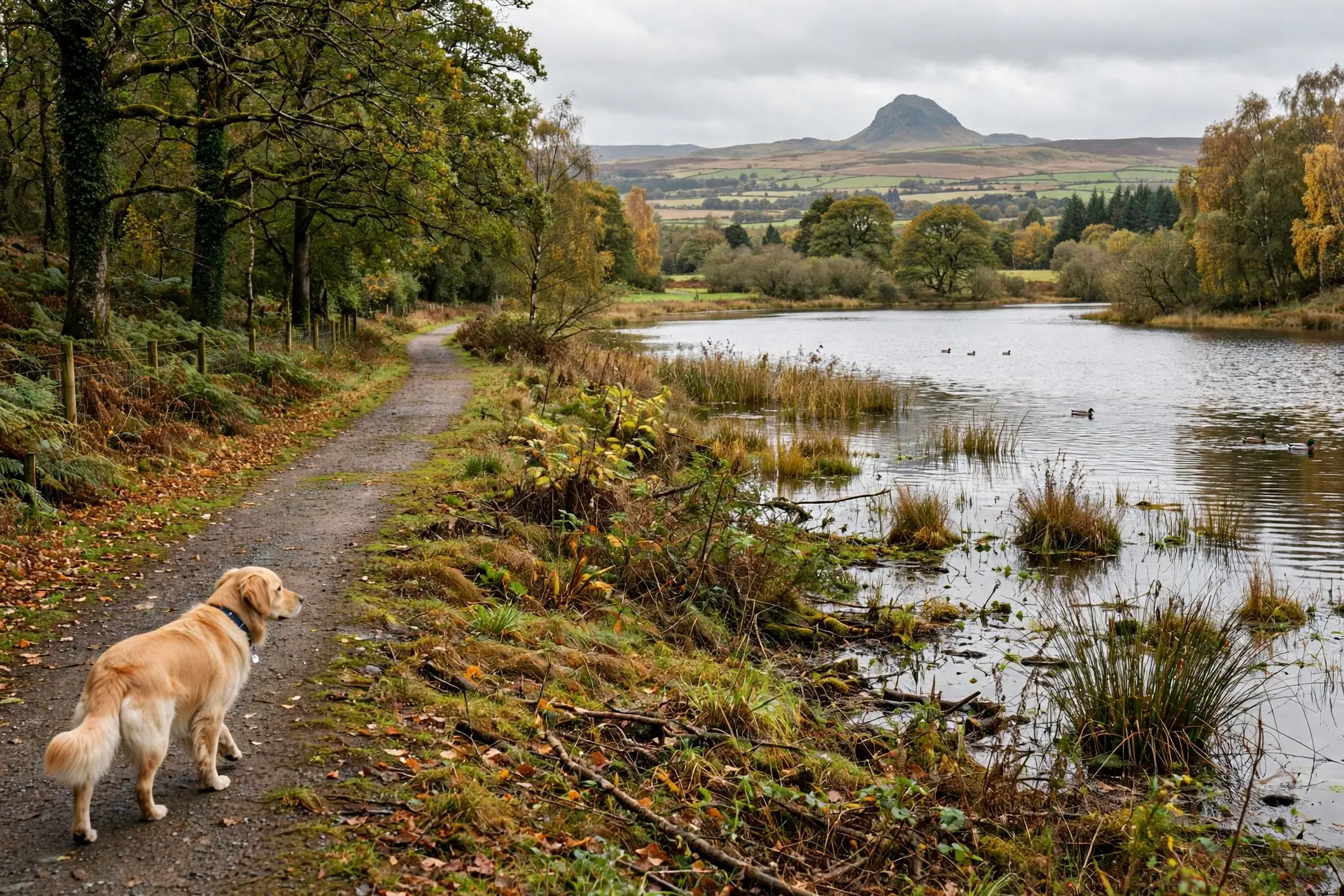
Ballymena is a busy market town in County Antrim, about 30 miles north-west of Belfast on the M2, and it does not pretend to be a holiday resort. That is exactly why Ecos Nature Park matters so much to a dog trip here. The park sits in the flood plain of the River Braid, a short distance from the town centre, and it gives a visiting dog what the town streets cannot: 220 acres of maturing woodland, wet meadow, ponds and a peaceful central lake, crossed by more than 8 kilometres of mostly flat footpaths. It is the anchor for the whole day, and the sensible place to begin.
The first thing to understand about Ecos is that it is a nature park first and a dog park second. Dogs are welcome, but they must be kept on a lead, and that rule is worth taking seriously rather than treating as flexible. The lake holds waterfowl, the meadows hold ground-nesting birds in season, otters have been spotted along the Braid, and Irish Moiled cattle graze parts of the site. A dog running loose through any of that is a problem for wildlife and for the other visitors who come here to watch it. A lead does not spoil the walk here, though, because the paths are wide, the ground is level, and there is so much to sniff at the dog's own pace that a three-metre lead feels generous rather than restrictive.
Arrive at the ECOS Centre car park off Kemohan's Lane, postcode BT43 7QA, following the brown signs for the Ecos Centre from the M2 and through the town. The centre itself is an environmental education and conference building with facilities available when it is open, and the car park is the start point for the main trails. The Millennium Bridge crosses the Braid at the back of the car park, and from there the park opens out: riverside path to the right, lake and playing area ahead, woodland closing in on the far side. On a fine weekend morning the car park fills early, so an 8 or 9 o'clock start buys you the quietest paths and the best chance of seeing birds on the lake before the cyclists and family groups arrive.
Before you set off, sort the basics at the car. Water for the dog, a towel for the return, poo bags in a pocket you can actually reach, and a lead you can hold comfortably for an hour or two. The park is flat enough for a pushchair and for older dogs, but the ground beside the surfaced paths can be soft after rain, so boots with grip are a better choice than trainers if the week has been wet. Check the notice boards by the centre for the current path layout and any temporary closures before you choose a loop, because flood-plain paths can be closed after heavy rain, and check the official guidance before you travel if you are planning around a particular facility.
The other thing Ecos gives you is a read on your dog for the rest of the day. A dog that settles into a steady, sniffing rhythm on the lakeside path is a dog that will probably enjoy an afternoon in the town or a longer drive into the Glens. A dog that is pulling, panting and over-aroused by the ducks within ten minutes is telling you to keep the day short, flat and close to the car. Ballymena's best days with a dog are the ones where Ecos sets the pace and everything else is optional.
Three Ecos loops, from a first sniff to a full circuit
Ecos rewards a simple approach: pick a loop that matches the dog you have today, walk it properly, and stop while it is still enjoyable. Three named routes cover most visits, and they share the same car park, so you can decide at the notice board rather than committing in advance.
The shortest option is a lakeside wander of roughly half an hour. From the ECOS Centre, cross the Millennium Bridge over the Braid, keep right along the lakeside path past the playing area, and circle back to the centre. This is the loop for puppies, older dogs, dogs that have just come out of the car after a long drive, and anyone arriving late in the day. It stays close to the car, it passes the lake where ducks and moorhens keep most dogs happily occupied, and it gives a nervous dog time to settle into the smells of a new place without committing to a long walk. Treat it as a warm-up rather than a tick-box exercise: let the dog sniff the lakeside reeds, watch the water, and decide for itself when it is ready to walk on.
The middle option is the Ecos Reserve Trail, a waymarked loop of about 3.6 kilometres, or 2.24 miles, that takes around an hour at a walking pace. From the rear of the car park, follow the path to the right of the Groundwork sculpture, cross the Millennium Bridge, and turn right along the Braid riverside for roughly 800 metres to Kemohan's Lane. Cross the main entrance road bridge, turn left and walk north along the lane, then turn right towards Summerfield Bridge and follow the perimeter path that runs close to the motorway for about 1.7 kilometres before sweeping back to the lakeside and returning to the centre. The motorway stretch is the least pretty part of the walk, and it is the section where a lead matters most, because the path runs near fast traffic and the noise can unsettle sound-sensitive dogs. On the plus side, the full loop shows you the whole character of the park in one hour: river, lane, meadow, lake and woodland edge, with the ground staying level throughout.
The longest option is the Ecos Centre Circular, listed at about 6.9 kilometres and an estimated two to two and a half hours. It takes in the same lake, woodland and riverside ground but at a fuller, slower pace, and it suits fit adult dogs that need a proper morning's work rather than a leg-stretch. Walk it clockwise if you want the riverside first and the lake as a reward at the end, and build in a water stop at the halfway point, because there is no guarantee of a dog-friendly tap along the way. If the weather turns, or the dog's pace drops, cut back towards the centre along any of the cross paths rather than pressing on: the park's flat layout means there is almost always a shorter way home.
Whichever loop you choose, keep to the marked paths. The wet meadows look inviting and are often the most interesting ground for a dog's nose, but they are also the most sensitive habitat in the park, and the ground can be deceptively soft. The same applies to the riverbank: stay on the path, keep children and dogs well back from the water in high flows, and remember that the Braid is a spate stream that rises fast and hard after rain. A good Ecos walk ends with a dog that has sniffed a lot, walked steadily and still has something left for the afternoon.
The Braid and the Main: Ballymena's two rivers
Ballymena grew up on its rivers, and the town still takes its bearings from them. The River Braid, known in Irish as Abhainn na Brad, rises in the Antrim Hills and runs south-west through Broughshane and through Ballymena itself, before joining the River Main near the town and feeding the Lough Neagh system. The museum and arts centre in the town centre is called The Braid after it, which tells you how central the river is to the town's sense of itself. For a dog owner, the practical point is simpler: the Braid is the river you will actually walk beside, and the Main is the bigger river you will cross on the way out of town.
The best riverside walking is inside Ecos Nature Park, where the Braid runs along the edge of the reserve and the paths are managed and signposted. The riverside stretch of the Reserve Trail follows the Braid for roughly 800 metres, and it is a different kind of walk from the lakeside: faster water, overhanging trees, kingfishers and dippers if you are lucky and quiet, and the smell of wet stone after rain. Dogs tend to love this section and pull towards the water, so keep the lead short here and do not let the dog scramble down the bank. The banks are not designed for access, the water is cold and fast after rain, and a dog that slips in can be swept a surprising distance before it finds a place to climb out.
Outside the park, be careful about assuming that any stretch of riverbank is a public path. Much of the Braid's bank is private land, and the fishing is looked after by the Braid Angling Club based in Broughshane. Fishing needs a DAERA rod licence plus the club's permission, and the bank is not public access, so do not assume you can fish or walk any stretch just because you can see the water. The village of Broughshane, a few miles north-east of Ballymena on the A42, is worth a short detour for the Broughshane Environment Waterfowl and Wildlife Trust sanctuary along the river, but check the official guidance before you travel for current access and dog rules, and keep the dog on a lead and out of the sanctuary enclosures.
Two cautions belong in any honest account of the Braid. The first is the spate nature of the river: after heavy rain it rises quickly, the paths beside it can flood, and the water that looked gentle in the morning can be a different river by the afternoon. If the park's riverside paths are closed, or the water is running high and brown, take the lakeside loop instead and come back another day. The second is blue-green algae, which can appear in still water in warm weather. Do not let your dog drink from or swim in the lake or ponds at Ecos, and if you see a green scum on the water, keep the dog well away and report it to the park or the council. The same caution applies to any still water you meet on the way out of town.
None of this should put you off the rivers. Walked with a lead and a bit of respect, the Braid is the prettiest hour in Ballymena, and it is the thread that ties the park, the village of Broughshane and the town centre together. The River Main, which the Braid joins, runs on towards Lough Neagh, and the low ground between Ballymena and the lough is worth remembering for another trip: flat, open, big skies, and a reminder that this part of Antrim is as much about water and farmland as it is about the coast.
Slemish: the half-day climb that earns its views
If Ecos is the gentle morning, Slemish is the afternoon that asks something of you. The mountain rises about 10 kilometres, or 6 miles, east of Ballymena near Broughshane, and it dominates the flat farmland around it so completely that you can see it from the Ballymena bypass on a clear day. It stands 437 metres, or 1,434 feet, above the surrounding plain, and it is the remains of the plug of an extinct volcano: a steep basalt crag that resisted erosion while the softer rock around it wore away. That geology is why the climb is short and why it is hard.
The walk from the Slemish car park on Carnstroan Lane is only about 1.5 kilometres round trip, and most people allow one to two hours for the ascent and descent. Do not let the distance fool you. The lower slopes follow a grassy track, but the ground turns rocky and steep higher up, there is no single marked path to the summit, and some scrambling is needed in places. The climb is about 180 metres of ascent, and the rock is very slippery when wet, which in County Antrim is often. Boots with good grip are essential, walking poles help on the descent, and waterproofs are worth carrying even on a bright morning, because the weather on an exposed summit changes faster than the weather in the town below.
For the dog, Slemish is a judgement call, and it is worth making it honestly before you drive out. A fit, sure-footed adult dog with good recall and experience on rough ground will enjoy it: the smells are new, the wind is full of information, and the summit is a proper reward. An older dog, a puppy, a very small dog, a dog with joint problems, or a dog that panics on steep or exposed ground should stay on the lower grassy track or skip the climb altogether. There are no facilities on the hill, so carry water for both of you and a bowl, and keep the dog on a lead on the ascent, because the mountain sits in an Environmentally Sensitive Area, the slopes hold grazing sheep, and a loose dog among livestock is a serious problem. The descent is often trickier than the climb, for dogs as much as for people, so take your time and be ready to turn back if the rock is wet or the wind is rising.
The reason to make the effort is the view. On a clear day you can see Ballymena and Lough Neagh to the west, the Sperrin Mountains beyond them, the Bann Valley and the Antrim Hills to the north, and the Antrim and Scottish coasts to the east. It is a wide, open panorama that makes sense of the whole area: the town in its river valley, the farmland, the lough, and the hills that frame them. The mountain also carries a story that is worth knowing before you climb. According to tradition, Saint Patrick, captured and brought to Ireland as a teenage slave in the fifth century, worked as a shepherd on the slopes of Slemish for around six years under a master named Milchu. The mountain is part of the Saint Patrick's Trail, a 92-mile driving route linking 15 sites connected with Patrick's life, and every 17 March large crowds climb Slemish as a pilgrimage. On that day the numbers can reach into the thousands, the car park and local roads are managed by the council, and it is not a day for a nervous dog. Go on an ordinary weekday instead, and you will often have the hill almost to yourself.
Practical details: the car park on Carnstroan Lane, Broughshane, Ballymena BT42 4PE, has basic toilet facilities and information boards, and parking is free, though arrangements on Saint Patrick's Day itself are set by the council and can change from year to year. The mountain is reached from Ballymena by the A42 to Broughshane, then by following the signs. Phone signal can drop out on the summit, so download an offline map before you start, and check the official guidance before you travel for the latest access information. If Slemish looks too steep for your dog on the day, the drive out is not wasted: the farmland lanes around Broughshane and Carnstroan are themselves a pleasant on-lead walk, with the mountain as a backdrop, and the village is a short drive back to Ballymena for lunch.
Beyond the mountain: Gracehill, Broughshane and the Glens
Ballymena's position is its real strength as a base. You are roughly 30 miles from Belfast, a similar distance from the Causeway Coast, and a short drive from the Glens of Antrim, so a second day here is best spent driving out and walking somewhere different, then coming back to the town for the night. Three places within easy reach deserve a mention, and each of them suits a different kind of dog day.
The closest is Gracehill, just outside the town, a Moravian settlement laid out in the 1760s around a square with a plain church at its centre. It survives as a remarkably complete piece of eighteenth-century planning, and in 2024 it was inscribed on the UNESCO World Heritage List as part of the Moravian Church Settlements. It is a quiet, orderly place, and the walk around the square and the settlement is a gentle on-lead stroll rather than a hike. Dogs are welcome on the public paths, but this is a residential village and a place of worship, so keep the dog close, keep the lead short, and do not let it wander into gardens or the churchyard. It pairs naturally with a Slemish morning: climb the mountain, then stop at Gracehill on the way back to town for a slow half hour that lets the dog cool down.
The second is Broughshane itself, the village on the A42 between Ballymena and Slemish. It is a small, tidy place with the river running through it, the waterfowl sanctuary already mentioned, and a village green that makes a good leg-stretch stop. It is also the place to check in with local knowledge: the people who live along the Braid know when the river is up, which paths are muddy, and whether the Slemish car park is full. A short on-lead walk along the village paths, a look at the river, and a drive on is the right scale for Broughshane; it is a pause, not a destination.
The third is the bigger day out, north into the Glens of Antrim and the Causeway Coast. From Ballymena the Glens are an easy drive, and Glenariff Forest Park, with its waterfall walks and riverside trails, is the most dog-friendly of the forest parks in the area. Dogs are welcome on a lead, and the Waterfall Walk Trail, at about 3 kilometres, and the shorter Rainbow Trail are both well within reach of a fit dog after a morning at Ecos. Further on, the Causeway Coast offers cliff-top paths and beaches, but the rules change by the season and by the beach, so check the official guidance before you travel, and read our guide to dog-friendly beaches and their rules before you plan a coastal day. The point of staying in Ballymena is that you do not have to do the coast every day: you can have a flat park day, a mountain day, and a Glens day, and sleep in the same bed each night.
South of Ballymena, the other direction is Lough Neagh, the largest lake in Britain and Ireland, whose shores are about a twenty-minute drive away. The lough shore is open, flat and exposed, which suits dogs that like big skies and long, straight walks, but the paths are less developed than the Ecos network, and the same algae caution applies to still water in warm weather. For most visitors, the Glens will be the more rewarding day out, and the lough is best kept for a quiet evening walk if you are staying over and want somewhere different from the park.
Ballymena town centre with a dog
The town centre is worth an hour or two, but it helps to arrive with the right expectations. Ballymena is a working market town, and its centre is built around shopping and services rather than sightseeing: the Tower Centre and Fairhill Shopping Centre, Church Street and Ballymoney Street, the bus and railway stations, and the civic buildings around Bridge Street and Linenhall Street. With a dog, the centre works best as a short, purposeful loop rather than an open-ended wander: a walk, a coffee, a look at one building, and back to the car before the dog gets bored or the pavements get crowded.
Start at the People's Park, north of the centre, which is the town's green heart and a good first stop after Ecos. The park was given to Ballymena by Sir Robert Adair in 1870, and it is a lakeside park with lawns, mature trees and paths that suit a gentle on-lead circuit. It also holds Five Apples, a steel sculpture by the Japanese artist Shiro Masuyama, which is worth a look even if modern sculpture is not usually your thing. Check the gate times before you go, keep the dog on a lead, and keep it out of the lake. The park is smaller and more formal than Ecos, so treat it as a half-hour breather between town errands rather than a second long walk.
From the People's Park, Church Street leads you into the centre, past St Patrick's Church, a striking nineteenth-century Gothic Revival landmark, and towards Bridge Street and The Braid. The Braid, at the junction of Linenhall Street and Bridge Street beside the Town Hall, houses the Mid-Antrim Museum, an arts centre, a theatre and a cafe, and it tells the story of mid-Antrim from its earliest times to the present day, including the linen trade that built the town's prosperity. Dogs are not admitted inside the museum, apart from assistance dogs, so plan a split visit: one person goes in while the other walks the dog along Bridge Street and the nearby riverside, then swap. Admission is free and the museum is open Monday to Saturday, roughly 10am to 5pm, closing at 4pm on Saturdays, so a half-hour each is realistic. If you only have time for one of you to look around, the permanent history gallery on the top floor is the part to see.
The town's other historic fragment is the site of Ballymena Castle, where the Scottish-Baronial pile built between 1865 and 1887 once stood before it was gutted by fire in 1922. Today there is a quiet heritage garden of low walls and earthworks by the Braid, and it makes a calm on-lead stop for a dog that has had enough of pavements. There is also a Norman motte at Harryville on the south side of town, a reminder that this ground has been settled and fought over for a very long time. Neither place is a destination in itself, but both are worth ten minutes if you are passing, and both are easier to enjoy with a dog than a busy shopping street.
For the practical side of the centre, the main Church Street car park sits directly opposite The Braid, which makes it the most convenient place to park for a town visit with a dog. You will need to cross the road at the traffic lights to reach the museum, so keep the dog close and the lead short at that crossing. The railway station and bus depot are about a ten-minute walk from The Braid, along Galgorm Road, which matters if you are arriving by public transport. If you need supplies, the town centre has the full range of shops, cafes and toilets, and the Tower Centre is the easiest place to pick up anything you forgot: extra poo bags, a towel, a lead, or a bag of treats for the drive home.
One honest note about the centre: it is busiest on Saturdays, when the pavements fill with shoppers and the noise and crowds can unsettle a nervous dog. A weekday visit, or a Saturday morning before the shops fill, is a much better experience. If your dog is reactive to people, other dogs or traffic, do the town as a short loop at a quiet time, and save the long walk for Ecos, where there is space to move aside and let the world pass.
Staying over: what to ask before you book
Ballymena is a sensible place to stay overnight because it is cheaper than the coast, it has a proper town for supplies, and it sits in the middle of the places you will want to visit. The town has hotels, guesthouses and self-catering cottages in and around it, and the surrounding farmland has farm stays and rural cottages within a short drive of Ecos. What it does not have is a long list of obviously dog-focused hotels, so the booking questions matter more than the brand name.
Ask about the dog policy in writing before you pay anything, and ask the specific questions rather than accepting a general "dogs welcome". How many dogs are allowed, and is there a charge per dog per night or per stay? Which rooms or units accept dogs, and are they the ones near an exit or at the far end of a corridor? Is the garden or outside area enclosed, and how high is the fence? Can the dog be left alone in the room, and if so, for how long and under what conditions? Is there a charge for cleaning, and is there a place to dry a wet dog? A property that answers these questions clearly is a property that has thought about dogs; a property that answers with a single reassuring sentence has probably not.
Location matters as much as policy. A stay within walking distance of Ecos Nature Park is the best option for a dog trip, because it gives you a proper morning walk without loading the car. A stay on the edge of town towards Broughshane puts you closer to Slemish and the Glens road. A stay beside the M2 is convenient for driving but can be noisy, and a dog that is already tired from a day's walking will sleep through it, while a light-sleeping dog may not. If you are staying in a cottage, ask whether the garden is genuinely secure for your dog's size and temperament, and whether there are livestock in the neighbouring fields. A terrier that can slip through a fence is a different problem from a greyhound that cannot, and the owner is the only person who knows which one you have.
The Galgorm Resort and Spa, just outside the town centre on Galgorm Road, is the best-known upmarket option in the area, and it is worth checking its current pet policy directly if you are considering it, because policies at resort hotels change and are often limited to particular room types. Do not assume a spa hotel accepts dogs, and do not assume it does not: ask, get the answer in writing, and check what the dog arrangements are for the restaurant and the grounds. For most dog owners, a self-catering cottage or a small guesthouse with a garden and a tolerant host will be a better fit than a large hotel, and the money saved on the room can go towards a longer stay.
If you are staying for more than a night, think about the vet. Save the number of the nearest veterinary practice before you need it, and know where the nearest out-of-hours service is. Rural practices can be twenty minutes away and close early, and a dog that eats something it should not on a walk is a problem you want a phone number for, not a search to do in a panic. This is a small piece of preparation that costs two minutes and is worth doing for any trip away from home.
Eating and drinking with a dog in Ballymena
Eating out with a dog in Ballymena follows the same pattern as in most Northern Irish towns: the dog is welcome on the terrace and in the beer garden when the weather allows, and indoors only if the individual place says so. Policies change with the season and with the management, so treat anything you read online as a starting point and check on the day, and check the official guidance before you travel if a particular meal matters to your plans.
The most convenient option is the Secret Garden Cafe at the ECOS Centre, which is the natural stop after a morning in the park. It is a short walk from the car park, it suits a dog that is already tired and ready to lie down, and it means you do not have to load a muddy dog into the car to find lunch. Opening times are seasonal, so check before you set out, and have a backup in the town centre if the cafe is closed. A tired dog, a coffee and a scone after a lakeside loop is a good way to end the morning, and it is better than driving into town with a dog that is still full of energy.
In the town centre, The Grouse Bar and Restaurant on Ballymoney Street is the best-known traditional stop, and the town's walking guides regularly point visitors towards it for comfort food and a fire. It is a proper old pub-restaurant rather than a cafe, so ask about the dog policy before you arrive, and be ready for the answer to be the terrace or a particular area rather than the whole dining room. Middletown Coffee on Church Street is the town-centre coffee stop most often recommended by locals, and it suits a short break between errands: a good coffee, a place to sit for twenty minutes, and a dog that can lie at your feet. Again, ask first, and do not assume that a cafe that welcomed dogs last year still does.
A few habits make eating out with a dog easier anywhere in Ballymena. Bring a mat or a blanket for the dog to lie on, so it has a defined place and is not sprawled across a walkway. Order quickly and keep the meal short, especially with a young or restless dog: a forty-minute lunch is realistic, a two-hour dinner is a test of patience for everyone. Keep the dog on a lead even on a terrace, and keep the lead short enough that it cannot reach the next table's food or a passing child. Bring water and a small bowl, because a pub will not always have one, and bring a chew or a stuffed Kong for a dog that needs something to do while you eat. If the dog cannot settle, take the food away and eat it in the car or back at your stay: a takeaway eaten in peace is better than a restaurant meal spent apologising.
For supplies, the town centre supermarkets and the shops in the Tower Centre and Fairhill cover everything a dog trip needs, from dog food to towels. If you are self-catering, buy the dog's food before you drive out to a rural cottage, because the village shops around Broughshane and Gracehill are small and may not stock your brand. And if you are planning a picnic, Ecos is the place for it: the playing area by the lake and the meadows are far pleasanter than any town-centre bench, and a dog that has already walked is a dog that will lie quietly beside a picnic rug.
Getting there and getting around
Ballymena is an easy drive from Belfast, about 30 miles north-west on the M2, and the motorway runs close enough to the town that you can be parked at Ecos within ten minutes of leaving it. From Derry-Londonderry, the A26 and the A37 bring you in from the north-west, and from the south the M2 and the A26 connect through Antrim town. The roads are good, the signage to Ecos and to Slemish is clear, and the driving is straightforward by Northern Ireland standards, with the usual cautions about tractors on the rural lanes and sudden rain on the motorway.
By public transport, Ballymena is on the Belfast to Derry-Londonderry railway line, and the station is about a ten-minute walk from The Braid in the town centre. Trains run regularly, and the bus depot sits beside the station, with local services to Broughshane, Antrim and the surrounding villages. Translink is the operator to check for current times and fares, and dogs on trains and buses are subject to the operator's conditions, so check those before you travel rather than assuming. A car is not essential for a town-centre and Ecos visit, because the park is a short walk or a short local bus ride from the centre, but it is close to essential for Slemish and the Glens, where the car parks and trailheads are reached by rural lanes with no regular bus service.
Parking is straightforward if you plan it. For Ecos, use the ECOS Centre car park off Kemohan's Lane, BT43 7QA. For the town centre, the main Church Street car park opposite The Braid is the most convenient, and there are other town-centre car parks around the Tower Centre and Fairhill. For Slemish, use the car park on Carnstroan Lane, Broughshane, BT42 4PE, which has basic toilets and information boards. All three are free or low-cost by city standards, but check the signs on the day, because arrangements can change, and on Saint Patrick's Day the Slemish car park is managed and may be restricted. Arrive early at Ecos and at Slemish on fine weekends, because both car parks fill, and the walk from an overflow space is longer than you expect with a dog that has already been in the car for an hour.
Once you are there, the town itself is walkable. The People's Park, Church Street, Bridge Street, The Braid and the castle garden are all within a compact area, and the walk from the town centre to Ecos is short enough to do on foot if you are staying centrally and the dog is fit. The pavements in the centre are generally wide, but the crossings on the main roads are busy, so keep the dog on a short lead and wait for the lights rather than trying to hurry across. If you are driving between the park, the town and Slemish, allow more time than the map suggests: the rural lanes are narrow, the farm traffic is slow, and the dog will be happier if you are not rushing.
Ballymena through the seasons
Ballymena is a year-round destination, but the experience changes with the season, and the best time to visit depends on the dog you have. Spring, from March to May, is the most rewarding season for most dogs: the meadows at Ecos come alive, the woodland is full of birdsong, and the paths are firm after the winter wet. It is also the season of ground-nesting birds, so the lead rule matters most in spring, and it is the season when Slemish is at its busiest, because Saint Patrick's Day on 17 March brings thousands of people to the mountain. If you visit in mid-March, avoid the mountain on the day itself and enjoy Ecos instead.
Summer, from June to August, brings the longest days and the warmest weather, and it is the season when the lake and meadows at Ecos are at their best, with butterflies over the meadows in large numbers on a warm day. It is also the season to be careful about heat: the park is mostly open, with limited shade on the lakeside paths, and a dark-coated dog can overheat quickly on a still afternoon. Walk early, carry water, and use the woodland paths for shade in the middle of the day. The lake and ponds are at their most tempting in summer, and also at their most risky for blue-green algae, so keep the dog out of the water and do not let it drink from the lake. Midges are less of a problem in Ballymena than on the west coast of Scotland, but they appear on still, damp evenings near water, so a summer evening walk can be itchier than you expect.
Autumn, from September to November, is the quiet season and, for many dog owners, the best. The crowds thin, the car parks empty, the woodland turns, and the paths are still firm before the winter rains set in. It is the best season for Slemish, because the rock is drier, the air is clear, and the views are at their widest. It is also the season to watch for fireworks around early November, which can unsettle noise-sensitive dogs, and to check the park notice boards for path closures after heavy rain. A wet autumn week can leave the riverside paths soft and the meadows boggy, so boots and a towel in the car are essential.
Winter, from December to February, is the season that tests your commitment. The park is open and the paths are usable, but the ground is wet, the daylight is short, and the wind across the open meadows is cold. The advantage is solitude: on a winter weekday you can have Ecos almost to yourself, and the birds on the lake are easier to see without the summer vegetation. Dress for it, keep the walk short, and dry the dog properly afterwards, because a wet dog in a cold car is a miserable end to a walk. Slemish in winter is a serious undertaking and should only be attempted in settled weather, with good boots and a willingness to turn back. For most dogs, winter in Ballymena means a short Ecos loop, a coffee, and a warm car home, and that is a perfectly good day.
The practical kit list for a Ballymena dog day
Ballymena does not demand specialist equipment, but a small amount of preparation makes the difference between a good day and a damp, muddy scramble. The list below is built around the places in this guide, and it fits in a single bag by the car door.
Start with the lead. A standard lead is right for the town centre and for Slemish, where a short lead near livestock and steep ground is essential. A longer training lead, of three to five metres, is better for Ecos, where the paths are wide and the dog needs room to sniff without being under your feet. A retractable lead is a poor choice here: the park paths are shared with cyclists, children and other dogs, and a long, thin cord across a path is a hazard. Bring a spare lead as well, because leads break, clips fail, and a dog that slips its lead beside the Braid is a problem you do not want.
Water is the next essential. Carry a bottle and a collapsible bowl for the dog, even for a short walk at Ecos, and especially for Slemish, where there are no facilities on the hill and the climb is thirsty work. Do not rely on the lake or the river for drinking water, and do not let the dog drink from puddles on the car park or the lanes, which can carry runoff. A towel, or better two, belongs in the car for the return: one for the dog, one for the seats. A drying coat is worth its weight if you are walking in winter or after rain, and a spare blanket for the car keeps a wet dog warm on the drive home.
Tick checks are part of the routine after any walk in long grass or woodland, and Ecos has both. Check the dog after the walk, particularly around the ears, the neck, the armpits and between the toes, and remove any ticks promptly with a tick remover. The same check applies after Slemish, where the grass on the lower slopes can hold ticks in the warmer months. Poo bags are obvious, but bring more than you think you need, and carry them out: the park has bins, but the bins are not always where you need them, and a bag left on a fence post is litter, not a plan.
Finally, think about the dog's feet and the weather. The paths at Ecos are mostly surfaced and kind to paws, but the rocky upper slopes of Slemish are hard on soft pads, and a dog that has never walked on rough stone will feel it. If your dog has sensitive paws, keep it to the lower grassy track on Slemish and save the summit for a dog that is used to rough ground. In wet weather, the paths can be slippery, so boots with grip for you and a steady pace for the dog are the right combination. And if the weather closes in, remember the rule that applies to every walk in this guide: the mountain and the park will still be there tomorrow, and turning back is not a failure.
A one-day plan that actually works
Here is the day this guide is built around, in the order that works best for most dogs. It assumes a car, a morning start, and a dog that is fit enough for a proper walk but not a mountain athlete. Adjust the timings to your dog, and cut any part of it without guilt: a shorter day that ends well is better than a longer day that ends in a tired, grumpy dog.
Arrive at the ECOS Centre car park by 9 o'clock. Walk the Ecos Reserve Trail, the hour-long loop, taking the riverside stretch first while the dog is fresh and the birds are active. Let the dog sniff, keep the lead on, and stop at the lake for ten minutes to watch the water. By 10.30 you should be back at the centre, and the dog should be pleasantly tired rather than exhausted. If the dog still has energy, add the short lakeside loop; if it is flagging, stop, give it water, and towel it down.
Late morning, drive into the town centre and park at the Church Street car park. Walk to the People's Park for a gentle half hour, then stroll down Church Street to Bridge Street. If you want to see the museum, split the visit: one person goes into The Braid while the other walks the dog, then swap. Pick up lunch from a cafe, and if the weather is kind, eat it outside with the dog at your feet. By early afternoon the dog will have had a full morning, and this is the point where you decide the rest of the day.
If the dog is still bright, the weather is settled and the rock is dry, drive out to Slemish for the afternoon climb. Allow two hours for the drive, the climb and the return, and be ready to turn back at the lower slopes if the dog is struggling. If the dog is tired, or the weather is closing in, skip the mountain and drive out to Gracehill instead for a slow half hour around the square, or simply head back to Ecos for a short, gentle lakeside wander before the drive home. Either ending is a good ending, and the dog will not know what it missed.
For a longer stay, the second day writes itself: a morning at Ecos on a different loop, then a drive north into the Glens of Antrim, with Glenariff Forest Park as the target, or a day on the Causeway Coast, checking the beach rules first. Our guide to Belfast with a dog covers the city you will pass through on the way in, and it is a useful read if you are combining Ballymena with a night in the city. The third day, if you have one, belongs to Lough Neagh or to a slow morning in Broughshane, and then the drive home. Three days in Ballymena is enough to see the park, the mountain, the town and the Glens, and to come home with a dog that has genuinely enjoyed itself.
Practical questions
Before you go
Are dogs allowed off the lead in Ecos Nature Park?
No. Dogs are welcome in Ecos Nature Park but must be kept on a lead. The park is a nature reserve with ground-nesting birds, waterfowl on the lake, otters along the Braid and grazing animals nearby, so a lead is a condition of visiting, not a suggestion. Bring a lead long enough for sniffing, and keep your dog on the marked paths.
Is Slemish Mountain a sensible walk for my dog?
It depends on the dog. The round walk from the car park is only about 1.5 kilometres and takes one to two hours, but the upper slopes are steep, rocky and slippery when wet, with some scrambling. Fit, sure-footed dogs cope well; older dogs, puppies, very small dogs and dogs with joint problems are better kept to the lower grassy track. There are no facilities on the hill, so carry water for both of you.
Can dogs go into The Braid museum in Ballymena?
No, dogs are not admitted inside the Mid-Antrim Museum at The Braid, apart from assistance dogs. Treat it as a split visit: one person looks around the galleries while the other walks the dog along Bridge Street and the nearby riverside paths, then swap. The museum is free and open Monday to Saturday, so a short visit fits easily between walks.
Where can I park for Ecos Nature Park with a dog?
Use the ECOS Centre car park off Kemohan's Lane, Ballymena BT43 7QA, reached from the M2 and signposted from the town. It is the start point for the Ecos Reserve Trail and the Ecos Centre Circular, and facilities are available at the centre when it is open. Arrive early on fine weekends, as the car park fills and the overflow is a walk in itself.
Is Ballymena a good base for the Causeway Coast with a dog?
Yes, for a quieter base. Ballymena sits on the M2 about 30 miles north-west of Belfast, with the Glens of Antrim and the Causeway Coast an easy drive to the north and Lough Neagh to the south. You trade seaside atmosphere for cheaper stays, flat local walks at Ecos and a proper town for supplies, then drive out to the coast for the day. Check the official guidance before you travel, as seasonal dog rules apply on several Causeway beaches.