This guide is independent and contains no paid placement. If affiliate links are added later, they will be clearly marked and will not change our editorial checks.
Colwyn Bay suits a dog day built around the tide: walk the flat promenade at any hour, use the beach where dogs are allowed and at low tide for the biggest stretch of sand, then rest in Eirias Park behind the seafront. Check the seasonal beach restrictions and the tide times before you travel.
Let the tide set the plan
Colwyn Bay is a town that changes shape twice a day. At high tide the sea comes right up to the promenade wall and the beach narrows to a strip of sand; at low tide the water pulls a long way out across Liverpool Bay and leaves a vast, flat expanse of firm sand that dogs love. That single fact decides more about your day than anything else, so check the tide times before you leave home and build the plan around them rather than around the clock.
The simplest shape for a day is this: arrive for low tide if you can, let the dog run and sniff on the open sand while the beach is at its widest, then move up to the promenade and Eirias Park as the tide comes in. A falling tide is the most forgiving window, because the beach only gets bigger while you are on it. A rising tide needs more attention, especially with a dog that chases the waterline or wanders: know which access point you came down, keep an eye on the water behind you, and head back up the steps before the sand you crossed disappears.
Colwyn Bay sits on the North Wales coast in Conwy County Borough, between Llandudno to the west and Rhyl to the east, with the A55 running just behind the town. It is a classic Victorian seaside resort that has kept its long promenade and its broad sandy bay, and the modern waterfront, including the Porth Eirias watersports centre, has given the seafront a fresh centre of gravity. The town centre is a short walk from the beach, so a dog day here rarely needs a car once you have parked.
Think of the day in three parts rather than one long walk. The promenade is the easy, always-available part: flat, surfaced and suitable in any weather. The beach is the exciting part, and it depends on the tide and the season. Eirias Park, the big green space just behind the seafront, is the resting part, with shade, grass and water for a calmer hour. Dogs that get all three in the right order tend to settle well in the evening; dogs that get the beach at the wrong tide, or the promenade at the hottest part of the day, tend to come home over-tired and sandy.
One more thing to settle before you set off is the seasonal beach rule. Colwyn Bay beach has a restricted zone in the summer months, and the exact area and dates are set by the council and can change, so check the official guidance before you travel rather than relying on memory or on what another visitor tells you. The signs at each beach access point are the final word on the day. If you are visiting between October and April, the rules are at their simplest; in summer, a little planning about where dogs are welcome makes the difference between a relaxed beach hour and an awkward one.
The beach: sand, seasons and the dog rules
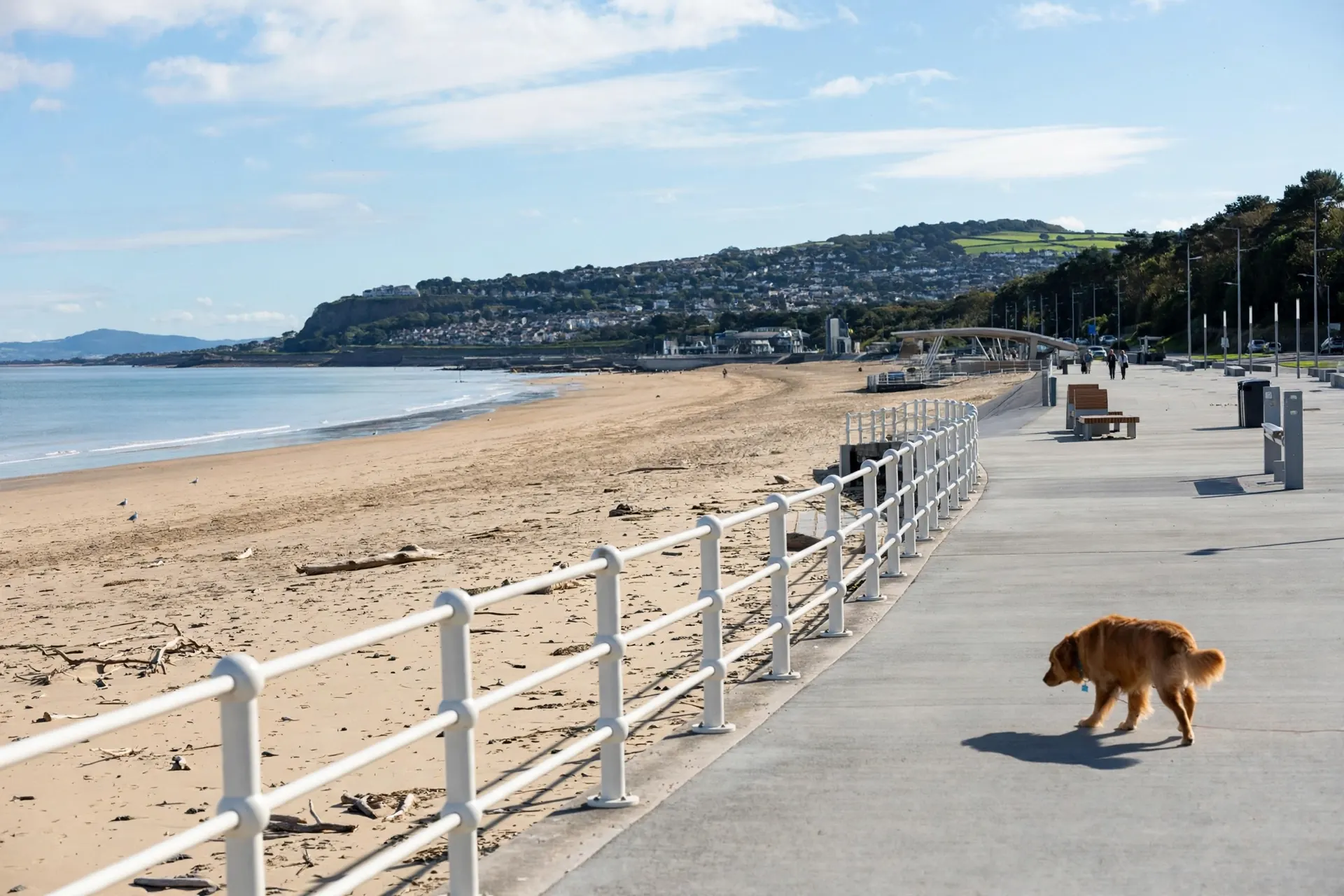
Colwyn Bay beach is a long, gently sloping stretch of golden sand that runs along the whole seafront, and at low tide it is one of the widest beaches on this part of the North Wales coast. The sand is mostly firm and flat, which suits older dogs and dogs that are not confident on soft, deep sand, and the shallow slope means the water stays ankle-deep for a long way out. That is good news for paddling dogs and for owners who want to keep a nervous dog close to the edge rather than in deep water.
The seasonal restriction is the rule that matters most. During the summer season, dogs are normally kept off the main beach section by the promenade, roughly from 1 May to 30 September, while other stretches of the bay remain open to dogs all year. The boundary is marked by signs at the access points, and it is worth reading them rather than guessing, because the restricted area is not always obvious from the sand. If you are unsure, ask at the seafront or check the official guidance before you travel; a fine for breaking a beach restriction is an expensive end to a good day, and the rules are enforced under a public spaces protection order.
Outside the summer months, the whole beach is generally open to dogs, which is why October through to April is the best season for a proper beach walk here. The light is lower, the beach is quieter, and a dog can run from one end of the bay to the other without the summer crowds. Winter brings its own conditions: the wind off the sea is cold and unbroken, so a short-coated dog may need a coat, and the sand can be wet and heavy after rain. A winter beach walk is often better as two shorter outings with a warm stop in between than as one long march.
On the beach itself, the practical rules are the same as anywhere on the British coast. Keep your dog in sight and under control, especially where children are playing or other dogs are off the lead. Pick up after your dog and use the bins provided at the promenade access points; sand hides what you miss, and the tide does not count as a bin. If your dog is a keen swimmer, be aware that the sea here is shallow and usually calm, but currents and cold water still deserve respect, and a dog that swims far out needs a recall you can trust. Our guide to dog-friendly beaches in the UK explains how seasonal bans, public spaces protection orders and fines work across the country, and it is worth a read before a summer visit.
Seawater is the other thing to manage. Most dogs will try to drink it, and a few mouthfuls are usually no more than an upset stomach, but a dog that swallows a lot can become seriously ill. Carry fresh water and a collapsible bowl, offer it often, and watch for vomiting, diarrhoea or unusual tiredness in the hours after a beach walk. Dogs that chase balls into the surf swallow more water than dogs that paddle at the edge, so if your dog is a keen retriever, use a floating toy and keep the game short. Rinse sandy paws and bellies with fresh water after the beach, because dried salt and sand irritate skin and paws, and check between the toes for grit before the drive home.
Finally, remember that the beach is shared. Colwyn Bay beach is used by walkers, runners, families, kite flyers and watersports users, and the wide sand means everyone spreads out, but a dog charging across a picnic or through a kite line is not going to make friends. A long line is a good compromise on a busy day: the dog still gets room to run and sniff, and you keep control near other people. If the beach is busy, the quieter stretches towards the ends of the bay are usually calmer, and early morning is the quietest time of all.
Walking the promenade end to end
The promenade is the backbone of a Colwyn Bay dog day. It runs along the seafront in a long, gentle curve, wide enough for dogs on leads, pushchairs, mobility scooters and cyclists to pass each other without the squeezing and dodging that spoils narrower seafronts. The surface is flat and smooth, so it suits older dogs, dogs recovering from injury, puppies on short outings and owners with a pushchair or a wheelchair. There are no steep steps to climb, and the sea is always on one side, which gives a dog a constant stream of smells and sights without the effort of a hill walk.
A full end-to-end walk is a comfortable hour at a dog's pace, and it works well as a morning outing before the beach or as a late-afternoon wind-down after it. Start at the western end near the town centre and walk east towards Rhos-on-Sea, or reverse the route and finish near the cafes; either way, the walk is an out-and-back, so you can turn around at any point and the distance is entirely up to you. The promenade is at its best early in the morning, when the light is soft, the dog walkers are out and the cyclists are still few, and again in the evening, when the sun drops over the bay and the crowds thin out.
Keep your dog on a lead on the promenade. It is a shared path, and cyclists use it at speed, especially on summer weekends, so a dog wandering across the path on a long lead is a hazard for everyone. A short lead, with the dog on the sea side or the land side consistently, makes passing easy and avoids tangles. Watch the access points where people come down from the car parks and the town, because dogs appear suddenly from side paths and a reactive dog needs a little warning. If your dog is nervous around bikes, walk on the landward side and step aside early when you hear a bell.
There is very little shade on the promenade, which matters more than people expect. On a hot day the surface can be warm underfoot, the sun reflects off the sea, and a dark-coated dog can overheat faster than on a shaded woodland walk. Test the paving with the back of your hand: if it is too hot for you to hold your hand on it for a few seconds, it is too hot for paws. Walk in the morning or the evening in summer, carry water, and use the beach access points to let the dog cool off in the shallows where dogs are allowed. In winter the same openness works the other way: the wind comes straight off the sea with nothing to break it, so a coat for a short-haired dog and a windproof layer for you make the walk far more pleasant.
Along the way, look out for the Porth Eirias watersports centre, the modern building on the seafront that has become a landmark for the town. The area around it is one of the busiest parts of the promenade, with people carrying boards and boats, and it is a good place to stop for a drink and a sit-down. The stepped sea defences along parts of the seafront are worth a look too: they are designed to break up waves, and they give dogs a series of low ledges to sniff along, although they are not a place to let a dog scramble unsupervised. The old pier is long gone from daily life, so do not plan a walk around it; the promenade and the beach are the attractions now.
Eirias Park: the green half of the day
Behind the seafront, a short walk inland, lies Eirias Park, and it is the part of Colwyn Bay that surprises first-time visitors. The park is a large, open green space with a boating lake, mature trees, sports pitches, tennis courts and a children's play area, and it gives a dog day the variety that a beach alone cannot: grass underfoot instead of sand, shade instead of open sky, and the slower smells of a park rather than the salt and wind of the shore. After an hour on the beach, most dogs are happy to slow down here, and the park is the natural place for a calm middle part of the day.
Dogs are welcome in Eirias Park on a lead. The main paths are flat and surfaced, which suits older dogs and dogs that find the beach tiring, and the open grass is good for a gentle sniffing walk and a rest. Keep your dog out of the boating lake and away from organised sports and the play areas, and keep the lead on around the lake, where ducks and other water birds draw dogs in. The park is heavily used by families, especially at weekends and in school holidays, so pick up after your dog and keep the lead short near the paths where children are running.
The park works well as a wet-weather fallback and as a summer shade stop. When the beach wind is too strong or the sun is too fierce on the promenade, the trees and the sheltered paths of the park make a walk possible that would be miserable on the open seafront. In autumn the trees turn, and the fallen leaves give dogs a whole new set of smells; in spring the park is one of the first green spaces in the town to feel warm. If your dog is the sort that needs to decompress after excitement, twenty minutes of slow walking on the park paths is a better reset than another half hour on the beach.
There are a few practical points to plan around. The park has sports facilities, including the stadium and pitches, and on match days parts of it are busy and noisy, with crowds, whistles and dogs that are not used to the noise. If your dog is sound-sensitive, check whether an event is on before you head in, and use the quieter wooded edges rather than the main pitches. The lake is the other draw: dogs that love water will want to get in, and the water is not for swimming, so keep the lead on and walk past with purpose rather than stopping at the edge. Bring a towel in the car if your dog is likely to find a puddle, because the park holds water after rain and the paths can be muddy in winter.
Combine the park with the seafront rather than treating it as an alternative. A good shape for a day is beach at low tide, park for a rest and a sniff, then promenade in the evening. The walk between the park and the seafront is short and mostly flat, and it passes through the town centre, which means you can pick up supplies, water or a coffee on the way. For dogs that travel with a crate or a car bed, the park is also the easiest place to settle a dog for a proper rest between outings, because there is grass to lie on and shade to lie in.
The Wales Coast Path east and west
The Wales Coast Path runs right through Colwyn Bay, and the town makes a convenient base for two very different coastal walks. Westward, the path heads towards Penrhyn Bay and then on to Llandudno, with the Great Orme rising ahead of you as a landmark for the whole walk. Eastward, it runs through Rhos-on-Sea and Old Colwyn towards Abergele and Rhyl, along a quieter stretch of coast where the beach is narrower and the villages are smaller. Both directions are mostly flat and surfaced near the town, which makes them suitable for a dog that can manage a couple of hours on a lead, and both can be done as out-and-back walks of any length.
The westward walk is the more scenic of the two. From Colwyn Bay the path follows the coast past Penrhyn Bay, a smaller sandy bay that is often quieter than the main beach, and then on towards Llandudno, where the path climbs towards the Great Orme. The full walk to Llandudno is a long day, around five miles each way, so most dog owners walk part of it and turn back at Penrhyn Bay, which gives a satisfying two-hour round trip with a beach stop in the middle. The path is on a lead throughout, and near the roads and the railway it needs a short lead and full attention. Our guide to Llandudno with a dog covers the two bays, the Great Orme walks and the promenade at the far end, so it is the natural companion piece if you walk west.
The eastward walk is the quieter choice. From the promenade the path runs through Rhos-on-Sea, a small village with its own harbour, a tiny beach and a row of cafes, and then on to Old Colwyn, where the coast becomes rockier and the path rises a little above the shore. Rhos-on-Sea is a good turning point for a shorter walk: the harbour is worth a look, the village is calm, and there are places to sit with a dog. Beyond Old Colwyn the path continues towards Abergele, and the walking becomes more rural, with fields on one side and the sea on the other. This direction suits dogs that find the main beach too busy, because the crowds thin out quickly once you leave Colwyn Bay behind.
On either direction, the same practical points apply. Keep the dog on a lead near roads, cliff edges and the railway, and be aware that the path crosses roads in places where traffic moves fast. Carry water, because there are long stretches with no shops or cafes, and check the tide if you plan to drop down to the sand, since some of the smaller bays are cut off at high tide. In summer the path can be hot and exposed, so walk early; in winter the wind is the main challenge, and a sheltered stretch through Rhos-on-Sea or the wooded parts of the park makes a better alternative. If your dog is not used to long walks, build up gradually: a two-hour coastal walk on consecutive days is a lot for a dog that normally walks for thirty minutes, and a tired dog on the way back is a dog that stops, lags and needs carrying.
Eating and drinking with your dog
Colwyn Bay is an easy town for eating out with a dog, because the seafront cafes and the town centre pubs are used to visitors with dogs, and many have outdoor seating where a dog is welcome. The promenade cafes are the simplest option: sit outside with a view of the bay, order something simple, and let the dog settle under the table. On a fine day the outdoor tables fill up, so arrive before the lunch rush or accept a later lunch, and bring a mat or a blanket so the dog has a defined place to lie down on the paving.
Inside, the picture is more mixed, and it changes from place to place. Some pubs and cafes welcome dogs indoors, especially in the quieter months, while others are outdoor-only or restrict dogs to a particular area. The rule is to ask before you sit down, and to accept the answer gracefully: a place that says no to dogs indoors is not being unfriendly, and there is usually a dog-friendly table outside or another cafe a few doors along. If your dog is likely to bark at other dogs or at people passing the table, choose a table at the edge of the seating area and keep the lead short, so the dog is not guarding the whole terrace.
Order with the dog in mind. A dog that has just had a beach walk is thirsty, so ask for a bowl of water when you sit down, and most places will happily provide one. Bring a few treats or a chew to keep the dog occupied while you eat, and feed the dog before you sit down if the meal is going to be long, because a hungry dog under a table is a restless dog. Avoid giving the dog food from the table, especially anything salty, fatty or containing onion or garlic, and keep the lead tucked away from the aisle so that staff carrying trays do not trip over it.
The town centre, a short walk from the seafront, has more choice, including cafes, bakeries and takeaways, and the high street is a useful stop for supplies. If the weather turns, a takeaway eaten on a bench on the promenade or in the car is a perfectly good dog-friendly meal, and it avoids the question of indoor access altogether. For a longer stay, look for accommodation with a kitchen or a kitchenette, because cooking for yourself takes the pressure off finding a dog-friendly restaurant every evening, and a tired dog will always prefer eating at your feet in a quiet flat to a busy dining room.
Staying overnight with a dog
Colwyn Bay has a good range of dog-friendly places to stay, from seafront hotels and guesthouses to self-catering flats and cottages, and the town works well as a base for a longer North Wales break. The seafront hotels are the most convenient for a dog day, because the beach and the promenade are on the doorstep, and a dog that needs a last outing at night does not have to cross the town to reach the grass. Self-catering flats and cottages suit dogs that need space and a garden, and they make feeding and drying a sandy dog much easier than a hotel room does.
When you book, ask the specific questions rather than relying on a "dog-friendly" label. How many dogs are allowed, and is there a charge per dog or per stay? Are dogs allowed in the bedroom, or only in certain rooms? Is there a garden or an enclosed area, and is it genuinely secure, with a gate that closes properly? Can the dog be left alone in the room for a short time, and if not, what are the arrangements for meals? The answers matter more than the label, and a place that gives clear, specific answers is usually a place that has thought about dogs properly.
Think about the room itself. A ground-floor room with direct access to the outside is worth asking for, especially for an older dog or a dog that needs the toilet at night, and a room near the exit is better than a room at the end of a long corridor full of other guests. Bring the dog's own bed, a blanket that smells of home, and a towel for drying sandy paws at the door, because a hotel carpet and a wet dog are a bad combination. If the accommodation has a hard floor in the entrance, use it as a drying station before the dog goes further into the room.
For a longer stay, Colwyn Bay is a sensible base for the whole North Wales coast. Conwy and its castle are a short drive west, Llandudno and the Great Orme are the same distance, and the mountains of Snowdonia are within an hour by car. That means a week here can mix beach days with town days and mountain days, which suits dogs that get bored of the same walk. Book the dog-friendly accommodation first and plan the day trips around it, rather than the other way round, because the best dog-friendly rooms in summer are booked well ahead.
Arriving, parking and getting around
Getting to Colwyn Bay with a dog is straightforward. The A55 runs along the North Wales coast just behind the town, so drivers come off the expressway and are at the seafront within a few minutes. The town also has a railway station on the North Wales Coast line, with trains to Chester, Crewe, Manchester and Holyhead, and dogs are welcome on trains, usually on a lead and at the owner's feet, although you should check the official guidance before you travel for the current rules and any restrictions on busy services. The station is a short walk from the seafront, so arriving by train and walking to the beach is entirely practical.
Parking is easiest if you arrive early, especially on sunny weekends and in school holidays, when the seafront fills up quickly. There are car parks along and just behind the promenade, including near Porth Eirias and the town centre, plus on-street parking on the roads behind the seafront. Charges and time limits change, so check the official guidance before you travel, and leave extra time to walk from the car park to the beach access point that suits your dog. On a hot day, choose a shaded space if you can, and never leave a dog in a parked car, even for a few minutes: a car heats up fast, and the seafront offers no shade for a parked vehicle.
Once you are here, the town is small enough to walk everywhere. The seafront, the town centre and Eirias Park are all within a short walk of each other, and most dog owners will not need the car again until they leave. That is one of the town's strengths: you can park once, walk to the beach, walk to the park, walk to lunch, and walk back to the car at the end of the day. If you are staying for several days, the same applies, and the car can stay parked while you explore on foot.
For dogs that travel badly, plan the journey as carefully as the day. Bring water for the car, stop on the way if the drive is long, and give the dog a short walk before you set off and as soon as you arrive. A dog that arrives stressed from a hot, noisy car journey will not enjoy the beach, so a calm arrival matters. Keep the car ventilated, use a shade on the window if the sun is strong, and secure the dog properly for the journey, whether that means a crate, a harness or a guard. On arrival, let the dog out, offer water, and take a short toilet walk before you head for the beach.
Before you travel, find the nearest vet and save the number in your phone. Colwyn Bay has veterinary practices in the town and nearby, and an emergency vet is available out of hours, but the number is much easier to find at home than in a panic on the promenade. Note the location of the nearest practice to your accommodation, and check whether it is open on the days you are visiting. This is a small job that takes five minutes and is worth doing for every trip, not just this one.
When the wind wins: a wet-weather plan
Colwyn Bay is an open coast, and the weather can change fast. A bright morning can turn into a wet, windy afternoon, and a dog day that depends entirely on the beach will fall apart. The good news is that the town has a workable wet-weather plan, and it starts with accepting that the beach is not always the right choice. On a day when the wind is driving rain across the bay, the beach is exposed, the sand sticks to everything, and a small dog can get cold quickly, so move the walk inland.
Eirias Park is the first fallback, because the trees give shelter and the paths stay usable in rain, although they can be muddy after heavy rain. A shorter, slower walk in the park, with the dog on a lead and a drying coat ready, is a better outing than a long beach walk in a storm. The town centre is the second fallback: a walk through the shops, a coffee in a dog-friendly cafe and a browse in the covered areas give the dog a change of scene without the exposure of the seafront. If the rain is heavy, a short walk and a long rest is a legitimate plan, and most dogs are content with a warm, dry afternoon after a wet morning.
Pack for the weather you might get, not the weather you hope for. A drying coat, a spare towel and a waterproof mat in the car turn a wet walk into a manageable one, and a towel at the door of your accommodation stops wet paws from spreading through the room. Dry the dog thoroughly after a wet walk, especially the belly, the ears and between the toes, and check the paws for grit and for sore spots after walking on wet sand and shingle. If the dog is shivering or reluctant to walk, cut the outing short: a dog that is cold and wet is not enjoying itself, whatever the plan says.
Winter storms deserve respect. When the sea is rough and the waves are coming over the promenade, stay well back from the edge, keep the dog on a short lead, and do not let the dog down on to the beach at all. The sea defences are designed for waves, not for dogs, and a wave that knocks a person off balance will sweep a small dog away. On stormy days, the best dog walk in Colwyn Bay is a short one in the park, followed by a long rest indoors.
Two easy day trips: Conwy and Llandudno
Colwyn Bay is a good base for two short day trips, and both are easy with a dog. Westward, about five miles along the coast, lies Conwy, a walled medieval town with a castle, a harbour and a quay that dogs love to sniff along. The castle itself does not admit pet dogs, but the town walls, the quay, the Smallest House and the walks around Morfa beach and Bodlondeb are all worth a dog day, and the town has cafes and pubs that welcome dogs. Our guide to Conwy with a dog covers the castle rules, the town walls walk and the harbour, so read it before you go and plan the day around the parts that suit your dog.
Llandudno, also about five miles west, is the grander seaside resort, with two bays, a Victorian pier and the Great Orme headland rising above the town. The North Shore and West Shore beaches have their own seasonal rules, the promenade is a classic walk, and the Great Orme offers longer walks with wide views across the bay. It is a bigger, busier town than Colwyn Bay, and the crowds on a summer day can be a lot for a nervous dog, so go early or go out of season for the calmest experience. Our guide to Llandudno with a dog covers the beach rules, the Great Orme and the promenade, and it pairs naturally with the walk west along the coast path from Colwyn Bay.
Both trips are short enough to do by car or by train, and both are best planned as half-days rather than full days, with the afternoon back in Colwyn Bay for a quieter walk. A dog that has had a busy morning in Conwy or Llandudno will be happy with a short promenade walk and an early evening in the evening, and a day that tries to do both towns and the beach is a day that ends with a tired, over-stimulated dog. Choose one, do it properly, and leave the other for another visit.
If you have longer, the mountains are within reach. Snowdonia, now also known as Eryri, is about an hour's drive, and the valleys and lakes offer a completely different kind of dog walk, with cooler air, fresh water and long, quiet paths. That is a different kind of day, and it needs different planning, including checking which paths are suitable for dogs and where livestock is grazing, but it shows why Colwyn Bay works as a base: the coast, the towns and the mountains are all within easy reach, and a week here can mix all three without a long drive on any single day.
What to pack for a Colwyn Bay dog day
A Colwyn Bay dog day needs a little more kit than a local park walk, because the beach, the wind and the tide all add demands. The essentials are water and a bowl, a lead and a long line, poo bags, a towel and a drying coat. Water is the most important item on the list: the promenade has little shade, the beach has no fresh water, and a dog that has been running on sand will drink far more than usual. Carry more than you think you need, and offer it often rather than waiting for the dog to ask.
The lead choice matters. A short lead for the promenade and the town, and a long line for the beach, cover most situations, and a harness is a good idea for a dog that pulls, because it spreads the pressure and gives you better control near cyclists and other dogs. Bring a spare lead as well, because a lead dropped in the sand or soaked in seawater is no fun to use for the rest of the day. A whistle or a favourite toy helps with recall on the beach, and a ball that floats is a better choice than one that sinks, especially if your dog swims.
For the dog, pack a drying coat or a spare towel, a blanket or a mat for lying on in a cafe, and a few treats or a chew for settling under a table. A dog first-aid kit is worth carrying on a coastal walk: tweezers for thorns and grit, a bandage, saline for rinsing eyes, and the vet's number saved in your phone. Check the paws before and after the beach, because sand, shingle and salt can irritate pads, and a dog that is limping after a beach walk may have grit between the toes or a cut from a shell.
For you, pack a windproof layer even on a sunny day, because the sea breeze can be cold when the sun goes behind a cloud, and sun cream for the same reason, because the sun reflects off the water and the sand. A bag for wet towels and sandy leads keeps the car clean, and a spare pair of socks is a small luxury after a beach walk. If you are visiting in winter, add a warm layer and a hat, because the wind on the promenade is the coldest part of the day, and a flask of something hot makes the walk far more pleasant.
Finally, pack patience. A beach day with a dog rarely goes exactly to plan: the tide is different from the forecast, the beach is busier than expected, or the dog decides that the most interesting thing in the world is a dead crab. Build slack into the plan, keep the distances short, and let the dog set the pace. The best Colwyn Bay days are the unhurried ones, with time for a long sniff, a paddle, a rest in the park and a slow walk back along the promenade as the light fades.
Practical questions
Before you go
Can dogs go on Colwyn Bay beach all year round?
Not on every stretch. Seasonal restrictions usually apply to the main beach by the promenade from 1 May to 30 September, when dogs are kept off that section, while other parts of the bay stay open to dogs year round. The restricted zone and its dates are set by Conwy County Borough Council and can change, so check the official guidance before you travel and read the signs at each beach access point. Outside the summer season the main beach is generally open to dogs, which makes autumn and spring the easiest times for a long beach walk.
Is the promenade at Colwyn Bay good for dogs?
Yes, it is one of the easiest seafront walks on the North Wales coast. The promenade is wide, flat and surfaced, with room for dogs on leads, pushchairs and cyclists to pass each other without crowding. There is little shade on a hot day, so bring water and plan the walk for the morning or evening in summer. Keep your dog on a lead, watch for cyclists, and use the beach access points to reach the sand where dogs are allowed.
Where can dogs go off the lead in Colwyn Bay?
The beach outside the seasonal restricted zone is the usual place for off-lead play, and the open grass and wooded paths of Eirias Park work well for on-lead exploring rather than off-lead running. Keep your dog on a lead on the promenade, near roads, around the boating lake and anywhere other dogs are close by. Recall matters more than the location: if your dog will not come back reliably, use a long line on the beach so they still get space to run.
Are dogs allowed in Eirias Park?
Yes, dogs are welcome in Eirias Park on a lead. The park has open grass, trees, paths and a boating lake, so it suits a calm sniffing walk and a rest after the beach. Keep dogs out of the water and away from organised sports and play areas, and pick up after your dog, as the park is heavily used by families. The paths are mostly flat and surfaced, which makes it a good option for older dogs and for wet days when the beach is too windy.
Where can I park with a dog in Colwyn Bay?
There are car parks along and just behind the promenade, including near Porth Eirias and the town centre, plus on-street parking on the roads behind the seafront. Arrive early on sunny weekends and school holidays, when the seafront fills up fast. Charges and time limits change, so check the official guidance before you travel, and leave extra time to walk from the car park to the beach access point that suits your dog.
What should I do if my dog drinks seawater at Colwyn Bay?
Offer fresh water straight away and watch for vomiting, diarrhoea or unusual tiredness over the next few hours. A few mouthfuls are usually no more than an upset stomach, but a dog that has swallowed a lot of seawater can become seriously ill, so contact a vet promptly if symptoms appear or your dog seems unwell. Carry fresh water and a bowl on every beach walk, and discourage drinking from the sea by offering water often, especially on a hot day.