This guide is independent and contains no paid placement. If affiliate links are added later, they will be clearly marked and will not change our editorial checks.
Combe Martin suits dogs best at low tide and on foot: the sheltered bay gives you a short, easy beach walk, the village street gives you shops and cafes within a few minutes of the car, and the South West Coast Path gives you big views — but only if you respect the tide, the steep climbs and the seasonal dog rules on the beach.
First impressions: a bay that shelters you
Combe Martin sits at the bottom of a steep, wooded valley where a long village street runs downhill to the sea. That geography is the first thing to understand with a dog, because it shapes every walk you will do here. The village is not a flat seaside town with a promenade; it is a line of cottages, shops and cafes strung along one road that drops steadily towards a small, sheltered bay, with high ground rising sharply on both sides. The bay itself faces roughly north-east into the Bristol Channel, tucked between headlands, which is why the water inside it is often noticeably calmer than the open coast a mile in either direction.
For a dog, that shelter matters. On a day when the wind is tearing across the exposed cliffs above the village, the beach can still be calm enough for a relaxed walk, and on a hot day the cliffs throw shade across part of the sand in the late afternoon. The trade-off is that the beach is small. At low tide it opens out into a broad sweep of sand and rock pools with room to move; at high tide most of it disappears, and the water comes right up against the sea wall and the rocks at the edges. So the rhythm of a Combe Martin day is set by the tide table, not by the clock. Check the tide times before you leave home, and plan the beach for the hours either side of low water.
Arriving with a dog works best if you treat the first twenty minutes as a settling-in walk rather than a route march. Park near the beach, let the dog out for water and a short toilet walk on the lead, and look at the bay together before deciding anything. The beach car park puts you within a couple of minutes of the sand, the harbour steps and the start of the coast path in both directions, so there is no need to rush. Watch how your dog reacts to the boats, the gulls and the smell of seaweed: some dogs settle instantly on a small beach like this, while others need a few minutes of sniffing before they relax. A nervous dog will often do better on the firm sand near the waterline than on the loose shingle and rock pools at the top of the beach, where the footing is uneven and the smells are intense.
The village street deserves the same slow start. It is long — one of the longest village streets in England, by local account — and it climbs steadily away from the sea, so a walk from the beach to the top of the village and back is a genuine little workout for an older dog. Pavements are narrow in places and the road carries through-traffic, including coaches and delivery vans, so keep your dog on a short lead and on the inside, away from the kerb. The reward for the climb is a proper village: a butcher, a small supermarket, a post office, gift shops, cafes and pubs, all within walking distance of the beach. That matters more than it sounds, because it means you can buy dog food, fresh water and a forgotten lead without getting back in the car.
One more thing about the setting: Combe Martin sits on the edge of Exmoor National Park, and the coast path here is part of the South West Coast Path, the long-distance trail that runs around the south-west peninsula. That gives the village a particular character. It is a working coastal village first and a holiday base second, with fishing boats, a small harbour area and a wildlife park on the edge of the village, rather than a resort built around amusements. Dogs fit naturally into that picture — you will see them on the beach, on the coast path and outside the cafes — but the village asks a little more of an owner than a flat resort does: more climbing, more attention to tides, and more care on unfenced cliff edges.
The beach, the tide and the dog rules
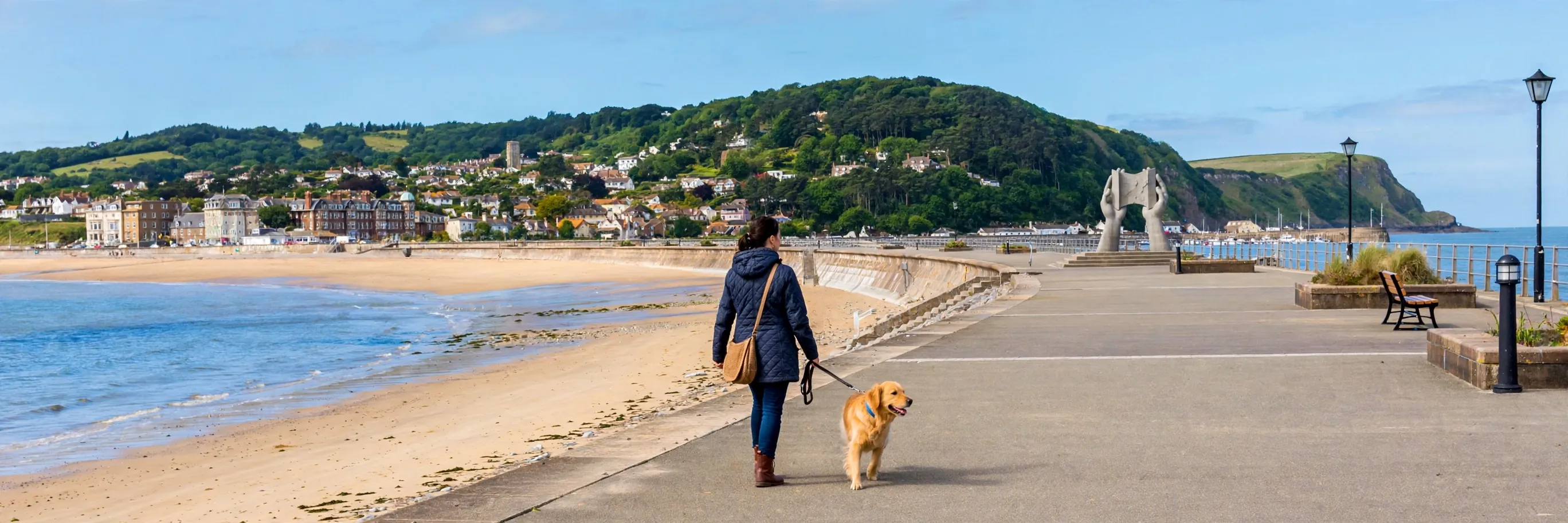
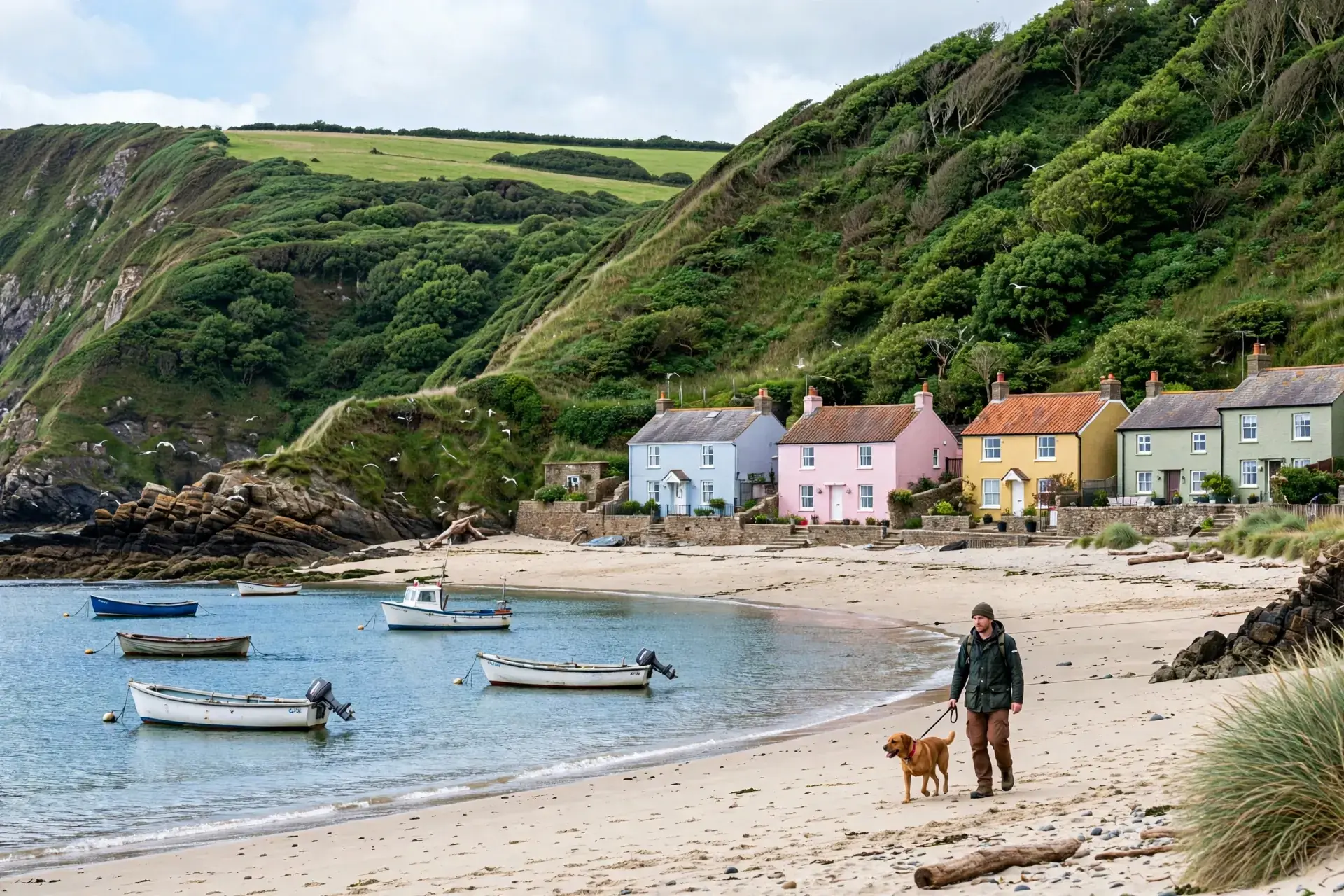
Combe Martin beach is a mix of sand and shingle, backed by a sea wall and a small harbour area, with rocky outcrops at both ends that uncover rock pools as the tide falls. At low water the sand is firm and broad, the pools are full of crabs, anemones and small fish, and there is room for a dog to trot along the waterline and sniff without crowding anyone. At high water the sand is mostly gone, the pools are submerged, and the only dry ground is the top of the beach and the promenade area. This is not a beach to improvise on: look up the tide times for the day, note the time of low water, and aim to be on the sand for the two hours either side of it.
Dog rules on the beach are the single most important thing to check before you travel, and they are also the thing most likely to catch a visitor out. Many beaches in North Devon carry seasonal restrictions that ban dogs from part or all of the beach during the summer months, and the dates and the exact stretch of sand covered can change from year to year. Combe Martin is no exception to the need to check: read the signs at every beach entrance on the day you arrive, and check the official guidance before you travel rather than relying on what a guidebook or a forum post said last year. If a restriction is in force, it usually applies to a defined section of the main beach, and there may be stretches at the edges where dogs are still welcome — but do not assume that. The signs on the ground are the rule that counts.
When dogs are allowed on the beach, a lead is still the sensible default. The beach is small enough that an off-lead dog can reach the harbour steps, the rock pools or another family's picnic in seconds, and the rocks at the edges hide fishing hooks, broken shell and slippery weed. A long line gives a dog room to run and sniff while keeping you in control near the water's edge, and it is the right choice for most dogs on a first visit. If your dog is reliable, calm around other dogs and has a solid recall, a short spell off the lead on the open sand at a quiet time is reasonable — but bring the dog back on the lead before you reach the rocks, the harbour or the steps up to the coast path.
Rock pools are the best and the riskiest part of the beach for a dog. They are fascinating — full of smells, movement and cool water — and most dogs love nosing around them. The risks are sharp barnacles, broken mussel shells, slippery weed and the chance of a cut paw, plus the temptation to drink the salty water in the pools. Keep a close eye on a dog that is new to rock pools, and carry fresh water so the dog does not drink seawater out of thirst. If your dog cuts a paw on a barnacle, rinse the wound with fresh water, check for shell fragments and walk the dog back on the lead; a cut that looks small on the beach can be sore by the time you reach the car, so check paws before you drive home.
Seawater and sand bring their own routine. Dogs that swim or paddle should be rinsed with fresh water afterwards, especially around the ears and paws, and dried properly before getting into the car — sand works its way into coat, ears and car seats alike, and wet sand on the drive home is a misery for everyone. Bring two towels rather than one, and a dry blanket for the boot or the back seat. If your dog eats sand, watch them closely: a small amount passes through, but a dog that gulps mouthfuls of sand can become unwell, so interrupt the behaviour and offer fresh water and a chew instead. And if your dog swims, keep them away from the harbour entrance and the boat moorings, where ropes, chains and propellers are a hazard even in calm water.
Finally, respect the beach as a shared space. Pick up after your dog every time — there are bins near the beach entrances, and a bag left on a rock or tucked behind the sea wall is still litter. Keep your dog away from people fishing from the rocks, from children playing in the pools, and from the small boats drawn up on the sand. A well-behaved dog on a beach this size is welcome; a dog that charges at other dogs or steals food from a picnic is remembered for the wrong reasons.
West on the coast path: Watermouth and Ilfracombe
Heading west from Combe Martin, the South West Coast Path climbs out of the bay and follows the cliffs towards Watermouth and then Ilfracombe. This is the gentler of the two directions for a first walk, because the climb out of the village is steady rather than brutal, and the path soon levels into a series of headlands and small coves with views back across the bay you have just left. It is still a proper coastal path — narrow in places, with drops to one side and no fences along much of it — so keep your dog on a lead for the cliff sections and let them off only where the path runs well back from the edge and you can see the ground ahead.
The first landmark west is Watermouth, a small cove with a harbour, a castle on the hillside and a beach that is mostly shingle. The walk from Combe Martin to Watermouth is a good out-and-back outing for a fit dog, taking roughly an hour each way at a walking pace with stops, and it gives you the shape of this coast: steep green slopes running down to the sea, rocky coves, and the open water of the Bristol Channel beyond. The path dips and climbs between the two bays, so an older dog will feel it in the legs, and there is little shade on the open cliff sections — carry water for both of you and take the shaded dips slowly. In summer, the gorse and bracken along the path can be thick, so check your dog for ticks after the walk, especially around the ears, armpits and groin.
Beyond Watermouth the path continues to Ilfracombe, a much longer walk of several miles that is better treated as a full day out or as a one-way walk with a bus or a lift back. The coast between Watermouth and Ilfracombe is beautiful and exposed, with the path running high above the sea for long stretches, and it is not a walk to start late in the day or in bad weather. If you are walking it with a dog, plan the return before you set out: either walk out for a fixed time and turn back at the halfway point, or arrange transport from Ilfracombe so the dog does not have to do the whole distance twice. Ilfracombe itself is a working harbour town with cafes, pubs and a long seafront, and it makes a good destination for a one-way walk — but check the official guidance before you travel for current bus times, because rural services can be infrequent and may not run on Sundays.
A few practical rules apply to the whole western stretch. Keep your dog on a lead wherever the path runs close to a cliff edge, wherever livestock graze the cliff-top fields, and wherever the path passes through a narrow gap with a drop on one side. Sheep and cattle do graze parts of this coast, and a dog that chases livestock is a danger to itself and to the animals — keep the lead short and the dog close whenever you see grazing animals ahead. The path surface varies from firm grass to bare rock and loose stone, and after rain the rock steps can be very slippery, so choose footwear with grip and watch your dog's paws on the rough sections. If the wind is strong, stay well back from the edge and consider turning back: gusts on an exposed headland can catch a small dog off balance, and there is no fence to stop a stumble.
For a shorter version of this walk, simply follow the path west from the beach as far as the first headland and back. That gives you the views, the sea air and the sense of the coast without committing to the longer climb to Watermouth, and it is the right choice for a puppy, an older dog, a dog that is new to cliff walking, or a day when the weather is turning. There is no prize for distance on a dog walk — a dog that comes back tired, happy and sound is a better outcome than a dog that comes back exhausted and lame.
East on the coast path: the Hangmans and Heddon's Mouth
East from Combe Martin is the serious walking. The coast path climbs steeply out of the village over Little Hangman and then Great Hangman, two great humps of grass and rock that dominate the skyline to the east. Great Hangman is the highest point on this stretch of coast and one of the tallest sea cliffs in England, and the climb to its summit is a sustained, calf-burning ascent with long views in every direction. This is magnificent walking for a fit dog and a fit owner, and it is also the walk that most often catches people out, because the climb looks shorter from the beach than it feels on the ground.
Do the Hangmans as a deliberate outing, not as an afterthought. Start early, carry water for the dog as well as for yourself, and allow at least three to four hours for the round trip to Great Hangman and back, longer if you stop for photographs or if your dog needs rest breaks. The path is steep and exposed, with loose stone underfoot in places and no shelter from wind or sun on the open tops. A dog that is overweight, arthritic, very young or recovering from illness should not be taken over the Hangmans; choose the valley walk or the shorter western path instead. For a fit, active dog, the Hangmans are a superb day out — open grass, sea views, and the kind of long, sniffing walk that tires a dog out properly.
Keep your dog on a lead on the Hangman climbs. The drops are severe, the path runs close to the edge in places, and a dog that spots a rabbit or a gull on the open hillside can be over the edge before you can react. The summits themselves are broad and grassy, and a well-behaved dog can be let off the lead on the flat top once you are well back from the edge — but bring the dog back under control before you start the descent, because the downhill is where tired legs slip. If you meet other walkers on the narrow sections, step to the uphill side and shorten the lead; a dog that lunges at a passing walker on a steep path is a danger to everyone.
Beyond Great Hangman the path drops towards Heddon's Mouth, a deep, wooded valley that opens onto a stony beach, and then on towards Lynton and Lynmouth. That is a long-distance walk of many miles and a full day even for strong walkers, so treat it as a separate expedition rather than an extension of a morning stroll. The stretch to Heddon's Mouth is wild and beautiful, with the valley bottom shaded by trees and the beach at the end a good place for a rest — but check the official guidance before you travel for current path conditions, because this section can be muddy, overgrown or affected by landslips after wet weather. If you do walk as far as Heddon's Mouth with a dog, remember that the return is the same distance again, and the climb back over the Hangmans is harder tired than fresh. Many walkers prefer to drive to the Heddon Valley car park and walk down to the mouth from there, which gives a dog the valley and the beach without the big climb — and that is a perfectly sensible way to see it.
If you are staying in Combe Martin for several days, the eastern coast path rewards patience. Walk it once as a short out-and-back to the first summit, learn how your dog copes with the climb and the exposure, and only then commit to the full Great Hangman round trip on a day with good weather and an early start. The views from the top — back across Combe Martin bay, out over the Bristol Channel towards Wales on a clear day, and east along the Exmoor coast towards Lynton — are among the best in North Devon, and they are worth earning properly rather than rushing.
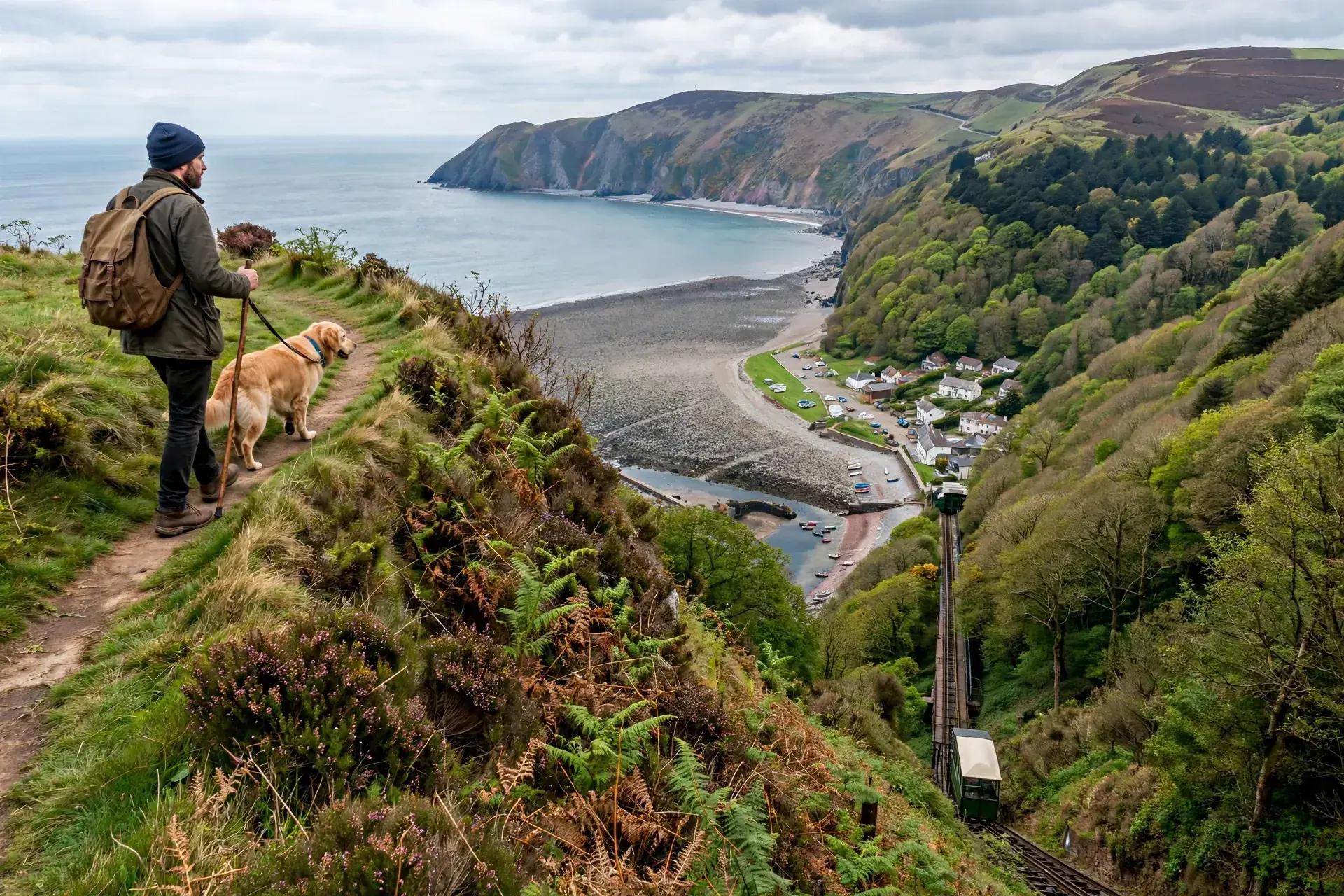
For a longer stay, the eastern path also connects Combe Martin to its neighbours along the coast. Lynton, with its cliff railway and valley walks, lies several miles to the east along the coast path, and makes a good next stop for walkers who want to keep following the trail. In the other direction, Minehead, where the South West Coast Path begins, is the far end of the same trail in Somerset, and a useful base if you want to walk the coast in the opposite direction. Both are worth a day trip from Combe Martin, and both are covered in their own guides.
The village street: shops, cafes and pubs
Combe Martin's village street is the heart of the place, and it is where a dog-owning visitor spends most of their non-walking time. The street runs for well over a mile from the top of the village down to the beach, lined with cottages, shops and places to eat, and it climbs steadily enough that the walk back up from the beach is a proper little workout. The shops are practical rather than touristy: a small supermarket for everyday supplies, a butcher, a post office, a pharmacy and a handful of gift and craft shops, plus the village museum, which tells the story of the silver mines, the fishing boats and the famous Pack o' Cards pub. That last one is worth a look from the outside even if you do not go in — it is a remarkable building, said to have been built from card winnings, with a facade that is hard to miss.
For dog owners, the useful shops are the ones that solve problems. The supermarket stocks dog food, treats and drinking water, and the pharmacy and the general stores along the street can usually supply the small things a trip throws up: a spare lead, poo bags, a towel, sun cream for the owner, plasters for a blistered heel. Buy poo bags before you need them, not after, and keep a roll in every pocket and in the car. If your dog needs a specific food or medication, bring it with you rather than assuming the village shop will stock it — the shops here are small, and a prescription diet or a particular brand is not something to gamble on.
Cafes and pubs in Combe Martin are generally welcoming to dogs, but the welcome is usually on the terrace, in the garden or in the bar area rather than in the main dining room, and it can change with the season, the weather and the landlord. The pattern to expect is this: a cafe with outdoor seating will usually be happy to have a dog at your feet, often with a water bowl provided; a pub will often allow dogs in the bar but not in the restaurant; and a place that is packed on a summer Saturday may be less relaxed about a large dog than the same place on a quiet Tuesday. The polite approach is to ask at the door, keep the dog on a lead, settle them under the table with a chew or a mat, and be ready to take them outside if they bark or fuss. A dog that lies quietly through a coffee is welcome anywhere; a dog that begs, barks or wanders between tables is not, however friendly the staff are.
Eating with a dog takes a little planning in a village like this. Choose a table on the edge of the terrace where the dog is out of the main walkway, order food that does not need both hands and a lot of attention, and bring something for the dog to do — a long-lasting chew, a stuffed Kong, or a familiar blanket to lie on. If your dog is reactive to other dogs, pick a table away from the entrance and away from other dogs, and be ready to leave promptly if the situation changes. And remember that a dog that has just had a long walk is a much better cafe companion than a dog that has been sitting in the car all morning: walk first, then eat.
There are a few other village facilities worth knowing about. Public toilets stand near the beach, and there are further facilities along the village street; check the official guidance before you travel for current opening times, because seasonal toilets can close outside the summer months. The beach car park has bins for dog waste, and there are litter bins along the street, so there is no excuse for leaving a bag behind. The village also has a small wildlife and dinosaur park on its edge, which is a popular family stop — check the official guidance before you travel, because rules about dogs at attractions like this can change, and many such parks do not admit dogs at all.
One last note on the street itself: it is a working road, not a pedestrian zone. Coaches, tractors and delivery vans use it, the pavements narrow in places, and parked cars can force a pedestrian into the road. Walk on the inside of the pavement, keep the lead short, and cross the road at the widest points where you can see traffic coming. A dog that heels well on a village street is a joy; a dog that pulls towards every shop doorway and every other dog is hard work on a long, sloping street, so practise the heel before you arrive rather than after.
Inland from the bay: valley paths and the Hangman climbs
Not every walk from Combe Martin has to follow the coast. The valley that runs inland from the bay gives you shaded, sheltered walking that is ideal on a hot day, a windy day, or a day when the cliff path feels too much for your dog. The valley path follows the stream up from the village into the wooded combes behind it, where the air is cooler, the ground is softer, and the birdsong replaces the sound of the sea. It is also the flattest walking anywhere near the village, which makes it the right choice for a puppy, an older dog, or a dog recovering from an injury.
Start at the beach end of the village and follow the valley inland, keeping the stream on one side and the gardens and cottages on the other. The path is a mixture of surfaced track and woodland trail, and it is easy to turn back at any point, which makes it a good first walk for a dog that is new to the area. Take it slowly: let the dog sniff the hedgerows, paddle in the shallow stream where it is safe to do so, and rest in the shade. The stream is shallow and slow in most places, but keep an eye on a dog that drinks from it — stagnant water after a dry spell can be unpleasant, so carry fresh water and offer that first.
The valley also gives access to the hills behind the village, including the routes up to the Hangmans from the inland side. These climbs are steep but they are sheltered by trees and hedges for much of the way, which makes them more pleasant than the exposed coast path on a windy day. If you are walking up to Great Hangman from the valley, allow extra time, carry water, and keep the dog on a lead through the fields and the farm tracks, where livestock and farm dogs are common. The view from the top is the same magnificent panorama as from the coast path — the bay below, the cliffs on either side, and the open sea beyond — and arriving at it through the quiet valley feels like a proper walk rather than a tourist tick-box.
Woodland and valley walking brings its own checks. Ticks are present in the long grass and bracken of the valley and the hillsides, so check your dog after every walk, paying attention to the ears, the armpits, the groin and between the toes. Midges and flies can be a nuisance on still, damp evenings in the valley, and a dog with sensitive skin may scratch at bites — a light dog-safe repellent or a quick wipe-down after the walk helps. Adders are present on Exmoor and the North Devon coast, and they favour sunny banks and rocky places in the warmer months; keep your dog on the path and out of the bracken in adder season, and check the official guidance before you travel for current advice on adder safety. If a dog is bitten, keep it calm and still and get veterinary help immediately — do not try to suck the wound or apply a tourniquet.
For a longer inland day, the valley paths connect into the wider network of footpaths and bridleways that cross Exmoor towards the villages inland. These are quieter than the coast path and often empty, which suits a reactive dog that needs space from other dogs and people — but they are also less well signposted in places, and a wrong turn can add a mile to a walk. Carry a map or a charged phone with an offline map, tell someone where you are going if you are walking alone, and be ready to turn back if the path becomes unclear. A dog that is tired, wet and lost is a problem that is easy to avoid and hard to fix.
Staying overnight with a dog
Combe Martin has a good range of dog-friendly places to stay, from cottages and bed-and-breakfasts in the village to caravan and camping sites on the hills above the bay, and the right choice depends on your dog rather than on the prettiest listing. A cottage with a small enclosed garden suits a dog that needs a safe toilet area at night; a bed-and-breakfast suits a dog that settles well in a new room and is happy to be left for an hour while you eat; a caravan or a lodge on a park suits a dog that is used to that kind of space and will not bark at every passing footstep. Work out what your dog actually needs — garden, ground floor, quiet location, space to be left alone — and ask about those things specifically before you book.
Always confirm the dog policy in writing before you pay. The questions that matter are the same ones that matter anywhere, but they have a local twist here: how many dogs are allowed, what the pet charge is, whether the charge is per night or per stay, whether there are restricted breeds or sizes, and whether the dog can be left alone in the property and for how long. A cottage at the top of the village with a steep garden is a different proposition from a flat near the beach with a yard, and a property that welcomes one quiet dog may not welcome two lively ones. Ask for the exact rules, get the answer by email, and keep it with your booking confirmation.
Location matters more in Combe Martin than in a flat town, because the village is built on a slope. A property near the beach means a short, easy walk to the sand and the coast path, but it also means more foot traffic past the door and more noise from the car park. A property higher up the village means a quieter stay and a view, but it also means a steep walk down to the beach and a steeper walk back, twice a day or more. For an older dog, or a dog that needs frequent toilet trips, a property near the bottom of the village is the practical choice even if the view is less impressive. For a fit, active dog, the higher properties are fine — the hill is part of the holiday.
Arriving at a place to stay with a dog follows the same routine everywhere, and it matters here because the first hour sets the tone for the whole stay. Walk the dog before you go inside, check the garden or the outdoor area for gaps in the fence, and look for hazards: a low wall a terrier could jump, a gate that does not latch, a pond, a compost heap, or a neighbour's cat flap. Put the dog's bed, water bowl and a familiar-smelling blanket in the place where the dog will sleep, and feed the dog at the usual time. If the dog is used to a crate, set it up exactly as at home. A dog that settles on the first evening is a dog that will enjoy the rest of the stay.
Be a good guest, because dog-friendly places in small villages depend on owners behaving well. Keep the dog off the beds and the sofas unless the host has said it is fine, wipe muddy paws at the door, and clean up the garden every day rather than leaving it for the end of the stay. If the dog barks when left alone, do not leave them — take them with you, or stay in, and work on the problem at home rather than in someone else's cottage. And if anything is damaged, say so honestly and offer to pay: a host who is treated fairly will welcome dogs again, and a host who finds damage after checkout may not.
If you are planning a longer stay in the area, Combe Martin makes a good base for exploring the Exmoor coast. Dunster, with its castle and medieval high street, is a rewarding day trip east along the coast, and the drive across Exmoor to reach it is part of the pleasure. Staying in one village and day-tripping to the others is a much easier way to travel with a dog than moving every night.
Parking, water, toilets and the kit list
Parking in Combe Martin is straightforward if you arrive early and frustrating if you do not. The beach car park at the bottom of the village is the natural starting point: it is close to the sand, the coast path and the village street, and it is where most visitors head first. On a summer weekend it fills early, and the overflow is along the village street, where spaces are limited and the road is narrow. Arrive before ten in the morning in the summer, or come later in the afternoon when the day-trippers are leaving, and you will have a much easier time. Check the official guidance before you travel for current charges, time limits and payment methods, because machines and tariffs change and a ticket bought for the wrong bay is no ticket at all.
Never leave a dog in a parked car, even with the windows open and even in the shade. A car in the sun heats up far faster than most people expect, and a dog in a hot car is in danger within minutes. If you need to pop into a shop, take the dog with you or leave one person with the dog outside. The same rule applies in winter: a car can be cold, damp and stressful for a dog left alone in it. Plan your errands so the dog is never waiting in the car while you shop or eat.
Water is the single most important thing to carry on any walk from Combe Martin. There is fresh water in the village, but there is little or none on the coast path, and a dog that has climbed a Hangman on a warm day will need a lot of it. Carry a collapsible bowl and at least a litre of water for the dog on a short walk, and twice that on a long one. Offer water regularly rather than waiting for the dog to ask, because a dog that is panting hard has already lost a lot of fluid. Do not let the dog drink seawater, and do not rely on the stream in the valley as a water source on a dry day.
Public toilets stand near the beach and along the village street, with opening times that vary by season — check the official guidance before you travel, because a toilet that was open in August may be closed in February. Dog waste bins stand near the beach entrances and at intervals along the street and the coast path, but they are not everywhere, so carry a bag with you and be prepared to carry a used bag until you reach a bin. A small, sealable bag for used poo bags is worth its weight in a rucksack.
The nearest vet is a short drive away, in Ilfracombe or Barnstaple, and it is worth saving the number and the address in your phone before you need it. Rural practices can be some distance away and may close early, so do not assume you can walk in at any hour. If your dog is on medication, bring a supply that covers the whole stay plus a day extra, and keep the prescription details with you. If your dog has a long-term condition, tell the vet practice where you are staying when you arrive, so they know where to find you in an emergency.
A practical kit list for a day in Combe Martin looks like this: a lead and a long line, a harness that fits well, a collapsible water bowl and at least a litre of water, poo bags and a sealable bag for used ones, two towels and a dry blanket for the car, a first-aid kit with saline, bandages and tick tweezers, a torch if you are walking late, a charged phone with an offline map, and a chew or a mat for cafe stops. Add a drying coat in wet weather and a cooling mat in hot weather. Pack it the night before, because the beach at low tide waits for no one, and a morning spent looking for a lead is a morning wasted.
Two ready-made days with a dog
A gentle day starts with the beach. Arrive an hour or two before low water, park at the beach car park, and walk the sand at a relaxed pace, letting the dog sniff the rock pools and paddle at the waterline. Follow that with a short stretch of the coast path west towards Watermouth, as far as the first headland, and then turn back for a late lunch at a cafe on the village street, with the dog settled under the table. Spend the afternoon on the valley path inland, in the shade, and finish with a quiet evening walk along the beach as the tide turns. That is a full day for most dogs, and it uses the best of Combe Martin — the bay, the cliffs and the valley — without asking too much of anyone.
A bigger day starts early. Eat breakfast, fill the water bottles, and set out on the coast path east towards Great Hangman, aiming to reach the summit before the heat of the day. Take the climb slowly, with rest stops in the shade, and spend half an hour on the broad summit letting the dog rest and looking at the view. Come back down the same way, or return through the valley if the path allows, and finish with a late lunch in the village and a short, easy beach walk to cool the dog's paws. That is a serious day out — four hours or more of walking with a big climb — and it is only right for a fit dog and a fit owner on a day with good weather. If the wind is strong or the rain is coming in, swap the Hangmans for the valley and the western path, and save the big climb for a better day.
Whatever plan you choose, build in a margin. Dogs get tired, weather changes, a path is muddier than expected, a cafe is full, a tide is earlier than you thought. A plan with an hour of slack in it is a plan that survives contact with reality, and a dog that comes home tired and happy is the measure of a good day in Combe Martin. The village rewards the visitor who slows down: the bay at low tide, the street at a walking pace, the cliffs one headland at a time.
Practical questions
Before you go
Can dogs go on Combe Martin beach all year?
Not necessarily on every part of the beach. Seasonal dog restrictions apply on many North Devon beaches, and the exact dates and the stretch of sand they cover can change. Read the signs at the beach entrances on the day and check the official guidance before you travel, because a rule that applied last summer may not be the one in force this year.
Is the South West Coast Path from Combe Martin suitable for dogs?
Yes, in sections, but it is a serious coastal path here, not a flat promenade. The climbs over Little Hangman and Great Hangman are steep, the drops are unfenced in places, and the ground can be slippery after rain. Keep your dog on a lead near cliff edges, carry water, and pick a shorter out-and-back stretch if your dog is older or unfit.
Where can I park in Combe Martin with a dog?
The beach car park at the bottom of the village is the most convenient starting point for the bay and the coast path, and there is further parking along the village street. Arrive early on summer weekends, because the beach car park fills fast. Never leave a dog in a parked car, even with the windows open, and check the official guidance before you travel for current charges and time limits.
Are dogs welcome in Combe Martin cafes and pubs?
Many of the village cafes and pubs welcome dogs, often on the terrace or in a bar area rather than the main dining room, and several put out water bowls. Policies change with the season and the landlord, so ask at the door rather than assuming, and keep your dog on a lead and settled under the table while you eat.
What is the best short walk from Combe Martin with a dog?
For a short outing, walk the beach at low tide and then follow the coast path west as far as the first headland before turning back, which gives you sea views without the full climb over Little Hangman. If your dog prefers shade and flat ground, the valley path inland from the village is the easier alternative, especially on a hot or windy day.
Is Combe Martin beach safe for dogs at high tide?
High tide covers most of the sand and pushes walkers against the sea wall and the rocks, so plan your beach time around low tide and leave well before the water returns. Check the tide times before you set out, keep your dog on a lead near the rocks and the harbour steps, and check the official guidance before you travel for current safety advice.