This guide was prepared independently, with no paid placement involved. Beach restrictions, railway rules and garden arrangements can change, so check the official guidance before you travel whenever a rule affects your day.
Start at the South West Coast Path monument, treat Minehead as a departure station rather than a single attraction, and build the trip in short legs: a first stretch of coast path, time on the sand at a suitable tide, a calm wander in Blenheim Gardens, and an unhurried visit to the West Somerset Railway terminus.
Begin at the starting line
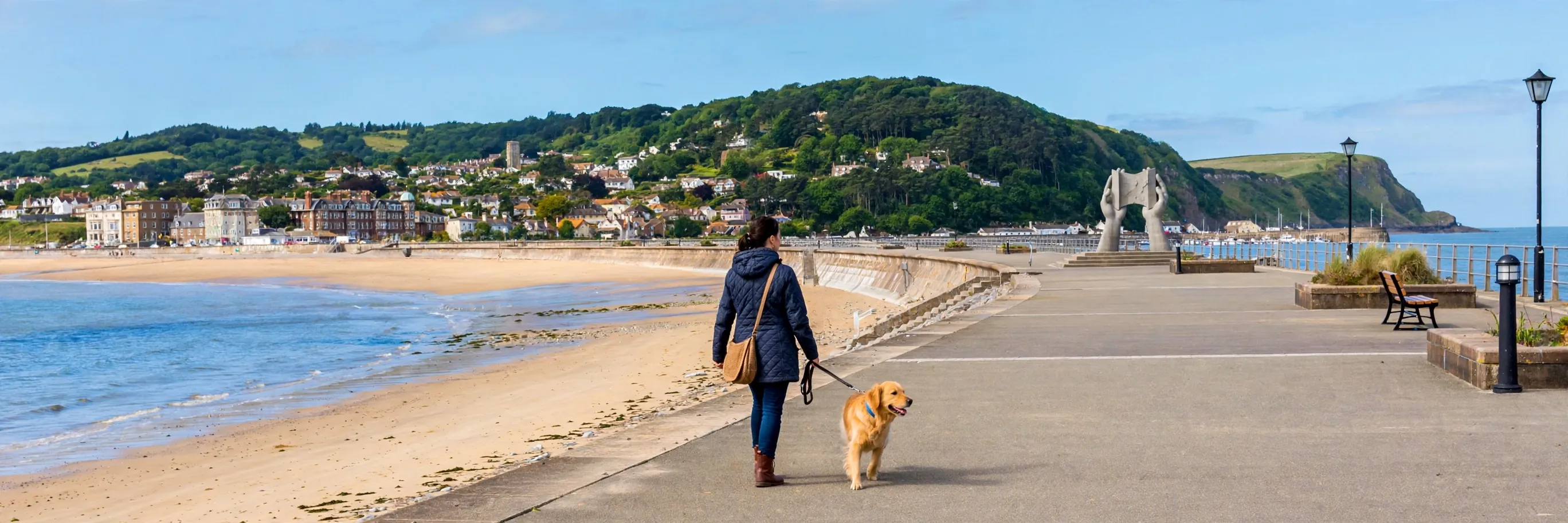
Most seaside towns invite you to arrive, look at the sea, and then decide what to do. Minehead does something subtly different. It hands you a line on the ground, or rather a monument beside the seafront, and invites you to imagine a journey that runs for hundreds of miles around the south-west peninsula. The South West Coast Path begins here, and its far end lies in Dorset, a distance that no dog, and very few walkers, would attempt in one trip. That is precisely the point. Minehead works best when you treat it as a departure station: a place to begin, to sample, to turn back from without any sense of failure, and to return to the next day for another short section.
The start monument gives the trip a shape that an ordinary beach day lacks. Children, if they are travelling with you, can stand beside it and understand at once that this walk has a beginning. Dogs, of course, understand no such thing, but the ritual still helps their owners. It creates a natural first photograph, a natural meeting point if a group splits up, and a natural excuse to walk slowly for the first ten minutes while everyone finds their rhythm. Begin there, not at the far end of the beach, and the whole day acquires a direction. You are walking out along a named trail, even if you only follow it for a mile or two before turning around for lunch.
That framing also solves a common planning problem. Visitors to a coastal town often try to see everything in one long, tiring walk, and the dog pays for that ambition with sore paws, a dry mouth and a restless evening. A starting-line mindset reverses the pressure. The trail will still be there tomorrow. The sensible first leg is the one your dog finishes happily, with energy left for an evening toilet walk and a settled night. For a fit adult dog, that might mean a couple of hours out and back along the first headland stretch. For an older dog, a puppy, or a dog that is still learning to walk calmly on a lead, it might mean twenty minutes along the promenade, a sniff around the monument area, and then a rest. Both are legitimate uses of a long-distance trail. The monument does not judge distance.
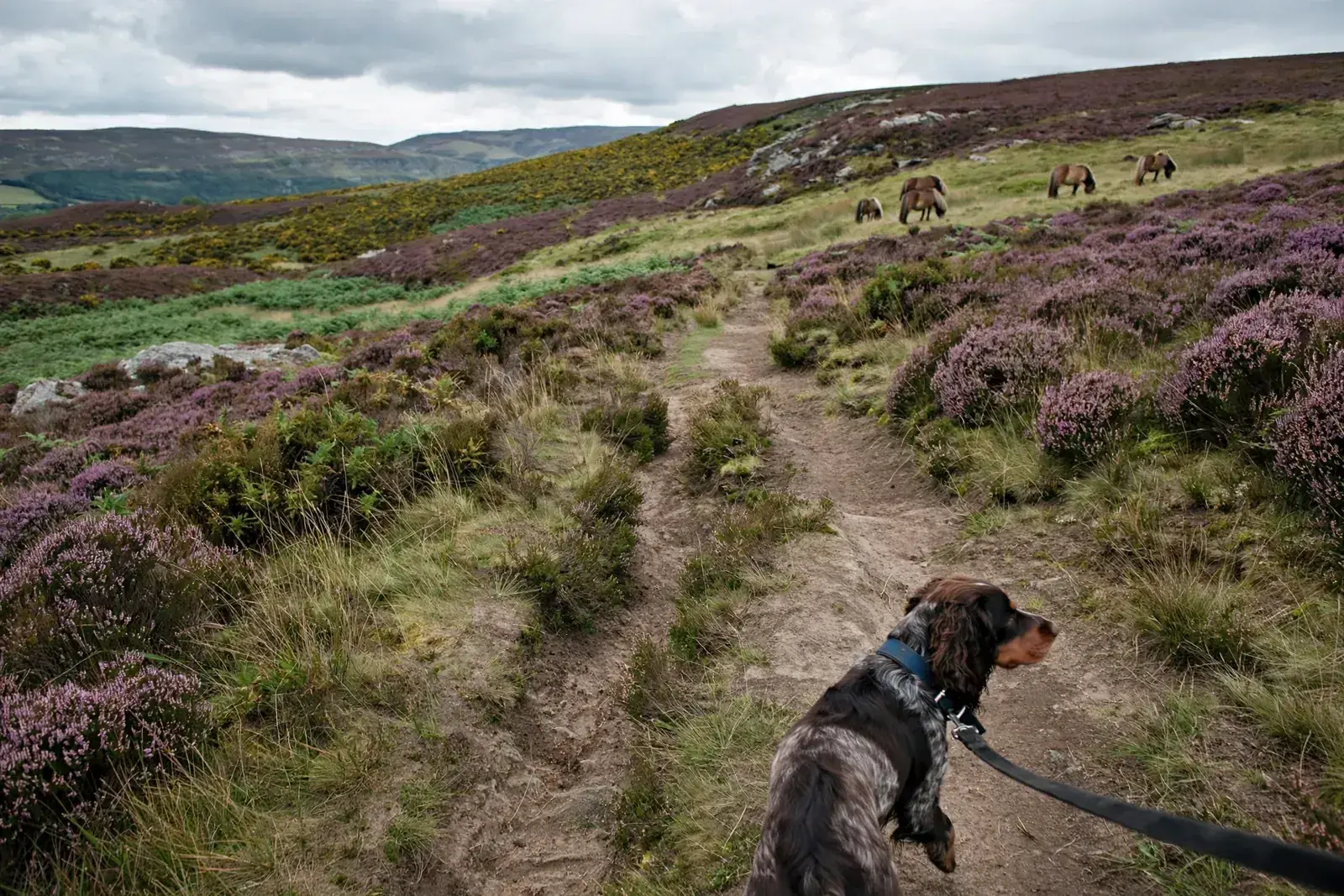
Before setting out, think about what the first stretch actually asks of a dog. The opening section of a coast path is rarely flat promenade all the way. Expect a mixture of surfaced paths, steps, slopes and more exposed ground as the route leaves the town behind and climbs towards the headland. The gradient matters more than the mileage. A short, steep climb on a warm day is harder work than a longer, level walk on the flat, and it is harder still for a short-legged dog, a brachycephalic breed, or any dog carrying extra weight. Build in pauses at viewpoints, not because the view demands it, but because the dog needs them. Offer water before the dog looks desperate for it, and watch for the early signs of fatigue: a slowing pace, a tongue hanging further than usual, a dog that starts to lag behind rather than pulling ahead.
Surface matters too. Tarmac and paving are kind to paws but can be hot in strong summer sun. Grass is softer but can hide uneven ground, rabbit holes and, after rain, deep mud. Rocky or shingle sections demand more concentration from the dog and more care from the owner, especially where the path narrows near a drop. None of this should put you off. It should simply shape your choice of lead and footwear. A standard lead gives control near roads, car parks and cliff edges. A longer line, used only where it is safe and lawful, gives a sniff-driven dog room to explore open grass without dragging you towards every interesting smell. Keep the longer line packed away for the promenade, the station approach and any stretch where other walkers, cyclists or livestock are close.
Weather is the third factor that the starting-line idea brings into focus. Minehead faces open water, and the wind that feels refreshing on the promenade can feel considerably stronger once you are out on an exposed headland. A dog with a thin coat, a small dog, or a dog that is anxious in gusts may enjoy a sheltered garden walk far more than a windswept cliff top. There is no prize for reaching a particular viewpoint. Turning back at the first sheltered bench, or cutting the walk short and spending the saved hour in Blenheim Gardens instead, is good judgement, not a wasted day. The trail rewards return visits. Most of the walkers who complete it do so in sections spread over months or years, and your dog will be just as happy with a short, well-chosen section as with a heroic one.
Finally, use the monument as an orientation tool for the rest of the trip. Once you know where the path begins, the town falls into place around it: the beach to one side, the gardens a short walk inland, the railway station waiting at the other end of the town's story. Each of those places is worth visiting in its own right, and each is covered below. But they make more sense when you see them as stations on a single, dog-shaped itinerary, rather than as unrelated attractions competing for the same afternoon. Start at the line, walk a little, and let the town reveal itself in that order.
Minehead beach, tides and sand
Minehead beach is a wide, sandy bay, and on a calm day it looks like the simplest dog walk imaginable: open sand, a long shoreline, and room to move. The reality is a little more interesting, and a little more rewarding, once tides enter the picture. At low tide the sand stretches a long way out, exposing firm, flat ground that is excellent for dogs that like to run, chase a ball, or simply trot beside you without the stop-start effort of soft, dry sand higher up the beach. At high tide the usable sand narrows considerably, the water comes closer to the promenade and sea wall, and the same beach becomes a shorter, more sociable walk, shared more closely with other visitors. Neither state is better in itself. They are different walks, and choosing between them is one of the most useful skills for a Minehead dog trip.
Plan around the tide rather than fighting it. Check a tide table for Minehead before you travel, and again on the morning of the walk, because times shift daily and a plan built on yesterday's tide will be wrong by roughly an hour today. A falling tide, with the water drawing back to reveal fresh sand, is often the most pleasant time for a dog: the sand near the waterline is firm underfoot, there is space to keep distance from other dogs, and the dog can paddle at the edge if it enjoys water. A rising tide needs more attention. Keep an eye on how quickly the water is advancing, know which access point you will leave by, and do not let a dog chase a ball so far out that the return route becomes a wade. Dogs that are strong swimmers can still be caught out by currents, cold water and tiredness, so treat the sea as an optional extra, not as the main event, unless your dog is experienced and the conditions are gentle.
Sand itself deserves a paragraph of its own, because it affects dogs in ways that owners often underestimate. Dry, soft sand high up the beach is hard work. It gives way under paws, forces the dog to lift its legs higher, and can tire a dog surprisingly quickly, especially a small dog, an older dog, or a dog recovering from a leg problem. Wet, compacted sand near the waterline is much kinder, which is another reason to favour a low-tide walk. After the walk, expect sand everywhere: between toes, in ears, in the car, and in the accommodation. A quick rinse of paws, a check between the toes for grit or small cuts, and a towel-dry before the dog climbs onto bedding will save a lot of later discomfort. Dogs that lick sand off their paws repeatedly may be telling you that something is irritating them, so look closely rather than assuming they are simply grooming.
Rules are the part of beach planning that most often catches visitors out, and Minehead is no exception. Some beaches, and some sections of a beach, restrict dogs during part of the year, typically the busier summer months, while other sections remain open. The boundary between a restricted section and an open section can be a single signpost or a line on a map that is easy to miss when you are watching a dog rather than reading notices. The safest approach is to check the official guidance before you travel, read the signs at the access point you actually use on the day, and assume that a restriction you have not checked still applies. This is not bureaucratic caution for its own sake. Breaching a beach restriction can lead to a fine, and it can also spoil a good walk with an awkward conversation with an enforcement officer while your dog is still on the lead wondering what has happened. For a fuller explanation of how seasonal bans, public space protection orders and fines work across the country, see our guide to dog-friendly beaches in the UK and the 2026 rules, which explains how to check a beach before you go and what the assistance-dog exceptions cover.
Lead etiquette on the beach is worth settling before you arrive, because a beach feels like freedom and behaves like a shared space. Even where dogs are allowed off lead, a dog that charges up to every other dog, small child or picnic will not be popular, and a dog with unreliable recall should stay on a long line rather than roaming free. Use the open space at low tide to practise distance: let the dog run, but recall it regularly, reward the return, and keep the game short enough that the dog still wants to come back. Bring fresh water and a bowl even on a cool day. Dogs that drink seawater often vomit later, and a dog that has been running on sand will be thirstier than it looks. A collapsible bowl weighs almost nothing and prevents the familiar problem of a dog drinking from a rock pool or a discarded cup.
Season changes the beach walk as much as tide does. In summer, the sand can be hot underfoot at midday, the beach is busier, and shade is scarce, so an early morning or late afternoon walk suits most dogs better, with the middle of the day reserved for gardens, the railway station area, or a rest indoors. In autumn and winter, the beach is quieter, the light is lower and more dramatic, and the wind is the main challenge rather than the heat. A dog that loves to run will find winter Minehead a delight, provided it has a drying coat or towels waiting afterwards and a warm place to settle. After storms, watch for debris washed up on the sand, including sharp shells, fishing line and anything the dog might try to eat. A quick scan of the ground ahead is a habit worth building, especially with puppies and confirmed scavengers.
Finally, think of the beach as a training ground as well as a playground. The wide, open sand is an ideal place to practise recall with gradually increasing distractions, to teach a dog to settle on a mat while other dogs pass at a distance, and to build confidence in a dog that finds busy pavements stressful. Keep sessions short, end while the dog is still enjoying itself, and finish with a calm walk back along the promenade rather than a sudden dash to the car. A dog that leaves the beach tired but not exhausted, with clean paws and a drink inside it, will sleep well and wake up ready for the next leg of the trip, whether that leg is another stretch of coast path or a quiet morning in the gardens.
Blenheim Gardens at a slower pace
After the scale of the coast path and the openness of the beach, Blenheim Gardens offers something deliberately smaller: a contained, green, human-scale space where the walk slows down and the dog can do the most underrated activity in any trip, which is simply to be somewhere pleasant without being asked to perform. Gardens are often treated as a filler between bigger attractions, but for dogs they serve a distinct purpose. They provide shade on a hot day, shelter on a windy day, level or gently graded paths for dogs that struggle with climbs, and a density of smells that can tire a dog's brain far more effectively than another mile of pavement. A sniff-heavy half hour in a garden is, for many dogs, a better outing than a forced march along a road.
Walk the gardens the way a dog would choose to walk them, which is slowly and with frequent stops. Let the dog investigate the base of a tree, the edge of a flower bed, and the corner where other dogs have clearly left messages. This is not wasted time. Sniffing is how dogs gather information, and a dog that has been allowed to sniff freely will often settle more readily afterwards than a dog that has been hurried past everything interesting. Keep the lead short enough to steer the dog away from planted beds and other visitors, but loose enough that the dog does not feel constantly corrected. If the gardens are busy, choose the quieter paths first and save the more popular areas for a moment when the dog is already calm, rather than starting in the middle of the crowd.
Gardens also suit the dogs that the coast path does not. An older dog with stiff joints, a dog recovering from an operation, a puppy that is still building stamina, and a nervous rescue that finds open headlands overwhelming can all enjoy a garden walk that would be impossible as a cliff-top hike. The paths are generally smoother, the distances are shorter, and there is always a bench nearby for a rest. That makes Blenheim Gardens a useful fallback as well as a destination in its own right. If the wind on the headland is too strong, if the tide has removed the beach, or if the dog simply wakes up tired after yesterday's walk, a garden morning keeps the day feeling like a holiday without asking the dog for more than it can give.
Good garden manners are simple but worth stating plainly. Keep the dog on a lead, keep it out of flower beds and water features unless dogs are clearly welcome there, pick up promptly, and do not allow the dog to approach other visitors' picnics or other dogs without an invitation. Gardens are shared, often with people who are not dog owners, and a single well-behaved dog does more for the reputation of visiting dogs than any number of signs. If the gardens have a cafe or a seating area, check the official guidance before you travel about whether dogs are welcome there, and do not assume that a dog welcome in the grounds is automatically welcome indoors. A dog that can settle quietly under a table on a terrace is a pleasure to travel with; a dog that barks at every passing visitor is not, and the gardens are a good place to practise that settling skill in short, rewarded stages.
Use the gardens as a bridge between the bigger experiences of the trip. A morning in the gardens after a long coast walk gives muscles time to recover. An afternoon visit before an evening at the railway station area gives a young dog a chance to burn off curiosity without another long walk. A final garden stroll on the last day gives the trip a calm ending, rather than a frantic dash to fit in one more attraction before the drive home. Dogs remember patterns more than sights, and a trip that alternates big, open walks with small, calm ones tends to produce a dog that is relaxed in the evenings, sleeps soundly, and is ready to enjoy the next day rather than dreading it.
The railway terminus and steam atmosphere
Minehead is the terminus of the West Somerset Railway, a heritage steam railway that runs inland through Somerset countryside, and that single fact gives the town a different atmosphere from a resort that only has a beach. A terminus is a place of arrivals and departures, of waiting and watching, and dogs tend to enjoy it for exactly those reasons. There are new smells, new sounds, people moving with purpose, and long pauses during which nothing is required of the dog except to sit, watch and settle. For a dog that finds constant walking tiring, a station visit is a welcome change of pace. For a dog that finds new places exciting, it is a concentrated dose of novelty in a contained, manageable space.
The steam itself is part of the experience, and it deserves preparation. A steam locomotive is loud, it releases steam with a sudden hiss, it smells of coal smoke and hot oil, and it moves in a way that is unfamiliar to a dog used to cars and buses. Some dogs take no notice at all. Others startle at the first blast of steam, and a startled dog on a platform needs a calm owner, a secure lead, and enough distance from the edge to feel safe. If your dog has never met a steam train, do not make the first encounter a boarding attempt. Visit the station area first, let the dog watch a train arrive and depart from a comfortable distance, reward calm behaviour, and leave while the experience is still positive. A dog that has learned that the station is a safe, boring, treat-producing place will cope far better on a later visit than a dog that was rushed onto a crowded train on its first day.
Practical preparation for a railway outing is similar to preparation for any public transport, with a few heritage-specific twists. Keep the lead short on platforms and in station buildings, because platforms are narrow, other passengers may have luggage, pushchairs or their own dogs, and a long lead across a platform is a tripping hazard. Bring water and a bowl, because station waiting rooms and carriages can be warm, especially on a sunny day, and a dog that has walked to the station will already be thirsty. Bring something for the dog to settle on, such as a familiar blanket or mat, if you plan to sit and watch trains for a while. Dogs settle more readily on a familiar surface than on bare platform benches or unfamiliar flooring, and a mat also marks out a small, personal space in a busy public area.
Whether dogs can travel on a particular service is a question to settle before you arrive at the platform, not after you have queued for tickets. Heritage railway arrangements can vary by service, by carriage and by season, and what applied to one train may not apply to another. Check the official guidance before you travel, and if anything is unclear, ask the railway directly before the day of travel rather than assuming. The same caution applies to station buildings, cafes and waiting rooms, where dog access may differ from platform access. A wasted journey to the station is disappointing, but it is far better than a confrontation at the ticket office with a dog that is already excited and a family that has built the day around a train ride. If dogs cannot travel on the service you wanted, the station visit itself is still worthwhile: watching trains, walking the station approach, and exploring the surrounding streets is a complete outing in its own right.
For dogs that do travel, carriage manners matter. Choose a quieter service if one is available, sit where the dog can lie at your feet without blocking the aisle, and keep the dog on a short lead for the whole journey. Some dogs enjoy looking out of the window; others prefer to curl up and sleep through the motion and noise. Either is fine. Do not allow the dog to climb on seats, approach other passengers uninvited, or bark at the guard's whistle. Bring a chew or a long-lasting treat only if the dog can enjoy it quietly without guarding it from neighbours, and be ready to step off at an intermediate station if the dog becomes distressed. Heritage railways usually serve a string of small stations, so abandoning a journey early is rarely a disaster, and it is always kinder than forcing a frightened dog to endure a full trip.
The terminus also works as a storytelling device for the trip. Minehead's railway connects the seaside to the inland countryside, just as the coast path connects Minehead to the wider peninsula. A family that walks the coast path in the morning and visits the railway in the afternoon has, in a small way, experienced the two great journeys that define this corner of Somerset: one on foot along the cliffs, and one by steam through the fields. Even without boarding a train, standing on the platform with a dog at your side gives a sense of a town that was built for arrivals, a town that has welcomed visitors for generations. That sense of continuity is part of what makes Minehead more than a beach with a car park, and it is worth slowing down long enough to notice it.
Building days from a Minehead base
The most useful way to plan Minehead is not as a list of attractions to tick off, but as a base from which to build days of different shapes. A base matters because dogs thrive on familiarity: the same accommodation, the same morning toilet walk, the same breakfast routine, and then a different outing each day. Minehead supports that pattern unusually well, because the coast path, the beach, the gardens and the railway are all close together, and because the surrounding area offers bigger walks for days when the dog has energy to spare and gentler options for days when it does not.
A first day built around the starting line might look like this. Begin at the coast path monument, walk a short first leg out along the trail, and turn back while the dog is still keen rather than tired. Return along the promenade, spend time on the beach at a suitable tide, and let the dog paddle or run on firm sand. After a rest and a drink, take a slow wander through Blenheim Gardens, where the dog can sniff and settle. Finish with a walk past the railway station area, watching a train if the timing works, and then return to the accommodation for a calm evening. No single element of that day is extreme, but together they give the dog variety: a climb, a run, a sniff, and a period of watching the world go by. Variety, more than distance, is what tires a dog in a healthy way.
A second day can lean further into the coast path. Walk a longer section, or revisit the first section and continue a little further than the day before, and pay attention to how the dog copes with the gradient and the surface. Take more water than you think you need, plan a turning point in advance, and be willing to use it. A dog that walks out for an hour and back for an hour has walked for two hours, and owners routinely forget the return leg when they plan. If the dog is flagging on the way out, turn back early. If the dog is still pulling happily at the planned turning point, you can extend the walk by a short, agreed amount, but do not double it on a whim. The coast path will still be there next year, and a dog that finishes a walk soundly is a dog that will enjoy walking again tomorrow.
A third shape of day is the railway and countryside day. Use the railway as the spine of the day: a station visit, a train journey if dogs are welcome on your chosen service and you have checked the official guidance before you travel, and a walk at the other end that suits the dog's energy. This shape suits dogs that enjoy novelty and dogs that find long cliff walks too demanding, because the train does the distance work and the dog does the interesting part. It also suits wet or windy days, when an exposed headland is unappealing but a sheltered inland walk is pleasant. Keep the total day shorter than a coast path day, because train travel, waiting and new stations are mentally tiring for dogs even when they involve little physical effort. Mental tiredness is real tiredness, and a dog that has spent a day processing new sounds, smells and people may sleep as soundly as a dog that has run on the beach.
A fourth shape is the rest day, and it deserves to be planned rather than treated as a failure. A rest day in Minehead might consist of a morning toilet walk, a garden wander, a beach visit at low tide for a gentle paddle, and long periods of doing nothing in particular. Rest days are especially important on multi-day trips, for older dogs, for puppies, and for any dog that has had a big walk the day before. They are also the days when many behavioural problems disappear, because a tired, overstimulated dog is more likely to bark, pull and scavenge than a rested one. If you are staying in the area for several days, consider basing yourself in Minehead and exploring the wider coast and countryside in short hops, rather than moving accommodation every night. For ideas on stays further along the coast, our guide to dog-friendly holiday parks in Devon explains what to check before booking a park stay, from boundaries and fees to the walks that matter once you arrive.
When you extend a Minehead trip into Exmoor, the same base logic applies. The moor offers open grassland, river valleys and a different set of challenges, including livestock, ticks and exposed weather, and it rewards the same short-leg approach. Do not try to combine a long moor walk, a long coast walk and a train journey into a single day. Choose one big experience, support it with a garden or beach visit, and leave the rest for another day. Dogs do not collect experiences. They accumulate tiredness, and the best trip is the one that ends each day with a dog that is content, clean, fed and ready to sleep, rather than a dog that is exhausted, overstimulated and dreading the next morning's lead.
Practical planning for coastal dogs
Coastal planning is mostly a matter of carrying the right things and making the right decisions early, before tiredness or weather forces them. The packing list for Minehead is not exotic, but it is worth getting right. A standard lead and a longer line cover different ground. A harness that fits well and does not rub is better than a collar for a dog that pulls, especially on climbs, while a collar with an identification tag remains essential for any dog off lead. Water and a bowl are non-negotiable, even in cool weather, because running on sand and climbing headland slopes are thirsty work. Poo bags, and a spare roll, prevent the familiar problem of running out at the furthest point from a bin. A drying coat or towels, a basic first-aid kit, and a torch for evening toilet walks complete a kit that will cover almost everything Minehead can throw at you.
Lead points are worth mapping in your head before you set out. Keep the dog on a short lead near roads, car parks, the promenade when it is busy, station platforms, and any cliff-edge section of the coast path. Use a longer line only on open grass or beach where you can see what is ahead, where there are no livestock nearby, and where you can reel the dog in quickly if another dog, a child, or a cyclist appears. Livestock deserves particular respect on the coast path and on any inland extension. Sheep and cattle are common on farmland crossed by the trail, and even a dog that has never chased livestock can surprise its owner when a sheep runs. Keep the dog close, keep it on a lead near livestock, and do not rely on a recall that has never been tested around farm animals. The same caution applies to ground-nesting birds in spring and to ponies or deer if you extend the trip onto Exmoor.
Seasonal planning changes the emphasis of the kit and the day. In summer, heat is the main risk. Walk early or late, carry extra water, watch for hot pavement and hot sand, and never leave a dog in a parked car, even with a window open. A dog that is panting heavily, drooling, or reluctant to move may be overheating, and the correct response is shade, water, and a shortened walk, not encouragement to continue. In autumn, the coast is quieter but the ground is wetter, so check paws after muddy walks and watch for slippery boardwalks and steps. In winter, wind and cold water are the main challenges. A short-coated dog may need a coat on an exposed headland, and any dog that swims in cold water should be dried and warmed afterwards. In spring, new growth, lambs and nesting birds all call for closer control and a shorter lead than the open landscape might suggest.
Veterinary planning is unglamorous and invaluable. Before you travel, identify the nearest veterinary practice to your accommodation and to the areas you plan to walk, and save the details in your phone. Do not wait until a dog has cut a paw on a shell or eaten something suspicious on the beach to start searching. Note also that rural practices may have limited hours, especially at weekends, and that the nearest emergency service may be further away than you expect. A basic first-aid kit should include a bandage, antiseptic wipes suitable for dogs, tweezers for ticks and thorns, and any regular medication your dog takes, with a spare dose in case one is dropped on a walk. Tick checks after moorland, woodland and long grass are a habit worth building, and any tick found should be removed promptly with a proper tick remover rather than pulled out by hand.
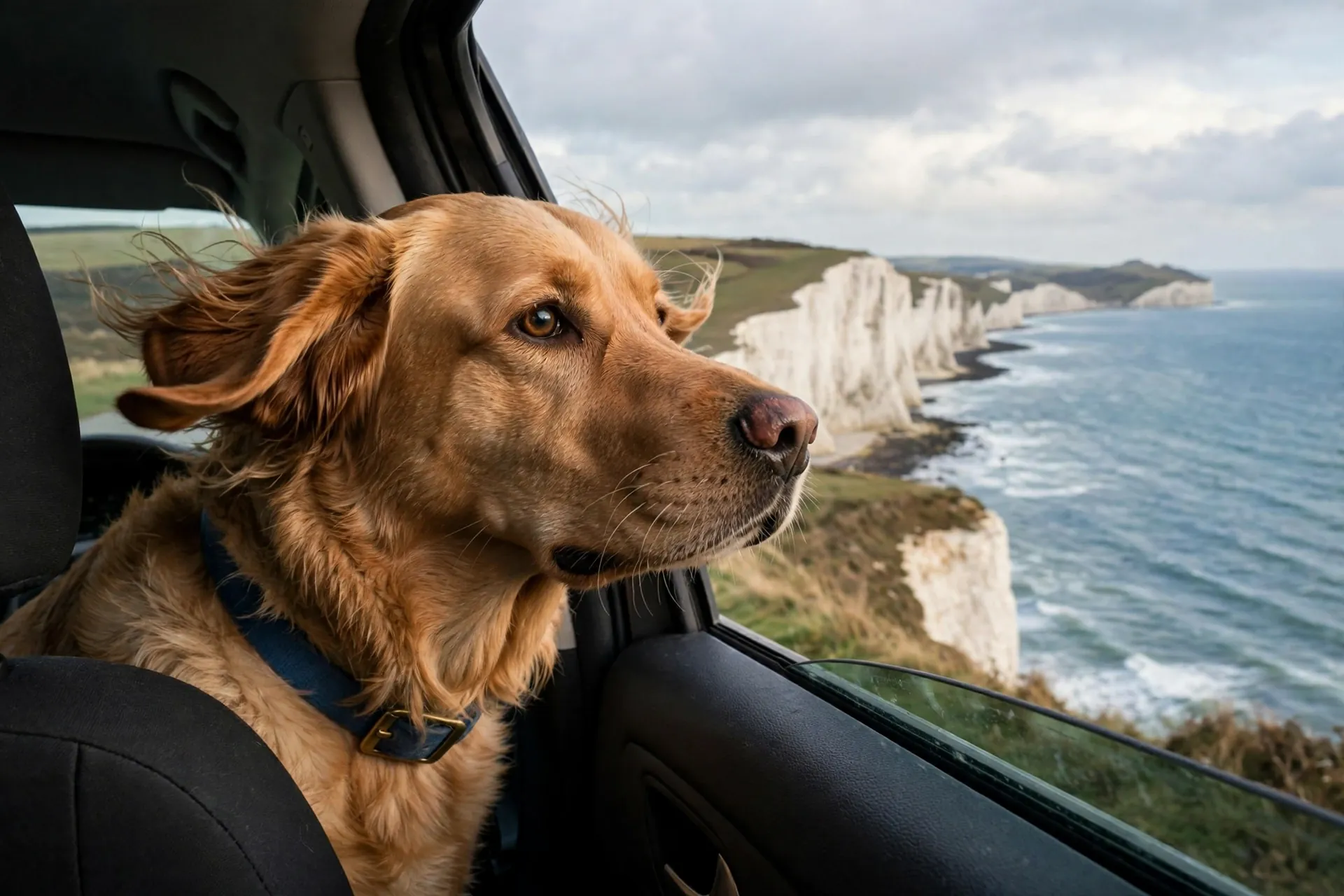
Finally, plan the journey to and from Minehead with the same care as the walks themselves. A dog that arrives after a long, hot, stressful car journey will not enjoy its first walk, however beautiful the coast path may be. Plan breaks every couple of hours, offer water at each stop, and allow a toilet walk before the final approach. On arrival, give the dog time to explore the accommodation, find its bed and water bowl, and settle before heading out. A calm arrival produces a calm first evening, and a calm first evening sets the tone for the whole trip. Minehead rewards that patience. It is a town built around a beginning, and the best way to enjoy it is to begin slowly, walk a little, rest well, and return the next day for the next short leg of a very long trail.
Practical questions
Before you go
Is Minehead beach dog-friendly all year?
Not necessarily in every part of the beach or in every season. Seasonal restrictions can apply to sections of the beach, so check the official guidance before you travel and look for the signs at each beach access point on the day.
Where exactly does the South West Coast Path start in Minehead?
The trail starts at Minehead, marked by a start monument near the seafront. Use it as a meeting point and a photo stop, then choose only as much of the first leg as suits your dog, rather than feeling obliged to walk a long distance.
Can dogs travel on the West Somerset Railway?
Dog policies on heritage railways can change by service and carriage, so check the official guidance before you travel. If dogs are welcome on your chosen service, keep the dog on a short lead, bring water, and choose a quieter departure where possible.
Is Blenheim Gardens suitable for dogs that need a short, level walk?
Blenheim Gardens works well as a shorter, calmer outing between bigger walks. Keep the dog on a lead, let it sniff at its own pace, and treat the gardens as a place to settle rather than a place to tire a dog out.
What is a sensible first day in Minehead with a dog?
Start at the coast path monument, walk a short first leg or the promenade, spend time on the beach at a suitable tide, rest in Blenheim Gardens, and finish near the railway station area. Short outings with rests suit most dogs better than one very long day.
What should I pack for a windy day on the Minehead coast?
Pack a lead and a longer line for open ground, water and a bowl, a drying coat or towels, poo bags, a basic first-aid kit, and something windproof for yourself. On exposed headland stretches, keep the dog close and shorten the walk if gusts make control difficult.