This guide is independent and contains no paid placement. If affiliate links are added later, they will be clearly marked and will not change our editorial checks.
Conistone is a small, quiet Wharfedale village whose best walking is written in limestone: the narrow gorge of Conistone Dib, cracked limestone pavement above it, old quarry workings, and the River Wharfe running fast below. Keep the dog on a lead in the gorge and near sheep, go slowly over the pavement, and treat the river with respect.
Start with the rock: why Conistone walks differently
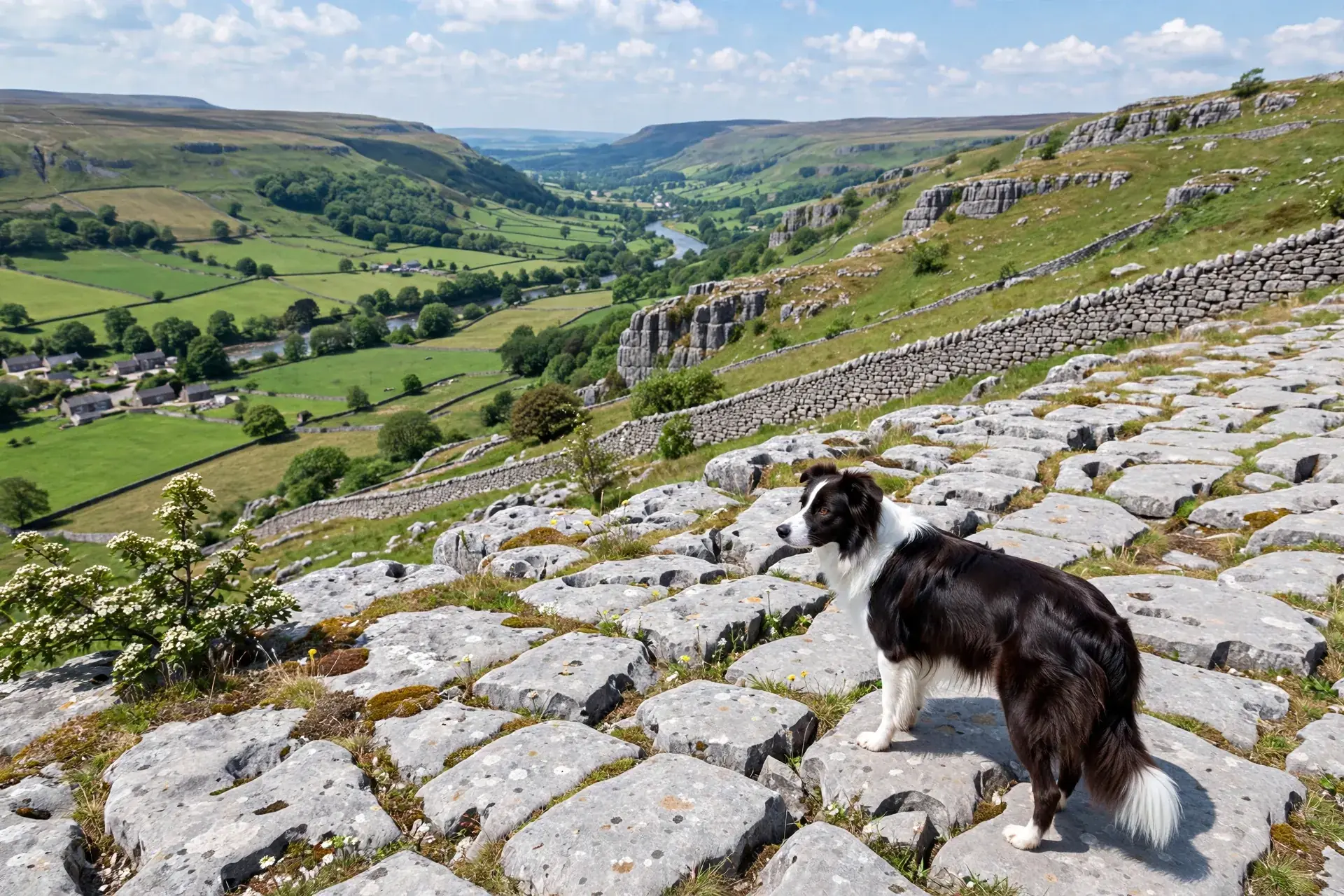
Most Wharfedale villages are described by their pubs, their greens or their views. Conistone is better described by its geology. The village sits on Carboniferous limestone laid down around 330 million years ago, when this part of Yorkshire lay beneath a warm tropical sea. The rock that resulted is pale grey, hard, and full of cracks, and it shapes almost everything a dog walker meets here: the dry stone walls built from its rubble, the flat pavements split by deep fissures, the narrow gorge that slices through the hillside, and the thin soils that make the grass short, springy and full of wildflowers in early summer.
Understanding that single fact changes how a day here is planned. Limestone drains fast, so paths that would be boggy on gritstone or shale stay firm underfoot after rain, and a wet morning rarely ruins the walking. The same rock, however, is unforgiving when it is wet: polished limestone slabs become slippery, gorge walls shed loose flakes, and the deep cracks in the pavement, known as grykes, can catch a running paw. A dog that charges happily across a grassy fell needs a slower pace here, and a walker who reads the ground as geology rather than scenery will make better decisions all day.
The limestone also explains the village itself. Conistone is small, quiet and easy to miss, a cluster of stone cottages and a church arranged around lanes that were laid out for farming rather than visitors. There is no pub in the village, no tearoom and no large car park, which is exactly why many dog owners prefer it to its busier neighbours. The trade-off is that facilities are thin: bring water, bring food, and plan the post-walk stop in Grassington or Kettlewell rather than expecting it in Conistone itself. The reward is space, silence and walking that begins the moment the car door opens.
The land around the village is working farmland as well as open access country. Sheep graze the limestone pastures for most of the year, and the dry stone walls that divide the fields are part of a farming system, not garden ornaments. A dog that respects walls, gates and livestock will have a far better day here than one that treats every field as a playground. The sections below follow the rock: first the gorge, then the river, then the quarries, and finally the practical rules that keep dogs, sheep and walkers on good terms.
One more thing the limestone gives the walker is a sense of time. The gorge of Conistone Dib was cut by water working on cracks in the rock over thousands of years, and the old quarry faces show where people later cut the same stone for building and lime burning. Walking here with a dog is a way of reading that story at paw level: the same pale rock underfoot from the village lane to the high pavement, changing character with every hundred metres of height. It is a small place, but it rewards a slow, attentive walk far more than a hurried one.
Conistone Dib: the limestone gorge on the doorstep
Conistone Dib is the feature that puts the village on the map. A dib, in Yorkshire dialect, is a deep, narrow valley, and this one is a short limestone gorge just to the north-east of the village, where a small beck has cut down through the rock to form steep walls, overhangs and a sequence of small waterfalls and plunge pools. The gorge is only a few hundred metres long, but it packs in more drama than many valleys ten times its length, and it is the single walk most visitors come for.
For a dog, the Dib is a lead-on place from start to finish. The path through the gorge is narrow, uneven and often wet, with rock steps, slippery slabs and drops to the beck below. There is no room for a dog to run ahead and no safe margin if a dog lunges at a scent or startles on a ledge. Keep the lead short, keep the dog on the uphill side of the path where the drop is on the other side, and take the descent slowly. Dogs that are nervous on narrow or enclosed paths may find the gorge stressful, and there is no shame in turning back: the open ground above the gorge offers the same limestone scenery without the confined path.
The best way to walk the Dib is as a short out-and-back from the village, which keeps the total distance modest and leaves energy for the longer loop over the pavement above. Approach from the village lane, follow the signed path towards the gorge, and allow at least forty minutes for the gorge section alone, because the ground demands attention and the dog will want to sniff every damp crevice. After rain, the beck runs high and the rock steps become genuinely treacherous, and in spate conditions the gorge should be avoided altogether. Check the official guidance before you travel if there has been heavy rain in the previous day or two, and be ready to swap the gorge for the riverside walk below the village instead.
What makes the Dib worth the care is the detail. Moss and ferns grow thick on the shaded walls, the rock is layered in bands that show how the limestone was laid down, and the pools below the small falls are clear and cold. Dogs are often drawn to the water, so watch for the moment a thirsty dog decides to scramble down a bank that looks easy from above and turns out to be a steep, wet slab. A long line is no substitute for a short lead here: a dog on a long line can still reach a drop, and a tangled line in a narrow gorge is a hazard for everyone. Clip the lead short, walk at the dog's pace, and let the sniffing happen on the flat ground at either end.
Above the gorge, the character of the walk changes completely. The path climbs out of the enclosed valley onto open limestone pavement and short turf, where the views open across Wharfedale and the walking becomes easy and expansive. This is the place to let the dog stretch out, provided there are no sheep in sight and the dog's recall is reliable. The contrast between the enclosed, dripping gorge and the bright, windswept pavement is the heart of the Conistone walk, and it is worth planning the route so the dog experiences both in the right order: gorge first, while legs and concentration are fresh, then open ground for the return.
Wildlife is part of the Dib as well. Dippers and grey wagtails work the beck, and the damp rock supports ferns and mosses that are easily damaged by scrambling boots and paws. Stay on the path, keep the dog out of the beck where the banks are fragile, and remember that the gorge is a small, enclosed habitat. The rule that serves every limestone gorge is simple: take the path, take the time, and leave the rock and the water as they were found.
The Wharfe below the village: riverside walking
Below Conistone, the River Wharfe runs through the valley floor on its way from the high fells towards Grassington and beyond. The river here is a different world from the beck in the Dib: wider, faster, and carrying far more water, with gravel banks, deep pools and long, quiet stretches between riffles. The riverside path makes a natural second half to a Conistone day, offering flat, easy walking after the gorge and the pavement, and a chance for the dog to cool off at the water's edge.
The first rule of the Wharfe is that it is a powerful river and should never be treated as a paddling pool. The water is cold even in summer, the current is strong, and the depth changes abruptly where gravel shelves drop into pools. Dogs that swim confidently in lakes and reservoirs can still be caught out by a river current, and a dog that chases a stick downstream can be in trouble within seconds. Choose a shallow, slow gravel edge for any paddling, keep the lead attached until the depth is known, and never throw a stick into moving water. If the river is running high, brown or fast after rain, keep the dog well away from the bank entirely.
That said, the riverside walking itself is among the easiest in Wharfedale. The valley floor path is mostly level, the ground is firm underfoot, and the views along the river to the limestone scars above are generous. It suits older dogs, dogs recovering from injury, and anyone who wants a gentle walk after the steeper ground above the village. The path also links naturally with the wider Wharfedale network: downstream towards Grassington, the river walk passes through meadows and riverside woodland, and the village of Grassington, with its pubs and car parks, makes a practical destination for a longer linear walk if transport can be arranged at both ends. Our guide to Grassington with a dog covers the village end of that route in detail, including pubs, parking and wet-day options.
Along the river, the dog will meet other walkers, other dogs and sometimes anglers, and the etiquette matters. Keep the dog on a lead when passing anglers, since a dog splashing through a fished pool is a fast way to ruin someone's day, and give other dogs space on narrow riverside stretches where there is no room to pass comfortably. The river attracts birds as well: herons, goosanders and kingfishers all use this stretch, and a dog that charges the bank will scatter them for hundreds of metres. A short lead near the water and a watchful eye on the dog's focus is all it takes.
The riverside is also where the geology shows itself from below. The limestone scars that edge the valley are the same rock as the pavement above the Dib, seen here as cliffs and crags rather than flat slabs, and the river has cut its own terraces through the glacial deposits on the valley floor. For a walker who has just come down from the pavement, the riverside completes the picture: high rock, low water, and a village sitting quietly between the two. It is a good place to finish the walk slowly, letting the dog sniff the riverbank smells and settle before the drive home.
Quarry ruins and old workings: reading the industrial past
Conistone's limestone was not only looked at; it was worked. Around the village, the remains of old quarries, lime kilns and spoil heaps mark a time when limestone was cut for building stone and burned for lime, which was used to improve acidic soils and to make mortar. The workings are mostly small and overgrown now, but their scars are still easy to read: flat quarry floors, vertical faces where the rock was cut, and tumbled blocks that have lain undisturbed for decades.
For a dog walker, the old workings are interesting ground with real hazards, and they deserve a careful approach. Quarry faces can shed loose rock without warning, especially after frost or heavy rain, and the edges of old quarry floors often drop without a fence or a warning sign. Spoil heaps look like inviting mounds to climb, but they are loose underfoot and can shift beneath a dog's weight. The safe approach is to admire the workings from the path, keep the dog on a lead near any quarry edge or face, and never let a dog scramble on a spoil heap or a quarry wall. The ruins are best enjoyed as scenery, not as a playground.
The lime kilns are the most distinctive relics. A lime kiln is a stone structure, often built into a bank, where limestone was burned at high temperature to produce quicklime. The kilns around Conistone are no longer in use, and some are ruinous, with open chambers and unstable masonry. Keep dogs well away from the structures themselves: the interiors can contain hidden drops, sharp stone and debris, and a dog that ducks into a dark opening can be hard to retrieve. Photograph the kilns from the path, read the shape of the structure, and move on.
What the quarries add to a walk is a sense of the working landscape. The dry stone walls that cross the fell were built from stone won from workings like these, and the cottages of Conistone themselves are built from the same pale limestone. A dog walker who notices the connection between the quarry face, the wall and the cottage roofline will see the village differently: not as a pretty backdrop, but as a place built from its own ground. That is a richer walk than a simple loop, and it costs nothing except attention.
Some of the old workings have also become wildlife habitats. The sheltered, south-facing quarry floors warm early in spring and attract insects, and the crevices in the old faces provide shelter for birds and small mammals. Adders are occasionally reported on sunny limestone slopes in the Dales, so keep the dog on the path and out of the long grass and bracken around quarry edges during warm weather, and know the signs of an adder bite. The risk is low, but the ground where adders bask is exactly the ground where an inquisitive dog likes to nose about, so a lead and a watchful eye are the sensible precautions.
Sheep, dry stone walls and lead rules
No part of a Conistone walk matters more than the sheep. The limestone pastures around the village are grazed for most of the year, and the short, sweet grass that grows on thin limestone soils is exactly what sheep prefer. A dog walker will meet sheep on the open fell, in the fields beside the paths, and sometimes on the path itself, and the law and the farming reality both point the same way: the dog must be under close control, and on a lead whenever sheep are present or likely to be near.
Worrying sheep is a criminal offence in England, and the consequences for the farmer, the sheep and the dog can all be serious. A chased ewe can miscarry, a scattered flock can lose lambs, and a farmer is entitled to shoot a dog that is worrying livestock. None of that is abstract around Conistone: the fields are small, the walls are low in places, and a dog that jumps a wall into a field of ewes and lambs can cause damage in seconds. The rule is blunt and worth repeating: if sheep are visible, the lead is on; if sheep might be over the next rise, the lead is on too.
Lambing season, roughly from late winter into spring, is the most sensitive time of all. Ewes with young lambs are easily stressed, and lambs separated from their mothers can die of cold or starvation. During lambing, keep the dog on a lead across all farmland, stick to the marked paths, and give any ewe and lamb pairs a wide berth. The exact lambing dates vary by farm and by year, so the practical rule is to assume lambs may be present from February through May and to behave accordingly. Check the official guidance before you travel if you are unsure about seasonal access or local restrictions.
Dry stone walls are the other half of the farming picture. These walls, built without mortar from the local limestone, divide the fields and shelter the sheep, and they are maintained at considerable effort by farmers and wallers. A dog that scrambles over a wall can dislodge coping stones and open a gap that sheep will find within hours. Keep the dog at stiles and gates rather than letting it climb walls, and use the proper crossing points even when a wall looks low enough to hop. The same applies to fences: a dog that pushes through a fence into a field it should not be in is a problem for the farmer and a risk for the dog.
On the open access land above the village, the legal position allows dogs off the lead where there is no livestock, but the practical position around Conistone is more cautious. The fell is a patchwork of grazed and ungrazed ground, and sheep move between fields through gaps that a walker cannot always see. A long line is the best compromise for a dog that needs space: it allows the dog to range and sniff while keeping the owner in control, and it can be gathered in quickly when sheep appear over a rise. A dog with unreliable recall should stay on a short lead on the open fell as well, because the distance a dog can cover in the time it takes to spot sheep is far greater than most owners expect.
Good sheep etiquette also covers what the dog leaves behind. Dog waste must be picked up and bagged even on open farmland, and the bag must be carried out rather than hung on a fence or a wall. Livestock can be harmed by bagged waste left in fields, and a plastic bag caught on a wall is a hazard for sheep and an eyesore for other walkers. Carry enough bags for the whole walk, including a spare, and take the used bags home or to a proper bin. It is a small discipline, but it is the one that farmers notice most.
Three routes from the village
Conistone works best as a base for loops rather than a single out-and-back. The three routes below are graded by effort and by the ground they cover, and each one can be shortened or extended by cutting across the fell paths. Distances and times are approximate: a dog that stops to sniff every wall will take longer than a dog that marches, and the limestone ground rewards a slower pace. Allow extra time in wet or icy conditions, and carry water for the dog on every route, since there is no guarantee of a safe drinking spot along the way.
The first route is the Dib and pavement loop, about 4 kilometres and roughly an hour and a half with a steady dog. Start in the village, walk out towards the gorge, follow the path through the Dib with the dog on a short lead, then climb onto the limestone pavement above the gorge and return across the open fell to the village. This is the classic Conistone walk and the best introduction to the limestone landscape: enclosed gorge, open pavement, wide views, and a short enough distance to leave time for a pub stop afterwards. It suits most fit dogs, but the gorge section is not suitable for dogs that struggle with steps or narrow paths, and the pavement demands a slow pace and attention to paws.
The second route is the riverside and village loop, about 5 kilometres and roughly two hours at a gentle pace. Drop down from the village to the River Wharfe, follow the valley floor path downstream towards Grassington for a stretch, then return by a higher field path to the village. This is the easiest of the three routes and the best choice for older dogs, for wet days when the gorge is best avoided, and for walkers who want a relaxed morning rather than a climb. The ground is mostly level, the river provides constant interest, and the return path gives views back across the valley to the limestone scars. For the Grassington end of this walk, including where to eat and where to park, see our guide to Grassington with a dog.
The third route is the long fell loop, about 9 kilometres and roughly three to three and a half hours, for fit dogs and experienced walkers. From the village, climb onto the high limestone ground, cross the open fell towards the Mastiles Lane area, then loop back down through the Dib or along the riverside. This is a proper half-day walk with long stretches of open country, and it needs the same planning as any fell walk: check the weather before setting out, carry water and a lead, and be ready to turn back if the weather closes in. The rewards are solitude and scale: long views across Wharfedale, empty limestone pavements, and a sense of the Dales as working country rather than a visitor attraction. Walkers heading further up the dale afterwards will find the same limestone character in our guide to Kettlewell with a dog, which covers the becks, stepping stones and village loops further north.
Whichever route is chosen, the same planning points apply. Start early on weekends, since the village has little parking and the paths are quietest in the morning. Tell someone the intended route on the longer loop, carry a charged phone, and remember that mobile signal can be patchy on the high fell. Keep the dog's energy in mind: a dog that has run hard on the pavement will be tired on the descent, and the walk back to the village should be the easiest part of the day, not the hardest. End the walk with water, a check of paws and coat, and a quiet few minutes before the drive home.
The village itself: parking, pubs and practicalities
Conistone is a small village, and its scale is part of its appeal. There is a church, a scatter of stone cottages, a village green of sorts, and lanes that are barely wide enough for two cars to pass. There is no shop, no tearoom and no pub, and visitors should arrive with everything they need for the day. That honesty is useful: a walker who expects a honeypot village with facilities will be disappointed, while a walker who expects a quiet farming village with superb walking on its doorstep will be delighted.
Parking is the main practical constraint. The village has only informal roadside space, mostly near the church and along the lanes, and there is no formal car park. On a fine weekend or a bank holiday, the available space fills early, and inconsiderate parking quickly blocks farm access, gates and passing places. Arrive early, park tightly and considerately, never block a field gate or a farm track, and be prepared to move on to Grassington if the village is full. Grassington has larger car parks and is a short drive away, and it makes a practical alternative base for the same walking. Check the official guidance before you travel for any current parking restrictions, since arrangements in small villages can change.
For food and drink, the plan is to walk first and eat afterwards in a neighbouring village. Grassington has several pubs and cafes, and many of them welcome dogs in at least part of the building, while Kettlewell further up the dale offers a similar choice on a smaller scale. Always check the current dog policy before travelling, since the areas where dogs are allowed, the opening hours and the food service can all change with the season. Bring a mat for the dog to settle on, a water bowl, and a chew to keep a tired dog occupied while food is ordered. A dog that has just walked for two hours will usually settle quickly, but a short visit is kinder than a long lunch if the dog is restless.
Overnight stays near Conistone follow the same pattern: the village itself has very limited accommodation, and most walkers stay in Grassington, Kettlewell or Skipton and drive to Conistone for the day. Skipton, as the gateway to the Dales, has the widest choice of dog-friendly stays, as well as supermarkets and vets, and it makes a sensible base for a longer trip. Our guide to Skipton with a dog covers canal walks, the market town and where to stay with a dog. When booking anywhere, confirm the dog policy in writing, including any pet fee, the number of dogs allowed, and whether the dog can be left alone in the room, since the answers vary widely between properties.
The village church is worth a look from the outside, and the lanes themselves repay a slow wander. The cottages are built from the same limestone as the gorge and the pavements, and the walls, gates and field barns tell the same story as the quarries: a village built from its own ground. Keep the dog on a lead in the village itself, since the lanes are narrow, farm vehicles use them, and sheep and other livestock are sometimes moved along them. A quiet, leaded walk through the village at the start or end of the day is a fitting frame for the wilder ground beyond it.
Seasons, weather and ground conditions
Conistone is a year-round walking village, but the limestone ground changes character with the seasons, and each season asks something different of the dog and the walker. Spring is the season of lambs and wildflowers. The short turf on the limestone is at its best in late spring, when cowslips, early purple orchids and other limestone specialists flower in the thin soils, and the gorge is at its greenest. Spring is also lambing season, so the lead stays on across farmland and the dog is kept to the paths. The weather can swing from warm sunshine to cold rain within an hour, so layers and a waterproof are worth carrying even on a bright morning.
Summer brings long days and warm rock. The limestone pavements heat up in the sun, and the pale rock can be hard on paws and on dogs that overheat easily. Walk early in the morning or late in the afternoon during hot spells, carry plenty of water, and watch for the signs of heat stress: heavy panting, drooling, restlessness or a reluctance to keep moving. The river is tempting in summer, but the Wharfe stays cold and fast, and the same rules about depth and current apply in July as in January. Ticks are active from spring through autumn on the Dales, so check the dog thoroughly after every walk, especially around the ears, the groin and between the toes, and use a vet-recommended tick treatment.
Autumn is many walkers' favourite season here. The light is low and warm, the crowds thin out, and the limestone takes on a golden tone in the late afternoon sun. The ground is usually firm underfoot, and the cooler temperatures suit dogs that struggle in summer heat. Autumn also brings rain, and after a wet spell the gorge path becomes slippery and the beck runs high. The riverside path can flood in places after heavy rain, so check conditions before setting out and be ready to swap the gorge for the higher fell paths. Fungus season brings mushrooms on the limestone grassland, and some species are toxic to dogs, so keep the dog from eating fungi and know the signs of poisoning.
Winter is the quietest and most demanding season. The village is at its most peaceful, the views are at their clearest, and a crisp, frosty morning on the limestone pavement is a memorable walk. The same rock that is firm in summer becomes treacherous in ice: polished limestone slabs, quarry floors and the steps through the gorge are all slippery when frozen, and a fall on limestone is a hard landing. Avoid the gorge in icy conditions, keep the dog on a lead on any frozen rock, and shorten the walk if the temperature is well below freezing. Short daylight hours mean starting early and carrying a torch for the return, and a drying coat and a warm car are worth having for the journey home.
Kit, safety and a calm plan for the day
A good Conistone day starts the night before, with a quick check of the weather, the route and the dog. The kit list is short but specific to limestone country. A short lead and a long line cover the gorge and the open fell between them. A harness that fits well gives better control on narrow paths than a collar alone, especially for a dog that pulls. Water and a collapsible bowl are essential, since the beck in the gorge is not a reliable drinking source and the river should not be relied on either. Poo bags, a spare, and a small bag to carry the used ones out are non-negotiable. A towel and a drying coat handle the wet dog at the end of the walk, and a basic first-aid kit with a tick remover, a bandage and the vet's number covers the common problems.
Footwear matters as much for the walker as for the dog. The limestone is hard and uneven, and the gorge path demands boots with a good grip rather than trainers, especially after rain. A walking pole helps on the descent through the gorge and on the climb out of it, and it is useful for steadying a walker who is managing a dog on a lead at the same time. For the dog, there is no need for boots on ordinary limestone walking, but paws should be checked at the end of the day for cuts from sharp edges and for grit caught between the toes, and any limping should be taken seriously rather than walked through.
Safety on the day comes down to a handful of habits. Keep the dog on a lead in the gorge, near quarry edges, near sheep and near the river when it is running high. Keep the pace slow on the pavement and watch the dog's feet. Give other walkers, anglers and livestock a wide berth, and be ready to shorten the lead and step aside on narrow paths. Know the nearest vet before setting out: the closest practices are in Grassington and Skipton, and saving the number in advance is far easier than searching for it in an emergency. If the dog is injured or unwell, the priority is to get the dog to safety and to the vet, not to finish the route.
The calmest plan for the day is also the simplest. Arrive early, walk the gorge while legs and concentration are fresh, cross the open pavement at a steady pace, drop to the river for the easy return, and finish in the village with water and a paw check before driving to Grassington or Kettlewell for food. Build in time for the dog to sniff, to rest and to settle, and resist the urge to pack two long walks into one day. A dog that has had one good limestone walk, a rest and a pub garden will have had a better day than a dog that has been marched for six hours without a break.
Finally, remember that Conistone is a working village in a farmed landscape, and that the walkers who are welcomed back are the ones who leave the place as they found it. Pick up after the dog, close gates, stay on the paths, keep the dog out of the beck where the banks are fragile, and park without blocking anyone's work. The limestone will still be there next time, the sheep will still be grazing, and the gorge will still be cutting its slow way through the rock. A careful, unhurried day here is the best way to enjoy it, and the best way to make sure it stays enjoyable for everyone who follows.
Practical questions
Before you go
Is Conistone Dib safe for dogs?
It can be, with care and a lead. The gorge is narrow, the rock is slippery when wet, and there are steep drops and deep pools in places. Keep your dog on a short lead through the Dib itself, watch for loose rock underfoot, and avoid the gorge in spate or after heavy rain. The open limestone pavement above the gorge is a better place for a longer off-lead stretch, provided there are no sheep nearby.
Can dogs swim in the River Wharfe at Conistone?
Some dogs do paddle at the shallow edges near the village, but the Wharfe is a fast river with deep pools, strong currents and cold water, and conditions change quickly after rain. Never let a dog swim unsupervised or enter the river at the Strid-like narrows downstream. Choose a shallow, slow gravel edge, keep the lead attached until you are sure of the depth, and dry the dog off afterwards.
Are dogs allowed off the lead around Conistone?
On open access land away from livestock, a dog under close control can often be off the lead, but the default around Conistone should be a lead. Sheep graze the limestone pastures for most of the year, lambing season brings extra sensitivity, and dry stone walls do not stop a chasing dog. Use a long line on the open fell, keep the dog close near walls and gates, and put the lead on the moment you see sheep.
Where can I park in Conistone with a dog?
Conistone is a small village with very limited parking, mostly informal roadside space near the village and the church. Arrive early on weekends and bank holidays, park considerately without blocking gates, farm access or passing places, and check the official guidance before you travel for any current restrictions. Grassington, a short drive away, has larger car parks and makes a practical alternative base.
Is the limestone pavement dangerous for a dog's paws?
Limestone pavement is hard, uneven and full of deep cracks called grykes, which can trap a paw or twist a leg. Most dogs manage it happily at a walking pace, but it is not a surface for fast running or ball games. Keep the pace slow, watch for limping, check paws afterwards for cuts from sharp edges, and avoid the pavement in icy conditions when the rock becomes treacherous.
Are there dog-friendly pubs near Conistone?
Conistone itself has no pub, so most walkers head to Grassington or Kettlewell afterwards, where several pubs welcome dogs in at least part of the building. Always check the current policy before you travel, since dog areas, opening hours and food service can change. Bring a mat and water bowl, settle the dog under the table, and keep the visit short if your dog is tired or restless after a long walk.