This guide is independent and contains no paid placement. If affiliate links are added later, they will be clearly marked and will not change our editorial checks.
Corwen works best as a slow, low-pressure day: ride the steam railway in if you can, walk the riverside path beside the Dee, eat in a dog-friendly pub, and save the longer valley walks for a second visit. Keep dogs on a lead near livestock and fast water, and check the official guidance before you travel for current train times, fares and dog rules.
Arrive the slow way: steam into Corwen
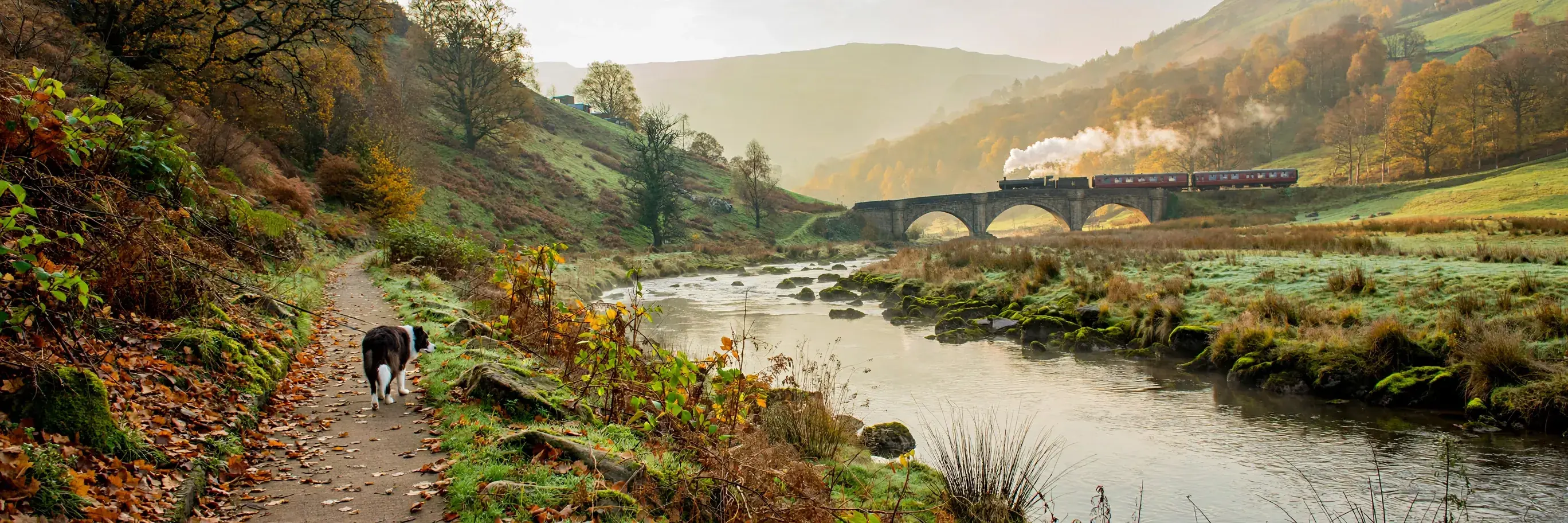
Most Welsh towns ask you to arrive by car and then look for somewhere to walk. Corwen is different, because the journey itself is part of the day. The Llangollen Railway runs heritage steam and diesel services along the Dee Valley, and its extension to Corwen means you can step off a train almost straight onto the riverside. For a dog, that matters more than it sounds: instead of a motorway service stop and a car park, the day starts with a short walk, fresh air and a platform where there is actually something to sniff.
Plan the rail part of the day first, because it sets the timetable for everything else. Heritage railways do not run like mainline services. Trains are less frequent, timetables change with the season, gala days and special events fill carriages quickly, and a missed departure can mean an hour on the platform rather than ten minutes. Check the official guidance before you travel for the running days, departure times, dog fares and any restrictions on busy days. If you are driving to Llangollen or another starting station and riding to Corwen, work out where the car will wait, how long the return train takes, and what happens if the last train of the day is full.
On the platform, treat the railway as a training exercise rather than a photo opportunity. Steam locomotives are loud, they release steam and smoke, and the platform edge is a genuine hazard. Keep your dog on a short lead, well back from the edge, and let them watch one train arrive before you expect them to board calmly. Some dogs love the noise and the movement; others find the whistle and the hiss of steam genuinely frightening. If your dog has never met a steam train, build in a visit to a station just to watch, or choose a diesel service for the first trip. There is no prize for forcing a nervous dog onto a crowded carriage.
Boarding is usually straightforward, but the details are worth checking in advance. Dogs are generally welcome on the Llangollen Railway, often for a small fare, and are usually expected to travel on the floor rather than on the seats, on a lead throughout. Carriages can be busy on event days and at school-holiday weekends, so a quieter weekday or an early departure gives a nervous dog far more space. Bring a mat or blanket so your dog has a familiar surface to lie on, and a chew or a stuffed toy to keep them settled during the journey. If your dog barks at other dogs, choose a compartment or a quieter end of the carriage where you can keep distance, and be ready to step off at an intermediate station for a break if the carriage gets too full.
If you arrive by car instead, the railway still shapes the day. Corwen station sits close to the town and the river, so it is a natural meeting point and a useful landmark when you are giving directions or arranging to meet friends. Park once, walk everywhere, and let the car stay parked while you explore on foot. That single decision — one car park, one base, everything on foot — is what turns Corwen from a drive-through town into a proper day out.
The riverside loop: the walk that makes the town
The best walk in Corwen is the simplest one: follow the River Dee. The river runs past the town through a broad, green valley, and the paths beside it give you the two things dogs value most — moving water to watch and a long, interesting scent trail. You do not need a map full of waymarks to enjoy it. Start at the town, find the riverside path, and walk out along the valley until the town noise fades, then turn back the same way or loop around through the quieter lanes.
Before you set off, take a proper look at the river. The Dee at Corwen is a working river, not a ornamental lake. It runs fast after rain, it is cold even in summer, and its depth changes quickly between shallow gravel edges and deeper channels. That is why the first rule of the riverside walk is to keep your dog on a lead near the water unless you are certain of the spot. A shallow, slow edge with a clear view of the bottom is a reasonable place for a careful paddle on a warm day. A fast stretch beside a bridge, a weir or a bank that drops away is not. If the river is high, brown or running hard after rain, keep your dog well back and enjoy the view from the path.
The loop itself is best treated as a sniffing walk rather than a march. Dogs get far more from forty unhurried minutes beside a river than from ninety minutes of brisk walking on a pavement. Let your dog stop, let them watch the ducks, let them work through the smells on a fence post. Bring a long line if your dog has a reliable recall and you want to give them more freedom on the open stretches, but clip it short again near roads, bridges, livestock and other walkers. A long line trailing through riverside mud is a hazard, not a freedom, so keep it tidy and keep your hands free.
Watch for the small hazards that riverside paths always carry. After wet weather the ground can be slippery, especially on wooden bridges, stone steps and shaded banks. Nettles and brambles grow thick along the edges in summer, and ticks are a real risk in long grass and bracken from spring through autumn, so check your dog thoroughly after the walk and carry tick-removal tools in your day pack. In autumn, fallen leaves can hide mud, holes and broken branches. In winter, short days mean you should start the walk with plenty of daylight left and carry a torch for the return.
Other walkers, cyclists and anglers share these paths, so good manners matter. Keep your dog close when you pass other people, especially families with small children and anyone with a fishing rod. Not every angler wants a wet dog investigating their tackle box, and not every walker wants to be greeted by an off-lead dog, however friendly. A short lead, a calm recall and a quick step to one side cost you almost nothing and keep the path pleasant for everyone.
The town itself: small, walkable and easy to read
Corwen is a small market town, and that is exactly its charm. There is no sprawling high street to navigate, no maze of one-way streets, and no sense that you have to rush to see everything before the car park runs out. The town centre is compact enough to explore on foot in under an hour, which suits dogs perfectly: a short wander, a sniff at every corner, a stop for a drink, and then back to the river.
Start with the practical geography. Corwen sits in the Dee Valley in Denbighshire, on the main road west from Llangollen towards Bala and the mountains of Eryri. The town has the usual small-town mix: a handful of shops, pubs, cafes, a church, and the railway station at one edge. The river runs close by, and the hills rise on both sides of the valley, so you are never far from a view or a walk. That compactness is useful when you are planning with a dog, because you can reach the car, the pub and the path without a long drive between each stop.
Corwen has a long history as a market town, and it is also associated with Owain Glyndwr, the Welsh prince whose statue stands in the town. You do not need to be a history enthusiast to enjoy that layer of the place — it simply gives the town a sense of identity that many bypass towns lack. A statue, a churchyard and an old street pattern are the kind of details that make a short wander interesting without demanding a full guided tour. Read the information boards as you pass them, take a photograph if your dog will sit still for one, and keep moving.
For dogs, the town centre is a training ground in miniature. Pavements are narrow in places, and the main road through town carries through traffic, so keep your dog on a short lead and on the inside of the pavement, away from the road. Crossings are few, so choose a clear spot with a good view in both directions and wait for a proper gap rather than hurrying across. If your dog is reactive to traffic noise, the quieter side streets and the riverside path will be far more comfortable than the main road.
Shops in a small town are often more flexible than chains in a city, but never assume your dog is welcome indoors. Ask before you take a dog into a shop, keep them close to you, and be ready to wait outside if the answer is no. Many owners are happy to chat about the town, the walks and the weather, and a polite question about dog-friendly spots often produces better local advice than any guidebook. That is one of the quiet advantages of a small town: people have time to talk.
Longer valley walks: from a stroll to a proper day
Once you have walked the riverside loop, the Dee Valley opens up. The valley floor is gentle, the hills on either side are steep, and the walking changes quickly with a small change in height. That contrast is useful, because it lets you choose a walk that matches your dog rather than forcing your dog to match a walk.
For an easy extension, stay low and follow the valley. Flat riverside and field-edge paths suit older dogs, puppies, and dogs recovering from injury, and they also suit owners who want a long walk without a long climb. The ground is usually firm in dry weather, but field paths can be muddy and rutted after rain, and stiles can be a problem for large or stiff dogs. Check the route before you commit to a long loop: a stile that looks easy on a map can be a genuine obstacle for a dog that cannot be lifted over it. If your dog struggles with stiles, choose routes that use gates and bridges instead.
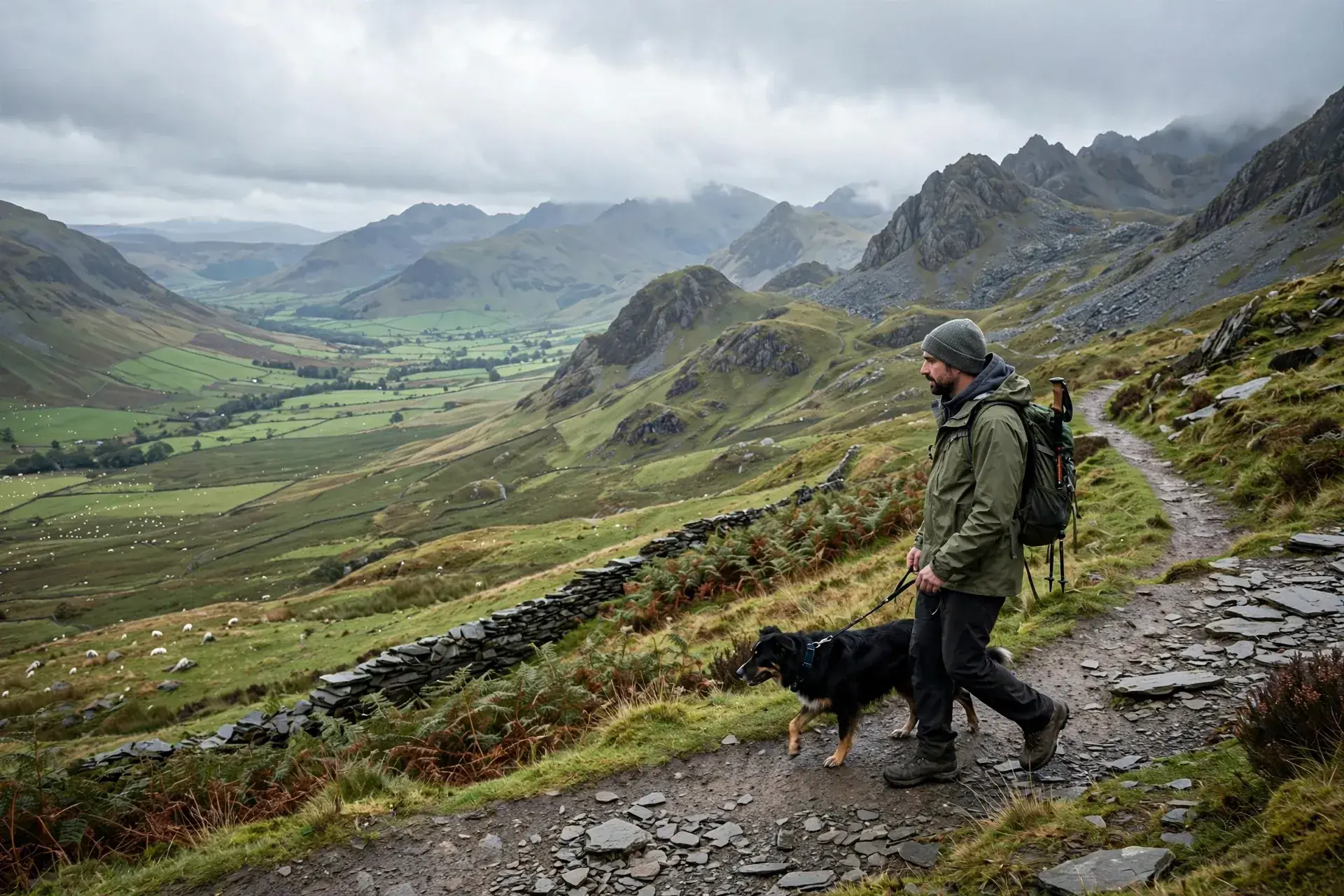
For a harder day, climb out of the valley onto the open hills. The views reward the effort — the whole Dee Valley spreads out below you, and on a clear day you can see for miles — but the conditions change with height. Wind is stronger, the ground is rougher, and the weather can turn quickly. Sheep graze freely on the open hills, so keep your dog on a lead throughout, even if the path looks empty. A sheep that appears suddenly over a rise can trigger a chase in even a well-trained dog, and the consequences for the sheep, the farmer and your dog can be serious. The rule is simple and non-negotiable: if there are sheep, the lead stays on.
Longer walks need better planning. Carry water for both of you, because valley streams are not always safe to drink from and hilltop paths may have no water at all. Pack a first-aid kit that includes a tick remover, a bandage, and something to clean a cut paw. Check your phone signal before you leave the valley floor — coverage can be patchy on the hills — and tell someone where you are going and when you expect to be back if you are walking alone. That sounds cautious, but it is the kind of caution that matters when a dog goes lame three miles from the car.
Corwen also works as a base for bigger days further afield. The mountains of Eryri are within reach by car, and the coast is a longer drive but a feasible day trip. Our Snowdonia dog guide covers lead rules on the mountains, sheep and livestock safety, easier valley walks and dog-friendly pubs, and it is worth reading before you plan a mountain day from Corwen. The same applies to a longer touring break: our dog-friendly North Wales road trip guide sets out a loop through the Conwy coast, the Eryri foothills and the Llyn Peninsula, with drive times and base towns, and Corwen fits naturally into that route as a quiet stop between busier places.
Whatever length you choose, build a rest into the walk. Dogs need time to drink, to cool down and to settle, especially on warm days or on steep ground. A ten-minute stop in the shade, with water and a chance to lie down, does more for a tired dog than pushing on to the next viewpoint. Watch for the signs of a dog that has had enough: slowing down, lagging behind, panting that does not settle, or a reluctance to keep walking. Those are signals to turn back, not to press on.
Dogs on the steam railway: the rules worth knowing
The steam railway is the reason many people come to Corwen, so it deserves its own section. The rules are not complicated, but they are specific, and they change with the type of service, the time of year and the event calendar. The safest approach is to treat every railway visit as a fresh check: read the current dog policy on the railway's official pages, and check the official guidance before you travel rather than relying on what a friend told you last year.
Dogs are generally welcome on the Llangollen Railway, and a small fare is usually charged. That fare can vary, and there may be limits on the number of dogs per carriage or per train on busy days. Dogs are expected to stay on the floor, on a lead, and under control at all times. They are not usually allowed on seats, and they should not be allowed to block the aisle or the doors. If your dog is large, choose a seat near the door or at the end of a carriage where there is more floor space. If your dog is small, a carrier or a blanket on your lap may be more comfortable, but check whether that is permitted on the service you are using.
Noise is the main issue for many dogs. A steam locomotive at full power is loud, and the whistle can be startling even for dogs that are normally calm. If your dog is noise-sensitive, sit as far from the locomotive as you can, bring ear protection in the form of a calm, familiar blanket and a chew, and consider a diesel service instead. Some dogs settle quickly once the train is moving; others stay tense for the whole journey. If your dog is clearly distressed — shaking, panting heavily, trying to hide — get off at the next station and walk back or wait for a quieter train. No photograph is worth a frightened dog.
Platforms deserve the same care as the train itself. Keep your dog on a short lead, well back from the edge, and do not let them investigate the tracks or the gap between the train and the platform. Steam and hot water can escape from a locomotive, and the platform surface can be slippery when wet. Arrive early enough to settle your dog before the train arrives, rather than rushing onto a crowded platform at the last minute. If the platform is busy, wait at the quieter end and board last, when there is more space to choose a seat.
Event days need extra planning. Galas, Santa specials, dining trains and other popular services can be much busier than an ordinary running day, and some may have different dog rules or may not be suitable for dogs at all. Book ahead where booking is available, arrive early, and be prepared to change your plans if the train you wanted is full. A quiet weekday in spring or autumn is often a far better railway day for a dog than a packed gala Saturday.
Pubs, cafes and cake stops: eating out with a dog
A small town lives or dies by its pubs and cafes, and Corwen is no exception. The good news is that a market town of this size usually has at least one pub and one cafe that welcomes dogs, and the welcome is often warmer than in a city chain. The bad news is that policies can change quickly — a new landlord, a refurbishment, a busy summer weekend — so always check before you settle in. Check the official guidance before you travel where a pub or cafe lists its dog policy online, and ask at the door if you are unsure.
The usual pattern is that dogs are welcome in the bar area or on the terrace, rather than in the main restaurant. That is not a snub; it is a practical arrangement that lets dogs settle on a hard floor near their owner while other diners eat in peace. Bring a mat so your dog has a defined place to lie, and a chew or a long-lasting treat to keep them occupied while you order. Order at the bar where possible, so you do not have to leave your dog alone at the table while you queue.
Terraces and beer gardens are the easiest option in good weather. A dog can lie in the shade, watch the world go by, and stretch out without blocking a walkway. In poor weather, a covered terrace or a dog-friendly bar is a better choice than a wet garden. Bring a towel to dry your dog before you go inside, especially after a riverside walk, and keep a spare lead in your pocket in case the first one gets muddy.
Cafes in Corwen are best used as short stops rather than long lunches. A coffee, a cake and a ten-minute rest suit a dog that has just walked the riverside far better than a two-hour meal. If you are planning a longer lunch, choose a pub with a proper dog-friendly area and book ahead if you can, so the staff know a dog is coming and can offer a suitable table. Tell them honestly about your dog: a calm older dog that sleeps under the table is a very different guest from a young, excitable dog that wants to greet every passer-by.
Carry your own water bowl. Many pubs and cafes will offer water, but a collapsible bowl in your day pack means you never have to wait or ask. The same applies to treats: a small bag of your dog's usual treats is more reliable than hoping the pub has dog biscuits. And always clean up after your dog, indoors and out. A single accident in a dog-friendly pub can change the policy for every dog that follows.
Where to stay: Corwen as a base, not just a stop
Corwen works as a day trip, but it also works as a base for a short break. The town is small enough to be quiet at night, yet close enough to Llangollen, Bala and the mountains that you can reach a different walk every day without a long drive. That combination — a quiet base and varied days — is exactly what many dog owners want from a Welsh break.
When you are choosing somewhere to stay, apply the same checks you would anywhere in Wales. Confirm that dogs are welcome in the specific room, cottage or pitch you are booking, not just on the site in general. Ask about the pet fee, the number of dogs allowed, and whether there are any breed or size conditions. Ask where the dog can go to the toilet at night, and whether there is a secure garden or a nearby field. A cottage with an enclosed garden is worth more than a larger cottage with an open frontage onto a road.
Self-catering cottages and small bed-and-breakfasts are the most common options around a town of this size. Cottages give you a kitchen, a garden and the freedom to come and go at your dog's pace. Bed-and-breakfasts give you a cooked breakfast and local advice, but they may have stricter rules about dogs in bedrooms or dining rooms. Ask those questions before you book, and get the answers in writing. A friendly phone call that confirms the dog is welcome is worth far more than a filter ticked on a booking site.
If you are staying further afield and using Corwen as a day stop, the same logic applies in reverse. Choose a base with good walking from the door, so you are not driving to every walk. A base near the Dee Valley, with a riverside path and a pub within walking distance, will give you a better break than a larger town where every walk starts with a car journey. Our North Wales road trip guide covers base towns in more detail, including drive times and how to structure a loop so you are not backtracking every day.
Whatever you book, arrive in daylight if you can. A first evening spent finding the toilet area, checking the garden fence and settling the dog is far easier in daylight than in the dark. Bring your dog's bed, their usual food, and a familiar blanket. Dogs settle faster when the new place smells like home, and a calm first night sets the tone for the whole break.
Seasons and weather: when Corwen is at its best
Corwen is a year-round town, but the experience changes with the seasons, and the best time to visit depends on your dog. Spring brings lambs, nesting birds and fast-growing grass, which means leads stay on near livestock and ticks become a daily check. Summer brings long days, warm riverside walks and busy railway carriages, which means early starts, shade and plenty of water. Autumn brings colour, quieter paths and the first frosts, which many dogs love. Winter brings short days, mud and cold water, which means shorter walks, a drying coat and a warm pub at the end.
Autumn is arguably the best season for a dog visit. The valley turns gold and red, the paths are quieter after the summer holidays, and the steam railway still runs on many weekends. The air is cool enough for a long walk without overheating, and the light in the valley is at its best in the early morning. Pack a waterproof layer for yourself and a drying coat for your dog, because autumn showers can arrive quickly, and a wet dog in a cold car is no fun for anyone.
Summer needs more care. The Dee Valley can be warm on a still day, and a dog walking on a sunny riverside path can overheat faster than you expect. Walk early in the morning or late in the afternoon, carry water for both of you, and watch for the signs of heat stress: heavy panting, drooling, a reluctance to walk, or a dog that seeks shade and will not move. If you see those signs, stop, cool the dog with water on their belly and paws, and get them into shade. Never leave a dog in a parked car, even for a few minutes, even with a window open.
Winter in the Dee Valley is quiet and beautiful, but it demands respect. Paths can be icy, the river runs high and cold, and daylight is short. Start walks early, carry a torch, and keep to the valley floor rather than climbing onto exposed hills in poor weather. A short, bright winter walk followed by a long pub lunch is a far better plan than a long, cold march that leaves both of you chilled and tired.
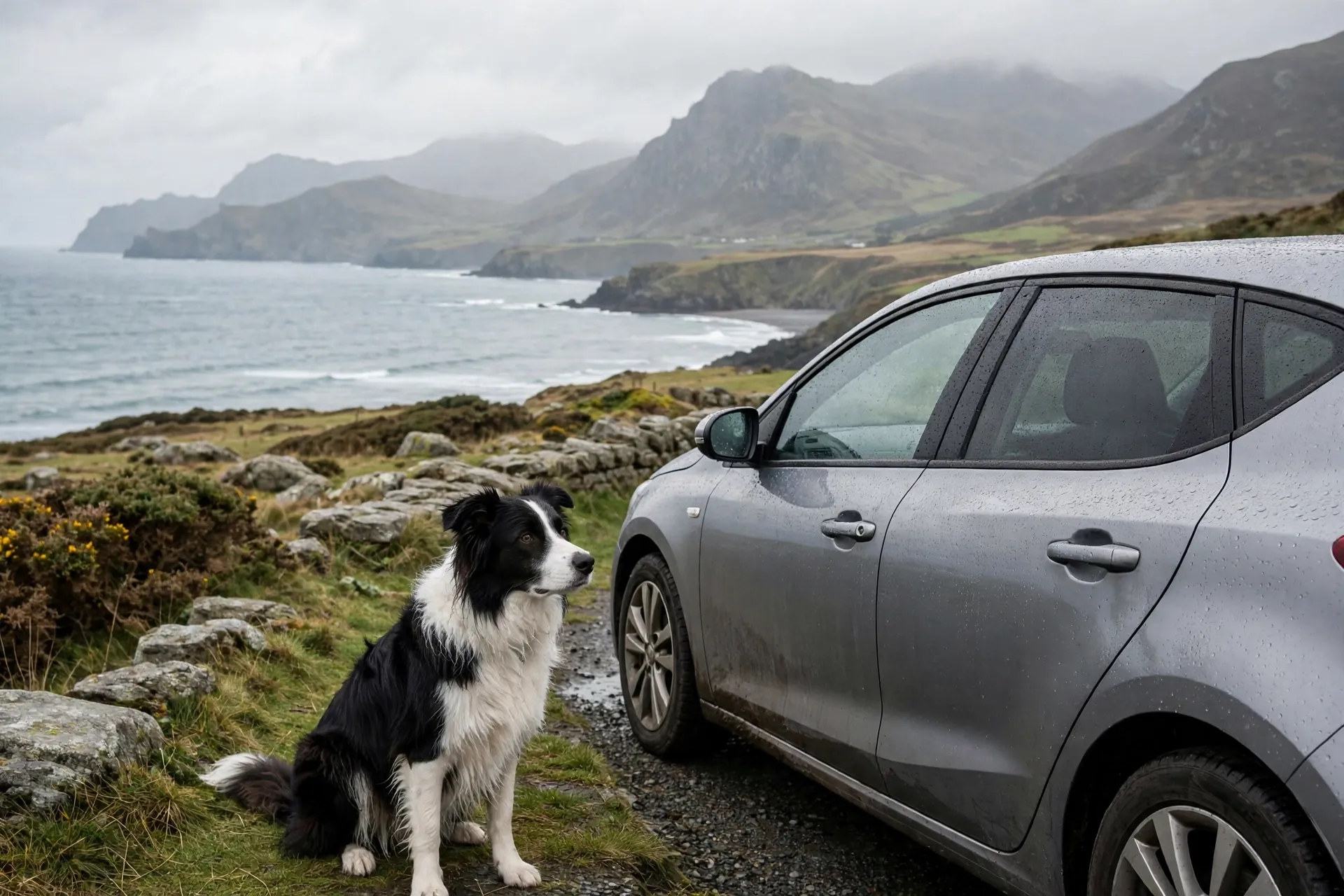
Whatever the season, check the forecast before you travel and pack for the weather you might get, not just the weather you hope for. Welsh valleys make their own weather, and a sunny morning in Llangollen can turn into a wet afternoon in Corwen. A waterproof jacket, a spare lead, a towel and a drying coat weigh almost nothing in the car and save the day when the rain arrives.
Practical details: parking, vets, kit and the small stuff
The practical details are what separate a smooth day from a stressful one, so sort them before you leave home. Parking in Corwen is straightforward by small-town standards, but spaces near the station and the river can fill on busy railway days and at weekends. Arrive early if you want a space close to the paths, and be prepared to walk a short distance from a quieter car park. Always check the parking signs for time limits and charges, and do not leave valuables visible in the car. Check the official guidance before you travel for current parking arrangements, because car park rules and charges can change.
Know where the nearest vet is before you need one. Save the number in your phone, along with the number of an out-of-hours vet if you are staying overnight. Rural practices can be some distance away and may close early, so a small cut, a swallowed object or a sudden limp is much easier to deal with if you already know where to go. Carry a basic first-aid kit in your day pack: a bandage, a tick remover, saline solution for cleaning a wound, and any medication your dog needs. If your dog takes regular medication, pack an extra day's supply in case your plans change.
Your day pack should be small but complete. Water and a collapsible bowl, poo bags, a spare lead, treats, a mat for pubs and cafes, a towel, a tick remover, and a torch in winter. A long line is useful on open valley stretches, but keep it tidy and clip it short near roads and livestock. A drying coat is worth its weight in autumn and winter, when a wet dog can chill quickly after a riverside walk. A spare towel in the car, for the journey home, is the detail most people forget and most often need.
Mobile signal in the Dee Valley is generally usable in the town, but it can be patchy on the hills and in the deeper parts of the valley. Download any maps you need before you leave, and do not rely on a live signal to navigate a long walk. A paper map or a downloaded offline map is a reliable backup, and it works even when your battery is low. Tell someone your route and your expected return time if you are walking alone on the hills, especially in winter.
Livestock deserves a final mention, because it is the single most important safety rule in this valley. Sheep and cattle graze on the hills and in the fields beside the paths, and dogs must be kept on a lead near them at all times. That applies even if your dog is normally calm, even if the sheep look far away, and even if the field looks empty. A dog that chases livestock can be shot by a farmer under UK law, and a farmer whose sheep are worried by a dog has every right to be angry. The lead stays on. There is no exception worth making.
Finally, leave the valley as you found it. Pick up after your dog, every time, including on remote paths. Take your litter home, including poo bags — a bag left hanging on a fence is worse than no bag at all. Keep to the marked paths where they exist, close gates behind you, and do not let your dog disturb wildlife, nesting birds or other walkers. Small towns and quiet valleys stay welcoming to dogs only because most dog owners behave well. Be one of them.
A one-day plan: how to put it all together
A good day in Corwen does not need a complicated itinerary. It needs a sensible order, a few choices made in advance, and enough slack to let the dog set the pace. The plan below is a template, not a timetable. Adjust it for the weather, the railway timetable and your dog's energy, and do not be afraid to cut a walk short if your dog is tired.
Start early, and start with the railway if you are riding in. An early train is quieter, the platform is calmer, and the light in the valley is at its best in the morning. Let your dog settle on the train with a mat and a chew, and enjoy the ride rather than trying to photograph everything at once. When you arrive in Corwen, step off the train and take a short walk straight away — a few minutes of sniffing and stretching after a train journey makes a real difference to a dog.
Mid-morning is the time for the riverside loop. Walk out along the Dee, take your time, and let your dog set the pace. Stop for water, stop for a rest in the shade, and turn back when you have had enough rather than when you reach a particular landmark. A riverside walk that ends with a happy, tired dog is a success, even if you did not walk as far as you planned.
Lunch is the natural break in the middle of the day. Choose a dog-friendly pub, ask for a table in the dog-friendly area, and settle your dog on their mat with a chew while you eat. A slow lunch is not wasted time; it is rest, and a rested dog walks better in the afternoon than a dog that has been marched all morning. If the weather is good, a terrace or a beer garden is the easiest option. If it is wet, a warm bar with a fire is hard to beat.
The afternoon is for the town itself, or for a second, shorter walk. Wander the town centre, look at the statue and the church, and pick up any supplies you need. Or take a short valley walk in the other direction, to see a different stretch of the river. Keep the afternoon walk shorter than the morning one, and build in a final rest before the journey home. A dog that has walked all day needs time to settle before a train or a car journey, and a calm dog travels far better than an over-tired one.
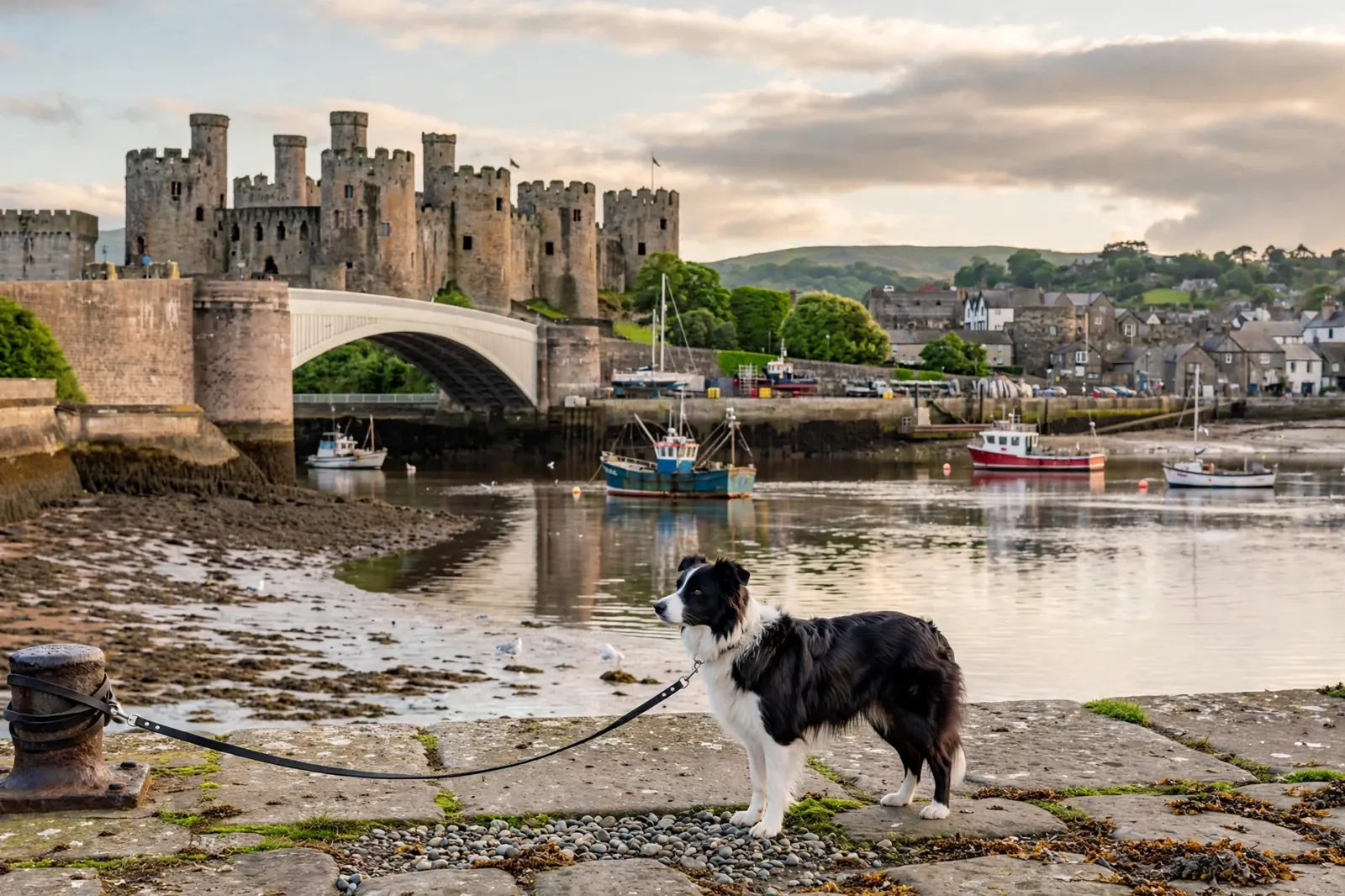
If you are staying overnight, the evening is for settling in. Find the toilet area in daylight, check the garden fence, and give your dog their usual food at their usual time. A quiet evening, a familiar bed and a short last walk are the best preparation for a second day. And if you are planning a second day, consider a bigger walk — the hills above the valley, or a drive to the coast or the mountains. Our Conwy dog guide covers castle rules, town walls, the quay and the harbour, and it makes a good next stop on a longer North Wales break, while the Snowdonia guide above covers the mountain days that Corwen makes such a calm base for.
Practical questions
Before you go
Can dogs ride the Llangollen Railway to Corwen?
Dogs are generally welcome on the Llangollen Railway, usually for a small fare, but spaces, carriage rules and busy-day limits can change. Check the official guidance before you travel, book ahead on event days, keep your dog on a lead on the platform, and choose a quieter carriage if your dog is nervous around noise, crowds or other dogs.
Where can I walk my dog off the lead near Corwen?
There is no single guaranteed off-lead field in the town centre, so treat the riverside paths as on-lead walks and use enclosed or clearly signed areas only where they are provided. The Dee Valley has livestock nearby, so keep your dog on a lead near sheep and cattle, carry a long line for open stretches, and only let your dog off where you have a clear view and a reliable recall.
Is the River Dee safe for dogs to swim in at Corwen?
The Dee is a fast, cold river with changing depth and strong currents after rain, so it is not a safe paddling spot for most dogs. Let your dog paddle only at a shallow, slow edge you can see clearly, never after heavy rain, and keep a lead on near weirs, bridges and fast water. If in doubt, skip the swim and use a riverside walk instead.
Are there dog-friendly pubs and cafes in Corwen?
Corwen has a small number of pubs and cafes that welcome dogs, usually in the bar area, on the terrace or in a specific dog-friendly section, but policies can change with the season or the landlord. Check the official guidance before you travel, ask before settling in with a wet dog, and bring a mat and a chew so your dog can settle quietly while you eat.
How long should I allow for a day in Corwen with a dog?
A relaxed day works well: allow two to three hours for a riverside walk and a wander around the town, plus time for a steam train ride if you are travelling by rail. If you want a longer valley walk, add another two hours and a pub stop. Arriving by mid-morning gives you the quietest paths and the best chance of a calm platform and carriage.
What should I pack for a wet-weather visit to Corwen?
Pack a drying coat and two towels, a waterproof lead, a spare lead, poo bags, a water bottle and bowl, a mat for pubs and cafes, and a torch for short winter days. Riverside paths can turn muddy after rain, so wear waterproof boots with grip and keep a clean towel in the car for the journey home.