This guide is independent and contains no paid placement. If affiliate links are added later, they will be clearly marked and will not change our editorial checks.
Craster to Dunstanburgh Castle is about 1.5 miles of coast path each way, and Embleton Bay lies just beyond the castle. Walk it as three legs — harbour, castle, beach — keep your dog on a lead near cliffs and livestock, check tide times before you go, and arrive early for parking.
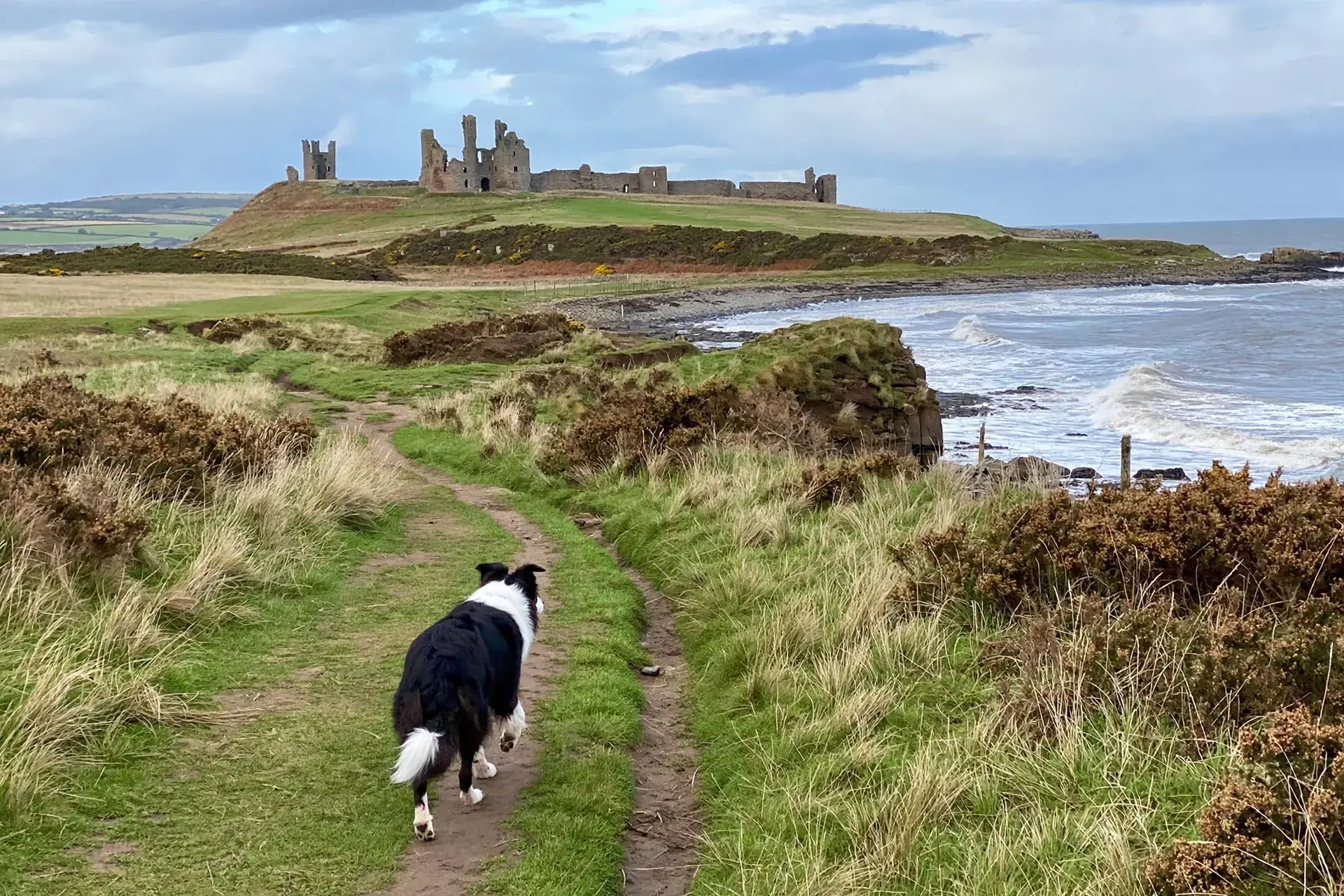
It is only about a mile and a half, and yet it feels like crossing three different worlds. At the far end stands Dunstanburgh Castle, a great broken outline on a dark rock above the sea, its towers open to the sky and its walls cut by wind and weather for centuries. From a distance it looks almost impossible, a fortress that seems to grow out of the headland itself, and that first sight is what pulls most walkers along the path. But the castle is the ending, not the beginning, and the walk is better understood backwards: start with the destination in mind, then return to the small harbour where the journey actually begins, and let each leg earn the next one.
That is the shape of this guide. Instead of a list of separate attractions, it follows one journey in order: Craster harbour, the coast path to Dunstanburgh, and the long beach of Embleton Bay beyond it. Each leg has its own character, its own ground underfoot, and its own rules for a dog. The harbour is close, busy and full of smells. The coast path is open, exposed and dramatic. The beach is wide, empty and made for running. A dog experiences them as three different days packed into a single morning, which is exactly why the route works so well — and why it needs a little planning. A tired dog at the castle is a happy dog; a dog that has already had its run at the harbour, been kept safe on the cliffs, and been given water and rest at the right moments will enjoy the beach far more than a dog that has been dragged through all three legs without a pause.
Craster sits on the Northumberland coast between Alnwick and the Holy Island road, a village small enough to walk across in minutes and famous well beyond its size. It is a working fishing village, not a resort, and that matters for dog owners: boats come and go, nets and crates appear on the quay, gulls work the harbour, and the smell of smoke from the village smokehouse drifts across the streets. Dogs notice all of it. The village is also the gateway to one of the best-known short walks in northern England, and on a fine weekend the car park and the path can be busy. Go early, go on a weekday if you can, and treat the crowds as part of the plan rather than a surprise.
Before any of the detail, one practical point shapes everything else: check the official guidance before you travel. Castle opening arrangements, beach restrictions, parking charges and bus times all change, and a guide written in October cannot promise what a sign at the harbour will say in July. The sections below give you the questions to ask and the habits that keep the day safe, but the official sources — the castle operator, the local council and the tide tables — are the final word on the day itself.
The journey in three legs
Think of the day as three legs of roughly equal weight, even though the distances are not equal. Leg one is Craster itself: the harbour, the smokehouse, the short streets and the first stretch of shore. It is the warm-up, the place to let the dog settle, sniff, drink and empty itself before the open path. Leg two is the coast path north to Dunstanburgh Castle, about 1.5 miles of grass, stone and cliff-top walking with the castle growing larger at every step. Leg three is the turn past the castle towards Embleton Bay, where the ground drops to a long sweep of sand and the walk changes completely, from a path with a destination to a beach with no edge in sight.
Each leg asks something different of the dog. The harbour asks for manners: a short lead, calm behaviour around boats, fishing gear and other dogs, and no stealing food from the quay. The coast path asks for stamina and control: steady walking on uneven ground, a reliable recall or a lead near drops and livestock, and the sense to keep moving when the wind picks up. The beach asks for energy management: space to run, but also a dog that will come back, drink fresh water, and rest in shade or shelter when the run is done. Planning the day leg by leg makes it easier to match the dog you have to the walk you are doing, rather than discovering halfway along the cliff that a nervous dog is frightened, a young dog is overexcited, or an older dog is already tired.
Time the legs honestly. The castle leg is often described as an hour each way at a comfortable walking pace, but a dog walk is rarely a comfortable walking pace. Dogs stop, sniff, greet, drink, and need a pause in the wind. Allow at least two hours for the return trip to the castle alone, and three to four hours if you continue to Embleton Bay and want a proper beach stop. That is a half day, not a quick stroll, and it is worth treating it as one: bring water, a lead and a long line, a towel, poo bags, and a snack for the dog as well as for yourself. A dog that is fed and watered at the castle will walk back far more willingly than one that has had nothing since breakfast.
The route is also a good test of fitness, for dog and owner alike. The coast path is not a flat promenade. It rises and falls, crosses grass and rocky ground, and in wet weather can be muddy and slippery. Small dogs, older dogs and dogs recovering from injury may find the full distance to the beach too much, and there is no shame in turning back at the castle — for many dogs, that is the perfect day. Puppies need particular care: a young dog should not be asked to cover the whole out-and-back distance in one go, and the beach run that looks joyful in photographs can be exhausting for joints that are still growing. Shorten the day to fit the dog, and the dog will enjoy the part it does far more.
One more framing point helps before you set out. This is a linear walk with a clear there-and-back shape, but it does not have to be walked the same way twice. The return can retrace the coast path, or it can take the inland route through the fields and lanes, which gives the dog different smells, different ground and a quieter finish. The section on return choices below sets out both options, so you can decide on the day, with the weather and the dog's energy in front of you, rather than committing in the car park. The best plan for this walk is a plan with a decision point built in.
For the wider county, our Northumberland with a dog guide sets Craster in context — castle rules, Bamburgh beaches, Holy Island tide safety, Hadrian's Wall walks and quiet dark-sky stays — so if this walk leaves you wanting a longer stay, that guide is the natural next step. And if you are travelling through the region, our Newcastle with a dog guide covers bridges, quays, Ouseburn, Jesmond Dene and Metro trips to Tynemouth beaches for the city end of the journey.
Leg one: the harbour and the smokehouse
Craster harbour is small, working and photogenic in the way that only a real harbour can be. Stone piers enclose a tidal basin, boats sit on the harbour floor at low water, and the village houses crowd close to the water. For a dog, the first five minutes here are a rush of information: salt air, fish, rope, gulls, diesel, seaweed, and the scent of every other dog that has walked the quay that morning. Let the dog take it in. A slow lap of the harbour, on a lead, with time to sniff and settle, is not wasted time — it is the dog's version of reading the map, and a dog that has settled at the harbour will walk more calmly on the open path.
Keep the lead short around the harbour itself. The quay edges are not fenced in the way a park path is fenced, and a dog that lunges at a gull or chases a crab across wet stone can be in the water or over an edge before you have time to react. Fishing gear is another hazard: hooks, lines, nets and crates are working equipment, not street furniture, and a curious nose can find a hook faster than you can pull it away. Watch where the dog puts its paws on wet stone and seaweed, which can be slippery, and keep the dog clear of boat launching areas and any machinery in use. This is a place to walk slowly and watchfully, not to let the dog run free.
Craster is famous for its smoked salmon and kippers, produced in the village smokehouse, and the smell is part of the village. The smokehouse shop is a natural first stop, but plan it as a human stop rather than a dog stop: one person can go in while the other waits outside with the dog, or the dog can wait in a shaded, supervised spot if the weather allows and the dog is settled. Do not feed the dog smoked fish from the shop, however much it begs. Smoked fish is salty, rich and not a suitable dog treat, and a dog that eats a large piece of kipper on an empty stomach may spend the rest of the walk with an upset stomach. Buy the fish for later, keep it sealed in a bag, and give the dog its own treat instead.
Food smells are everywhere in a fishing village, and dogs will find them. Fish boxes, discarded bait, gull-dropped scraps and seaweed washed up on the slipway are all worth a sniff and, for some dogs, a taste. A firm leave-it and a watchful eye matter more here than on an inland path. If your dog is a known scavenger, a muzzle is not a punishment — it is a practical tool that lets the dog enjoy the harbour without eating something that could make it ill. Bring water for the dog even on a short harbour stop, because salt water is not drinking water and a dog that has been sniffing and pulling in the sun will be thirsty before the path begins.
The village itself is worth a slow look before you leave it behind. Stone cottages, narrow lanes and a pub or two cluster around the harbour, and the atmosphere is quieter than the honeypot villages further south. Dogs are part of daily life here, and well-behaved dogs on leads are generally welcome in the outdoor spaces, but do not assume every doorway is open to them. Check signs at each pub, cafe or shop, ask staff before you bring a dog inside, and be ready to sit outside with the dog if that is the rule. A dog that lies quietly under a table outside is a pleasure for everyone; a dog that barks at every passing gull is not, and the harbour is a good place to practise the calm behaviour the rest of the day will need.
Use the harbour as your last chance to check the basics before the open coast. Is the lead comfortable and secure? Is the harness fitted properly? Do you have enough poo bags for a half-day walk, and a bag to carry them in until you reach a bin? Is there water in the bottle, and does the dog know where it is? Is the phone charged, and do you know the tide times for the day? These are small questions, but they are much easier to answer beside a harbour wall than halfway along a cliff path in a rising wind. Take five minutes here, and the next two legs will go more smoothly.
Leg two: the coast path and the castle
Leave the harbour to the north and the path begins in earnest. The coast path from Craster to Dunstanburgh runs along the cliff top and the grassy edge above the shore, with the sea on one side and fields on the other, and the castle visible ahead for most of the way. It is one of those walks where the destination does half the work: every rise in the path brings the ruins a little closer, a little larger, a little more detailed, and dogs seem to pick up on the momentum, walking with more purpose as the towers grow. The path is well used and generally easy to follow, but it is a coast path, not a pavement, and the ground changes with the weather and the season.
Underfoot, expect a mix of short grass, bare earth, stone and, after rain, mud. The path can be narrow where it runs close to the cliff edge, and wider where it crosses open grass. In dry summer weather it is firm and easy; in winter, after heavy rain, it can be slippery and churned, especially on the slopes. Footwear matters: walking boots or sturdy shoes with grip are a better choice than trainers on a wet day, and a dog with sore paws or a recent injury will feel every uneven step. Check the dog's paws at the castle and again on the way back, and carry a small towel to clean mud and grit from between the toes, where it can cause soreness on a long walk.
Lead policy on this leg is a judgement call, and the right answer changes with the dog. On open grass away from the edge, a dog with a reliable recall can enjoy off-lead time, and the path is wide enough in places for a good run. Near cliff edges, near livestock, near other walkers, near the castle itself, and anywhere the path narrows, the lead should go back on. A long line is the best compromise for many dogs: it gives the dog room to sniff and move, while keeping you in control if a gull, a rabbit or a sudden gust sends the dog towards the edge. Never let a dog off lead if you cannot call it back from a distraction at distance, and never assume that a dog that is calm at home will be calm beside a cliff with seabirds overhead.
The wildlife of this coast is part of its appeal and part of its risk. Seabirds nest on the cliffs and feed along the shore, and a dog that chases birds can disturb nesting sites and put itself in danger on unstable ground. Ground-nesting birds in the fields beside the path are equally vulnerable in spring and early summer, and a dog running through long grass can do damage without meaning to. Keep the dog close during the breeding season, watch for signs asking walkers to keep dogs on leads, and treat every sign as a rule rather than a suggestion. The same care applies to seals, which can haul out on quieter stretches of shore: a dog that rushes a seal can be bitten, and a seal that is disturbed may abandon a resting place it needs. Give wildlife a wide berth, keep the dog on a lead, and enjoy the sight from a distance.
Dunstanburgh Castle itself is a ruin on a grand scale. Built in the fourteenth century, it stands on a basalt outcrop with the sea on two sides, and its great gatehouse and curtain walls survive as broken towers against the sky. Dogs on leads are generally welcome in the castle grounds, but check the official guidance before you travel, because access rules and opening arrangements can change. The castle is managed as a historic site, and there may be an admission charge, seasonal hours, and rules about where dogs can go. Do not assume that a dog can enter every part of the site, and do not let the dog climb on loose stonework, scramble up walls, or dig in the grass among the ruins. Loose stones, sudden drops and uneven masonry are real hazards for a dog that is allowed to roam freely among ruins.
Plan the castle stop as a rest, not a rush. Find a sheltered spot out of the wind, give the dog water, let it lie down, and take the time to look at the castle properly. The view back towards Craster, the view north towards Embleton Bay, and the view out to sea are all worth a pause, and the dog will benefit from the break as much as you will. If the castle is closed on the day you visit, the walk is still worth doing: the ruins are impressive from the outside, the coast path is the real attraction, and the beach beyond is still there. Check the official guidance before you travel so that a closed gate does not feel like a wasted journey, and have a plan for a longer beach stop instead.
Photographs at the castle are a pleasure, but take them with the dog's safety in mind. The most dramatic viewpoints are often the closest to a drop, and a dog that is posing for a photograph is a dog that is standing still beside an edge. Keep the lead on, keep the dog on the inland side of the path, and do not back up towards a cliff while framing a shot. A photograph is not worth a fall. If you want the classic picture of a dog with the castle behind it, take it from the path on the approach, where the ground is level and the castle fills the frame without an edge in the foreground.
Wind is the constant companion of this leg. The Northumberland coast is exposed, and a breeze that feels pleasant in the village can become a strong wind on the cliff top. Dogs with thin coats, small dogs and older dogs feel the wind chill quickly, and a wet dog in a cold wind can become chilled in minutes. Bring a drying coat or a fleece for the dog if the forecast is cool or changeable, and watch for signs that the dog is cold: shivering, tucking its tail, seeking shelter behind your legs, or refusing to walk into the wind. Turn back early if the wind is stronger than expected; the castle will still be there on a calmer day, and a dog that has been frightened by a gust on a cliff path may be reluctant to walk it again.
Leg three: Embleton Bay
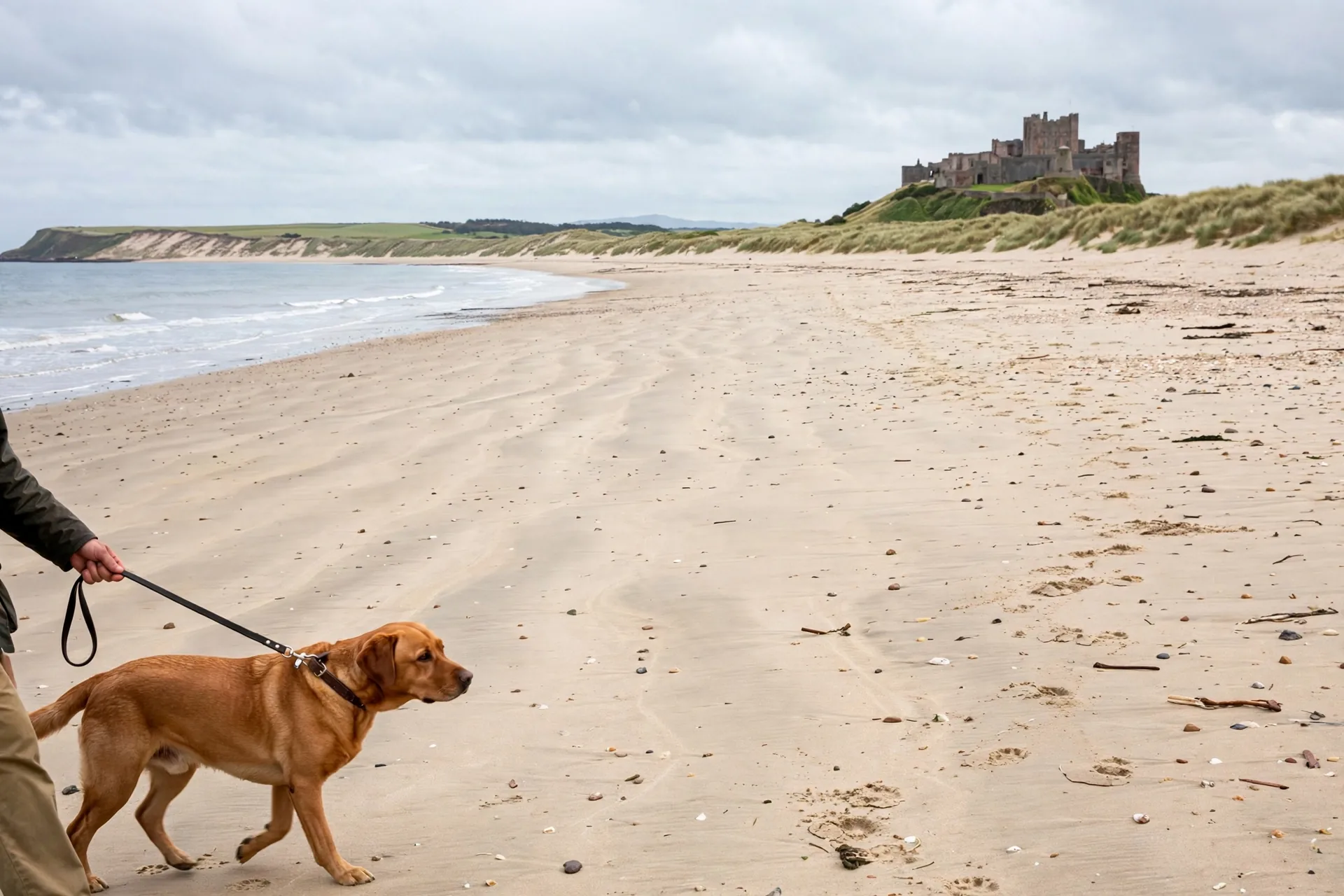
Past the castle, the land opens out and the walk changes character completely. Embleton Bay is a long, wide beach of sand that curves away to the north, with dunes behind it and the sea in front, and on a quiet day it can feel almost empty. After the narrow cliff path and the stone of the castle, the openness is a release — for the dog most of all. This is the leg where a dog can run, chase a ball, paddle in the shallows and roll in the sand, and where the walk stops being a route with a destination and becomes a place to be.
Dogs are generally welcome on Embleton Bay, and the beach is popular with dog walkers throughout the year. Seasonal restrictions can apply on some Northumberland beaches, so check the official guidance before you travel, and do not assume that the rules at Embleton are the same as the rules at a beach further south. Even where dogs are welcome, the usual courtesies apply: keep the dog under control around other beach users, pick up after the dog, and keep the dog away from picnics, children playing, and anyone who has clearly chosen a quiet spot. A beach is shared space, and a dog that runs through a family's picnic will not be forgiven because the beach is large.
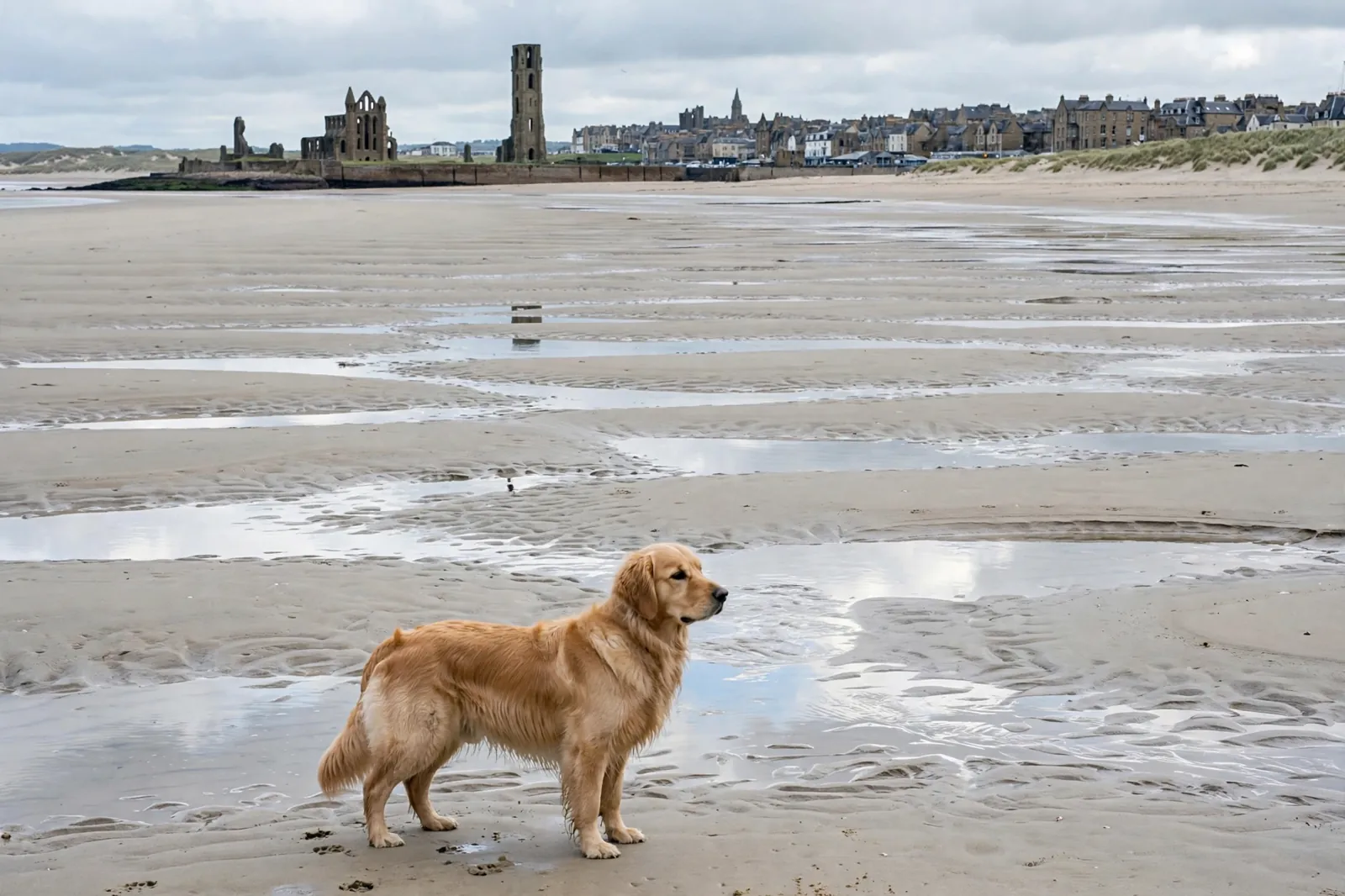
The beach is also a place to watch the dog's energy carefully. Sand is harder work than a path, and a dog that runs flat out on soft sand will tire faster than it would on firm ground. Puppies, older dogs and dogs that are unfit can overdo it quickly, and the excitement of a beach can mask tiredness until the dog is already exhausted. Build in rests: walk for a while, let the dog run for a while, then walk again. Offer fresh water regularly, because a dog that has been running on a beach will be thirsty, and sea water is not a substitute. Watch for the dog drinking sea water, which can cause vomiting and diarrhoea, and discourage it firmly.
Swimming needs the same caution as running. The North Sea is cold even in summer, and the water at Embleton Bay can have strong currents and a shelving shore. Not every dog is a strong swimmer, and even a confident swimmer can be caught by a current or a sudden wave. Let the dog paddle in the shallows if it wants to, but do not throw a ball into deep water, do not encourage the dog to swim out after a stick, and keep the dog on a long line if you are unsure about its swimming or its recall in water. After a swim, dry the dog thoroughly, especially the ears, and check for sand and salt between the toes. A dog that has been swimming in cold water and then walks back in a cold wind can chill quickly, so a drying coat is worth carrying even on a warm day.
The dunes behind Embleton Bay are a habitat in their own right, and they need care. Dune grasses hold the sand together, and the dunes shelter nesting birds and other wildlife. Keep the dog on the beach or on the marked paths through the dunes, do not let the dog dig in the dunes or chase through the grass, and respect any signs asking walkers to keep to the paths. The dunes are also a good place for a sheltered rest out of the wind, if you can find a hollow away from the main routes, but do not let the dog disturb other people who have chosen the same shelter. Leave the dunes as you found them, and take any litter — including poo bags — with you.
How far to go along the beach is a decision for the day. Some walkers turn back after a short stretch of sand, content with the run and the paddle. Others walk the length of the bay towards Low Newton, adding a mile or more to the day. The right distance depends on the dog, the weather, the time of day and the tide. A dog that is already tired from the castle leg will not thank you for an extra mile of soft sand, and a dog that is full of energy will be disappointed by a ten-minute stop. Watch the dog, not the map: a dog that is still running in wide circles has energy to spare, while a dog that is walking slowly behind you, tongue out and tail low, is telling you it is time to turn back. The beach will still be there tomorrow.
Coming back: the return and the loop
The simplest return is to retrace the coast path from Embleton Bay, past the castle, and back to Craster. It has one great advantage: you already know the ground, the distances and the tricky spots, and the views in the other direction are different enough to feel fresh. The light changes, the castle looks different from the north, and the harbour appears gradually as you come back south. For a tired dog, familiarity is a comfort — the dog knows the way home, and the walk back feels shorter than the walk out, even when it is the same distance.
The alternative is an inland loop, turning away from the coast after the castle or after the beach and returning to Craster through the fields and lanes behind the village. This route is quieter, more sheltered from the sea wind, and different underfoot, which can be a relief for a dog that has had enough of cliff-top exposure. It also passes through farmland, which brings its own rules: keep the dog on a lead near livestock, close gates behind you, and stick to the marked rights of way rather than cutting across fields. Check the official guidance before you travel for the current state of the inland paths, because field paths can be muddy, overgrown or diverted, and a route that looks clear on a map may be impassable after heavy rain.
Whichever return you choose, decide at the castle or at the beach, not in the car park. The decision depends on the wind, the light, the dog's energy, and the time. If the wind has risen, the inland route is the kinder choice. If the dog is tired, the coast path is the more direct one. If the light is fading, the familiar coast path is safer than an unfamiliar field route. If the dog is still full of running, the beach can be extended and the return shortened. Build the decision point into the day, and make it with the dog in front of you, not with a plan made at home.
Practical points for the return matter as much as the route. Offer the dog water again at the castle on the way back, and check the paws for sand, grit and soreness. A dog that has been running on the beach may have sand packed between its toes, which becomes painful on the walk home. A quick rinse with fresh water, if you have any left, or a wipe with a damp towel, will help. Watch for limping, lagging or a change in gait, and be ready to slow down, shorten the return, or carry a small dog for part of the way. There is no prize for finishing the full loop if the dog is hurting.
For dogs that travel by public transport, the return is also the point to think about buses and trains. Craster is served by local buses, but services can be infrequent, especially on Sundays and outside the summer season, and the bus stop is a walk from the harbour. Check the official guidance before you travel for current timetables, and do not assume that a bus that brought you to Craster in the morning will still be running when you are ready to leave. Dogs are generally allowed on local buses, but check the operator's rules, keep the dog on a lead and under control, and be ready to wait if a bus is full. A taxi from a nearby town is a useful fallback, but book ahead if you think you might need one, and confirm that the driver accepts dogs.
Tides, cliffs and livestock
Tides are the single most important safety factor on this coast, and the one most easily overlooked on a fine day. The tide at Craster and Embleton Bay rises and falls twice a day, and the difference between high and low water can be large. At low tide, the beach is wide and inviting; at high tide, the water reaches the base of the cliffs and the dunes, and stretches of beach that were easy walking in the morning can be cut off by the afternoon. Check tide times before you set out, plan the beach leg for a falling or low tide, and allow a generous margin for the return. If you are ever unsure, check the official guidance before you travel and ask locally before starting the walk.
Never try to wade around a headland or cross a beach that is being cut off by a rising tide. The water rises faster than it looks, the rocks become slippery, and a dog that is paddling happily in the shallows can be swept off its feet by a wave. Keep the dog on the higher coast path where the beach narrows, and turn back early if the water is rising faster than expected. Teach the dog — or rather, teach yourself — to treat a rising tide as a signal to leave, not as a challenge to beat. The RNLI and the coastguard give the same advice to walkers every year, and it is worth following even when the day feels calm.
Cliffs need the same respect as tides. The cliffs between Craster and Dunstanburgh are not fenced, and the edge can be undercut, crumbling or hidden by long grass. Keep the dog on a lead near the edge, keep yourself on the inland side of the path where it runs close to a drop, and do not let the dog peer over the edge or chase a bird towards it. Children need the same care, and a dog on a long line can still reach an edge if the line is too long — shorten the line where the path narrows, and keep the dog close. If the dog is frightened by heights or by wind, it may freeze or pull away from the edge; respect that fear, give the dog space, and take the inland side of the path.
Livestock is a regular feature of the fields beside the coast path, and the rules are simple and non-negotiable. Keep the dog on a lead near sheep, cattle and horses, keep the dog under close control, and never let it chase or worry livestock. Worrying livestock is an offence, and a farmer is entitled to act if a dog is threatening animals. Cattle with calves can be protective, and a dog that runs at cattle can put its owner in danger as well as itself. If you meet cattle on the path, keep the dog on a short lead, walk calmly and steadily past them, and do not let the dog bark or lunge. If the cattle block the path, wait, give them space, or take a different route rather than forcing your way through.
Other hazards are smaller but worth knowing. Adders can be found on warm, sunny banks and in dune grass in summer; a dog that sniffs in long grass can be bitten, and an adder bite needs urgent veterinary attention. Keep the dog on the path in warm weather, watch where it puts its nose, and know the location of the nearest vet before you set out. Ticks are present in grass and bracken, especially in spring and summer; check the dog after the walk, remove any ticks promptly, and use a tick treatment if your vet recommends it. Sharp shells, broken glass and fishing debris on the beach can cut paws, so check the paws after the beach leg and carry a small first-aid kit with a bandage and antiseptic wipes.
Finally, know what to do if something goes wrong. Save the coastguard emergency number and the location of the nearest vet in your phone before you set out, and tell someone where you are walking and when you expect to be back. Mobile signal on the coast can be patchy, so do not rely on it. If the dog is injured, keep it calm, keep it warm, and carry it if you can; a dog that is carried off a cliff path is a dog that is not making an injury worse by walking on it. If you are cut off by the tide, call for help and stay where you are rather than trying to wade out. The coast is beautiful, but it is not a park, and the habits that keep you safe on a country walk need to be sharper here.
Eating, staying and parking
Craster is a small village, and its eating and drinking options are correspondingly small — which is part of its charm, and part of the planning. The village pub is the natural place for a drink and a meal after the walk, and dogs are often welcome in the bar or in the outdoor areas, but check the official guidance before you travel and ask staff on the day, because policies change with the season and with the management. A dog that has walked to the castle and back deserves a rest under a table, but a dog that is wet, sandy and overexcited will be more comfortable outside, on a towel, with water and a chew, than in a crowded bar. Bring a towel and a mat for the dog, so it has a clean place to lie, and order food that you can eat calmly while the dog settles.
Cafes and tea rooms in and around Craster follow the same pattern: some welcome dogs inside, some welcome them outside, and some have a dog-friendly area that is not obvious from the street. Ask before you bring the dog in, and be ready to sit outside if that is the rule. If you are planning a longer stay, the same question applies to every meal: is there somewhere the dog can lie quietly while you eat, and is there water for the dog? A pub that welcomes dogs is a pleasure; a pub that tolerates them grudgingly is not, and the difference is usually clear from the first minute. Choose the places that genuinely welcome dogs, and leave the others for another day.
Staying overnight near Craster opens up the walk still further, because it lets you start early, before the car park fills and the path gets busy, and it lets you walk again in the evening when the light is softer and the beach is quieter. Holiday cottages, bed and breakfasts, and small hotels in Craster and in nearby villages such as Embleton and Alnwick vary widely in their dog policies: some welcome dogs in selected rooms, some charge a per-dog fee, some limit the number or size of dogs, and some welcome dogs only outside the main season. Ask for the written dog policy before you book, including the fee, the number of dogs allowed, whether dogs can be left alone in the room, and where the nearest toilet walk is after dark. Our county guide to Northumberland with a dog covers stays across the county, including quiet dark-sky options, and is a useful starting point if you want to turn this day walk into a longer break.
Parking in Craster is limited, and it is the practical constraint that shapes the day more than any other. The village car park is small, it fills quickly on fine weekends and in school holidays, and there is limited on-street parking in a village whose streets were not built for modern traffic. Arrive early — before ten in the morning on a weekend is a good rule — and have a fallback in mind if the car park is full. That fallback might be a later start, a different village, or a bus from Alnwick, but it should be decided before you leave home, not when you are circling a full car park with a dog in the back of the car. Check the official guidance before you travel for current charges, restrictions and any seasonal arrangements.
Never leave a dog in a parked car, even for a short time and even on a cool day. A car heats up quickly in sun, even with a window open, and a dog left in a car can overheat in minutes. If you need to pop into the smokehouse or a shop, take the dog with you or leave one person with the dog outside. The same rule applies to the return: if the dog is wet and tired, it needs fresh air, water and a comfortable place to lie in the car, not a hot boot. Pack the car as carefully as you pack the walk: water, a towel, a blanket, and a shade for the dog if the sun is strong.
For visitors arriving without a car, the bus is the main option, and it needs planning. Local bus services connect Craster with Alnwick and with other coastal villages, but they can be infrequent, especially on Sundays and outside the summer season. Check the official guidance before you travel for current timetables, and allow plenty of time for connections. Dogs are generally allowed on local buses, but check the operator's rules, keep the dog on a lead, and be prepared for a busy bus on a fine day. Alnwick, the nearest market town, has more accommodation, more places to eat, and more transport options, and it makes a good base for a stay that includes Craster as a day walk rather than a destination in itself.
Seasons, sea wind and wet days
Craster is a walk for every season, but it is a different walk in each one. Spring brings nesting birds, lambs in the fields, and a coast path that can be muddy after winter rain. The light is clear, the crowds are thin, and the castle looks its best against a pale sky — but the wind can still be cold, and a dog that is wet from a spring shower will chill quickly. Bring a coat for the dog, keep the dog on a lead near nesting birds and livestock, and enjoy the quiet before the summer crowds arrive.
Summer is the busiest season, and the one that needs the most planning. The car park fills early, the coast path is busy, the beach is shared with families, and the sun can be strong even when the sea wind makes it feel cool. Dogs overheat more easily than people realise, especially on a beach with no shade and on a cliff path with no water. Walk early in the morning or late in the afternoon, carry more water than you think you need, offer shade and rest, and watch for signs of heatstroke: heavy panting, drooling, lethargy, and a dog that refuses to walk. If the dog shows these signs, move it to shade, offer cool water, wet its coat, and seek veterinary advice. A summer walk that starts at dawn is a pleasure; a summer walk that starts at midday can be a risk.
Autumn is, for many dog owners, the best season for this walk. The crowds thin, the light turns golden, the sea is still relatively warm, and the beach is often empty. The coast path is firm after a dry summer, the castle looks dramatic against an autumn sky, and the dog can run on the beach without disturbing a crowd. The trade-offs are shorter days and changeable weather: a fine morning can turn to rain by afternoon, and the wind can rise quickly. Check the forecast, bring waterproofs for yourself and a drying coat for the dog, and plan to finish the walk well before dark. Autumn storms can make the cliff path dangerous, so do not walk it in high winds or heavy rain.
Winter is the quietest and the most dramatic season, and the one that demands the most respect. The castle in winter light, with a grey sea and a low sun, is a sight worth the journey, but the wind is colder, the days are shorter, and the path can be icy or waterlogged. Dogs feel the cold, especially small, thin-coated and older dogs, and a wet dog in a winter wind can become hypothermic. Keep the walk short, keep the dog moving, bring a warm coat, and dry the dog thoroughly before the drive home. Check the official guidance before you travel for castle opening hours in winter, because the site may have reduced hours, and check the forecast for storms and high winds before you set out.
Sea wind deserves a paragraph of its own, because it is the weather feature that defines this coast. The wind at Craster is rarely still, and it can change direction and strength during a single walk. A wind from the sea brings salt spray, which dries on the dog's coat and can irritate the skin; a wind from the land brings dust and pollen from the fields. Dogs with sensitive ears may be bothered by a strong wind, and dogs with long ears may find them blown about uncomfortably. After a windy walk, rinse the dog's coat with fresh water if you can, check the ears for sand and salt, and dry the dog thoroughly. If the wind is strong enough to make walking difficult, or to blow sand into the dog's eyes on the beach, turn back. The walk is not a test of endurance.
Rainy days need a backup plan, and Craster has a good one: shorten the walk, enjoy the harbour and the village, and save the castle for a drier day. A short harbour walk, a visit to the smokehouse, a drink in the pub, and a drive to a nearby town can make a pleasant wet day without asking the dog to walk a muddy cliff path in the rain. Alnwick, with its castle, gardens and cafes, is a useful wet-day alternative, and the city guide to Newcastle with a dog covers indoor-friendly options further south if the rain settles in for the day. If you do walk in the rain, bring waterproofs, a towel and a drying coat, keep the dog on the lead on slippery ground, and dry the dog thoroughly afterwards. A dog that has been wet and cold on a cliff path will not enjoy the drive home, and a wet dog in a car can chill quickly.
Whatever the season, the habit that makes the difference is the same: check the forecast, check the tides, check the official guidance before you travel, and be ready to change the plan. The castle, the beach and the harbour will all still be there tomorrow, and a walk that is shortened or postponed is not a walk that is wasted. The best Craster day is not the longest one, or the one with the most photographs, but the one where the dog comes home tired, dry, fed and happy — and ready to do it all again.
Practical questions
Before you go
Can dogs walk off lead on the Craster to Dunstanburgh coast path?
Often yes on open ground, but keep your dog on a lead near cliff edges, livestock, other walkers and the castle ruins. The path is popular and narrow in places, so recall must be reliable before you let your dog off lead, and a long line is a sensible middle ground.
Are dogs allowed at Dunstanburgh Castle?
Dogs on leads are generally welcome in the castle grounds, but check the official guidance before you travel, because access rules and opening arrangements can change. Keep your dog on a lead among the ruins, do not let them climb loose stonework, and check whether dogs can enter any indoor spaces before you queue.
Is Embleton Bay dog friendly all year?
Embleton Bay is a long, open beach that is popular with dog walkers, and dogs are generally welcome. Seasonal restrictions can apply on some Northumberland beaches, so check the official guidance before you travel, keep your dog under control around other beach users, and be careful with strong tides and deep water at the shoreline.
How long is the walk from Craster to Dunstanburgh Castle and Embleton Bay?
Craster to Dunstanburgh Castle is about 1.5 miles each way along the coast path, and continuing to Embleton Bay adds further distance, so the full out-and-back journey is a half-day walk for most dogs. Allow extra time for sniffing, photos, a harbour stop and a rest at the castle, and plan your return before the light or the weather changes.
Where can I park in Craster with a dog?
Craster has a car park near the village and harbour, but it is small and fills quickly on fine weekends and in school holidays, so arrive early. Check the official guidance before you travel for current charges and restrictions, never leave a dog in a parked car, and have a later village or a different start point in mind if the car park is full.
What should I do if the tide cuts off part of the beach walk?
Do not try to wade around a headland or cross a cut-off beach. Check tide times before you set out, stay on the higher coast path where the beach narrows, and turn back early if the water is rising faster than expected. If you are ever unsure, check the official guidance before you travel and ask locally before starting the walk.