This guide is independent and contains no paid placement. If affiliate links are added later, they will be clearly marked and will not change our editorial checks.
Criccieth is a compact, walkable seaside town where almost everything a dog owner needs sits within a few hundred metres: a castle rock to look at, two beaches to walk, a coast path in both directions and a main street with places to sit outside. Check the tide times and the seasonal beach rules first, then let low tide decide when the long walk happens.
Let the tide set the plan
Most seaside towns reward an early start. Criccieth rewards a different habit: checking the tide table before anything else. The town sits on a curve of Cardigan Bay where the sands stretch wide at low water and shrink to a narrow strip at high water, and the castle rock that gives the place its character also divides the shore into two separate beaches. A walk that is easy and generous at low tide can become a scramble between the waterline and the sea wall a few hours later, so the tide, not the clock, should decide when the long beach walk happens.
The practical routine is simple. Before you leave your accommodation, or before you set off from home, look up the tide times for Criccieth and note the low water time and the time the tide starts to come back in. Plan the longest walk for the hour or two either side of low water, when the sand is firm, wide and forgiving. Keep the town, the castle viewpoint and the coast path for the hours around high water, when the beach is at its narrowest. This single habit turns a day that could feel cramped into one that feels spacious, and it costs nothing.
Tide times shift by roughly an hour each day, so a plan that worked on Tuesday will not work on Wednesday. A morning low tide one day becomes an afternoon low tide a few days later, and the best beach window moves with it. If you are staying for a week, the pattern will move across your whole visit, which is one reason Criccieth repays a longer stay: the same beach shows a different face at different states of the tide, and a dog that loves chasing a ball across wet sand at low water will find a different kind of fun sniffing the seaweed line as the tide turns.
Spring tides, which follow the new and full moon, produce the biggest difference between high and low water, exposing broad flats where wading birds feed and dogs can run in wide arcs. Neap tides, a week later, are gentler and the change is smaller. Neither is better in itself, but spring low tides deserve extra respect: the water comes back in faster than it looks, and a dog that has wandered far out across the flats can find the returning tide cutting across the route home. Keep your dog within sight, keep a lead in your pocket even on an off-lead stretch, and start heading back well before the sand starts to narrow.
Families with older dogs or puppies should treat the tide as a mobility question as well as a timing one. Wet sand near the waterline is firm and easy to walk on, while the soft dry sand higher up the beach is hard work for arthritic legs and tiring for small paws. At low tide the firm band is wide and the walk is gentle; at high tide only the soft band may be left. If your dog struggles on soft sand, aim for the low-tide window and keep the walk shorter, with plenty of pauses.
The castle on the rock
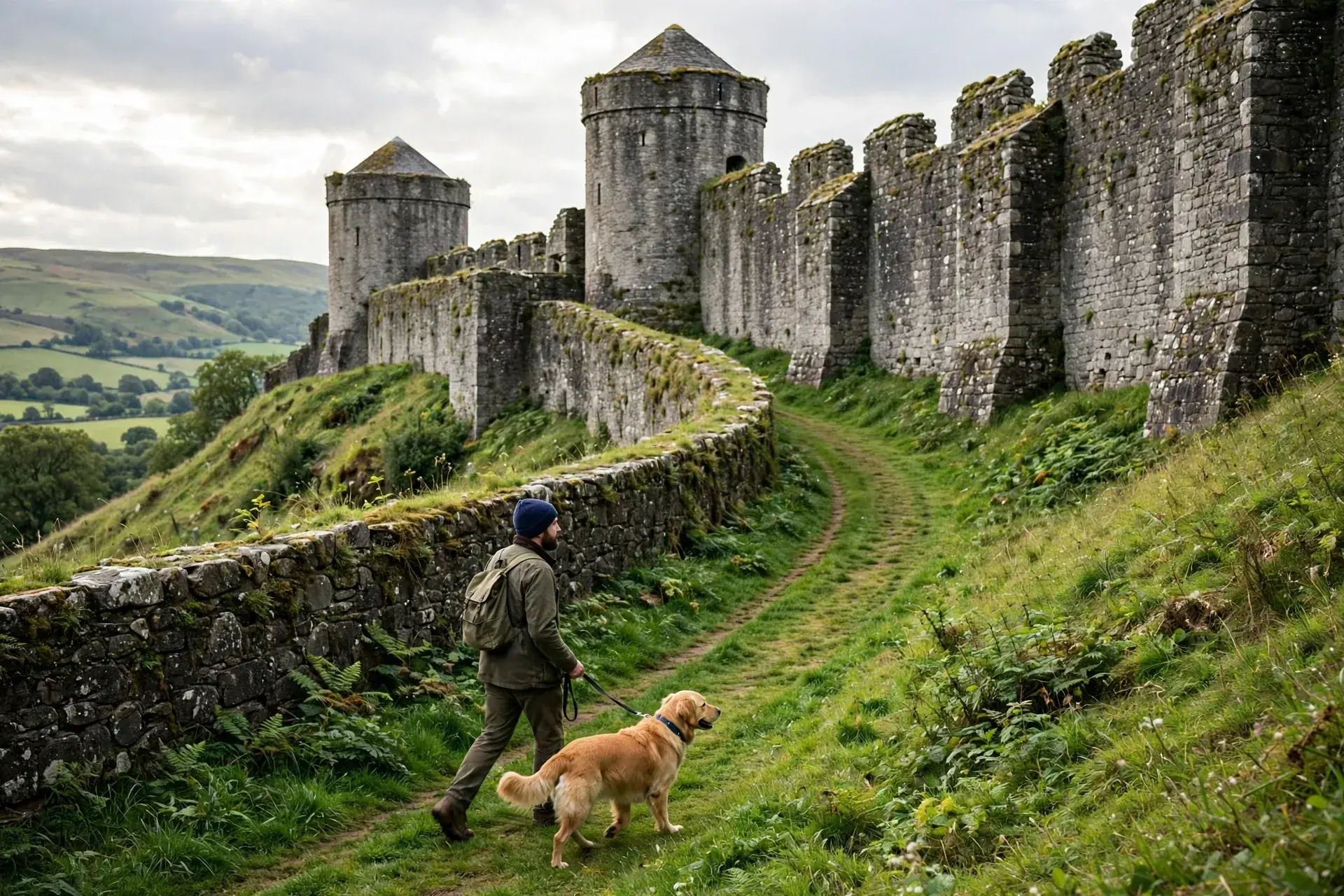
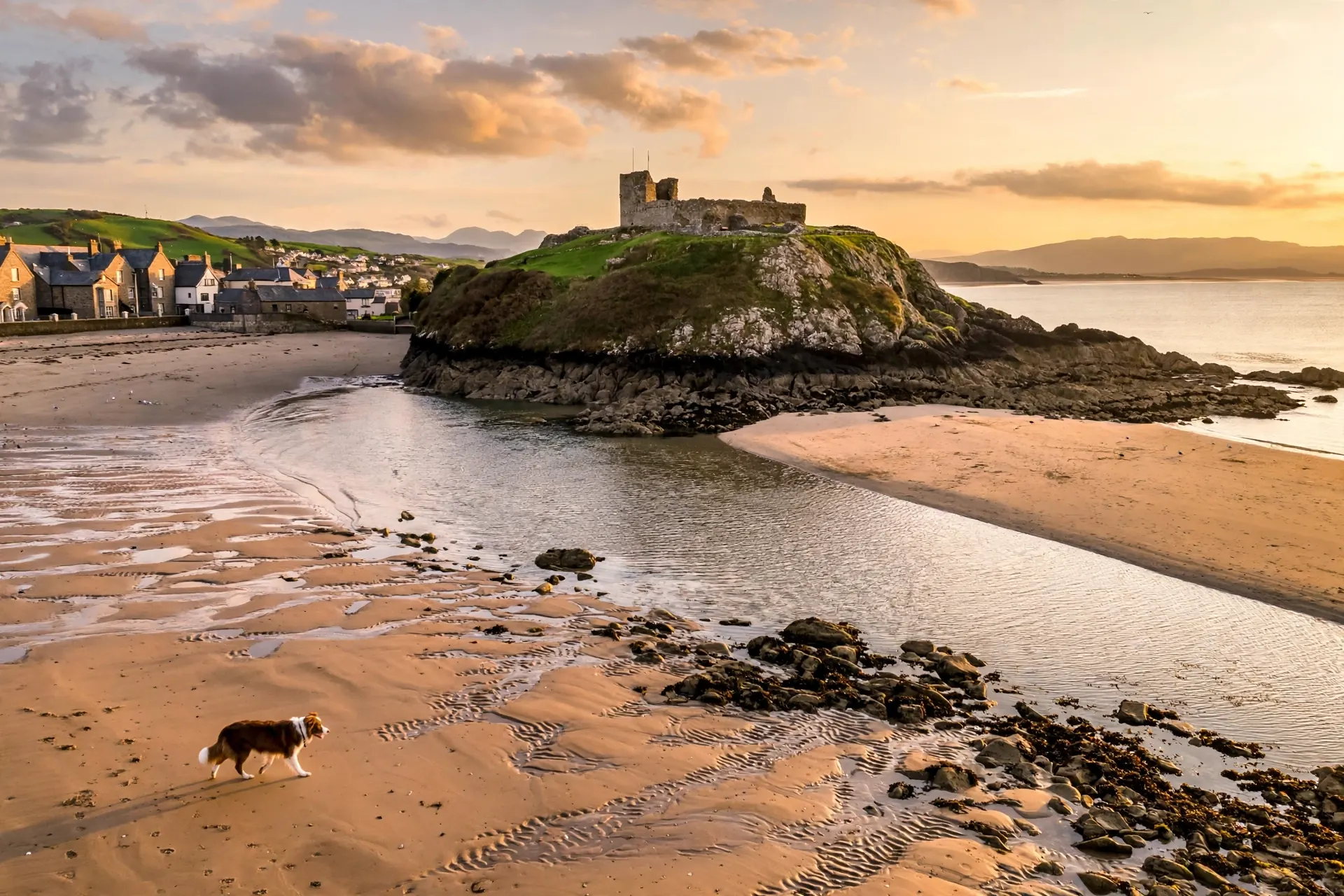
Criccieth Castle stands on a rocky headland between the town's two beaches, and it is the first thing most visitors notice. The ruins are the remains of a thirteenth-century Welsh castle, later held by English kings, and the twin towers still frame the view across Cardigan Bay towards the mountains of Snowdonia. For a dog owner, the castle matters less as a place to go inside and more as the landmark that organises the whole visit: it marks the division between the beaches, it gives every walk a destination to aim for, and it makes the town easy to navigate on foot.
Dogs on leads are generally welcome in the castle grounds, which are in the care of Cadw, the Welsh historic environment service. That said, a ruined castle is not a dog playground. The ground is uneven, the steps up to the towers are steep and narrow, and the walls drop sharply to the rocks and the sea below. A confident, sure-footed dog on a short lead will enjoy the sniffing and the views from the grassy areas, but a nervous dog, a very small dog or a dog that pulls hard on the lead is better kept on the paths below the castle, where the views are just as good and the drops are not a worry. Check the official guidance before you travel, because opening arrangements and any seasonal conditions can change, and the castle may occasionally close for conservation work.
The best castle views for most dogs are not from inside the walls at all. From the beach at low tide, looking back towards the headland, the towers rise out of the rock in a way that photographs cannot quite capture, and the dog can be off the lead on the sand while you take it in. From the road above the eastern beach, the castle sits against the sea and the mountains beyond, which is the classic postcard view and an easy stop on a short stroll from the town centre. From the coast path to the west, the castle shrinks into the curve of the bay and the scale of the place opens up. Each of these viewpoints costs nothing and needs no ticket, and each suits a different kind of dog: the beach for runners, the road for slow walkers, the coast path for dogs that like a longer outing.
If you do go up to the castle with your dog, go slowly and treat it as a short visit rather than a long explore. Let the dog sniff the grass and the stone, take the photographs, and come back down before the dog gets bored or the wind picks up. The headland is exposed, and the wind off Cardigan Bay can be sharp even on a day that feels mild in the sheltered streets below. A dog that is happy in a breeze will be fine; a dog that dislikes wind will tell you quickly, and the sensible answer is to head back down to the beach, where the cliffs and the castle rock give some shelter.
For the wider picture of visiting historic sites with a dog in this part of Wales, our guide to dog-friendly castles in Wales explains which sites welcome dogs, where leads are required, and how castle zones differ from one site to another. Criccieth is one of the more forgiving castle visits because so much of the pleasure is outside the walls, but the same principles apply: lead on, stay on the paths, and do not let the dog climb on the masonry.
Two beaches, two moods
Criccieth has two beaches, and they feel like different places. The beach to the east of the castle rock runs towards the town and the caravan parks beyond, a long stretch of sand that at low tide seems to go on for ever. The beach to the west of the castle rock curves away towards Black Rock Sands and Porthmadog, with the headland at your back and the open bay in front of you. Both are sandy, both are good for dogs outside the restricted season, and both reward the low-tide habit described above. The difference is in mood: the eastern beach is the town beach, busier and closer to everything, while the western beach feels wilder and more open, and on a quiet weekday you can walk a long way without meeting anyone.
Seasonal dog restrictions apply to parts of Criccieth's beaches during the summer months, and the rules can differ between the two stretches of sand. This is the single most important detail to check before a summer visit, and it is also the detail most likely to catch people out. The restrictions are normally shown on signs at the beach entrances and slipways, and the dates and the exact areas they cover can change from year to year. Our guide to dog-friendly beaches in the UK explains how seasonal bans and public space protection orders work in general, including fines and assistance-dog exceptions, but the signs on the beach and the official guidance for Criccieth itself are the final word for your visit, so check the official guidance before you travel.
Outside the restricted season, the beaches are generous. At low tide the sand is firm and flat, which suits ball games, long-line training and dogs that like to run in straight lines. The wet sand near the waterline holds scent well, so a sniffy dog will be busy for an hour without covering much distance, which is ideal for older dogs and for puppies that tire quickly. Rock pools appear around the castle rock and along the edges of the beaches at low water, and they are worth a careful look with a dog on a lead: crabs, small fish and seaweed keep a curious dog occupied, but sharp shells and slippery rock need care, and dogs should not be allowed to drink seawater or eat washed-up debris.
Swimming is a question to answer dog by dog. Cardigan Bay is a big, open bay and the water is cold even in high summer, with currents that can be stronger than they look from the shore. Some dogs take to the sea happily and swim in the shallows near the waterline; others are better kept to paddling. Never throw a ball far out into the water, never let a dog swim after a stick in a current, and keep a lead on a dog that is tempted to chase waves out of its depth. After a swim, rinse the dog with fresh water if you can, because salt water and sand between the toes cause irritation, and check the ears of dogs prone to ear infections.
The sand itself brings its own small chores. Fine sand gets everywhere: between toes, in ears, in the car and in the accommodation. Pack a towel and a bottle of fresh water for a quick rinse at the slipway, and check your dog's paws after a long walk, especially if the sand is mixed with shingle near the castle rock. A dog that has been running on wet sand for an hour will drink a lot afterwards, so carry water on the walk rather than relying on finding a tap at the far end of the beach.
One more practical point: the two beaches are not connected at high tide. The castle rock blocks the way, and trying to pass around it as the tide comes in is dangerous. Treat the two beaches as two separate walks, not one continuous route, and return to the road or the coast path to get from one to the other. This matters most on a day when you have parked at one end of town and walked to the other: allow time to come back by road, or plan the walk so that it ends near the car.
Walking the Llŷn coast from town
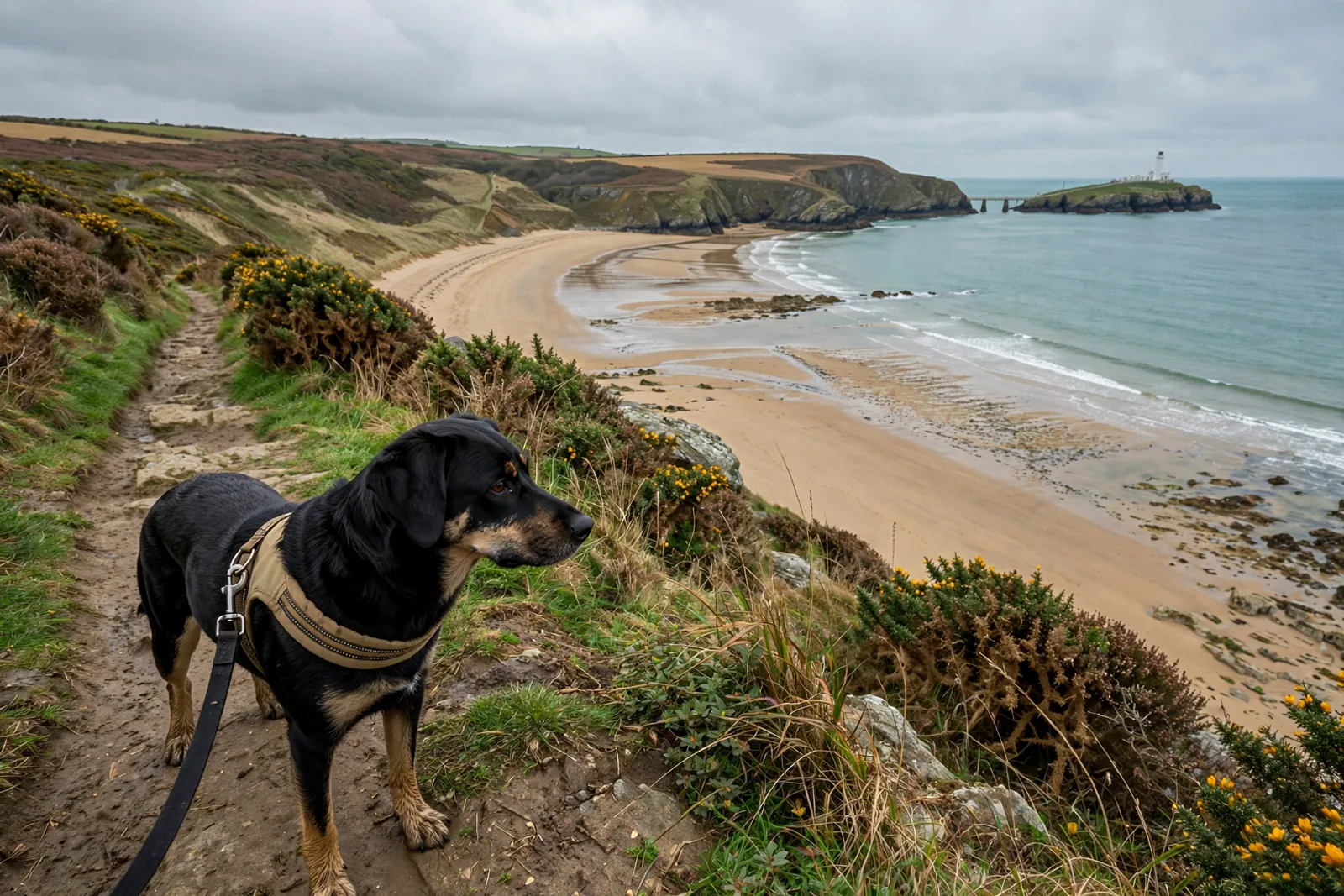
Criccieth sits on the Wales Coast Path, the long-distance trail that runs around the whole Welsh coast, and the town makes a natural base for shorter sections in either direction. To the east, the path runs towards Llanystumdwy, the village where David Lloyd George grew up, along field edges and quiet lanes with views back across the bay to the castle. To the west, it runs towards Black Rock Sands and Porthmadog, a longer and more varied stretch that mixes sandy beach, dunes and low cliffs. Both directions are manageable as out-and-back walks with a dog, and both are better walked in the morning or late afternoon, when the light is kind and the paths are quieter.
The eastern walk is the gentler of the two and a good first choice for a dog that is new to coast walking. The ground is mostly level, the route is easy to follow, and there are places to turn back at several points if the dog tires. The views open up quickly: looking back, the castle grows smaller against the bay, and looking ahead, the coast curves towards the mountains. Keep the dog on a lead where the path runs beside fields with livestock, and watch for the small lanes where cars appear without much warning. A long line gives a dog freedom to sniff while keeping control near roads and sheep, and it is worth packing even if your dog is usually reliable off the lead.
The western walk towards Black Rock Sands is the more dramatic option and the one to choose when the dog has energy to spare. Black Rock Sands is a wide, drive-on beach a few miles west of Criccieth, and the coast path and the beach together make a long, satisfying outing. The sand there is vast at low tide, which suits dogs that like to run, but the same tide rules apply: check the times, keep an eye on the returning water, and do not let the dog wander so far out that the way back is cut off. Seasonal dog restrictions may also apply on parts of Black Rock Sands, so check the signs and the official guidance before you travel.
For dogs that prefer a shorter outing, the coast path immediately around the town is enough on its own. A loop from the seafront up past the castle and back through the streets takes under an hour at a gentle pace and gives a dog a mix of sea air, grass, pavement and new smells, which is often more tiring than a long straight walk. Older dogs and puppies do well on this kind of loop, and it leaves the rest of the day free for a second, shorter beach visit at low tide.
Whatever direction you choose, the coast path rules are the same: keep dogs on leads near cliff edges, livestock and roads; carry water, because there are long stretches with no fresh water; and pick up after your dog everywhere, including on the open beach, where waste left on the sand is a problem for other walkers and for wildlife. The path is well used by walkers, runners and horse riders in places, so a dog that is reactive to other dogs or to horses needs a short lead and a plan for passing on narrow stretches: step aside, keep the dog close, and let the other party pass.
A slow morning in the town
Criccieth is a small town, and that is its charm. The main street runs a short distance from the seafront, with a mix of cafes, small shops, a bakery, a bookshop and the famous ice cream parlours that the town is known for. Everything is within a few minutes' walk of the beach, which means a dog can be part of the whole morning rather than left behind while the humans go into town. Dogs are welcome outside many of the cafes, and some have water bowls by the door, but policies change, so ask before settling in, and keep the dog settled on a mat or a blanket so that a cafe stop stays calm for everyone.
The ice cream is worth a mention because it shapes the summer crowds. Criccieth has a long-standing reputation for ice cream, and on a warm weekend the queues outside the parlours can be long and the pavements crowded. A dog that is nervous in crowds will find the seafront on a summer Saturday afternoon hard work, and the kindest plan is to visit the town early in the morning or in the evening, when the streets are quieter and the light is better. If you do join a queue with a dog, keep the lead short, keep the dog close to your legs, and do not let the dog approach other people's food or children.
Parking deserves a few minutes of thought. There are car parks near the seafront and the town centre, and on-street parking on the roads above the beach, but on summer weekends and school holidays the seafront fills early. Arriving before mid-morning makes the whole day easier, and it also means the dog gets the best of the beach before the crowds arrive. Check the charges and time limits on the signs when you park, because these can change, and never leave a dog in a parked car on a warm day, even with the windows open: the temperature inside a car rises far faster than most people expect, and a shaded car in the morning can be in full sun by midday.
For a wet morning, the town still works. A slow wander through the shops, a long cafe stop and a short walk between showers is a reasonable plan, and the castle viewpoint from the road can be enjoyed in a few minutes without a long walk in the rain. The town's small size is an advantage here: you are never far from the car or from shelter, and a dog that dislikes rain can be back indoors quickly. Pack a drying coat and a towel in the car so that a wet dog does not have to sit in a damp coat for the drive home.
The town is also a good base for exploring the wider Llŷn Peninsula. Porthmadog, with its harbour and the Ffestiniog Railway, is a short drive to the east, and the beaches and villages of the peninsula stretch away to the west. Many of these places welcome dogs, but each has its own rules, so check before you go rather than assuming that a dog-friendly town means a dog-friendly everywhere. Criccieth works best as a base precisely because it is small and calm: a dog can settle into a routine of beach, town and coast path, and the longer the stay, the more the dog relaxes into it.
Staying over with a dog
Criccieth works well as an overnight base because the town is small enough for a dog to learn the routine quickly: morning beach, midday rest, evening coast path. Dog-friendly accommodation in and around the town includes cottages, bed and breakfasts and caravan parks, and the choice matters more than the price. A cottage with a small enclosed garden near the seafront suits a dog that needs a safe toilet area at night, while a caravan on a park at the edge of town suits a dog that likes a longer morning walk before breakfast. Ask the same questions you would ask anywhere: how many dogs are allowed, what the pet fee covers, whether the dog can be left alone for a short time, and where the nearest practical toilet walk is after dark.
Booking ahead is essential in school holidays and on summer weekends, when the dog-friendly places fill first. The quieter months, from late September through to Easter, offer more choice and lower prices, and the beaches are at their most generous for dogs outside the restricted season. If you are travelling with two dogs, say so at the time of booking rather than on arrival: some places accept one dog happily and two only by arrangement, and a surprise second dog at check-in is a poor start to a stay.
Inside the accommodation, the same first-hour routine that works anywhere applies here. Walk the boundary or the garden before unloading everything, check gates and fences, move anything chewable or toxic out of reach, and set up the dog's bed in the same spot you use at home. Criccieth's streets are quiet at night, but the seagulls start early, and a dog that is woken by gulls at dawn will want an early toilet walk: keep a lead and a torch by the door so the first outing is easy. If the accommodation has a hard floor, pack a non-slip mat for the dog's bed, because tired paws slip on laminate and tile after a long day on the sand.
For meals, plan around the dog rather than around the restaurant. Many places in town welcome dogs outside, and a few welcome them inside, but the policy can change with the season and the time of day, so check before you sit down. A takeaway eaten on a bench above the beach, with the dog settled beside you, is often the most relaxing option on a warm evening, and it avoids the problem of a dog that barks at strangers in a busy dining room. If you do eat out, bring the dog's mat and a chew, and keep the visit short on the first night until you know how the dog settles.
Self-catering suits many dog owners here because the town has the shops needed for a simple stay, and a cottage with a kitchen means the dog's feeding routine does not have to change. Keep the dog's food in a sealed container, because the smell of the sea air seems to make every dog hungrier than usual, and a dog that has run on the beach for an hour will finish a meal fast and look for more. Fresh water should always be available, especially after a beach walk, and a spare bowl by the door is useful for a quick drink before the dog comes inside.
When the weather turns
The Llŷn Peninsula catches weather from the Atlantic, and Criccieth is no exception. A bright morning can turn to rain by lunchtime, and a forecast of sunshine can still include a sharp shower off the sea. The right response is not to cancel the walk but to change its shape: shorter, closer to shelter, and with a drying plan at the end. A dog in a drying coat, with a towel in the car and a warm spot to settle afterwards, will enjoy a wet walk far more than a dog that is dragged around a long exposed route in driving rain.
Wet sand and wet paths change the walking. The coast path can be slippery after rain, especially on grassy slopes and on the steps near the castle, and the rocks around the headland are treacherous when wet. Keep the dog on a lead on slippery ground, slow down on descents, and avoid the rock edges entirely in wet weather. The beach itself stays walkable in rain, and many dogs love a wet beach walk, but the wind off the bay can be cold when you are wet, so keep the outing shorter than you would on a dry day and head for shelter before either of you gets chilled.
Wind deserves respect on this coast. The town faces south-west across the bay, and a south-westerly gale can drive spray over the seafront and make the beach unpleasant even for a dog that loves the outdoors. On a very windy day, choose the sheltered lanes behind the town rather than the exposed beach, and keep a firm grip on the lead: a sudden gust can startle a dog and pull a lead out of a loose hand. Small dogs and very old dogs are most affected by wind chill, so a coat is worth packing even in summer.
After a wet walk, the drying routine matters. Towel the dog down at the car or in the porch before going inside, paying attention to the paws, the belly and the ears. Check between the toes for sand and small stones, and dry the ears of dogs with floppy ears to reduce the risk of infection. A wet dog in a warm room will steam, so open a window slightly to let the moisture out, and wash the dog's bedding if it has picked up a damp, sandy smell. None of this is difficult, but doing it every time keeps a multi-day stay comfortable.
Winter brings its own rewards. The beaches are empty, the light is low and golden, and the town is quiet enough for a nervous dog to relax. The trade-off is shorter days and colder water, so walks need to be planned around daylight, and a dog that swims in summer should be kept to paddling in winter. Pack an extra layer for the dog, keep the walks shorter, and enjoy the fact that the best table outside a cafe is always free.
Safety: tides, cliffs and livestock
Three hazards deserve a clear mention, because each of them is easy to underestimate on a first visit. The first is the tide, covered above but worth repeating here: the water returns faster than it looks, the castle rock cuts off the beach at high water, and a dog that has run far out across the flats can be cut off from the way home. Check the tide times, keep the dog in sight, and start back early. The second is the cliffs and the castle rock itself: the drops are real, the ground is uneven, and a dog on a long lead or off the lead near an unfenced edge is at risk. Keep the lead short near edges and never let a dog climb on the castle masonry.
The third hazard is livestock. The fields along the coast path hold sheep for much of the year, and the law in Wales requires dogs to be under close control near livestock. A dog that chases sheep can cause serious harm, and a farmer is entitled to act if a dog is worrying livestock, so the rule is simple: lead on near fields, no exceptions, even for a dog that has never chased anything. The same applies to ground-nesting birds on the dunes and the shore in spring and early summer: keep the dog on the path and on a lead where signs ask for it, and do not let the dog run through the dunes.
Adders are present in some coastal grassland and dune areas in Wales, although encounters are uncommon. The practical advice is to keep dogs on paths in warm weather, avoid letting them nose into long grass and rock crevices, and know the signs of a bite: sudden pain, swelling and distress. If you suspect a bite, keep the dog calm and still and get to a vet quickly, because a frightened, running dog spreads venom faster. This is not a reason to avoid the coast path, only a reason to stay on the path and to keep the dog close in the warm months.
Other practical safety points are ordinary but worth stating. Carry a phone with charge, because the coast path has stretches with no easy exit and no nearby help. Carry water for the dog, because the sea is not drinking water and there are long stretches without a tap. Pick up after the dog everywhere, including on the beach, and carry spare bags. Know where the nearest vet is before you need one: the nearest practices are in Porthmadog and the surrounding towns, and opening hours can be limited at weekends, so save the number when you arrive rather than searching for it in an emergency.
Finally, watch for the small things that spoil a day: hot sand on a rare scorching afternoon, which can burn paws; sharp shells and broken glass near the slipways; and fishing hooks and line left on the rocks by anglers. A quick paw check after the walk, and a lead near the slipways and the harbour area, prevents most of these problems. None of these hazards should put anyone off Criccieth: they are the normal cautions of a working coast, and a dog owner who plans for them will have a better day than one who discovers them by accident.
A sample day, two ways
Because the tide moves the day around, it helps to have two versions of the same plan: one for a morning low tide and one for an afternoon low tide. The morning-low-tide day starts early, with the long beach walk first, while the sand is wide and the town is still quiet. Walk the eastern beach towards the caravan parks, or the western beach towards Black Rock Sands, for an hour or so, letting the dog run and sniff while the tide is out. Return to the accommodation for breakfast and a rest, then spend the late morning in the town: a slow wander, a cafe stop, a look at the castle from the road. The afternoon can be a short coast path walk east towards Llanystumdwy, followed by a second, shorter beach visit as the tide drops again in the evening, and a takeaway supper above the beach.
The afternoon-low-tide day reverses the order. Start with the town and the castle viewpoint in the morning, when the beach is narrow and the streets are quiet. Walk the coast path towards Llanystumdwy or explore the lanes behind the town, then have a long lunch and a rest while the tide is high. In the afternoon, when the sand opens up, take the long beach walk, with time for ball games and a paddle, and finish with an evening stroll along the seafront as the light fades over the bay. The two versions use the same ingredients in a different order, and the dog gets the same amount of exercise either way.
For a dog that tires easily, shrink both versions rather than cutting one part out entirely. A twenty-minute beach walk, a ten-minute town wander and a ten-minute garden sniff add up to a satisfying day for an older dog, and two short outings beat one long forced march. For a young, energetic dog, add a second beach visit or a longer coast path section, but keep a rest in the middle of the day: a dog that runs all morning and all afternoon without a break will be exhausted rather than happy by the evening, and an overtired dog is more likely to be reactive on the lead.
Whatever version you follow, end the day the same way: a short last toilet walk, fresh water, a towel-down if the dog has been on the beach, and a settled bed. A dog that has had a predictable day, with exercise, rest and food at roughly the same times as at home, will sleep well and be ready for the next day, which is the real test of a good dog-friendly destination. Criccieth passes that test because it is small, calm and close to the sea: the routine is easy to keep, and the dog can relax into it within a day or two.
What to pack for Criccieth
A short packing list, tuned to this town rather than to dog travel in general, saves a lot of improvising. Start with the beach kit: a long line for the sand, a ball or a toy that floats and is easy to see, a towel, a bottle of fresh water and a collapsible bowl, and spare poo bags. The long line matters more here than in many places, because the beaches are wide and the tide creates a temptation to let the dog run far out, and a long line gives freedom with a way back. Add a drying coat for the journey home, because a wet dog in a car is nobody's idea of a good end to the day.
For the coast path, add a harness that the dog is comfortable wearing for an hour or two, a short lead for livestock and road sections, and a small first-aid kit: tweezers for thorns and ticks, saline for rinsing eyes, a bandage, and any medication the dog normally takes. A tick remover is worth carrying from spring through autumn, because the grass and the field edges along the path hold ticks, and a quick check after the walk is a good habit. Pack a torch for the evening toilet walk, because the lanes and the beach access points are not all lit, and a reflective collar or lead helps the dog be seen.
For the accommodation, pack the dog's own bed or blanket, the usual food measured out for the stay, and a familiar chew or toy. A dog that has its own bed settles faster in a new place, and a familiar smell is worth more than any amount of reassurance. If the dog is anxious in new places, bring a worn item of your clothing as well, and keep the first evening quiet rather than filling it with new experiences. For the car, pack a non-slip mat for the boot, a seat cover, and a spare towel, because the sand will get everywhere no matter how careful you are.
Finally, pack the information rather than relying on memory: the tide times for your dates, the address and phone number of the nearest vet, the name and address of your accommodation, and the current beach restriction signs photographed on your phone when you arrive. A screenshot of the tide table is more useful than a vague memory of it, and a photograph of the restriction sign settles any argument about where dogs are allowed. With that list covered, Criccieth is an easy place to enjoy: the town is small, the walks are close, and the dog will tell you quickly which beach is their favourite.
If Criccieth leaves you wanting more of the Welsh coast, our guide to Anglesey with a dog covers the island's beaches, coast path walks and ferry crossings, and it pairs naturally with a Llŷn Peninsula trip for a longer Welsh holiday.
Practical questions
Before you go
Can dogs go on Criccieth beach all year round?
It depends on the season and the exact stretch of sand. Parts of Criccieth's beaches carry seasonal dog restrictions in the summer months, and the rules can differ between the beach east of the castle rock and the beach to the west. Check the current signs at the beach entrance and the official guidance before you travel, and plan a low-tide walk outside restricted hours or dates if your visit falls in the restricted season.
Are dogs allowed at Criccieth Castle?
Dogs on leads are generally welcome in the castle grounds, which are managed by Cadw, but the ruined towers and steep steps are not suitable for every dog. Keep your dog on a lead, stay on the marked paths, and check the official guidance before you travel, because access and any seasonal conditions can change. The best views of the castle for most dogs are from the beach and the headland paths below it.
When is the best time to visit Criccieth with a dog?
Late spring and early autumn usually give the best balance: milder weather, quieter streets, and beach access outside the peak summer restrictions. Winter brings big empty sands and dramatic light, but also stronger winds and shorter days. Whatever the season, time your beach walk around low tide, because the sands are widest and the walking is easiest then.
Where can I park in Criccieth with a dog?
There are car parks near the seafront and the town centre, plus on-street parking on the roads above the beach. Arrive early on summer weekends and school holidays, because the seafront fills quickly. Park in the shade where possible, never leave a dog in a hot car, and check the current charges and time limits on the signs, as these can change.
Is the Wales Coast Path near Criccieth suitable for dogs?
Yes, for dogs that are comfortable on mixed terrain. The path east towards Llanystumdwy and west towards Black Rock Sands and Porthmadog mixes pavement, field edges, lanes and sandy stretches. Keep dogs on leads near livestock, roads and cliff edges, carry water, and check the official guidance before you travel for any temporary closures or diversions.
What should I do if the tide cuts off the beach walk?
Do not try to wade around the castle rock. Turn back the way you came while the sand is still wide, or leave the beach at the nearest slipway and continue on the road or the coast path above. Check tide times before you set out, allow a generous margin, and keep your dog on a lead near the waterline so a sudden wave or a strong current cannot catch either of you out.