This guide is independent and contains no paid placement. Beach restrictions, pier policies and venue rules change, so check the official guidance before you travel.
Walk the pier, use the dog-friendly beach stretches outside the signed summer zone, and take the clifftop path to Overstrand for the best views. Cromer is a pier town first and a beach town second, and that order suits dogs well.
The pier and the lifeboat tradition
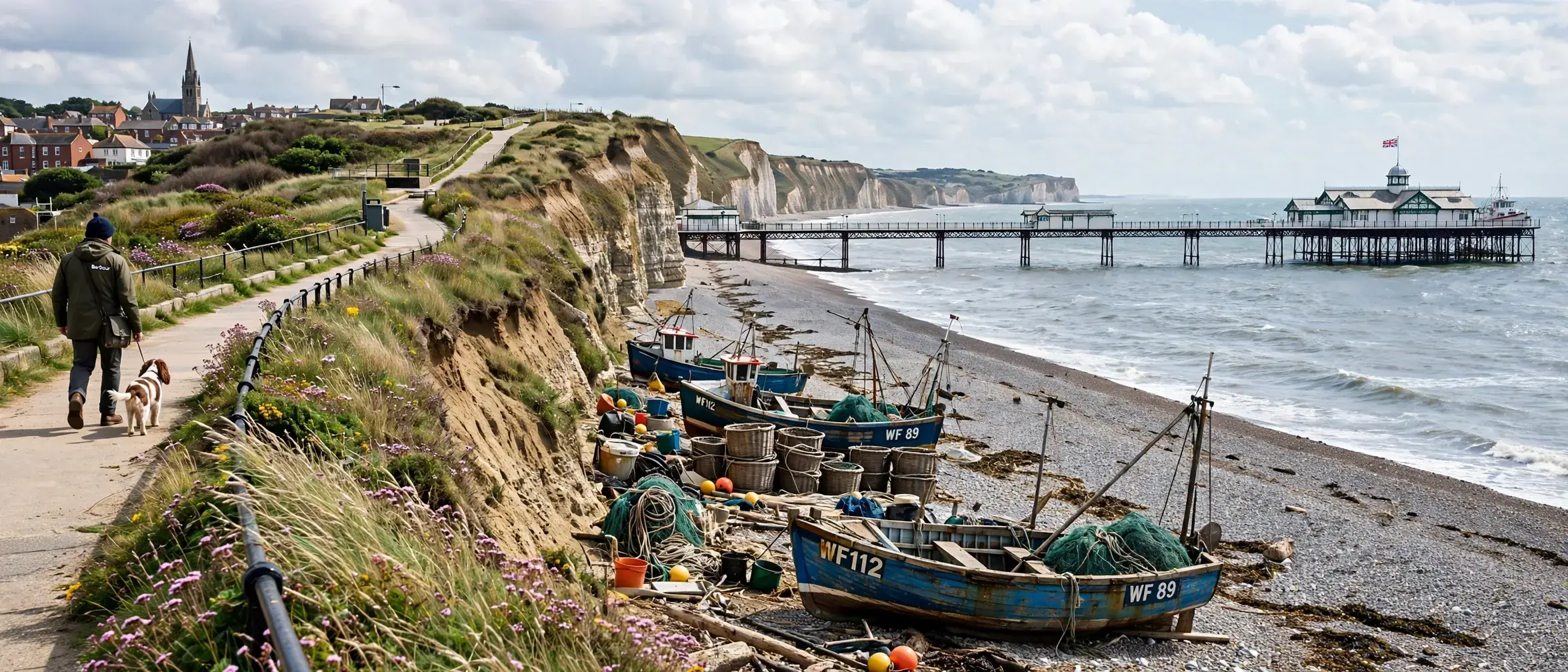
Step onto Cromer Pier from the promenade and the decking changes the walk at once. Planks rattle under boots, gulls wheel above the Pavilion Theatre roof, and anglers haul lines hand over hand beside rod rests bolted to the rails. Winch crews no longer launch from this deck, yet the pier still works as Cromer's seaward workshop: rods flick out, crab lines drop, bait boxes clatter, and visitors pause where fishermen once hauled boats through surf. Clip a lead short before the first plank, steer a small dog away from gaps between boards, and let the sea noise do the talking for a few minutes.
Look shoreward from mid-pier and Cromer stacks itself in layers. Below, shingle rattles under the promenade wall; above, the church tower cuts the skyline; behind the pier steps, the lifeboat station doors face the slipway where crews once dragged boats across stones. Henry Blogg's name belongs to that slipway story, not to a plaque hunt. Blogg rowed, steered, and coxed through gales that tore roofs from Norfolk streets, and Cromer still measures seamanship against his launches.
Follow the pier to its seaward end and the wind sharpens. Spray lifts over the rails, flags snap, and the deck narrows into theatre business: posters, ticket boards, and the Pavilion Theatre doors. Show nights change the rhythm here, with queues, music, and staff moving gear through the entrance, so treat the notice pinned beside the theatre doors as that evening's word on where a lead-clipped dog can wait.
Work the pier as a short, sharp outing rather than a long sit. Anglers need elbow room at the rails, so keep to the centre boards, pass rod tips without touching lines, and move a dog clear when a catch swings up over the deck. A dog that flinches at spray or at the hollow thump of waves under timber will do better on the promenade below, where the same sea view arrives without the deck vibration.
Return along the pier with the town ahead and the routine settles. Fishermen coil lines, theatre staff stack chairs, gulls settle on rail tops, and the lifeboat station doors catch the light from the slipway. That working rhythm gives Cromer Pier its character: not a fairground walkway, but a timber jetty where catching, launching, performing, and promenading still share the same boards. Use it that way, early or late when crowds thin, and a dog gets sea air, new smells, and a clear end point before the longer beach and clifftop stretches begin. Board gaps, rail heights, and deck vibration make the pier a short-visit place.
The beach: zones, surf and crab boats
Drop from the promenade steps onto Cromer sand and the ground shifts underfoot. Shingle crunches, sand firms near the waterline, and groynes march out in dark timber rows that break waves into white bursts. Fishermen drag boats across this mixture every working morning, winching hulls up the slope, propping them on timbers, and stacking crab pots in rust-red towers beside coiled rope. Walk wide around that working strip. Ropes snake across stones, hooks glint in pot stacks, and bait buckets sit where a curious nose will find them first.
Watch a crab boat crew at work and Cromer's fishing geography sharpens. One man steadies the hull, another feeds rope through a winch, a third sorts pots by size and mends netting with a needle and twine. Pots smell of bait, salt, and tar, and the catch stays in covered crates, not open displays. Keep a dog on a short lead through this strip, steer clear of winch cables, and never let a dog nose into a crate or a pot mouth.
Read the shore by its timber and water marks. Groynes divide Cromer sand into short bays, each with its own slope, weed line, and pool pattern at low water. Sand widens as the tide drops, exposing firm flats near the groyne ends, while high water pushes the sea hard against the promenade wall and squeezes walkers onto shingle. Plan beach hours around that retreat: arrive as water pulls back, work along the firm sand, and leave the wall-side shingle before the tide turns.
Face the open North Sea from Cromer sand and the wave story writes itself. Swell rolls in unbroken from the northeast, breaks against groyne ends, and drags back across shingle with a hiss that startles first-time dogs. That shared water demands distance: give surfers their take-off zone, give anglers their casting arc, and keep a dog out of the white water where boards and lines cross. Cromer waves look playful from the promenade and pull hard at ankle depth, so treat every breaking set as working water, not a paddling pool.
Finish a beach stretch at the promenade wall and the town reasserts itself. Kiosks steam, the pier casts its shadow across sand, and crab stalls stack dressed crab on ice behind glass. Cromer beach rewards that order: boats first, sand second, promenade last. The fleet, the groynes, and the tide line together make a beach that feels like a workplace with a shoreline attached, and a dog that learns its working zones early will enjoy the rest of the day far more.
Clifftop walks to Overstrand
Leave the pier steps, climb the promenade slope, and the coast path peels east along Cromer's cliff top toward Overstrand. Grass edges the track, field hedges run inland, and the sea drops away to the right in a long, pale cliff face streaked with flint and clay. Walk the inland side of the fence line, keep the lead clipped through the first open stretch, and let the dog settle into a steady trot before the path opens fully.
Pass the last Cromer gardens and the walk changes character. Holiday chalets give way to open fields, the path firms into a level track, and sea views widen across the bay toward the Overstrand cliffs. Look for the fingerpost marking the Overstrand turn, the bench overlooking the beach below, and the gap where a side track drops toward the village. Those three markers break the walk into manageable chunks for an older dog: pier to fingerpost, fingerpost to bench, bench to village. Stop at each, offer a drink from a carried bowl, and judge the dog's gait before pushing on.
Enter Overstrand as a village, not a resort extension. Its beach sits below a gentler cliff slope, its pub and café cluster near the village green, and its lanes carry far less foot traffic than Cromer's promenade. A beach return at low water offers a different Cromer-to-Overstrand experience: shingle underfoot, cliff shadows overhead, and the pier reappearing slowly as the walk westward progresses. Time that return by the tide table posted at the Overstrand beach steps, since high water narrows the sand against the cliff base.
Head west from Cromer instead and the coast path runs toward East Runton and Beeston Bump country. That western track stays closer to gardens and caravan fields at first, then opens onto quieter cliff grass with fewer walkers. Use it as a second-day walk, or as a shorter alternative when the eastern path feels crowded. Cromer's two directions thus offer a choice: Overstrand for open cliff walking and village quiet, East Runton for a shorter, sheltered outing.
Close a clifftop walk back on Cromer's promenade and the day's geography clicks into place. Pier, beach, cliff top, and village each did a different job: pier for novelty, beach for running, cliff path for distance, village for rest. Pack a lead extension for the open stretches, a towel for cliff-top wind, and a spare bag for the muddy field-edge sections after rain. Cromer's cliff path never needs speed; it needs a steady pace, regular pauses at fingerposts and benches, and a dog that arrives back at the promenade tired in the legs, not frazzled by wind and crowds.
The town: church, shops and streets
Climb from Cromer seafront into town and the gradient announces itself at once. Steps rise from the promenade, lanes steepen past fish stalls, and St Peter and St Paul church towers over rooftops, its flint tower ranking among Norfolk's tallest. Circle the churchyard on its outer path, where gravestones lean, yew trees shade the grass, and the tower's flintwork catches light from the sea side. Tower views reward the climb, even when the interior stays closed to dogs.
Work the shopping streets as a Cromer-specific errand run. Fish merchants stack ice, dressed crab, and smoked fish behind glass on the seafront side, while crab stalls further up the hill sell sandwiches wrapped for promenade eating. Keep a dog tight to the kerb past those stalls, since fish smells pull hard and dropped shell fragments litter the pavement. Independent shops line the climb: outdoor outfitters, bakeries, cafés with window seats, and a supermarket for a longer Cromer stay.
Thread the steep side streets with an older dog in mind. Cobbles slick after rain, pavements narrow beside parked delivery vans, and the climb from pier to town centre taxes stiff joints on the way up and brakes them hard on the way down. Break the ascent at the churchyard, then at a café terrace, then at the top of the hill, and let the dog choose the pace between stops. That single change turns a punishing Cromer climb into a manageable town circuit.
Use Cromer's compact layout to stitch town and coast together. A morning can run pier, promenade, churchyard, and fish stalls in one loop without a car move, and an afternoon can swap town for cliff path without backtracking through traffic. For a rainy-day fallback inland, Cromer's Georgian market-town fallback for crab stalls and wet-weather shopping covers Holt's high street and woodland edges, a useful contrast to Cromer's steep seafront lanes. Cromer itself supplies the essentials for a day visit: food, water bowls at many cafés, and a pharmacy and supermarket within a short walk of the pier steps.
End a town wander back at the seafront and Cromer's working character returns. Crab men hose down stalls, café staff stack chairs, and gulls patrol the pavements for dropped chips. Keep food bags closed through that final stretch, since Cromer gulls swoop low over the promenade and snatch from open hands. A town walk done well leaves a dog with churchyard smells, fish-stall smells, and pavement miles in its legs, ready for a promenade sit while the sea does the evening work below the pier.
Cromer crab and dog-friendly eating
Order Cromer crab and the plate tells the fishing story before the first bite. Pots hauled off Cromer's chalk and flint seabed yield crabs with sweet, dense meat, and local dressers pick that meat by hand into white and brown piles for sandwiches, salads, and platters. Keep the plate high and the shell fragments away from a dog, since crab shell splinters and seasoned dressing belong nowhere near canine stomachs.
Pick an eating spot by dog temperament, not by menu alone. Seafront terraces suit confident dogs that ignore gulls, prams, and passing anglers, while quieter lanes behind the church suit nervous dogs that startle at pier crowds. Pub bars around Cromer town centre often set water bowls by the door and keep a corner table for a dog under the table, yet each venue writes its own seating terms, so read the board by the entrance and ask staff about the exact table before ordering.
Work a takeaway crab sandwich into a promenade lunch and Cromer eating turns simple. Buy from a stall near the pier steps, carry the sandwich to a bench facing the sea, and eat with the lead looped around a wrist. Gulls learn Cromer benches fast, so keep wrapping closed between bites, eat with the sea at your back rather than facing an open sky full of birds, and never leave a sandwich unattended on a bench while photographing the pier.
Plan an evening crab meal around the dog's tiredness, not the restaurant's peak hour. A dog that walked the Overstrand cliff path all afternoon will settle under a pub table far better than a dog dragged straight from a car into a busy bar. Cromer pubs vary in evening seating, so treat the chalkboard by each pub door as that night's word on dog tables, and move on to the next pub rather than arguing a policy at the bar. A settled dog, a dressed crab, and a quiet corner make the town's best evening combination.
Close a Cromer food day with a self-catering or picnic option when pubs fill. Buy dressed crab, bread, and salad from town shops, carry them to the cliff-top bench above Overstrand, and eat with the sea below and the dog at your feet. That picnic dodges gull patrols on the promenade, skips queues at seafront stalls, and turns leftovers into an easy car meal. Cromer crab tastes best eaten close to the boats that caught it, whether on a pub table, a promenade bench, or a cliff-top grass verge, and a dog that waited politely through lunch earns the last walk home along the promenade.
Parking, facilities and seasons
Drive into Cromer and the parking choice shapes the whole dog day. Seafront car parks sit closest to the pier steps and promenade, town-centre car parks sit at the top of the steep climb, and Overstrand's smaller car park suits walkers starting the cliff path in reverse. Pay at the machine by the car-park entrance and display the ticket as the board there directs, since Cromer charges and payment methods change with the season and the board at each entrance carries the current terms for that car park.
Use the town-centre car parks as a gradient dodge for older dogs. Park at the top, walk the shopping streets downhill toward the church, then ride or walk back up only when the dog feels fresh, or drive down to the seafront for the promenade stretch. Overstrand parking works the other way: start at the village, walk the cliff path west into Cromer, eat crab in town, and return east along that track or via the beach at low water.
Map Cromer facilities by promenade landmarks, not by generic resort lists. Toilets sit on the promenade near the pier steps and again in the town centre, cafés and kiosks line the seafront, and the lifeboat station area gives a clear meeting point when a party splits between pier, beach, and shops.
Read Cromer seasons through fishing and pier business, not through calendar clichés. Spring brings quieter promenades, crab boats working longer days, and cliff-path grass firming after winter rain. Summer brings the pier show at full stretch, crowded seafront car parks, and gulls at their boldest around crab stalls. Autumn brings thinner crowds, steady crab landings, and cliff walks with cooler air and clearer light. Winter brings big seas against the promenade wall, empty benches, and some seasonal stalls shuttered, with wind cutting across the pier deck even on bright days.
Close the practical planning with a Cromer-specific kit check. Test the lead clip before the pier boards, pack a bowl that will not blow across the promenade, and carry a jacket that handles sea spray on the pier and drizzle on the cliff path. For a gentler Suffolk comparison after a Cromer trip, Aldeburgh's boardwalk and fishing-boat beach as a quieter Suffolk counterpart to Cromer pier covers a flatter seaside walk, and for the wider British picture, Cromer town-front beach rules set against other British beach zone systems explains how different towns draw their beach maps. Cromer planning stays simple when car park, promenade landmark, and season each get a decision before leaving home.
Beach zones, cliff safety and sea safety
Start every Cromer beach day at a board, not at the sand. The promenade board by the pier steps, the board by the lifeboat slipway, and the board at the Overstrand beach steps each carry Cromer's current beach map for that stretch, with the town-front stretch, the Overstrand stretch, and the East Runton stretch marked separately. Read the pier-steps board first, since it shows the town-front area where summer rules bite hardest, then match the day's walk to the stretch that fits the dog: town-front sand for a short promenade-side run, Overstrand sand for a longer beach morning, East Runton sand for a quieter afternoon.
Work the cliff rule as a distance rule on Cromer's own ground. Stay on the inland side of the cliff-top fence line from the pier slope to the Overstrand fingerpost, keep the lead clipped through the open grass sections, and never let a dog run the cliff edge to peer over. Cromer cliffs crumble from soft glacial clay and flint, and falls drop without warning after rain, frost, and dry spells alike, scattering debris across the sand below. On the beach, keep the same distance from the cliff base: walk the waterline side of the sand, not the cliff-foot strip, and steer a digging dog away from the cliff foot, where loose material slides first.
Read Cromer sea safety from the lifeboat station and the flag pole, not from the promenade view alone. The station board by the slipway notes the day's tide, wind, and surf state for Cromer water, while flags on the beach mark bathing water and warn where currents run strongest around groyne ends. Paddle a dog only where water stays ankle-deep and close in, under close supervision, and only when the station board and flags agree that Cromer water sits calm; rough water, a rising tide, and post-storm currents each rule swimming out for that session.
Finish the rules check with Cromer's working hazards. Crab pot ropes, winch cables, and bait crates on the boat strip tangle leads and tempt noses, so walk that strip on a short lead and wide of stacked pots. Discarded fish, chip wrappers, and shell fragments on the promenade attract gulls and upset stomachs, so keep food bags sealed and a dog's nose out of litter bins. After a beach and cliff day, rinse salt and sand from coat and paws at the promenade tap or at home, inspect paws for shingle cuts, and check ears for wind-blown sand. Cromer rules work best as a short board-reading habit: pier steps, lifeboat slipway, Overstrand steps, then sand, and the rest of the day runs itself.
A pier-to-clifftop day plan
Start a Cromer day at the pier steps before cafés fill. Park at the seafront, clip the lead short, and walk the pier while anglers set rods and theatre staff unlock doors. Pause at the seaward end for the town view, count crab boats below, and return to the promenade before the pier crowds build. That early pier loop gives a dog sea smells, deck sounds, and a clear finish line, and it leaves legs fresh for the longer stretches ahead. That pier-first order suits dogs that need novelty before distance.
Move next to the beach at low water, working the firm sand east of the pier toward the Overstrand side. Let the dog run the waterline flats, sniff rock pools near groyne bases, and shake off shingle before the tide turns. Keep the beach stretch short on a warm July day: work the morning cool, pause in the shade of the promenade wall between runs, and carry a bowl for frequent drinks, since Cromer sand reflects glare and tired dogs overheat quietly on bright shingle. End the beach hour at the promenade steps, brush sand from paws, and head uphill toward the church for the town loop.
Spend midday on crab and town streets. Eat a dressed crab sandwich at a seafront stall or a pub corner table, rest the dog under the table on a blanket, and walk the churchyard loop while the sun sits highest. Midday rest matters more than midday miles on a Cromer day, since the afternoon cliff walk rewards a rested dog.
Walk the cliff path east in the afternoon cool, from Cromer promenade to the Overstrand fingerpost and on to the village. Stop at the bench overlooking the beach, stop again at the Overstrand beach steps, and turn in the village lanes for the return. Finish back on Cromer's promenade as light softens over the pier, then eat a second crab meal or fish and chips under a café awning. Rinse paws, check for ticks picked up on cliff-top grass, and inspect for shingle cuts before the car ride home.
Stretch Cromer into a wider Norfolk break without losing its pier-town shape. Add a Sheringham day for its heritage railway and quieter beach, add a Holt day for Georgian streets and woodland, and keep Cromer as the pier, crab, and cliff day in the middle. Done in that order, with pier first, beach second, town third, and cliff path last, a Cromer day leaves a dog pleasantly tired, salt-dusted, and ready for a calm evening under a pub table.
Practical questions
Before you go
Are dogs allowed on Cromer beach?
Cromer sand splits by stretch: town-front sand beside the pier steps follows the summer map pinned on the promenade board there, while Overstrand sand to the east and East Runton sand to the west stay the usual longer dog-running stretches. Read that pier-steps board on arrival, then match the walk to the stretch it marks for dogs that day.
Can dogs go on Cromer Pier?
Lead-clipped dogs can walk Cromer Pier's boards, passing anglers at the rails and pausing at the Pavilion Theatre end, though show nights change the theatre-door terms. Treat the notice beside the theatre doors as that evening's word, and use the promenade below when spray or deck wind unsettles a nervous dog. Show nights change that mood, so a quiet-morning dog may still prefer the promenade below at performance time.
Is the clifftop walk from Cromer to Overstrand suitable for dogs?
Most dogs manage the level cliff-top track from Cromer promenade to the Overstrand fingerpost and village, with benches breaking the walk into short chunks. Stay inland of the fence line, skip the walk in strong cliff-top wind, and return by the same track or by Overstrand beach at low water. Benches and the Overstrand beach steps break the return into short, restful chunks.
What is Cromer crab and where can dogs eat with their owners?
Hand-picked crab from pots worked off Cromer's seabed, served as sandwiches, salads, or dressed platters at seafront stalls and town pubs. Many Cromer pub bars and terraces seat dogs under tables, so read each entrance board, ask staff for a corner table, and keep shells away from the dog. Ask for a corner table with floor space, and keep the lead clear of waiters passing with hot plates.
Is Cromer beach safe for dogs to swim?
That water demands caution: swell breaks hard around groyne ends, currents swirl near the pier, and the lifeboat station board plus beach flags give the day's verdict. Paddle only where water stays ankle-deep and close in when both agree Cromer water sits calm, and choose the promenade when either signals rough water. Groyne ends and pier casting arcs deserve extra distance, since currents and lines cross there.
What is the best time of year to visit Cromer with a dog?
For Cromer dogs, spring and autumn work best, with quieter promenades, steady crab landings, and long cliff-path days without summer crowds. Summer brings the pier show and busy seafront car parks, while winter brings big seas, empty benches, and wind that shortens pier walks. Cromer seasons turn on pier business and crab landings, not on calendar labels, so match the trip to the dog's wind and crowd tolerance.