This guide is independent and contains no paid placement. If affiliate links are added later, they will be clearly marked and will not change our editorial checks.
Dawlish is one of the easiest South Devon towns for a dog day out: everything is flat, close together and walkable. Start at the black swans on Dawlish Water, follow the sea wall path beside the railway, and finish on the wide sands at Dawlish Warren — keeping your dog on a lead near the swans, the railway and the nature reserve dunes.
Why Dawlish works for dogs
Dawlish is a small seaside town on the South Devon coast, between Exeter and Torquay, and its geography does most of the work for a dog owner. The town sits in a shallow valley where a brook, Dawlish Water, runs down to the sea, and the mainline railway runs along the sea wall right through the town. That means the three things most dogs want — water to look at, a long flat walk and a beach — are all within a few minutes of each other, with almost no hills in between. Older dogs, puppies, dogs with sore joints and owners pushing a pushchair all get the same easy ground.
The town centre is compact. From the railway station you can reach the seafront promenade, the lawns beside the brook and the main beach without crossing a busy road more than once or twice, and the high street — known locally as The Strand — runs back from the sea in a gentle line of shops, cafés and takeaways. You can build a whole day out of short loops rather than one long expedition, which suits dogs that tire quickly or need regular toilet stops. If the weather turns, you are never far from the car, a café awning or the station shelter.
Dawlish also rewards a slower pace. It is not a big resort with arcades and crowds; it is a working seaside town where people come to watch the trains run along the sea wall, look at the swans and walk the dog. That calm matters if your dog finds busy promenades stressful. Early mornings and weekday afternoons are especially quiet, and even on a sunny summer weekend the town feels manageable compared with the bigger bays along the coast. If you want a livelier day, the coast path and the train both connect Dawlish to Teignmouth in one direction and to Torquay in the other, so a small town can be the base for a much bigger trip.
Before you set out, match the day to your dog. A young, fit dog will love the full walk to Dawlish Warren and back, or the sea wall to Teignmouth. An older dog or a nervous dog will be happier with the brook, the lawns and a short stretch of promenade, with plenty of sitting and watching. Dawlish lets you scale the day up or down without changing the plan, because every walk starts from the same flat seafront and every route has an easy way back.
The black swans and Dawlish Water
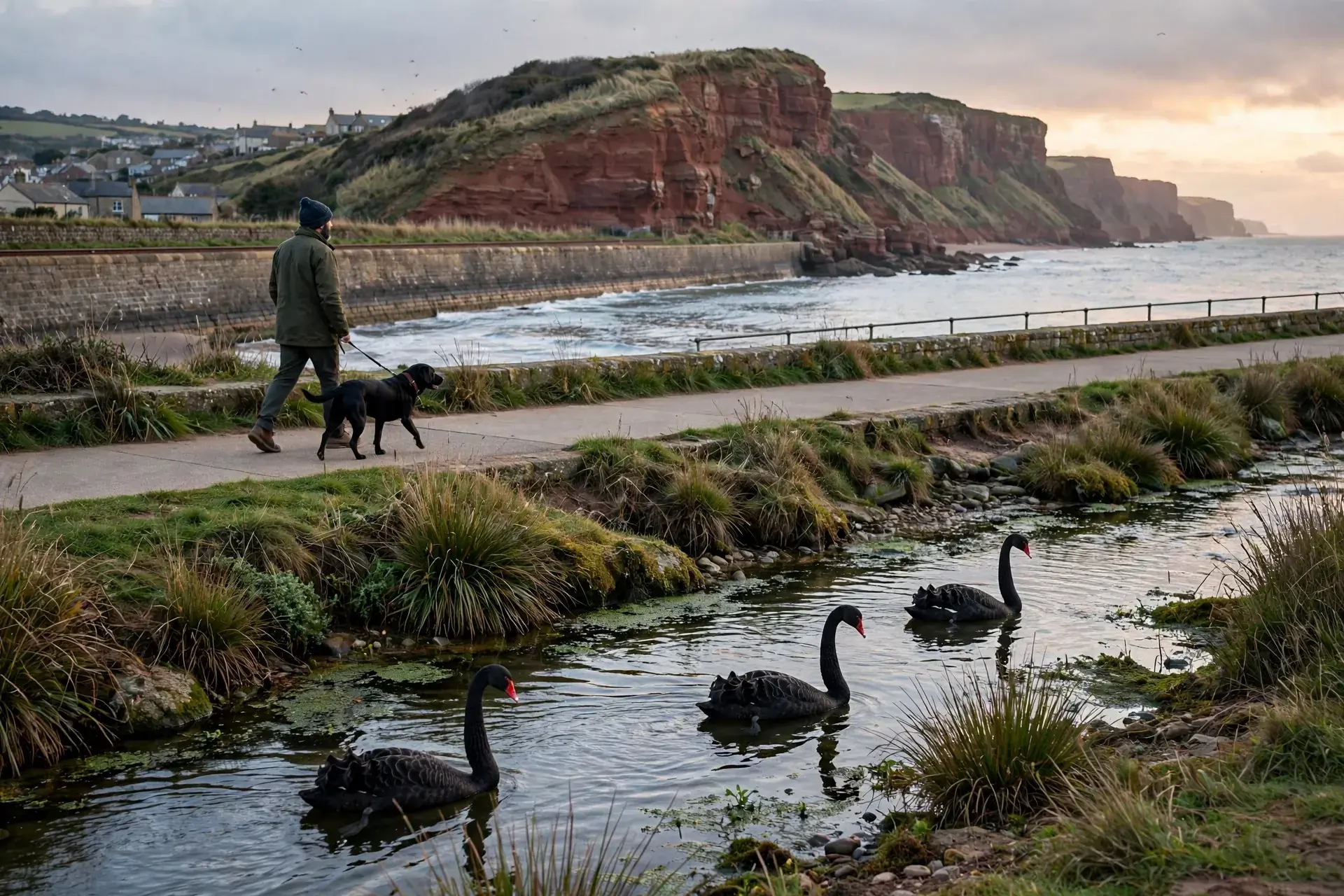
The black swans are the reason many people first hear of Dawlish, and they are the natural first stop on a dog walk. Dawlish Water is the brook that runs through the centre of town, past the grassy area called The Lawn, and down to the sea. The swans live on the brook, and they are used to people standing on the bankside paths watching them. They are striking birds — dark plumage, a red bill and a long curved neck — and they glide up and down the water between the little bridges and the lawns, often with cygnets in tow during the spring and summer.
For a dog owner, the swans set the tone for the whole visit: this is a place where wildlife is part of the town, not something you drive out to see. Keep your dog on a lead around the brook. Swans are large, strong birds and they will defend themselves and their young if a dog gets too close, and a dog that jumps into the water can injure itself on the bankside stonework as well as frightening the birds. A short lead and a calm pace let you watch the swans properly without turning the moment into a chase. If your dog is highly reactive to birds, walk the far side of The Lawn and keep a little distance, and use the open grass to practise calm watching rather than forcing a close encounter.
The Lawn itself is a useful piece of dog infrastructure. It is a broad stretch of grass beside the brook, with benches, trees and open space, and it works as a toilet stop, a sniffing break and a place to sit while the dog settles. The paths beside the water are flat and surfaced, so a dog that struggles with uneven ground will manage them easily. Take a bag for waste, because the lawns are used by families and children as well as dog walkers, and pick up every time even if nobody is watching. There are litter bins around the town centre, but carry a spare bag in case the nearest one is full.
Do not feed the swans bread. Bread has little nutritional value for waterfowl and can pollute the water, and the habit of being fed by hand brings the birds close to dogs and children in ways that end badly for everyone. If you want to feed them, look for proper waterfowl food sold locally, and offer it sparingly from the bank rather than by hand. The best way to enjoy the swans with a dog is simply to watch them: find a bench, keep the lead short, let the dog settle, and give the birds space. If the swans are nesting, give them a particularly wide berth and keep your dog well away from the nest site.
The brook walk also teaches you the layout of the town. Follow Dawlish Water downstream and you reach the seafront; follow it upstream and you pass gardens, small bridges and quieter paths where the town thins out into greener, leafier streets. The upstream stretch is a good option if your dog needs a calmer walk after the bustle of the seafront, and it is still flat and short. In wet weather the paths beside the brook can be slippery, so take care with a dog that pulls, and keep an eye on the water level after heavy rain — check the official guidance before you travel if the weather has been severe.
The sea wall railway walk
The walk along the sea wall is the signature dog walk in Dawlish, and it is unlike almost any other coastal walk in Britain. The mainline railway runs between the town and the sea, on a wall built to hold back the waves, and the public footpath runs beside it. On one side you have the red sandstone cliffs and the open sea; on the other, trains passing a few metres away. Dogs that are comfortable with noise will enjoy the spectacle, and dogs that are not will need a bit of preparation — the trains are loud, close and frequent, and there is nowhere to step aside.
The most popular stretch for dog walkers runs from Dawlish station towards Dawlish Warren to the north-east. It is flat, surfaced and easy underfoot, and it follows the sea wall out of the town with the beach below and the railway beside you. This is a walk where a lead is not optional. The path runs directly beside a live railway line, and in places there are drops down to the beach and the rocks. A dog off the lead near a railway is in real danger, and a long line can snag or drift across the tracks. Use a short lead, keep your dog on the side away from the railway where the path allows, and do not let the dog climb on the wall or the sea defences.
Walking the other way, from Dawlish towards Teignmouth to the south-west, is the longer and more dramatic option. The sea wall path runs for about two miles between the two towns, with the cliffs rising on the landward side and the sea breaking against the wall at high tide. It is part of the South West Coast Path, and it is a walk to do in calm weather rather than in a storm. In rough conditions the waves can break over the wall, and the path can be closed for safety. Check the conditions before you set out, and check the official guidance before you travel if there has been storm damage or repair work — the wall was badly damaged in the winter storms of 2014 and has been rebuilt in sections since, and closures still happen.
For the dog, the sea wall walk is mostly about managing excitement and tiredness. There is very little shade on the wall, and on a hot day the stone and the tarmac reflect the heat. Carry water for the dog, offer it regularly, and watch for signs of overheating: heavy panting, a reluctance to keep walking, or a dog seeking every patch of shade. In summer, walk early in the morning or in the evening, when the light is softer and the path is cooler. In winter the wall is exposed to wind and spray, so a dog coat helps a short-coated dog, and you should be ready to turn back if the wind picks up.
The railway itself is part of the pleasure of the walk. Trains run frequently between Exeter and Plymouth, and the sight of a train running along the sea wall with the waves beside it is one of the most photographed scenes in Devon. Some dogs will be unbothered; others will startle at the noise and the speed. If your dog is nervous about trains, introduce the walk gradually: start on the promenade in town, where the trains are further away and there is more space, and build up to the wall itself over several visits. Never try to desensitise a dog to trains by standing close to the line and forcing them to stay — that is how a fear becomes a phobia. Let the dog choose its distance, reward calm behaviour, and be ready to walk back to town if the dog is not coping.
There are no toilets or water points on the wall itself, so plan before you leave town. Fill the water bottle, take a bag for waste, and be ready to carry everything out with you. The walk to Teignmouth and back is around four miles in total, which is a proper outing for a fit dog but too much for a puppy or an older dog. You can shorten it easily: walk as far as you like and turn back, or catch a train back from Teignmouth station, which sits close to the town centre. If you take the train, check the operator's rules for dogs before you travel, and keep your dog on a lead and under control on the platform.
Dawlish town beach
Dawlish town beach sits right in front of the seafront, below the promenade and the railway, and at low tide it opens out into a broad stretch of sand with rock pools at the edges. It is the beach you will use most on a short visit, because it is steps from the car parks, the cafés and The Lawn. The sand is fine and soft, good for dogs that like to dig and run, and the slope is gentle, so the water stays shallow for a long way out at low tide.
Dog rules on beaches change, and Dawlish is no exception. The town beach is generally welcoming to dogs, but seasonal restrictions can apply on parts of the South Devon coast, and the rules at Dawlish Warren are different from those in the town. Always read the signs at the beach entrance on the day you visit, and check the official guidance before you travel so you are not relying on last year's rules or on what another dog owner told you. If a restriction is in force, respect it — the wardens and the local community notice, and a dog on a restricted beach is the fastest way to sour a town that is otherwise very welcoming.
At low tide the rock pools at the edges of the beach are worth exploring with a careful dog. They hold small crabs, anemones and seaweed, and they give a dog a lot of sniffing interest in a small area. Keep your dog from eating dead crabs or fish, and from drinking the pool water, which can be stagnant. Check the tide times before you go: the beach narrows quickly as the tide comes in, and at high tide there is very little sand left in front of the sea wall. A dog that is happily running at low tide can find itself squeezed against the wall with the waves coming in, so plan your return and leave the beach with time to spare.
Beach safety for dogs deserves a proper mention, because the hazards are easy to miss. Sea water makes dogs thirsty and then sick if they drink too much of it, so bring fresh water and offer it often. Washed-up food, dead fish, bait and fishing tackle can all be harmful or dangerous, and palm oil and other washed-up substances occasionally appear on Devon beaches. If your dog picks something up, take it away calmly and check their mouth. After a beach walk, rinse your dog's paws and coat with fresh water if you can, and check between the toes for sand and small cuts. A dog that has been running on wet sand and then on tarmac can develop sore paws, so watch for limping on the walk back.
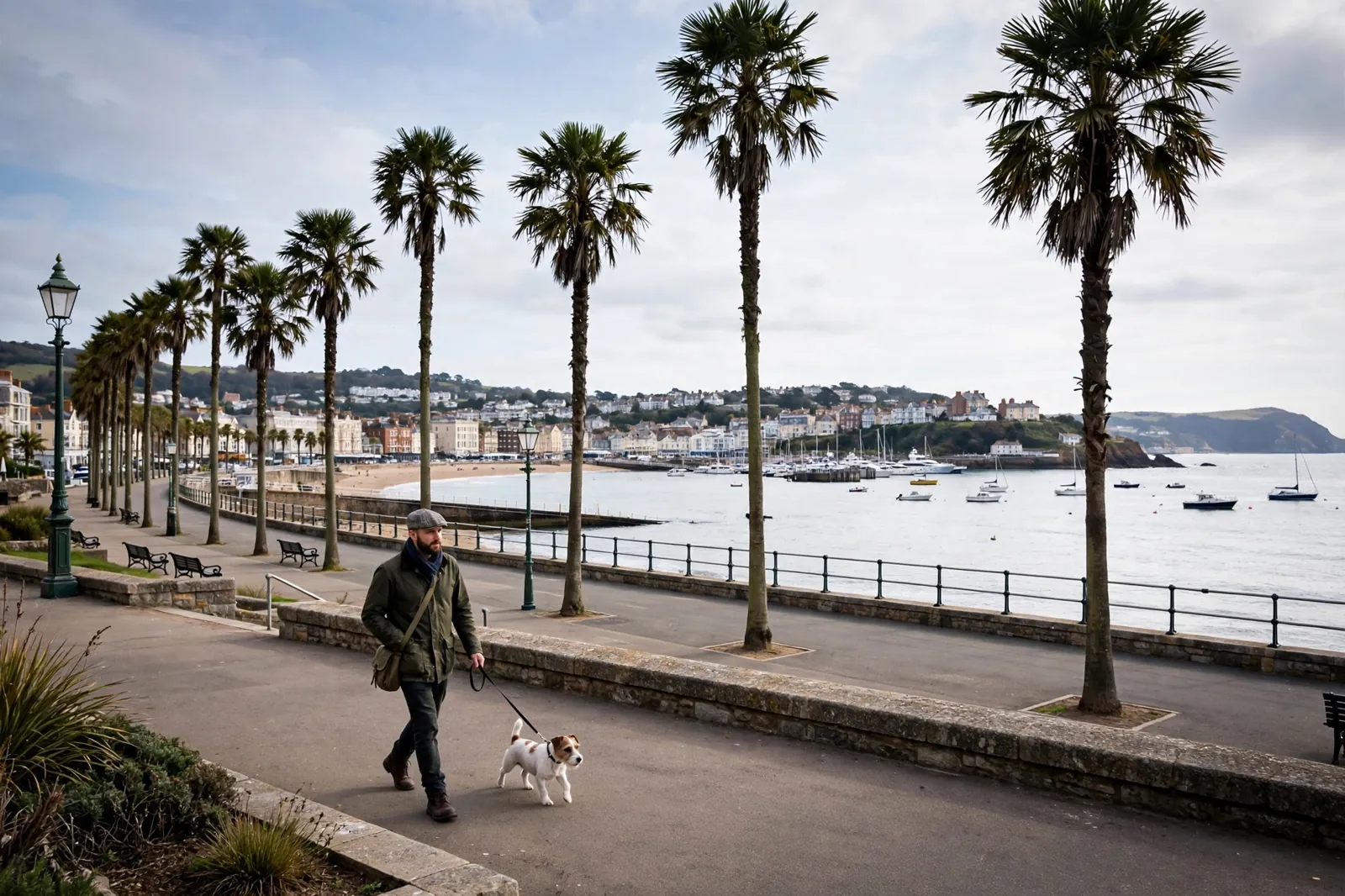
The promenade above the beach is a good alternative when the tide is in or when the beach is busy. It is flat, wide and surfaced, with benches facing the sea, and it runs along the front of the town so you can dip down to the beach at the access points. On a sunny day the promenade is where everyone gathers, so keep your dog close and on a short lead, and be ready for children, pushchairs, cyclists and other dogs. On a quiet weekday morning it is one of the most peaceful places in Devon to sit with a dog and watch the sea.
Dawlish Warren: dunes and nature reserve
Dawlish Warren is the big sandy spit at the mouth of the River Exe, about two miles north-east of Dawlish town, and it is the place to go when your dog wants a proper run on open sand. The Warren is a long, curving beach backed by sand dunes, with a nature reserve behind it, a golf course, and the railway station at its southern end. On a good day the beach feels enormous: flat sand stretching in both directions, the estuary on one side and the open sea on the other, and enough space for a dog to run without bothering anyone.
Getting there is part of the trip. You can walk from Dawlish along the sea wall, which takes around forty minutes to an hour at a dog-walking pace, or you can drive and park at the Warren, or take a train to Dawlish Warren station and walk the short distance to the beach. The walk from town is flat and straightforward, but it is exposed, so take water and sun protection in summer and a windproof layer in winter. If you drive, arrive early on a sunny weekend, because the car parks fill up and the queue on the approach road can be long.
The nature reserve is what makes Dawlish Warren special, and it is also what asks the most of dog owners. The Warren is a National Nature Reserve and a Site of Special Scientific Interest, with sand dunes, salt marsh and mudflats that support wading birds, wildfowl and rare plants. The dunes are fragile: the plants that hold them together are easily damaged by trampling, and ground-nesting birds use the dunes and the upper beach in the breeding season. Keep your dog on a lead in the nature reserve and on the marked paths through the dunes, and do not let your dog chase birds on the mudflats or in the estuary. The birds you see feeding at low tide have flown a long way to get there, and every time they are flushed they burn energy they cannot easily replace.
The beach itself is divided in practice, if not always in law, between the busy family beach near the car parks and the quieter stretches further along the spit. Dog rules here are seasonal, and the details matter: there is a dog exclusion zone on part of the main beach during the summer months, with other areas remaining open to dogs. The dates and the exact boundaries change, so read the signs at the beach entrance and check the official guidance before you travel. Do not assume that because dogs were allowed on a particular stretch last year, they still are. Outside the exclusion period, much of the beach is open to dogs, and the long walk towards the far end of the spit is one of the best off-lead runs in South Devon — provided your dog has reliable recall and you can see them at all times.
Off-lead or not, the Warren demands good recall. The beach is wide and open, and a dog that runs off can be a long way away very quickly, especially if it picks up the scent of something on the wind. There are other dogs, children, kite flyers, horse riders and golfers nearby, and the estuary side has deep, fast-moving water and soft mud that can trap a dog. Keep your dog in sight, call them back regularly, and put the lead on before you reach the car park, the golf course or the nature reserve paths. If your dog's recall is unreliable, use a long line on the open beach — it gives the dog freedom to run while you keep control — and avoid the far end of the spit, where the water and the mud are most dangerous.
The dunes themselves are worth a slow walk on the marked paths, even if your dog would rather be on the sand. In spring and summer they are full of wildflowers, and in autumn the light across the estuary is beautiful. Stick to the paths, keep the dog on a lead, and do not climb the dune ridges, which are fenced or signed in the most sensitive areas. The visitor centre and the information boards at the Warren explain the wildlife and the rules for the current season, and they are worth a few minutes of your time before you let the dog off the lead. If you are visiting in the breeding season, take the extra care that the signs ask for: it is the difference between a nature reserve that survives and one that does not.
After the beach, the Warren has a small cluster of cafés, takeaways and shops near the car parks, and a fairground-style amusement area in the summer. It is busier and more commercial than Dawlish town, and the pavements can be crowded. If your dog is nervous in crowds, walk the beach and the dunes and skip the busy centre, or visit on a weekday when it is much quieter. There are toilets and water points near the car parks, but bring your own water for the dog, because the walk back along the sea wall is long and exposed.
Longer walks from Dawlish
Dawlish sits on the South West Coast Path, which means a short town walk can grow into a serious day out without any planning at all. The two obvious directions are south-west to Teignmouth and north-east to Dawlish Warren and beyond, and both are flat by coast-path standards, which is unusual. Most of the South West Coast Path climbs and falls steeply; the Dawlish stretches follow the railway and the sea wall, so they stay level. That makes them suitable for dogs that would struggle with the usual ups and downs, and for owners who want a long walk without a hard climb.
The walk to Teignmouth is the classic. From Dawlish station, follow the sea wall path south-west for about two miles to Teignmouth, where the path brings you into the town near the station and the harbour. Teignmouth is a working fishing town with its own beach, a pier and a long promenade, and it makes a natural halfway point for lunch or a rest. The return is the same two miles back, or you can catch a train from Teignmouth back to Dawlish, which takes a few minutes. The total round trip on foot is around four miles, which is a good length for a fit adult dog. Allow at least two hours, and longer if your dog likes to stop and sniff — the sea wall is full of smells, and a dog will want to investigate every one of them.
The walk to Dawlish Warren and beyond is the other classic. From Dawlish, follow the sea wall north-east to the Warren, then continue along the beach or the paths behind the dunes towards the mouth of the Exe. On a clear day you can see across the estuary to Exmouth, and the birdlife on the mudflats is excellent. The beach walk is soft sand, which is tiring for dogs, so pace it: let the dog run on the firm sand near the waterline rather than the soft dry sand above, and turn back before the dog is tired. The walk to the Warren and back is around four miles as well, and you can shorten it by taking the train back from Dawlish Warren station.
For a longer day, the coast path continues from Teignmouth towards Shaldon, across the passenger ferry over the River Teign, and on towards the cliffs above the river. That is a hillier walk and a bigger commitment, and the ferry has its own rules for dogs, so check the official guidance before you travel if you plan to cross. A simpler extension is to walk from Dawlish to Teignmouth, spend time on Teignmouth beach and the back beach by the river, and then walk back. The two towns are different enough — Dawlish quiet and leafy, Teignmouth busier and more maritime — that the walk feels like a proper day out rather than an out-and-back.
Whichever direction you choose, the same practical rules apply. Carry more water than you think you need, because there is no shade and no water on the sea wall. Take a lead and a long line, so you can give the dog freedom on the beach and control on the wall. Check the tide times if you plan to walk on the beach rather than the path, and check the weather forecast for wind and rain — the sea wall is exposed, and a walk that is pleasant in a breeze can be miserable in a gale. And always have a plan for getting back: the train is the easy option, but check the timetable and the operator's rules for dogs before you rely on it.
If your dog is not up to a four-mile walk, do not force it. Dawlish is a town of short loops, and you can have a perfectly good day with a walk to the swans, a stroll along the promenade and a short stretch of sea wall. A tired, sore dog does not enjoy a holiday, and a dog that is pushed too far on one day will be stiff the next. Build up the distance over a few days if you are staying for a week, and let the dog's pace set the day. The coast path will still be there tomorrow.
Eating and drinking with your dog
Dawlish is a small town, and its eating and drinking scene is built around the seafront and The Strand rather than around a big restaurant quarter. That works in a dog owner's favour: most of the places where you will want to eat are the kind of relaxed café, pub and takeaway where a well-behaved dog on a lead is a normal sight, especially outside in the warmer months. The pattern is familiar across South Devon: cafés with outdoor seating welcome dogs at the tables, pubs with beer gardens are usually happy to have a dog under the table, and takeaways are the easiest option of all, because you can eat on a bench on the promenade with the sea in front of you.
The seafront cafés are the natural lunch stop on a dog walk. They are close to the beach and the promenade, they serve the kind of food you want after a walk — breakfasts, sandwiches, cakes, coffee and ice cream — and most have outdoor tables where a dog can settle beside you. Bring a mat or a blanket for your dog to lie on, because the pavements and the terrace floors are hard and cold, and a dog that has been walking on sand will be grateful for something soft. Bring water for the dog too, and ask for a bowl if the café has one, but do not rely on it. Keep the lead short and tucked under the table so it does not trip anyone, and keep the dog out of the walkway.
The pubs in Dawlish follow the same pattern. The ones near the seafront and on The Strand tend to be welcoming to dogs in the bar or the garden, but policies differ from pub to pub and can change with the season, so check before you go in. A quick look at the door for a dog sign, or a polite question at the bar, saves an awkward moment. If a pub welcomes dogs only in the garden, plan for the weather: a garden table is lovely on a sunny evening and miserable in the rain, and a wet dog in a crowded garden is nobody's idea of a good time. Choose a table at the edge of the garden where the dog has space, and keep the lead short.
Takeaway food is the most flexible option with a dog in Dawlish. Fish and chips, pasties and sandwiches are all easy to buy and eat on the promenade or on The Lawn, and the town has several takeaways within a few minutes of the seafront. Eat on a bench rather than on the sand if you can, because a dog will be interested in your food and the gulls will be interested too, and a dog that lunges at a gull can end up in the road. Keep your food up high and your dog's attention on you, and clear up properly afterwards — dropped chips and wrappers are a hazard for dogs as well as a mess for everyone else.
For a longer stay, the supermarkets and food shops in the town centre make self-catering straightforward, and the morning walk to the shops is a useful routine for a dog that needs a reason to get out. If you are staying in a cottage or a caravan, plan the evening meal around the dog: a dog that has had a long walk and a proper meal will settle for the evening, while a dog that is still full of energy will not. Eat early if you can, especially in the summer, so the dog gets a last walk in the light and a calm evening.
A note on manners, because it matters in a small town: Dawlish is a place where people notice a well-behaved dog and remember a badly behaved one. A dog that lies quietly under a table, does not bark at other dogs and does not beg from strangers will be welcomed back. A dog that barks, jumps up or steals food will not, and the owner will hear about it. Train the café settle at home before you travel — a mat, a chew and a calm wait — and your dog will be welcome in far more places than a dog that has never practised it.
Where to stay with a dog
Dawlish has a good range of dog-friendly places to stay for a town of its size, and the choice comes down to how much space your dog needs and how much you want to be in the centre. The town has hotels and guest houses near the seafront, self-catering cottages in the streets behind The Strand, and holiday parks and caravan sites on the edges of town and at Dawlish Warren. Each has its own trade-offs, and the right choice depends on your dog rather than on the price.
Self-catering cottages are the most popular option for dog owners, because they give the dog a proper routine: a door to the garden, a kitchen for the dog's food, and no shared corridors to negotiate. In Dawlish, look for a cottage with an enclosed garden or a yard, and check the height and the security of the fence before you book — a low wall or a gap under a gate is an escape route for a determined dog. Ask whether the garden is private or shared, whether there are steps to the front door, and how far it is to the nearest green space for a last toilet walk. A cottage a few minutes from The Lawn or the seafront is worth more than a prettier one a long walk away.
Hotels and guest houses near the seafront suit shorter stays and dogs that are happy in a smaller space. Ask the specific questions before you book: how many dogs are allowed per room, whether there is a charge, whether dogs can be left alone in the room, and where the nearest toilet area is. A hotel that welcomes dogs in the bar or the garden but not in the restaurant changes how you eat, and a hotel that charges per dog per night can add a surprising amount to a week's bill. Get the total in writing, including the pet charge, and keep the confirmation with your booking.
Holiday parks and caravan sites around Dawlish and at the Warren offer the most space, and they suit families and multi-dog households. The same checks apply as anywhere: the security of the boundary, the distance to the toilet walk, the rules about leaving a dog alone, and the facilities for drying a wet dog. A caravan or a lodge with a deck can be a trap for a small dog if the decking has gaps, so check the photographs and ask about the deck. The advantage of a park is the outdoor space and the freedom to come and go; the disadvantage is that you are further from the town centre, and the walk to the beach or the shops may need a car.
Whatever you book, read the dog policy in full before you pay. The questions to ask are the same ones you would ask anywhere: how many dogs, what size, what charge, what happens if the dog barks, whether the dog can be left alone, and whether there is a secure outdoor space. Ask for the answers by email and keep the reply. A place that answers clearly and specifically is usually a place that has thought about dogs; a place that answers with a vague reassurance has usually not. And if you are travelling with more than one dog, declare the number at booking — a second dog discovered on arrival can end a stay.
Finally, think about the first and last hours of the stay. Arrive in daylight if you can, so you can walk the garden and the boundary, find the toilet area and settle the dog before dark. Leave a familiar bed and a familiar blanket in the same place every night, and keep the feeding and walking times close to home. A dog that knows where it sleeps and when it eats will settle in a new place far faster than a dog whose routine has been thrown away with the suitcases.
Practical planning: parking, tides and seasons
Parking in Dawlish is straightforward, but it rewards an early start. The town has several car parks close to the seafront and the town centre, including spaces near the railway station and at the Warren, and from most of them the seafront, The Lawn and the beach are a short, flat walk. On a sunny weekend the car parks fill early, and the roads through the town can be slow, so arrive before late morning if you can. Check the official guidance before you travel for current charges, time limits and any height restrictions, and take change or a card for the machines. If you are staying in the town, ask your accommodation about parking before you arrive — some cottages have a space and some do not, and the difference matters when you are unloading a dog, a crate and a week's luggage.
Tides shape the day in Dawlish more than most visitors expect. At low tide the town beach is wide and inviting; at high tide there is very little sand left, and the sea comes up against the sea wall. The same is true at Dawlish Warren, where the estuary and the beach change completely with the tide. Check the tide times for the day you visit, and plan the beach walk for the falling or low tide, when there is the most sand and the most space. Do not walk out on the sand at the Warren towards the estuary mouth without knowing when the tide turns, and do not let your dog run on the mudflats — the mud is soft, the channels fill quickly, and a dog can get stuck.
Seasons change the town in ways that matter for a dog. In spring, the swans may have cygnets, the dunes are full of nesting birds, and the weather is changeable — pack a waterproof and a dog coat, and be ready for a shower. In summer, the beaches are at their busiest, the seasonal dog restrictions are in force on parts of the coast, the sun is strong and the sea wall is hot underfoot. Walk early or late, carry water, and use the shade on The Lawn for a midday rest. In autumn, the light is beautiful, the crowds thin out, and the beach restrictions usually lift, which makes it one of the best times to visit with a dog — but the weather can turn quickly, and the sea wall is exposed to the wind. In winter, Dawlish is quiet, the cafés are calmer, and the sea wall walk is bracing rather than busy, but check for storm damage and path closures, and keep a short-coated dog warm.
Getting to Dawlish is easy by car and by train. The town is on the A379 between Exeter and Teignmouth, and the railway station is on the main line between Exeter and Plymouth, with regular trains in both directions. Arriving by train is a good option if your dog travels well, because the station is right beside the seafront and the town centre — you step off the train and you are already on the walk. Check the operator's rules for dogs before you travel, keep your dog on a lead on the platform, and be ready for the noise of the trains on the sea wall. By car, the approach from Exeter is straightforward, and the car parks are well signed.
Vets and emergencies are worth sorting out before you need them. Dawlish has veterinary practices in the town and nearby, and there are emergency vets in Exeter and Torquay. Save the number of the nearest practice in your phone before you set out, and note the opening hours. If your dog eats something on the beach, drinks too much sea water, cuts a paw on a rock or is stung by a jellyfish, you will want that number to hand rather than searching for it in a panic. Carry a small first-aid kit: saline for rinsing eyes and wounds, bandages, tweezers for thorns and ticks, and a towel. And make sure your dog's identification is up to date — a tag with your mobile number and a microchip with current details — because a dog that slips a lead on a busy beach needs to be reunited quickly.
Finally, a word about the railway and the road. Dawlish is a town where the railway and the road run close to the places dogs walk, and both demand respect. Keep your dog on a lead near the station, the level crossings and the sea wall, and do not let the dog run across the road to the beach. The A379 through the town is busy in the summer, and the side streets are narrow. A dog on a short lead, on the pavement, on your side away from the traffic, is a safe dog — and a dog that is safe is a dog you can relax with.
A relaxed day plan
A good day in Dawlish does not need a timetable, but a loose shape helps, especially if your dog is new to the town. Start early, while the town is quiet and the light is soft. Walk from your accommodation or the car park to The Lawn, let the dog have a toilet stop on the grass, and then follow Dawlish Water down to the seafront. Watch the black swans for a few minutes from the bank, keeping the dog on a short lead and giving the birds space. If the swans have cygnets, keep a little further back and let the dog watch from a distance.
From the seafront, turn along the promenade and walk a short stretch of the sea wall towards the Warren, or towards Teignmouth if you prefer the quieter direction. This is the time to judge how your dog feels about the trains: if the dog is relaxed, carry on; if the dog is nervous, turn back to the promenade and the lawns and try again later. Stop for coffee at a seafront café, with the dog settled on a mat beside the table, and let the dog watch the world go by. A café stop is not a wasted hour — it is training, and a dog that can settle in a café is a dog you can take anywhere.
By late morning, head for the beach at low tide. Let the dog run on the sand, paddle in the shallows and sniff the rock pools, keeping an eye on the tide and on what the dog picks up. An hour on the beach is enough for most dogs, especially in the sun. Rinse the dog's paws if you can, offer fresh water, and then walk back through the town for lunch. A takeaway eaten on a bench on the promenade is the easiest option, and it keeps the dog with you.
The afternoon is for the Warren, if your dog still has energy. Drive or take the train to Dawlish Warren, walk the beach and the marked dune paths, and give the dog a proper run on the open sand outside the exclusion zone. Keep the dog on a lead through the nature reserve and on the dune paths, and let them off only where it is allowed and where you can see them. If the dog is tired, skip the Warren and take a slower walk upstream along Dawlish Water instead — the quieter paths, the gardens and the trees are a good wind-down after a busy morning.
Finish the day with a short evening walk on the promenade, when the light is soft and the town is quiet. Let the dog have a last toilet stop, a drink and a settle, and then head home or back to your accommodation. A dog that has had a morning of new sights, a midday rest and an afternoon run will sleep well, and you will have seen the best of Dawlish without rushing any of it. If you are staying for longer, swap the directions on the second day — Teignmouth one day, the Warren the next — and let the dog's energy set the pace.
That is the shape of a good Dawlish day: swans in the morning, sea wall in the middle, sand in the afternoon, and a quiet promenade to finish. It works because the town is flat, compact and honest about what it is — a small seaside town with a brook full of black swans, a railway beside the sea and a wide beach a short walk away. Bring a lead, bring water, check the signs, and let the dog set the pace. Dawlish will do the rest.
Practical questions
Before you go
Can dogs go on Dawlish beach all year round?
Dawlish town beach is generally dog-friendly, but seasonal restrictions can apply on parts of the South Devon coast, and the rules at Dawlish Warren are different from those in the town. Always read the signs at the beach entrance on the day, and check the official guidance before you travel so you are not relying on last year's rules.
Are dogs allowed off the lead at Dawlish Warren?
Parts of the Dawlish Warren beach allow dogs off the lead outside the seasonal exclusion period, but the nature reserve and the dunes are sensitive wildlife habitat where dogs should be kept on a lead and on the marked paths. Ground-nesting birds use the dunes, so keep your dog close, stay on the paths and check the official guidance before you travel.
Is the sea wall walk from Dawlish to Teignmouth suitable for dogs?
Yes, for most dogs it is one of the easiest coastal walks in Devon: the sea wall path between Dawlish and Teignmouth is flat, surfaced and about two miles each way, with the railway on one side and the sea on the other. Keep your dog on a lead, because the path runs beside a live railway line and there are drops to the beach in places. Take water, allow time for the return leg, and check the official guidance before you travel if storms have damaged the path.
Can I take my dog to see the black swans?
Yes. The black swans live on Dawlish Water, the brook that runs through the town past The Lawn, and you can watch them from the bankside paths with your dog on a lead. Do not let your dog enter the water near the swans or chase the birds, and never feed the swans bread. If you want to feed them, use proper waterfowl food if it is sold locally, and check the official guidance before you travel.
Where can I park in Dawlish with a dog?
Dawlish has several car parks close to the seafront and the town centre, including spaces near the railway station and the Warren. On a sunny weekend they fill early, so arrive before late morning if you can, and check the official guidance before you travel for current charges and any height or time limits. From most town car parks the seafront, The Lawn and the beach are a short, flat walk.
What should I do if my dog drinks sea water or eats something on the beach?
Stop the walk, offer fresh water, and watch your dog closely for vomiting, diarrhoea or unusual tiredness. Sea water can upset a dog's stomach, and washed-up food, dead fish and bait can be harmful. If your dog keeps being sick, seems weak or collapses, contact a vet straight away. Save the number of the nearest vet before you set out, and check the official guidance before you travel for the closest emergency practice.