This guide is independent and contains no paid placement. If affiliate links are added later, they will be clearly marked and will not change our editorial checks.
Brixham rewards visitors who plan around a working port, not a seaside resort. Walk the Breakwater first, see the Golden Hind replica from the quay, watch the fish market from public areas, then use the harbour loop for a calmer second walk. Keep dogs on leads around vehicles, crates and gulls, and check the official guidance before you travel for beach rules, boat rules and any temporary closures.
Read the harbour before the postcard
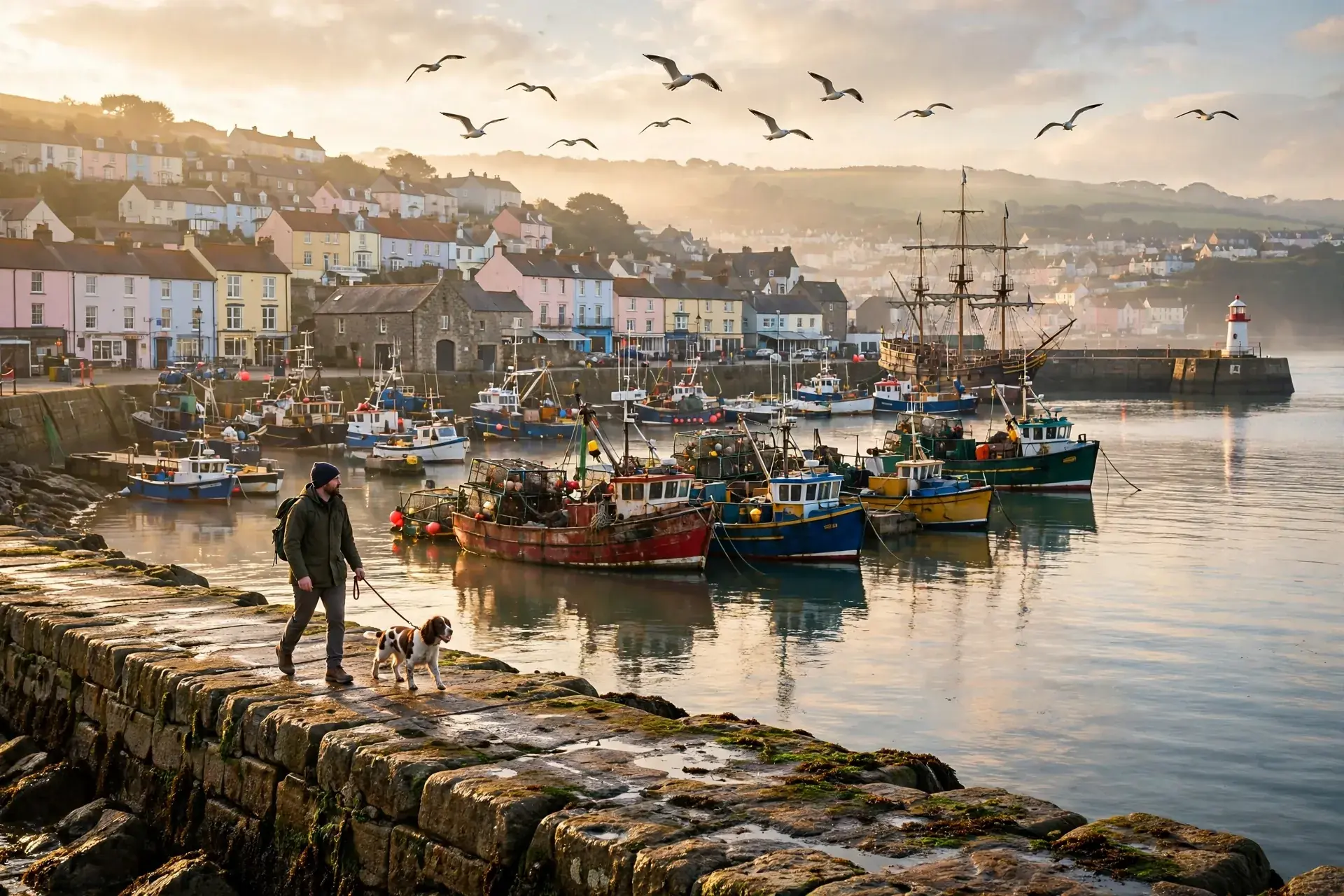
Brixham is easiest to enjoy once you stop treating it as a backdrop and start treating it as a workplace that happens to be beautiful. The harbour is not a museum set. Boats land fish, crews mend gear, forklifts move crates, gulls circle the quays with serious intent, and the smell of the sea changes with the catch and the tide. A dog experiences all of that before a human notices any of it: the noise of winches, the slick patches on the quay, the sudden rush of a vehicle, the dropped fish that smells like the best thing in the world. Planning for a working harbour, rather than for a pretty promenade, is what turns a Brixham visit from stressful into satisfying.
The most useful habit is to read the day in harbour order. Early in the day the working side of the port is busiest, the light is lower, and the town is still waking up. By late morning the visitor side takes over: people gather around the replica ship, the cafes fill, and the quayside becomes a slow promenade. In the afternoon the light moves across the bay and the Breakwater walk becomes the obvious choice. In the evening the fishing boats, the harbour lights and the smell of cooking fish give the town a different character again. None of this requires a rigid timetable. It simply means that the same walk feels different at different hours, and that a dog that copes well with a quiet morning quay may find a crowded afternoon quay much harder.
Start by standing still for five minutes on arrival, dog on a short lead, and watching what is actually moving. Where are vehicles going? Where are crews working? Where do gulls gather? Where does the pavement narrow between parked cars and the water? That short pause tells you more than any map about where to walk, where to cross, and where to give your dog space. Dogs that are nervous around traffic, machinery or crowds do best when the first walk is the quietest one available, not the most famous one. In Brixham that often means a short harbour-side stroll first, then the Breakwater once you know how your dog is settling.
It also helps to decide in advance what kind of day you want. A harbour-watching day is slow, flat and full of stopping points: benches, quayside views, a replica ship, a cafe pause, a second short loop. A coast-path day is longer, hillier and better suited to a fit dog that needs to burn energy before it can settle. A beach day depends entirely on the season and the rules in force, and it should never be the only plan. Brixham is at its best when the harbour day comes first and the longer walk is treated as a bonus, because the harbour day works in wind, in drizzle and in a busy holiday week, while the longer walk does not always.
Finally, keep expectations honest about what a fishing port can offer a dog. There will be wet ground, fish smells, shouting, ropes, nets and other dogs. There will also be long flat stretches where a dog can walk calmly beside you, watch boats, sniff seaweed and settle under a bench while you drink coffee. The dogs that enjoy Brixham most are not necessarily the boldest dogs. They are the dogs whose owners choose the quieter route, keep the lead short near vehicles, carry water, and quit a walk while it is still going well rather than pushing on to the end of the Breakwater in a gale.
The Breakwater walk, step by step
The Breakwater is the long stone arm that shelters Brixham harbour from the open sea, and walking it is the single most Brixham thing a visitor can do with a dog. It is a straight, exposed promenade walk with water on one side, the harbour on the other, and a view that opens wider with every step. The beginning feels sheltered and town-like, with houses, boats and people close by. The middle feels properly coastal, with wind, spray and the sound of water against stone. The far end feels wild, with open sea, big skies and very little shelter. That progression is the point of the walk, and it is also the reason to judge it in stages rather than committing to the whole length before you start.
Begin at the town end and walk out slowly. The surface is generally firm and level, which suits older dogs, dogs on leads and dogs that struggle with steep paths, but it is still a working coastal structure, not a park path. There can be wet patches, seaweed, uneven joints and puddles after rain or heavy spray. Keep your dog on a lead throughout, keep to the main walking line, and do not let a dog scramble onto rocks, slipways or the harbour wall edge. The drop to the water, the swell and the slippery stone make those edges dangerous for a dog that slips, and a lead is the simplest protection against a moment of excitement when a gull lands close by.
Wind is the deciding factor on the Breakwater. A calm day makes it a gentle, memorable walk for almost any dog. A strong onshore wind turns the far end into a buffeting corridor of spray, and a dog that is small, elderly, anxious or noise-sensitive may hate it even if its owner is enjoying the drama. There is no shame in turning back halfway. The walk is an out-and-back route, so every step out must be walked back again, and a dog that is already tired or unsettled at the halfway point will be more tired on the return. Watch for the early signs: ears back, low body, pulling towards shelter, refusing to walk forward, or sudden interest in every exit. Those are signals to turn around, not failures.
Water and rest matter more here than on a woodland walk because there is almost no shade and no fresh water supply along the exposed stretch. Carry water and a collapsible bowl, especially in summer, and offer drinks before your dog starts panting hard. On a hot day, test the stone with your hand: sun-warmed stone can be uncomfortable for paws, and the combination of heat, wind and reflected light tires dogs faster than the distance suggests. In winter the opposite problem applies. Cold spray, wind chill and wet fur chill a small or short-coated dog quickly, so a drying coat and a towel in the car turn a bracing walk into a comfortable one.
The reward for pacing the walk well is the view back towards the town. From the Breakwater, Brixham reads as a working amphitheatre: the harbour packed with boats, the houses climbing the hill, the fish market buildings at the quay, and the coast curving away towards Tor Bay. It is a good place to stop, let the dog sniff the wind, take photographs, and simply watch boats come and go. Dogs often settle surprisingly well here once the initial excitement passes, because the walk is linear, predictable and free of the sudden encounters that make town centres stressful. Keep the stop short in poor weather, keep the lead in your hand rather than tied to a railing, and head back while your dog still has energy in reserve.
For a longer day, the Breakwater pairs naturally with the harbour loop described later in this guide. Walk the Breakwater first while energy is high, return to the town end, give the dog water and a rest, and then choose a shorter, sheltered harbour stroll for the second half of the day. That sequence gives a dog both the big coastal experience and the calm town experience without asking for two long walks back to back. If you are visiting with children, the same logic applies: the Breakwater is exciting precisely because it is exposed, so agree a turning-back point before you set out rather than negotiating it in a gale at the far end.
The Golden Hind replica on the quay
The Golden Hind in Brixham is a full-size replica of the ship associated with Francis Drake's circumnavigation, moored in the harbour as a visitor attraction beside the quay. For a dog owner, its value is partly the ship itself and partly its position: it sits right where the harbour walk is most interesting, so it works as a natural stopping point between the town centre and the Breakwater. You can admire the masts, rigging and hull from the quayside without any boarding decision at all, and for many dogs that quayside view is the best version of the visit. The dog gets boats, water, smells and people to watch, while you get the photograph and the sense of scale, all without narrow stairs, low decks or crowded below-deck spaces.
Boarding is a separate question, and it deserves a separate check. A replica Tudor ship is not designed like a modern visitor centre. Decks can be steep, companionways narrow, headroom low, and surfaces slippery when wet. Some dogs cope happily with that kind of environment, especially confident dogs used to boats and stairs. Others find it stressful, and a stressed dog on a crowded replica ship helps nobody. Operator rules for dogs can also change with the season, with staffing, or with the type of visit on offer, so the only safe approach is to check the official guidance before you travel and to ask at the quay on the day. Do not assume that because dogs are welcome on the quayside, they are welcome on board, and do not assume that a policy you read last year still applies.
If dogs cannot board on the day you visit, treat the quayside as the attraction rather than a consolation prize. The replica looks most impressive from the water side and from a little distance, where the full hull and rigging can be seen against the harbour houses. Walk slowly past, let the dog sniff the quay, sit on a bench for a few minutes, and watch how the ship moves with the tide. Children often enjoy the ship just as much from outside, especially when you explain what the masts and sails were for, and a dog that stays calm on the quay is a dog that will enjoy the rest of the harbour far more than a dog that has just endured a stressful boarding.
If dogs can board, prepare for it like a short boat trip rather than a museum visit. Use a short lead, keep the dog close on stairs and narrow passages, watch for ropes and low beams, and be ready to leave promptly if the dog becomes anxious or if the space becomes crowded. Bring water, but do not expect to find a convenient dog water point on board. Keep the visit short, praise calm behaviour, and have a quayside rest planned afterwards. A dog that boards calmly, looks around, and leaves happily has had a good experience. A dog that is carried, dragged or coaxed through a long queue below deck has not, and the harbour walk afterwards will show it.
The Golden Hind also works as a useful landmark for planning the rest of the day. It marks the point where the visitor harbour meets the working harbour, and where a flat quayside stroll turns into a more exposed coastal walk. Use it as a meeting point, a turning point and a decision point: if the dog is settled here, the Breakwater is a sensible next step; if the dog is already overstimulated here, choose the quieter harbour loop instead. That kind of landmark-based planning is far more useful than a fixed itinerary, because it lets the dog's behaviour on the day decide the route.
The fish market and the working quays
Brixham's fish market is the economic heart of the town and one of the busiest fish markets in England, landing a wide variety of catch that is sold on to buyers across the country. For visitors, the interest is not in getting inside the trading floor but in understanding what the harbour is for. Watch the boats unload, see the crates stacked on the quay, notice the different types of vessel, and follow the chain from sea to market to lorry. A dog owner who understands that chain will also understand why some parts of the quay are for working and some parts are for walking, and why the boundary between them matters.
The practical rule is simple: stay in clearly public areas, keep the dog on a short lead, and keep well clear of moving vehicles, forklifts, cranes, stacked crates and wet working surfaces. Do not let a dog wander into a working area to investigate fish, and do not let a dog eat anything dropped on the quay. Fish bones, hooks, line, nets and sharp shells are all real hazards, and a dog that scavenges on a fishing quay can be in trouble very quickly. Gulls add another layer of excitement: a dog that chases gulls on a busy quay can pull its owner into the path of a vehicle or towards the water's edge. A short lead, a calm pace and a firm habit of moving on past dropped fish will prevent most problems.
Early morning is when the working harbour is most vivid, but it is also when it is least suitable for a leisurely dog walk. Crews are working, vehicles are moving, and there is little patience for visitors standing in a working route with a dog on a long lead. If you want to see the market at its busiest, do it as a brief, respectful look from a public viewpoint rather than a long stroll through the working area, and choose a quieter time for the dog's main walk. Later in the day the balance shifts: the visitor side of the harbour becomes calmer, the quayside cafes and benches become the focus, and a dog can walk the harbour loop without constantly negotiating working traffic.
There is also a food story worth following, even without entering the market itself. Brixham fish appears on menus across the town, and the short distance from boat to kitchen is part of what makes eating here distinctive. For a dog owner, the useful version of that story is practical: look for quayside places where dogs are welcome in an outdoor area, check the policy before you sit down, and keep the dog settled under the table rather than wandering between tables where staff carry hot food. If a place cannot welcome the dog, take food to a bench or a harbour viewpoint instead. The harbour is generous with viewpoints, and a takeaway eaten beside the water with a settled dog is often better than a rushed meal indoors.
Finally, use the fish market as a lesson in harbour manners that applies to the whole visit. Working harbours reward visitors who watch first, walk second, keep dogs close, and leave working space clear. That attitude also makes the visit more interesting, because once you stop expecting the harbour to behave like a theme park, you start noticing the real details: the different hull colours, the names on the sterns, the way boats raft together, the rhythm of loading and unloading, and the way the whole town seems to turn towards the water. Dogs notice those details too, in their own way, through smell, sound and movement. A calm walk past a working quay gives a dog a richer day than a hurried march through a crowded attraction.
The harbour loop and the coast path
Once you have walked the Breakwater and seen the Golden Hind, the harbour loop is the walk that ties Brixham together. It is not a single waymarked trail with a fixed start and finish. It is better understood as a series of linked, mostly flat quayside and promenade stretches that let you circle the inner harbour, pass the replica ship, reach the Breakwater, and return through the town side without retracing every step. The exact route can be adapted to your dog: a short loop for an older dog, a longer loop for a fit dog, and a loop with extra bench stops for a dog that needs frequent rests.
The inner harbour is the calmest part of the walk and the best place to start if your dog is new to fishing ports. The water is sheltered, the boats are close, and there are regular places to stop. Walk slowly, let the dog sniff the quay walls and bollards, and watch the boats rather than rushing past them. Dogs that are reactive to other dogs do better here than on a narrow coast path, because the quayside is generally wide enough to create distance, cross to the other side, or pause behind a bench until another dog has passed. If the harbour is busy, walk the loop in the quieter direction first: away from the main visitor crowd, then back through it once the dog has settled.
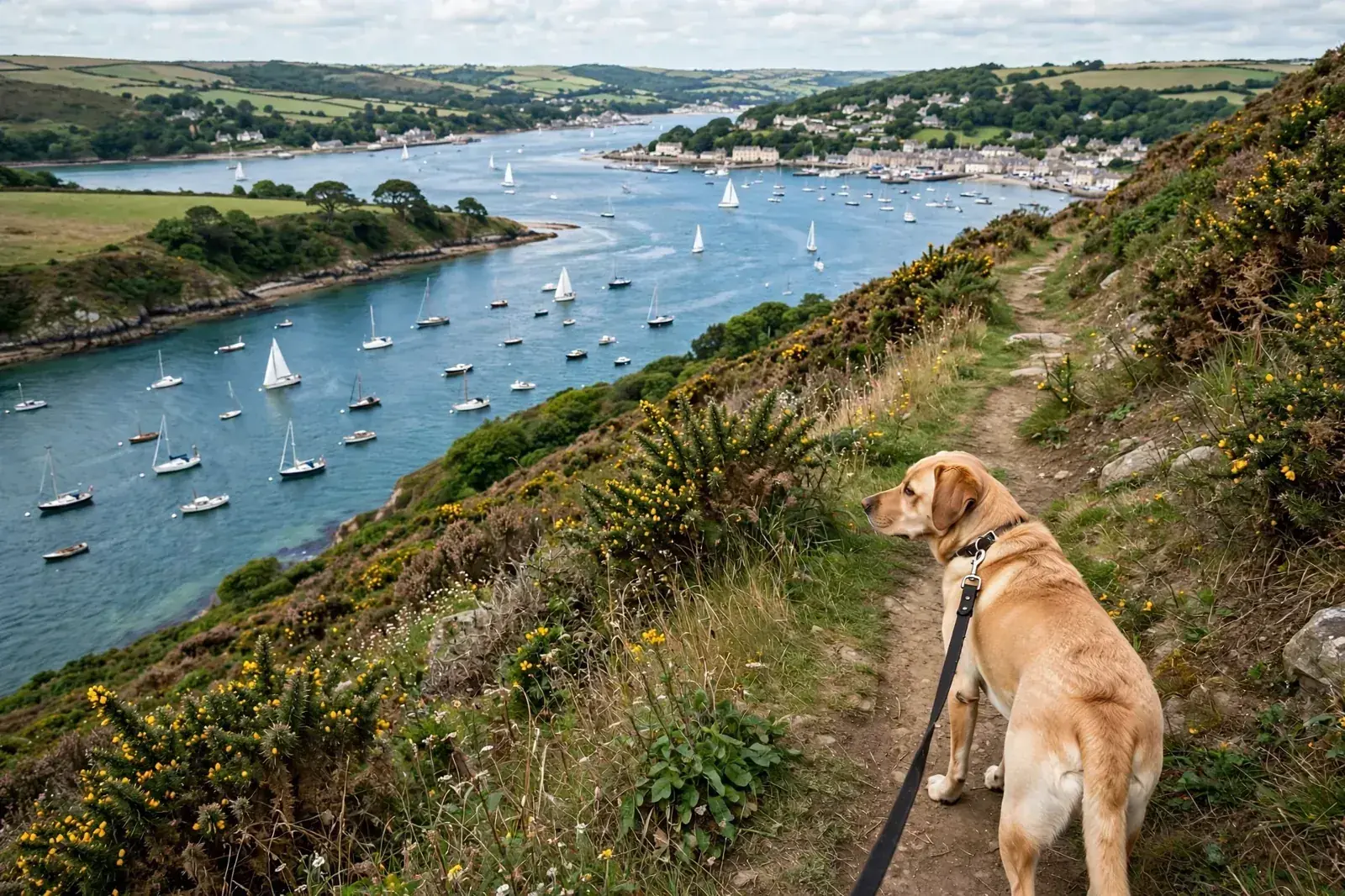
From the harbour, the coast path towards Berry Head offers a completely different walk for dogs that still have energy. Berry Head is a dramatic headland with open grassland, sea views and a very different feel from the enclosed harbour. The path climbs, the ground becomes more exposed, and the walk becomes a proper countryside outing rather than a town stroll. Only choose this extension if your dog is fit, the weather is suitable, and you have water and time in hand. Dogs on leads near cliff edges are essential, and the exposed headland is no place for a dog that is already tired from the Breakwater. For many visitors, the right choice is to save Berry Head for a second day, when the dog is fresh and the harbour day has already given it a good outing.
In the other direction, the coast path towards Torquay and Paignton links Brixham to the wider sweep of Tor Bay. That route suits a longer day and a confident walking dog, but it should not be attempted as an afterthought at the end of a harbour day. Check the route, the distance, the return transport and the dog rules for any beaches or sections along the way before you set out, and check the official guidance before you travel for any path closures or diversions. A coast-path walk that ends with a tired dog facing a long walk back in the dark is a planning failure, not an adventure, and Brixham is well served by buses and taxis for a planned one-way walk if you arrange the return in advance.
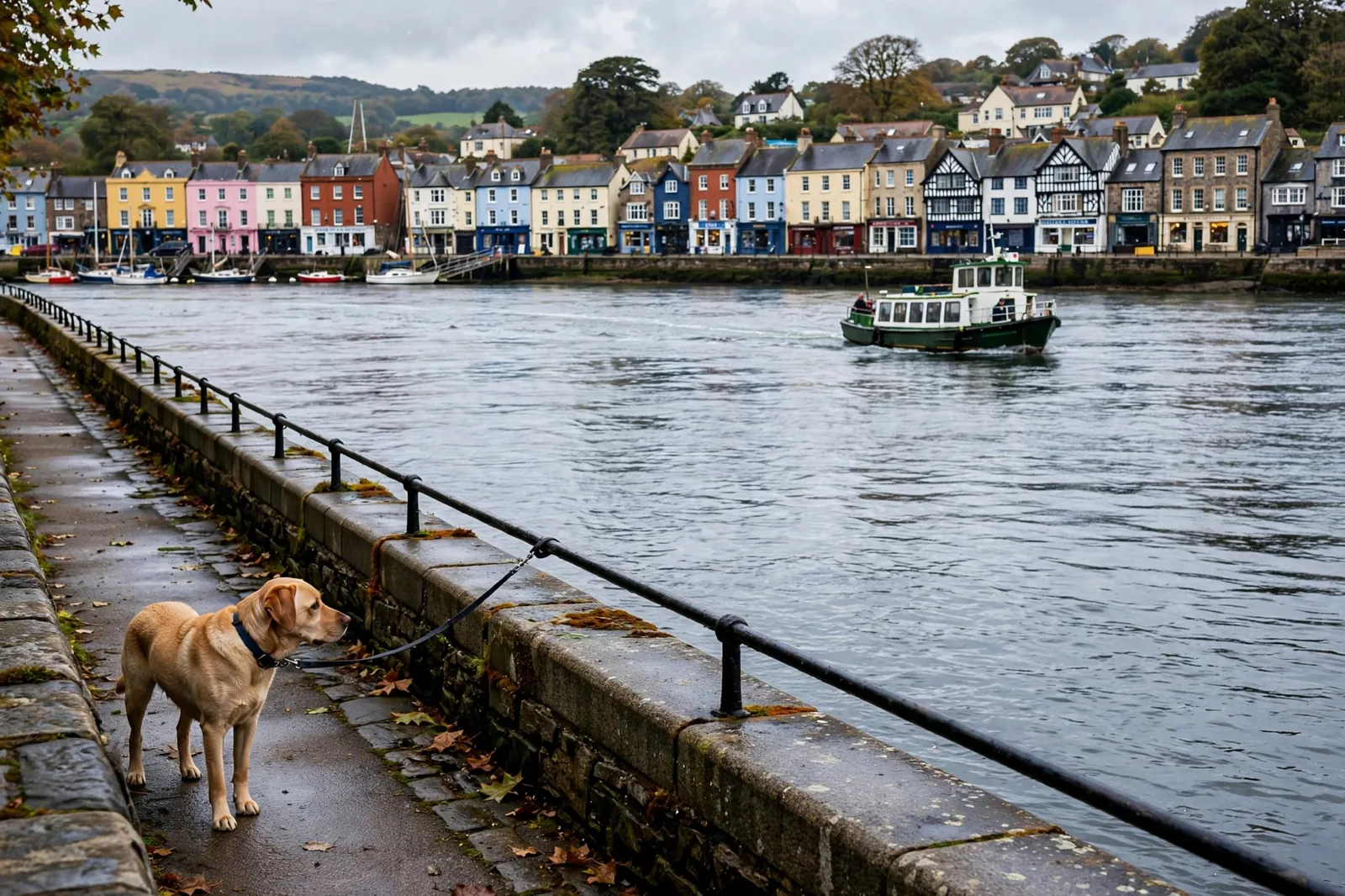
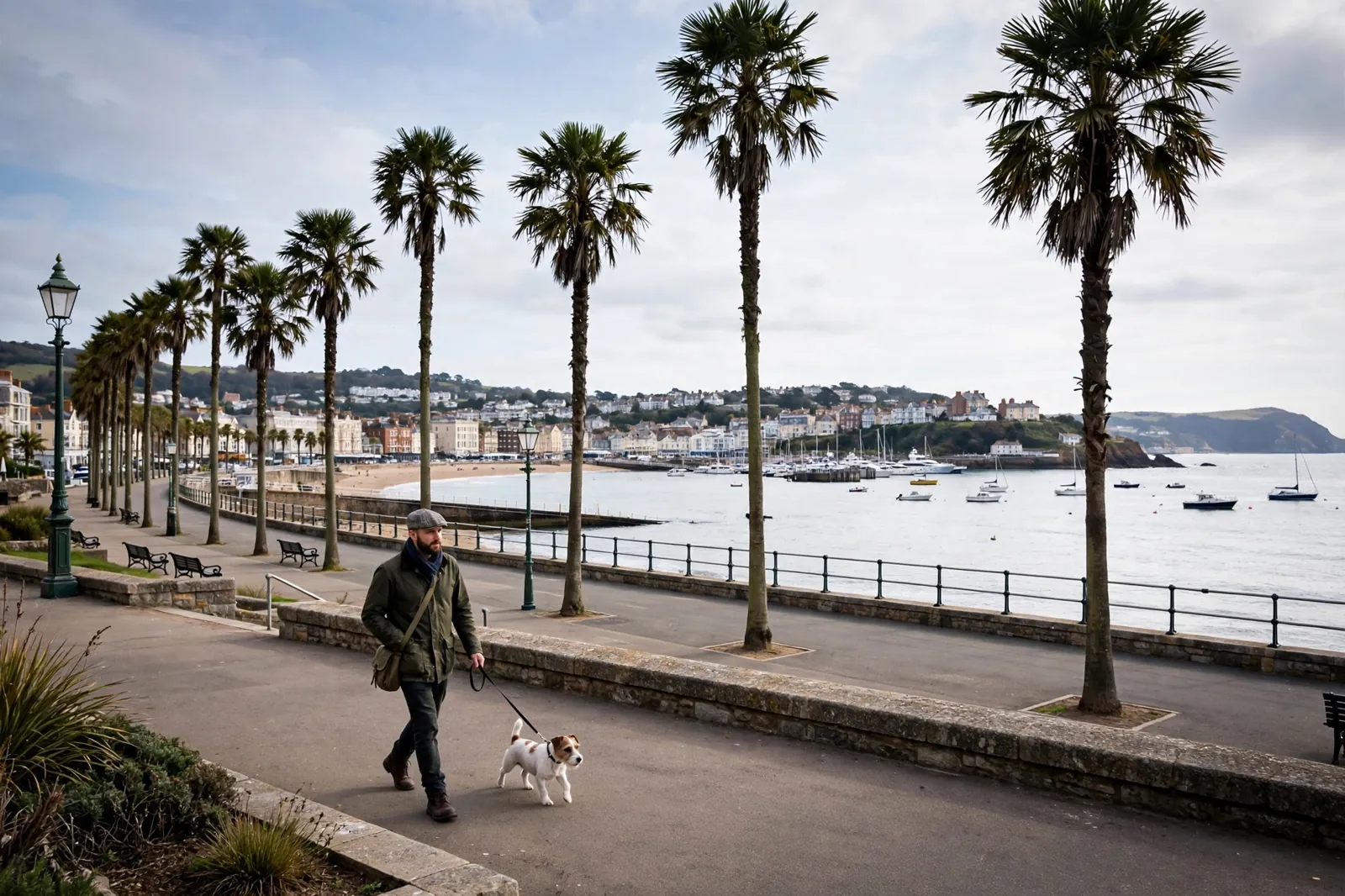
For visitors combining Brixham with nearby towns, the harbour loop also makes an excellent base for comparison. Dartmouth with a dog offers a river harbour, castle walks and ferries across the Dart, while Torquay with a dog offers a grander seafront, palm-lined promenades and a different set of beaches and coast-path choices. Brixham feels smaller, busier in a working sense, and more intensely maritime than either. Visiting all three in one holiday works well if each town gets its own day, because each harbour rewards a slow walk rather than a quick tour. Trying to rush all three in a single day, with a dog, usually means seeing car parks rather than harbours.
Whatever loop you choose, build in a proper rest in the middle. Dogs do not need constant walking to enjoy a harbour day. They need a mix of walking, sniffing, watching and settling. A twenty-minute bench stop, with water and a chew or a quiet lie-down, often does more for a dog's enjoyment than another kilometre of walking. Look for benches with a view of the water, shade in summer, and enough space that other dogs can pass without a face-to-face meeting. That rest is also the moment when the harbour reveals itself: boats move, gulls settle, fishermen mend nets, and the town goes about its business around you.
Beaches, tides and seasonal rules
Brixham's beaches are smaller and more varied than the long resort sands elsewhere in Tor Bay, and that variety is part of their charm. Breakwater Beach, close to the harbour, is a shingle beach with harbour views and easy access. Shoalstone, a little further along the coast, is a natural seawater pool and rocky shore area with a very different character. Other small coves and stretches of shore around the town offer yet more variety, from sheltered corners to open, pebbly strands. For a dog, the difference between these places matters: shingle, rock pools, slipways and tidal pools each bring different paw, swimming and scavenging considerations.
Beach rules are the part of a Brixham visit that most needs checking, because they vary by beach and by season. Some beaches welcome dogs all year, while others have seasonal restrictions during the busiest months, and the exact dates and boundaries can change. A beach that welcomed dogs in October may restrict them in July, and a restriction that applied last summer may have been revised. That is why this guide does not print a fixed list of dates as if it were permanent. Instead, check the official guidance before you travel, look for the signs at the beach entrance on the day, and have a harbour walk ready as a fallback. A dog that arrives expecting a beach and finds a restriction will still enjoy a harbour day. A dog whose whole day depended on one beach will not.
Tides matter just as much as rules. At high tide, some small Brixham beaches shrink to almost nothing, leaving little room for a dog to run without disturbing other beach users or approaching the water's edge. At low tide, rock pools, seaweed and exposed sand create a much richer environment, but also bring hazards: sharp shells, fishing line, hooks, slippery rock and the temptation to eat things washed ashore. Check tide times before a beach visit, arrive as the tide is falling rather than rising if you want space, and keep a close eye on a dog that scavenges. A dog that eats fish remains, crab shells or unknown seaweed can become ill quickly, and a beach walk that ends at the vet is a poor end to a holiday.
Swimming deserves the same careful judgement. Some dogs love the sea and will swim happily from a Brixham beach. Others are frightened by waves, confused by currents, or exhausted faster than their enthusiasm suggests. Never let a dog swim near harbour entrances, boat channels, slipways or fishing gear, and never throw a ball into deep or fast-moving water. Rinse a dog with fresh water after swimming, dry its ears and coat, and watch for excessive drinking of seawater, which can cause sickness. If you are unsure about a particular beach on a particular day, a paddle at the edge is a better test than a full swim, and a dog that paddles happily can always swim another day.
For a broader understanding of how beach restrictions work across the country, our guide to dog-friendly beaches in the UK and the 2026 rules, bans and fines explains seasonal bans, public space protection orders and assistance-dog exceptions in plain language. It is worth reading before any coastal holiday, not just a Brixham visit, because the same legal framework produces very different local rules in neighbouring towns. What applies in Brixham may not apply in Torquay or Paignton, and what applies in July may not apply in November. Local signs and official guidance always override a general guide.
Finally, remember that a beach is only one way for a dog to enjoy the sea at Brixham. The Breakwater, the harbour quays and the coast path all give a dog sea air, sea views and sea smells without the specific pressures of a crowded beach. Dogs that are nervous around other dogs, children, balls and buckets often enjoy the harbour far more than a beach, because the harbour walk is linear and predictable while a beach is open and full of sudden encounters. Choosing the harbour on a busy beach day is not missing out. It is choosing the version of the sea that suits your particular dog.
Where to pause with a dog
A Brixham harbour day needs pauses, and the town is well supplied with places to stop. The quayside and harbour area offer cafes, fish restaurants, pubs and takeaway spots, many with outdoor seating where a dog can settle beside a table. The most reliable approach is to look for outdoor space first and a dog policy second: a place with a terrace, a courtyard or a pavement area is far more likely to work for a dog than a small indoor room, however welcoming the staff may be. Check the policy before you sit down, keep the dog on a short lead under the table, and bring a portable water bowl and a mat or blanket so the dog has its own defined space.
Fish is the obvious choice in Brixham, and it is worth eating well while you are here. Freshly landed fish, simply cooked, is the town's signature, and a harbour-side meal after a Breakwater walk is one of the great small pleasures of a Devon holiday. For a dog owner, the practical version of that pleasure is a calm meal, not a long one. Order food that arrives promptly, keep the dog settled rather than begging at neighbouring tables, and be ready to take the meal as a takeaway if the dog becomes restless. Staff in a busy harbour restaurant are handling hot plates and moving quickly, and a dog wandering between tables is a safety issue as well as a nuisance.
Pubs in and around the harbour offer a different kind of pause: quieter, more spacious, and often more dog-tolerant than a formal restaurant. The same rules apply, however. Ask before entering with a dog, respect any dog-free areas, keep the dog away from the bar area where drinks are carried, and do not assume that a pub that welcomed dogs last year still does. Policies change, and a polite question at the door prevents an awkward exit with a dog and a drink order half placed. If you are travelling with a dog that barks at strangers or other dogs, choose a quiet corner, visit outside peak hours, and keep the visit short.
Benches and harbour viewpoints deserve as much attention as cafes, because they are free, flexible and often more comfortable for a dog. A bench beside the harbour, with a takeaway coffee and a view of the boats, gives a dog space to watch the world without the pressures of a restaurant. Bring a towel for wet benches, a blanket for cold stone, and a chew or a quiet toy for a dog that needs something to do while you rest. Dogs that settle well on a bench are dogs that have been given a clear job: lie down, watch the boats, drink water, rest. Dogs that are expected to stand beside a table for an hour with nothing to do will usually find their own entertainment, and it rarely matches the owner's plans.
For visitors planning a longer South Devon stay, the eating pattern in Brixham also sets a useful template for nearby towns. Salcombe with a dog offers estuary walks and a different harbour atmosphere, where the same habits apply: outdoor seating first, policy checked at the door, short lead under the table, and a bench fallback if the first choice does not work. The towns differ in character, but the dog manners that make a meal enjoyable are the same everywhere. A settled dog, a short lead and a backup plan will carry you through every harbour town in the county.
A practical Brixham day with a dog
A good Brixham day with a dog can be planned in four blocks, each with a clear purpose and a clear exit. The first block is arrival and settling: park, walk the dog briefly on a quiet stretch, offer water, and let the dog toilet before the main walk. Do not start with the Breakwater if the dog has just endured a long car journey. A short, boring toilet walk first, followed by a few minutes of calm, makes the main walk far more enjoyable. Check parking arrangements in advance, because harbour parking can be busy in peak season, and a long search for a space with an impatient dog in the car is a poor start to any day.
The second block is the main walk, and in Brixham that usually means the Breakwater or the harbour loop, depending on weather and the dog's energy. Walk it at the dog's pace, not at a sightseeing pace. Stop for sniffs, stop for views, stop for water, and turn back while the dog still has energy. Carry the essentials: lead, water, bowl, poo bags, a towel, and a drying coat in cold or wet weather. Add a spare lead if your dog is strong or if the main lead could fail on a coastal walk. Pack light enough to carry comfortably, but do not leave the water behind to save weight. A coastal walk without water for the dog is a planning error, not a minor omission.
The third block is the pause: food, rest and harbour watching. This is the part of the day that visitors most often rush, and it is the part dogs most often need. Sit down, let the dog settle, eat something, and watch the harbour for at least half an hour. Dogs that get a real rest in the middle of the day walk better in the afternoon, settle better in the car, and sleep better in the evening. Dogs that are marched from walk to attraction to walk without a rest become overtired, and overtired dogs bark more, pull more, scavenge more and cope less well with every new encounter.
The fourth block is the gentle second walk and the journey home. Choose a short, sheltered route: a harbour loop, a quayside stroll, or a brief return to a favourite bench. This is not the time for a new long walk or a first beach swim. It is the time to let the dog stretch, toilet, sniff the evening harbour and finish the day calmly. End the walk before the dog is exhausted, offer water, dry paws and coat if needed, and check for cuts, shells, hooks or line caught in fur or between toes. A quick post-walk check on the quay takes two minutes and prevents a minor harbour injury from becoming an evening vet visit.
For dogs that travel by boat, the same four-block logic applies with extra care. Our guide to dog-friendly boat trips in the UK covers life jackets, boarding safety, seasickness and booking checks in detail, and it is worth reading before any harbour boat trip from Brixham, whether a short tour or a longer coastal sailing. Boat rules vary by operator, and a dog that enjoys a harbour walk may still dislike a boat. Check the official guidance before you travel, ask the operator about dog facilities before booking, and have a harbour walk ready as an alternative if the boat is not suitable on the day.
Seasonal packing completes the practical picture. In summer, bring water, shade plans, a cooling mat for the car, and a plan for hot stone and crowded quays. In winter, bring a drying coat, a towel, a torch for darker afternoons, and a plan for wind and spray on the Breakwater. In spring and autumn, bring layers for both, because a Brixham morning can be cold and an afternoon can be warm, and a dog that starts the day in a coat may need it removed by lunchtime. All year round, bring poo bags, a spare bag for wet items, and a first-aid basics kit. A harbour town is not a remote wilderness, but a dog that cuts a paw on a shell or a hook still needs prompt attention, and the nearest shop may not be the nearest help.
Finally, plan the journey home with the same care as the walk itself. A wet, tired dog in a car needs ventilation, a dry blanket, water on arrival, and a calm settling routine. Do not feed a large meal immediately after a long coastal walk; offer a small meal, water and rest first. Check the dog again at home for sand, salt, shells and minor cuts, and wash any salt from the coat to prevent irritation. A Brixham day ends well when the dog comes home tired in the good sense: walked, sniffed, watched boats, rested beside the harbour, and ready to sleep. That is the measure of a successful harbour day, far more than the number of attractions ticked off or the distance walked.
Practical questions
Before you go
Can dogs walk the Brixham Breakwater?
Yes, in general the Breakwater is a public promenade walk that dogs on leads enjoy, but conditions at the exposed end can be rough in strong wind and spray, so turn back early if your dog is unhappy and check the official guidance before you travel for any temporary closure.
Is the Golden Hind replica suitable for dogs?
The Golden Hind in Brixham is a full-size replica ship moored in the harbour and a popular quayside stop, but boarding rules for dogs can change with the operator and the season, so check the official guidance before you travel rather than assuming dogs can go below deck.
Can dogs go into the fish market area in Brixham?
The working quays and market buildings are not a visitor attraction in the same way as the promenade, so keep dogs on a short lead, stay in clearly public areas, keep clear of forklifts, crates and moving vehicles, and check the official guidance before you travel if you want a closer look.
Which Brixham beaches allow dogs all year?
Beach rules in Brixham vary by beach and season, and seasonal restrictions can apply to some popular sands, so check the official guidance before you travel and plan a harbour or coast-path walk as your fallback if your first-choice beach is restricted on the day.
Is Brixham a good base for a longer South Devon dog holiday?
Yes, Brixham works well as a base because Torquay, Paignton and Dartmouth are all close by, but each town has its own beach rules and parking pressures, so plan one harbour day and one coast-path day rather than trying to cover the whole bay in a single trip.