This guide is independent and contains no paid placement. If affiliate links are added later, they will be clearly marked and will not change our editorial checks.
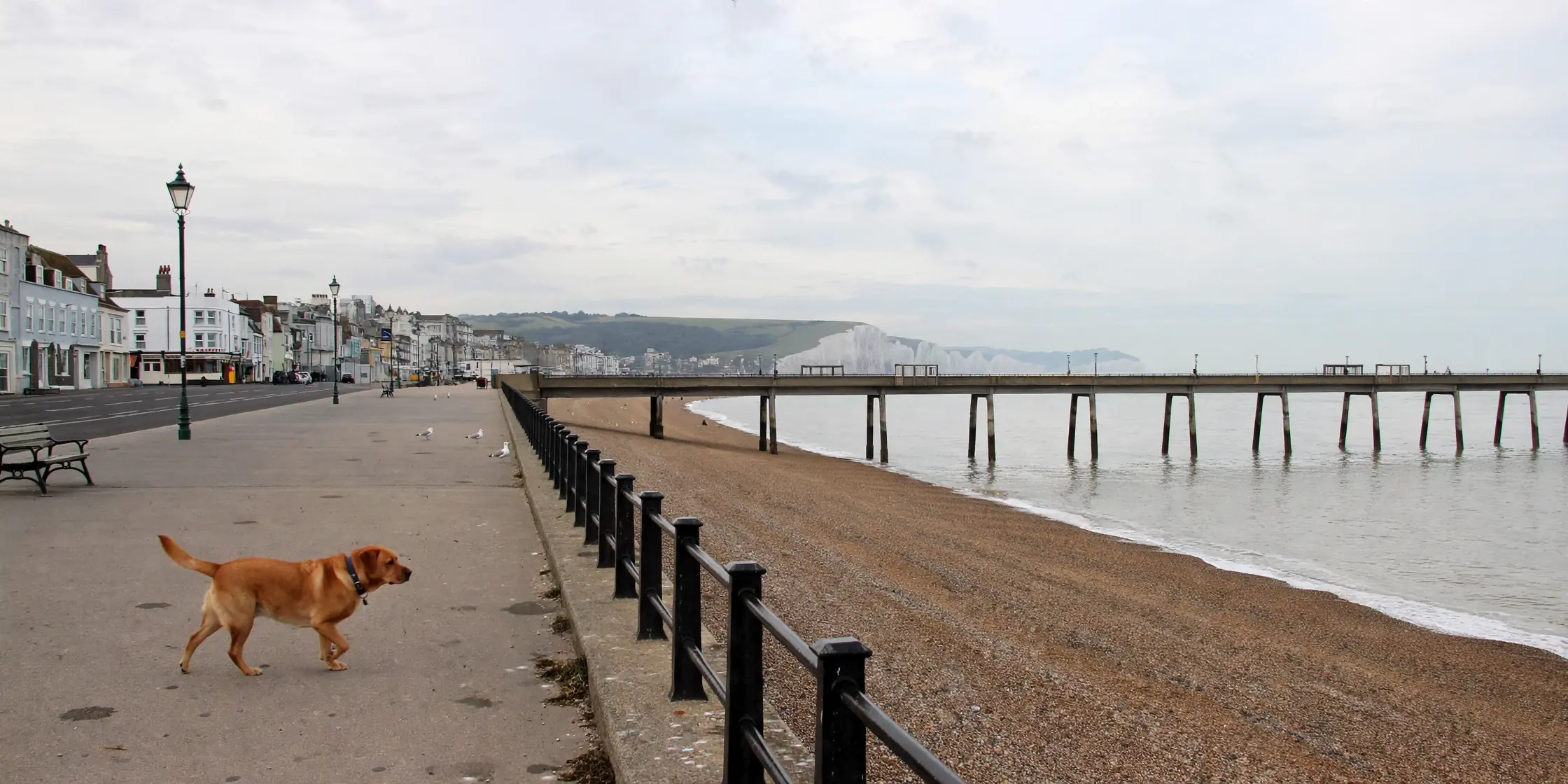
Deal is a flat, unhurried Kent seaside town: a shingle beach and promenade, a Tudor castle, a 1,026-foot pier, the gardens of Walmer Castle a short walk south, and a High Street of dog-welcoming pubs. Most of it is walkable on the lead, and the best plan is simply to follow the seafront.
A seafront town
Deal sits on the Kent coast between Dover and Sandwich, facing the Channel across a wide curve of shingle. It is a town that grew up around the sea rather than around a resort: fishing boats are still hauled up on the beach, the pier is a working one used by anglers, and the streets behind the seafront are a tangle of fishermen's cottages, Georgian houses and narrow lanes that reward a slow wander. For a dog owner, the most useful fact about Deal is its scale. The pier, the castle, the High Street and the station are all within about a mile of each other, and almost everything is flat, so a day here asks very little of tired legs or older dogs.
The town's history is written into the seafront itself. Deal was once one of the busiest anchorages in England, a place where ships waited for a fair wind down the Channel and where the Cinque Ports kept their watch on the coast. The castle at the southern end of the seafront was built by Henry VIII in 1539-40 as part of a chain of coastal defences, and Walmer Castle, a short walk further south, later became the home of the Duke of Wellington. The Timeball Tower on the seafront, built in 1818, once dropped a ball at one o'clock each day so that ships in the Downs could set their chronometers. None of this is fenced off behind a ticket barrier: you walk past it all on the promenade, with the dog beside you, which is exactly the point of coming here.
Deal has never tried to be a big resort, and that shapes the visit. There is no amusement arcade strip, no funfair and no crowds of the kind you find at larger Kent resorts. What there is instead is a long, open promenade, a shingle beach that stretches for miles in both directions, independent shops on the High Street, and a surprising number of pubs and cafes that keep a water bowl by the door. It suits a particular kind of trip: a slow day out, a weekend break built around walks, or a base for exploring the east Kent coast with a dog that prefers sniffing to sprinting.
Getting here is straightforward. Deal station is on the line from London St Pancras via Canterbury and Dover, with high-speed services reaching the town in around an hour and twenty minutes from the capital, and the station is a ten-minute walk from the seafront along Queen Street and the High Street. Dogs travel free on the train, and the walk from the platform to the beach is flat and pavemented all the way. By car, the A258 runs in from Sandwich and the A2 from Dover, and the main car parks for dog walkers are the Tides Leisure Centre car park on Beach Street, the Deal Castle car park at the southern end of the promenade, and the car park at Walmer Castle. Arrive early on a sunny Saturday and the seafront car parks fill up; arrive on a weekday and you will usually find a space within a few minutes of the beach.
The beach itself is shingle, not sand, which changes how a dog experiences it. Shingle is kinder on paws than hot sand in summer and it does not cling to coats the way wet sand does, but it is hard work for a small dog to run on, and the stones can be sharp after a storm. Most dogs settle into a steady trot along the waterline, where the shingle is compacted and easier underfoot. The sea here shelves gently, and on a calm day dogs that like to paddle can wade in at the water's edge, though the Channel is cold even in August and the current off Deal can be strong, so swimming is best left to confident dogs and calm days. Fishing boats are winched up on the beach near the pier, and their nets, ropes and fish boxes are worth steering a curious dog around. Anglers fish from the beach as well as the pier, so keep an eye out for bait and hooks on the shingle, especially at dawn and dusk when the beach is quiet and the lines are out.
Dog rules on the beach are set by Dover District Council, and they can change between seasons and between stretches of shore, so check the official guidance before you travel. The general picture is that Deal's beach is open to dogs for much of the year, with restrictions that tend to apply to particular sections during the summer months. The safest habit is to look for the signs at the top of the beach steps before you let your dog off the lead, and to keep the lead on near the pier, the fishing boats and the busiest part of the promenade in summer. Bins are placed at regular intervals along the seafront, and there is a tap and a dog-wash point near the Tides Leisure Centre car park, which is worth knowing about before a shingle-covered dog climbs back into the car.
Deal works in most weathers, which matters in Kent. On a bright day the light off the Channel is extraordinary, and the white cliffs towards Dover glow in the afternoon sun. On a grey, windy day the town feels properly coastal: the sea grey-green, the gulls loud, the pier empty except for the anglers in their waterproofs. The promenade is exposed, so a windproof coat for the humans and a drying coat for the dog are sensible from October to April. In summer, the shingle reflects the heat, so bring water for the dog and plan the longer walks for the morning or the evening, when the promenade is quieter and the light is softer. The town's cafes and pubs are used to wet dogs and wet walkers, which is one of the reasons Deal has become a favourite with people who holiday with their dogs rather than despite them.
A useful way to think about the day is in three movements: the seafront and the castle in the morning, the pier and the High Street around lunch, and Walmer and its gardens in the afternoon. That order follows the geography of the town, keeps the walking flat, and leaves the dog with a proper rest between the two longer stretches. The rest of this guide walks through each part in that order, with the practical details — where the lead goes on, where the water is, where the dog can go inside — that make the difference between a good day and a frustrating one.
Deal Castle and the seafront walk
Deal Castle stands at the southern end of the seafront, a low, round Tudor fortress that looks less like a castle and more like a stone rose pressed flat against the shore. It was built in 1539-40, one of a chain of artillery forts ordered by Henry VIII after the break with Rome left England expecting invasion from France and Spain. The design is distinctive: a central keep ringed by six rounded bastions, built low so that its guns could fire across the water at ships rather than over the town. It saw action in the Civil War, when it was held for the King and besieged by Parliamentary forces, and it remained a working military building for centuries, its captaincy a sought-after post. Today it is in the care of English Heritage, and its shape is best appreciated from the seafront path, where the whole plan of the building opens out in front of you.
Dogs on leads are welcome in the castle grounds, but they are not allowed inside the castle itself, apart from assistance dogs, so plan the visit as a pair. One person can take the interior tour while the other walks the dog around the moat path and the gardens, then swap. The grounds are worth the time on their own: the dry moat, the bastions and the views back along the seafront to the pier give a dog plenty to sniff, and the grass is a welcome change from shingle after a long beach walk. The castle gardens are kept simple and open, with benches facing the sea, and the whole site is small enough that a visit takes an hour rather than a day. If the castle is closed, the walk past it is still one of the best in Deal, because the seafront path narrows here and the sea comes right up to the wall on a high tide.
The walk from the castle back towards the pier is the spine of any visit to Deal, and it is a walk that a dog can do entirely on the lead without ever leaving the pavement. The promenade runs north from the castle for about a mile, past the Timeball Tower, the Royal Hotel, the beach huts and the fishing boats, to the pier and beyond to the North End. The surface is flat tarmac and paving, with benches every few dozen yards and bins at the beach steps. There are no roads to cross for most of its length, because the promenade is separated from Beach Street by the beach itself, which makes it one of the easiest seafront walks in Kent for a dog that pulls or a puppy that is still learning to walk on a lead.
The Timeball Tower deserves a stop. Built in 1818 on the site of an earlier semaphore station, it is a four-storey tower with a mast and a ball that was dropped at one o'clock each day so that ships anchored in the Downs could set their chronometers before sailing. The tower is now a museum, and dogs are not allowed inside, but the building itself is worth looking at from the promenade, and the small garden beside it is a good place to pause. A little further north, the beach huts begin: a long run of brightly painted huts that are rented by the season, each with its own small patch of shingle in front. Dogs are not allowed inside the huts, obviously, but the huts make the promenade feel lived-in rather than municipal, and in summer their owners sit out with their dogs and their windbreaks, which tells you something about how the town treats its four-legged residents.
At the northern end of the promenade the character of the beach changes. The shingle gives way to a broader stretch of shore towards Kingsdown, and the houses thin out into the village of Walmer and then the open coast towards St Margaret's Bay. The walk from Deal Pier north to Kingsdown is about two miles along the beach and the cliff-top path, and it is a proper walk rather than a stroll, with the white cliffs rising ahead of you and the sea on your right. It suits a fit dog and a dry day, and the return can be made by the same route or by the bus that runs along the coast road. For most visitors, though, the mile of promenade between the castle and the pier is enough, and it is the walk that this guide keeps coming back to, because it is the one you can do in any weather, at any time of day, with any dog.
A word about tides and weather on this walk. The promenade is built above the beach, so a high tide does not cut it off, but on a stormy day the waves can throw spray and shingle over the wall near the castle, and the wind can be strong enough to make a small dog nervous. Check the forecast and the tide times before you set out, and if the sea is rough, keep the dog on a short lead near the wall. In summer the promenade is busiest between eleven and three, when families arrive for the beach; before nine in the morning and after five in the evening it belongs to the dog walkers, the anglers and the early swimmers, and those are the hours when a reactive dog will be happiest here.
The pier
Deal Pier is the town's landmark, a concrete structure that stretches about 1,026 feet out into the Channel, and it is the third pier to stand on this spot. The first, built of wood in 1838, was damaged by a ship in 1843; the second, an iron pier opened in 1864, was wrecked by a drifting ship in a storm in 1889; the present pier, designed by Sir Thomas Bennett and opened in 1957, was built to last, with a lower deck for anglers and a cafe at the far end. It is a working pier rather than a pleasure pier: there are no arcades, no rides and no souvenir stalls, just anglers, walkers, a cafe, and one of the best views on the Kent coast.
Dogs on leads can walk the length of the pier, and for many dogs it is the highlight of a visit to Deal. The walk out takes about five minutes at a dog's pace, and the change in the air is noticeable: the town falls away behind you, the wind picks up, and the sea is on both sides. On a clear day you can see the white cliffs towards Dover to the south and the low coast of France across the Channel to the east, and the fishing boats and the castle look small and neat from the far end. The cafe at the end of the pier serves drinks and simple food, and there is seating outside where a dog can settle beside the table. The cafe is a good place to stop for a rest, because the walk back is the same distance and the wind can be tiring for a small dog.
The pier is popular with anglers, and that shapes how you walk it with a dog. Fishing takes place from the lower deck and from the sides of the upper deck, and anglers leave bait, hooks and line on the decking. Keep your dog on a short lead, keep them away from the railings where lines are cast, and watch where they put their nose. A dog that lunges at gulls is best kept on the town side of the pier, because the birds sit on the railings at the far end and a sudden lunge on a narrow deck is a hazard for everyone. The pier is also exposed: there is no shelter for most of its length, so on a wet or windy day it is a short walk rather than a long one, and on a hot day the concrete can be warm underfoot, so check the surface with your hand before you set off.
Angling from the pier is a serious business in Deal, and the pier's reputation among sea anglers is part of its character. Catches include bass, cod in winter, whiting, plaice and mackerel in season, and the pier is fished at all hours, with anglers arriving before dawn in summer and staying late into the evening. If your dog is interested in fish, the lower deck is where the catch is landed and cleaned, and it is best avoided. The pier is free to enter, which is unusual for a British pier, and it is open through the day and into the evening, though the cafe keeps its own hours. At dusk the pier is at its best: the town lights come on behind you, the sea darkens, and the walk back feels like coming home.
From the pier, the rest of Deal is easy to reach. The High Street is two minutes inland along Beach Street, the Tides Leisure Centre car park is beside the pier entrance, and the beach steps down to the shingle are at either end of the pier approach. The pier is also the natural meeting point for a day out: if your party splits up, agree to meet at the pier entrance, because it is the one place in Deal that everyone can find. For a dog that has done the castle walk in the morning and the pier at midday, the afternoon is best spent somewhere shaded and quiet, which is where Walmer comes in.
Walmer and the castle gardens
Walmer lies immediately south of Deal, and the two towns run into each other along the seafront, so the walk from Deal Castle to Walmer Castle is a continuation of the same promenade rather than a separate expedition. It is about a mile and a half from Deal Pier to Walmer Castle, all of it flat, and it takes most people around thirty to forty minutes with a dog that stops to sniff. The promenade changes character as you go south: the beach huts thin out, the houses become larger and quieter, and the sea opens out towards the white cliffs. Walmer itself is a village rather than a town, with a green, a church, a handful of pubs and a sense of calm that Deal, for all its quiet, does not quite have.
Walmer Castle is the reason most visitors make the walk. Built in the same programme as Deal Castle in 1539-40, it began as a coastal fort and became, over the centuries, the official residence of the Lord Warden of the Cinque Ports. Its most famous resident was the Duke of Wellington, who lived there for more than twenty years and died at the castle in 1852. The castle is in the care of English Heritage, and its gardens are the part that matters most to a dog owner: eight acres of grounds, including a broad lawn, a woodland walk, a kitchen garden and the Queen Mother's Garden, a walled garden created in the 1990s that is planted for scent and colour. Dogs on leads are welcome in the gardens and grounds, though not inside the castle, apart from assistance dogs, so the same take-it-in-turns arrangement applies as at Deal Castle.
The gardens are worth a proper visit rather than a quick look. The Queen Mother's Garden is the most formal part, with a pond, a thatched pavilion and planting chosen for fragrance, and it is a good place to sit while the dog rests in the shade. The woodland walk is cooler on a hot day and quieter than the lawn, and the kitchen garden is a working garden that changes with the seasons. There is a cafe in the grounds with outdoor seating where dogs are welcome, and the car park at Walmer Castle is a useful starting point if you are driving rather than walking from Deal. The castle is open seasonally, and the hours change through the year, so check the official guidance before you travel rather than assuming it will be open on the day you visit.
Walmer village itself is small and easy to explore on the lead. The Green is the centre of the village, a broad stretch of grass with the church of St Mary on one side and the village pubs on the other. The Green is a good place for a dog to have a proper sniff and a rest after the walk from Deal, and there are benches and a water tap nearby. The village has two pubs that welcome dogs, and the streets around the Green are quiet enough for a relaxed wander. From the Green, the coast path continues south towards Kingsdown and St Margaret's Bay, climbing gently onto the cliff top, and this is the point at which the walk becomes a proper hike: the path is rougher, the climbs are longer, and a dog that has already walked from Deal will be tired. Most visitors turn back at Walmer, and that is the right call for a day out that is meant to be enjoyable rather than exhausting.
The walk back from Walmer to Deal is the same promenade in reverse, and it looks different in the afternoon light, with the sun behind the cliffs and the sea a deeper blue. If the dog is tired, the bus that runs along the coast road between Walmer and Deal is an option, and dogs are carried on it, though space for a large dog can be tight at busy times. Alternatively, the car park at Walmer Castle lets you drive back to Deal in five minutes. Either way, the afternoon in Walmer is the slow part of the day, and it is the part that most visitors remember: the gardens, the Green, the quiet streets and the sense that the coast has slowed down.
For walkers who want more, the coast path from Walmer to Kingsdown and on to St Margaret's Bay is one of the finest stretches of the Kent coast, with chalk cliffs, wildflower grassland and views across the Channel. It is a walk for a fit dog and a dry day, because the path is uneven and exposed, and there is no shade for much of its length. The full walk to St Margaret's Bay is about four miles from Walmer, and the return is the same distance, so it is a half-day commitment rather than an afternoon stroll. Our guide to dog-friendly beaches in the UK explains how to check seasonal rules before you set off on a longer coastal walk, which is worth doing here, because the beaches at Kingsdown and St Margaret's Bay have their own restrictions.
The High Street
Deal's High Street runs inland from the seafront for about half a mile, and it is one of the best-preserved shopping streets in Kent. The buildings are a mix of Georgian facades, Victorian shopfronts and older timber-framed houses, and the street is narrow enough that it feels like a place for walking rather than driving. Traffic is allowed through, but it moves slowly, and the pavements are wide enough for a dog on a lead. The shops are mostly independent: a butcher, a baker, a fishmonger, a bookshop, a cheese shop, a deli, a florist and a string of cafes, with a weekly market on Saturdays that fills the street with stalls selling local produce, bread, flowers and crafts. The market is a good place to buy lunch, but it is busy, so a nervous dog is better walked through it on a short lead early in the morning before the crowds arrive.
Middle Street, which runs parallel to the High Street behind it, is worth finding. It is a narrow lane of fishermen's cottages and small houses, many of them painted in soft colours, with doorways that open straight onto the pavement and window boxes full of flowers. It is quiet, it is pretty, and it is the street that most visitors photograph without realising they have left the High Street at all. Dogs are welcome everywhere on Middle Street, because it is a public street, and the lack of traffic makes it a good place for a puppy to practise walking on a lead. At the southern end of Middle Street, the lanes open out towards the castle and the seafront, and at the northern end they lead back to the town centre and the station.
Beach Street, which runs along the seafront, is the third of Deal's shopping streets, and it is the one most directly useful to a dog owner. It is home to the Tides Leisure Centre, the pier entrance, the fishing boats and a row of cafes and restaurants with outdoor seating, many of which welcome dogs. The Royal Hotel, a large white building on the seafront, is a landmark in its own right, and its terrace is a good place to sit with a dog and watch the sea. Beach Street is also where you will find the town's ice cream parlours and fish and chip shops, which are a Deal tradition, and the smell of chips on a summer evening is part of the town's character. Keep the dog on a lead on Beach Street in summer, because the pavement is busy and the food smells are a powerful distraction.
The shops on the High Street are, on the whole, welcoming to dogs, though policies vary from shop to shop and it is always worth asking at the door. The bookshop, the deli and several of the cafes keep water bowls outside, and the staff in the independent shops are used to dogs and will usually offer a biscuit. The larger chain stores are less consistent, so if you need to go into one, be prepared to wait outside with the dog or to take it in turns. The Saturday market is the busiest time on the High Street, and the stalls are set up along the street with their goods at dog-nose height, so keep a close eye on a food-motivated dog and keep the lead short through the market itself.
Deal also has a small museum, the Deal Museum on High Street, which covers the town's maritime history, and the Astor Theatre on Stanhope Road, which puts on plays, concerts and films through the year. Dogs are not allowed inside either, so they are for the humans to note rather than to visit with the dog, but they are a sign that Deal is a living town rather than a resort that closes in winter. The town's churches, St George's on the High Street and St Leonard's near the seafront, are worth a look from the outside, and the churchyards are quiet places to pause. For a longer stay, the High Street is also where you will find the town's supermarkets and the pharmacy, which matter when you are staying with a dog and need to buy food, towels or first-aid supplies.
A practical note for the High Street: the pavements are narrow in places, and the street is busy on Saturdays, so a long lead is a liability here. Use a short lead, keep the dog on the inside away from the road, and step into a doorway if a pram or a wheelchair needs to pass. The street is flat, the shops are close together, and a wander from the seafront to the station and back takes about half an hour, which is a good length for a dog that has already walked the seafront. If you are staying in Deal, the High Street is where you will do your shopping, and it is worth getting to know it on the first day, because it is the street you will keep coming back to.
Pubs and stays
Deal's pubs are one of the town's strengths, and they are unusually welcoming to dogs. The Rose, on the seafront near the pier, is the pub most visitors find first: a large, traditional pub with a terrace facing the sea and a bar that welcomes dogs inside, where the water bowl is by the door and the fire is lit in winter. The Saracen's Head, on the High Street, is a smaller, older pub with low ceilings and a warren of rooms, and dogs are welcome in the bar. The Ship Inn, near the pier on Middle Street, is a fishermen's pub with a garden and a reputation for good food, and dogs are welcome in the bar and the garden. The Kings Head, on the seafront at the southern end of the promenade, is a good stopping point after the castle walk, with outdoor seating and a view of the sea. The Alma, on the corner of West Street, and The Three Compasses, on the High Street, also welcome dogs, and the Port Arms on the seafront is worth knowing about for a drink after a beach walk.
Pub policies can change, and a pub that welcomed dogs last year may have changed its rules, so check the official guidance before you travel, and look for the signs at the door. The general pattern in Deal is that dogs are welcome in the bar and on the terrace, but not in the restaurant area, and that they are expected to settle under the table rather than to wander. Bring a blanket for the dog to lie on, because pub floors are hard and cold, and bring a chew or a stuffed Kong to keep a young dog occupied while you eat. If your dog is reactive, choose a table in a corner rather than by the door, where every arrival is a new excitement, and visit at lunchtime rather than on a Friday evening, when the pubs are at their busiest. Most of Deal's pubs serve food at lunchtime, and the menus are traditional pub food: fish and chips, pies, ploughman's lunches and Sunday roasts, with local beer from Kent breweries on tap.
The cafes on the seafront and the High Street are equally welcoming, and they are the better choice for a morning coffee or a light lunch. The cafes on Beach Street have outdoor seating where dogs can sit beside the table, and several have indoor seating where a well-behaved dog is welcome. The delis and bakeries on the High Street sell sandwiches and pasties that make a good picnic for the beach, and there are benches along the promenade where you can eat them with the dog beside you. If you are buying food to eat on the beach, remember that the gulls in Deal are bold and experienced, and a sandwich left unattended on a bench will not stay unattended for long.
Staying overnight in Deal with a dog is straightforward, because the town's accommodation is mostly small and independent. There are several hotels and guest houses on the seafront and the High Street that accept dogs, and a number of self-catering cottages in the streets behind the seafront that welcome dogs by arrangement. The larger hotels on the seafront, including the Royal Hotel, have their own dog policies, and it is worth asking directly about the details: whether dogs are allowed in the room, whether there is a charge, whether dogs can be left alone in the room, and where the nearest toilet walk is. The cottages are often the better choice for a dog that needs space, because they come with a garden or a yard and a kitchen for preparing the dog's food, and the streets around Middle Street and the town centre are quiet at night.
When you book, ask the questions that matter for your particular dog. If your dog barks when left alone, ask whether the accommodation has a rule about unattended dogs, because some places prohibit it outright and others allow it for a short period only. If your dog is large, ask about the size of the room and the stairs, because some of the older guest houses have steep, narrow staircases that are hard for an older dog. If you have two dogs, say so at the time of booking, because some places charge per dog and others have a limit of one. And if you are arriving late, say so, because the smaller guest houses may lock up early and the check-in arrangements can be informal. A cottage or a room with a ground-floor entrance and a door straight onto a garden is worth paying a little more for, because it makes the early-morning and late-night toilet trips easy.
Deal also makes a good base for a longer stay in east Kent. Canterbury is about forty minutes away by train, and our guide to Canterbury with a dog covers the cathedral precinct rules, the river walks and the medieval lanes, which make a good contrast to Deal's seafront. Dover is fifteen minutes away by train, and the castle there is one of the great sights of Kent, though dogs are not allowed inside the castle itself. Sandwich, a short drive or bus ride north, is a medieval town with a river, a quay and a nature reserve at the mouth of the Stour that is excellent for dog walking. And the coast path south from Walmer to St Margaret's Bay is there for the day when the dog is feeling fit and the weather is kind. Deal is not a town you visit once and tick off; it is a town you come back to, because the walks are easy, the pubs are welcoming, and the sea is always there at the end of the street.
A last practical note for the end of the day. The seafront is at its best in the early evening, when the day-trippers have gone and the dog walkers come out, and a final walk along the promenade before supper is the right way to finish a day in Deal. The light on the water, the sound of the gulls, the fishing boats hauled up on the shingle and the pier stretching out into the darkening sea are the images that stay with you, and they are the reason that Deal, for all its quiet, has a hold on the people who come here with their dogs. Take the last walk slowly, let the dog have a long sniff at the beach steps, and save the castle and the gardens for the next visit, because there will be one.
Practical questions
Before you go
Can dogs go on Deal beach all year round?
Deal's shingle beach is generally open to dogs, but seasonal restrictions can apply to particular stretches, and the rules are set by Dover District Council, so check the official guidance before you travel. Keep your dog on a lead near the fishing boats and the pier entrance, carry bags, and watch for hooks and line left by anglers.
Are dogs allowed inside Deal Castle?
Dogs on leads are welcome in the grounds of Deal Castle, but they are not allowed inside the castle itself, apart from assistance dogs. Plan for one person to stay outside with the dog while the other explores the interior, or enjoy the castle from the seafront path and the gardens instead.
Can my dog walk on Deal Pier?
Yes, dogs on leads can walk the length of Deal Pier, which stretches about 1,026 feet out over the Channel. The pier is popular with anglers, so keep your dog close to you, watch for bait and hooks on the deck, and avoid the far end on very windy days.
Where can I park in Deal with a dog?
The most useful car parks for dog walkers are the Tides Leisure Centre car park on Beach Street, the Deal Castle car park at the southern end of the seafront, and the car park near Walmer Castle. All three put you within a short walk of the promenade, and on-street parking is available on many side streets away from the seafront.
Is the seafront walk from Deal to Walmer suitable for dogs?
Yes, it is one of the easiest coastal walks in Kent: a flat, paved promenade of about a mile and a half from Deal Pier to Walmer, with benches, bins and water along the way. There are no steep climbs, and the beach is beside you the whole way, so it suits older dogs and puppies as well as fit walkers.
Which pubs in Deal welcome dogs inside?
Several pubs on and near the High Street welcome dogs inside, including The Rose on the seafront, The Saracen's Head on the High Street and The Ship Inn near the pier. Policies can change, so check the official guidance before you travel, and bring a blanket for your dog to settle on.