This guide is independent and contains no paid placement. If affiliate links are added later, they will be clearly marked and will not change our editorial checks.
Start at the top. Denbigh makes most sense when you climb to the castle first, read the shape of the Vale of Clwyd from above, and then drop down into the town for the easy part of the day. Keep the dog on a lead on the hill and near livestock, carry water, and check the official guidance before you travel for castle access, opening times and any temporary closures.
Read the town from the hill down
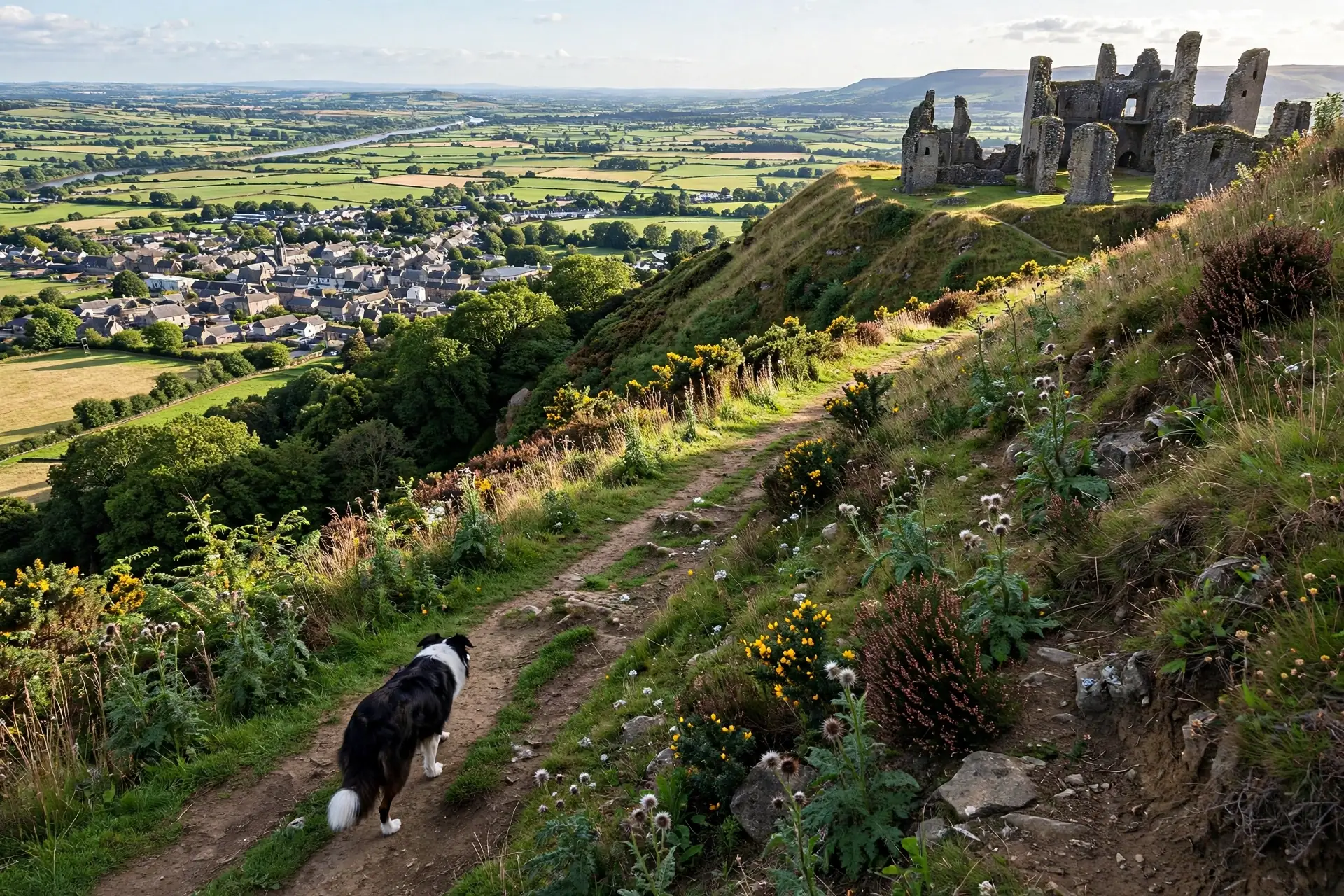
Denbigh is a town that explains itself from above. The castle ruins stand on a rocky hill at the edge of the Vale of Clwyd, and from that height the whole pattern of the place becomes clear: the steep streets running down towards the market area, the church and the older buildings gathered below the walls, and the flat green valley floor stretching away towards the Clwydian hills on one side and the lower ground towards the coast on the other. For a dog owner, that view is more than a photograph. It is the map for the day. You can see where the climb will be hard, where the level walking will be, where the fields begin, and where the traffic is likely to be busiest.
The sensible way to use that view is to treat the hill as the first part of the day and the town as the second. Dogs that arrive fresh can manage a steady climb, sniff the castle banks, look out over the valley, and then come down to the streets while they still have energy for the social part of the visit: pavements, shop fronts, other people, other dogs, and the stop for a drink. The reverse order is harder. A dog that has already spent an hour weaving through a busy town centre, stopping at every doorway and greeting every passer-by, will have less patience left for a steep climb in the afternoon, and an owner carrying a tired dog down a slope is not having a good day either.
That does not mean every dog must climb to the castle. Denbigh is a genuinely hilly town, and the climb from the lower streets to the castle area is steep in places, with uneven surfaces, steps and cambers that can be awkward for older dogs, very small dogs, dogs recovering from injury, and dogs that pull hard on the lead. The guide below is built so that the hill and the town can be separated. If the climb is too much, skip it without guilt: the lower town, the valley paths and the short level loops still make a worthwhile visit, and the castle can be admired from below. If the dog is fit and keen, the climb is the best part of the day, and the view over the Vale of Clwyd is the reward that makes the effort feel sensible rather than dutiful.
Before setting out, it helps to think about what kind of dog you have brought to a hill town. A confident young dog that loves open ground will want the hill paths and the longer views, and will probably be bored by a short pavement loop. A nervous dog that dislikes traffic and crowds will prefer the quieter hillside paths to the busiest streets, even if those paths are steeper. A reactive dog needs space and sightlines, and the open castle banks give more room to step aside than a narrow pavement does. A scent-driven dog will find the hedgerows, field edges and castle banks full of interest, and will need a longer time allowance than the distance on the map suggests. Plan for the dog in front of you, not the dog in the photograph, and let the hill decide the pace.
Practical preparation matters more here than in a flat coastal town. Water is the first item, because there is no guarantee of a tap or a stream at the top of the hill, and a dog that has climbed in warm weather will need a drink before the descent. A lead that gives control on a slope matters more than a fashionable one, and a harness that spreads pressure across the chest is kinder than a collar when a dog pulls uphill. Poo bags, a towel and a spare lead are worth carrying even on a short visit, because hill paths after rain are muddy, field edges are often churned, and a wet dog in a car is a problem that is easy to prevent and miserable to solve afterwards. Check the weather forecast for the hill rather than the valley, because wind and rain arrive earlier and feel stronger on exposed ground, and check the official guidance before you travel for any closures affecting the castle, the paths or the town centre.
Denbigh Castle and the old walls
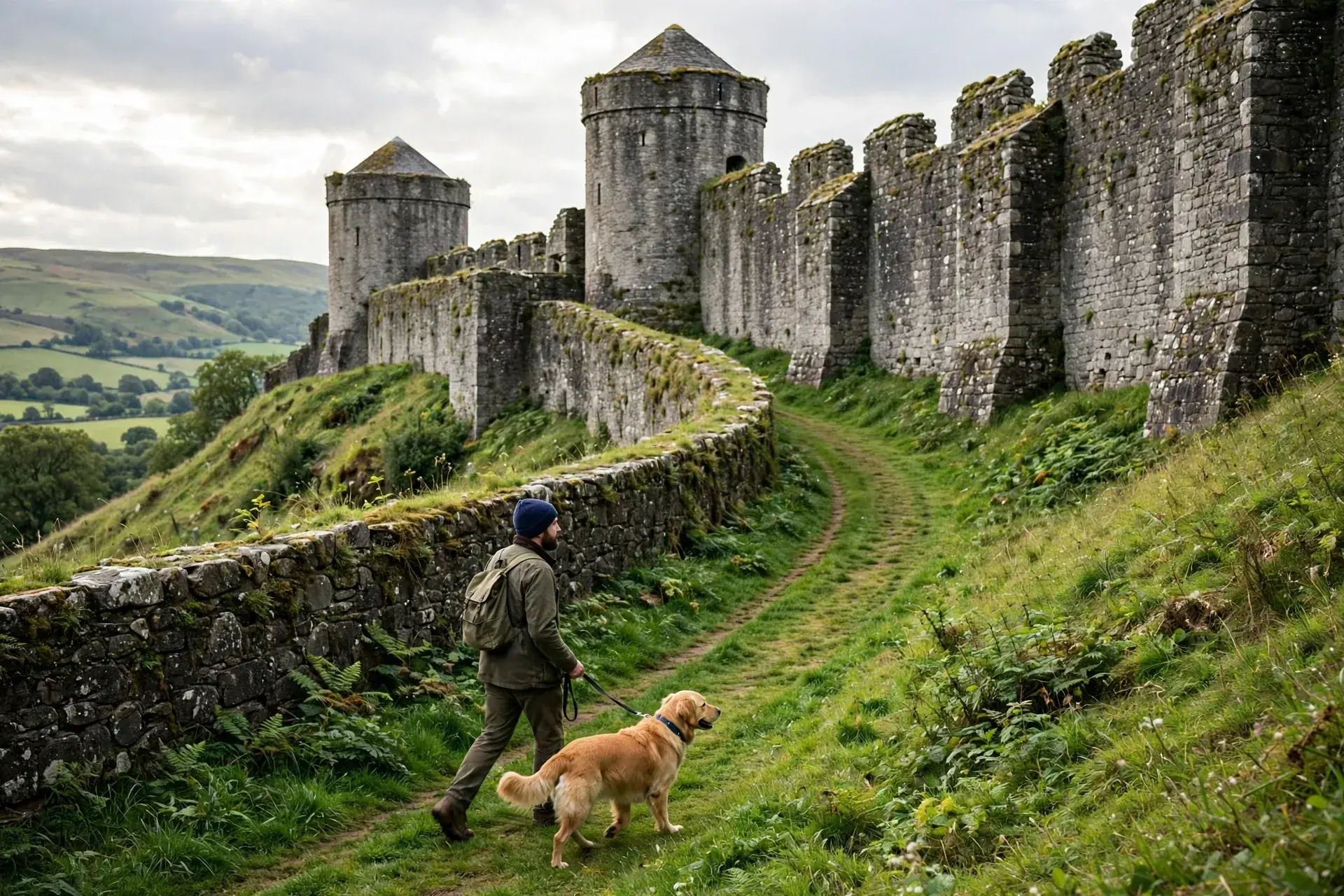
Denbigh Castle is the reason most visitors come to the town, and it is also the part of the visit that needs the most careful planning with a dog. The castle was built in the late thirteenth century, and its ruins still dominate the hill: great gatehouse towers, curtain walls and broken stonework that show how the fortress once guarded the Vale of Clwyd. The site is managed as a historic monument, and the ground around it is open, grassy and uneven, with drops, low walls and stonework that a dog should not be allowed to scramble over. The atmosphere is exactly what a dog walk should feel like on a good day — open sky, long views, wind in the grass — but it is not a fenced dog park, and it should not be treated as one.
Access rules for dogs at historic sites can change with the season, with conservation work and with events, so the only safe approach is to check the official guidance before you travel and to read the signs at the entrance on the day. Many castle ruins in Wales welcome dogs on leads in the grounds, while indoor rooms, towers, narrow staircases and exhibition spaces may be restricted. That distinction matters in Denbigh, because the most interesting parts of the castle for a person — the climb to a viewpoint, the walk along a wall, the look through a gatehouse arch — may be the least suitable parts for a dog. Plan the castle as an outdoor visit: walk the banks and the open ground, look at the stonework from the paths, take the photographs from the safe viewpoints, and do not try to take the dog into a space that is clearly signed as unsuitable.
Leads are essential around the castle for three reasons. The first is the drops. Castle hills are steep, walls are high, and a dog chasing a rabbit or a bird can be over an edge before an owner has time to react. The second is other visitors. Families, school groups and photographers share the same narrow paths, and a loose dog weaving between them creates exactly the kind of friction that leads to stricter rules for everyone. The third is the stonework itself. Loose stones, hidden holes and uneven steps are easy for a person to see and hard for a dog to judge, and a dog that scrambles onto a wall can damage both the monument and itself. A short lead on the castle hill, with a longer line only on the open grass well away from the edges, is the right balance.
Below the castle, the remains of the town walls and the great unfinished church known as Leicester's Church tell the second half of Denbigh's story. The church was begun in the sixteenth century and never completed, and its tall empty walls stand as a reminder that the town was once planned on a much grander scale than the one that survives. The area around it is quieter than the castle itself, and it suits a slower walk with a dog that needs time to settle after the climb. The ground is still uneven, and the same lead rules apply, but the pace here can be gentler, and the views back across the valley are often better than the views from the castle itself because the church walls frame the landscape rather than competing with it.
If you are building a wider castle trip, Denbigh sits naturally alongside other Welsh castle towns, and the practical lessons carry over: check access before you go, keep the dog on a lead near walls and drops, and treat each castle as a different set of rules rather than assuming one visit is like another. Our guide to dog-friendly castles in Wales explains how castle zones differ, where leads are required and how to build a castle day that the dog enjoys rather than endures. Denbigh is a good place to practise that approach, because the castle, the walls and the town are close enough together that a mistake in one part of the day can be corrected in the next, and a good decision at the castle sets up the rest of the visit.
Allow at least an hour for the castle area if the dog is comfortable on the hill, and longer if you want to walk the full circuit of the banks and the church. Take water, take pauses, and watch the dog rather than the clock. A dog that is panting hard, lagging behind or refusing to climb further is telling you that the visit should move downhill, and the town below will still be there. The castle will also still be there on a return visit, and a dog that leaves Denbigh happy is far more likely to enjoy the next castle town than a dog that was pushed too far on the first one.
A town-centre loop that suits dogs
Denbigh town centre is compact, and that is its main advantage for dog owners. The High Street and the streets around it can be walked as a short loop without a car, and the loop can be shortened or extended according to how the dog is coping. The streets are a mix of older buildings, independent shops, cafes and services, and the pavements are generally wide enough for a dog and an owner to walk together without constantly stepping into the road. Traffic is present, as in any working market town, and the streets are not pedestrianised throughout, so the dog should stay on a short lead in the centre and close to the owner's side at crossings.
The best way to walk the town is to treat it as a slow circuit rather than a straight line. Start at the lower end of the High Street, walk up one side and down the other, and let the dog sniff the shop fronts and the doorways that interest them. That sounds trivial, but it matters: dogs gather most of their information about a new place through scent, and a town centre walked too quickly feels like a corridor rather than a place. A slow loop with pauses gives the dog time to settle, and it gives the owner time to notice which cafes have outdoor seating, which shops have a water bowl outside, and which streets are quieter if a second loop is needed later.
Market days change the character of the town. A market brings stalls, more people, more smells and more noise, and for many dogs that is exciting rather than stressful. For a nervous or reactive dog, it is the opposite: crowds, trolleys, children and food stalls in a narrow space can be overwhelming, and the dog may do better on a quieter street or on the hill paths instead. Check the market day before you travel if the dog is sensitive to crowds, and have a fallback route ready. The fallback does not need to be complicated — a side street, a churchyard path where dogs are allowed on leads, or a short walk out towards the valley edge will give the dog space while the market does its business.
Pavement manners matter more in a small town than on a country path. Keep the dog on the inside, away from the road, at crossings and on narrow stretches. Step aside for pushchairs, wheelchairs and older pedestrians rather than expecting them to step around a dog on a long lead. If the dog greets other dogs, ask first and keep the greeting short; many dogs in a town centre are on their way somewhere and do not want a long interaction in the middle of a pavement. If the dog is reactive, cross the road early, use a shop front as a visual barrier, and do not try to train through a difficult moment in the busiest part of the street. The town is small enough that a quieter parallel street is usually only a few steps away.
Toileting is a practical point that is easy to overlook in a hill town. Dogs that are used to a garden may be reluctant to toilet on a pavement, and the steep streets give few grassy verges. The castle banks and the greener edges of the town are better for this, which is another reason to do the hill first. Carry more poo bags than you think you need, use the bins provided, and do not leave bags on walls or fences. A town that welcomes dogs is a town where owners clean up properly, and Denbigh's compact centre means that a single lapse is noticed quickly.
Finally, remember that the town centre is where the day slows down. The castle is the effort, the hill walks are the exercise, and the town is the reward: a slower pace, a place to sit, a drink, and a chance for the dog to lie down and watch the world go by. Do not rush this part. A dog that has climbed a hill and walked a town needs rest, and a town centre that is walked at the dog's pace feels very different from one that is rushed through on the way to the next attraction.
Vale views and hill walks
The Vale of Clwyd is a wide, green valley between the Clwydian Range to the east and lower hills to the west, and Denbigh sits at its edge where the valley floor meets the rising ground. The walks around the town take advantage of that position: short climbs give long views, and longer routes lead into the hills proper. The most useful distinction for a dog owner is between the short hill loops around the castle, which can be done in under an hour, and the longer hill routes that need half a day, proper footwear and a plan for water and weather.
The short loops are the best starting point. From the castle area, paths drop and rise across the hillside, giving views over the valley floor, the patchwork of fields, hedgerows and small woods, and the distant hills. These paths are uneven, sometimes steep and often muddy after rain, and they are shared with other walkers, so a lead is the default. The reward is the sense of space: after the enclosed streets of the town, the open hillside lets a dog move more freely, sniff more widely and settle into a proper walking rhythm. Even a short loop of thirty to forty minutes can feel like a real walk here, because the climb and the views do the work that distance does on flat ground.
Longer routes lead east into the Clwydian Range, a chain of hills that includes Moel Famau, the highest point in the range, and a network of paths that link hillforts, viewpoints and valleys. These are proper hill walks, not town strolls, and they need to be treated as such. Check the route, the weather and the official guidance before you travel, carry water for the dog as well as for yourself, and allow more time than the distance suggests. The hills are exposed, the wind can be strong, and the paths can be rough underfoot. Dogs that are fit, used to hills and comfortable on a lead will enjoy these routes enormously; dogs that are unfit, elderly or unused to rough ground will not, and a shorter valley walk is the kinder choice.
The Offa's Dyke Path, the long-distance trail that follows the English-Welsh border, passes through the Clwydian hills to the east of Denbigh, and sections of it can be walked as a day route from a car or a bus stop. That is a serious undertaking with a dog, and it should not be attempted as an afterthought after a morning in the town. If you want to walk a section, plan it as the main event of the day, start early, and choose a short, well-marked stretch with a clear return route. Check the official guidance before you travel for path conditions, diversions and livestock, and remember that long-distance paths cross farmland, so the lead stays on unless a sign clearly says otherwise.
Navigation deserves a word of its own. Hill paths around Denbigh are not always signposted as clearly as a town street, and field paths can be hard to follow when the grass is long or the ground is wet. Carry a map or a charged phone with an offline map, and do not rely on memory alone. Tell someone your route if you are walking alone, especially on a longer hill route, and turn back early if the weather changes or the dog is tiring. The hills will still be there on a better day, and a walk that ends with a happy dog in the car is a better walk than one that ends with a limping dog and a long drive home.
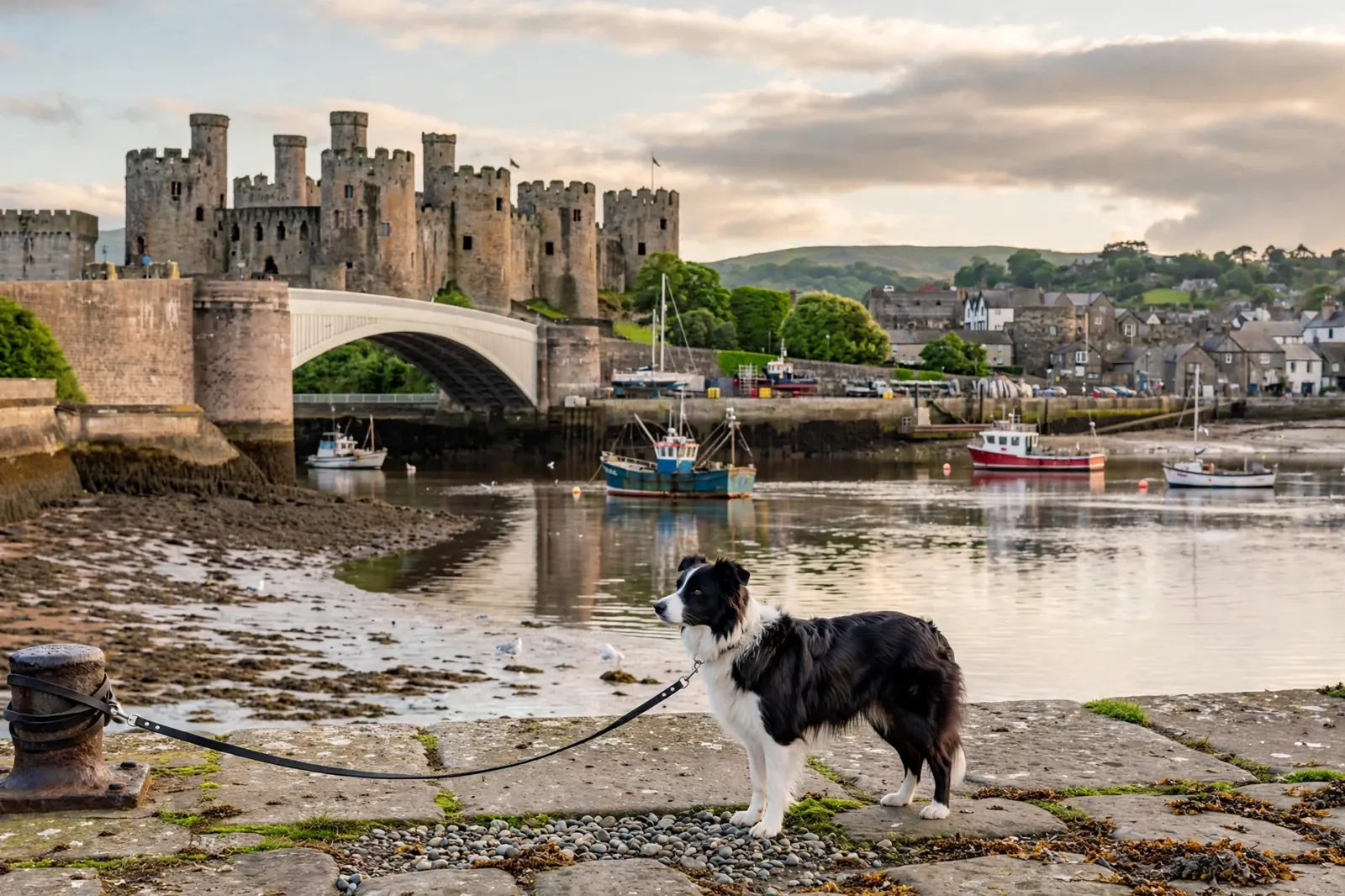
For visitors who want to place Denbigh in a wider North Wales trip, the town works well as a quieter base or a stop between busier places. Conwy, on the coast to the north-west, offers a very different kind of castle town — walls, harbour and beach in a single compact visit — and our Conwy dog guide covers castle rules, the town walls walk and the harbour in detail. The contrast is useful: Conwy is flat, busy and coastal, while Denbigh is hilly, quieter and inland, and a dog that enjoys one may need a different pace for the other. If you are planning a longer loop, our North Wales road trip guide sets out drive times, dog stops and base towns for a route that takes in the coast, the foothills and the Llyn Peninsula, and Denbigh fits into that route as a calm inland stop between coastal days.
Rivers, fields and livestock
The River Clwyd runs through the valley below Denbigh, and the lower ground around the town is a mix of riverside meadows, farmland and small woods. These are attractive walking areas, and they are also working landscapes, so the rules are different from those on a public park. Fields are often grazed by sheep or cattle, gates must be left as found, and paths that cross farmland are rights of way, not open access. The dog's freedom on these paths is limited by law and by common sense, and the lead is the tool that makes the walk possible at all.
Sheep are the main consideration. The Vale of Clwyd and the surrounding hills are sheep country, and a dog that chases sheep can cause serious harm even if it never catches one: ewes can miscarry, lambs can be separated from their mothers, and a farmer is entitled to protect livestock. The law in England and Wales allows a farmer to shoot a dog that is worrying livestock in certain circumstances, and no owner wants to be in that position. The rule is simple and absolute: if there are sheep or cattle in a field, or in the next field, the dog stays on a lead. If you are unsure whether livestock are present, keep the lead on anyway. A long line gives the dog room to sniff and explore without giving it the freedom to chase, and it is the single most useful piece of equipment for a valley walk in this part of Wales.
Cattle deserve the same respect, for a different reason. A herd with calves can be protective, and a dog running loose among cattle can trigger a charge that puts both the dog and the owner at risk. Walk calmly through a field with cattle, keep the dog close and on a short lead, and do not try to walk between a cow and its calf. If the cattle block the path, turn back rather than pushing through. The path will still be there on another day, and a field that feels unsafe is unsafe.
Rivers and streams need care too. The Clwyd and its tributaries can be fast after rain, the banks can be steep and slippery, and the water can be cold even in summer. Some dogs love to paddle and swim, and a shallow, slow stretch can be a good place for a hot dog to cool down, but a dog should never be allowed to swim in a fast or flooded river, and should never be encouraged to jump from a high bank. Check the water before the dog goes in, keep the lead on near fast water, and dry the dog afterwards, because a wet dog that then walks a cold hill can chill quickly. If the river is in flood, stay well away from the banks and choose a higher path instead.
Field paths also bring the practical problems of mud, stiles and gates. Stiles are often difficult for dogs, especially large or older ones, and some dogs need to be lifted over or guided through a nearby gate. Do not force a dog over a stile it is afraid of, and do not let a dog jump from a high stile onto hard ground. Gates should be closed behind you, even if they were open when you arrived, unless a sign says otherwise. Mud is a fact of life in the Vale of Clwyd, particularly in autumn and winter, and the paths can be deep and slippery. Waterproof footwear, a towel and a drying coat are not optional extras here; they are the difference between a walk that ends well and one that ends with a muddy car and a miserable dog.
Finally, remember that the countryside around Denbigh is not a theme park. It is a place where people live and work, and the paths exist because farmers and landowners allow them to. A dog owner who keeps the dog on a lead near livestock, closes gates, picks up waste and stays on the marked path is welcome. A dog owner who does not is the reason signs go up and paths get closed. The Vale of Clwyd is generous to walkers who respect it, and Denbigh is a good place to practise that respect on a small scale before attempting longer rural walks elsewhere.
Where dogs can rest and drink
A dog that has climbed a hill needs somewhere to rest, and Denbigh's town centre is the natural place for that rest. The town has cafes, pubs and takeaway places in and around the centre, and some of them welcome dogs, often in a particular area such as a terrace, a ground-floor room or a specific corner. Policies change frequently, and a place that welcomed dogs last year may have changed its rules, so check the official guidance before you travel or ask on arrival rather than assuming. The question to ask is not simply whether dogs are allowed, but where they are allowed, and whether that area suits your dog: a busy doorway is a poor resting place for a nervous dog, while a quiet corner with space for a mat is ideal.
Outdoor seating is often the easiest option in good weather. A terrace or a pavement table gives the dog fresh air, space and a view, and it avoids the problem of a dog in a crowded indoor room. In wet or cold weather, outdoor seating is less appealing, and the dog may be happier resting in the car for a short period — with ventilation, shade and a check every few minutes — than sitting in a draughty doorway. Never leave a dog in a car in warm weather, even for a few minutes, because a car heats up far faster than most people expect, and a dog can overheat quickly. If the weather is warm, choose shade, water and a short stop rather than a long lunch.
Water is the item that owners most often forget in a town centre. Dogs need water after a climb, and not every cafe will have a bowl ready. Carry a collapsible bowl and a bottle of water, and offer the dog a drink before you sit down to eat, not after. A dog that is thirsty will be restless, and a restless dog in a cafe is a dog that will be asked to leave. A mat or a blanket also helps: it gives the dog a defined place to lie down, it protects the floor, and it signals to the dog that this is a resting place rather than a place to explore. Train the dog to settle on the mat at home before you rely on it in a cafe, because a new behaviour in a new place is a lot to ask.
Food for the dog should be planned as carefully as food for the owner. A dog that has walked for several hours will be hungry, and a small meal or a chew can help it settle while the owner eats. Do not feed the dog from the table, and do not let it beg from other tables, because that creates the kind of behaviour that leads cafes to change their policies. A stuffed food toy or a long-lasting chew, given on the mat, keeps a dog occupied without involving other people, and it is far more effective than repeatedly telling a hungry dog to lie down.
Public toilets, baby-changing facilities and indoor attractions are generally not dog-friendly, and that needs to be planned for. If the group includes children or people who need facilities, plan the stops so that one person stays with the dog outside while the others go in, and do not try to take the dog into a space where it is not welcome. The same applies to shops: some independent shops welcome dogs, others do not, and the sign on the door is the rule. A dog that waits calmly outside a shop for a few minutes, with a person it trusts, is a dog that has been trained for town life; a dog that panics when left outside a shop needs more practice before a town-centre day.
Rest is not wasted time. A dog that lies down for twenty minutes in a town centre, watches the world go by and then walks on refreshed will enjoy the second half of the day far more than a dog that is dragged from one attraction to the next without a break. Build rest into the plan deliberately: a cafe stop after the castle, a quiet bench after the town loop, and a final drink before the drive home. The day will feel longer and richer for it, and the dog will remember Denbigh as a place where good things happened, not as a place where it was tired and rushed.
Arriving, parking and buses
Denbigh is most easily reached by car, and the approach matters because the town is hilly and the streets around the castle are narrow. Arrive with a plan for where to park, and do not assume that the car park closest to the castle will have space, especially on a market day or a sunny weekend. Public car parks in the town centre offer the most straightforward option, and parking in the lower town and walking up to the castle is often easier than trying to drive to the top and park on a steep, narrow street. Check the official guidance before you travel for car park locations, charges and time limits, because these can change, and do not rely on memory or on an old guide.
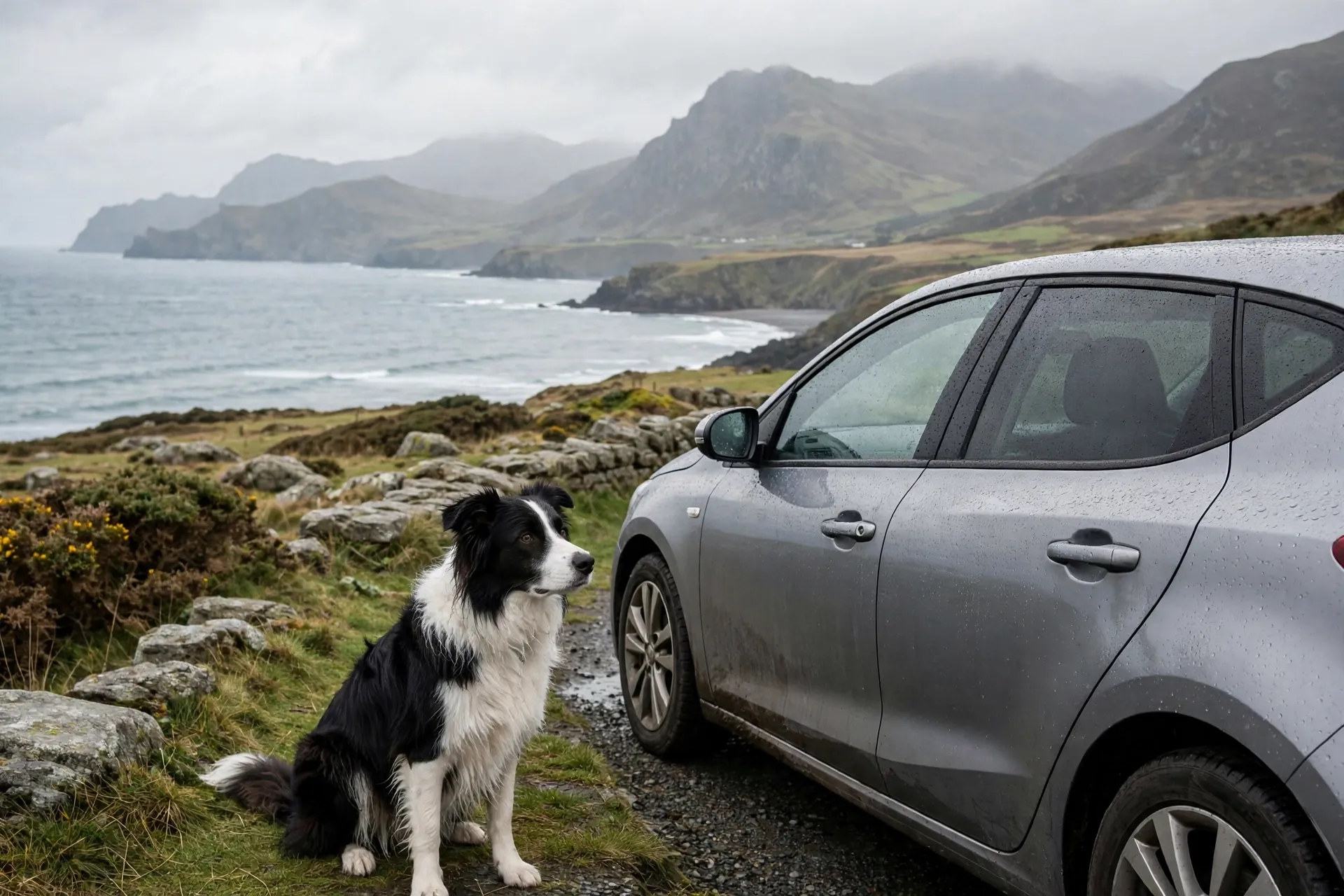
When you park, think about the dog's exit from the car. A dog that jumps out into traffic, onto a steep slope or into a busy car park is at risk, so open the door carefully, clip the lead on before the dog gets out, and choose a parking space that gives room to get the dog out safely. In warm weather, park in shade if you can, and never leave the dog in the car while you go to look at the castle or to buy a ticket. In cold weather, remember that a car cools quickly, and a wet dog left in a cold car will chill. The car is a base, not a kennel, and the dog should be with you for the visit.
Public transport to Denbigh is by bus, as the town has no railway station. Bus services link Denbigh with nearby towns including Ruthin, St Asaph and Rhyl, and the journey can be a pleasant way to arrive without worrying about parking. Dogs are generally allowed on buses at the driver's discretion, usually on a lead and on the floor rather than on a seat, but this is not guaranteed, and a large dog on a busy bus may be refused. Check the official guidance before you travel for the current rules of the bus operator, carry a lead and a mat, and have a backup plan — a taxi that accepts dogs, or a lift — if the bus does not work out. If you are travelling by bus, keep the walk shorter and the bag lighter, because you will be carrying everything the dog needs for the day.
Taxis and private hire cars can fill the gap between the bus stop and the castle, or between Denbigh and a nearby village, but not every driver accepts dogs. Ask when you book, say how large the dog is, and bring a blanket to protect the seat. A dog that is wet or muddy after a hill walk should not be put straight onto a clean car seat, and a driver who has had a bad experience with a previous dog may refuse the next one. A little courtesy — a towel, a blanket and a calm dog — goes a long way.
For drivers, the roads around Denbigh deserve respect. The A543 and the A525 run through the Vale of Clwyd and link the town with the coast and with the Clwydian hills, and the smaller lanes around the town are narrow, with blind bends, tractors and walkers. Drive slowly on the lanes, expect walkers and dogs around every bend, and do not park on a verge or in a passing place. If you are walking from a lay-by or a small car park into the hills, make sure the car is parked legally and safely, and do not block a farm gate or a field entrance. A car that blocks a gate will be remembered, and it will not be remembered fondly.
Finally, plan the departure as carefully as the arrival. A tired, muddy dog needs a towel, a drink and a comfortable place in the car, and the drive home should not begin with a rush. Allow time to dry the dog, to check its paws for mud, stones and cuts, and to give it a final toilet walk before the journey. A dog that travels home comfortable and dry will be ready for the next trip; a dog that travels home wet, cold and stressed will associate the car with the end of a bad day.
Seasons, weather and mud
Denbigh changes with the seasons, and the best time to visit with a dog depends on what the dog enjoys. Spring brings lambs in the fields, new growth on the hedgerows and longer days, but it also brings mud, and the hill paths can be slippery well into April. Summer brings the best views, the driest paths and the longest days, but it also brings heat, and a hill climb in warm weather is hard work for a dog. Autumn brings colour, quieter paths and cooler walking weather, but it also brings rain, fallen leaves that hide uneven ground, and early darkness. Winter brings crisp, clear views across the Vale of Clwyd, but it also brings ice on the steep streets, short days and the risk of a hill path that is unsafe after frost.
Summer heat needs particular care. Dogs overheat far more easily than people, and a hill climb in direct sun can be dangerous for a brachycephalic dog, an older dog, a very young dog or a dog with a thick coat. Walk early in the morning or late in the afternoon, choose shaded paths where possible, carry extra water, and watch for the signs of overheating: heavy panting, drooling, lethargy and a refusal to walk further. If the dog shows these signs, stop, move to shade, offer water and cool the dog gradually with damp towels. Do not pour ice-cold water over an overheated dog, and seek veterinary help if the dog does not recover quickly. A summer day in Denbigh is best enjoyed slowly, with long rests in the shade and a short hill walk rather than a long one.
Autumn and winter bring the opposite problem: cold, wet and mud. The hill paths around Denbigh are clay-based in places, and after rain they become slippery and churned. A dog that slips on a steep, muddy path can injure a leg, and an owner who slips can injure themselves and lose control of the lead. Wear footwear with a good grip, use walking poles if they help, and shorten the route if the ground is bad. A drying coat, a towel and a spare lead are essential in wet weather, and the car should have a waterproof cover or an old blanket for the journey home. Check the forecast for the hill, not just the town, and be prepared to change the plan if the weather turns.
Fireworks, lambing and the shooting season are seasonal events that affect dogs in rural Wales. Around early November, fireworks can unsettle noise-sensitive dogs, and a hill walk at dusk during fireworks season is a poor choice. In spring, lambing means that fields that were empty in winter are suddenly full of ewes and lambs, and the lead rules become even more important. In autumn, the shooting season brings gunfire in the countryside, and a dog that is sensitive to loud noises may be distressed by distant shots. Check the official guidance before you travel for local events, and choose a town-centre day over a hill day if the dog is likely to be affected.
Whatever the season, the rule is the same: check the forecast, check the official guidance before you travel, dress for the hill rather than the town, and be ready to shorten the walk. Denbigh is a town that rewards flexibility. A plan that can be shortened without disappointment — a hill loop that can become a town loop, a long walk that can become a short one — is a plan that works in every season, and a dog that is walked within its limits in bad weather will enjoy the good weather all the more when it comes.
Staying over and using Denbigh as a base
Denbigh works well as a base for a short break in North Wales, particularly for visitors who prefer a quieter town to a busy coastal resort. The town has a range of accommodation, including hotels, bed and breakfasts, self-catering cottages and farm stays in the surrounding valley, and some of these welcome dogs. The details matter more than the headline: a place that accepts dogs may still restrict them to certain rooms, charge a fee, limit the number of dogs, or require that the dog is not left alone in the room. Ask for the written rules before you book, and get the pet fee, the room type and any restrictions confirmed in writing.
Self-catering accommodation often suits dog owners best, because it gives the dog a familiar routine: its own bed, its own feeding times, and a garden or a yard where it can toilet without a lead. Cottages in and around Denbigh vary widely, from converted farm buildings in the valley to smaller houses in the town itself, and the garden is the feature that matters most. A securely fenced garden is worth more than an extra bedroom, and a garden that is not fenced is a garden that needs a lead. Ask for the height and the condition of the fence, whether the gate closes properly, and whether there are gaps that a small dog could slip through. Photographs can be misleading, and a fence that looks secure in a photograph may have a gap at the bottom that a terrier will find in minutes.
Hotels and bed and breakfasts can work well for a single night, particularly if the dog is used to settling in a new room and the owner is happy to eat with the dog on a terrace or in a dog-friendly area. The questions to ask are the same: which rooms accept dogs, is there a fee, can the dog be left alone in the room, and where is the nearest toilet walk after dark? A hotel on a steep street with no nearby green space is a poor choice for a dog that needs a late-night toilet walk, while a place on the edge of town with a level path to a field is ideal. The location of the accommodation matters as much as the room itself.
Using Denbigh as a base for wider exploring has clear advantages. The town is within reach of the Clwydian hills, the coast at Rhyl and Prestatyn, the historic towns of Ruthin and St Asaph, and the larger attractions of North Wales, including Conwy and the Eryri mountains. That means a stay in Denbigh can combine quiet hill days with busier coastal days, and the dog can have a rest day in the valley between more demanding trips. The drive to the coast is short enough for a day trip, and the drive into the mountains is manageable if the dog travels well. Plan the week so that the hardest day is followed by an easier one, and do not try to do a hill walk, a coastal walk and a castle visit on three consecutive days without a rest day in between.
If you are staying for several days, the practical details become more important. Find the nearest vet before you need one, and save the number in your phone. Find a shop that sells the dog's usual food, or bring enough food for the whole stay, because a change of food in a new place can upset a dog's stomach. Find a launderette or a place to wash muddy towels, and bring spare bedding. And find a short, level, reliable walk near the accommodation that can be used for the first and last toilet walks of the day, when the dog is tired and the owner does not want a hill climb in the dark. That short walk, used twice a day, will do more for the success of the stay than any single attraction.
Two ready-made day plans
The half-day plan is for a first visit, a dog that is new to hill towns, or a day when the weather is uncertain. Arrive in the lower town and park in a town-centre car park. Walk the town centre slowly, letting the dog sniff and settle, and stop for a drink. Then climb to the castle at a steady pace, with pauses, and spend time on the banks and around Leicester's Church. Come down the same way, rest in a cafe or on a bench, and take a short level walk on the valley edge before driving home. The whole visit takes three to four hours, the dog gets a hill, a town and a rest, and the owner gets a proper sense of Denbigh without overdoing it. This plan works in most seasons, and it can be shortened further by skipping the castle climb and staying in the lower town.
The full-day plan is for a fit dog, a good forecast and an owner who wants a proper hill walk. Start early, park in the lower town, and climb to the castle before the day warms up. Walk the castle banks and the church, then take a hill path out towards the Clwydian edge for an hour or two, keeping the dog on a lead near livestock and on the marked paths. Return to the town for a long rest and a meal, then take a shorter valley walk in the afternoon, along a riverside or field path, before driving home. The day takes six to seven hours including rests, and it needs water, food for the dog, a towel and a change of footwear. Do not attempt the full-day plan if the dog is unfit, elderly or unused to hills, and do not attempt it in hot weather, when the hill walk should be shortened or replaced by a valley walk in the shade.
Both plans share the same principles: start with the hill, rest in the town, keep the dog on a lead near livestock and drops, carry water, and be ready to shorten the walk. The difference is one of scale, not of kind. A half day in Denbigh, done well, is a better day than a full day done badly, and a dog that leaves happy will want to come back. The town rewards visitors who take it slowly, and the Vale of Clwyd rewards walkers who look up from the path and take in the view. That is the whole point of Denbigh with a dog: a castle, a town and a valley, walked at the dog's pace.
Before you leave, do a final check of the dog: paws for mud and stones, coat for burrs and ticks, lead and collar secure, water offered, and the car ready for a comfortable journey. Check that nothing has been left behind — a mat in a cafe, a bowl on a bench, a lead on a wall — and that the dog has had a final toilet walk. Denbigh is a small town, and it is easy to leave something behind in a place that felt like a rest stop rather than a destination. A last look back at the castle from the valley road is a good way to end the day: the hill, the ruins and the green valley together, and a dog asleep in the back of the car.
Practical questions
Before you go
Can dogs go into Denbigh Castle?
Access rules can change, so check the official guidance before you travel. Many castle ruins in Wales welcome dogs on leads in the grounds, while indoor rooms, towers and narrow staircases may be restricted. Plan the castle as an outdoor visit, keep the dog on a lead near drops and walls, and have a town or hill walk ready as the backup if access is limited on the day.
Is Denbigh a good walk for an older dog?
The town centre is manageable, but the castle hill is steep in places, so older dogs do better with a slow climb, frequent pauses and a shorter loop. Start low, walk the level streets first, and only climb as far as the dog is comfortable. A shorter out-and-back on the lower paths still gives good views without the hardest slopes, and a car can be used between the lower town and the castle area.
Where can I walk my dog off lead near Denbigh?
Do not assume any field or hillside is an off-lead area. Much of the land around Denbigh is farmland with sheep and cattle, and many paths cross working fields. Keep the dog on a lead unless a sign clearly says off-lead exercise is allowed and no livestock is present. A long line gives a dog more freedom on open ground while keeping control near animals, roads and other walkers.
Are there dog-friendly cafes in Denbigh?
Denbigh has cafes and pubs in and around the town centre, and some welcome dogs, often in a particular area such as a terrace or a ground-floor room. Policies change, so check the official guidance before you travel or ask on arrival. Carry water and a mat so the dog can settle quietly, and choose a spot away from the main doorway if the dog watches every person who comes in.
How long should I allow for a day in Denbigh with a dog?
Allow at least three to four hours for the castle area, the town centre and one hill or valley walk, and a full day if you want a longer route into the Clwydian hills. A half day works well for a first visit: arrive, walk the town, climb to the castle, rest, and then take a short valley walk before driving on. Build in extra time in wet weather, when paths are slower and dogs need drying.
What should I pack for a Denbigh hill walk with a dog?
Pack water and a bowl, a lead and a long line, poo bags, a towel and a drying coat, and a basic first-aid kit. Hill paths can be muddy, exposed and uneven, so wear sturdy footwear and carry a waterproof layer for yourself and the dog if rain is forecast. Check the weather and the official guidance before you travel, and tell someone your route if you are walking alone in the hills.