This guide is independent and contains no paid placement. If affiliate links are added later, they will be clearly marked and will not change our editorial checks.
Dingwall is a small, practical Highland base: a flat canal walk to the Cromarty Firth, a 5.5 km castle loop above the town, a railway station with direct trains to Inverness, and easy drives to Nairn, Cromarty and the Black Isle. Bring a lead for livestock, check the firing-range flags on the canal path, and treat the firth shore as tidal mud rather than a swimming beach.
Why Dingwall works with a dog
Dingwall is the sort of town that rewards dog owners who prefer a real place to a resort. It was the county town of Ross and Cromarty, and it still feels like one: a compact High Street, a railway station, a museum, a market-town rhythm and the Cromarty Firth at the end of the road. Most visitors to the Highlands drive straight through on the A9 towards Inverness or the North Coast 500, which is exactly why Dingwall is worth stopping in. The town is quiet, the walks start from the pavement, and the dog is part of the day rather than a problem to be worked around.
The name itself is a clue to the town’s age. Dingwall comes from the Old Norse for a parliament field, a reminder that Vikings held assemblies here, and it became a royal burgh in 1226 under Alexander II — the town marked 800 years as a burgh in 2026. That long history is visible in small ways rather than grand ones: the remains of Dingwall Castle, the museum on the High Street, the 16th-century Tulloch Castle on the hill above the town. For a dog owner, the practical point is that the town is walkable end to end. You can park once, walk the dog, look at the town, buy supplies and be back at the car without ever needing a second journey.
Location is Dingwall’s real strength. It sits about 11 miles (18 km) north of Inverness, at the head of the Cromarty Firth, where the Far North Line meets the Kyle of Lochalsh Line. That puts it within easy reach of the Moray Firth coast, the Black Isle, the spa village of Strathpeffer and the Cairngorms, while the town itself stays calm and affordable. Dogs that find Inverness busy and Aviemore crowded in peak season often settle better here, where the streets are quieter, the walks are shorter and the pace is slower. If your dog is nervous in traffic, reactive to crowds or happiest on a long, flat sniffing walk, Dingwall suits them better than a busier Highland honeypot.
None of this makes Dingwall a place for every dog. There is no big sandy beach in the town, no dedicated dog park, and the firth shore is tidal mudflat rather than a place to swim. The best walks are the canal path, the castle loop and the farmland tracks around the town, and the best days out need a car or a train. But as a base — a place to sleep, walk the dog properly twice a day and plan the next day’s outing over a quiet evening — it is hard to fault. The rest of this guide works through the walks, the rules and the day trips in the order you will actually need them.
Arriving: the first hour
Arrive by train if you can, because Dingwall station is one of the town’s best features. It opened in 1862 on the line from Inverness, it sits just south of the junction of the Far North Line and the Kyle of Lochalsh Line, and every train on the Far North Line stops here. The journey from Inverness takes around 30 to 35 minutes, and ScotRail allows dogs to travel on its trains, so a car-free break is genuinely possible — check the official guidance before you travel for the latest rules on dogs on trains. From the station it is a short, flat walk into the town centre, which matters when you are carrying bags and holding a lead at the same time.
Arriving by car is straightforward too. Dingwall sits just off the A9, the main road north from Inverness, and the town has car parks around the centre and at Pefferside Park, where the canal walk starts. On a first visit, park near the centre and walk the dog before doing anything else. A tired, settled dog makes the rest of the day easier, and the High Street is short enough that a twenty-minute leg-stretch covers most of it. Keep the dog on a lead through the town centre: the pavements are narrow in places, delivery vans use the High Street, and the railway station and the A9 both sit close to the centre.
Use the first hour to learn the town’s layout. The High Street runs through the middle, the River Peffery runs along the eastern edge past Pefferside Park, and the canal path heads east from the park to the firth. Tulloch Castle stands on the hill to the south-west, and the ground rises in that direction on every walk out of town. Knowing which way is up matters more than it sounds: the flat walks are east towards the firth, and the climbing walks are south and west towards Tulloch Hill and Strathpeffer. If your dog is older or stiff, plan the flat routes first and save the hill for a day when they are fresh.
Before you unpack, find the practical things. Note where the nearest vet is and save the number in your phone, because rural practices can be some distance away and may not offer out-of-hours cover on site — check the official guidance before you travel for current opening hours and emergency arrangements. Buy dog food, poo bags and any forgotten kit in town rather than assuming a village shop further north will stock them. And check the weather forecast for the firth, not just for Dingwall: wind off the water can make a still morning feel cold, and a calm-looking day can turn wet quickly in the Highlands.
The canal walk to the Ferry Point
The walk every dog owner in Dingwall should do first is the canal walk. The Dingwall Canal was a short tidal canal, just 1.1 miles (1.8 km) long, completed in 1819 to a design by Thomas Telford. The River Peffery was deepened and widened so that boats could reach the town, but the canal was never a commercial success — it earned only about £100 a year — and it fell out of use in the 1880s after the railway arrived. The waterway has since reverted to the river, but the path beside it survives as one of the town’s best walks, running from Pefferside Park east to a picnic site on the Cromarty Firth known as the Ferry Point.
Start at Pefferside Park, where there is a car park and views of the River Peffery along the eastern side of the park. From here, trails head east through the park to join the canal, and the route follows the water all the way to the firth. It is flat, easy underfoot for most of the way and short enough for a morning or evening leg-stretch — the Ramblers’ evening version of the route, returning via Ferry Road, is about 4.5 km (2.8 miles) in total. The reward is at the end: the Ferry Point picnic area, with seats, tables and wide views across the Cromarty Firth towards the Black Isle. It is a good spot for birdwatching, and the picnic area even has a sculpture modelled on the Fyrish Monument, the hilltop landmark above Evanton.
There is one warning that matters more than any other on this walk. A firing range sits near the canal, and it fires over the route, so red warning flags and signs indicate when it is unsafe to use the path. Check the flags and signs before you set off, and if they are flying, do not use the canal route — pick another walk instead. This is not a detail to improvise around: the flags are there because the range is active, and a dog off lead cannot read a sign. If you are unsure, ask locally or check the official guidance before you travel.
On the walk itself, keep the dog under close control. The path is shared with walkers, cyclists and families, and it runs beside water for much of its length, so a dog that loves to swim needs a lead until you know the banks. The river is tidal near the firth, and the mud at the Ferry Point is soft and deep in places — the same warning applies to every firth shore in this guide. Let the dog sniff, watch the wading birds and enjoy the flat ground, but keep the lead handy for the road sections at either end, for cyclists coming up behind you and for any livestock in the fields beside the path. In spring and summer, ground-nesting birds use the rough ground near the firth, so keep the dog close and on a lead where signs ask for it.
The Tulloch Castle loop
The classic Dingwall walk is the circular route to Tulloch Castle, and it is the one to choose when your dog needs a proper outing rather than a leg-stretch. The walk is 5.5 km (3.5 miles), takes about 1.5 to 2 hours and climbs around 90 metres, starting from Dingwall Museum on the High Street. It follows waymarked footpaths, tracks and roads with pavements, climbing through woodland to the castle before dropping back into town. It is a genuine half-day walk, not a stroll, so take water for the dog, allow time for sniffing stops and do not rush the climb.
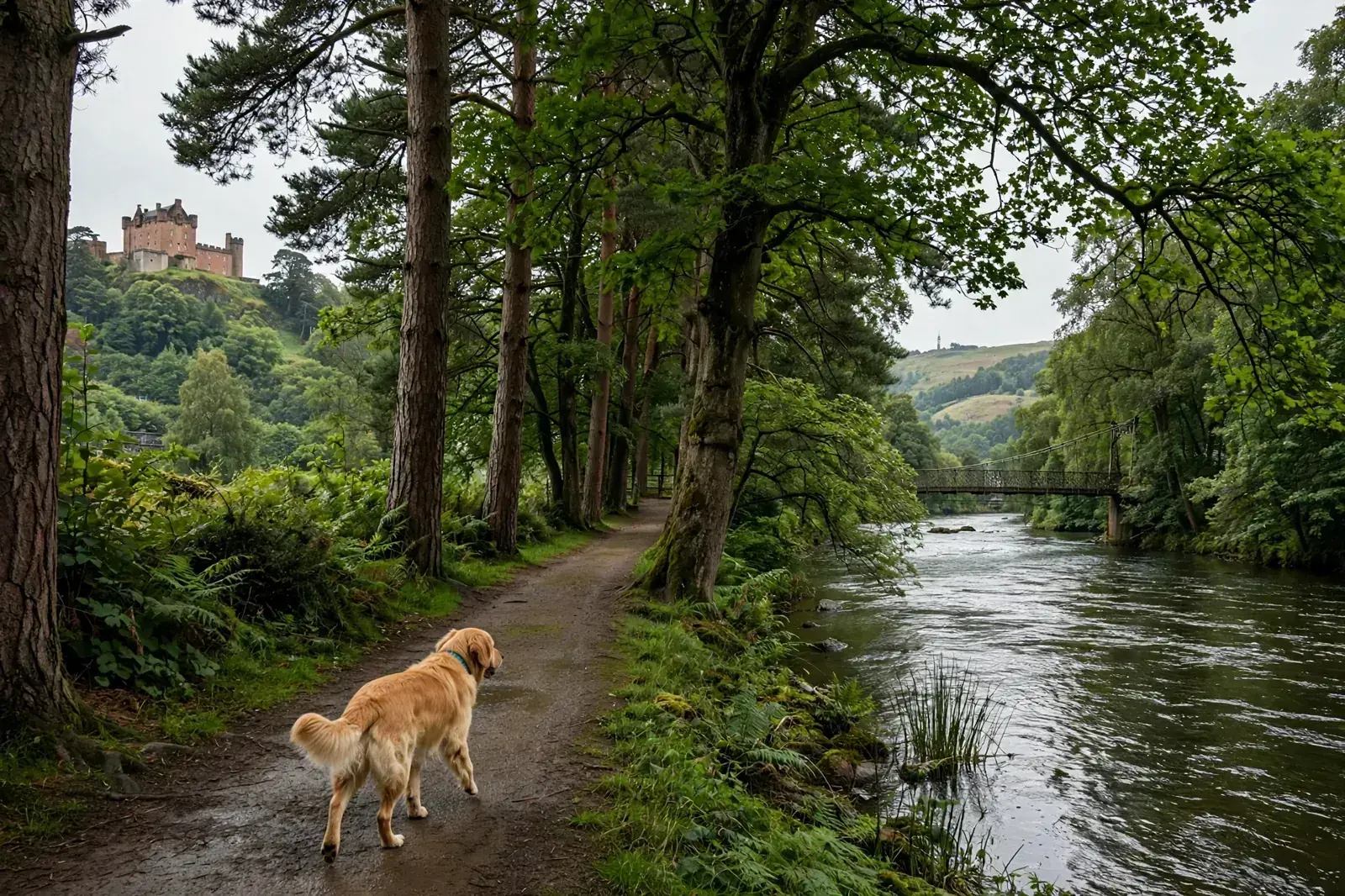
Tulloch Castle itself is worth the effort. It is a 16th-century tower house, built in the 1540s and added to over the centuries, that became the traditional home of Clan Davidson after it was bought by Henry Davidson, a London sugar merchant, in the 1760s. Today it is a hotel, so you cannot simply wander inside, but the walk passes the grounds and gives you the building from the outside, with views over Dingwall and the Cromarty Firth opening up as you climb. The beech-lined paths and the old wall of the walled garden give the walk a different feel from the open firth paths — shaded, sheltered and full of smells for a dog that likes woodland.
The route is well described by Walkhighlands, and the stages are worth knowing before you go. From the museum, the path climbs past fields and beech trees, crosses a minor road and follows a lane uphill, then turns onto a footpath signed for Tulloch Castle. After a gate, the path leaves the trees, with the old walled-garden wall on the left, and the back entrance to the castle comes into view. From there the route returns towards town, with views of Knockfarrel, the pointed hill to the south-west, opening up on the way back. The descent is on tracks and lanes, so watch for vehicles and keep the dog on a lead on the road sections.
For the dog, the practical questions are about gradient, surface and stamina. The climb is steady rather than steep, but 90 metres of ascent on woodland paths is enough to tire an older dog or a puppy, and the ground can be muddy after rain. A long lead works well on the woodland sections, where the dog can explore without disappearing into the trees, but switch to a short lead on the lanes and at every road crossing. In summer, check for ticks after any woodland walk in the Highlands, and carry water — there is no guaranteed water source on the hill, and a warm day on a climb is when dogs overheat. Fit dogs will finish the loop ready for a nap; less fit dogs will do better on the flat canal walk, and there is no shame in choosing the easier route.
Longer walks: Tulloch Hill and Strathpeffer
Above Tulloch Castle stands Tulloch Hill, also known as Cnoc a’Bhreacaich, the hill that dominates the view over Dingwall between the town and Ben Wyvis. A track climbs steeply from the farms at Drynie, past Tulloch Castle, all the way to the summit, where a trig point marks the top. On the slopes sits Caisteal Gorach, a folly designed by Robert Adam and built in 1789, and the views from the hill take in Dingwall, the Cromarty Firth, the Black Isle and the hills to the north. This is a proper hill walk, not a town walk: steep in places, exposed to wind at the top and best done on a clear day with a fit, experienced dog. Check the official guidance before you travel for route details, and do not attempt it in poor visibility or high wind.
The Ramblers’ longer circular from Fodderty, west of Dingwall, gives a sense of what the hill country around the town offers. That 13 km route starts at Fodderty cemetery, crosses farmland and a railway crossing, heads towards Tulloch Castle through forest, then returns west through the town and picks up the Strathpeffer trail back to the start. It crosses farms, so livestock is a real consideration, and the paths can be muddy — this is a walk for a fit dog with a reliable recall and an owner who is comfortable reading a map. It is also a reminder that the best walking around Dingwall is not always the shortest: the town sits at the edge of real hill country, and the routes get wilder quickly once you leave the pavements.
Strathpeffer, about four miles west of Dingwall, is the easiest longer outing and the best one for a mixed-ability group. The village was a Victorian spa resort, and it still has a gentle, slightly grand feel, with walks through woodland and around the old spa buildings. The Strathpeffer trail links the village to Dingwall, so you can walk one way and catch a bus or a lift back, or drive to Strathpeffer and walk a short circular there. The ground is kinder than Tulloch Hill, the village has places to stop, and the walk suits dogs that want an hour of interesting ground without a steep climb. As always in this area, keep the dog on a lead near livestock and check the official guidance before you travel for current path conditions.
Ben Wyvis, the big mountain that fills the western skyline, deserves a mention mainly as a warning. At 1,046 metres it is a serious Munro, not a dog walk to attempt on a whim, and the weather on its summit can be very different from the weather in Dingwall. Experienced hillwalkers with fit, well-conditioned dogs do climb it, but it needs proper planning, navigation skills and an early start, and it is not suitable for most dogs on a town-based holiday. Enjoy it as a backdrop from the canal path and the castle loop, and save the summit for a trip planned around the mountain rather than around the town.
The Cromarty Firth: tides, birds and dolphins
The Cromarty Firth is the landscape that defines Dingwall, and understanding it makes every walk here better. It is a long, sheltered sea inlet that runs north-east from Dingwall towards Invergordon and the open Moray Firth, and at low tide it reveals wide mudflats that are rich feeding ground for wading birds. Curlew, oystercatcher, redshank and shelduck are common sights, and the firth is one of the reasons birdwatchers come to Easter Ross. For a dog owner, the firth is a place to look and to walk beside, not a place to let the dog charge into. The mud is soft, the tide comes in fast across flat ground, and the birds are easily disturbed — keep the dog on a lead on the shore, and keep a sensible distance from feeding flocks.
Seals haul out on the firth, and bottlenose dolphins from the Moray Firth population are sometimes seen in the Cromarty Firth and around its mouth. The best-known dolphin-watching spot in the area is Chanonry Point on the Black Isle, across the water, where dolphins come close to shore on a rising tide. From Dingwall itself, dolphin sightings are a matter of luck and patience rather than something to plan a day around. If you do spot dolphins or seals, keep the dog on a lead and well back from the water’s edge: a dog in the water near marine mammals is a risk to the dog and a disturbance to the animals, and the firth’s currents and cold water are not a safe place for a dog to swim.
Tides matter here in a way they do not on a sandy beach. The firth shore at the Ferry Point and around the canal mouth is tidal, and the mud can be deep and sticky. Dogs that run onto mudflats can get stuck, and the tide can cut off a route back to shore faster than expected. Check tide times before any shore walk, keep the dog off the mud, and walk the firm paths rather than the foreshore. After any walk near the firth, rinse the dog’s paws: estuary mud and salt water irritate skin and paws, and dogs that lick salt water can become unwell. A towel and a bottle of fresh water in the car are worth more here than on any inland walk.
The firth also shapes the town’s working life. Invergordon, across the water to the north-east, is a deep-water port, and the firth has a long history of shipping, oil and naval use. You will see ships and the occasional rig in the firth, and the railway that runs along the shore from Dingwall towards Invergordon is part of the same industrial landscape. None of this spoils the walking — the firth is wide enough that the industrial shore feels distant — but it is worth knowing that the paths along the water are working landscapes as well as wildlife ones, and that access can change. Check the official guidance before you travel if you plan a shore walk beyond the Ferry Point.
In town: the High Street and old Dingwall
Dingwall’s High Street is short, practical and easy to walk with a dog. Start at Dingwall Museum, which sits on the High Street and is the natural starting point for the Tulloch Castle walk. The museum covers the town’s history, including its Norse roots and its time as a royal burgh, and it is a good place to get your bearings before a walk. Dogs are not generally allowed inside small museums, so plan for one person to wait outside with the dog — check the official guidance before you travel for the museum’s current opening hours and dog policy.
From the museum, a short walk takes you to the remains of Dingwall Castle, once one of the most important castles in the medieval Highlands. Very little survives above ground — a doocot is the most visible remnant — but the site is worth a look for the sense of scale: this was a major stronghold, and its stones were later reused across the town. The castle site is best treated as a short stop on a town walk rather than a destination in itself, and the ground around it is not a place to let a dog run free. Keep the dog on a lead, look at the site, and move on to the canal or the castle loop for the real walking.
The rest of the town is about supplies and routine. Dingwall has supermarkets, independent shops, cafes and pubs along and around the High Street, and it is the last sensible place to stock up before heading further north or west. Dog-friendly policies in individual cafes and pubs change often and are rarely written down, so do not rely on a list: walk in, ask, and be ready to sit outside or take food away. A dog that settles quietly under a table will be welcome in far more places than a dog that barks at every passer-by, and a blanket or mat from home helps a dog settle in an unfamiliar cafe. If you are staying in self-catering accommodation, the town’s shops make cooking for yourself easy, which is often the simplest option with a dog.
One local landmark worth knowing about is Ross County Football Club, whose Victoria Park ground sits in the town. On match days the town is busier, the streets around the ground fill up, and parking is tighter — plan your walks to avoid the crowds if your dog is nervous, and do not expect to take a dog into the ground. On non-match days the ground is simply part of the town’s backdrop. The same advice applies to any event day in Dingwall: the town is small, so a single event changes the feel of the centre, and a dog that is fine on a quiet Tuesday may find a busy Saturday harder. Check the official guidance before you travel if your visit coincides with a local event.
Beaches and day trips
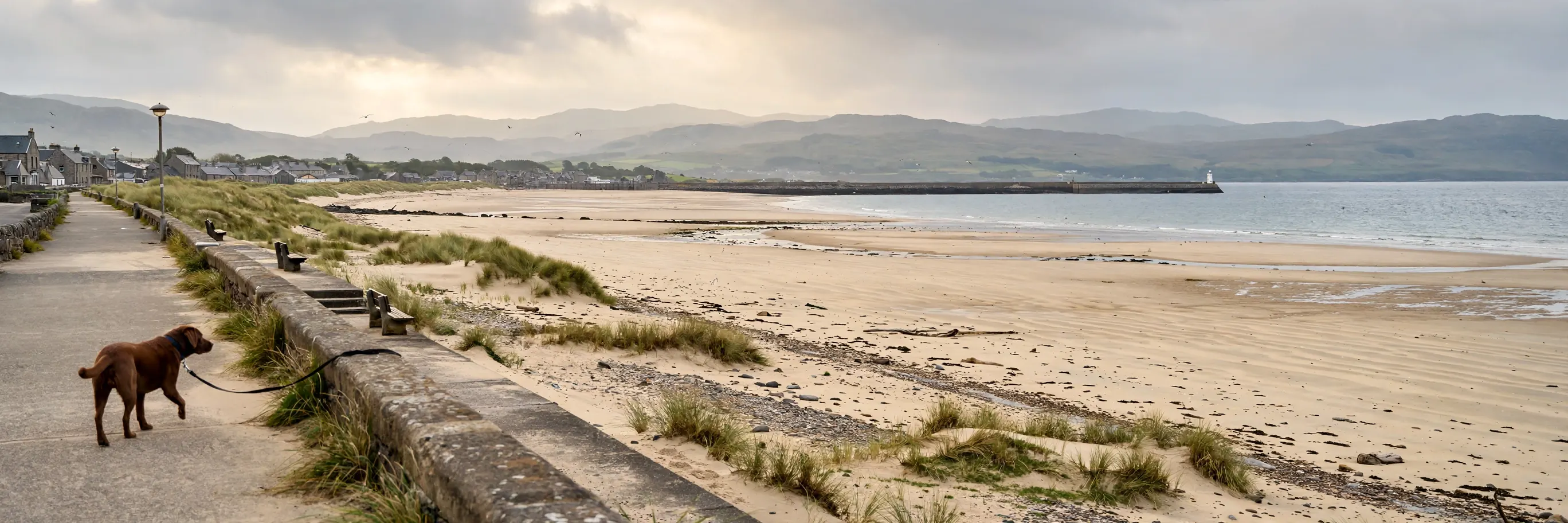
Dingwall’s best days out are the ones that use the town as a base and go looking for the coast. The nearest proper sandy beach is at Nairn, on the Moray Firth, about 25 miles to the south-east. Nairn has long sandy beaches, a promenade and a town that is used to dogs, and our Nairn guide covers beach rules, cafes, parking and day trips from the town in detail. Beach rules can change by season, so check the official guidance before you travel — and remember that a beach that is quiet on a weekday can be busy on a sunny weekend, which matters if your dog is reactive to other dogs or to children.
The Black Isle, across the Cromarty Firth, is the other obvious day trip. Cromarty, at the tip of the peninsula, is a small historic town with a harbour, narrow streets and a beach, and it is a good place for a slow afternoon with a dog. Fortrose and Rosemarkie, on the eastern side of the Black Isle, lead to Chanonry Point, where bottlenose dolphins are often seen from the shore on a rising tide. The point is a narrow spit, so keep the dog on a lead and be ready for crowds on a good dolphin day — the car park fills up, and the path to the point is busy. The Black Isle is also farmland, so the livestock rules in this guide apply there too, and the lanes are narrow, so drive slowly and expect tractors.
Closer to Dingwall, Evanton and the Fyrish Monument make a good half-day. Evanton sits on the eastern shore of the Cromarty Firth, a short drive north-east of Dingwall, and the walk to the Fyrish Monument climbs through woodland to a hilltop folly with wide views over the firth. The monument was built in the 18th century, and the walk is popular enough that the paths are well worn but still steep in places — it suits a fit dog, and the views are the reward. The shore at Evanton and at nearby Nigg is tidal firth shore rather than a sandy beach, so the same mud and tide warnings apply as at the Ferry Point. Check the official guidance before you travel for the current path and parking arrangements.
Further afield, Inverness is the obvious city day out, about 30 to 35 minutes away by train or car. The River Ness, the Ness Islands and the Caledonian Canal towpaths give a dog a proper city walk, and the city has more cafes, shops and vets than Dingwall. Our Inverness guide covers the walks, the rules at Culloden and the practicalities of a city day with a dog. If you want mountains rather than a city, Aviemore and the Cairngorms are roughly an hour’s drive south, with Loch Morlich, Rothiemurchus and the Green Lochan offering a very different kind of walking — pine forest, loch shore and mountain views. Both are easy from Dingwall, and both are covered in detail in our guides, so use Dingwall as the quiet base and let the day trips provide the variety.
Where to stay with a dog
Dingwall’s accommodation is small-scale, which is part of its charm and part of its challenge. Tulloch Castle Hotel, the town’s best-known place to stay, sits on the hill above Dingwall in the castle grounds, and its dog policy should be confirmed directly with the hotel before you book — check the official guidance before you travel, and get any dog permission in writing with the room type and any fee itemised. The same advice applies to every hotel, guest house and bed and breakfast in the town: dog-friendly can mean one specific room, a ground-floor room only, or dogs welcome in the bar but not in the bedrooms, and the only way to know is to ask.
Self-catering is often the easiest option with a dog, and there are cottages and apartments in and around Dingwall, in Strathpeffer and across the Black Isle. When you compare them, ask the questions that matter for your dog rather than the ones on the listing. Is the garden enclosed, and how high is the fence? Is there a ground-floor bedroom, or will an older dog have to manage stairs? Where is the nearest practical toilet walk after dark, and is it lit? Is there somewhere to dry a wet dog, and is there an outdoor tap? A cottage with a secure garden and a flat walk to the firth will suit most dogs better than a prettier cottage on a steep hill with an open garden next to a road.
Caravan and camping sites around Easter Ross and the Moray Firth coast are another option, especially in summer. The usual questions apply: how many dogs are allowed per pitch, what is the pet fee, are dogs allowed in every pitch or only in designated areas, and where is the nearest walk that does not need a car? Sites near the coast can be exposed to wind off the firth, so check the shelter and the ground conditions after rain — a pitch on soft ground is miserable for a dog that needs to go out at night. Book early for school holidays and for the summer months, because dog-friendly pitches are often the first to sell out.
Whatever you book, read the cancellation terms before you pay. A typical pattern is a deposit with the balance due some weeks before arrival, and refunds shrink as the date approaches. Illness — yours or the dog’s — is the most common reason plans change, so check whether the policy distinguishes between cancelling and moving the dates; moving a booking is often cheaper than losing it. Keep every confirmation email until you are home, and keep the dog’s details — breed, size, number of dogs — exactly as you declared them at booking, because a mismatch on arrival is the most avoidable way to start a holiday badly.
Eating out with a dog
Eating out with a dog in Dingwall is straightforward if you keep your expectations realistic. The town has cafes and pubs, and many of them welcome dogs in at least part of the premises, but policies are set by each business and they change. The reliable approach is to ask before you sit down, to favour places with outdoor seating in good weather, and to bring a mat or blanket so the dog has a defined place to settle. A dog that lies quietly on its mat will be welcomed back; a dog that wanders between tables will not, and no amount of asking will fix that.
Plan the meal around the dog, not the other way round. A short walk before you eat takes the edge off a restless dog, and a chew or a stuffed Kong under the table buys you a quiet meal. Choose a table at the edge of the room rather than in the middle of the foot traffic, and avoid the busiest times if your dog is nervous — an early lunch or a late dinner is calmer than the midday rush. If the dog is having a bad day, take the food away instead: Dingwall has takeaway options, and eating in your accommodation with a settled dog is a better evening than a stressful hour in a busy pub.
On day trips, the same rules apply with a little more planning. Nairn, Cromarty and Inverness all have dog-friendly cafes and pubs, but the popular ones fill up on sunny weekends, and a dog-friendly terrace can still be full. Our guides to Nairn and Inverness include the practical detail for those towns, and the general rule is the same everywhere: check the official guidance before you travel, call ahead if the meal matters to you, and always have a takeaway or self-catering fallback. Water is the other essential — carry a collapsible bowl and a bottle of fresh water on every outing, because a dog that has walked the castle loop or the canal path in summer will need a drink before you sit down to eat.
Food safety matters too, especially on the firth shore and on farmland walks. Dogs should not drink from the River Peffery near the firth, where the water is tidal and brackish, and they should not eat anything washed up on the shore — dead fish, shellfish and seaweed can all make a dog ill. On farmland, keep the dog away from sheep feed, fertiliser and any animal carcass, and watch for blue-green algae in still water in warm weather: if the water looks green and soupy, keep the dog out and check the official guidance before you travel for current warnings. A dog that has eaten something it should not have needs a vet, not a wait-and-see approach.
Seasons, midges and Highland weather
Dingwall is a year-round town, but the experience changes sharply with the season. Late spring and early autumn are the sweet spot for most dog owners: the days are long, the canal path and the castle loop are at their best, the midges are not yet at their worst or have already faded, and the town is quiet. May and September are particularly good, with mild weather, open paths and fewer visitors than the summer peak. If your dog is older or struggles with heat, these shoulder months are the time to come.
Summer brings the longest days and the busiest roads. The A9 fills up, Inverness and Aviemore get crowded, and the firth shore can be hot in direct sun — but Dingwall itself stays calmer than the honeypots, and the woodland on the castle loop gives shade that the open firth paths do not. The main summer problem is midges, which trouble much of the Highlands from June to August, especially in still, damp conditions at dawn and dusk. Midges bite dogs too, particularly around the ears, belly and eyes, so carry a dog-safe repellent, avoid standing water at dusk and keep walks moving rather than standing still. Check the official guidance before you travel for current midge forecasts and dog-safe products, and never use a human repellent on a dog without checking that it is safe for them.
Autumn is underrated here. The beech trees on the Tulloch Castle walk turn colour, the wading birds return to the firth in numbers, and the light over the water is at its best. The ground gets muddier, so the canal path and the woodland tracks need proper footwear and a towel for the dog, and the days shorten quickly — a walk that was comfortable at 5pm in June needs a torch by 5pm in October. Fireworks season around early November can unsettle noise-sensitive dogs, so ask your accommodation whether the town or nearby venues host displays, and plan a quiet evening indoors if your dog is frightened by bangs.
Winter in Dingwall is quiet, dark and often wet rather than snowy, although the hills around the town can hold snow while the town stays clear. Short days mean short walks, and the canal path can be slippery after frost, so a lead and good footwear matter more than distance. The upside is that the town is at its most peaceful, accommodation is cheaper and easier to book, and a dog that likes cold, bright days will enjoy the firth air. Whatever the season, Highland weather changes fast: pack a waterproof for yourself and a drying coat for the dog, check the forecast on the morning of the walk, and be ready to swap a hill walk for the flat canal path if the wind picks up.
Practical kit: vets, rules and the Access Code
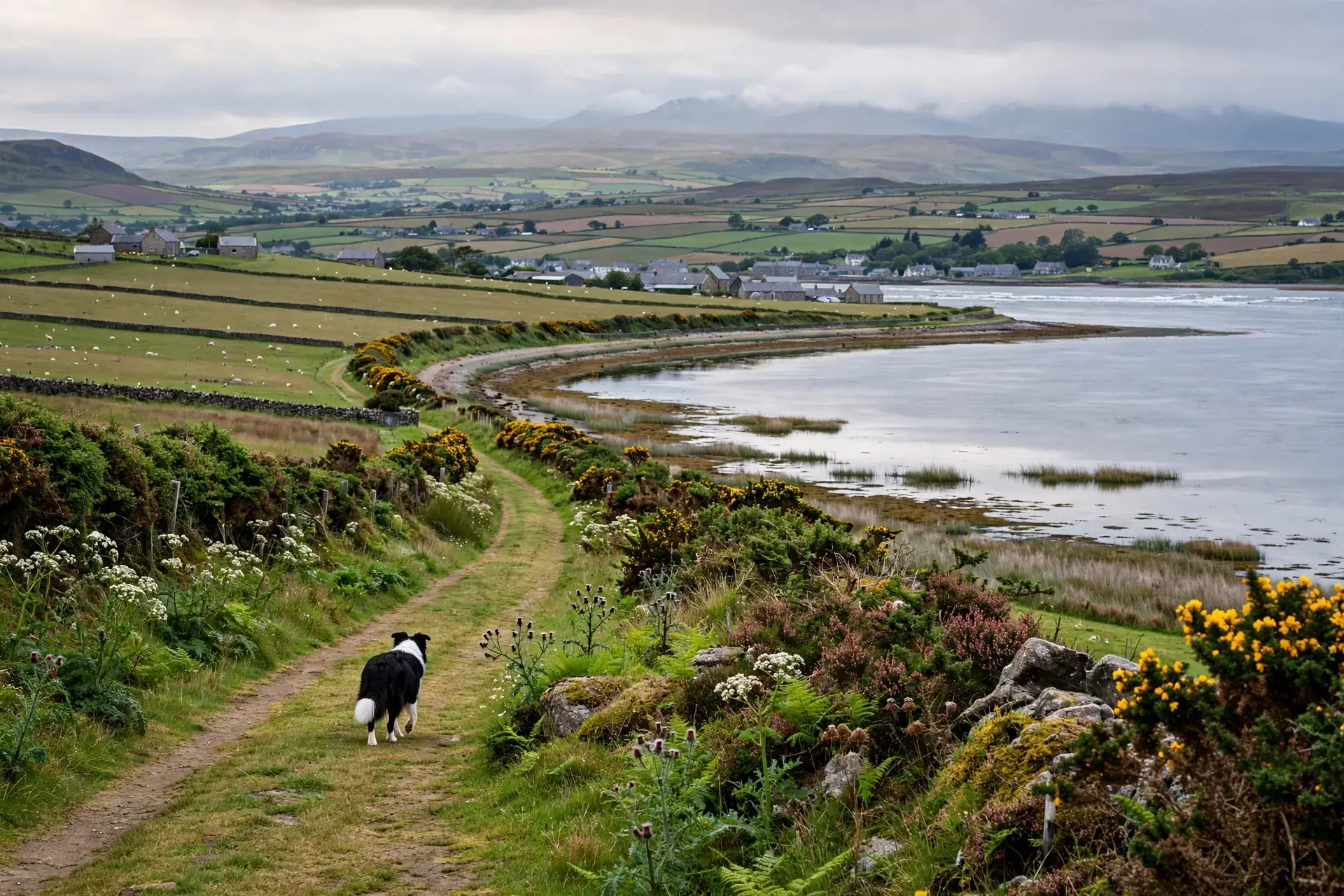
The Scottish Outdoor Access Code is the framework for every walk in this guide, and it is worth knowing before you arrive. In Scotland, you have a right of responsible access to most land and inland water, but that right comes with responsibilities: keep your dog under close control at all times, keep it on a lead near livestock, and do not let it disturb wildlife, especially ground-nesting birds in spring and summer. During lambing season, which runs roughly from April to June, and around cattle with calves, a lead is not optional — it is the rule. Farmers can take action against a dog that worries livestock, so the safest habit is simple: lead on whenever you see animals, and lead on whenever you are not sure what is over the next rise.
Your kit list for Dingwall is the same as for any Highland trip, with a few local additions. Pack a lead and a long line, poo bags, a collapsible water bowl and fresh water, a towel and a drying coat, tick tweezers and a tick remover, and a basic first-aid kit including a bandage and saline for eyes. Add a torch for short winter days and for the after-dark toilet walk, and a high-visibility jacket or collar light if you walk near roads at dusk. After woodland and farmland walks, check the dog for ticks, especially around the ears, armpits and groin, and check paws for cuts from rough tracks and for mud packed between the toes. If you find a tick, remove it with a tick remover rather than pulling it, and watch the bite site over the following days.
Health risks in the Highlands are manageable if you know them. Adders are present in parts of Scotland and are most active in warm weather on sunny banks and dry heath — keep the dog on paths in adder country and seek a vet immediately if you suspect a bite. Blue-green algae can appear in still, warm water in summer, and sheep ticks can carry disease, so the tick check after every walk is not optional. Make sure the dog’s vaccinations are up to date and that flea and worming treatments are current before you travel, and carry the vet’s number and the dog’s insurance details in your phone. If the dog becomes ill on the trip, call a vet early rather than waiting: rural practices may need time to fit you in, and an early call is always better than a late one.
Finally, plan for the drive home as carefully as the drive up. A wet, tired dog in a car needs ventilation, water and regular stops, and a dog that has swum in the firth or rolled in estuary mud needs a rinse before the journey — salt water and mud dry into the coat and irritate the skin. Keep a spare towel and a bottle of fresh water in the car for the return trip, and stop every couple of hours on a long drive so the dog can stretch, drink and toilet. Dingwall is the kind of place that makes a good last walk easy: a final flat loop along the canal to the Ferry Point, a last look across the firth, and a dog that sleeps all the way home.
Practical questions
Before you go
Is Dingwall a good base for a dog-friendly Highland holiday?
Yes, for walkers who want a quiet, practical base rather than a resort. Dingwall has a railway station, a compact High Street, the canal walk to the Cromarty Firth, the Tulloch Castle loop and easy day trips to Inverness, Nairn, Cromarty and the Black Isle. It suits dogs that are happy with town pavements, riverside paths and farmland tracks, and owners who prefer a slower pace.
Can dogs walk off lead on the Dingwall Canal path?
The canal path is a shared, mostly flat route used by walkers, cyclists and families, so off-lead walking is only sensible where you have clear sightlines, a reliable recall and no other users nearby. Keep your dog on a lead near roads, the firing range area and livestock, and check the official guidance before you travel for any current restrictions or warning flags.
Is the Tulloch Castle walk suitable for older dogs?
The 5.5 km circular walk from Dingwall Museum takes about 1.5 to 2 hours with around 90 metres of ascent on waymarked paths, tracks and pavements, so fit older dogs usually manage it at a gentle pace with breaks. Dogs with stiff joints or poor stamina will do better on the flat canal walk to the Ferry Point instead, which has almost no climbing.
Where is the nearest beach to Dingwall for dogs?
The closest stretches of shore are around the Cromarty Firth at the Ferry Point, Evanton and Nigg, but these are tidal firth shores with mud and wading birds rather than sandy swimming beaches. For a proper sandy beach, drive to Nairn on the Moray Firth or to Cromarty on the Black Isle, and check the official guidance before you travel, as seasonal dog rules can apply.
Do dogs need to stay on lead near livestock around Dingwall?
Yes. Under the Scottish Outdoor Access Code, dogs must be under close control at all times and on a lead near livestock, especially during lambing season and around cattle with calves. Farmland surrounds Dingwall on almost every side, so carry a lead on every walk, even on routes that start in town.
Can I take my dog on the train to Dingwall?
Yes. ScotRail allows dogs to travel on its trains, and Dingwall station is served by the Far North Line and the Kyle of Lochalsh Line, with regular services to and from Inverness taking around 30 to 35 minutes. Keep your dog on a lead, keep it off seats, and check the official guidance before you travel for the latest rules and any service changes.