This guide is independent and contains no paid placement. If affiliate links are added later, they will be clearly marked and will not change our editorial checks.
Nairn is one of the easiest Highland towns to visit with a dog: a long sandy beach, a flat promenade, a compact town centre with dog-friendly places to eat and drink, and straightforward day trips to Inverness, Culloden and the Moray coast. Check beach signs on arrival, keep your dog on a lead near the harbour and roads, and plan around the tide for the best beach walks.
Why Nairn suits dogs
Nairn is a small seaside town on the Moray Firth, about sixteen miles east of Inverness, and it works for dogs because almost everything a visitor needs is within a short, flat walk. The beach, the harbour, the High Street and the golf links sit close together, so a dog that is happy on a lead can cover the whole town in a morning without ever needing the car. That compactness matters more than it sounds: a town where the walk, the coffee stop and the evening stroll all happen on foot is far less stressful for a dog than a place where every outing starts with loading up and driving somewhere new.
The town has a long history as a Victorian seaside resort, and that heritage still shapes how it feels. Wide streets, whitewashed buildings, a sandstone town hall and a harbour that once served fishing boats give Nairn a calm, unhurried character. It never feels crowded in the way a city does, even in summer, and the pace suits older dogs, nervous dogs and puppies that are still learning how to cope with new places. There is enough going on to keep a visit interesting — boats in the harbour, golfers on the links, swimmers and paddleboarders on calm days — without the noise and crowds that can overwhelm a sensitive dog.
What sets Nairn apart from many other Scottish coastal towns is the sheer scale of its beach. At low tide the sand stretches a long way out into the Moray Firth, giving dogs room to run, sniff and play without being hemmed in by other visitors. The sand is firm and flat in places, which suits dogs that struggle with steep shingle or deep soft sand, and the gentle slope means the water stays shallow for a long way out. That combination — space, firm sand and shallow water — is exactly what most dogs want from a beach, and it is why so many regular visitors return year after year.
The town also makes a practical base for a longer Highland trip. Inverness is a short drive or train ride away, the Cairngorms are within reach for a day out, and the Moray coast runs east towards Elgin and Lossiemouth with more beaches and villages to explore. Staying in Nairn rather than in a city means quieter evenings, easier parking and a beach on the doorstep, and the trade-off is simply that you plan your bigger outings as day trips rather than expecting everything to be in one place. For most dog owners that is a good deal, and it is the reason this guide treats Nairn as a base as well as a destination in its own right.
Before you travel, it helps to know what Nairn is not. It is not a place with a long list of indoor dog attractions, and on a wet and windy day the honest plan is a short beach walk, a cafe stop and a relaxed afternoon indoors. The town rewards visitors who are happy to slow down, watch the light change over the firth and let the dog set the pace. If that sounds like your kind of trip, Nairn will suit you very well indeed, and the sections below cover the practical details — beach rules, where to eat and drink, where to stay, where to park and which day trips work best — so you can arrive with a plan instead of working it all out on the pavement.
Nairn Beach and the promenade
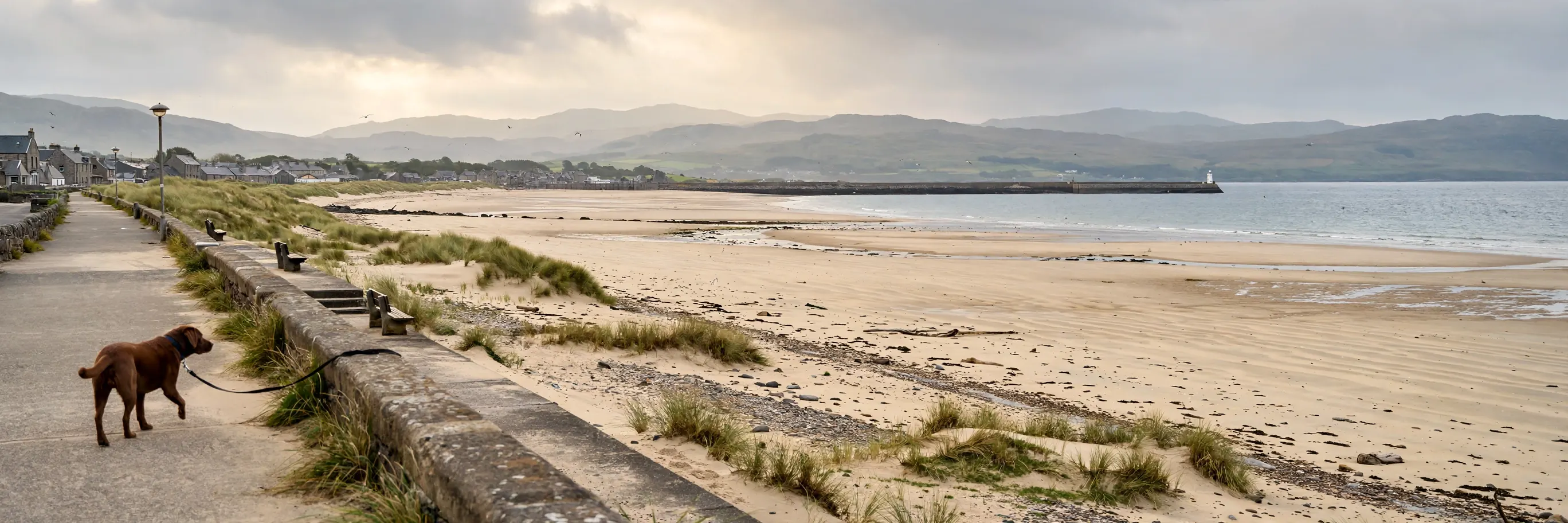
Nairn Beach is the reason most dog owners come to the town, and it deserves to be the first thing you do after arriving. The central beach sits directly in front of the town, with the promenade running along its edge, and from there the sand continues in both directions — east towards the harbour and the links, and west towards the long, quiet stretch that eventually reaches the mouth of the River Nairn. At low tide the beach is enormous, and even at high tide there is usually a good strip of sand to walk on, which makes it usable in almost all conditions except the roughest winter storms.
Dog rules on the beach follow the pattern of most Scottish beaches: dogs are generally welcome, but restrictions can apply to parts of the central beach during the busiest summer months, and the signs at each access point are the final word. Always read the sign where you step onto the sand rather than relying on what you remember from a previous visit or what another visitor tells you, because restrictions can change from year to year and can differ between the central beach and the stretches further out. If a sign says dogs must be on a lead or are not allowed in a particular area, follow it — the restrictions exist to keep the beach pleasant for everyone, and ignoring them is the fastest way to sour a visit for other dog owners too.
The practical approach is to walk a little further than everyone else. The central beach near the promenade is the busiest part, especially on sunny weekends, school holidays and warm evenings, and it is also where families with small children, picnics and ball games concentrate. Head east past the harbour or west towards the river and the crowds thin out quickly, the sand opens up, and a dog on a long lead or under good voice control has room to run without bothering anyone. Early morning and late evening are the best times of all: the light over the Moray Firth is at its most beautiful, the beach is quiet, and a dog can have a proper run before the day warms up.
The promenade itself is a gentle, flat walk that suits every kind of dog. It runs along the seafront with benches, grassy areas and views across the firth to the Black Isle, and it is the natural route for a short evening stroll or a slow walk with an older dog that cannot manage a long beach session. Keep your dog on a short lead here, because the promenade is shared with cyclists, joggers, pushchairs and other dogs, and the road runs close by in places. The surface is smooth and kind on paws, and there are places to sit and watch the water, which makes it a good option for a dog that likes to watch the world go by rather than charge into it.
Beach safety deserves a few lines of its own. The tide at Nairn moves a long way, and a dog that runs out across the sand at low tide can find the water coming back faster than expected, so keep an eye on the tide times and stay aware of how far out you have walked. The harbour area needs care too: wet stone, ropes, mooring chains and boat traffic are all hazards for a curious dog, so keep a lead on around the harbour walls and do not let a dog jump onto boats or pontoons. After a beach walk, rinse sandy paws before getting back in the car, and check between the toes for sand and small stones, because a dog that has been running hard on sand can pick up sore spots that only show up later. If you are planning more beach days elsewhere in Scotland, our guide to dog-friendly beaches in Scotland covers the rules and the best stretches of coast across the country.
Moray Firth views and dolphins
The Moray Firth is the great sweep of water that defines Nairn, and it is worth understanding what you are looking at. The firth is one of the largest in Scotland, opening out into the North Sea, and its relatively sheltered, shallow waters are home to one of the best-known populations of bottlenose dolphins in the world. On a calm day the surface can look almost still, and the light changes constantly — silver in the morning, blue in the afternoon, and a soft pink and gold at sunset that photographers travel a long way to see.
Dolphin watching from the shore at Nairn is a genuine possibility rather than a marketing claim, but it needs patience and realistic expectations. The dolphins are wild animals moving through a huge area of water, and they appear when they choose to, not when visitors arrive. Your best chances come on calm days with little wind, when the surface is smooth enough to spot a dorsal fin breaking the water, and around a rising tide, when fish move inshore and the dolphins follow them. The harbour wall, the end of the promenade and the higher ground along the links all give a good vantage point, and a pair of binoculars makes a real difference — without them, a distant fin is easy to miss entirely.
When you do spot dolphins, the etiquette is simple: watch quietly, keep your dog on a lead and do not try to follow them along the shore or encourage your dog to enter the water to get closer. Dolphins are protected, and the best viewing is always the kind that leaves them alone. Children and dogs both get excited at the sight of a fin, and that excitement is part of the pleasure of the moment, but a dog barking and lunging at the harbour wall will spoil the watch for everyone nearby and can be dangerous near the edge. Settle the dog, sit down, and let the watching be slow.
Even on days when no dolphins appear, the firth rewards a slow look. Seals haul out on sandbanks at low tide and can often be seen from the beach with binoculars. Oystercatchers, curlews, redshanks and other wading birds work the shoreline in large numbers, especially in winter, when the firth becomes an important refuge for birds arriving from further north. The Black Isle sits across the water to the north, and on a clear day the hills beyond Inverness are visible to the west, giving the horizon a layered, painterly quality that changes with every hour of light.
The harbour is the other half of the firth experience. Nairn Harbour is a working harbour rather than a museum piece, with fishing boats, leisure craft and the harbourmaster's buildings clustered around a small basin, and it is a pleasant place to wander with a dog on a lead. The harbour wall is a good spot for watching the water, and the area around it tends to be quieter than the central beach, which makes it a useful alternative on a busy day. Take care with the usual harbour hazards — wet surfaces, ropes, chains and sudden drops — and keep small dogs close, because a gap in a harbour wall is exactly the sort of thing a curious terrier will find before you do.
Walks in and around town
Beyond the beach, Nairn offers a good range of shorter walks that suit different dogs and different weather. The riverside walk along the River Nairn is one of the best of them. The river runs through the town and out to the sea, and the paths beside it pass through wooded stretches, open grass and quiet residential streets, giving a dog a mix of scents, shade and open ground in a single loop. The paths are generally flat and well used, which makes them suitable for older dogs and for puppies that are still building up their stamina, and the river itself is a pleasant backdrop on a warm day.
For a longer walk, the coastal path east from Nairn towards the links and beyond gives a sense of the open Moray coast without needing to drive anywhere. The route passes the golf courses, open grassland and the edge of the town, and on a clear day the views across the firth are continuous. Keep your dog on a lead where the path runs near the golf course, because golfers do not expect a dog to appear on a fairway, and a ball can travel fast and far. The same rule applies near any livestock you meet on the rural stretches: a dog that chases sheep can cause serious harm, and the legal and practical consequences are severe, so a lead is the only safe choice around grazing animals.
Woodland walks are available a short drive from the town for days when the beach wind is too strong or you want shade and shelter. The forests and trails around the wider Nairn area include waymarked paths through pine and mixed woodland, with softer ground underfoot and plenty of sniffing opportunities for a dog that prefers trees to open sand. Woodland also suits dogs that find the beach too exciting: the enclosed feel of a forest path can calm a dog that becomes over-aroused by the space and the gulls on an open beach. Check the official guidance before you travel for the current state of any forest trail you plan to use, because forestry work can close paths at short notice.
Walking in town itself is straightforward. The High Street and the streets around it are flat, the pavements are generally wide enough for a dog and a pushchair to pass, and the distances between the beach, the shops and the cafes are short. That makes Nairn a good town for a dog that is still learning to cope with traffic, shop doorways and the general bustle of a town centre, because nothing is far away and you can always retreat to the quieter streets or back to the beach if the dog has had enough. Short, successful town walks are far better training than one long, overwhelming one.
A sensible daily rhythm for a Nairn stay is a long beach walk in the morning, a rest in the middle of the day, and a short town or riverside walk in the evening. Dogs, like people, tire in the sun and wind, and a dog that has run hard on the sand in the morning will often be content with a gentle evening stroll and an early night. Build rest into the plan rather than treating it as wasted time: a tired dog is a happy dog, but an exhausted dog is a grumpy one, and the difference is usually one walk too many.
Dog-friendly cafes and pubs
Nairn has a reasonable number of cafes and pubs that welcome dogs, and the honest picture is that most of them welcome dogs in a defined area rather than everywhere. That is the normal pattern across Scotland: a cafe may welcome dogs on the terrace and in one ground-floor room, while keeping the main dining room dog-free, or a pub may welcome dogs in the bar but not in the restaurant. The arrangement works well as long as you know it in advance, and it works badly when you arrive expecting the dog to sit beside you at any table and discover that only the terrace is available in the rain.
The best approach is to check before you set out. Look at the venue's own website or social media page, or call ahead on the day, and ask the simple questions: where exactly can the dog sit, is there a water bowl, is there a limit on the number or size of dogs, and is the arrangement different at lunchtime and in the evening. A two-minute call saves a twenty-minute walk with a disappointed dog, and it also tells the staff to expect you, which usually means a warmer welcome when you arrive. Policies can change with the season, with staffing and with the weather, so a place that welcomed dogs on the terrace all summer may have a different arrangement in November, and the only reliable source is the venue itself.
When you do eat or drink out with your dog, a little preparation makes the difference between a relaxed meal and a stressful one. Bring a familiar blanket or mat so the dog has a defined place to settle, and bring a chew or a stuffed Kong to keep them occupied while you eat. Arrive at a quiet time for your first visit — mid-afternoon rather than the Saturday lunch rush — so the dog can learn the space without a room full of strangers, plates and other dogs. Choose a table at the edge of the room rather than in the middle of the traffic, and keep the lead short and under your foot so the dog cannot wander into the path of waiting staff.
Takeaway food is a useful fallback and Nairn has plenty of it. Fish and chips eaten on a bench on the promenade, with the dog sitting beside you watching the firth, is one of the great simple pleasures of a Scottish seaside town, and it removes all the complications of indoor dining. The same applies to a bakery lunch eaten on the beach or a coffee taken away and drunk on a bench by the harbour. Not every meal needs to be a sit-down event, and for many dogs the takeaway-and-bench version is the more enjoyable one.
Finally, remember that your dog's behaviour in a cafe reflects on every dog owner who comes after you. A dog that settles quietly under a table, stays off the furniture unless invited, and does not bark at every passing dog will be welcomed back, and the staff will remember it. A dog that jumps up at other tables, steals food or barks at the door will not, and the next dog owner will pay for it. Bringing a dog into a cafe or pub is a privilege that depends on good behaviour, and the small courtesies — asking first, keeping the dog settled, cleaning up any mess straight away — are what keep Nairn's dog-friendly places dog-friendly.
Where to stay with a dog
Nairn offers the usual mix of places to stay for a dog trip: hotels, guesthouses, self-catering cottages and flats, and caravan and lodge parks in the surrounding area. The right choice depends less on the star rating than on the practical details that matter to a dog owner — whether the dog can be left alone for a short time, whether there is a garden or a nearby toilet area, whether the floors are easy to clean after a sandy beach walk, and whether the owner charges a pet fee or a refundable deposit.
Self-catering accommodation is often the easiest option for a dog stay in Nairn, because it gives you a kitchen, a living space and usually a garden or a yard, and it removes the pressure of keeping a dog quiet in a hotel corridor or a dining room. Look for a property with an enclosed garden if your dog needs one, and ask specifically about the boundary: a low wall or a hedge with gaps is not the same as a fence, and a dog that can slip out will do so at the worst possible moment. Also ask about the check-in and check-out times and whether an early check-in is possible, because arriving in daylight gives you time to walk the garden, settle the dog and find the nearest toilet spot before dark.
Hotels and guesthouses in Nairn can work well too, especially for a short stay of one or two nights. The questions to ask are different: which rooms accept dogs, is there a charge per dog per night, can the dog be left alone in the room, and is there a ground-floor room near an exit so that late-night toilet trips are easy. A hotel that welcomes dogs in the bar or lounge as well as in the bedroom is worth its weight in gold on a wet evening, because it means the dog can come with you instead of being left alone upstairs. If you are comparing several places, our guide to dog-friendly holiday parks in the UK sets out the questions that apply to park stays as well, and many of them — boundaries, fees, alone-time rules — are just as useful when you are choosing a cottage or a hotel.
Whatever you book, confirm the dog arrangement in writing before you pay. A listing that says "dogs welcome" in the headline can still mean one dog only, or dogs only in selected rooms, or a weight limit, or an extra charge that is not shown until the booking summary. Get the pet fee, the number of dogs allowed and any conditions in the confirmation email, and keep that email until you are home. If the property has a damage deposit, ask what it covers and how it is returned, and photograph the room or cottage on arrival so that any existing marks are recorded before your dog has a chance to be blamed for them.
Book early if you can, particularly for summer weekends and school holidays, because the best dog-friendly places in a small town sell out quickly. The properties that welcome dogs well — enclosed gardens, hard floors, a warm welcome and no fuss about sandy paws — are a small subset of all the places to stay, and they are the ones that regular visitors rebook year after year. If your first choice is full, consider a weekday stay or a shoulder-season date: Nairn in May, September or October is quieter, cheaper and often sunnier than the peak summer weeks, and the beach is just as good.
Parking and getting there
Most visitors reach Nairn by car, and the drive is part of the pleasure of the trip. The town sits just off the A96 between Inverness and Aberdeen, and the road east from Inverness runs along the coast with views of the firth for much of the way. From the south, the usual route is through Perth and Inverness, and the whole journey from the central belt takes around three hours in good traffic, longer in summer or in bad weather. Plan a stop on the way for the dog: a service area or a lay-by with a grassy verge is enough for a toilet break and a stretch, and a dog that arrives stiff and desperate is a poor start to any holiday.
Nairn also has a railway station on the Aberdeen to Inverness line, which makes a car-free trip possible. Dogs travel free on most UK trains and are welcome on a lead, though they cannot sit on seats and a larger dog may need the floor space beside you. The station is a short walk from the town centre and the beach, and the train journey itself is a pleasant way to arrive, with coastal views along the way. If you arrive by train, pack light and plan your first walk from the station, because there is no need to rush to a car park — the beach is the natural first stop. Our guide to dog-friendly train stations in the UK covers waiting rooms, platform changes and the practical details of travelling with a dog by rail.
Parking in Nairn is generally straightforward, but it rewards early arrival. The harbour car park and the links car park put you closest to the beach and the promenade, while the car parks near the High Street are better if you plan to visit the shops and cafes first. On sunny weekends, school holidays and the days around local events, the seafront spaces fill up early, and a late arrival can mean a walk from a car park further out. That is not a disaster — the town is small and the walk is flat — but it is worth knowing in advance so that you are not circling the seafront with a dog getting restless in the back seat.
Charges and time limits vary between car parks and can change, so check the official guidance before you travel for the current position, and read the signs in the car park itself before you walk away. Keep a lead, water and a towel in the car rather than buried under the luggage, because the first thing you will want after parking is to get the dog out and onto the beach, and the second thing you will want is to dry sandy paws before the drive home. In summer, never leave a dog in a parked car, even with the windows open: a car in the sun heats up far faster than most people expect, and a shaded seafront car park can still become dangerously hot within minutes.
For getting around once you are there, walking is the best option in town, and a car is the best option for day trips. The town centre, the beach, the harbour and the golf links are all within easy walking distance of each other, and most visitors find they only use the car to go further afield. Cycling is possible on the quieter roads and paths, but a dog on a lead and a bicycle are a combination that needs care and practice, and the promenade is not the place to try it for the first time.
Day trips: golf, castles and countryside
Nairn is famous for its golf, and even if you never pick up a club, the golf links shape the town and the landscape around it. Nairn Golf Club and the neighbouring Nairn Dunbar course are two of the most respected links courses in Scotland, set on the dunes and grassland between the town and the sea. Dogs are not generally allowed on the courses themselves while play is in progress, and that is entirely reasonable: a dog on a fairway is a hazard to golfers and to itself. What the golf does give a visitor is a beautiful landscape to walk around, with the coastal paths and the open ground beside the links offering long views and good walking without ever stepping onto a green.
If you do play golf and want to bring the dog, the honest answer is to treat the two as separate activities. Book a tee time and arrange for the dog to stay with a companion, at the accommodation or on a walk with someone else, rather than trying to combine a round of golf with a dog on a lead. The same applies to any activity where the dog would be an afterthought: a rushed round with a bored dog tied to a fence is no fun for anyone, and the dog will enjoy a proper walk far more than four hours of waiting around. Nairn's golf heritage is worth appreciating from the paths and the clubhouse terrace, where a well-behaved dog is often welcome outside, and the game itself is best left to the golfers.
For a day out with the dog, Culloden Battlefield is the most famous destination near Nairn, about twenty minutes away by car towards Inverness. The battlefield itself is open moorland with walking trails, and dogs on leads are welcome to explore the site, which gives a dog a long, open walk with a powerful sense of history. The visitor centre has its own rules about dogs indoors, so plan for one person to stay outside with the dog while the other visits the exhibition, or enjoy the outdoor trails and the memorial cairn together and save the indoor exhibition for another trip. The nearby Clava Cairns, a group of ancient burial cairns in a quiet wooded setting, make a good second stop on the same day and are a calmer, more sheltered walk than the open moor.
Cawdor Castle, a short drive south of Nairn, is another rewarding day trip. The castle gardens and grounds are the main attraction for a dog visit, with woodland walks, a walled garden and open parkland to explore, while the castle interior has its own rules and dogs are generally not allowed inside. The grounds are extensive enough for a proper walk, and the woodland paths give shade on a hot day, which makes Cawdor a good choice when the beach is too exposed. As with all historic properties, check the official guidance before you travel for the current dog policy, because the rules for gardens and grounds can differ from the rules for the house, and they can change between seasons.
Further afield, the Moray coast east of Nairn offers more beaches and villages for a slow day of exploring. Findhorn, a small village at the mouth of the River Findhorn, has a long sandy beach, a harbour and a relaxed, slightly bohemian atmosphere that suits a dog walk followed by a cafe stop. Lossiemouth, further east, has two beaches and a harbour, and the coastal path between the Moray towns is a rewarding walk for a fit dog. To the west, Inverness is the obvious city day trip, with riverside walks, a castle viewpoint and a good range of dog-friendly cafes, and our Inverness dog guide covers the city in the same practical detail as this guide covers Nairn. Whichever direction you choose, the rule for a good day trip is the same: one main destination, one good walk, and time left over for a relaxed return to Nairn and an evening on the beach.
Seasons, tides and safety
Nairn changes with the seasons more than most visitors expect, and choosing when to come is part of planning the trip. Summer brings the warmest weather, the longest days and the busiest beach, with the town at its most lively and the cafes and pubs at their fullest. It also brings the possibility of seasonal dog restrictions on parts of the central beach, more visitors to share the sand with, and the need to book accommodation well in advance. A summer visit is at its best early in the morning or late in the evening, when the beach belongs to the early risers and the dog walkers, and the middle of the day is for shade, rest and a slow lunch.
Spring and autumn are the quiet favourites of many regular visitors. May and September often bring settled weather, warm sunshine and far fewer people, and the beach restrictions of high summer have usually lifted. The light in autumn is particularly beautiful on the Moray Firth, and the town feels calm and spacious after the summer crowds have gone. October brings the half-term holidays and a short burst of family visitors, but even then Nairn never feels overwhelmed. Spring brings nesting birds to the dunes and the shoreline, so keep your dog on a lead near the dunes and the grassy areas where birds may be nesting on the ground, and respect any temporary signs asking visitors to keep to the paths.
Winter in Nairn is a different kind of visit and it suits a particular kind of dog owner. The beach is often empty, the light is low and dramatic, and the town is quiet, with a few cafes and pubs keeping the fire lit. The trade-offs are real: the wind off the firth is cold, the days are short, some businesses reduce their hours, and a wet and windy day can mean a short walk and a long afternoon indoors. A dog with a warm coat, a drying coat and a tolerant attitude to rain will enjoy a winter visit enormously, and a dog that hates the cold and the wet will not. Pack accordingly, and do not expect a winter beach walk to last as long as a summer one.
Tides deserve a short explanation because they shape every beach visit at Nairn. The tide goes out a very long way, exposing a huge expanse of sand, and it comes back in steadily rather than in a sudden rush, but it still catches out visitors who walk too far out without checking the times. Before a long beach walk, look up the tide times for the day and plan to be heading back towards the shore well before the tide turns. A simple rule is to start your walk at low tide and walk with the incoming tide behind you rather than in front of you, so that the water is always pushing you gently back towards the town rather than cutting you off from it.
Safety on the beach and in the water is worth taking seriously. The Moray Firth looks calm and inviting, but the water is cold even in summer, and a dog that swims far out can tire quickly. Do not encourage a dog to swim in rough conditions, near the harbour mouth or where boats are moving, and be aware that strong currents can run along the shore. After swimming, rinse your dog with fresh water if you can, because salt water and sand can irritate the skin and the paws, and watch for any signs of sickness after a dog has swallowed sea water. If your dog eats something on the beach — dead fish, seaweed, picnic leftovers — keep a close eye on them, and save the number of the nearest vet before you travel so that you are not searching for it in a hurry.
Packing list and vets
A well-packed dog bag makes a Nairn trip smoother, and the list is short enough to fit in a single tote. Start with the leads: a short lead for town, cafes and the promenade, and a long lead for the beach, because a long lead gives a dog freedom to run and sniff without the risks of being fully off lead in a busy place. Add a harness if your dog pulls, a collar with an ID tag showing your mobile number, fresh water and a collapsible bowl, poo bags — more than you think you need — and a towel or a drying coat for the journey home.
Food and routine matter more than most people plan for. Bring the dog's usual food in the usual amounts, and do not switch brands for the trip, because a change of diet plus travel plus excitement is a reliable recipe for an upset stomach. Bring the usual treats, any medication the dog needs with the instructions written down, and a familiar blanket or bed so the dog has something that smells of home in a new place. If your dog is on regular medication, pack a spare day's worth in a separate bag in case the main supply is lost, and keep the vet's phone number in your phone rather than on a piece of paper that can be left behind.
A basic first-aid kit is worth carrying on any dog trip, and Nairn is no exception. Include a tick remover, antiseptic wipes, a bandage, saline solution for flushing eyes or small wounds, and any allergy medication your vet has prescribed. Ticks are present in the grassland and woodland around Nairn, particularly from spring to autumn, so check your dog after every walk through long grass or woodland, and remove any tick promptly with the proper tool. Adders are present in parts of the Scottish countryside, though they are rarely seen and prefer to avoid people and dogs, and the practical precaution is to keep your dog on the path in sunny, rocky or heathery areas rather than letting them nose into every gap between stones.
Before you travel, save the details of the nearest vet. Nairn has veterinary practices in the town, and Inverness has larger practices and an out-of-hours emergency service a short drive away. Save the number in your phone before you leave home, along with the address of the nearest practice to your accommodation, so that you are not searching for it in a stressful moment. If your dog has an ongoing condition, take a copy of the relevant notes or ask your own vet for a short summary to carry with you, and make sure your pet insurance details are accessible. None of this is difficult, and all of it is the sort of preparation that turns a small problem into a minor inconvenience rather than a crisis.
One last piece of preparation is to tell someone where you are going. If you are walking alone with your dog on a quiet stretch of beach or a remote coastal path, let someone know your route and when you expect to be back, and carry a charged phone. The coast around Nairn is generally safe and well used, but mobile signal can be patchy in places, and a phone with a flat battery is no help to anyone. A charged phone, a lead, water and a plan are the four things that cover almost every situation a dog walk in Nairn is likely to produce.
Practical questions
Before you go
Can dogs go on Nairn Beach all year round?
Nairn Beach is generally open to dogs throughout the year, but seasonal restrictions can apply to parts of the central beach during the busiest summer months, so check the signs at each access point before letting your dog off the lead. The long stretches east and west of the town centre are usually quieter and more relaxed, and dogs should always be under close control near families, other dogs and the harbour area.
Where is the best place to park in Nairn with a dog?
The harbour and links car parks put you closest to the beach, while the town-centre car parks near the High Street are better if you plan to visit cafes and shops first. Arrive early on sunny weekends and in school holidays, because the seafront spaces fill quickly. Keep a lead, water and a towel in the car, and check the official guidance before you travel for current charges and time limits.
Are there dog-friendly cafes and pubs in Nairn?
Yes, several cafes and pubs in Nairn welcome dogs, usually in a defined area such as a terrace, a bar area or a ground-floor room, and many provide water bowls and treats. Policies can change with the season and with staffing, so it is worth checking the venue's own page or calling ahead on the day, especially if you have more than one dog or a large breed.
Can you see dolphins from Nairn with a dog?
Bottlenose dolphins are regularly seen in the Moray Firth, and Nairn is one of the better shore-based viewing spots, particularly on a calm day around a rising tide. Keep your dog on a lead on the promenade and harbour walls while you watch, bring binoculars if you have them, and remember that sightings are never guaranteed, so treat a dolphin as a bonus rather than the plan.
Is Nairn a good base for exploring the Highlands with a dog?
Yes. Nairn sits between Inverness and the Moray coast, so day trips to Culloden, Cawdor Castle grounds, Findhorn and the Cairngorms foothills are all straightforward by car. The town itself is compact and walkable, which makes it a calmer base than a city, and most days can be planned around one morning walk, one outing and a relaxed evening near the beach.
What should I pack for a dog trip to Nairn?
Pack a long lead for the beach, a short lead for town, a drying coat or towels, fresh water and a bowl, poo bags, a familiar blanket, and a basic first-aid kit. Add a warm layer for the dog if you visit in winter, because the sea wind on the promenade is cold even on a bright day, and save the number of the nearest vet before you travel.