This guide is independent and contains no paid placement. If affiliate links are added later, they will be clearly marked and will not change our editorial checks.
Make Diss a slow, Mere-centred day: a short lakeside circuit first, a calm town-centre stop for supplies, and only then a country walk chosen for the ground, the livestock and the weather. Keep the lead handy near waterbirds, check the official guidance before you travel for any changing local rules, and let the dog set the pace.
A slow morning at the Mere
The best way to understand Diss with a dog is to begin without a timetable. Diss Mere sits at the heart of the town, a shallow lake ringed by parkland and paths, and it gives a small Norfolk market town something many larger places lack: a natural pause in the middle of everything. Start there, before the errands and before any longer walk, and the rest of the day becomes easier to judge. You will see how your dog is feeling, how busy the paths are, how wet the ground is underfoot, and whether the wind across the water is making the birds restless or the dog overexcited. That first circuit is not wasted time. It is the information-gathering part of the day, disguised as a pleasant walk.
Walk the Mere at the dog's pace, not at a marching pace. Let the dog sniff the grass edges, pause at the water's edge, watch a moorhen or a duck from a respectful distance, and settle into the new smells of a different town. A dog that has travelled, even for a short journey, often needs this decompression more than it needs distance. Ten unhurried minutes of sniffing can tire a dog more usefully than a brisk half hour of pulling, because sniffing is work for the brain as well as the body. If the dog is pulling hard, stop, shorten the lead, wait for slack, and start again. If the dog is lagging, do not drag it onward to a country lane it has not asked for. The Mere circuit is the test: a relaxed dog after the circuit is ready for more, while a dog that is still panting, scanning constantly, or unable to settle probably wants a shorter day.
Think of the morning in three small stages rather than one long walk. First, a gentle loop beside the water, with plenty of pauses and a chance to drink. Second, a quiet sit on a bench or a grassy edge, where the dog can watch people, ducks and other dogs go past without having to greet every one of them. Third, a decision point: head into town for supplies, return to your accommodation for a rest, or extend into a country route only if the dog is calm, the weather is holding and the ground looks suitable. This rhythm suits almost every kind of dog, from a puppy learning that new towns are safe to an older dog that values a short, flat walk over a heroic one. It also suits the humans, because Diss rewards a slow look around rather than a dash between sights.
Water changes the character of a walk, and the Mere is no exception. Some dogs are drawn to water instantly, others are wary, and both reactions need managing. Do not encourage a dog to enter the Mere on a first visit, and do not assume that because the water looks calm it is suitable for swimming. Water quality, wildlife disturbance, slippery banks and underwater hazards are not things a visitor can judge from the path, so check the official guidance before you travel and follow whatever local rules are in place on the day. Keep the dog back from the water's edge where the bank is steep or muddy, and watch for the moment when excitement tips into fixation: staring hard at ducks, lunging at the waterline, or refusing to move on are all signs to shorten the lead and walk on calmly. A dog that learns that the Mere is a place to walk beside, not to charge into, will enjoy every later visit far more.
Morning light also matters for practical reasons. Early in the day the paths are often quieter, the dog is fresher, and you can see mud, puddles and slippery boards before you commit to them. If you are staying overnight, the early Mere walk doubles as the first toilet walk, which is far more pleasant than searching for a suitable spot in an unfamiliar street. Take bags, take water, and take a towel if the grass is wet, because even a short lakeside loop can leave a low dog damp around the belly and legs. That small preparation is the difference between a dog that returns to the car or the accommodation clean enough to settle and a dog that spends the next hour shaking mud across everything.
Leads, waterbirds and lakeside manners
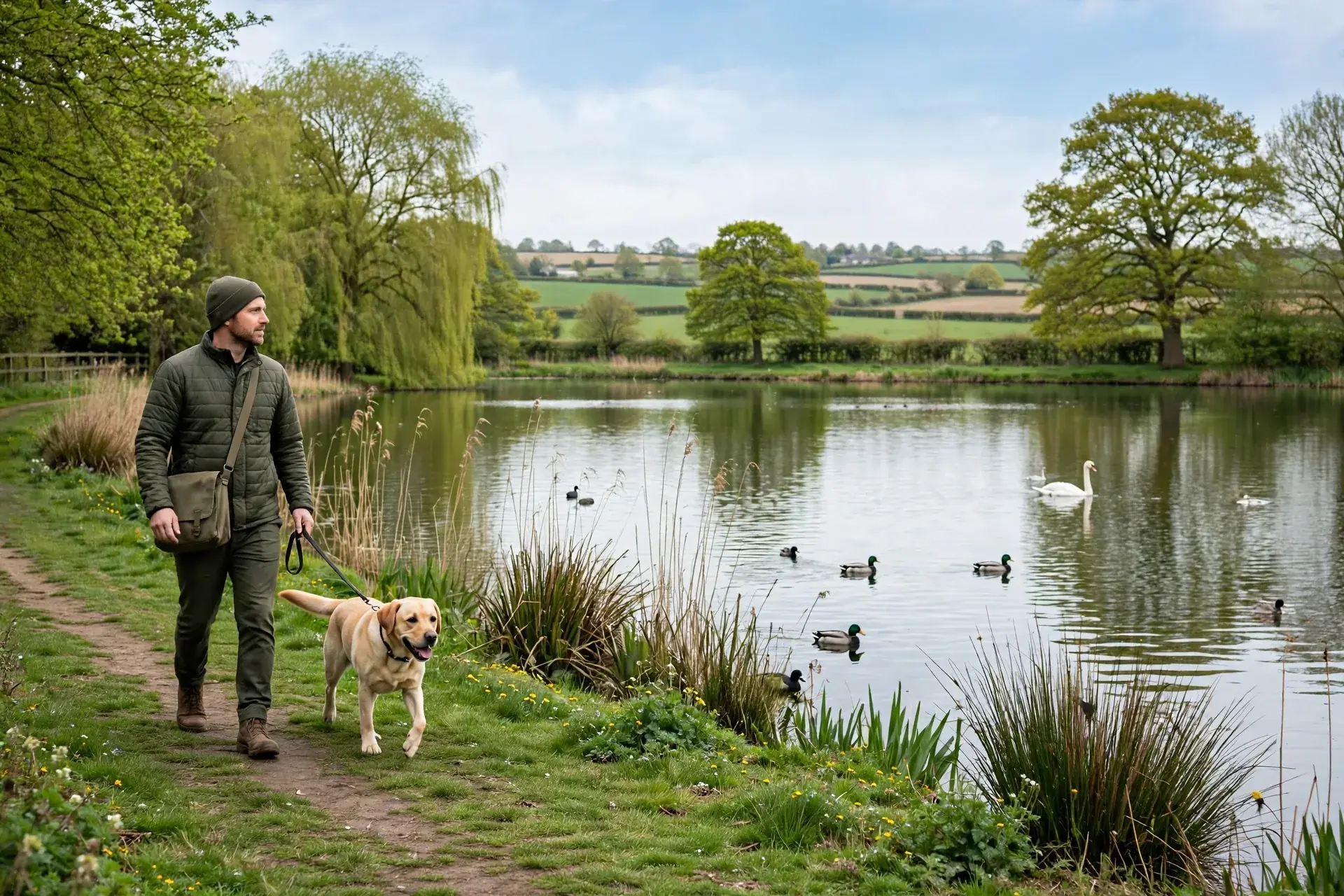
Diss Mere is a shared space, and lakeside manners are mostly about remembering who else is using it. Waterbirds are not scenery for a dog to chase; they are residents and, at certain times of year, parents protecting nests and young. A dog that rushes the waterline can scatter a whole group of birds, stress them during breeding or moulting periods, and create a problem that lasts long after your walk has ended. The kindest and simplest rule is to keep the dog on a lead near the water, keep a sensible distance from the birds, and move past calmly rather than stopping to let the dog stare. If a bird is on the path or very close to it, give it a wide berth and do not let the dog investigate at close quarters.
Lead choice matters more than many owners expect. A short, standard lead gives you the most control on a narrow lakeside path, beside a road, or when another dog appears around a bend. A long line can be useful on open grass, but only where the rules allow it, where there are no nesting birds nearby, and where the dog will come back when called. A retractable lead is a poor choice around water and wildlife, because it offers little real control at the moment it is needed most and it can tangle around benches, other walkers and the dog's own legs. In Diss, the practical approach is to start on a short lead, read the ground and the wildlife, and only lengthen the lead when the space genuinely allows it. When in doubt, stay short. Nobody will judge a dog on a lead; plenty of people will notice a dog harassing ducks.
Other dogs are the second lakeside question, and the Mere's popularity means meetings are likely. Not every dog wants to greet, and a dog on a lead is not automatically a dog that wants to say hello. Keep greetings short, or skip them altogether, and watch body language rather than relying on breed or size. A stiff body, a high tail, hard staring or a frozen pause are all reasons to move on cheerfully rather than forcing a meeting. If your dog is reactive, nervous or simply tired, cross to a wider part of the path, create distance, and reward calm behaviour. A lakeside walk that avoids three forced greetings is a better walk than one that includes them. The same logic applies to children, cyclists and joggers: give space, keep the lead short where paths narrow, and step aside where the path pinches near the water.
Feeding the birds deserves a separate warning, because it is a common and well-meaning mistake. Bread and other human food are poor nutrition for waterbirds, and food thrown near a dog creates a scramble that can end in snapping, chasing or a dog eating something it should not. Do not feed the birds while your dog is with you, and do not let your dog eat food left on the ground by others. If you see scattered food on the path, steer the dog around it and keep walking. Clean water for the dog, carried from home or bought in town, is always safer than letting the dog drink from the Mere, where water quality can vary and where algae and other hazards are not visible to a visitor. If your dog does drink from the lake or enters the water despite your efforts, rinse it afterwards if you can and watch for any signs of illness, seeking veterinary advice if you are concerned.
Finally, remember that lakeside rules can change. Seasonal wildlife protection, maintenance work, path closures and water-quality advice all vary through the year, and a rule that applied on a previous visit may not apply on the next one. That is why this guide keeps repeating the same sentence: check the official guidance before you travel. It is not filler. It is the only honest way to write about a living lake in a town you do not control. A quick check before you leave, plus a look at any signs on the day, will tell you more than any guide written months earlier possibly could.
The park, the town centre and supplies
After the Mere, the park and the town centre turn a walk into a usable day. Diss is a market town, which for a dog owner means something very practical: you can buy what you forgot, find drinking water, pick up food for the dog, and replace a chewed lead or a forgotten bag without driving to a larger town. That matters more than it sounds. Many countryside walks fail not because the route is wrong but because a small supply problem becomes a big one halfway along a lane. A town-centre stop before the longer walk is insurance, and it also gives the dog a change of scene: pavement, people, shop fronts and new smells, all at a gentle pace.
Plan the town stop as a short, structured errand rather than a long shopping trip. Dogs cope better with a clear task and a clear end than with an hour of browsing while they wait outside or lie under a table. Before you set out, make a small list: water, bags, treats, a towel if the dog is wet, and any food or medication the dog needs for the day. If you need a longer shop, consider splitting it so that one person waits with the dog or the dog rests in the car or accommodation in between. Do not leave a dog tied outside a shop for a long period, and never leave a dog in a hot or cold car while you shop. A dog that is left briefly, in shade, with water and in sight of the door is a different matter from a dog left for an hour in an unfamiliar street, and the difference is entirely about duration, weather and supervision.
Dog access inside shops, cafes and other indoor spaces varies from place to place and can change, so do not rely on a single rule for the whole town. Some places welcome dogs inside, some allow them in a particular area only, and some do not allow them indoors at all. The polite approach is to ask before entering, keep the dog close and on a short lead, and be ready to take the dog outside if it barks, pulls or becomes distressed. A well-behaved dog that lies quietly under a table is welcome in far more places than a dog that jumps up, barks at every arrival or begs at other tables. If you are unsure, choose a pavement or outdoor seating option where the dog can settle without the pressure of an enclosed room, and check the official guidance before you travel for any venue you are counting on.
The park itself is worth treating as a destination, not just a route through. Grass, trees, benches and open space give a dog room to move without the constraints of a narrow lakeside path, and they give the owner a place to practise recall, settle work and calm greetings in a controlled way. Use the park for a short training break: a few minutes of loose-lead walking, a settle on a mat or blanket, and a calm release back onto the path. This is especially useful for young dogs, who need to learn that a park is not a signal to run wild, and for older dogs, who benefit from a soft surface and a chance to rest. Keep to the paths and grass that are open to the public, respect any fenced or planted areas, and always clear up after your dog, including in the park where other people will sit and children will play.
Toileting is a practical point that visitors often underestimate in a town centre. The Mere and the park are good places for a dog to toilet, but the town streets are not, and a dog that is desperate in a shopping street is a problem for everyone. Give the dog a proper toilet opportunity in the park before heading into the centre, carry more bags than you think you need, and dispose of them properly rather than leaving them by a bin or on a wall. If your dog toilets on a pavement, clean it up immediately and thoroughly. Market towns run on goodwill, and dog owners who clean up, keep dogs close and respect other people's space are the reason dogs keep being welcomed back.
Country lanes and the Waveney Valley direction
From Diss, the countryside opens quickly, and the direction towards the Waveney Valley is the natural one for a longer walk. The Waveney is the river that forms much of the Norfolk and Suffolk border here, and its valley gives the landscape its character: flat or gently rolling fields, hedgerows, drainage ditches, small woods and quiet lanes that link villages rather than racing between towns. This is not dramatic hill country, and that is its strength for many dogs. The walking is mostly level, the distances can be scaled up or down easily, and a walk that starts as a lane can become a field-edge path and then a lane again without any difficult terrain in between.
Choose a country route by the ground, not by the map distance. A three-mile lane walk on a dry, firm surface is easier than a one-mile walk through deep mud, and a dog that is happy on grass will struggle on a long stretch of hard tarmac in summer heat. Before you commit, look at the first few hundred metres: is the surface firm, is there a grass verge for the dog to walk on, is the lane busy with traffic, and is there somewhere safe to step aside when a vehicle passes? Norfolk lanes can be narrow, with high hedges and blind bends, so a dog should be on a lead and on the verge or pavement side wherever traffic is possible. Do not let a dog run loose on a lane, however quiet it looks, because a tractor, a delivery van or a cyclist can appear suddenly and a loose dog on a road is in real danger.
Field-edge paths and public rights of way are the reward for leaving the town, but they come with responsibilities that town paths do not. Keep to the marked path, close gates behind you, and do not let the dog run through crops or cut across a field that is not a right of way. In spring and summer, crops are growing and ground-nesting birds may be present; in autumn, fields may be freshly drilled or harvested and the surface may be rough. A dog on a lead on a field-edge path is welcome in a way that a dog ranging freely across a field is not, and farmers remember the difference. If a path is unclear, overgrown or blocked, turn back rather than forcing a way through. A walk that ends early is still a walk, while a walk that creates a dispute or damages a crop is a problem for the next dog owner as well.
The Waveney Valley direction also connects Diss to a wider Norfolk story, which is worth keeping in mind if you are planning more than one day. The Broads, to the north-east, offer a completely different kind of water walk, with boats, towpaths and reedbeds, and our guide to Norfolk Broads with a dog explains boat hire, life jackets and towpath lead rules in detail. Diss and the Broads are not interchangeable: Diss is a compact, lake-centred market town day, while the Broads are a water landscape that needs more planning, more water safety and more time. Used together, they give a Norfolk trip real variety, with Diss as the calm, walkable base and the Broads as the bigger water adventure. If you are building a longer itinerary, our weekend in Norfolk with a dog shows how to pace two days without overloading the dog, and Diss fits naturally into that slower rhythm as a first or last stop.
Distance, duration and daylight need honest planning on country lanes. A route that looks short on a map can take much longer with a sniffing dog, a muddy section and a gate that needs negotiating, and a walk that starts late in the afternoon can run into dusk on a lane with no pavement. Plan to finish well before dark, carry a torch in winter, and make sure someone knows roughly where you have gone if you are walking alone. Take water for the dog even on a cool day, because ditches and field ponds are not safe drinking water, and take a phone with charge for navigation and emergencies. If the dog is tired, do not push on to complete a loop for its own sake; a lane walked out and back is a perfectly good walk, and it has the advantage that you already know the ground on the return leg.
Arriving by rail and using Diss as a base
Diss is a practical rail-served town, and that changes how a dog trip can be planned. Arriving by train removes the parking search, the car-park-to-town walk and the temptation to drive everywhere, and it forces a healthier structure on the day: you walk from the station into the town, you walk to the Mere, you walk to the park, and you walk back. For many dogs, that walking structure is better than a series of short car hops, because the dog settles into a rhythm instead of being repeatedly loaded and unloaded. It also means the trip is possible for owners who do not drive, or who prefer not to drive on unfamiliar country lanes.
Rail travel with a dog still needs preparation, and the rules are worth checking before you travel rather than assuming them. Dogs usually travel on trains in Britain under conditions that include keeping the dog under control, on a lead, and not occupying a seat, but individual operators and services can differ in detail, so check the official guidance before you travel for the specific service you plan to use. Choose a quieter service if you can, especially with a nervous dog, and aim for a carriage area where the dog can lie at your feet without blocking an aisle. Bring water, a familiar blanket or mat, and something for the dog to chew or lick if that helps it settle. A dog that has had a toilet walk and a short play before boarding will travel far more calmly than a dog that has been rushed straight from the car to the platform.
Using Diss as a base, rather than just a stop, is where the town earns its keep. A base means you can leave luggage, return for a midday rest, and choose a second, different walk in the afternoon without repacking everything. It means the dog can sleep in the same place each night, which helps nervous dogs enormously, and it means you can learn the town over two or three days: which park entrance is quietest, which lane dries fastest after rain, and where the dog settles best. If you are staying for a weekend, resist the urge to fill every hour with a new destination. One good Mere morning, one country lane walk, and one relaxed town afternoon will leave the dog happier than three rushed trips to three different places.
For visitors without a car, the limits of a Diss base should be stated honestly. The town centre, the Mere and the park are all walkable, and that covers a full, satisfying day. Longer countryside routes, however, may involve lanes with no pavement, distances that are too far on foot for an older dog, or return routes that are awkward without a car. That does not make Diss a poor base; it makes it a base that rewards planning. Check walking distances on a map, not just in miles but in time with a dog, and have a fallback: a shorter loop, a return by the same lane, or a taxi or bus option if one is available and the dog is accepted. Check the official guidance before you travel for any public transport you plan to rely on, because dog rules on buses and taxis vary and are not guaranteed.
Accommodation choice is part of the rail-base question, even though this guide does not name specific places or prices, which should be checked at the time of booking. Look for the practical details that matter to a dog owner: a ground-floor or step-free room if your dog struggles with stairs, a nearby toilet area for last thing at night, a place to dry a muddy dog, and a clear statement of the dog rules for that specific room rather than for the property in general. Ask whether the dog can be left briefly, whether there is a charge, and whether the dog is welcome in any shared outdoor area. A base that answers those questions clearly is worth more than a prettier base that answers them vaguely.
Mud, livestock and the seasons
Norfolk in general, and the Diss area in particular, is a place where the season changes the walk more than the map does. The same lane that is firm and pleasant in a dry May can be deep, clinging mud in a wet February, and the same field-edge path that is open in winter can be a livestock field in summer. Planning by season is not about avoiding Diss for half the year; it is about choosing the right route, the right equipment and the right expectations for the month you are actually in. A dog that is prepared for mud will enjoy a wet walk; a dog that is not will hate it, and so will its owner.
Mud deserves a full paragraph because it is the single most common reason a Norfolk walk goes wrong. Clay soils, field entrances, ditch edges and the shaded side of a hedge all hold water long after rain has stopped, and a path that looks dry at the start can become a bog at a gateway or a stream crossing. Wear boots with grip, not trainers, and bring a towel, a drying coat and a spare bag for muddy leads. For the dog, a short lead through the worst sections prevents it from plunging into the deepest mud, and a rinse or a wipe-down afterwards is part of the walk, not an afterthought. If the dog has sore paws, cracked pads or a skin condition, wet mud can make it worse, so shorten the walk and stick to firmer surfaces. A walk that ends with a clean, dry dog is a success, even if it was shorter than planned.
Livestock is the other seasonal constant, and it requires more respect than most visitors give it. Cattle, sheep and horses are working animals, not scenery, and a dog's presence changes their behaviour. During lambing and calving seasons, animals are especially protective and easily stressed, and a dog that chases or even approaches too closely can cause serious harm. The rule is simple and non-negotiable: keep the dog on a short lead in any field with livestock, keep moving calmly, do not let the dog bark at or run towards the animals, and turn back if the route passes too close to a herd or if the animals block the path. If cattle approach you, stay calm, keep the dog close, and move steadily to the nearest exit without running. Never get between a cow and its calf, and never let a dog off lead in a livestock field, however well behaved it is at home.
Each season also brings its own smaller hazards. Spring brings nesting birds, new lambs and rapidly growing crops, so lead control and path discipline matter most. Summer brings heat, longer days and busier paths, so walk early or late, carry water, and watch for overheating, especially in flat-faced breeds, older dogs and dogs with thick coats. Autumn brings harvest, mud, fallen leaves that hide holes and ditches, and shorter daylight, so finish earlier and carry a light. Winter brings cold, wet ground, early darkness and the possibility of ice on lakeside paths and lanes, so shorten walks, dry the dog thoroughly, and watch for grit or salt on pavements that can irritate paws. In every season, ticks can be present in grass and woodland, so check the dog after countryside walks and remove any ticks promptly and correctly.
Seasonal closures and maintenance are a final reason to check before you travel. Paths can be closed for drainage work, tree work or wildlife protection, and a lakeside path that was open last month may have a diversion this month. A diversion is not a disaster if you have a fallback route in mind, but it is a frustration if you have planned a single, rigid loop. Build every Diss day with a shorter alternative: if the country lane is too muddy, the Mere and park still give a good walk; if the park is busy, a quiet town-centre loop still gives the dog a change of scene. Flexibility is the most useful piece of equipment a dog owner can bring to Norfolk.
A rainy-day plan that still works
Rain in Diss is not a reason to cancel the dog's day, but it is a reason to redesign it. A rainy-day plan should be shorter, closer to shelter, and built around drying, not distance. Start with a brief Mere-side leg stretch, long enough for a toilet walk and a sniff, but short enough that the dog does not become soaked and chilled. Then move into the town centre for a practical errand, which gives the dog a change of scene and gives you a reason to be out without committing to a long, exposed walk. Then return to shelter for the long part of the day: drying, food, rest and quiet play. A dog that has had a short, successful wet walk and a proper dry-down will settle far better than a dog that has been dragged around a muddy lane for an hour and then left wet.
Drying is a skill, not an afterthought, and it deserves the same attention as the walk itself. Bring at least two towels, or a drying coat if your dog will wear one, and dry the dog in a sheltered spot before returning to a car or accommodation. Pay attention to the belly, legs, ears and paws, where mud and water collect, and check between the toes for grit, small stones or cuts picked up on a wet path. If the dog is shivering, cut the walk short and warm it up indoors; small, older and short-coated dogs chill faster than they appear to, and a wet coat in wind loses heat quickly. Never leave a wet dog in a cold car or an unheated room to dry on its own, and never use a hairdryer on a high heat setting close to the skin.
Indoor options on a rainy day need to be checked, not assumed. Some cafes, shops and other venues welcome dogs indoors, while others do not, and the rules for a particular venue can change with the season, the time of day or a change of management. If you are counting on an indoor stop, check the official guidance before you travel and, if possible, confirm on the day before you set out in the rain. Have a second option ready: if one venue cannot take the dog, another outdoor shelter, a covered park area or a return to accommodation still gives the day a structure. The worst rainy-day plan is a single, rigid plan that depends on one indoor venue; the best is a short walk plus two or three flexible options.
Rain also changes the ground in ways that are easy to underestimate. Lakeside paths can become slippery, grass can become boggy, and lane verges can disappear under puddles that hide ditches or drains. Keep the dog on a lead on wet paths, avoid steep or muddy banks beside the Mere, and do not let the dog drink from puddles on roads or lanes, where run-off can carry oil, grit or chemicals. After a wet walk, check the dog's paws and coat for ticks, burrs and debris, and clean any mud from the paws before the dog walks across floors. A rainy day that ends with a clean, dry, settled dog is a good day, even if the walk itself was only twenty minutes long.
Finally, use a rainy day to do the planning that a sunny day crowds out. Check the forecast for tomorrow, look at the map for a drier route, note which lanes were muddy today so you can avoid them tomorrow, and give the dog a rest day if it needs one. Dogs do not need a long walk every single day, and a rest day after a wet, tiring walk is often more restorative than another forced outing. Diss rewards this patience: the Mere will still be there tomorrow, the park will still be there tomorrow, and a dog that is rested today will enjoy both far more than a dog that is exhausted by them.
Older, nervous and high-energy dogs
Diss suits a wide range of dogs, but not in the same way, and the plan should be adjusted for the dog in front of you. An older dog often benefits most from the Mere and park alone, with a flat, short circuit, frequent rests, and a soft surface where possible. Avoid long lane walks, steep banks and deep mud, and watch for signs of stiffness, lagging or reluctance to continue, which are requests to stop rather than challenges to push through. Bring a blanket or mat for rests, keep water close, and plan the day so that the longest walk is the first one, when the dog is freshest, rather than the last one, when it is tired. If the dog needs a ramp for a car or a step, bring it, and do not rely on lifting a large older dog in and out of vehicles repeatedly.
A nervous or reactive dog needs a different kind of Diss day, built around distance, predictability and escape routes. Choose the quietest time for the Mere circuit, keep greetings to a minimum, and use wide parts of the park where you can create space from other dogs and people. A nervous dog that can watch the world from a distance, with its owner calm and unhurried beside it, will learn that Diss is safe far faster than a nervous dog that is forced into close encounters. If the dog becomes overwhelmed, do not punish it and do not force it to continue; move away calmly, give it a quiet place to recover, and shorten the day. A short, successful walk is worth far more than a long, stressful one, and a nervous dog that has one good Diss day is more likely to have a second.
A high-energy dog presents the opposite problem: how to tire it out without a long, frantic walk that leaves it overexcited. The answer is not more distance but more brain work. Use the Mere circuit for sniffing, the park for training games, and a country lane for structured walking with regular stops, rather than a single, flat-out run. Scatter feeding on grass, a short search game with treats, or a few minutes of recall practice in a safe, enclosed-feeling space will tire a young dog more effectively than another mile of pulling. If the dog is a breed that needs to run, look for a safe, legal off-lead area where running is allowed, and check the official guidance before you travel for any such area, rather than letting the dog run loose on a lane, a field path or beside the Mere where it may disturb wildlife or other walkers.
Puppies deserve a special note, because Diss is an excellent first town for a young dog if the day is kept short and positive. Keep walks brief, avoid over-tiring a growing puppy, and use the town centre as a socialisation opportunity in small doses: a few minutes of watching people, a calm greeting with one friendly person, and then a rest. Do not let a puppy greet every dog it meets, and do not let it drink from the Mere or eat food from the ground. A puppy that leaves Diss having had a calm Mere walk, a quiet park rest and a short town errand has learned more useful lessons than a puppy that has been walked for hours and is too tired to learn anything at all.
Multi-dog households should plan for the weakest link, not the strongest. If one dog is older, nervous or less fit, the day should be built around that dog, with the fitter dog getting extra brain work rather than extra distance. Keep both dogs on leads where paths are narrow or wildlife is near, and do not let one dog's excitement pull the other into a situation it cannot handle. Two dogs that walk calmly together beside the Mere are a pleasure to watch; two dogs that pull in opposite directions around ducks are a problem for everyone. Diss, with its compact centre and its choice of short and longer routes, makes it easy to split the day if needed: one short walk for both dogs, a rest, and then a second, slightly longer outing for the fitter dog if that is appropriate.
A workable Diss day, step by step
A workable Diss day does not need to be complicated. It needs a clear order, a decision point in the middle, and a fallback for weather or tiredness. The order below is a template, not a timetable, and it can be stretched into a weekend or compressed into a single afternoon. The point is the sequence: Mere first, town second, country third, and rest whenever the dog asks for it.
Step one is the Mere circuit, early and unhurried, with the dog on a lead near the water and plenty of sniffing time. Step two is a park rest and a toilet opportunity, with water offered and a towel ready if the grass is wet. Step three is the town-centre errand, kept short and structured, with supplies bought and any dog access checked before entering a venue. Step four is the decision point: if the dog is calm, the weather is holding and the ground looks suitable, extend into a country lane or Waveney Valley direction walk; if not, return to shelter for a rest and a second, shorter Mere or park walk later. Step five is the wind-down: a final short toilet walk, a proper dry-down, food and water, and a quiet evening. That is the whole day, and it is enough.
Timing matters less than order, but a few practical points help. Walk the dog before a long car or train journey, not after it, so that the dog travels settled rather than restless. Feed the dog at roughly its normal times, and do not feed a large meal immediately before a long walk, which can cause discomfort. Give the dog a chance to toilet before entering a shop, a cafe or a vehicle, and carry bags on every outing, not just the first one. If you are staying overnight, do the last toilet walk in the park or by the Mere rather than in a town street, and keep the evening routine as close to home as possible: same bed, same feeding pattern, same last outing.
If you have a second day, use it to change one variable, not all of them. On day one, learn the Mere and the park; on day two, try a country lane in the same direction, or revisit the Mere at a different time of day. A second day that repeats a successful first day with one small extension is more enjoyable than a second day that tries a completely new area, a new route and a new routine all at once. Dogs learn places by repetition, and a dog that recognises the Mere on day two will walk it more calmly than a dog that is taken somewhere new every hour. That calm is the real reward of a market-town base: familiarity, not novelty.
Finally, keep a simple record of what worked. Note which park entrance was quietest, which lane was muddiest, which time of day the Mere was busiest, and how long your dog actually walked before tiring. That note, even if it is only a few lines on a phone, will make the next Diss visit far easier, and it will help you advise other dog owners honestly. A guide can describe Diss in general, but only your own notes can describe Diss for your particular dog, and that particular dog is the one the trip is for.
Packing and safety checks
Packing for Diss is packing for a market town plus a muddy lane, which means a small kit that covers both. Start with the essentials that should be on every outing: a lead, a harness or collar with identification, bags, water and a portable bowl, treats, and a towel. Add a drying coat or a second towel in wet weather, a torch in winter, and a first-aid kit that includes something for paw cuts and a tick remover. If your dog takes medication, pack it separately from luggage so that it is not left in a car or a hotel room by mistake, and carry a note of your vet's number and the nearest emergency vet details for the Diss area, which you should look up before you travel rather than searching for in a crisis.
Safety checks before a country walk are quick and worth doing every time. Check the lead and harness for wear, check the dog's paws for cracks or soreness, and check the weather forecast for rain, wind and temperature changes during the walk. Check that your phone is charged, that you have water for the dog, and that you know the return route. If you are walking alone, tell someone roughly where you are going and when you expect to be back. If the dog is off lead anywhere, which should only be where it is legal and safe, check recall before you need it, not after the dog has already run towards livestock or water. A recall that works in a garden does not always work beside a lake full of ducks, and Diss is a good place to learn that lesson gently rather than dramatically.
Health checks after a walk matter as much as checks before it. Look over the dog's paws, belly and ears, remove any burrs or debris, and check for ticks after grass and woodland walks. Dry the dog thoroughly, especially in cold or wet weather, and watch for limping, excessive licking of a paw, or a change in appetite or energy after a long walk. If the dog has been in or near water, watch for vomiting, diarrhoea or lethargy and seek veterinary advice if you are concerned, mentioning where the dog has walked and whether it drank from standing water. Most Diss walks will end with nothing more than a muddy dog and a tired owner, but a quick post-walk check turns a small problem into a small solution rather than a vet visit the next day.
Identification and insurance are the unglamorous parts of a dog trip, and they are worth a sentence each. Make sure the dog's tag and microchip details are up to date before you travel, because a dog that slips a lead in an unfamiliar town is far harder to reunite than a dog that slips a lead at home. Check that your pet insurance covers travel and third-party liability for the activities you plan, and keep the policy details accessible on your phone. These are not Diss-specific points, but they are the points that matter most on the rare day when something goes wrong, and a market town with a lake and country lanes is exactly the kind of place where a little preparation pays off.
Diss, in the end, is a town that rewards a dog owner who slows down. It does not offer a single, dramatic attraction that a dog must see; it offers a lake, a park, a market town and a valley of lanes, and it offers them in a compact, walkable form that a dog can actually enjoy. Start at the Mere, respect the waterbirds, stock up in town, choose a lane that suits the mud and the season, and have a rainy-day plan ready. Check the official guidance before you travel for any rule that might have changed, and let the dog tell you when the day is long enough. Done that way, Diss is not just a stop on the way to somewhere else in Norfolk. It is a complete, satisfying dog day in its own right, and a base worth returning to.
Practical questions
Before you go
Can my dog swim in Diss Mere?
Do not assume swimming is welcome. Keep your dog out of the water unless the current local rules clearly allow it, and check the official guidance before you travel, because water quality, wildlife protection and bank conditions can change.
Should my dog stay on a lead around Diss Mere?
A lead is the safest default around the Mere, especially near waterbirds, nesting areas, other walkers and the town centre. Use a short lead where paths are narrow or busy, and only consider a longer line where the ground is open, the rules allow it and your dog has reliable recall.
What should I do if we meet livestock on a Norfolk footpath?
Put your dog on a short lead, keep calm and steady, and give the animals plenty of space. Do not let your dog chase, bark at or cut through a herd, and be ready to turn back if the route feels unsafe. If livestock are close to a gate or stile, wait for a clear gap rather than rushing through.
Is Diss a practical base without a car?
Diss works well as a compact rail-served base because the town centre, the Mere and the park are close together, so a short stay can be built around walking rather than driving. Longer countryside routes still need planning, so check train times, walking distances and the return route before you set out.
What is the best rainy-day plan in Diss with a dog?
Keep the day short and local: a brief Mere-side leg stretch, a town-centre errand, then back to dry shelter for drying, food and rest. Check the official guidance before you travel for any indoor venue rules, because dog access indoors can vary and may change without notice.