No accommodation or service paid for coverage in this independent guide. Dobermanns vary in temperament and health, and breed-level guidance never substitutes for knowing your own dog — or your vet's judgement on exercise and medication. Rules and stay policies change; confirm from official sources before booking or travelling.
A Dobermann holiday works when the stay is chosen for a secure, enclosed garden and a room without a street-facing guard post, walks are led-on and livestock-aware, the dog gets structured mental work as well as miles, and the owner handles strangers' nerves with grace and distance. Declare the breed honestly on insurance and bookings, and carry proof of cover.
The silhouette people have already judged
Few breeds carry their reputation into a holiday quite like the Dobermann. Before your dog has done anything at all — before a paw has crossed the pub garden — strangers have read the silhouette: guard dog, police dog, something from a film. Some of them will cross the street. Some will scoop up their child. A few will openly say they do not like big dogs, to you, in the breakfast room. None of this is a verdict on your dog. It is, however, a fact of your trip, and trips go better when you plan for facts rather than resenting them by the second day.
There is a useful way to think about this: your Dobermann gets about five seconds of goodwill credit with strangers, and everything after that is earned by how the dog and its handler behave in public. The currency is legibility. A Dobermann at heel on a short lead, sitting calmly while you order coffee, reads completely differently from the same dog trotting ten metres ahead on an extending lead, head up and scanning. Both dogs are being perfectly well-behaved in their owners' eyes; only one is being read as safe by everyone else. On holiday, when you will encounter hundreds of strangers instead of your usual handful, legibility is the whole strategy.
Start with positioning. In queues, doorways, ticket desks and pub orders, keep your dog at your side or behind you, never out front where approaching people must pass the dog before they reach you. On narrow coastal paths and village pavements, step aside early and let the dog stand at your far side, away from passers-by — this is not submission, it is choreography, and it quietly removes ninety per cent of friction. When someone wants to say hello to the dog, which will happen often because Dobermanns are striking, you are the one who decides: short, side-on, with your permission, and cheerfully declined whenever the setting is wrong. A refusal delivered warmly — "not today, he's tired" — offends no one; a hesitant half-permission that turns into jumping up offends everyone and gets retold.
Children need a special rule, applied every single time without exception: no uninvited approaches from either direction, and no face-to-face greetings. Ask the adult first, keep it at the dog's shoulder, keep it brief, and end it yourself while it is still going well. Your Dobermann does not have to be uncomfortable with children for this to matter — the parents' nerves are real, and a lean dog standing taller than a toddler triggers protective instincts in adults that have nothing to do with your dog's character. Owners of tall, intense breeds protect everyone's holiday by being the most careful handler in the playground queue, not the most relaxed.
Finally, watch your own mood around other people's fear. It is tempting, after the tenth sidestep, to lecture the public about how sweet your Dobermann is. Resist. Nobody's fear was ever reduced by a stranger's lecture, and the holiday you want — the one with the dog asleep in the pub while you finish lunch — is built on being visibly, boringly, unfailingly attentive. Let the dog be the advertisement by being the calmest presence on the path, and accept that some people will never be fans. Their holiday matters too.
Book for the guard instinct, not the postcard
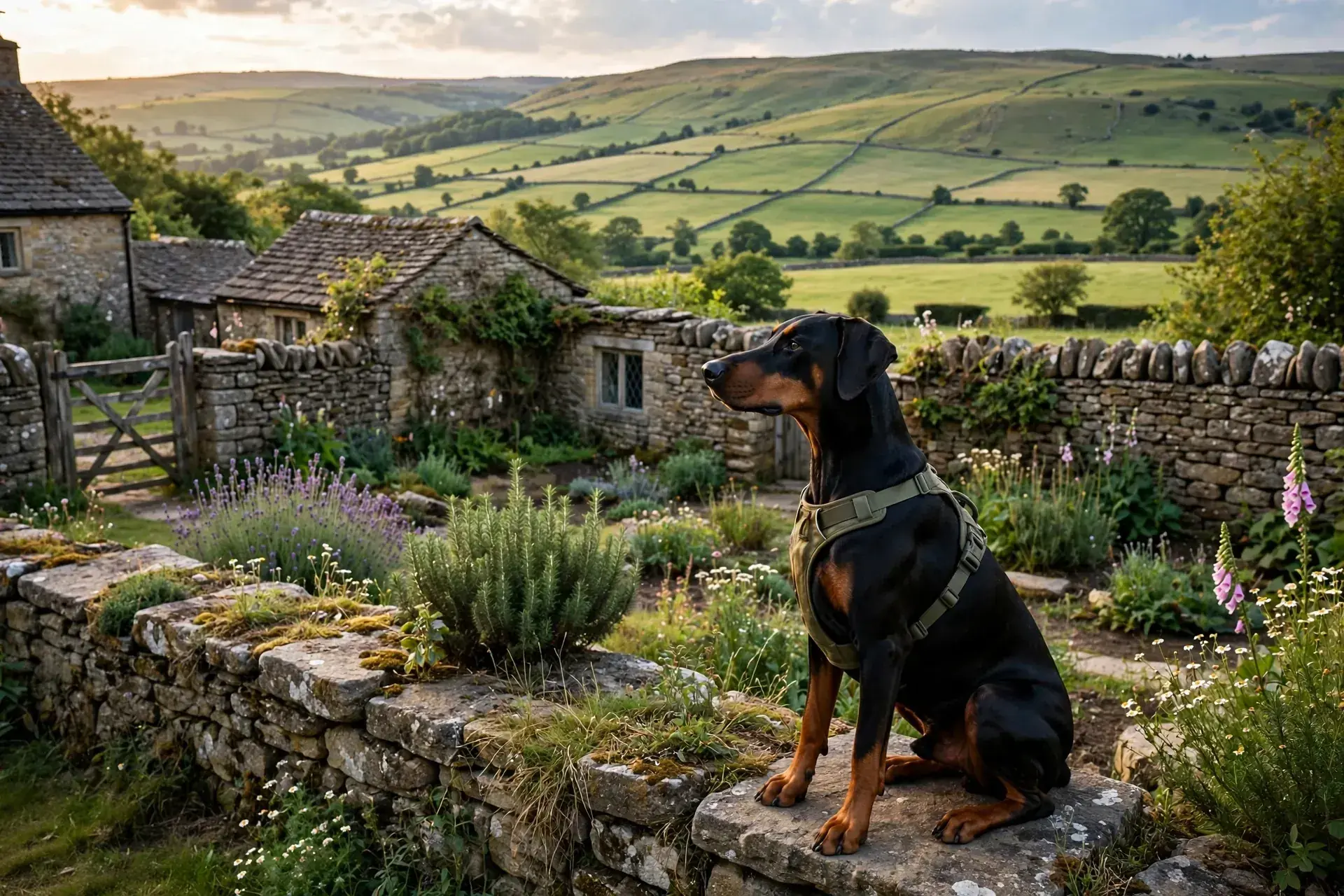
A Dobermann's holiday accommodation is first a security audit, then a holiday. This is a territorial, alert breed that treats unfamiliar territory as a posting to assume: the dog will map the perimeter, identify the weak points and select a vantage from which the whole approach is visible. In a holiday cottage with a glass front door opening onto a busy footpath, that means one dog on permanent, vocal duty in the hallway. In a barn conversion with a properly enclosed back garden and no sightline to the road, the same dog settles into the bed by six. Book for the dog you actually have, not the holiday you vaguely imagined.
Begin the enquiry honestly. State the breed, the weight and the age in the first message, and ask directly whether any size, breed or behaviour conditions apply to the booking. A Dobermann is not a banned breed in the UK, but some stays set weight caps — typically around 25 to 30 kilograms, a line some male Dobermanns cross — others limit the number of dogs per property, and a few carry insurance wording that names particular breeds or types. Finding this out after the drive is the avoidable catastrophe of large-dog travel; finding out before is a two-minute email. Keep the answer in writing, with the pet fee itemised and the specific property named.
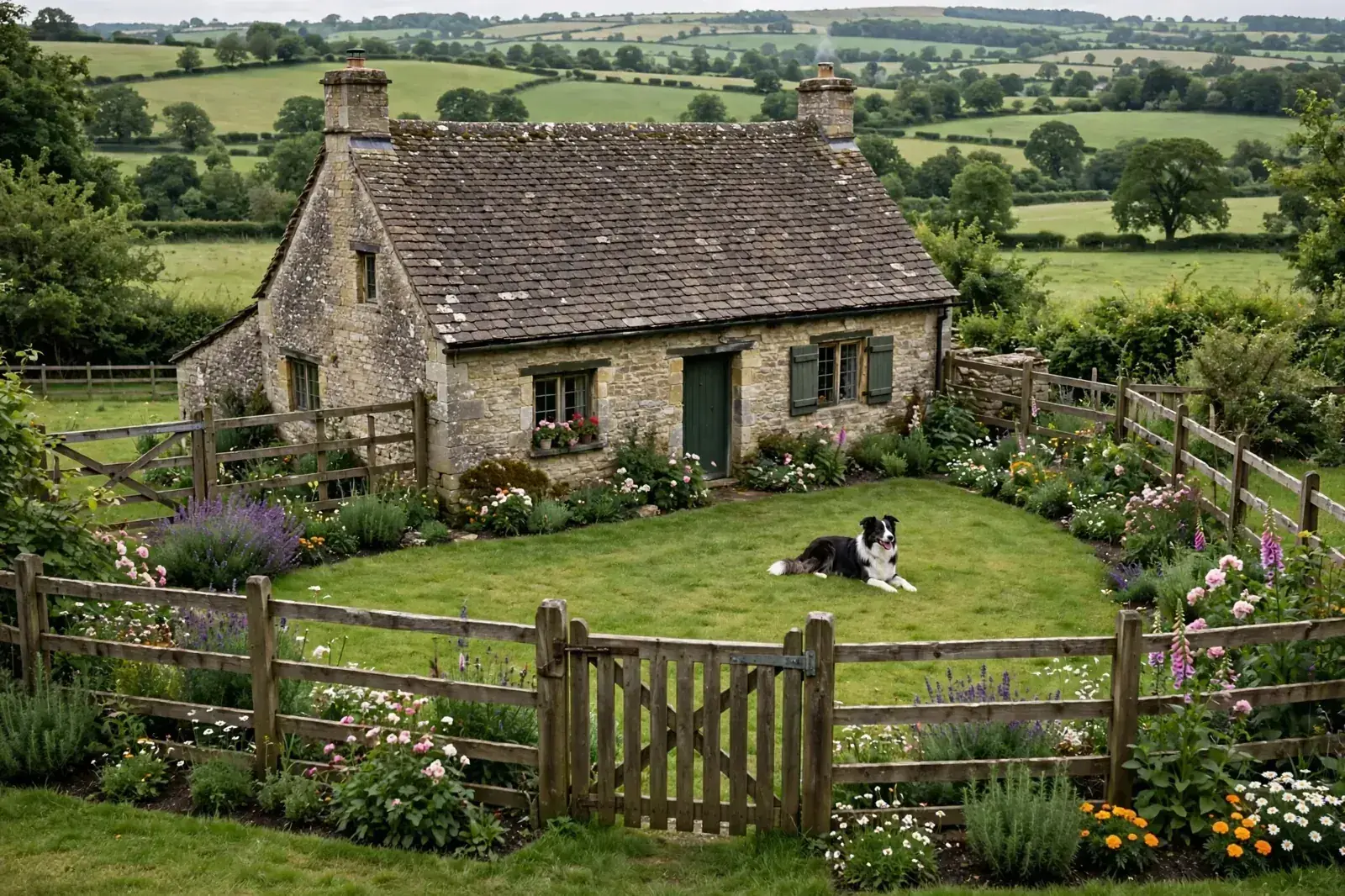
Then audit the territory. The single most important feature for a Dobermann stay is a genuinely enclosed outdoor space: fence height a tall dog cannot casually hop, gates that latch rather than lean, no gaps under hedges a determined escape artist can use, and no shared access the dog must negotiate every toilet trip. Our guide to cottages with secure gardens gives the full fence-and-gate checklist, and this is the breed it was most needed for — a Dobermann that patrols a shared courtyard will have opinions about the neighbours' comings and goings within hours. Ask for photographs of the garden from inside it, not from a drone; hosts who have genuinely thought about dogs answer these questions fast and specifically.
Inside, think about what the dog will guard. Properties where the dog's resting place naturally faces the only busy entrance are the worst for this breed: choose a layout where the dog's bed can sit away from the front door, and favour upstairs living areas or bedroom corridors that do not funnel visitors past the dog's nose. Avoid glass-fronted ground floors on main streets, places where the dog must cross a shared reception to reach the garden, and anything with a cat-flap-sized territory the dog is expected to respect without a gate. Self-catering cottages, farm annexes and lodges with their own entrance beat hotels for most Dobermanns for a simple reason: fewer shared corridors, fewer lift rides, fewer compressed encounters with strangers' dogs at breakfast.
Some properties will ask extra questions — prior incidents, barking, how the dog is left. Answer them as a mark of seriousness, not an interrogation: "He is crate-trained, sleeps through, has never bitten, and we have third-party liability cover" is the sentence that opens doors other owners keep closed. If a stay turns you down, thank them and book elsewhere; Britain is full of rural properties that welcome big dogs well, and a host who is uneasy about a Dobermann will never give you a relaxed week. The right property is one where the owner asks intelligent questions rather than performing either alarm or bravado.
Leadcraft for a fast, intense dog
A Dobermann can accelerate like few other British walking companions, and its owner needs a lead system built for that reality. The default holiday configuration should be a short, secure lead with a comfortable harness or well-fitted collar the dog is used to — not new equipment trialled for the first time on a Cornish clifftop. Extending leads in crowded holiday environments are a poor match for this breed: the ten-metre surprise launch that is merely annoying from a spaniel becomes genuinely alarming at the end of a Dobermann's momentum. Choose equipment you can actually hold if the dog lunges at something interesting.
Make the default off-lead policy conservative. Dobermanns combine high prey drive, intense focus and a guarding reflex, and holiday environments stack novelties — cyclists around blind corners, deer bursting from bracken, a cat sitting on the garden wall of your rental — faster than any home training schedule. Off-lead time should happen only where recall has been honestly proofed against those distractions, which for many holiday makers means designated enclosed fields rather than open countryside. Hiring a secure dog exercise field near your stay is one of the best spends of a Dobermann holiday: forty minutes of full-tilt, safe off-lead running beats a week of marginal open-field recalls. If your dog's recall is not reliable, there is no shame in a long line — a twenty-metre line on a harness gives freedom without surrendering control, and it keeps everyone else's dog safe from a greeting they did not consent to.
Greetings with other dogs deserve a protocol, applied on every walk. Dobermanns often approach directly and intensely, and other dogs — and their owners — can read that as confrontation even when your dog intends play. Keep meetings rare, brief and structured: a couple of seconds of sniffing on loose leads, then a cheerful recall and carry on, rather than the stand-around-and-chat-while-dogs-work-it-out pattern. If the other owner tightens up, scoop up your spaniel, or calls their dog away, read it as information and move on with a smile. Your dog's social needs are met at home; the holiday is about keeping the path calm for everyone, including nervous people who walked this route long before you arrived.
Consider the muzzle as a social tool, not a punishment. There is no general UK law requiring muzzles for Dobermanns, but a well-fitted basket muzzle does three useful things at once: it makes nervous strangers measurably more relaxed, it satisfies any venue or transport policy that requires muzzling, and it gives you a clear, visible answer to anyone who asks whether your dog is "under control". The only condition is that the dog must be conditioned to it positively at home for weeks before the trip — a dog fighting its muzzle is the opposite of reassuring. Our guide to pub garden etiquette discusses how calmly settled dogs make the best impression; a muzzled dog lying quietly under the table is often the most welcomed dog in the garden.
Finally, have an honest word with yourself about reactivity. A Dobermann that barks, lunges or fixates around other dogs, people, bikes or vehicles can still holiday — but the holiday must be designed for that dog: quiet areas, off-peak walk times, accommodation with a private entrance and enclosed garden, and an itinerary without surprise-heavy festivals, busy beaches or crowded promenades. Our guide to reactive dog holidays sets out the whole low-encounter design. What does not work is hoping the holiday will somehow fix a problem that training at home has not: hope is not a behaviour plan, and at the end of a Dobermann's lead the stakes of getting it wrong are higher than with most breeds.
Around livestock: treat every field as serious
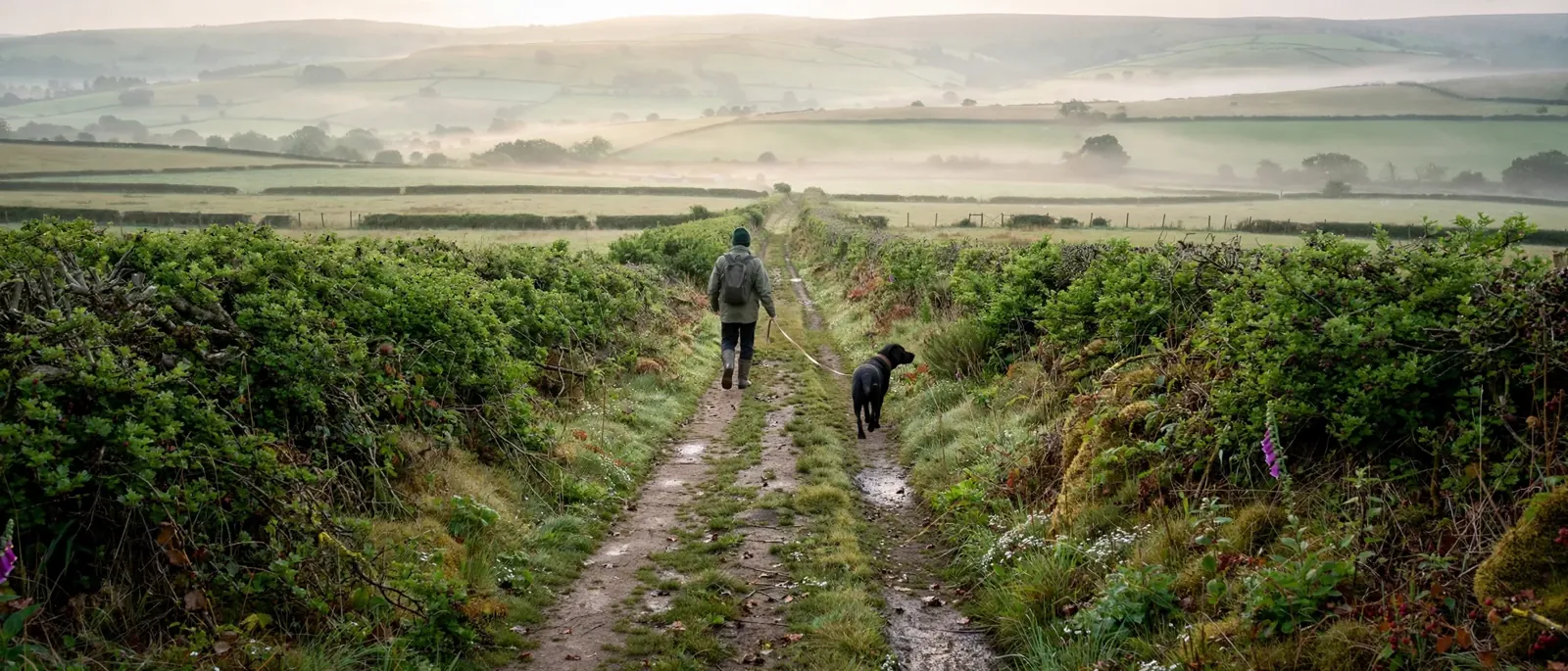
This section exists because of a specific mismatch: Dobermanns are one of the breeds with the strongest chase drive holidaying in a country where sheep, cattle and horses are the scenery. A Dobermann that spots movement on a hillside can commit to a chase in under a second, and what follows is not a harmless run — worrying livestock is a serious offence in the UK, farmers are entitled to protect their animals, and the consequences for owners are severe. The rule is simple and absolute: around livestock, or anywhere livestock could plausibly appear, the Dobermann stays on the lead. Even on apparently empty fields, even "just for a minute", even when your dog has never chased anything. Novelties plus adrenaline write their own rules, and holiday landscapes hold more temptation than any home walk.
Plan farmland walks defensively rather than reactively. Before the trip, look at routes on an OS-style map and mark the grazing land, then choose walks with wide verges, clear sightlines and distance from herds wherever possible. On the walk itself, keep the dog at your far side from the animals, shorten the lead early rather than late, and move through the stock quietly and steadily — no stopping for extended photography sessions in the middle of a flock. If a gate sign says livestock are present and you are not confident, turn around; there is always another route, and there is never a reason to gamble a dog, a sheep and your liability cover on one field crossing.
Know the countryside code obligations without treating the holiday as a law exam: dogs must be under control in public places, microchipped with details kept current, and wearing identification as required; around livestock the expectations tighten further, with dogs expected to be on leads or otherwise under close control near farm animals and on most open access land where livestock graze. If anything ever goes wrong — your dog chases or frightens animals — leash up immediately, do not argue on the path, exchange details, and report appropriately. For breeds whose silhouette is already memorable, being visibly responsible in a difficult moment protects not just your week but the access of every large-dog owner who walks that path after you.
Spend the Dobermann brain, not just the legs
A Dobermann with tired legs and a busy brain is a dream holiday companion. A Dobermann with tired legs and an idle brain will invent work — guarding the rental's front window, herding other people's children at the beach, or shadow-patrolling the cottage every twenty minutes without ever settling. This is a working breed shaped for sustained, intelligent partnership, and the exercise plan that suits it is built from two halves: a proper daily outing, and structured thinking time that most owners underestimate.
Design the day around one strong outing rather than three mediocre ones. A morning walk of ninety minutes to two hours — moorland, coastal path, forestry track — with sniffing, varied terrain and training woven in will leave most healthy adult Dobermanns genuinely content. Alternate the intensity across the week: a big hill day followed by a shorter, flatter day of sniffing and swimming keeps muscles and joints honest, and builds in the recovery this athletic breed needs without being asked for. Avoid the trap of marching a young dog into exhaustion to force calm — puppies and adolescents need restrained exercise to protect growing joints, and exhaustion is not the same as satisfaction at any age. If your Dobermann is older or has a heart or joint condition, discuss the planned activity honestly with your vet before booking; general breed information cannot judge an individual dog.
Then spend the brain. Tracking-style find-it games on a long line, scatter searches in rough grass, practising familiar obedience cues in new places for generous rewards, and food puzzles back at the cottage all do what extra miles cannot: they satisfy the breed's need to work with its handler. Twenty minutes of scent work in the garden tires a Dobermann more reliably than another lap of the same path, and a dog that has worked for its rewards settles faster in unfamiliar accommodation. Bring the dog's normal chews and long-lasting licking activities for the evening — the first night in a new place is the hardest, and a stuffed Kong plus the familiar bed routine teaches the dog that this territory requires no patrolling.
Watch the heat and the water with the same care as the mileage. Dobermanns are short-coated and feel cold snaps on exposed hills, but they also overheat faster than their athletic appearance suggests when racing in warm weather; plan hot days around early-morning outings, shade and water, and never leave a dog in a car on a warm day. For swimming, check currents and blue-green algae risks before letting a water-keen Dobermann launch itself — enthusiasm exceeds judgement in most dogs of this breed, and holiday water is unfamiliar water.
Pubs, cafés and the shared path: good neighbour conduct
Britain's dog-welcoming pubs and cafés are a highlight of any dog holiday — and they are the public arena where a Dobermann's reputation is made or broken. The goal is a dog that venue staff forget about within ten minutes: settled on a mat under or beside the table, out of the walking route, out of the children's zone, and out of the kitchen's path. Bring the dog's own bed or mat and train the settle at home until it survives novelty; a dog that can genuinely relax in strange rooms is worth more than any amount of charm.
Choose the table like a tactician. Edge tables away from the main door, the bar queue and the children's corner give the dog less to manage and other guests less to navigate around. A Dobermann stretched fully along a thoroughfare teaches a venue to question its dog policy; the same dog tucked at a corner table, calm and unnoticed, teaches staff that big dogs are fine. Book where booking is possible so you are not competing for the one workable table at lunch rush, and be prepared to skip a cramped, fashionable venue for a larger, plainer one where the dog can actually lie down without blocking a fire exit, a pram or another guest's chair.
Manage food and water with care. Feed the dog at its normal times rather than sharing from your plate, keep the water bowl under the table rather than in the walkway, and prevent begging or table-surfing absolutely — a Dobermann's head is at table height, which makes thefts impressive and memorable in all the wrong ways. If the venue provides treats or fuss, accept or decline based on your dog's manners that day, and never let strangers feed the dog without your explicit agreement. A brief, honest note to staff on arrival — breed, that the dog will settle, and that you will take it out if it gets restless — marks you as the kind of owner venues welcome back.
On shared footpaths, the rules of legibility apply all day. Step aside early for walkers with children or dogs on leads, keep your Dobermann at your far side, and never let it rush up to another party — "he's friendly" is not a greeting protocol, and at the end of a fast, large dog it lands badly. If a conflict ever starts — a growl, a snap, a frightened walker — separate immediately, check for injuries, exchange details calmly, and report appropriately rather than debating fault on the hillside. Owners of conspicuous breeds keep Britain's paths open to large dogs by being the most responsible party in every disagreement, especially the ones they did not start.
Insurance, declarations and the paperwork folder
A Dobermann holiday needs an insurance check before the booking, not after the incident. Start with your own policy: confirm the breed is declared accurately with the correct weight, confirm third-party liability cover is active and understand its limit, and read any conditions about leads, muzzling, unattended dogs, numbers of animals or exclusions tied to breeds or prior incidents. If a policy asks about specific breeds and your dog is one of them, answer precisely — an inaccurately declared breed can invalidate a claim, which is a discovery you do not want to make in a vet's waiting room in Devon. Our guide to dog travel insurance in the UK walks through the questions that matter for pet cover and travel cancellation cover alike, and this breed is exactly why the declaration questions exist.
Assemble a small paperwork folder, digital and paper, and carry it on every trip. Contents: proof of insurance with the policy number and emergency helpline, vaccination record, microchip number with the database details current, a recent photograph of the dog in case it is ever lost, your vet's details and the number of a practice near your destination, and any medication list with doses. If a venue, site or authority ever asks for evidence — insurance, vaccinations, identification — producing it calmly and promptly does more for this breed's reputation than any argument about fairness. Large, conspicuous dogs benefit enormously from owners whose paperwork is boring and complete.
Read the accommodation's own liability position too. Some properties ask you to confirm the dog is covered by third-party liability; some set conditions — dogs on leads in shared areas, not left unattended in rooms — that your insurance also expects. Where a condition appears in both your policy and the property rules, that is the rule to follow most carefully, because breaching it can affect both the stay and a future claim. If you are unsure what a policy clause means in practice — "attended at all times", say — check with the insurer before the trip, because their current wording is the only interpretation that counts. Confirm any uncertain facts from official sources before travelling.
The first hour sets the week
A Dobermann arrives at a holiday property and immediately starts work: mapping exits, testing boundaries, selecting guard posts. Your job in the first hour is to make that work boring. Arrive in daylight if you can — unloading a large, alert dog into an unfamiliar cottage at dusk is a poor start — and walk the perimeter before anything else: check gates actually latch, fence lines are continuous, windows near ground level close properly, and there is nothing the dog can guard through from the inside. Photograph any existing damage and move anything chewable, poisonous or valuable out of nose range.
Then install the routine. Put the bed where the dog can see you without commanding the front door, set up water in a spill-resistant spot, feed at the normal time in the normal bowl, and give the evening's chew or licking mat while you unpack. Take a short orientation walk so the dog can map smells, sounds and toilet places before dark — a calm sniff around the garden and the first hundred metres of path beats an immediate expedition. If curtains face a busy street or footpath, close them; a Dobermann that can see every passer-by from the sofa will bark at every passer-by from the sofa, and the first evening is when the pattern gets set.
Keep the first evening deliberately quiet. Same feeding time, same bed arrangement, same last-outing pattern as home — dogs read consistency as safety, and a guarding breed reads it fastest of all. Save the nearest vet's number into your phone before you need it; rural practices can be twenty minutes away and close early, and a Dobermann's size means you cannot improvise transport easily. If the dog settles, leave it be — do not keep testing whether it is really settled by inviting the neighbours in. A boring first hour buys you a relaxed first morning, and a relaxed first morning buys you the whole week.
Practical questions
Before you go
Can I take my Dobermann to dog-friendly stays in the UK?
Most dog-friendly stays accept Dobermanns, but always declare the breed and weight when you enquire, because some properties set weight limits, pet-number limits or their own breed conditions. A Dobermann is not a banned breed in the UK, yet individual businesses may have insurance-driven rules, so ask about any conditions in writing before you pay a deposit.
Should my Dobermann wear a muzzle in public places on holiday?
There is no general UK law requiring muzzles for Dobermanns, but a well-fitted basket muzzle is a sensible piece of holiday kit: it reassures nervous strangers, satisfies venue policies that require muzzling, and keeps busy days calm. Train the muzzle positively at home well before the trip so the dog is comfortable wearing it.
How do I handle people who are frightened of my Dobermann?
Stay friendly and give space: keep your Dobermann at your side on a short lead, step aside on narrow paths, and never let your dog approach someone uninvited — especially children. A calm, visibly attentive handler defuses most situations faster than any explanation, and accepting someone's discomfort gracefully costs you nothing.
How much exercise does a Dobermann need on a UK holiday?
Healthy adult Dobermanns are high-energy working dogs and generally need a generous daily outing plus mental work: tracking games, scent searches and training practice tire this breed more reliably than endless miles. Balance hard days with easier ones, keep walks off-lead only where recall is genuinely proofed, and check with your vet if your dog is older or has any heart or joint condition.
Do I need to declare my Dobermann on pet insurance before a holiday?
Yes — tell your insurer the correct breed and weight, confirm your third-party liability cover is active, and read any conditions about leads, muzzling, unattended dogs or numbers of animals. If a policy asks about specific breeds or exclusions, answer accurately: an undeclared breed can invalidate a claim. Carry proof of cover on the trip.
Is a Dobermann safe around sheep and farm animals?
Dobermanns have a strong chase drive, so keep yours on a lead wherever livestock could be present, even on apparently empty fields. Worrying livestock is a serious offence in the UK and farmers are entitled to protect their animals. Plan walks with distance from grazing animals, and if your dog has any chasing history, choose routes and stays away from farmland.