This guide is independent and contains no paid placement. If affiliate links are added later, they will be clearly marked and will not change our editorial checks.
A fit adult dog can usually carry up to 10–25% of its body weight in a balanced hiking backpack — start at 10% and build up over four weeks. Choose a pack by measured girth fit, balanced saddlebags, breathable fabric and reflective trim; watch for rubbing and overheating on every walk; and never load a puppy, a senior or a flat-faced breed.
The 10 to 25 per cent rule: how much your dog can carry
Before looking at a single product, learn the one number that keeps a hiking pack safe. Among working-dog trainers and veterinary physiotherapists, the widely used guideline is that a fit, adult dog should carry no more than 10 to 25 per cent of its own body weight — and that the sensible target for most British hill walking is the lower end of that range, not the top of it.
Start with 10 per cent. For a 20kg working cocker spaniel that is 2kg: enough for a litre of water, a collapsible bowl, poo bags and a handful of treats. For a 30kg Labrador, 10 per cent is 3kg; the full 25 per cent would be 7.5kg, but that ceiling is really for short, steady carries by very fit dogs on easy ground — not for a six-hour day on the Cairngorm plateau in October weather. The dogs that suffer in packs are almost never under-loaded; they are over-loaded on day one by owners who treated the 25 per cent figure as a starting target.
Four things move the safe number up or down. Build and breed matter most: a deep-chested, athletic build carries weight better than a long-backed or very short-legged dog of the same mass. Conditioning matters more than breed, though — a lean, hill-fit collie that walks daily will handle a pack far better than an overweight dog of any pedigree. Terrain changes the maths: scrambling over boulder fields, steep scree and bog-hopping multiply the effort compared with a level forestry track. Heat is the silent fourth factor: a pack adds insulation, so the same load that was fine in February can overheat a dog in an unseasonable April warm spell.
Put the rule into practice with a kitchen scale, not guesswork. Weigh the loaded pack the first few times you use it, including the weight of the pack itself — an empty large pack can already weigh 400–600g, which counts toward the percentage. A simple rule of thumb: weigh the dog, write down 10 per cent, and treat that as the budget. If the dog handles a full season at that load with no rubbing, no soreness and no behaviour change, you can cautiously explore a little more on short walks. If you are unsure where your dog sits on this scale, ask your vet at the next check-up and check the official guidance before you travel with a loaded pack in a new area.
Anatomy of a good dog backpack: saddlebags, straps and handle
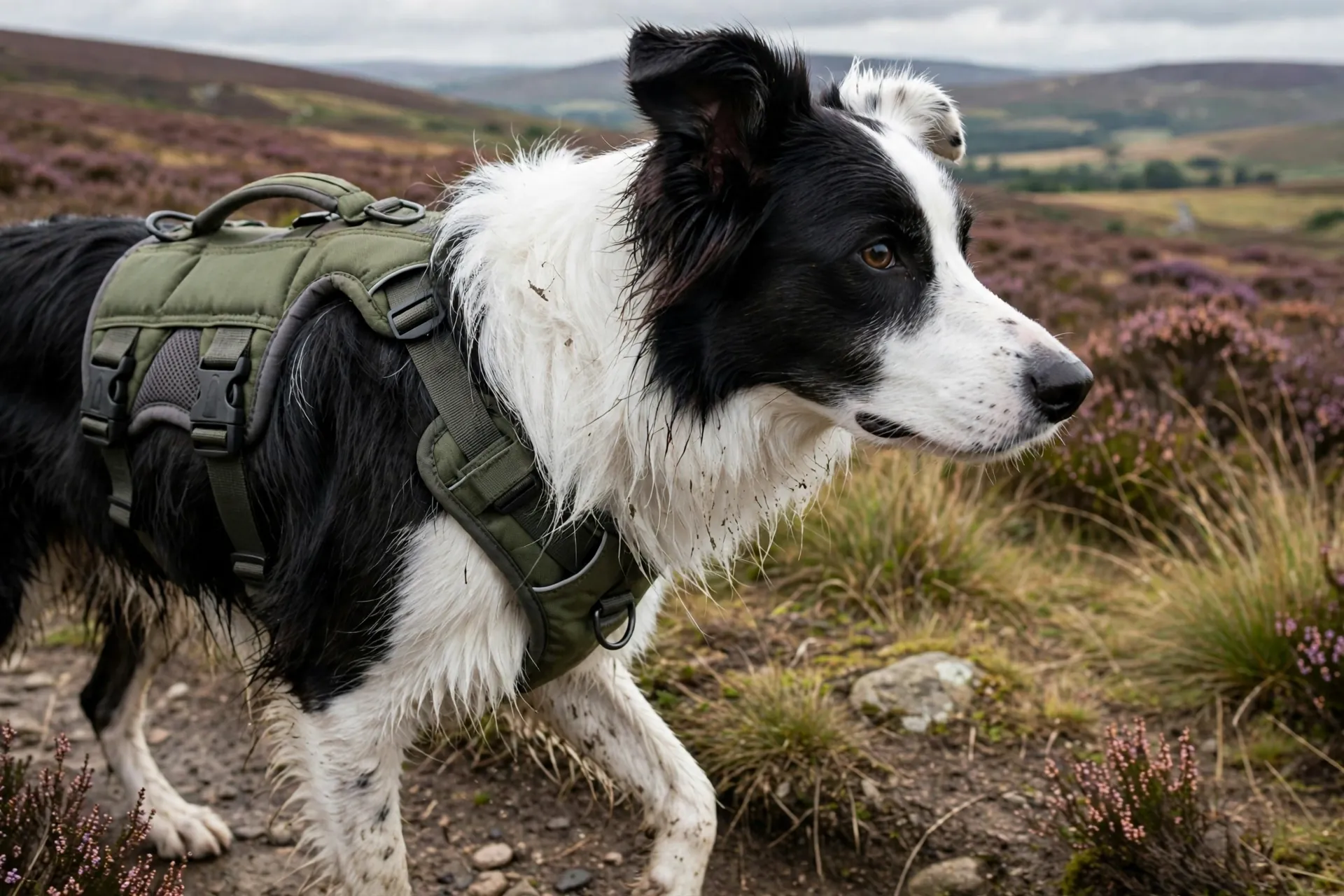
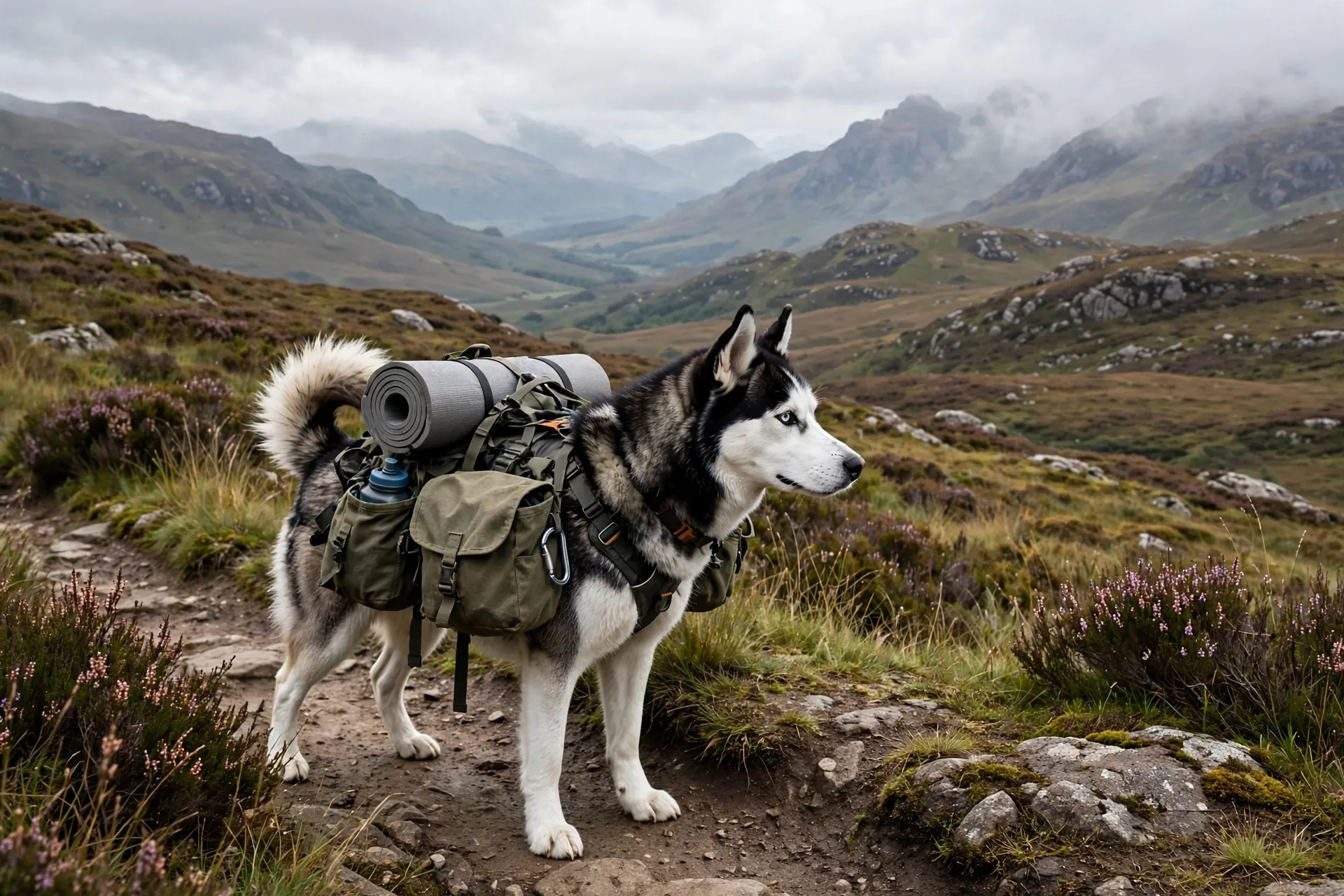
Every dog hiking backpack is the same basic machine: a padded harness with two saddlebags hanging over the ribcage, joined by straps under the chest and a bridge across the back. The differences between a good one and a bag-shaped frustration are in the details.
Saddlebags and balance. The bags should sit over the ribcage — the dog's weight-bearing middle — not draped forward over the shoulders or slung back toward the belly. Good designs have several smaller compartments rather than one big sack per side, because small pockets stop the contents sloshing from front to back as the dog moves. Look for bags that hang vertically and keep a low profile; wide, floppy bags catch on gorse, bracken and stiles, and a pack that swings is a pack that chafes.
Girth straps. Most packs have two: one just behind the front legs and one around the belly. Two straps spread the load and stop the pack rotating around the dog's body; single-strap budget designs tend to slide sideways on any dog that scrambles or rolls. The belly strap should sit well clear of the last rib and never press on the soft abdomen. Wide webbing (at least 38mm) with a soft neoprene or padded lining causes far less rubbing than narrow cord.
The chest and bridging straps. A strap across the chest connects the two sides at the front and stops the bags sliding backward; on many packs the two girth straps join into a "bridge" over the back. These straps must be fully adjustable because a dog's chest depth and shoulder slope vary enormously between a greyhound and a staffie of the same weight. Quick-release buckles are worth having: if a dog gets tangled in a stile or snagged in a fence, you want the pack off in two seconds, not after unthreading webbing.
The top grab handle. This is not a convenience feature — it is a safety one. A sturdy handle lets you steady the dog over a stile, lift it over a boggy gap, or hold it clear of a sheep encounter. It should be sewn into the load-bearing structure, wide enough to grab with a gloved hand, and rated for a firm lift of the dog's weight. While you are at it, check the handle's position: it should sit over the dog's centre of gravity so a lift keeps the pack balanced instead of tipping it.
Back pad and breathability. The panel between the pack and the dog's spine should be padded and shaped to stand clear of the backbone itself, channelling weight onto the muscles either side. Mesh panels in the pad help heat escape — worth prioritising even in Britain, because a pack worn for five hours on a warm day turns into a blanket. Water-resistant fabric on the outside of the bags is useful for Scottish weather; fully waterproof packs are rare, so treat the contents you must keep dry (phone, first-aid kit) as needing their own dry bags regardless.
Buying checklist: capacity, fit, breathability, visibility
Dog packs are sold by girth size, not by dog breed or weight, and the size charts differ between makers. Measure before you buy anything.
Fit first: measure the girth. Wrap a soft tape measure around the widest part of the ribcage, just behind the front legs — not the neck, not the waist. That number decides the size. Between sizes, most fitters recommend sizing up and tightening down, because an undersized pack leaves the bags riding too far forward and the straps digging in. Once fitted, apply the two-finger test: you should be able to slide two flat fingers under every strap. Any tighter risks chafing and restricted breathing; any looser and the pack will swing. If you are kitting out a large breed, our large-dog travel guide covers measuring for crates and boot space, and the same tape-measure discipline applies here — guess the size and you will buy twice.
Capacity tiers for British days out. Think in terms of what the dog will actually carry, not the maker's litre number. Small day packs (around 6–9 litres total) suit dogs up to about 15kg on short walks: water, bowl, treats and bags. Medium packs (around 10–14 litres) fit a 15–30kg dog on a full day: water, food, a drying towel, a small first-aid kit and a spare lead. Large packs (15 litres and up) are for 30kg-plus dogs on long expeditions and can carry a share of human kit too — but remember the 10 per cent rule caps most real loads well before the pack is full. A half-empty pack with well-placed dividers beats a crammed one every time.
Breathability and weather. Look for a mesh-lined back pad, ventilation channels and straps with soft edges rather than raw webbing. For British conditions, favour packs with a water-resistant shell and covered zips; after a wet walk, hang the pack open to dry, because a damp pack put straight into the car boot goes musty and stiffens the straps. Dark fabrics absorb heat on the rare hot day and are harder to spot on the hill — a brighter colour is not a fashion choice, it is a find-your-dog choice.
Visibility and reflectivity. British trails mean dawn starts, dusk finishes and long stretches of moor in flat light. Reflective piping or panels on the bags, a bright colour that contrasts with bracken and heather, and a loop for a small clip-on light make the dog visible to you, to other walkers and to traffic on lanes. Some packs include a spot for a bear-bell-style ringer — overkill in most of Britain, but the principle of being findable in mist is sound.
Details that separate the good from the annoying. Leash attachment points on top of the pack (so the lead clips to the pack, not the collar, on scrambly ground), external mesh pockets for poo bags and a water bottle, compression straps to cinch down a light load so it cannot shift, and zips with big pull tabs you can work with gloves on. Check stitching at the handle and strap anchors — these are the failure points — and read the maker's stated maximum load, which should be honest about the 10–25 per cent range rather than claiming every dog can carry the pack's full volume.
The four-week loading plan
No dog should go from never having worn a pack to a loaded ten-miler in one weekend. Muscles, skin and confidence all need conditioning. This four-week plan assumes a fit adult dog that already walks well on a lead; scale it slower for a dog new to longer walks.
Week one: the empty pack. Let the dog sniff the pack indoors, then put it on empty for short sessions — ten minutes in the garden, then a normal 20-minute walk. Reward calm behaviour, check for any sign of irritation at the straps, and take the pack off before the dog gets bored. The goal is only that the pack predicts good things. Three or four sessions this week is plenty.
Week two: 10 per cent on easy ground. Load to the 10-per-cent budget (pack included) and walk 30–45 minutes on familiar, level routes. This is where you learn your dog's baseline: does the gait change, does the dog slow down, does it try to roll? Check the armpits and girth area for redness after every walk — this is when most fit problems show up, not in the shop. Keep at least one rest day between loaded walks.
Week three: varied terrain, same weight. Keep the load at 10 per cent but introduce hills, uneven ground and longer outings up to 90 minutes. British hillside paths are perfect for this: grass, stone, bog and stile in one loop. Watch how the dog handles stiles with the pack on — you may need to unclip the belly strap to help it through, and that is exactly what the grab handle is for. If any rubbing appears, stop and refit before continuing; do not walk through it.
Week four: the real thing. Now the pack can carry its full intended load for a proper day walk — still capped by the weight rule, and still balanced side to side. Do a final pre-walk ritual: lift the pack by the handle to confirm balance, run two fingers under each strap, and set a reminder to re-check the straps after the first twenty minutes, because straps settle as the dog warms up. After the walk, check skin, paws and attitude. A dog that finishes bright and eats normally is a dog whose pack programme worked.
Ongoing discipline matters more than the plan itself. Re-check the fit every few weeks — dogs gain and lose condition across the seasons, and a pack fitted in lean spring condition rides differently on an autumn dog. Training on varied terrain pairs naturally with lead skills: our guide to long lines versus leads covers the control options when a packed dog needs freedom on open ground without getting tangled in its own kit. And if the dog ever plants its feet and refuses the pack after weeks of happy wearing, believe the dog: refusal is information, not disobedience.
What to pack and how to balance it
A dog's pack should carry the dog's own kit first. That is the point of the exercise: your rucksack gets lighter, the dog gets a job, and everything either of you needs is still on the walk.
The standard day-walk load. Water is the heaviest and most important item — a litre weighs a kilo, so it dominates the budget; a collapsible bowl, the dog's lunch or trail snacks, treats for recall, poo bags, a small first-aid kit, a light drying towel or coat, and a spare slip lead. On remote Scottish routes, add a foil emergency blanket and a vet's phone number written on a card. Anything you would be miserable without if the walk overruns belongs in the dog's pack rather than left in the car: hypothermia does not wait for the car park.
Weight distribution: low, central, even. Split the total exactly between the two bags — weigh each side on the kitchen scale until they match. Pack the heaviest items low and close to the spine, over the ribcage; this is the dog's strongest zone and the load sways least there. Light, bulky items like a towel or rain coat go in the outer pockets where they act as padding. Nothing should hang below the belly line or swing freely: dangling kit throws the dog off balance on slopes and catches on every stile. Once loaded, lift the whole pack by its top handle — if it tilts even slightly, repack until it hangs level.
On-trail management. Stop and check the straps after the first twenty minutes of every walk; webbing settles and loosens as the dog warms up. Rebalance if one side has been drunk from — dogs drink the water, and a litre drunk from the left bag is half a kilo of asymmetry for the rest of the walk. Top up water at streams where it is safe to do so (and carry purification for you, not the dog), and always carry more water than the dog needs: a packed dog working on a warm day drinks noticeably more than the same dog off-duty. At the halfway point, do the thirty-second check: fingers under the straps, quick look at the armpit skin, a glance at the dog's breathing and energy. It takes less time than reading a map.
Rubbing and overheating: the stop signals
A pack the dog barely notices is a good pack. A pack the dog notices is telling you something — and the two problems to learn are chafing and heat.
Rubbing. Chafing shows up where straps meet moving skin: the armpits behind the front legs, the chest where the front strap crosses, and the belly under the rear girth strap. Early signs are flattened or thinned fur; a day later the skin goes pink, and after that it can break. Prevention is fit, balance and clean fabric: refit when the dog's condition changes, keep both sides equal, and rinse salt, mud and grit out of the straps after coastal or wet walks — dried mud on webbing is sandpaper. If rubbing appears mid-walk, stop: pad the spot with a folded cloth or your spare sock, loosen and re-centre the pack, and if the skin is broken, finish the walk with you carrying the pack. A dog that has been hurt by a pack will remember it, and a ruined pack association takes weeks to rebuild.
Overheating. A loaded pack is an extra layer of insulation on a working dog, and dogs cool themselves far less efficiently than we do. The early warning is panting that stays heavy long after a rest stop; then comes thick drooling, a glazed or unfocused look, and eventually stumbling or refusal to move. If you see the early signs, act at once: get the dog into shade, remove the pack, offer cool (not ice-cold) water, and wet the belly, groin and paw pads — never wrap a hot dog in a wet towel, which traps heat. Rest until the breathing is fully normal before carrying on, and seriously consider whether the dog should carry anything for the rest of the day. On warm days, plan the walk for early morning, cut the load to the minimum, and always carry a human-sized backup plan: you should be able to take the pack onto your own shoulders without drama.
Soreness the next day. Not every problem announces itself on the walk. A dog that is stiff rising the morning after a loaded walk, that is reluctant on stairs, or that flinches when you touch its shoulders has done too much. That is a conditioning problem, not a failure: drop back a week in the loading plan, cut the load, and build again more slowly. Keep a simple log for the first season — date, distance, load weight, terrain, and how the dog was the next day. Patterns you cannot see in one walk become obvious across six.
When your dog should not carry a pack
Some dogs should never be loaded, whatever the pack. This is the section to read honestly before you buy.
Puppies. Growing bones have open growth plates, and loading them risks injuries that can deform joints for life. The general veterinary guidance is to wait until growth is complete: roughly 12 months for small breeds, 18 months for medium breeds and 18–24 months for large and giant breeds. An empty pack worn for a few minutes can be part of socialisation, but weight waits for the vet's all-clear. If you are walking a young dog on the hills, you carry everything — that is the deal for the first year or more.
Seniors and arthritic dogs. Older dogs earned their rest. Arthritis, spondylosis and general stiffness all argue against added load, and a pack changes an old dog's centre of gravity at exactly the age when balance is already declining. If your senior still loves the hills, keep the walks, drop the pack, and carry their water and coat yourself. A drying coat after the walk does more for an old dog than a backpack ever will.
Flat-faced (brachycephalic) breeds. Pugs, French bulldogs, bulldogs and similar breeds already work hard to breathe; adding a pack that presses on the chest and adds heat is asking for trouble. They also overheat faster than other dogs, which compounds the pack's insulation effect. These are dogs to walk unloaded, in cool conditions, with frequent water stops.
Dogs with health conditions. Any dog with heart disease, breathing problems, spinal issues, recovering from surgery, or carrying extra weight should not be loaded without explicit veterinary approval — and "explicit" means you asked about the pack specifically, not that the vet once said the dog was fine in general. Pregnant dogs are obviously out. And any dog that is unfit after a quiet winter needs its base fitness rebuilt with unloaded walks before a pack enters the picture.
Wrong conditions, right dog. Even a fit adult dog should go unloaded on genuinely hot days (and British heatwaves are exactly when the risk spikes, because neither dog nor owner is acclimatised), on scrambles where a pack could snag, and on any walk where you cannot commit to the thirty-second strap checks. The pack is a tool for suitable days, not a uniform. When in doubt, the human rucksack still works — it worked for every generation of hill walker before dog packs existed, and it asks nothing of the dog at all.
Practical questions
Before you buy
How much weight can my dog safely carry in a hiking backpack?
For a fit, adult dog, a widely used guideline is a maximum of 10 to 25 per cent of body weight, with 10 per cent as the safe starting point. That means a 20kg spaniel starts at around 2kg and should rarely exceed about 5kg. Puppies, seniors, brachycephalic breeds and dogs with joint or heart conditions should carry nothing at all, and any dog new to packs should build up gradually over several weeks. If in doubt, ask your vet before you load the pack.
How do I stop a dog backpack rubbing my dog's skin?
Chafing usually comes from a poor fit or a pack that has slipped sideways. Measure your dog's girth at the widest point of the ribcage and follow the maker's size chart rather than guessing; you should be able to slide two fingers under every strap. Keep the load balanced left to right, tighten the girth straps so the pack cannot swing, and check the armpits and chest for redness after the first few walks. Padded, wide straps and rounded strap ends chafe far less than narrow webbing.
Can a puppy wear a hiking backpack?
No, not loaded. A puppy's bones and joints are still developing, and adding weight risks growth-plate injuries that can cause lasting damage. Most vets advise waiting until growth is complete, which can be 12 months for small breeds and 18 to 24 months for large breeds. An empty pack worn for a few minutes indoors can help a young dog get used to the feeling, but do not add weight until your vet confirms your dog's skeleton is mature.
Where should the weight sit in the saddlebags?
Weight should be split exactly evenly between the two saddlebags, with the heaviest items packed low and close to the dog's spine, over the ribcage rather than the belly or shoulders. Light, bulky things like a drying towel or rain coat can go in the outer pockets; water, food and first-aid kit belong near the centre. When the pack is loaded, lift it by the top handle: if it tilts, rebalance before you set off.
Is a dog hiking backpack the same as a dog carrier rucksack?
No. A dog hiking backpack is worn by the dog, with saddlebags hanging on either side of the dog's own body so the dog carries water, food and kit. A dog carrier rucksack is worn by you, with the dog riding inside it like a passenger. The two solve opposite problems: the backpack gives an energetic adult dog a job and lightens your load, while the carrier is for small, old or injured dogs that cannot walk the whole route themselves.