This guide is independent and contains no paid placement. Size limits, weight caps and carriage rules change — check before you book, directly with the property or operator for your dates.
Bring a tape-measure mindset. For a large dog — and especially a giant breed — the real filters are numbers: your dog's weight and shoulder height, a doorway and gate width, boot and crate internal dimensions, a bed that fits a fully stretched dog, and any written cap in the booking terms. Measure first, book second, and get acceptance for your actual dog in writing.
Start with a tape measure, not a photo gallery
Before you look at a single listing photograph, measure your dog. You need four numbers, written down and kept with your booking notes. First, weight, ideally from a recent vet visit rather than a guess — owners of big dogs routinely underestimate by several kilos, and that gap matters when a property sets a cap. Second, height at the shoulder, measured standing square on a hard floor. Third, nose-to-tail length when standing, and fourth, the length and width your dog occupies lying fully stretched on one side, legs out, which is how large dogs actually sleep when they are warm and relaxed. That last measurement is the one most holidays fail on: a dog that curls neatly at home in winter may sprawl across a surprising area in a warm cottage in July.
Then measure the things your dog has to fit through and into. Note the width of your own hallway and doors for comparison, the internal floor dimensions of any crate you own, and the usable boot space of your car with seats in the position they will be in on the journey. Usable is the key word. A boot brochure figure counts every awkward corner behind a wheel arch; your dog needs a flat rectangle, with room to turn, that is not shared with suitcases, a cool box and walking boots. If you do this measuring once, properly, every later question in this guide becomes quick to answer, because you can compare a property's numbers with your numbers instead of trading vague reassurances.
Keep the figures honest for giant breeds in particular. A Great Dane, Leonberger, Newfoundland, Bernese mountain dog, Irish wolfhound or large mastiff type does not scale up politely from a Labrador. Turning circles widen, tails sweep at table height, a shake after rain covers a whole small kitchen, and a dog lying across a cottage hallway can block it completely. None of this makes travel difficult in itself — plenty of large dogs are calm, practised travellers — but it does mean the margin for error in a small property, a small car or a crowded train carriage is much thinner. Planning for size is not pessimism. It is how you avoid discovering a problem at a doorway, with luggage in your hands, at the start of a week you have paid for.
A worked example: one dog, one doorway, one boot
Numbers become useful when you run them against a real doorway and a real car, so here is a complete worked example using invented but typical figures. The dog is a retriever cross weighing 38 kilograms, standing 64 centimetres at the shoulder, measuring 105 centimetres from nose to tail base when standing, and occupying a rectangle 128 centimetres long by 78 centimetres wide when lying fully stretched on one side. Those four figures are the dog. Everything else is a comparison against them.
Start with the doorway. The cottage front door itself is 82 centimetres wide, but the clear opening — measured from the face of the open door to the frame stop, at the narrowest point — is 74 centimetres. The dog does not need 74 centimetres of body width, but the dog, a handler holding a lead at one side, a wet coat and a turn into a hallway at right angles together do. The check that matters is the turn after the door: draw the hallway as a rectangle, mark the stretched-lying rectangle inside it, and ask whether a person can still step past at night. In this example the hallway is 95 centimetres wide, so the lying dog leaves a 17-centimetre gap — passable for an adult stepping carefully, not passable for a child carrying a tray, and a reason to put the bed in the kitchen instead.
Now the boot. The load floor measures 110 centimetres by 96 centimetres on paper, but the wheel arches cut the usable flat rectangle to 110 by 80 centimetres, and the sloping tailgate steals length at head height. A crate with an internal floor of 102 by 72 centimetres looks close to the dog's standing length, yet it fails the lying test: the dog needs 128 centimetres of diagonal or length to stretch, and this crate offers neither. The honest solutions are a larger vehicle, one rear seat folded to lengthen the rectangle and a crash-tested harness instead of a crate, or a different crate whose internal diagonal genuinely allows a stretched lie. What the worked example shows is the method: never compare a dog's standing length with a crate's external length, never count boot corners a dog cannot use, and write the comparison down, because the same arithmetic settles questions about kennels, beds, lift cars and garden gates for the rest of the trip.
How properties define “large” — and why the label misleads
There is no UK-wide definition of a large dog for holiday purposes, and that is the first trap. One cottage owner means a spaniel rather than a terrier. A holiday park may mean anything over a weight cap written in its terms. A ferry company may care only about kennel dimensions. A listing that says “large dogs welcome” and a listing that says “one dog welcome” can both be describing a stay that will not work for your dog, for opposite reasons. Treat every size statement as the start of a conversation, not as confirmation.
Weight caps are the most explicit filter. Where they appear, they commonly sit somewhere that excludes genuinely giant dogs while allowing most Labradors and similar breeds, which is why you must ask for the number rather than the adjective. Check before you book, in writing, and give your dog's real weight. If your dog is close to a cap, say so and ask whether the cap is strict. Some owners set it as a proxy for floor space or for wear on furnishings and will happily accept a calm, heavier dog once they understand the actual dog; others have insurance or lease conditions behind the number and cannot flex it. Either answer is useful — what you cannot afford is silence followed by a dispute on arrival.
Breed lists are the second filter, and they work differently. Some properties and parks exclude named breeds or types, sometimes because of their own insurance, sometimes because of local rules, and sometimes because of the legal framework around banned types in the UK. Declare breed or type accurately, including crosses, and do not rely on how your dog looks in a photograph. If your dog resembles a listed type, raise it early and ask exactly what documentation, muzzling or lead conditions apply in shared areas. A clear no at enquiry stage is disappointing; a refusal at check-in, with no alternative accommodation nearby, is a ruined holiday.
The third filter is the quietest: one-dog rules and per-dog pricing that assume small dogs. “One well-behaved dog welcome” often imagines a dog that sleeps under a chair. If your one dog weighs as much as three of those imagined dogs, occupies a whole rug and needs the garden gate opened fully to pass comfortably, the spirit of the listing may not match its letter. The same applies to “dogs stay free” offers with fair-use expectations, and to pet fees charged per dog with no regard to size — sometimes in your favour, sometimes funding a deep clean that a large, moulting, muddy dog genuinely needs. The fix is always the same: describe your dog in numbers and temperament, ask whether the stay suits a dog of that size, and keep the reply.
Finally, separate pets from assistance dogs in your mind. Assistance dogs have legal access rights that pet dogs do not, and they should not be counted against pet limits or charged pet fees. If you travel with both an assistance dog and a pet, clarify the arrangement explicitly so there is no confusion at booking or arrival.
Young large dogs: booking for the dog you will have, not the dog you have
A large-breed puppy breaks ordinary booking logic, because the dog you describe in March may be a substantially different animal by the August holiday. Giant and large breeds gain weight quickly through their first year and continue filling out well beyond it, so a stay, crate or car arrangement chosen around a five-month-old's current measurements can be outgrown before you travel. When you enquire, give the age the dog will be on the travel dates, the weight your vet expects by then, and the adult size of both parents where you know it. Book for the projected dog, and if a property's cap sits between the puppy's present weight and its expected weight, raise that openly rather than hoping nobody weighs the dog on arrival.
Growth also changes what a trip should ask of the dog's body. Developing joints in large breeds are vulnerable to repetitive impact, so build a young dog's holiday around short, frequent outings rather than one long hike, avoid repeated stair climbing and jumping down from boots or walls, and ask your vet before the trip what level and type of exercise suits your dog's exact age and breed. This is general guidance, not a prescription: growth rates and advice vary, and a vet who knows the dog overrides any rule of thumb you read online.
Behaviour is the third growth issue. An adolescent large dog combines adult strength with unfinished training: pulling towards other dogs, mouthing during excitement, chewing unfamiliar woodwork when teething or bored, and testing a garden fence it could ignore as a small puppy. Practise the specific skills the holiday needs — settling on a mat in a busy room, waiting at doors, walking past livestock distractions at home where you can — and pack chew-safe occupation for wet afternoons, because a bored young giant in a small cottage will find its own entertainment. Finally, expect more toilet stops, more water, more mud and more sleep than an adult dog needs, and choose a stay with easy, level access to an outdoor toilet area so those frequent trips do not involve a staircase at two in the morning.
Measuring a stay: doorways, stairs, turning space and gates
Ask a property four spatial questions that photographs never answer. How wide is the narrowest doorway your dog must use — usually the front door, a hallway pinch point or the door to the room where the dog will sleep? Is there a flight of stairs, how steep and narrow is it, and is the dog expected to sleep upstairs or downstairs? Where, exactly, will a large dog bed fit without blocking a door swing, a fire exit route or the only path to the bathroom at night? And how wide is the garden gate, and does it open fully or stick at an angle against a wall or bin store?
Stairs deserve special attention with big dogs. A steep, narrow cottage staircase that a person finds charming can be genuinely unsafe for a heavy dog, especially a young, enthusiastic one going down in the morning or an older dog with stiff hips. Many owners of large breeds prefer, or insist on, ground-floor sleeping for the dog. That means the downstairs layout matters more than the bedroom count: is there a hard-floored room where a big bed fits, near a door for last-out toilet trips, where the dog can settle without being in the kitchen work triangle? If the only downstairs space is a small open-plan living kitchen, picture your dog stretched out in it while someone cooks, carries a hot pan and opens the oven. If that picture is stressful on paper, it will be worse in person.
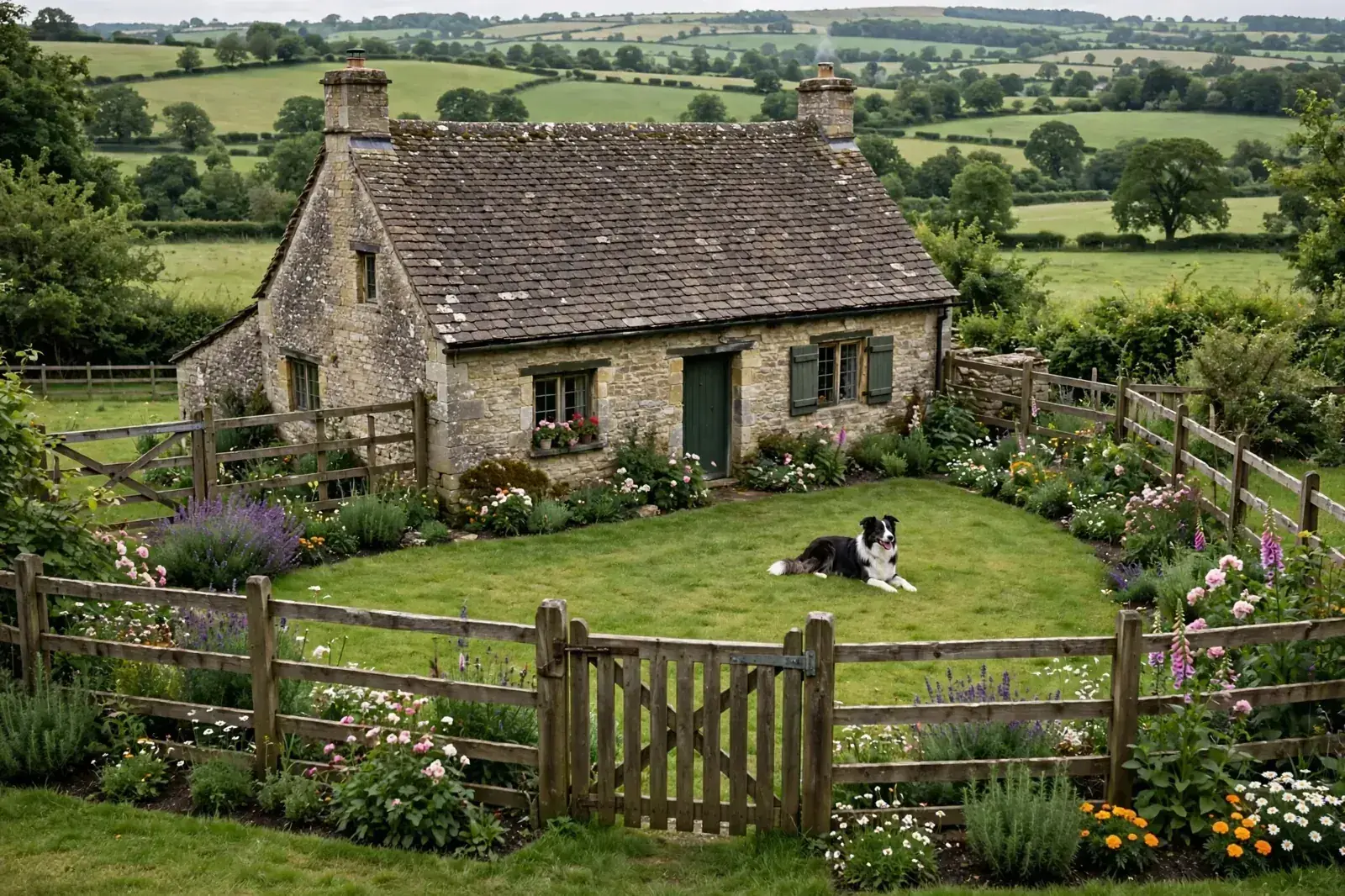
Turning space is the test nobody thinks to apply. Large dogs do not pivot like small ones. In a tight hallway, a big dog that meets a child, a suitcase or another dog may need to reverse to a wider point rather than turn. Look for at least one room or landing where your dog can turn comfortably, and think about the route from car to door: a narrow side passage, a flight of external steps or a gate that opens onto a road all change the risk picture for a strong dog on a lead. Our guide to self-catering stays with a secure garden goes deeper on boundaries and gates, and its checks pair well with the measurements here — fence height matters, but so does whether a large dog can actually get through the gate and turn in the garden without flattening every border.
Floors and furnishings are a size issue too. Laminate and polished wood that are easy to clean can be slippery for heavy dogs, raising the risk of splayed legs and joint strain; a large washable rug of your own can transform a room. Low windowsills sit at nose height. Coffee tables sit at tail height, and a happy giant breed's tail will clear them. Ask what is at tail height in the main room, move what you can on arrival, and photograph existing damage before your dog is blamed for it. None of these questions makes you a difficult guest. Owners of genuinely suitable properties answer them easily, because they have hosted big dogs before and know their own numbers.
Hotels and flats: stairs, lifts and the fire-exit question
Cottages get most of the measuring attention, but hotels and apartment stays introduce a different bottleneck: vertical travel. Ask, before you book, which floor the room is on, whether dogs are permitted in the lift, and what route the hotel expects you to use if they are not. Some buildings restrict animals to a service lift or a specific staircase; some leases for flats inside converted houses prohibit dogs in shared halls altogether. A ground-floor or low-floor room removes most of the risk, so request one in writing and explain why — large dog, stairs difficult — rather than discovering on arrival that your room is three flights up a narrow stairwell with a banister your dog cannot comfortably pass on the turn.
Measure the lift the way you measure a crate. A small passenger lift may fit four people standing, yet offer a floor rectangle too tight for a stretched large dog plus two adults and luggage, and a dog that rides pressed against strangers' legs, with the lead trapped in closing doors, will learn to dread the journey several times a day. Ride at quiet times, position the dog at the back wall facing the doors, keep the lead short enough that it cannot slip into the door gap, and let a full lift go without you. If the lift is out of service — common enough in older buildings — your fallback is the staircase, so that fallback needs to be realistic for your dog's age and joints before you commit to an upper floor.
Then ask the question almost nobody asks: what happens in a fire evacuation? Lifts are normally out of use during an alarm, so your exit is the stairs, in the dark, possibly in a crowd, with an alarm sounding. Walk that route once in daylight on your first evening, note where it narrows, where doors swing, and where you can pause aside to let others pass, and keep the lead, a torch and footwear by the bed rather than by the door. In a flat, add the shared-landings problem: a large dog settling or waiting on a communal landing can block neighbours, so keep landings clear, carry waste straight to an outside bin, and never tie a lead to a railing across a shared route. None of this is likely to be needed, but a dog too big to carry turns an evacuation plan from a formality into a genuine piece of trip planning.
Car, boot and crate sizing: the rectangle that decides the journey
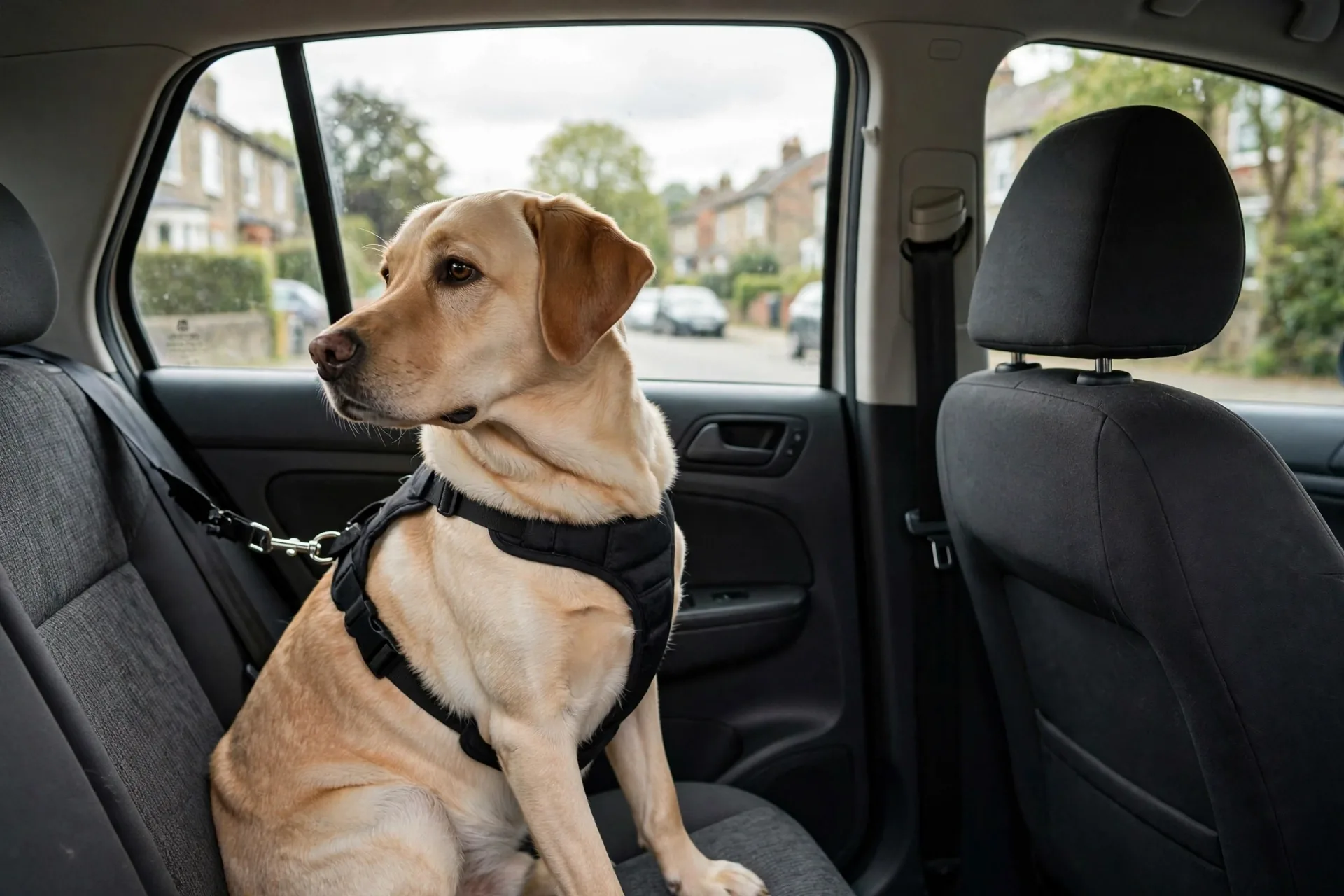
Most large-dog holidays begin and end in a car, and the car is where size mistakes hurt first. Start with the legal and safety baseline — a dog must be suitably restrained so it cannot distract the driver or injure anyone if you brake hard — and then get specific. Our guide to driving with a dog and UK law sets out the restraint rules in full; for a large dog, the practical question that follows is which restraint actually fits. A harness needs a correctly sized fitting and a tether point that lets the dog lie down; a crate or guard needs a flat rectangle big enough for your dog to stand, turn and lie fully flat.
Measure crates by their internal floor, not the external frame on the box. Sloping sides, which help a crate fit a hatchback boot, steal exactly the shoulder and hip room a large dog needs. As a working test, your dog should be able to walk in, turn without shuffling, and lie on one side with legs extended without pressing hard against the sides. If your dog can only curl, that may be acceptable for a short vet trip but is a poor plan for a four-hour holiday drive with breaks. Do a full rehearsal at home: crate or harness in place, luggage loaded, dog settled, a short drive, and a check for panting, scrabbling or inability to change position. A dog that cannot shift position on a long journey arrives stiff, stressed and harder to settle.
Luggage strategy changes with a big dog. The dog's rectangle is not negotiable, so everything else goes elsewhere: roof box, footwells behind the front seats for soft bags, or simply less luggage. Food for a large dog is itself luggage — a week's food for a giant breed can fill a carrier bag or more, and it must travel somewhere dry and sealed. Plan water and breaks around size too. Large dogs need room to stretch and relieve themselves at stops, which means choosing stops with a grass verge or dog area rather than a tight car-park corner, and allowing longer, calmer breaks. In warm weather the stakes rise: a big dog overheats in a stationary car just as fast as a small one, generates more heat in a confined boot, and needs ventilation and shade planned, never improvised. Never leave the decision about a break until the dog is already distressed; build stops into the route at intervals that suit your dog's age and bladder, and keep the last leg short enough that arrival is still relaxed.
Hire cars and van hire with a large dog: permission first, vehicle second
Your own car is a known quantity; a hire car is a contract, and many standard rental contracts either prohibit animals or allow them only with conditions and a cleaning charge. Never assume a dog is permitted because the vehicle looks suitable, and never rely on a verbal assurance at a busy desk. Get pet permission in writing when you book, state the dog's size and breed honestly, and ask three follow-up questions: whether the dog must travel in the boot area or may use a harnessed rear seat, what cleaning or valeting charge applies if hair or mud is found on return, and whether the excess or deposit changes when an animal is carried. Keep that confirmation with the rental agreement, because a dispute about a muddy load bay is settled by paperwork, not by memory.
Choose the vehicle by opening shape, not badge. A tall hatchback or estate with a low, flat load lip and a wide, near-vertical tailgate suits a large dog far better than a sloping coupe-style boot whose brochure volume is mostly unusable height at the edges. Ask for the load-floor dimensions with rear seats up and folded, check for a spare-wheel hump or battery box that breaks the flat rectangle, and confirm there is a proper anchor point for a harness tether or a guard — a luggage hook designed for shopping bags is not a restraint fixing. Photograph the boot and upholstery at collection, with the dog's blanket or fitted cover in place, so existing scuffs and your protection are both on record.
Van hire solves the space problem and creates two new ones. The first is ventilation and temperature: a dog must never travel in a sealed, unventilated cargo area, and if the van has a solid bulkhead the driver cannot hear or check the dog, so only consider layouts where the dog travels in a properly ventilated, lit and safely restrained space you can monitor. The second is movement: an unrestrained or loosely restrained large dog in a smooth-floored van will slide at every corner, so a correctly sized secured crate or a rated harness anchored to a structural point is essential, with a non-slip mat beneath. Check the hire firm's animal clause even more carefully for vans, since commercial hire terms are often stricter than car terms, and confirm collection and return inspection arrangements — returning a van that smells of wet dog to a depot that never agreed to carry one is an expensive conversation. Where a hire firm refuses, accept it and find one that welcomes dogs openly; firms that say yes in writing tend to have the right vehicles, covers and cleaning process already in place.
Ramps for older large dogs: small equipment, large difference
For a young, athletic large dog, jumping into a boot is unremarkable. For an older large dog, a dog with hip or elbow problems, or a giant breed you have deliberately never allowed to jump, that same boot lip is the hardest moment of the whole trip. You cannot lift a forty- or sixty-kilo dog safely, and a failed scramble risks injury to dog and owner alike. A ramp solves the problem, but only if you choose and train it before the holiday rather than unfolding a new, strange, slightly wobbly object in a wet car park.
Choose a ramp by numbers again. Its weight rating must exceed your dog's weight with margin. Its width should suit a broad dog that does not place its feet in a narrow line. Its surface needs grip in the rain, not just in the showroom, and its angle against your particular boot height should be gentle — a longer ramp gives a shallower slope and is worth the storage cost if your dog is arthritic. Practise at home on flat ground first, then at low height, with rewards, until the ramp is boring. Our guide to travelling with a senior dog covers the wider comfort picture — bedding, medication timing and pacing walks — and a ramp fits naturally into that routine.
Think beyond the car. A ramp or portable steps can help with a high cottage threshold, a raised deck or a holiday-park unit with steps, but only if you have asked whether there is space to deploy it and a door wide enough to use it through. Some dogs prefer a single wide step to a slope; some properties have a level rear entrance that removes the problem entirely, if you ask. The principle is to remove every jump and lift from the trip in advance, on paper, rather than discovering at dusk that the only entrance involves three steep steps and a dog that cannot manage them.
Trains and ferries with a big dog: space at your feet
On UK trains, dogs generally travel without a separate ticket, but the real limit is not a weight rule — it is the floor area at your feet and the expectation that your dog settles there without blocking the aisle or disturbing other passengers. For a small dog that is easy. For a large dog on a busy service, it is a genuine constraint. Read our dedicated guide to taking your dog on UK trains for operator detail, then apply the size test: can your dog curl or lie in the foot space of the seats you are booking, for the length of this journey, including the moment someone needs to pass with a trolley? If not, travel off-peak, choose services and carriages with more open space near doors or luggage areas where dogs are permitted, book seats that give you an end position rather than a middle one, and keep the lead short and the dog's kit — water, a mat to define the settling spot, and waste bags — in one grab bag. A familiar mat helps a big dog understand exactly where its rectangle is in a strange carriage.
Escalators, stairs and crowded platforms need a plan too. Many large dogs dislike escalators and some stations require dogs to be carried on them, which is impossible at this size — use lifts or stairs instead, allow extra interchange time, and keep your dog close and to the wall side in crowds so a tail or a sudden head turn does not trip a stranger. Start with a short, quiet journey as practice if your dog is new to trains; a calm ten minutes teaches more than a stressful three hours.
Ferries add booking rules to the space question. Depending on route and operator, dogs may stay in the vehicle, use an onboard kennel area, or join you in a designated pet-friendly area or cabin, and pet places can be limited and bookable in advance. Our guide to dogs on UK ferries explains the main patterns route by route. For a large dog, check before you book: whether a pet place must be reserved and what it costs, the kennel internal dimensions if kennels are used, whether a muzzle is required while moving through the ship, how long the crossing leaves the dog unattended if it stays in the car, and what exercise or toilet area exists on longer sailings. Measure a kennel the way you measure a crate — internal floor, standing height, room to turn — and if the answer does not fit your dog, choose a different route or sailing pattern rather than hoping to negotiate on the dock.
Pubs and cafes: etiquette when your dog is the floor plan
A dog-friendly pub sign usually shows a small dog under a table. Your dog, lying fully out, may occupy the space of a whole table setting, and good etiquette starts with accepting that rather than apologising for it all afternoon. Apart from assistance dogs, venues choose whether to admit pet dogs, and a landlord who welcomes dogs warmly can still reasonably refuse a spot where a large dog would block a walkway, a toilet corridor or a fire exit. Phone ahead for anywhere you are counting on, say honestly that yours is a large or giant dog, and ask where big dogs usually settle. The best answers name a specific area — a snug, a garden room, a corner table — which tells you the venue has hosted dogs like yours and has a place in mind.
On arrival, settle the dog first and order second. Put a mat down to mark the spot, position the dog out of the serving route between bar and tables, keep the lead short and never tied across a path, and place your water bowl where staff will not step in it. Choose off-peak times for a first visit, sit where an early exit is easy if your dog is unsettled, and be ready to leave without fuss if the room fills and your dog's space disappears. Watch the tail and the head: at this size both operate at table and tray height, and a friendly investigation of a neighbouring table's chips is funnier in a story than in person. Our wider guide to dog-friendly cafes in the UK covers venue-finding in general; the large-dog addition is simply to treat floor space as a booking requirement, like a table for six rather than a table for two, and to reward venues that plan for it by going back.
Beaches and narrow coastal paths: passing room is the issue
Open beaches suit large dogs beautifully — there is room to move, settle and shake without consequences — but the rules still apply by beach and by season, including lead zones, dog-free sections and seasonal restrictions, so check the specific beach before you travel rather than assuming a winter rule holds in August. The size-specific issues are at the edges: access steps and slipways where a big dog needs a steady, unhurried descent; rock pools and groynes where turning room is tight; and the moment a large, wet dog shakes beside a stranger's picnic. Give that shake a wide berth, keep more distance than you think you need, and remember that some people are frightened of large dogs regardless of temperament. Space is courtesy.
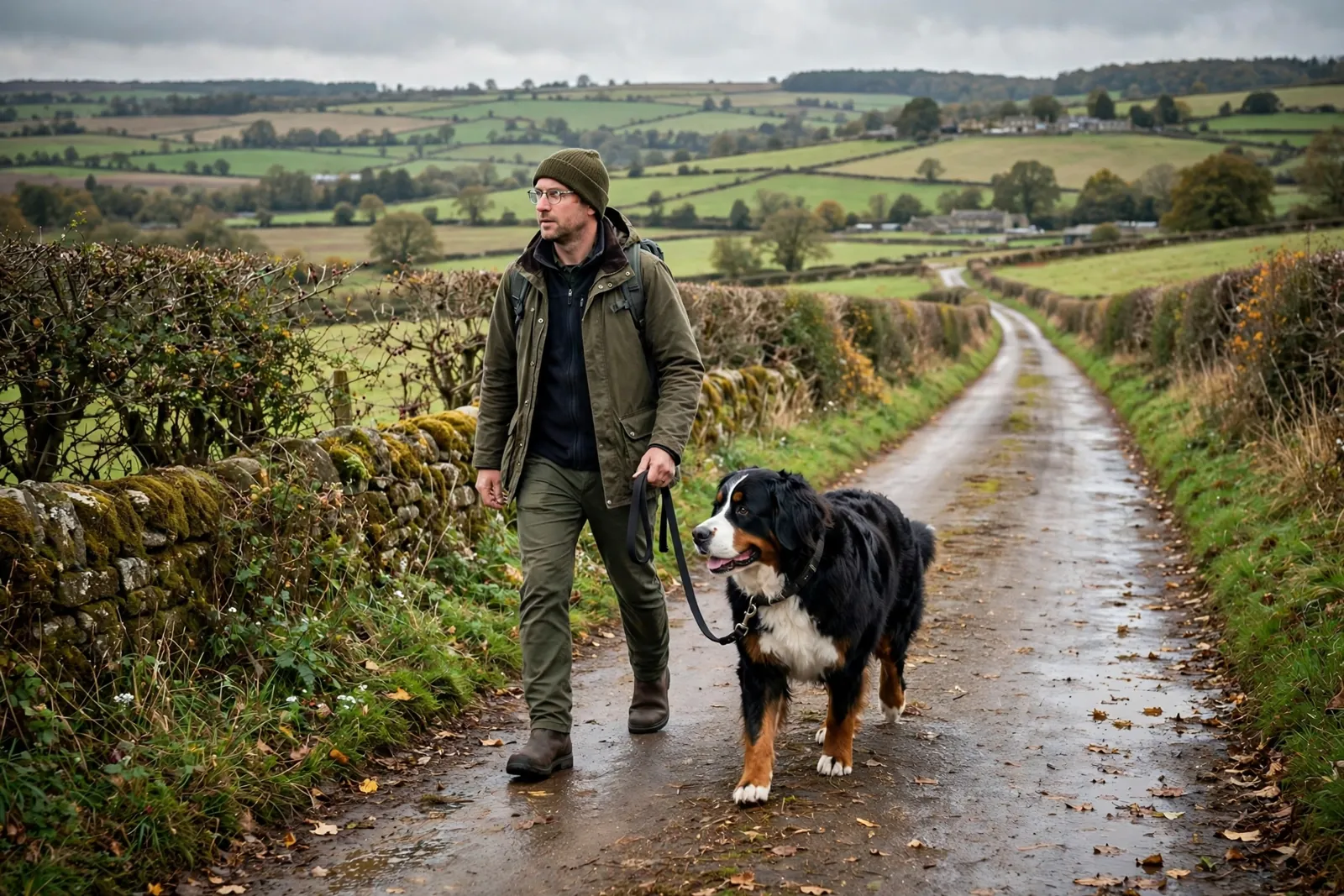
Narrow coastal and countryside paths sharpen the same point. On a path with room for one person, meeting another dog walker means somebody steps aside, and with a large dog that somebody needs a passing place, a gateway or a wider verge — not a cliff edge or a barbed fence line. Scan ahead, step aside early into a genuinely safe spot, shorten the lead, and let the other party pass while your dog is settled rather than mid-lunge of enthusiasm. Around livestock, follow the countryside rules without exception: keep the dog on a short lead near animals, give herds a wide berth, and remember that a large dog's mere presence can move sheep or cattle even from a distance, so increase your margin rather than testing it. Stiles are a practical filter too — many are impassable for a large dog that cannot be lifted, so plan circular walks around gates and dog-friendly gaps, and be ready to retrace your steps rather than improvising a lift that injures you both. A walk that works for a big dog is chosen for its gates, widths and passing places as much as for its views.
Promenades and lifeguard zones: body space where everyone gathers
The busiest part of a seaside day is rarely the open sand; it is the promenade, the slipway and the flagged swimming area where families, pushchairs, mobility scooters, ice-cream queues and other dogs all compress into the same few metres. Many beaches mark lifeguard-supervised swimming zones with red and yellow flags, and dogs are commonly excluded from those flagged areas and from defined sections of beach during the main season — the exact boundaries, dates and lead rules are set locally, so read the signs at the access point you actually use and follow the local council or beach operator information for that beach rather than relying on a general list.
With a large dog, treat the promenade as a narrow pavement, not as part of the beach. Walk on the seaward or wall side consistently, keep the lead short enough that the dog walks within your own body width, and stop only in recesses, shelters or widened areas where a lying dog does not narrow the route for everyone else. A big dog that settles across a promenade forces pushchairs and wheelchairs into the road side or into a squeeze past a strange dog's head, and that is a positioning failure by the owner, not a fault in the dog. Choose access steps with a handrail and a turning landing where you can, avoid carrying towels, chairs and a pulling dog down a crowded stair in one load, and time arrivals and departures away from the midday peak when queues at kiosks and toilets spill across the walkway. Space, given early and generously, is what makes a very large dog unremarkable in the most crowded part of a British seaside town.
Seasonal problems at large size: coats, paws and heat
Winter kit for a large dog is a sizing exercise before it is a shopping exercise. Measure chest girth at the widest point of the ribs, neck circumference where a collar sits, and back length from neck to tail base, then check a coat's size chart against all three rather than ordering by breed name, because two dogs both labelled large can differ by fifteen centimetres of chest. A coat that fits the chest but ends halfway along the back still helps an older or thin-coated dog; a coat that restricts the shoulders will change the dog's gait and rub on long walks, so watch the first outing closely. Big dogs also produce big drying work: a giant breed coming in wet can soak two large towels, carry remarkable quantities of grit into a hallway, and shake water across an entire room, so position drying at the door, with a mat that covers the full shake zone rather than a token square by the step.
Paws wear in proportion to weight. Every step loads pads with the dog's full mass, so a sudden jump from pavement walks at home to long days on tarmac, shingle or rocky shore paths can leave a large dog footsore by day three. Build distance gradually during the trip, check pads each evening for cracks, cuts and lodged grit or salt, rinse road salt off after winter walks, and carry more rest days in the plan than your own legs need. In summer, hot pavement tests apply to any dog, but a heavy dog cannot be carried across a scorching car park or lifted away from a hot surface, so route choice — grass, shade, early and late walking — is your only real tool.
Heat deserves particular respect with large, dark-coated dogs. A bigger body generates and holds more heat, heavy coats insulate in both directions, and dark fur absorbs strong sun during a slow, sniffing walk that feels mild to a person in a breeze. Plan shade as deliberately as water: carry a volume of water scaled to the dog, not a small bottle meant for a terrier, choose rest stops where a fully stretched dog can lie in complete shade rather than half in sun, and treat a cooling mat as a sized purchase — a mat the dog can only curl on will be ignored by a dog that sleeps stretched. If a dog shows signs of overheating, stop, move to shade, cool gradually and seek veterinary advice promptly rather than finishing the walk; with a dog too heavy to lift, prevention and early decisions are the whole strategy. Check official guidance before you travel in a heatwave, and be willing to cancel a walk entirely — a large dog will forgive a quiet garden day far more easily than a forced march at noon.
Insurance, liability and food costs on the road
Size raises the stakes of a mistake, which is why insurance belongs in a large-dog travel plan rather than in a drawer at home. Third-party liability cover matters because a large dog can knock a person over, damage furnishings or be blamed — fairly or not — for an incident involving another dog, simply by being the biggest animal present. Check that your pet insurance includes third-party liability, that it covers you away from home across the UK, and what excess applies; if you have no cover, read our guide to dog travel insurance in the UK before a long or expensive trip. Carry the policy details and your vet's number on your phone, know the nearest emergency vet to your stay, and keep your dog's microchip details and ID tag current — a lost large dog is harder for finders to hold, scan and transport, so prevention and fast contact matter even more.
Food is the other cost that scales with kilos. A large dog eats a large amount, every day, and running out of a specific food mid-trip risks a stomach upset from a sudden change as well as a hunt for a stockist. Pack the full amount plus a spare day, sealed and dry, plus the measuring cup you actually use so portions do not creep. Budget honestly for the whole size picture: pet fees or a larger damage deposit where charged, a ramp or bigger crate bought once and used for years, possible ferry pet charges, extra towels and bedding spares for a dog that brings in serious mud, and replacement costs if a giant tail meets a cottage ornament. Our breakdown of dog travel costs in the UK helps you build the total; with a large dog, simply refuse to guess any line that a property can state exactly. Get every dog-related charge in writing before you pay, keep the confirmations, and your budget will survive contact with the actual holiday.
End, as you began, with the tape measure. A trip planned around real numbers — weight, height, doorway, boot, bed — is not a lesser, more anxious kind of holiday. It is the kind where a large dog walks through the door, turns around comfortably, lies down in a space that was always theirs, and settles. That settled dog, asleep on a big enough bed in a stay that genuinely fits, is the whole point of travelling together.
A pre-booking email template: the exact measurements to send
Most size disputes start as vague emails, so send numbers instead of adjectives. Copy the structure below, replace the bracketed parts with your own measurements, and keep the reply with your booking confirmation. A property that answers these questions clearly is telling you it understands large dogs; a property that ignores them has answered in a different way.
Subject: Dog details and space questions — [dates] — [your name]. Opening line: “Hello, I would like to check the stay suits our dog before booking, rather than assume from the dog-friendly label.” Then give the dog in one block: breed or type, age on the travel dates, weight in kilograms, height at the shoulder, standing nose-to-tail length, stretched lying length and width, temperament in shared spaces, and whether the dog sleeps downstairs, uses stairs confidently, or needs level access. Add any relevant needs in plain terms — for example, cannot be lifted, uses a ramp, or settles on a mat of a stated size.
Follow with the questions, numbered so they are easy to answer one by one. One: is there a weight, height or breed limit in your terms, and does our dog fit within it? Two: what is the clear width of the narrowest doorway and garden gate we must use? Three: which floor will the dog sleep on, and if there are stairs, roughly how steep and narrow are they? Four: where would a bed measuring [length] by [width] fit without blocking a door or exit route? Five: is the garden fully enclosed, how high is the fence, and does the gate open fully? Six: what are the total dog charges, deposit and cleaning terms? Seven: are there livestock, resident dogs or shared spaces we should know about? Close by asking the owner to confirm in the reply that a dog of this stated size is accepted for these dates. That single sentence, answered, is worth more than every photograph on the listing — it turns a hope into an agreement you can both point to on arrival day.
Practical questions
Before you go
What counts as a large dog for UK holiday bookings?
There is no single UK definition. Each property, ferry company and hire firm sets its own cut-off, commonly by weight, height at the shoulder, breed list or a simple maximum number of dogs that quietly assumes small dogs. Always give your dog's actual weight, height and breed when you book and get acceptance in writing, rather than relying on a generic dog-friendly label.
How do I know if my large dog will fit in the car and crate?
Measure your dog standing and lying fully stretched, then measure the boot with the seats in their travelling position and the crate's internal floor, not its external frame. Your dog should be able to stand, turn and lie flat without pressing against the sides. Test the full set-up on a short drive at home before a long holiday journey.
Can large dogs travel on UK trains and ferries?
Yes, in most cases, but the practical limit is space rather than a weight rule. On trains your dog must settle at your feet without blocking the aisle, and busy services can be difficult with a dog that cannot curl tightly. On ferries, rules vary by route: some require dogs to stay in the vehicle or a kennel, others allow a designated pet area. Check before you book for the exact route and sailing.
Do pubs and cafes have to let a large dog in?
No. Apart from assistance dogs, admission is at the venue's discretion, and a venue that welcomes a small dog under a table may not have floor space for a large dog to lie without blocking a walkway or fire exit. Phone ahead, ask where large dogs usually settle, and choose off-peak times and garden or snug seating where your dog is not in everyone's way.
What extra costs should I budget for a large dog on holiday?
Budget for higher pet fees or damage deposits where they apply, more food by weight, a larger crate or ramp, possible ferry pet charges, and pet insurance that includes third-party liability. Large dogs also wear out bedding and towels faster on muddy trips, so packing spares is cheaper than buying replacements mid-break. Get every dog-related charge in writing before you pay.