This guide is independent and contains no paid placement. If affiliate links are added later, they will be clearly marked and will not change our editorial checks.
Use air conditioning as your main cooling, add a fixed fan to move air across the dog, and never use a fan as a reason to leave a dog alone in a parked car. A fan stirs air; it does not remove heat from a closed, sun-baked car.
Five minutes in a parked car
Picture the ordinary version of this mistake. It is a warm Saturday, the car park is busy, and the errand will only take five minutes. The windows are left open a crack, a small fan is switched on, the dog has water, and the car is in a patch of shade. Five minutes feels responsible. The problem is that a parked car does not warm up on a human timetable. On a sunny day, the temperature inside can climb sharply within the first ten minutes, and the rise is steepest at the start, when the car is already warm from the drive and the sun is heating the roof, dashboard and seats. The dog, meanwhile, cannot open a door, move into shade, or explain that panting is no longer working.
Dogs cool themselves mainly by panting and through limited heat loss from their paws and ears. They do not sweat efficiently over their whole body the way people do. That matters in a car because panting works best when the air being breathed in is cooler than the body and can carry moisture away. In a small, sealed space, the air quickly becomes hot and humid, so each pant does less work. A fan can help while the car is moving, because fresh or cooled air is constantly arriving. In a parked car, the same fan is mostly recirculating the same hot air past a dog that is already struggling. The breeze may feel reassuring to a hand held in front of it, but that is not the same as cooling a dog.
Shade is also less reliable than it looks. A car parked in shade at midday can be in full sun half an hour later, and a white car, a light interior and a sunshade all slow the rise without stopping it. A cracked window changes the air by a small amount, not by enough to matter for a dog that cannot leave. Researchers and veterinary organisations have repeatedly warned that opening a window slightly does not keep a parked car safe, and the UK position is blunt: dogs should not be left in hot cars. If you remember only one number from this guide, make it this one — five minutes is not a safe unit of measurement for a dog in a parked car, because heat, stress and the risk of heatstroke do not pause while you queue.
That is why this guide separates two jobs that are often confused. The first job is travelling ventilation: keeping a dog comfortable while the car is moving, with air conditioning, well-placed vents and, where useful, a fan. The second job is parked-car safety: recognising that no fan, window gap, water bowl or sunshade turns an unattended parked car into a safe place on a warm day. Get the first job right and summer journeys become calmer. Get the second job wrong and the best fan in the world will not save the trip. The rest of this guide works through the first job in detail, and returns to the second job whenever a shortcut tempts you to blur the two.
Why cars heat so fast
A car is, in effect, a glass box with a metal roof. Sunlight passes through the windscreen and windows, heats the dashboard, seats and steering wheel, and that heat then radiates into the cabin air. The glass that let the light in does not let the heat out as easily, so the interior warms faster than the air outside. Dark interiors, leather seats and a dashboard already hot from a previous journey all add to the starting temperature. Even on a day that feels mild to a person walking in a breeze, a car sitting in direct sun can become uncomfortably hot, because the person outside is in moving air while the dog inside is not.
Humidity makes the situation worse. A dog panting in a small cabin adds moisture to the air, and damp, hot air is harder to cool by panting. Add a second dog, a crate with limited airflow, or a boot cover that blocks vents, and the effective temperature the dog experiences rises further. Brachycephalic breeds — flat-faced dogs such as bulldogs, pugs and French bulldogs — are at higher risk because their shorter airways make panting less efficient. Older dogs, overweight dogs, puppies and dogs with heart or breathing conditions are also more vulnerable. A ventilation setup that suits a fit young collie in an estate car may not suit an older bulldog in a small hatchback, so judge the setup by the dog in front of you, not by the average dog in a product photograph.
Air conditioning changes the equation because it actively removes heat and moisture from the air. A fan does not. A fan only moves air, which helps sweat and panting work better when the air itself is cool enough, and helps a dog feel cooler through evaporation. That distinction explains almost every disappointment with car fans: people buy a fan expecting a small air conditioner, then wonder why the dog is still panting in a parked car or in a boot with no cooled air reaching it. A fan is a useful second tool. It is not a substitute for cooled, fresh air, and it is never a substitute for a person staying with the dog.
Before buying anything, check how your own car actually ventilates. Sit in the back seat or look into the boot on a warm day with the engine running and the air conditioning on. Can you feel air at the dog's head height? Does the boot get any airflow at all, or does it sit behind a closed parcel shelf and a solid guard? Do the rear windows open, and do the rear vents — if your car has them — point anywhere near the dog? Many cars are designed around front-seat comfort, with rear passengers getting whatever air spills over the front seats. Dogs, who often travel lower, further back and behind barriers, can be in the worst-ventilated part of the car. Knowing that gap is the starting point for every choice that follows.
Fan types compared
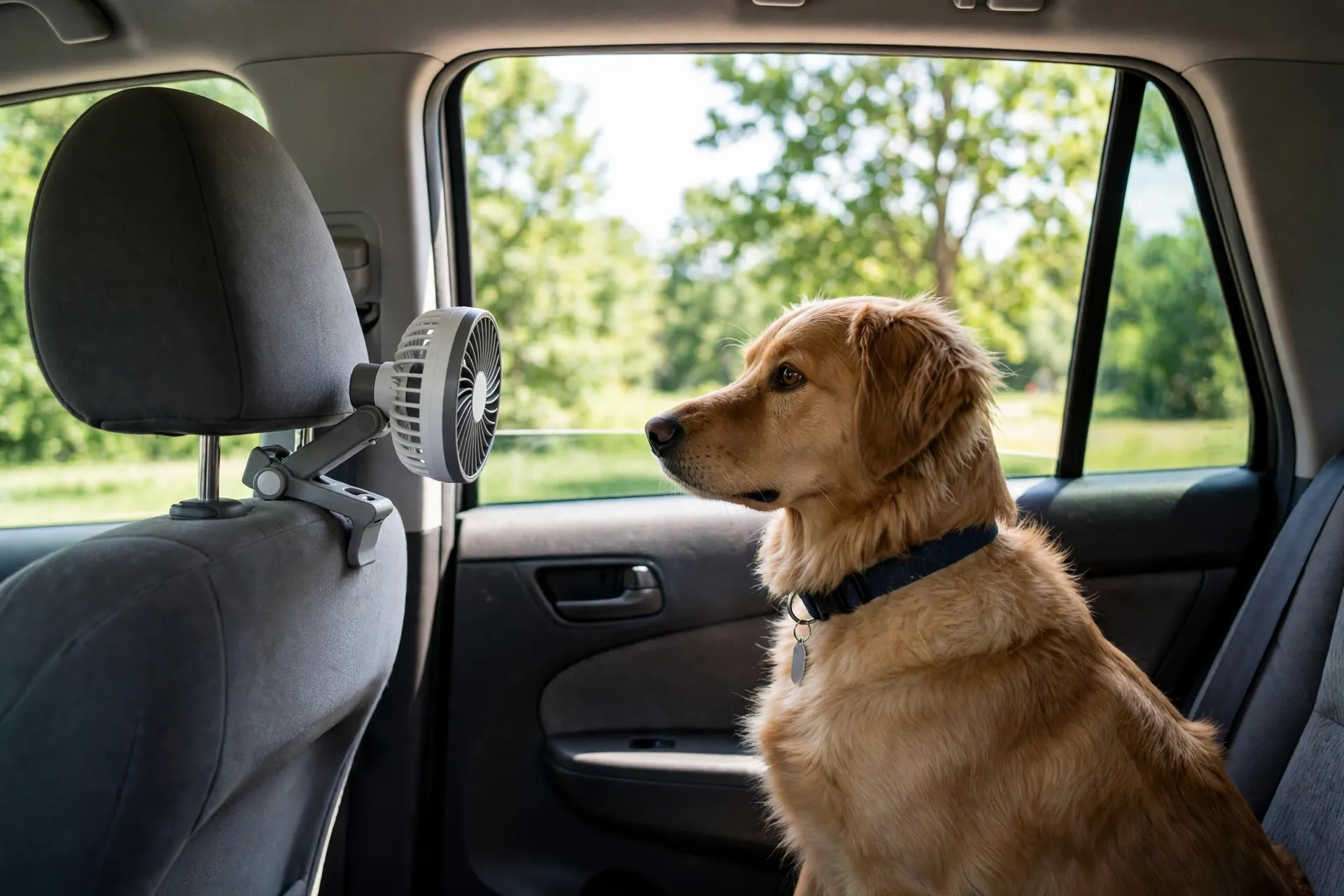
Car fans for dogs fall into a few practical families, and the differences matter more than the brand name on the box. Headrest fans clip or strap to a front or rear headrest and blow backwards or forwards across the cabin. They are popular because they are easy to fit, easy to aim and easy to remove, but their airflow is modest and they can wobble if the strap is loose. Dashboard fans sit on the dashboard and usually blow towards the driver or front passenger; they are the least useful for a back-seat dog unless the car is small and air circulates well. Clip-on fans attach to a headrest post, a crate bar or a boot guard, and are useful precisely because they can be placed close to the dog, but a clip that is not secure becomes a projectile in a sudden stop.
USB fans are the smallest and quietest option. They draw power from a USB port or a power bank, cost little, and suit short journeys and mild days. Their weakness is airflow: many USB fans move enough air to be felt at arm's length but not enough to change the temperature a dog experiences in a warm boot. Larger 12V fans, powered from the cigarette-lighter socket or a dedicated 12V outlet, generally move substantially more air and keep running for a whole journey. They are louder, heavier and need cable management, but for a large dog, a boot traveller or a long motorway journey, that extra airflow is often the difference between a fan that helps and a fan that merely hums.
Battery-powered fans sit between the two. A rechargeable fan with its own battery can be used in a parked car for a short, attended stop, in a crate at a showground, or in a car whose sockets switch off with the ignition. The trade-off is run time: check the stated hours at the speed you will actually use, not the lowest speed, and remember that batteries lose capacity in heat. Mains-style fans with a household plug and an inverter are rarely a good idea in a car with a dog, because the inverter, cable and fan together create trip, chew and electrical hazards that outweigh any airflow gain.
Some products are sold as car coolers or evaporative coolers rather than fans. These pass air over a wet pad or add a fine mist, and they can feel cooler in dry air, but they also add humidity, need refilling and cleaning, and can leave bedding and crates damp. In the humid British summer, the benefit is often small, and damp bedding is a poor trade for a slightly cooler breeze. A simpler approach — air conditioning plus a well-placed fan plus a cool mat and water — is usually more reliable, easier to clean and less likely to create a new problem. Whatever type you choose, look for a fan with a guarded blade or a bladeless design if the dog can reach it, a stable mount that survives a bumpy road, and a speed control that lets you choose a low, steady setting rather than only a noisy maximum.
For readers planning the wider summer routine, our heatwave guide sets out cool-hour walks, shade, water and heatstroke signs in more detail; the fan advice here fits inside that routine rather than replacing it. See the heatwave week guide for dogs in the UK before a run of hot days, and treat the car as one part of a hot-day plan that starts at home with timing, shade and water. A fan bought in a panic on the hottest day is rarely the fan you would choose with a day to compare airflow, noise and mounting.
Where to put the fan
Placement matters more than fan size. Air that blows across the front seats and never reaches the back seat does not help a back-seat dog, however powerful the fan. Start by mapping the dog's space: where does the dog's head sit, where does air from the car's vents arrive, and what blocks it? A dog guard, a crate, a boot cover, luggage and even a tall headrest can all deflect air. The fan should fill the gap between the car's vents and the dog, not duplicate air that already reaches the dog's face.
For a dog on the back seat, a headrest-mounted fan on the front passenger headrest, aimed slightly above and across the dog, usually works best. The air should cross the dog's body rather than blast directly into its eyes and nose for hours, which can dry eyes and irritate airways. If there are two dogs, or one large dog spread across the seat, two smaller fans — one each side — often beat one large fan in the middle, because they cover the whole seat without creating a single noisy jet. Test the position with the dog in place before a long journey: sit in the back yourself, or hold a hand at the dog's head height, and check whether air actually arrives there at the fan's normal setting, not just at maximum.
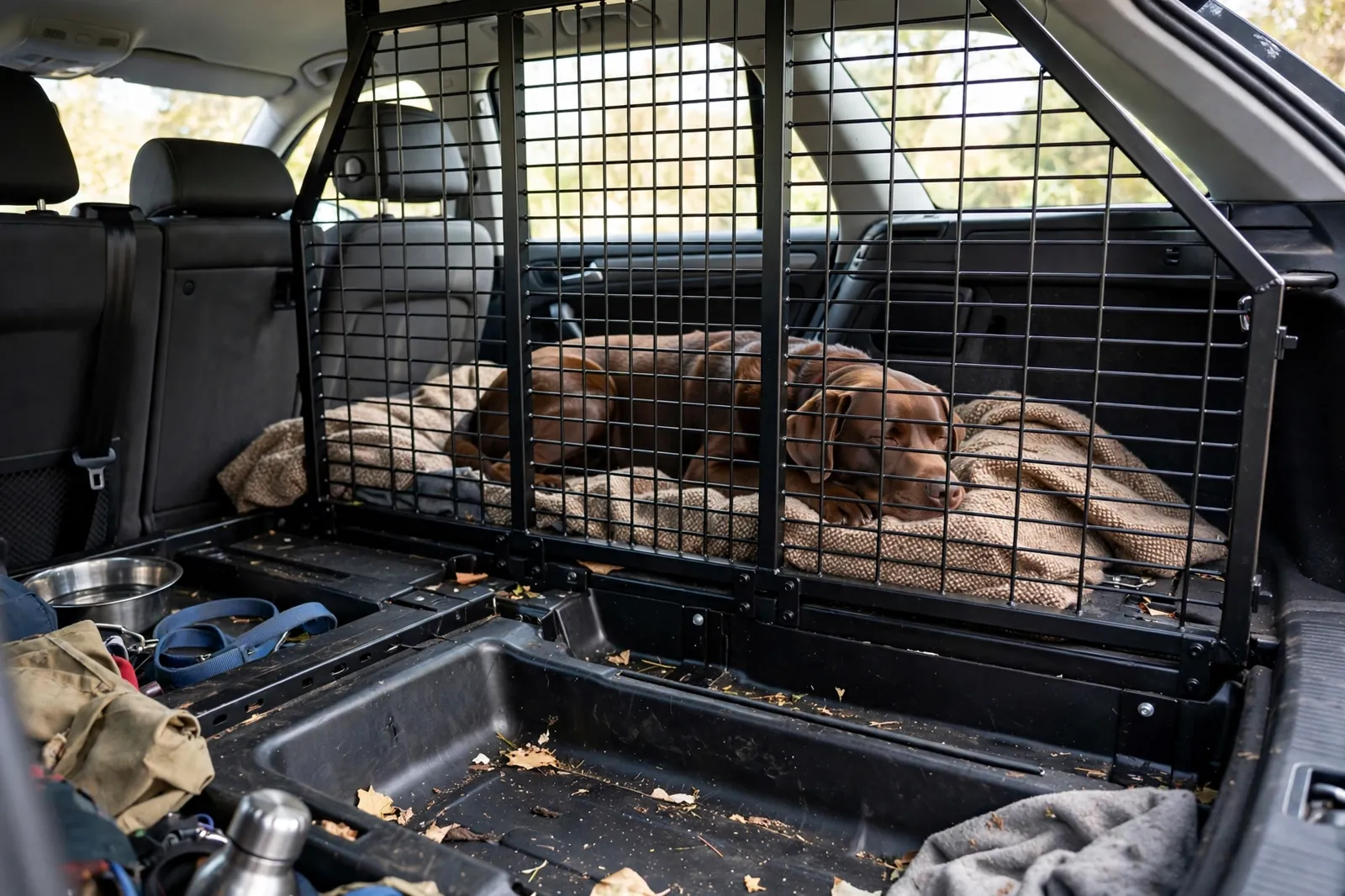
For a dog in the boot, the challenge is different. Many boots receive little direct airflow, especially when a parcel shelf, a boot cover or a solid guard closes them off. A front-seat fan will not solve that. Check first whether your car has rear vents, boot vents or an air channel that can be left open, and whether the boot guard you use is a mesh design that lets air through or a solid panel that blocks it. A clip-on fan fixed to the guard, aimed into the boot at a safe distance from the dog, can help, but it can only move air that is already in the boot or arriving from the cabin. If the boot stays hot with the air conditioning on, the answer may be to change the guard, open the cabin-to-boot route, or move the dog to the back seat for hot journeys, rather than to buy a bigger fan. Our guide to choosing and fitting a guard explains how mesh, measuring and fitting affect both safety and airflow; see the dog car boot guard guide before changing a guard for ventilation reasons.
For a crated dog, never point a fan directly into a crate at close range with no escape from the draught, and never attach a fan inside a crate where the dog can chew the cable or knock the fan onto itself. Fix the fan outside the crate, aimed to move air through the crate's ventilation openings, and leave part of the crate out of the direct stream so the dog can move away from the breeze. The same principle applies to a dog behind a guard: the dog should be able to shift position, lie down away from the jet, and still breathe cooler cabin air. A fan that forces a dog to sit in a single draught for two hours is not good ventilation, however cool it feels to a hand.
Finally, fix the fan as if you will brake hard. A fan that swings, slides or falls is a distraction for the driver and a hazard for the dog. Use the mount the fan was designed for, tighten straps, route cables away from paws and teeth, and check the mount after the first bumpy road. If a fan cannot be fixed securely in your car, it does not belong in your car with a dog, however good its airflow rating looks on the box.
Power, cables and noise
Power is where many car fans disappoint on the second journey, not the first. A USB fan that runs happily from a port while the engine is on may stop the moment you switch off at a service station, because many cars cut USB power with the ignition. A 12V fan may keep running from a live socket, but it will drain the battery if left on for a long attended stop, and a flat battery at a motorway service area is a miserable way to learn that lesson. Before a long trip, test your sockets with the engine off and the engine on, and note which ones stay live. If you need a fan during a stop, use a rechargeable fan with its own battery for that stop, and keep the car fan for driving.
Cable routing deserves the same attention as the fan itself. A cable trailing across the back seat is a chew toy, a trip hazard when the dog moves, and a snag risk when a harness or crate door moves. Route cables along headrest posts, under seat edges or through the boot trim, use short cables where possible, and secure loose lengths with clips rather than leaving loops. Never run a cable across the driver's footwell, across an airbag cover, or through a door seal that will pinch and damage it. If the only route is a long cable across open space, choose a different fan position or a battery fan instead. A tidy cable is not cosmetic; it is part of keeping the dog and the driver safe.
Noise is the most underestimated factor. A fan that sounds acceptable in a shop can become a constant whine at motorway speed, and dogs hear higher frequencies than people do. A nervous dog may settle worse with a loud fan than with a quieter fan and good air conditioning. Test the fan at the speed you will use, with the car at speed if possible, and watch the dog: ears back, restlessness, panting that increases rather than settles, or a refusal to lie down can all be signs that the noise or draught is adding stress rather than comfort. Some fans offer a low, steady setting that moves enough air without a high-pitched whine; that setting, used consistently, usually beats a powerful fan that is switched off after twenty minutes because everyone in the car is irritated by it.
Battery and charging habits matter too. Keep a rechargeable fan charged before a hot journey, not during it, and do not leave a charging fan on a hot dashboard in direct sun. Lithium batteries and extreme cabin heat are a poor combination, so store spare power banks in shade and out of the dog's reach. If a fan smells hot, buzzes unevenly, or has a damaged cable, retire it. A car fan is a cheap item; a fire risk or a chewed live cable in a car with a dog is not a saving worth making.
As a rule of thumb, judge power by the whole journey, not by the specification sheet. A fan that runs quietly for four hours from a socket you can reach, with a cable you can route safely, is better than a fan that promises twice the airflow but dies at a service station, needs a cable across the dog's bed, or whines at a pitch your dog hates. Write down what your car actually provides — live sockets, rear vents, boot airflow — and buy to fill that specific gap.
Airflow while you drive
Good airflow while driving is a system, not a single device. Start before you set off: if the car has been parked in sun, open all doors for a minute or two to let the hottest air out, then close them and start the air conditioning. A car that starts cool stays cool far more easily than a car that starts hot and is asked to cool down while the dog is already panting. Point the dashboard vents towards the back, open rear vents if you have them, and set the fan to recirculate only once the cabin is already cool; on a very hot day, fresh-air mode for the first few minutes can clear hot air faster than recirculating it.
While driving, aim for steady, even air rather than bursts of cold air followed by stuffiness. Keep the air conditioning on, even if the front seats feel cold, because the back seat and boot lag behind the front by several degrees. Check the dog at every stop, not just the dashboard display: a dashboard showing 21 degrees does not guarantee 21 degrees in a boot behind a solid guard. Feel the air at the dog's head height, offer water, and watch breathing. If the dog is panting hard despite the air conditioning, the problem may be airflow to the dog's space, not the air conditioning setting, and a fan repositioned to fill that gap may help more than turning the temperature down another degree for the front seats.
Windows have a place, but it is a limited one. At low speed in mild weather, a partly open rear window gives fresh air and a familiar breeze, and many dogs enjoy it. At motorway speed, open windows create strong draughts, noise and a risk of debris in eyes, and they let cooled air escape, forcing the air conditioning to work harder. A dog with its head out of a fast-moving window also risks eye injury, ear damage and, in the worst case, a sudden movement that unbalances a restrained dog. Keep windows mostly closed on hot, fast journeys, and use the air conditioning and fan instead. If a window must be open, keep it to a narrow gap on the opposite side from the dog's head, and use a window guard or a partially open setting that prevents the dog pushing its head fully out.
Speed, sun and stops all change airflow. A car in stop-start traffic on a hot day gets less airflow through its vents than the same car at a steady cruise, because the air conditioning compressor and the cabin airflow both depend on engine speed and vehicle speed. Plan hot journeys for cooler hours where possible, take shade breaks where the dog can get out, stretch and drink, and avoid leaving the dog in the car while you queue for food or fuel. At a service station, the best ventilation is not a fan in a parked car; it is the dog out of the car, in shade, with water, while a person stays with it.
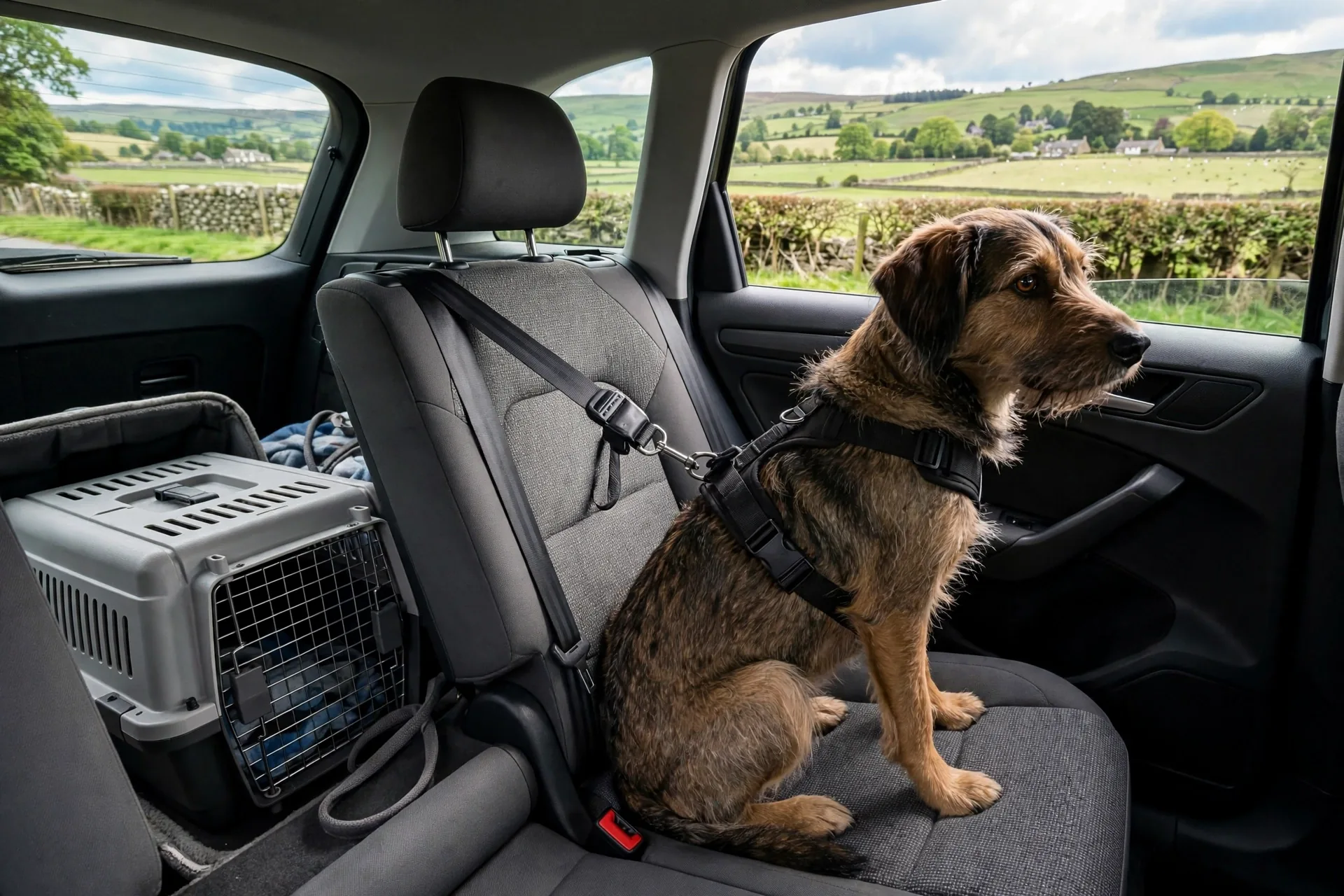
Finally, think about the dog's own position. A dog lying flat on a cool mat in a well-ventilated boot will cope better than the same dog sitting upright in a hot, still corner, panting to stay cool. A light-coloured cover over a crate, a cool mat that does not need power, and bedding that does not trap heat all support the fan rather than competing with it. Ventilation works best when the dog, the restraint, the guard and the fan are planned together; for the restraint part of that plan, our comparison of harnesses and crates covers fitting and crash safety in detail, and it is worth reading alongside this guide — see the dog car safety guide on harnesses and crates before changing how the dog travels for ventilation reasons.
Parked-car myths to drop
Several parked-car myths survive because they sound sensible. Each one fails for a specific reason, and recognising the reason makes it easier to resist the myth when you are in a hurry. The first myth is that a cracked window makes a parked car safe. It does not. Studies of parked cars show that opening windows slightly lowers the peak temperature by only a small amount, and the car still becomes dangerously hot. A dog cannot rely on a two-centimetre gap to exchange enough air to offset full sun on a metal roof.
The second myth is that a fan makes a parked car safe. A fan in a parked car moves hot air, and if it draws air from outside through a cracked window, it moves hot outside air. It does not cool the cabin the way air conditioning does, because there is no heat removal, only circulation. A battery fan that runs for an hour in a parked car is still circulating air that is getting hotter, and the dog is still trapped in that air. The fan may delay discomfort by minutes; it does not create a safe environment for an unattended dog.
The third myth is that shade, a sunshade or a light-coloured car makes a parked car safe. All three help, and all three are worth using for an attended, short stop with the dog out of the car or a person with the dog. None of them stops the interior warming on a warm day, and shade moves. A car in shade at 11am can be in sun by noon, and a sunshade on the windscreen does nothing for heat entering through the side windows and roof. Treat shade and sunshades as ways to keep a car cooler for the next journey, not as permission to leave a dog in it.
The fourth myth is that a water bowl makes a parked car safe. Water is essential on every journey, and a spill-proof bowl in a moving car is good practice. In a parked car, water does not prevent heatstroke; a dog that is overheating may not drink, may spill the bowl, or may drink and still overheat because panting has stopped working in hot, humid air. Water supports a cool dog; it does not cool a hot car.
The fifth myth is that it is fine because the dog has done it before, or because the day is cloudy, or because the errand is short. Dogs that have tolerated a warm car before can still suffer heatstroke on a hotter, more humid or more stressful day, and cloud cover does not prevent a car warming in still, warm air. Short errands routinely take longer than planned — a queue, a phone call, a closed shop — and the dog pays for the overrun. If a plan depends on a dog being safe alone in a parked car, change the plan: take the dog with you, leave the dog at home in a cool room, use a drive-through, or ask another person to stay with the dog. If none of those is possible, the errand waits. That sounds strict because heatstroke is strict: once a dog's temperature rises dangerously, minutes matter, and veterinary treatment is urgent, not optional.
There is also a legal and practical point worth stating plainly. In the UK, leaving a dog in a hot car can lead to a call to the police or the RSPCA, and a member of the public who believes a dog is in immediate danger may take action to help it. Even without that, a dog that has suffered in a hot car may be frightened of cars afterwards, making future journeys harder. The reputational and practical costs of a parked-car mistake last far longer than the errand that caused it. When in doubt, check the official guidance before you travel, and err on the side of keeping the dog with a person.
A hot-day driving routine
A routine removes decisions on the hottest day, when decisions are hardest. Start the evening before a forecast hot journey: charge any rechargeable fan, check the car's air conditioning, fill a spill-proof water bottle and a bowl, pack a cool mat and a damp towel in a sealed bag, and plan the route around shade stops and cooler hours. In the morning, walk the dog in the cool hours, offer water, and avoid a long, exciting walk immediately before a long car journey, which leaves the dog already warm and panting before the car adds heat.
Before setting off, cool the car as described above, settle the dog in its restraint, and check airflow at the dog's head height. Offer a small drink, not a large one immediately before a long drive, and make sure the dog has toileted. Set the air conditioning to a comfortable, steady temperature rather than the coldest setting, which can make front passengers cold while the back is still warm, and then fiddle with the fan position rather than the temperature dial. A steady system is easier to monitor than one that swings between cold blasts and stuffiness.
On the road, stop every two hours at most, and more often on very hot days or with vulnerable dogs. At each stop, get the dog out, offer water, walk in shade, and check breathing, gums and energy. A dog that is reluctant to move, panting hard after a few minutes out of the car, or wobbly needs shade, gradual cooling and veterinary advice, not another hour in the car with the fan turned up. Keep a note of the nearest veterinary practice on a long route, especially on rural roads where the next practice may be some distance away. If you are travelling in an unfamiliar area, check the official guidance before you travel for local emergency veterinary cover, rather than assuming a practice will be open.
At the destination, do not rush from a hot car into a hot car park. Let the dog out in shade, offer water, and allow a few minutes to settle before a walk. If the destination is a beach, a showground or a busy town, remember that the car will heat again while you are away, so the return journey needs the same cool-down routine as the outward one. Pack the fan, water and cool mat so they are accessible for the return, not buried under luggage in a hot boot.
For multi-day hot spells, the routine extends beyond the car. Walk early and late, rest in shade at midday, keep the house cool, and watch for cumulative heat stress: a dog that coped on Monday may be more tired and less able to cope by Thursday if it has not fully recovered between hot days. The car fan is one tool in that wider routine, and its job is to make the driving part of the day comfortable, not to compensate for a midday walk, a hot house or a parked-car wait.
Buying checklist
Use this checklist in a shop or online, and ignore any feature that does not help your dog, your car and your journeys. First, airflow at the dog's position: does the fan move air you can feel at the dog's head height, at a normal setting, from the mount you will actually use? Second, mounting: does it fix securely to a headrest, guard or crate bar in your car, and does it stay fixed on a bumpy road? Third, power: does it run for your longest journey from a socket that stays live, or from a battery that lasts that long at a usable speed? Fourth, noise: can you and the dog tolerate it for an hour at motorway speed? Fifth, safety: are blades guarded or bladeless, are cables routable away from the dog, and is there nothing the dog can chew, knock off or swallow?
Next, consider size and weight. A heavy fan on a weak clip is worse than a lighter fan that stays put. A very large fan may block a vent, a mirror or a guard opening. Check the fan's dimensions against the space where it will sit, and check that it does not block your view, interfere with an airbag, or prevent a crate door or guard gate opening. If the fan needs an adaptor, a mount or a cable that is not included, add that cost and complexity before comparing prices. A cheap fan that needs three extra parts is not cheap.
Cleaning and durability matter in a car with a dog. Hair, mud and drool will reach the fan, so choose one that can be wiped clean, with a grille that can be brushed, and a mount that can be removed without tools for cleaning. Check whether the fan is rated for car use, not just indoor use, and whether the manufacturer states a temperature range. A fan designed for a desk may not cope with a hot car boot in August, and a fan that warps or smells hot in heat should be retired, not tolerated.
Finally, keep the receipt and the return option. Test the fan on a real journey, not just in the driveway, and return it if the dog dislikes the noise, the mount slips, or the airflow does not reach the dog. A fan that works in theory but not in your car is not a bargain. If you are unsure about a specific model, check the official guidance before you travel for any safety recall or vehicle-specific advice, and ask the seller about the return period before you buy for a holiday.
A short shopping list, in order of importance, is therefore: a car whose air conditioning works and whose rear or boot airflow you understand; a restraint and guard that let air through; a fan that fills the specific airflow gap in your car; a spill-proof water system; a cool mat; and a damp towel for stops. Buy in that order, and the fan will be a useful addition rather than a hopeful purchase that is asked to do a job it cannot do.
Troubleshooting
If the dog is still panting despite the fan, work through the system in order. Is the air conditioning on and working, or is it blowing warm air because it needs servicing or regassing? Is air reaching the dog, or is it blocked by a guard, crate cover, luggage or a closed parcel shelf? Is the fan aimed at the dog, or at the front seats, the roof or an empty space? Is the dog restrained in a way that lets it lie down and stretch, or is it sitting upright in a hot corner because the restraint or guard forces that position? Fix the airflow route before buying a bigger fan.
If the fan is noisy, try a lower speed, a different mount, or a fan with a larger, slower blade, which often moves similar air with less whine. Check for vibration against a headrest post or guard bar, which can amplify noise, and add a small pad or reposition the mount if needed. If the dog is still unsettled by the sound, try the journey with air conditioning alone and a repositioned vent, and use the fan only on the hottest part of the journey. A fan that stresses the dog is not helping, even if it moves air.
If the fan stops at stops, check whether your sockets switch off with the ignition, and whether the fan's battery or power bank is actually charged. Do not wire a fan directly to the battery without proper advice, and do not leave a fan running unattended in a parked car with a dog, for the reasons set out above. For attended stops, a rechargeable fan, shade and water are the right tools, and the car fan can resume when you drive.
If the boot stays hot, suspect the guard and the cabin-to-boot route before the fan. A mesh guard lets air through; a solid guard does not. A parcel shelf left in place, a boot cover pulled tight, or luggage stacked against vents can all trap hot air. Try the journey with the shelf removed and the guard's airflow route open, and feel the boot air at a stop. If the boot still does not cool, consider moving the dog to the back seat for hot journeys, where air conditioning and fans reach more directly. That change may require a different restraint, so plan it before a hot day, not on one.
If the dog chews cables, the answer is routing, not scolding. Move the cable out of reach, use a shorter cable, cover the accessible length with a chew-resistant sleeve if the manufacturer allows it, or switch to a battery fan with no trailing cable in the dog's space. If the dog can reach the fan itself, move the fan further away, choose a guarded or bladeless design, or fix it outside a crate or guard where the dog cannot touch it. Safety and airflow must be solved together; a fan that the dog can chew is not a ventilation solution.
Practical questions
Before you go
Can a car fan keep my dog safe if I leave the car parked in the sun?
No. A fan moves hot air around a closed car but does not cool it, and a parked car can become dangerously hot in minutes. Never leave a dog alone in a parked car on a warm day, even with a fan running, a window cracked open, or shade that will move as the sun moves. Take the dog with you or change the plan.
Where should a car fan point for a dog in the back seat or boot?
Point airflow across the dog, not straight into its face for the whole journey, and keep the fan fixed so it cannot swing, fall, or be chewed. For a back-seat dog, a headrest-mounted fan aimed slightly above the dog works well. For a boot dog, airflow must reach the boot itself, which usually means using the car's vents and a boot-ventilation route rather than a front-seat fan alone.
Is a 12V fan better than a USB fan for a dog in the car?
A 12V fan usually moves more air and runs for a whole journey without draining a phone charger, but it needs a suitable socket and safe cable routing. A USB fan is quieter, cheaper, and easier to move between cars, but its airflow is weaker and it may stop if the USB port switches off with the ignition. Choose by airflow and run time, not by price alone.
Should I use air conditioning, open windows, or both with a dog in the car?
Use air conditioning as the main cooling method on hot days, with windows closed so cooled air is not lost immediately. Open windows help at low speed in mild weather and when you want fresh air, but at motorway speed they create draughts, noise, and debris risk. On a hot day, set the air conditioning early, direct rear vents towards the dog, and check the dog, not just the dashboard temperature.
How can I tell if my dog is too hot in the car, even with a fan on?
Watch for heavy or rapid panting that does not settle, drooling, restlessness, a bright red tongue or gums, wobbliness, or vomiting. A fan does not override these signs. Stop in a safe place, move the dog into shade, offer small amounts of water, cool the dog gradually with damp towels on the body, and seek veterinary advice promptly if signs do not improve quickly. Do not plunge a very hot dog into ice-cold water.
Can I run a fan from the car battery while parked without the engine on?
Only for a very short, attended stop, and only if you understand the drain on your battery. Many 12V sockets switch off with the ignition, and a fan left running can flatten a weak battery. More importantly, a parked fan does not make a parked car safe for an unattended dog. If the dog must stay with the car, a person must stay with the dog.